BNG for Small Development Projects
Starting on 2nd April 2024, policies regarding Biodiversity Net Gain (BNG) also apply to smaller development sites. This includes residential locations of less than 1 hectare with fewer than 10

Starting on 2nd April 2024, policies regarding Biodiversity Net Gain (BNG) also apply to smaller development sites. This includes residential locations of less than 1 hectare with fewer than 10

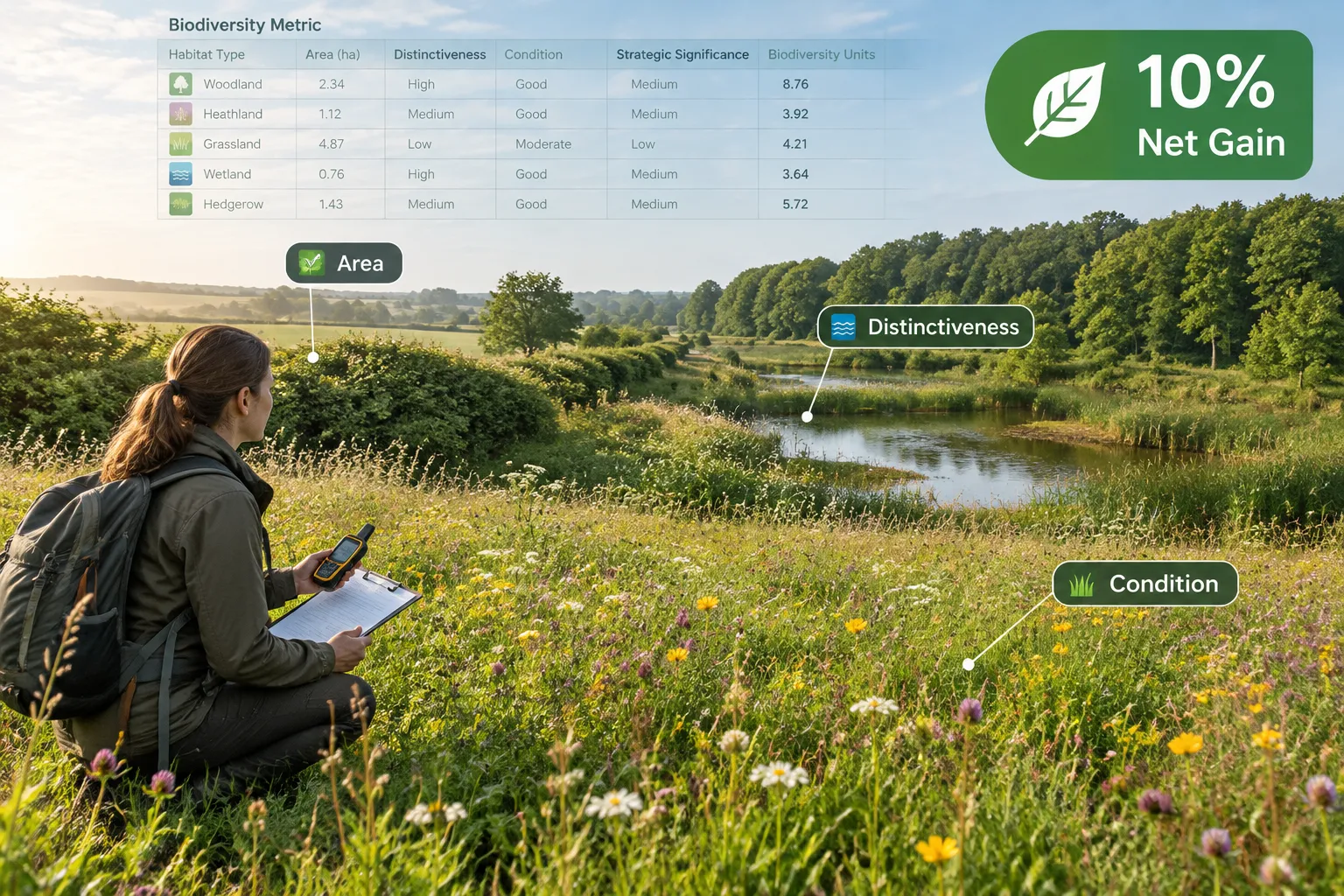
Image: surveyor holding paper and looking over river. The Government’s 25-year Environment Plan has, as one of its objectives, “to leave the environment in a better state than we found

Image: drone hovering over river in field. The Environment Act’s biodiversity net gain (BNG) legislation has a 2-year phasing-in period, which ends in November 2023. That means developers must ensure

About Biodiversity Net Gain BNG is a concept that could dramatically change the environmental planning scene. It now obligates all developers to ensure that their projects do not diminish the

Two hundred and fifty-five pages. That is the length of the first draft Environmental Delivery Plan (EDP) that Natural England published on 17 September 2026, and it covers a single issue in a single county: nutrient pollution affecting protected habitats in Norfolk. The consultation window is short, closing on 27…
Twenty days. That is all that remains before mandatory Biodiversity Net Gain (BNG) sweeps into the Nationally Significant Infrastructure Projects (NSIP) regime, and the autumn survey window needed to support it is already closing. Any promoter whose baseline ecology work is not substantially complete right now is gambling with a…
Thirty-three percent. That is how far residential construction starts collapsed year-on-year in the three months to September 2026, according to Glenigan's October Index, while civil engineering starts surged 43% over the same period. For ecology consultants, planners and developers, this is not just a construction statistic. It is a signal…
Three weeks. That is roughly how long the gap is between the government unveiling a new equity loan scheme designed to get thousands more first-time buyers into new-build homes, and the Autumn Budget that will decide how it actually works. For ecological consultants, that short window matters more than it…
A levy set at £2,675 per home, before indexation and VAT, could unlock up to 15,780 new homes across Norfolk's protected river and wetland catchments. That single number, buried inside a 28-working-day consultation window, is now the most consequential figure in East Anglian planning. The Norfolk Environmental Delivery Plan consultation…
Ninety days. That is roughly how long developers, ecologists, and local planning authorities had between the government confirming a sweeping overhaul of committee decision-making and the rules actually taking effect. From 31 October 2026, the National Scheme of Delegation 31 October 2026 biodiversity gain plans officers reform means biodiversity gain…
Twenty-six days. That is all the runway left before Biodiversity Net Gain becomes legally mandatory for Nationally Significant Infrastructure Projects across England. On 2 November 2026, every major road, railway, reservoir, and energy scheme entering the planning system will need to prove it leaves nature measurably better off than before…
Three out of twenty-three. That is the blunt scorecard The Wildlife Trusts handed the UK government on 6 October 2026, and it lands squarely on the desks of planners, landowners and developers already navigating mandatory Biodiversity Net Gain. The report, Runway to Recovery, Fixing Nature in the UK, confirms the…
Fifty thousand pounds. That is the figure the Conservative Party put on the table on the opening day of its October 2026 conference, claiming its policies could knock that much off the price of a new-build home. Roughly £6,000 of that saving, the party said, would come from easing biodiversity…
A single announcement on 2 October 2026 has quietly rewritten the safety net that thousands of planning applications have relied on for years. Natural England will concentrate its bespoke, case-by-case advice on high-risk and strategically significant proposals, with routine matters supported by standing advice and upfront guidance. If your scheme…
From 31 October 2026, no planning committee in England will be able to decide a biodiversity gain plan: the decision passes to planning officers alone. Officer delegation becomes the default, and the quality of the paperwork a developer submits now carries the entire weight of the decision. This matters because…
Forty-eight local authorities now have a combined £26 million reason to turn years of habitat mapping into diggers on the ground. That sum, confirmed at the Labour Party conference in Liverpool on 30 September 2026, works out to roughly £185,000 per responsible authority per year, not a fortune individually, but…
A single hedge row can still decide whether a small housing scheme needs biodiversity net gain sign-off. That is the reality many councils and developers have discovered since 6 August 2026, when the Government's reformed small-sites rules came into force. Two months on, this biodiversity net gain small sites exemption…
Thirty-three days. That is roughly how long infrastructure promoters had left, as of late September 2026, before mandatory biodiversity net gain rules swept into the world of Nationally Significant Infrastructure Projects. For an industry used to multi-year consenting timelines, a month is nothing, and the sector's inboxes showed it, with…
Fifteen thousand seven hundred and eighty homes. That is the number of dwellings the government says could be unlocked in Norfolk by a single document published on 17 September 2026. For an industry that has spent years watching nutrient neutrality rules stall housing sites across the Broads and the Wensum…
Seven weeks. That is how long England's newest biodiversity net gain rules have been live, and already planning inboxes are filling with the same question: does my site actually qualify? The biodiversity net gain small sites exemption September 2026 update has reshaped how small and medium housebuilders, self-builders and landowners…
Last updated: September 28, 2026 Quick Answer The Biodiversity Net Gain BNG update September 2026 amendments developers need to know centre on Defra's Biodiversity Gain (Town and Country Planning) (Amendments and Transitional Provisions) (England) Regulations 2026, which took effect on 6 August 2026. The headline change is a new 0.2-hectare…
Last updated: September 27, 2026 Quick Answer Since 6 August 2026, development sites of 0.2 hectares or less are exempt from mandatory Biodiversity Net Gain (BNG) in England, provided they do not affect an onsite priority habitat [1][2]. A new temporary development exemption also applies to permissions of five years…
Last updated: September 26, 2026 Ten percent is no longer a target. It's a legal floor. Since 2024, English planning law has required most developments to leave nature measurably better off than before construction started, and the rules governing that requirement have shifted twice more in 2026 alone. Quick Answer…
Last updated: September 20, 2026 Quick Answer Mandatory Biodiversity Net Gain (BNG) for Nationally Significant Infrastructure Projects (NSIPs) commences on 27 November 2026, bringing energy, transport, water and waste schemes consented under the Planning Act 2008 into the same 10% net gain regime already applied to town and country planning.…
Ten weeks. That was the countdown industry commentators were running by early September 2026 before the biggest change to infrastructure planning since the Environment Act 2021 took effect.[6] From 2 November 2026, every developer bringing a Nationally Significant Infrastructure Project through the Development Consent Order process in England must prove…
Last updated: September 19, 2026 Quick Answer From 2 November 2026, developers submitting a Development Consent Order (DCO) application for a nationally significant infrastructure project in England must deliver a minimum 10% biodiversity net gain against the pre-development baseline. Biodiversity Net Gain NSIP nationally significant infrastructure November 2026 UK rules…
Fifty-eight days. That is roughly how much runway major infrastructure developers had left as of early September 2026 before biodiversity net gain became a legal condition of every new Development Consent Order application in England. For an industry used to years-long consenting timelines, that is not a distant compliance date…
Wait, I made an error, I need exactly 2 items in content array. Let me redo properly. Last updated: September 19, 2026 Half of all new residential planning permissions in England are about to fall outside mandatory biodiversity rules entirely. That is not a leak or a rumour, it is…
Last updated: September 18, 2026 Quick Answer Biodiversity Net Gain becomes mandatory for Nationally Significant Infrastructure Projects (NSIPs) in England from 2 November 2026, delayed from the original May 2026 date [1][2]. NSIP developers submitting a Development Consent Order (DCO) application from that date must demonstrate at least 10% biodiversity…
Ninety-seven more days. That is roughly how long developers of Nationally Significant Infrastructure Projects (NSIPs) now have before Biodiversity Net Gain becomes a legal requirement on their schemes. What was meant to arrive in May 2026 has been pushed to 2 November 2026, and the Biodiversity Net Gain changes September…
Ten weeks. That is roughly how long England's biggest infrastructure developers have left before a legal duty reshapes how motorways, power lines, reservoirs and railways get planning consent. From 2 November 2026, Biodiversity Net Gain becomes mandatory for every Nationally Significant Infrastructure Project (NSIP) submitting a Development Consent Order application,…
Two rule changes, four weeks apart, have quietly reshaped how nature is counted in English planning. On 6 August 2026, new exemptions from mandatory Biodiversity Net Gain (BNG) took effect for small sites and temporary works, while, in the same stroke, the government closed a loophole for self-build housing. Then,…
Last updated: September 14, 2026 Quick Answer As of September 2026, biodiversity net gain rules in England have split into two tracks. Small sites under 0.2 hectares have been exempt from BNG since 31 July 2026, removing roughly half of residential planning applications from the requirement [9][2]. At the same…
Globally, habitat fragmentation has reduced average within-sample species richness by 13.6% and total abundance by 10.7%, but in the worst-affected habitats, those figures spike to a staggering 76.5% richness loss [1]. For biodiversity surveyors working on development sites, these numbers are not abstract statistics. They are the baseline reality that…
Over 90% of England's ancient grasslands have been lost since the 1930s, yet the tools available to measure what remains have never been more powerful or more accessible. The arrival of mandatory Biodiversity Net Gain (BNG) legislation has created an urgent, large-scale demand for habitat baseline data, and citizen science…
Only 15% of England's land area falls within designated protected areas, yet these zones can unlock disproportionately large biodiversity gains when properly integrated into Biodiversity Net Gain (BNG) site surveys. For ecology teams racing to meet 2026 compliance deadlines, understanding how to leverage existing conservation designations is no longer optional.…
Only 47% of England's Sites of Special Scientific Interest are currently in favourable condition, a stark reminder that good intentions alone do not restore ecosystems. For ecologists working at the sharp end of the planning system in 2026, Biodiversity Net Gain for Ecologists: Practical Field Strategies to Hit the 10%…
Brownfield land covers an estimated 28,000 hectares across England, and a significant portion of it already supports richer wildlife than the manicured lawns or sterile hard-standing that often replaces it. That ecological irony sits at the heart of one of the most pressing challenges in planning today. Since February 2024,…
Fewer than half of BNG submissions rejected by local planning authorities in the past two years were turned away because of calculation errors. The far more common reason was a flawed baseline, surveys that missed habitat parcels, misclassified condition, or were conducted at the wrong time of year. For ecologists…
Only 13% of England's Sites of Special Scientific Interest were in favourable condition as of recent government assessments, a figure that underscores why translating raw biodiversity data into enforceable, long-term management actions is no longer optional. Since BNG became mandatory for major developments on 12 February 2024 and for small…
England's mandatory Biodiversity Net Gain regime has now been in force long enough to expose a stubborn problem: the static, snapshot-in-time nature of traditional ecological surveys struggles to keep pace with dynamic, living habitats. Digital twins for biodiversity net gain modeling are emerging as a direct response to that gap,…
By 2026, more than 36 jurisdictions have either adopted or are actively incorporating ISSB Standards into their regulatory frameworks [8], while thousands of EU companies are simultaneously producing their first ESRS-based sustainability disclosures under the Corporate Sustainability Reporting Directive. For global ecology surveyors, this convergence is not a distant policy…
Across England, the average woodland patch has shrunk by more than 40% since 1930, yet the number of isolated fragments has multiplied, a pattern that exposes a critical weakness in how biodiversity value is measured at the baseline stage of development appraisal. Applying habitat fragmentation metrics for BNG baselines and…
Fewer than 3% of Biodiversity Net Gain (BNG) habitat management plans submitted in England currently include any measure of genetic diversity, yet genetic erosion can silently undermine a habitat's long-term viability even when species counts appear healthy. As the BNG regime matures and regulators scrutinise the quality of biodiversity outcomes,…
} England's mandatory Biodiversity Net Gain (BNG) requirement, now embedded in the planning system under the Environment Act 2021, has created an unprecedented demand for accurate, repeatable, and defensible habitat surveys. Yet traditional field-only methods, clipboards, paper maps, and manual data entry, struggle to keep pace with the volume, complexity,…
Roads, railways, and pipelines in England collectively span tens of thousands of kilometres, and every new or upgraded scheme is now legally required to deliver a minimum 10% Biodiversity Net Gain under the Environment Act 2021. Yet the standard BNG toolkit was designed around compact development plots, not corridors that…
Forty-nine days. That is roughly how much runway remains between mid-September 2026 and the moment mandatory Biodiversity Net Gain becomes a hard legal requirement for every Nationally Significant Infrastructure Project application submitted in England. For a sector used to multi-year consenting timelines, forty-nine days is not a planning horizon, it…
Fifty days. That is all the time left before every Nationally Significant Infrastructure Project promoter in England must legally deliver a 10% biodiversity net gain before consent can be granted. Not a target, not an aspiration, but a statutory precondition. As of this September 2026 update, the BNG NSIP 2…
Last updated: September 11, 2026 Roughly 5% of England's land carries Local Wildlife Site status, yet until this week, no single national platform told surveyors, planners or developers where consistent data about those sites actually lived [1]. That changed on 10 September 2026, when Natural England published details of a…
Last updated: September 11, 2026 Quick Answer From 2 November 2026, every developer submitting a Development Consent Order (DCO) application for a Nationally Significant Infrastructure Project in England must prove at least 10% biodiversity net gain against pre-development habitat value. Unlike the town-and-country planning system, NSIP biodiversity net gain is…
Roughly half of all small residential planning applications in England may have quietly dropped out of the mandatory Biodiversity Net Gain regime this summer, without a single line of primary legislation changing.[3][8][12] That is the scale of what happened on 6 August 2026, when Defra's updated exemption rules took effect,…
Fifty-four days. That is roughly how long infrastructure promoters have left before the biggest change to major project consenting since the Planning Act 2008 takes effect. From 2 November 2026, every Nationally Significant Infrastructure Project applying for a Development Consent Order must prove its habitat outcomes will be at least…
Last updated: September 10, 2026 Statutory biodiversity credits are meant to be expensive by design. Defra built the pricing structure so that buying a credit from government is always the costliest way to meet a Biodiversity Net Gain obligation, not the cheapest. That single policy choice is why the BNG…