

Fewer than 3% of Biodiversity Net Gain (BNG) habitat management plans submitted in England currently include any measure of genetic diversity, yet genetic erosion can silently undermine a habitat's long-term viability even when species counts appear healthy. As the BNG regime matures and regulators scrutinise the quality of biodiversity outcomes, ecologists face a pressing question: how do you prove that a restored habitat is not just species-rich today, but genetically resilient for decades to come?
This article addresses that question directly. Conservation Genetics for BNG Enhancement: Metabarcoding and Survey Protocols for Genetic Diversity in 2026 Habitats sits at the intersection of population genetics, environmental policy, and practical field ecology. It focuses specifically on population-level genetic metrics, allelic richness, heterozygosity, and gene flow, rather than species detection through eDNA alone. These metrics align with the Convention on Biological Diversity's (CBD) post-2020 genetic diversity indicators and provide a defensible, cost-effective evidence base for long-term BNG compliance.
Key Takeaways
- The current BNG metric in England is habitat-based and does not formally require genetic data, but emerging CBD-linked indicators create a strong case for voluntary inclusion.
- Population-level genetic metrics (heterozygosity, allelic richness, effective population size) measure viability that species counts cannot capture.
- Non-invasive sampling methods, hair snares, leaf clips, scale samples, make genetic surveys cost-effective for standard ecological budgets.
- Metabarcoding complements but does not replace population genetics; the two approaches answer different questions and should be deployed together strategically.
- Long-term genetic monitoring, structured around BNG management plan milestones, provides the strongest regulatory evidence for habitat quality gains.
Why Genetic Diversity Matters for BNG Outcomes
Biodiversity Net Gain explained in its current statutory form uses a habitat-based metric: area, condition, and strategic significance combine to produce biodiversity units. This framework is powerful for driving habitat creation and restoration at scale. However, it does not distinguish between a population of 200 genetically diverse individuals and 200 individuals derived from a single clonal lineage, a distinction that determines whether that population will survive disease, climate shifts, or stochastic events over the 30-year management horizon BNG requires.
Genetic diversity operates at three levels relevant to BNG practitioners:
- Within-population diversity, measured by expected heterozygosity (He) and allelic richness (Ar), these metrics indicate a population's adaptive potential.
- Effective population size (Ne), the genetically active fraction of a census population; Ne below 50 signals immediate inbreeding risk, and Ne below 500 signals long-term evolutionary constraint [4].
- Between-population connectivity, measured by Fst or its analogues, this shows whether habitat patches support gene flow or are functionally isolated.
The CBD's Kunming-Montreal Global Biodiversity Framework explicitly calls for maintaining genetic diversity within species, particularly for wild populations [4]. National reporting against this framework is increasingly tied to demonstrable data, not assumptions. For developers and land managers seeking to demonstrate genuine biodiversity gain, voluntary inclusion of genetic metrics now provides a competitive and regulatory advantage.
"A habitat can score well on the BNG metric and still be a genetic sink, diverse in species but impoverished in the variation that drives long-term survival."
Practical Survey Protocols for Population-Level Genetic Sampling
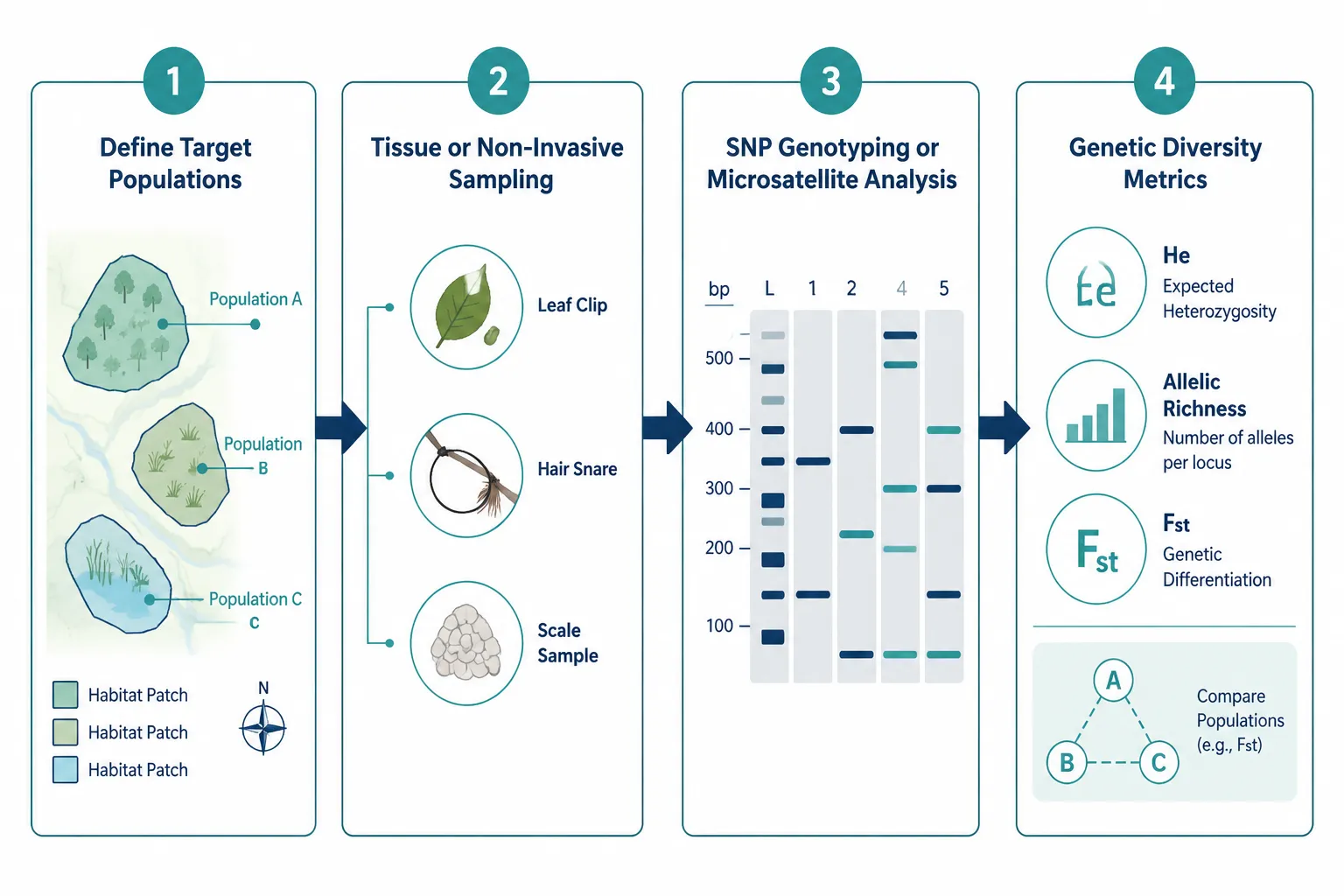
The central challenge for ecologists is designing surveys that are scientifically robust, proportionate to project budgets, and compatible with BNG management plan timelines. The good news is that advances in genotyping technology have dramatically reduced the cost per sample since 2020, making population genetics accessible for mid-tier development projects.
Choosing the Right Sampling Method
Non-invasive sampling is the default for most BNG contexts because it avoids disturbance to protected or sensitive species. The main options are:
| Method | Best for | Cost per sample (approx.) | Genetic resolution |
|---|---|---|---|
| Leaf clip (plants) | Grassland, woodland flora | Low | High (SNPs, microsatellites) |
| Hair snare | Mammals (dormouse, badger) | Low-medium | High |
| Scale/fin clip | Fish, amphibians | Medium | High |
| Buccal swab | Reptiles, birds (licensed) | Medium | High |
| Faecal DNA | Mammals, birds | Medium | Medium-high |
For plant communities, often the most tractable target in BNG habitats, leaf clips from 25 to 30 individuals per population provide sufficient statistical power to estimate He and Ar with acceptable confidence intervals [7]. Sampling should span the spatial extent of the habitat unit, not cluster around accessible points, to avoid spatial autocorrelation biasing connectivity estimates.
Genotyping Approaches
Two genotyping platforms dominate conservation genetics in 2026:
Microsatellite panels remain cost-effective for single-species studies where established primers exist. Costs have fallen to roughly £8-15 per sample for a 10-locus panel when batched. They are ideal for ongoing monitoring because results are directly comparable across laboratories using standardised allelic ladders.
Single Nucleotide Polymorphism (SNP) panels via reduced-representation sequencing (RADseq, ddRAD) offer higher resolution and are now competitive in price for multi-species or novel-species work. A 500-SNP panel can resolve fine-scale population structure invisible to microsatellites [9]. For BNG applications, a targeted SNP panel designed at baseline can be redeployed at monitoring intervals for consistent longitudinal data.
Sample Size and Replication
Survey design recommendations for genetic monitoring emphasise replication across time as well as space [2]. A minimum design for a BNG habitat unit should include:
- Baseline survey at habitat creation or restoration (Year 0)
- Early monitoring at Year 1 or 2 to detect founder effects or bottlenecks
- Mid-term survey at Year 5, aligned with BNG condition assessment windows
- Long-term survey at Year 10 and Year 30 to demonstrate sustained genetic viability
This schedule integrates naturally with the management plan milestones required under the BNG regime. When conducting a biodiversity impact assessment, building genetic sampling into the baseline phase is far more cost-effective than retrofitting it later.
Metabarcoding Within a Conservation Genetics Framework for BNG
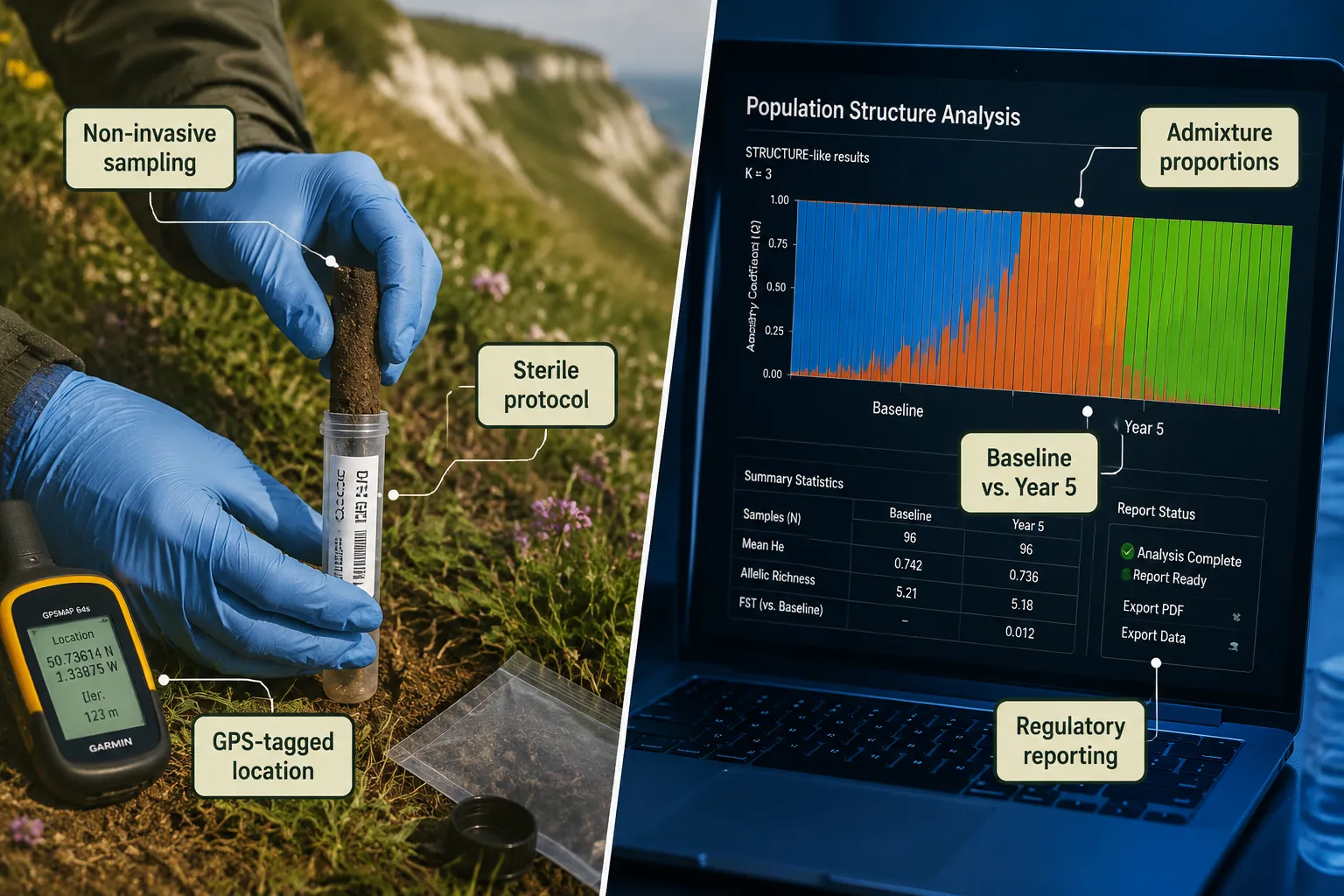
Metabarcoding, the high-throughput sequencing of bulk environmental or community DNA samples to identify multiple taxa simultaneously, has transformed biodiversity assessment since its widespread adoption in the early 2020s. By 2026, standardised workflows now cover water, soil, and air matrices, with dedicated guidance on best practices for species identification using eDNA metabarcoding emerging from national bodies [8].
However, it is essential to understand what metabarcoding does and does not measure in the context of Conservation Genetics for BNG Enhancement: Metabarcoding and Survey Protocols for Genetic Diversity in 2026 Habitats.
What Metabarcoding Measures
Metabarcoding detects presence and relative abundance of taxa from environmental samples. A soil metabarcoding survey of a restored grassland can reveal:
- Fungal community composition and mycorrhizal diversity
- Soil invertebrate diversity (nematodes, collembolans, mites)
- Plant community structure via pollen or root DNA
- Microbial diversity as a proxy for soil health [5]
These are community-level metrics. They tell you which species or operational taxonomic units (OTUs) are present, and in what proportions. This is genuinely valuable for BNG condition assessments, a species-rich soil community is a strong indicator of habitat quality [3].
What Metabarcoding Does Not Measure
Metabarcoding does not routinely provide:
- Within-species genetic diversity (He, Ar)
- Effective population size (Ne)
- Population connectivity or gene flow (Fst)
- Identification of inbred or bottlenecked populations
These require targeted population genetic approaches. A metabarcoding survey might confirm that a great crested newt is present in a restored pond; it cannot tell you whether that population is genetically viable or a remnant of a severely bottlenecked founder group [6].
Strategic Integration of Both Approaches
The most defensible BNG evidence base combines both tools:
- Metabarcoding for broad community-level condition assessment and species detection across the habitat unit
- Population genetics for focal species, those with conservation significance, legal protection, or high sensitivity to genetic erosion
This tiered approach is proportionate and cost-effective. For a standard BNG habitat unit, metabarcoding of soil and water samples at baseline and at monitoring intervals provides the community-level data, while targeted genetic sampling of two to four focal species provides the population-level viability evidence [1].
Reference databases remain a limiting factor for metabarcoding accuracy, particularly for invertebrates and fungi. National capacity-building efforts in 2026 are actively expanding reference libraries and establishing DNA barcoding networks to address this gap [10]. Ecologists should document which reference database version was used at each survey interval to ensure longitudinal comparability.
Linking Genetic Diversity Data to BNG Regulatory Requirements
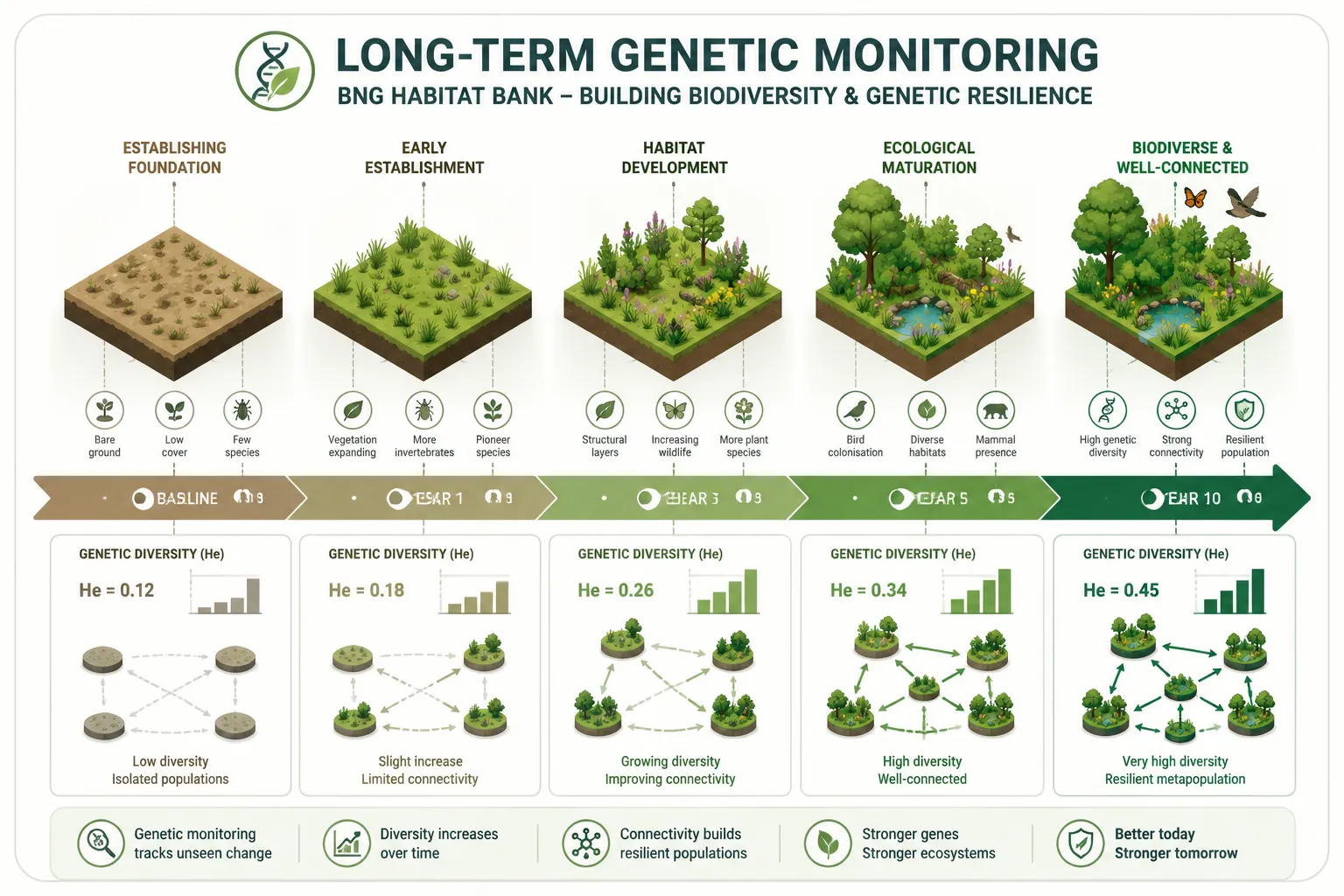
The current BNG metric does not formally score genetic diversity. However, the regulatory landscape in 2026 is shifting in ways that make genetic data increasingly relevant to compliance and to the commercial value of biodiversity units.
The Regulatory Case for Genetic Monitoring
Several converging factors create a strong case for including genetic data in BNG documentation:
Habitat condition assessments under the BNG framework evaluate structural and functional attributes of habitats. Genetic diversity is a functional attribute, it underpins the adaptive capacity that makes a habitat genuinely resilient rather than superficially species-rich. As condition metrics are refined in 2026 and beyond, genetic indicators are likely candidates for inclusion [4].
Biodiversity credits and off-site delivery are subject to increasing scrutiny. Landowners and developers trading biodiversity units or purchasing biodiversity credits face growing due-diligence expectations. Genetic data provides an objective, auditable measure of habitat quality that supports the credibility of biodiversity unit markets.
Long-term management obligations under BNG run for a minimum of 30 years. Demonstrating that a habitat is not only maintained but improving in genetic terms provides strong evidence of genuine additionality, the core principle that distinguishes real biodiversity gain from greenwashing.
For those exploring off-site or on-site BNG delivery, genetic monitoring adds a layer of evidence that is particularly valuable for off-site habitat banks, where the connection between development impact and compensatory gain must be robustly demonstrated.
Metrics to Report
A practical genetic monitoring report for a BNG habitat unit should include:
- He (expected heterozygosity) for each focal species population, compared to regional reference values where available
- Ar (allelic richness) standardised to a common sample size across monitoring intervals
- Ne estimates derived from linkage disequilibrium methods (software: NeEstimator, LDNe), these require no additional sampling beyond standard genotyping data
- Fst or Dest between habitat patches to assess connectivity
- Trend analysis across monitoring intervals, expressed as change from baseline
These metrics should be reported alongside the standard BNG condition assessment, not as a separate technical annex, to ensure they are visible to planners and local authority ecologists reviewing compliance. Planners seeking to understand how genetic data fits into the broader BNG framework will find the top questions about BNG from planners a useful reference for contextualising these requirements.
Cost Benchmarks for Genetic Surveys
A realistic budget for population genetic monitoring integrated into a standard BNG management plan:
- Baseline genetic survey (3 focal species, 30 individuals each): £2,500,£4,500 including laboratory genotyping and analysis
- Monitoring interval resample (same species, same protocol): £1,500,£3,000
- Full 30-year programme (baseline plus 4 monitoring intervals): £8,500,£16,500
These figures represent a small fraction of typical BNG compliance costs and are readily justified by the risk reduction they provide, both for developers facing potential retrospective scrutiny and for landowners whose biodiversity unit values depend on demonstrable habitat quality. Those working through how to achieve 10% biodiversity net gain will find that genetic monitoring strengthens the evidence base for meeting that threshold sustainably.
Building Capacity: Reference Databases, Training, and Quality Assurance
The reliability of both metabarcoding and population genetic data depends on the quality of reference databases, laboratory protocols, and analytical workflows. In 2026, national and international efforts to standardise these components are accelerating [10].
Key quality assurance steps for ecologists commissioning or conducting genetic surveys:
- Laboratory accreditation: Use UKAS-accredited or equivalent laboratories for all genetic analyses submitted in support of planning conditions.
- Negative controls: Include field blanks and laboratory negative controls in every metabarcoding run to detect contamination.
- Voucher specimens: Where possible, deposit physical voucher specimens alongside genetic data to enable future verification.
- Data deposition: Submit raw sequence data to public repositories (NCBI SRA, BOLD) at each monitoring interval. This creates an auditable record and contributes to national reference databases.
- Analytical transparency: Report which software versions, parameter settings, and reference database releases were used. This is essential for longitudinal comparability as databases expand [8].
Training for ecologists in genetic sampling protocols is increasingly available through professional bodies and specialist providers. Non-invasive sampling, in particular, requires specific field skills, contamination avoidance, sample preservation, and chain-of-custody documentation, that differ from conventional ecological survey training.
Conclusion
The integration of population-level genetic metrics into BNG habitat assessments is not a distant aspiration, it is a practical, cost-effective step that forward-thinking ecologists and developers can take now. The tools exist, the costs are proportionate, and the regulatory direction of travel strongly favours those who can demonstrate genetic as well as structural habitat quality.
Actionable next steps for ecologists and developers:
- Identify two to four focal species for each BNG habitat unit at the design stage, prioritise legally protected species, species with known sensitivity to genetic erosion, and keystone species for the habitat type.
- Integrate genetic sampling into the baseline survey, using non-invasive methods wherever possible to minimise disturbance and cost.
- Adopt a tiered approach: metabarcoding for community-level condition, population genetics for focal species viability.
- Align monitoring intervals with BNG management plan milestones (Years 1, 5, 10, 30) and report genetic metrics alongside standard condition assessments.
- Deposit data publicly at each interval to build a credible, auditable evidence trail that supports biodiversity unit value and regulatory compliance.
- Engage with national capacity-building initiatives to access updated reference databases and standardised protocols as they emerge.
For developers and land managers navigating the full scope of BNG obligations, working with specialist biodiversity surveyors who understand both the regulatory and scientific dimensions is the most reliable way to ensure that genetic diversity evidence is collected correctly, reported effectively, and genuinely adds value to long-term habitat management.
The habitats created and restored under BNG today must still be functioning ecosystems in 2056. Genetic diversity is the hidden architecture that makes that possible.
References
[1] Wjbphs 2025 1056 – wjbphs.com
[2] Edn3 – onlinelibrary.wiley.com
[3] Full – frontiersin.org
[4] S0168 9525(23)00020 3 – cell.com
[5] mbmg.pensoft – mbmg.pensoft.net
[6] S41598 026 41937 X – nature.com
[7] academic.oup – academic.oup.com
[8] mbmg.pensoft – mbmg.pensoft.net
[9] Pmc13036477 – pmc.ncbi.nlm.nih.gov
[10] New Study Outlines How Countries Can Build Effective Dna Barcoding Networks – blog.pensoft.net