

Twenty-six days. That is all the runway left before Biodiversity Net Gain becomes legally mandatory for Nationally Significant Infrastructure Projects across England. On 2 November 2026, every major road, railway, reservoir, and energy scheme entering the planning system will need to prove it leaves nature measurably better off than before construction began. At the same moment, the Conservative Party is publicly pledging to strip away planning rules that developers call costly red tape. These two forces, one tightening environmental law and one promising to loosen it, are colliding in the same autumn news cycle, and anyone involved in NSIP delivery needs to understand exactly what changes and when.
The biodiversity net gain NSIP deadline 2 November 2026 is not a proposal or a consultation outcome waiting to be finalised. It is a confirmed regulatory milestone, arriving almost three years after BNG became mandatory for most other developments in February 2024. For NSIP promoters still treating biodiversity gain as a future problem, the window to act is closing fast.
Key Takeaways
- Mandatory Biodiversity Net Gain applies to Nationally Significant Infrastructure Projects from 2 November 2026, introducing a new "BNG boundary" concept and limited flexibility to aggregate gains across affected local planning areas.
- Water-related impacts must be addressed within the same catchment, not simply offset anywhere convenient.
- Earlier 2026 reforms already reshaped the wider BNG regime, including a 0.2 hectare small-sites exemption, removal of the self-build exemption, and a digital metric tool.
- Conservative conference proposals to scrap the Future Homes Standard and merge Section 106 and CIL into a single charge remain opposition policy, not law, but signal where planning debate is heading.
- NSIP promoters have less than four weeks to finalise baseline ecology surveys, metric calculations, and habitat bank or credit arrangements before autumn survey windows close.
What Changes Under the Biodiversity Net Gain NSIP Deadline 2 November 2026
From 2 November 2026, Nationally Significant Infrastructure Projects join the mandatory BNG framework that has applied to town and country planning applications since February 2024. The headline requirement is familiar: a minimum 10% biodiversity net gain, measured using the statutory biodiversity metric, verified against a pre-development baseline.
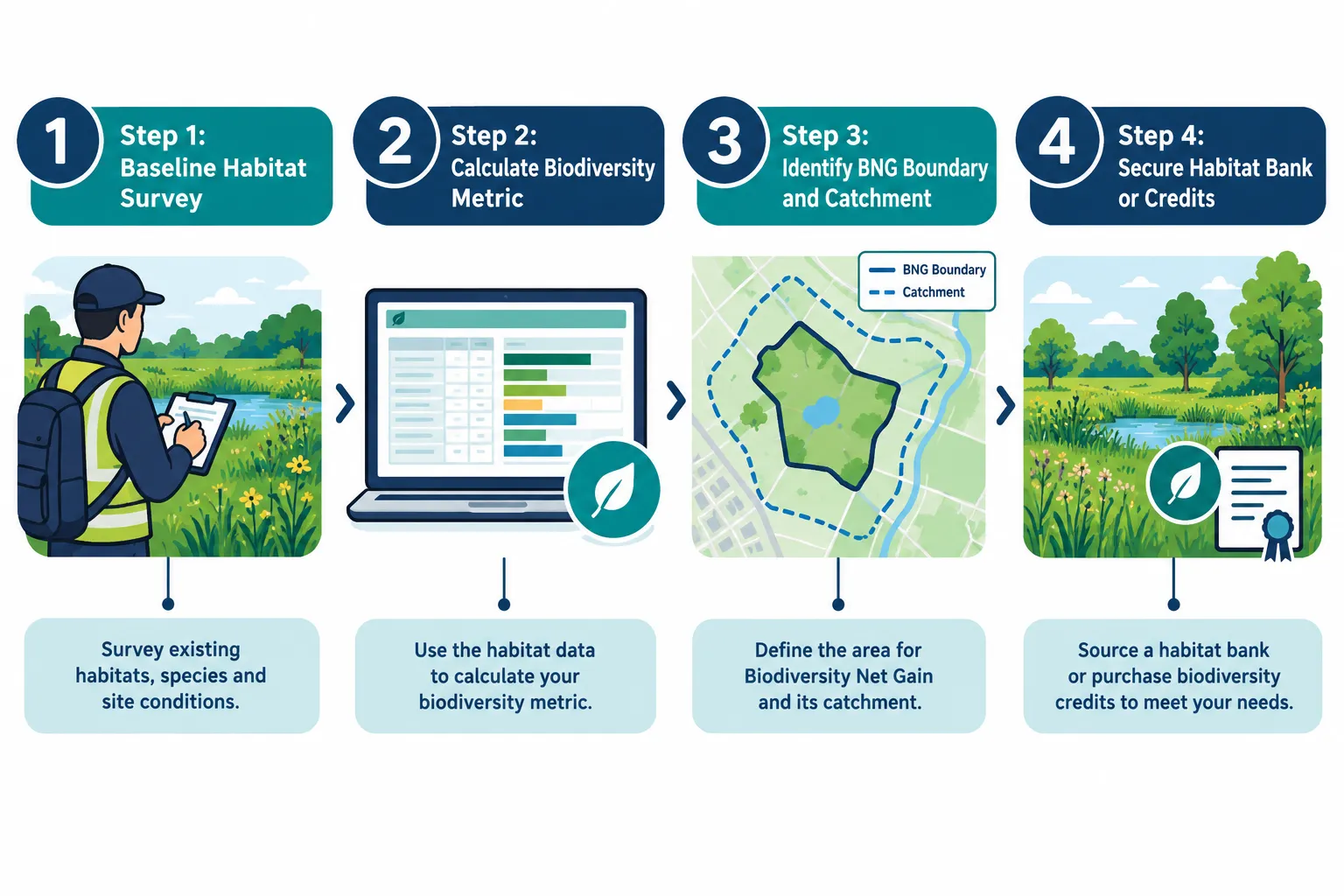
What makes the NSIP regime distinct is the introduction of a formal "BNG boundary." This defines the geographic area within which a project's biodiversity gains must be delivered or accounted for. Unlike smaller developments tied to a single local planning authority, NSIPs often cross multiple council boundaries, sometimes spanning dozens of miles for a transmission line or a rail corridor.
To reflect that reality, the new rules allow promoters to aggregate biodiversity gains across the local planning areas their project touches, rather than forcing a separate gain calculation for every council area individually. This is a practical concession to the scale of infrastructure schemes. However, one category of impact does not get this flexibility: water.
Where a project affects watercourses, wetlands, or water-dependent habitats, any compensatory gain must stay within the same hydrological catchment. Regulators are drawing a firm line here because moving water-related mitigation outside its catchment can break the ecological logic that justified the gain in the first place.
Why the Catchment Rule Matters for Large Schemes
For linear infrastructure like pipelines, grid connections, and road widening schemes, the catchment restriction can meaningfully narrow where suitable habitat banks or credits can be sourced. Promoters cannot simply shop across the national market for the cheapest or most convenient water-related offset; it has to sit within the right drainage basin. This has direct implications for site selection, early engagement with catchment-based habitat providers, and realistic programme timelines.
The Wider 2026 BNG Reform Picture Before the NSIP Deadline
The November deadline does not arrive in isolation. It caps a year of incremental changes to the broader BNG system that every NSIP promoter should already have on their radar.
On 31 July 2026, government introduced several adjustments to the mandatory BNG regime:
- A new exemption for very small sites of 0.2 hectares or below, reducing burden on minor works.
- Removal of the self-build and custom-build exemption, bringing those projects back into scope.
- An exemption for temporary planning permissions lasting five years or less.
- Further exemptions for conservation-led developments and improvements to parks, playing fields, and public gardens.
- A shift toward a digital, web-based biodiversity metric tool, replacing the older spreadsheet-based approach.
Separately, Defra ran a consultation closing 10 June 2026 on a targeted brownfield residential exemption for sites up to 2.5 hectares. Notably, Defra's own analysis acknowledged this exemption could reduce off-site biodiversity market transactions by as much as 48%, a figure that signals just how much the habitat banking and credit market depends on smaller residential schemes currently buying into off-site gains.
Timothy Douglas of Propertymark has warned that policy makers must not make cost savings at the expense of quality and standards, and that a balance will need to be struck.
That tension between streamlining regulation and preserving environmental and quality safeguards is now playing out at the highest political level.
Conservative Planning Deregulation Pledges and What They Mean
At the Conservative Party conference on 5 October 2026, shadow housing secretary Katie Lam set out a deregulatory agenda aimed squarely at housebuilding costs. The proposals, currently opposition policy rather than enacted law, include:

- Scrapping the Future Homes Standard entirely.
- Replacing Section 106 agreements and the Community Infrastructure Levy with a single, simplified charge.
- Removing a range of housebuilding regulations, which the party claims could cut up to £50,000 from the cost of building a new home.
Industry reaction has been mixed. Timothy Douglas of Propertymark warned explicitly against pursuing cost reductions at the expense of quality and build standards, a caution that applies equally to biodiversity safeguards. For NSIP promoters, it is worth stressing: these pledges are not current law. The 2 November 2026 BNG requirement for NSIPs remains fully in force regardless of opposition party policy positions. Planning teams should treat the deregulation pledges as a political signal to watch, not a reason to delay BNG compliance work.
Four Weeks to Prepare: Practical Steps for NSIP Promoters
With the biodiversity net gain NSIP deadline 2 November 2026 now inside a single month, promoters, developers, and landowners involved in infrastructure schemes should prioritise the following:
1. Lock in baseline ecology surveys. Autumn is a transitional season for habitat surveys. Many botanical and faunal survey methods rely on specific seasonal windows, and some indicators become harder to record reliably as vegetation dies back and daylight hours shrink. Any outstanding baseline habitat surveys should be scheduled immediately, with recognition that certain survey types may need to wait for the next appropriate seasonal window if they are missed now.
2. Run metric calculations early, using the correct tool. With the shift toward a digital, web-based BNG metric, promoters should confirm which version of the metric applies to their project and avoid relying on outdated spreadsheet calculations that may not reflect current guidance.
3. Map the BNG boundary and catchment constraints now. Given that water-related impacts must be addressed within the originating catchment, promoters with linear or multi-authority schemes should identify catchment boundaries before searching for compensation land, not after.
4. Begin habitat bank and credit planning conversations. Securing off-site gains, where needed, takes lead time. Engaging with habitat bank operators and landowners within the relevant catchment and BNG boundary should start well before formal application submission.
5. Document exemption eligibility carefully. Where elements of a scheme might fall under the small-sites, temporary permission, or conservation-led exemptions introduced in July 2026, promoters should keep clear records justifying that status, since scrutiny of exemption claims is likely to increase.
| Action | Why It Matters | Timing Pressure |
|---|---|---|
| Baseline habitat survey | Legally required evidence base for metric | High, autumn windows closing |
| Metric calculation | Determines gain shortfall or surplus | High, must use current digital tool |
| BNG boundary mapping | Defines aggregation and catchment limits | Medium, needed before offsetting decisions |
| Habitat bank engagement | Secures compensation land/credits | Medium to High, lead times vary |
| Exemption documentation | Protects against later compliance challenge | Ongoing |
Frequently Asked Questions
Does the 2 November 2026 deadline apply to all infrastructure projects?
It applies specifically to Nationally Significant Infrastructure Projects going through the relevant planning consent process, not to every development. Smaller schemes have been under mandatory BNG since February 2024, subject to various exemptions introduced since.
What is the BNG boundary?
It is the defined geographic area, potentially spanning multiple local planning authorities, within which an NSIP's biodiversity gains can be aggregated and accounted for under the new rules.
Can water-related biodiversity impacts be offset anywhere?
No. Compensation for water-related impacts must remain within the same catchment as the original impact, reflecting the ecological connectivity of water systems.
Are the Conservative planning deregulation proposals already law?
No. As of the proposals announced on 5 October 2026, these remain opposition party pledges, not enacted legislation. The mandatory BNG requirement for NSIPs stands independently of this political debate.
Will the small-sites and brownfield exemptions affect NSIP promoters?
Generally, these exemptions target smaller residential and site-specific schemes rather than large infrastructure projects, but promoters with mixed-use or phased elements should check eligibility carefully.
Conclusion
The biodiversity net gain NSIP deadline 2 November 2026 is fixed, confirmed, and fast approaching, regardless of the political noise around planning deregulation. Promoters who have not yet locked in baseline surveys, finalised metric calculations, or begun habitat bank conversations are working against a shrinking seasonal and regulatory window. The sensible path over the next four weeks is straightforward: commission outstanding ecology surveys immediately, calculate gains using the current digital metric, map catchment and BNG boundary constraints before sourcing offsets, and document any exemption claims thoroughly. Political pledges to loosen planning rules may shape future debate, but they change nothing about what is legally required from 2 November 2026 onward. Acting now, rather than waiting to see how the deregulation conversation unfolds, is the only reliable way to keep major infrastructure schemes on schedule and compliant.