

From 31 October 2026, no planning committee in England will be able to decide a biodiversity gain plan: the decision passes to planning officers alone. Officer delegation becomes the default, and the quality of the paperwork a developer submits now carries the entire weight of the decision.
This matters because the shift is not cosmetic. Biodiversity gain plan officer delegation 31 October 2026 marks the point at which planning committees in England lose the ability to hear, debate or override biodiversity gain plan submissions. The decision rests with a planning officer alone, working strictly against the statutory metric and the evidence in front of them. For developers, consultants, architects and local authority ecologists, that changes how gain plans must be written, timed and supported.
Key Takeaways
- From 31 October 2026, the National Scheme of Delegation (SI 2026/854) removes biodiversity gain plan decisions from committee; officers decide them under Schedule 1.
- Schedule 2 applications can only reach committee if a nominated officer and nominated member jointly agree they pass a gateway test; call-in and objection-number thresholds are abolished and committees are capped at 13 members.
- A committee ruling on a case that should have been delegated risks judicial review, according to statutory guidance.
- With no committee debate available, gain plans must be technically complete and metric-compliant on first submission, there is no political safety net.
- The 0.2 hectare BNG exemption (from 6 August 2026), the incoming NSIP mandate (2 November 2026) and the pending brownfield exemption decision all interact with how gain plans are scoped this autumn.
What Changes on 31 October 2026 for Biodiversity Gain Plan Decisions
The Town and Country Planning (Discharge of Local Planning Authority Functions) (England) Regulations 2026 (SI 2026/854), commonly called the National Scheme of Delegation, comes into force on 31 October 2026. Every local planning authority in England must have updated its own scheme of delegation before that date.
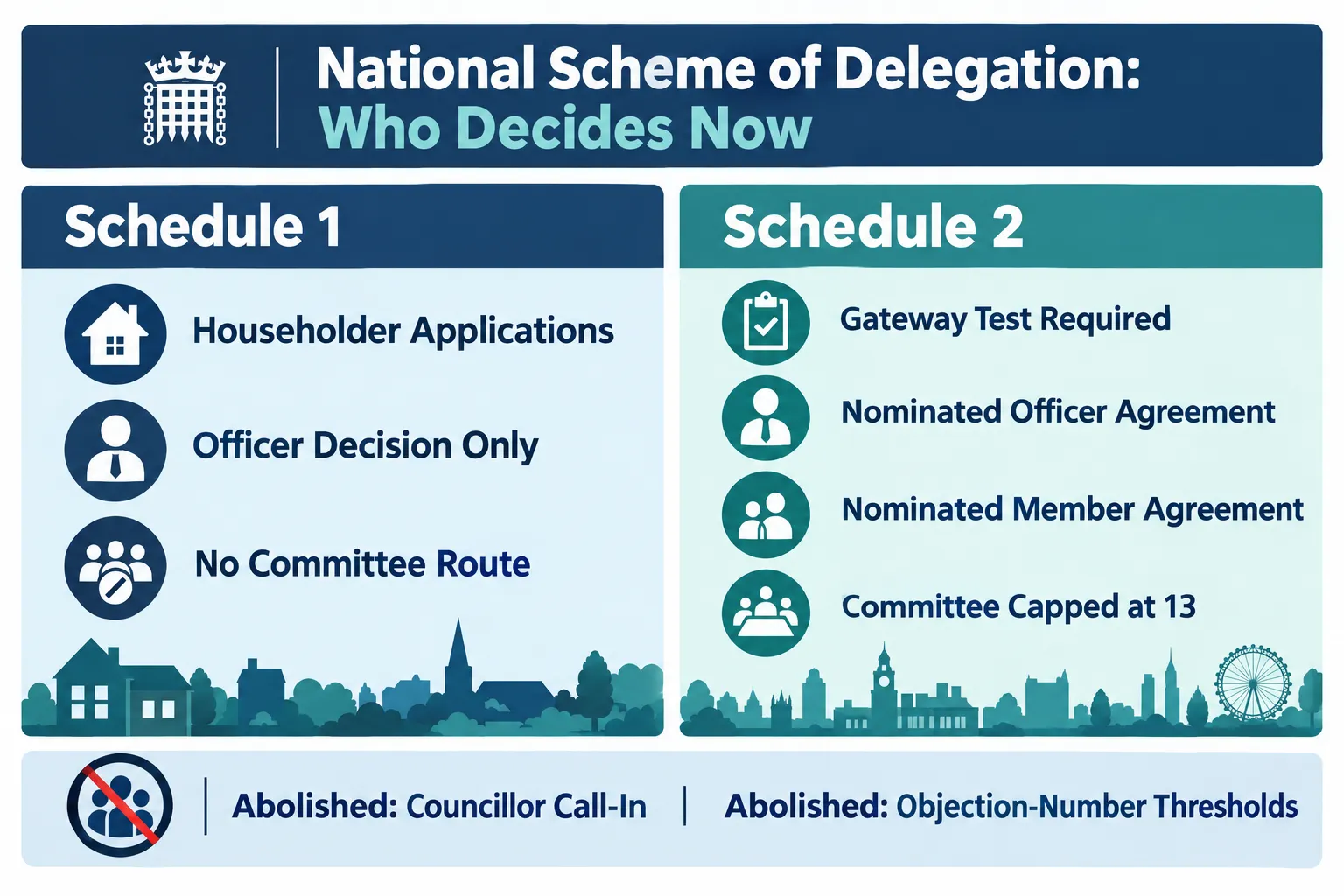
The practical effect is straightforward. Biodiversity gain plan submissions can no longer be routed to planning committee. Schedule 1 of the regulations lists the categories of application that must be decided by an officer, including householder applications. Schedule 2 covers a wider set of applications that may only reach committee if a nominated officer, typically the chief planner, and a nominated member, usually the committee chair, jointly agree the case passes a defined gateway test.
Two further changes reinforce this shift:
- Councillor call-in and automatic objection-number thresholds are abolished. A high volume of local objections, or a single councillor's request, can no longer force a biodiversity gain plan in front of committee.
- Committees are capped at 13 members, tightening the scope of what committees handle even when a gateway test is passed.
Statutory guidance is explicit that a committee decision taken on an application that should have gone to an officer is exposed to legal challenge. Authorities that get this wrong risk a judicial review; applicants caught in that uncertainty risk delay. For a primer on how BNG obligations interact with planning decisions more broadly, see this overview of what planners need to know about biodiversity net gain.
Why Officer-Only Determination Raises the Bar for Biodiversity Gain Plans
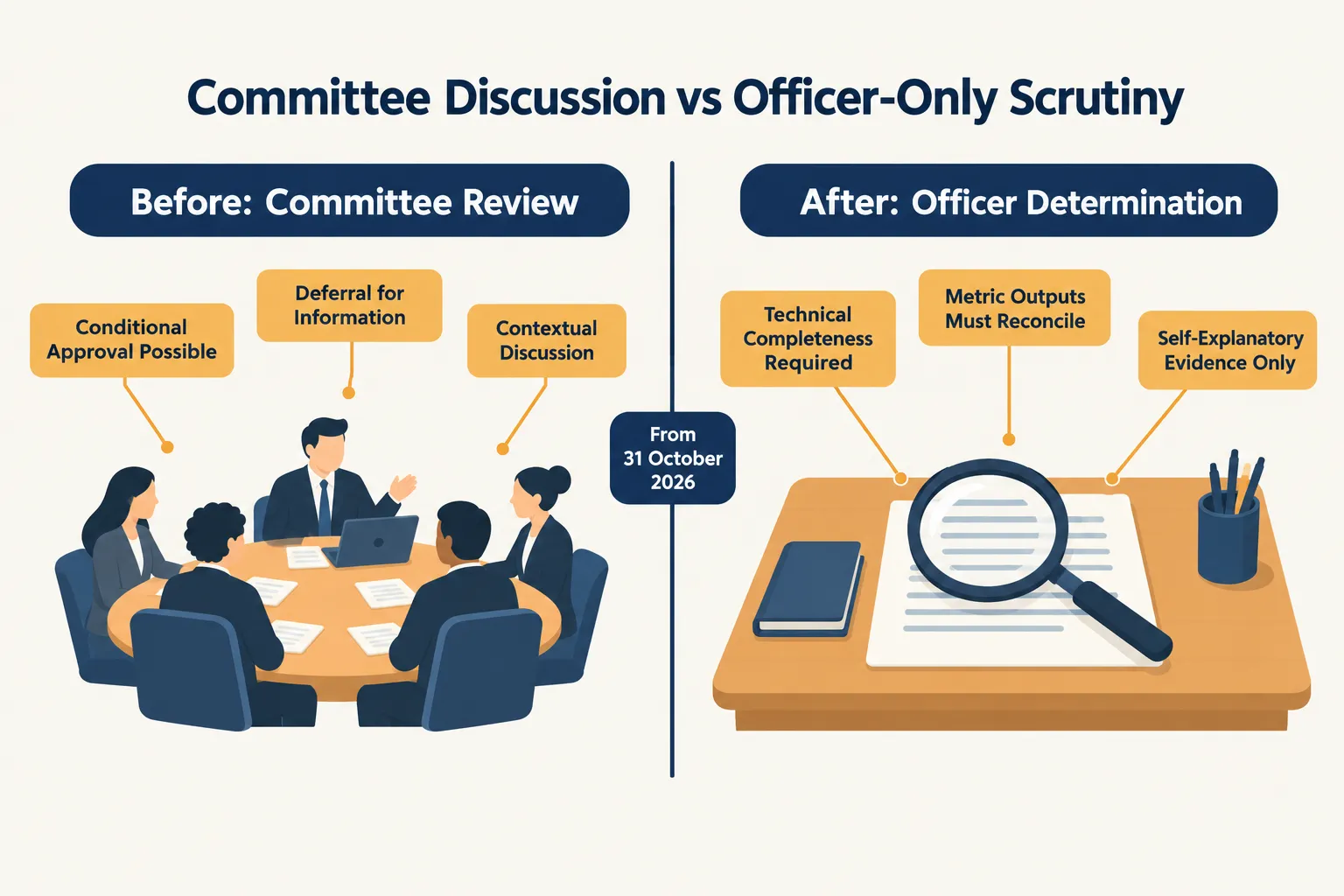
Committees have historically offered a form of flexibility, even if an informal one. A borderline gain plan might attract a conditional approval after discussion, a deferral for more information, or a sympathetic reading of context that a report alone wouldn't convey. Biodiversity gain plan officer delegation 31 October 2026 removes that layer entirely.
An officer working through Schedule 1 or a gateway-tested Schedule 2 application has no committee to persuade and no political cover to lean on. The decision is made against the biodiversity gain plan as submitted, measured strictly against the statutory metric, the legal tests, and the authority's adopted policy. There is no second audience to argue nuance in front of.
This has three concrete consequences for anyone preparing a submission:
- Technical completeness is no longer optional context, it is the whole case. Gaps that a committee might once have overlooked will now simply result in a refusal, a delay for further information, or conditions that slow the build programme.
- Metric outputs must reconcile exactly. Baseline habitat units, post-development units, and any offsite or statutory credit contributions need to add up without requiring the officer to make assumptions on the applicant's behalf.
- Supporting evidence must be self-explanatory. Officers working through the gateway test criteria, or simply processing a Schedule 1 case, will not chase up missing detail in the way a committee discussion sometimes forced into the open.
Consultants who have relied on a persuasive committee presentation to carry a thin gain plan will need to rethink that approach completely. Our guide to the questions planners most commonly raise about biodiversity net gain is a useful checkpoint before submission.
What a Robust Biodiversity Gain Plan Must Contain
Under officer-only determination, every component of the gain plan needs to stand on its own evidential merit. At minimum, a submission should include:
- A pre-development baseline using the statutory biodiversity metric, with habitat parcels mapped accurately against the red-line boundary and condition scored to a defensible standard.
- Habitat condition assessments carried out at the correct time of year, with survey dates and methodology clearly recorded so an officer can verify the scoring without further enquiry.
- A 30-year habitat management and monitoring plan, setting out management actions, monitoring frequency, and responsible parties for the full duration required.
- Legal agreements and registered offsite units, where offsite delivery forms part of the strategy, with clear evidence the units are secured and registered on the national register before determination.
- Evidence of the mitigation hierarchy, demonstrating that onsite habitat creation and retention were genuinely prioritised before offsite gains or, as a last resort, statutory credits were considered.
For a full breakdown of what belongs in this kind of assessment, see our guide on what should be included in a biodiversity net gain assessment and our step-by-step guide on creating a biodiversity plan for development projects in England.
Where offsite delivery is used, applicants should understand how onsite and offsite routes now rank for non-major development, and when statutory credits genuinely apply as the fallback option, covered in our comparison of offsite versus onsite biodiversity net gain delivery and our guide to biodiversity credits for developers.
Timeline Tips for Autumn 2026: Do Not Leave Gain Plans to the Last Minute
Autumn brings a practical complication that has nothing to do with regulation: survey seasons are closing. Many habitat condition assessments depend on vegetation being in active growth or flowering, and leaving baseline surveys until late in the year risks a gap that cannot be filled until next spring.
With officer delegation live from 31 October 2026, applicants cannot rely on a committee hearing to buy extra time while survey data is finalised. Practical steps worth taking now:
- Commission baseline and condition surveys immediately if they have not already been completed this growing season.
- Build in time for metric recalculation following any late design changes, since officers will check the figures line by line.
- Secure offsite units and legal agreements early, as registration delays can stall determination regardless of how strong the ecological case is.
- Review the authority's updated scheme of delegation so applicants know in advance whether their case sits in Schedule 1 or faces a Schedule 2 gateway test.
Developers weighing up timing and risk more broadly may find it useful to revisit our wider guidance on planning a project around biodiversity net gain requirements and on achieving biodiversity net gain without unnecessary risk.
How the 0.2ha Exemption, NSIP Mandate and Brownfield Decision Interact
Officer delegation does not operate in isolation. Three other moving parts shape which applications even require a biodiversity gain plan this autumn:
| Change | Status | Effect on gain plan requirement |
|---|---|---|
| 0.2 hectare site exemption | In force since 6 August 2026 | Sites at or below 0.2ha are exempt from mandatory BNG unless priority habitat is affected; applies to applications submitted on or after that date |
| NSIP 10% BNG mandate | Expected from 2 November 2026 | Brings major infrastructure projects into mandatory 10% net gain, broadening the scope of who needs a compliant gain plan |
| Residential brownfield exemption | Consultation closed 10 June 2026; decision pending | Could narrow the pool of residential brownfield schemes needing a gain plan once a government response is published |
Smaller residential schemes already benefit from the 0.2ha exemption, which Defra estimates removes roughly half of residential permissions from mandatory BNG, unless priority habitat is present, in which case the exemption does not apply. Temporary developments reinstated within five years remain exempt too, and the self-build and custom-build exemption has been removed. For non-major development, offsite gains now rank equally with onsite creation, with statutory credits retained strictly as a last resort.
Layered on top, the NSIP mandate due from 2 November 2026 widens the net for large infrastructure, while the outstanding decision on a brownfield exemption could still reshape how many residential schemes need a gain plan at all. Anyone scoping a project this autumn should check exemption status before investing in survey work. Our overview of why biodiversity net gain matters across UK development sets out the bigger picture, and architects weighing design implications may find how architects can address biodiversity net gain requirements a practical companion piece.
Biodiversity Surveyors continues to track each of these interlocking changes and supports developers, consultants and local authority ecologists with baseline surveys, metric calculations and gain plan preparation built for officer-only scrutiny.
Frequently Asked Questions
Does biodiversity gain plan officer delegation 31 October 2026 apply to all applications?
It applies to applications requiring a biodiversity gain plan that fall within Schedule 1, which must be officer-decided, and those in Schedule 2 that fail the gateway test, which also default to officer determination.
Can a councillor still force a gain plan to committee after 31 October 2026?
No. Councillor call-in and automatic objection-number thresholds are abolished under SI 2026/854, so neither route can override officer delegation.
What happens if a committee wrongly decides a delegated application?
Statutory guidance warns that such a decision could be open to judicial review, creating legal risk for the authority and delay for the applicant.
Does the 0.2 hectare exemption mean smaller sites never need a gain plan?
Not always. Sites at or below 0.2 hectares are exempt from mandatory BNG only where no priority habitat is affected; where priority habitat is present, a gain plan is still required.
Will the brownfield exemption change gain plan requirements soon?
Possibly. The consultation closed on 10 June 2026 and a government response is still awaited, so applicants should monitor developments before assuming an exemption applies.
Conclusion
From 31 October 2026, biodiversity gain plans are decided by officers alone, with no committee discussion to fall back on. That makes technical completeness, accurate metric outputs and watertight legal agreements essential from the first submission. Developers and consultants preparing applications this autumn should commission outstanding surveys now, confirm which exemption or mandate applies to their site, and ensure every element of the gain plan, baseline, condition assessment, 30-year management plan and hierarchy evidence, is ready to withstand officer-level scrutiny without a safety net. Speaking with an experienced ecological consultancy before submission is the most reliable way to avoid delay under the new delegation regime.
References
- UK Statutory Instruments, The Town and Country Planning (Discharge of Local Planning Authority Functions) (England) Regulations 2026 (SI 2026/854), legislation.gov.uk (2026)
- Department for Environment, Food and Rural Affairs, guidance on biodiversity net gain exemptions, gov.uk (2026)
- Department for Environment, Food and Rural Affairs, consultation on a targeted BNG exemption for residential brownfield development, gov.uk (2026)
LANGUAGE: en