

By 2026, more than 36 jurisdictions have either adopted or are actively incorporating ISSB Standards into their regulatory frameworks [8], while thousands of EU companies are simultaneously producing their first ESRS-based sustainability disclosures under the Corporate Sustainability Reporting Directive. For global ecology surveyors, this convergence is not a distant policy debate, it is a direct operational challenge that reshapes how biodiversity net gain assessments are scoped, measured, and reported on multinational projects. Aligning EU and ISSB Standards: 2026 Biodiversity Net Gain Strategies for Global Ecology Surveyors is therefore less a theoretical exercise and more a practical protocol that every cross-border ecology practice must now build into its workflow.
Key Takeaways
- The IFRS Foundation and EFRAG have confirmed a "very high degree of alignment" between ESRS and ISSB climate disclosure requirements, with ongoing work extending toward nature and biodiversity topics [4][9].
- ISSB launched dedicated research on biodiversity, ecosystems, and ecosystem services in 2024, signalling that formal nature-related disclosure requirements will shape project-level biodiversity net gain practice by 2026 [2][4].
- EU Omnibus Programme amendments and EFRAG's December 2025 draft ESRS revisions are bringing EU sustainability standards closer to IFRS S1/S2, but full ISSB integration remains incomplete [10][11].
- Global ecology surveyors advising multinational clients must prepare more granular quantitative impact data for EU-regulated entities than for jurisdictions applying ISSB standards alone [10][14].
- ESRS-TNFD interoperability mapping creates a practical bridge that surveyors can use to translate habitat condition and species richness data into disclosure-ready metrics [1][2].
The Convergence Driving Change in Nature Reporting
The alignment story began formally in July 2023, when the European Commission, EFRAG, and the ISSB jointly acknowledged a "high degree of alignment" in climate-related disclosure requirements and committed to maintaining interoperability going forward [4][9]. The IFRS Foundation and EFRAG then published joint ESRS-ISSB Interoperability Guidance in May 2024, confirming that a single data set can, in principle, produce reports compliant with both regimes for climate disclosures [4][9].
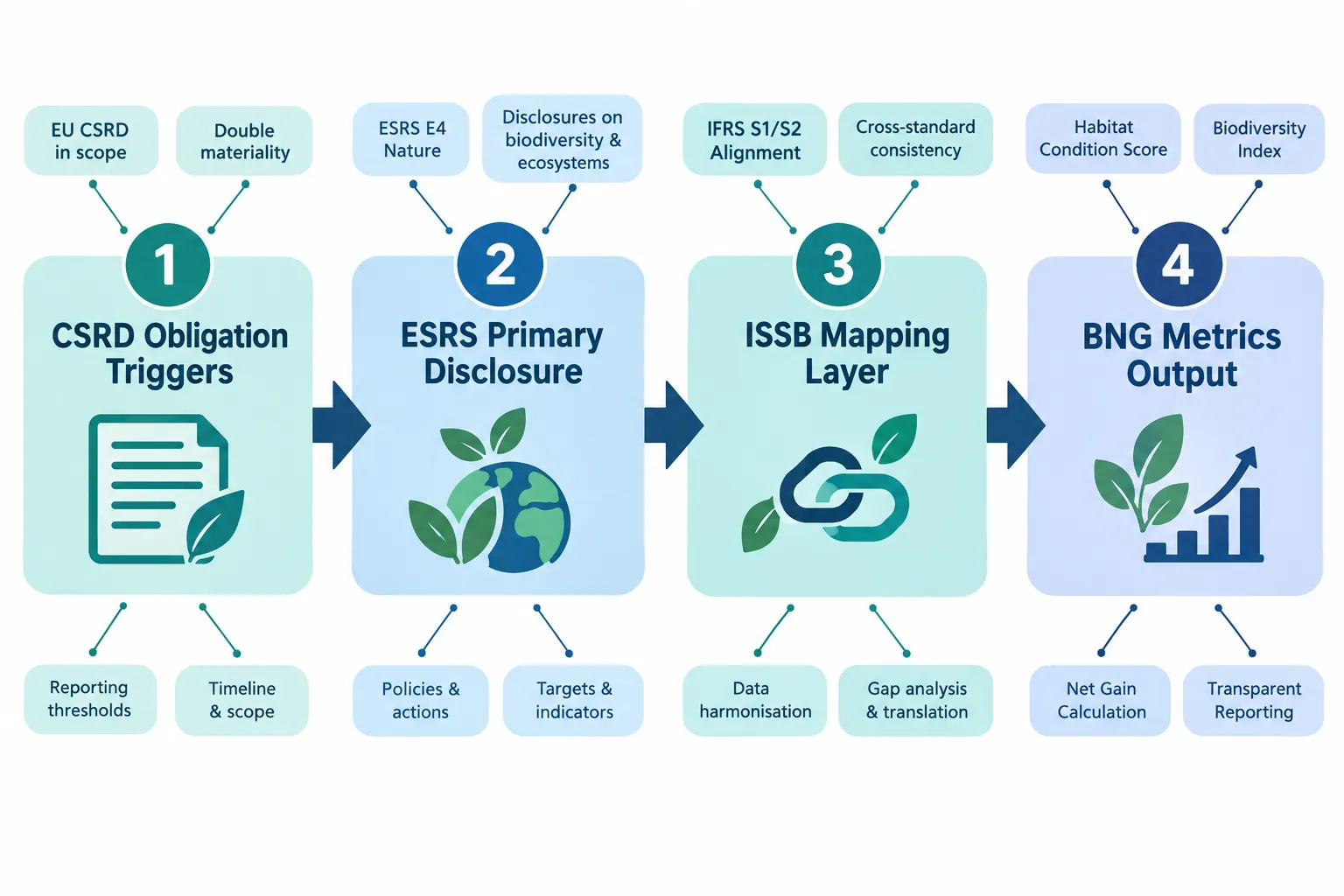
This matters for ecology surveyors because the institutional architecture being built for climate reporting is the same architecture that will eventually govern nature-related disclosures. Technical mapping by EFRAG in 2024 concluded that almost all climate-related disclosure requirements within ISSB Standards are already captured within ESRS [9][13]. When ISSB's dedicated biodiversity and ecosystems research programme reaches its conclusions, initial research was published in June 2024 with completion targeted for the first half of 2025, the expectation is that any resulting nature standard will be designed to dovetail with ESRS and frameworks like TNFD [2][4].
What does this mean in practice? Ecology surveyors working on projects for large EU-regulated clients will increasingly be asked to structure biodiversity net gain data in ways that feed directly into ESRS E4 (biodiversity and ecosystems) disclosures. At the same time, those same clients may have parent companies or investors operating under ISSB-aligned rules in jurisdictions such as the UK, Canada, Australia, or Japan. A surveyor who understands both frameworks can deliver a single, coherent evidence base rather than two separate assessment reports.
"The ESRS can serve as a primary framework from which an ISSB-aligned report can be derived, but ecology surveyors must understand where the two regimes still diverge." [9][10]
For a grounding in what a biodiversity net gain assessment actually contains and why it matters, the biodiversity net gain explained resource provides a clear starting point before engaging with the reporting layer.
How EU Amendments and ISSB Research Are Reshaping the Standards Landscape
The Omnibus Programme and ESRS Revisions
In February 2025, the European Commission launched its Omnibus Programme to simplify CSRD and ESRS obligations. EFRAG followed with draft ESRS amendments submitted on 3 December 2025, aimed specifically at better aligning EU sustainability standards with IFRS S1/S2 [11][14]. Key changes address how anticipated financial effects of sustainability risks, including nature-related risks, must be reported, with some new exemptions introduced to ease the burden on preparers [3][11].
An informal EU agreement recorded in December 2025 also confirmed that CSRD reporting obligations would be limited to companies with more than 1,000 employees and over €450 million in net annual revenue [7][6]. This threshold means that the largest, most complex development projects will fall squarely under ESRS/ISSB-aligned reporting requirements, while smaller ecology and surveying practices are more likely to encounter these standards indirectly through client supply chains and sector guidance rather than direct legal mandates.
Where the Gap Still Exists
Despite strong interoperability efforts, legal analysis from May 2026 makes clear that the revised ESRS do not yet provide "full ISSB integration" [10]. Companies cannot simply treat ESRS reporting as ISSB reporting. A specific and important gap remains around anticipated financial effects: ESRS currently requires both qualitative and quantitative information, while ISSB Standards allow qualitative-only disclosure in certain circumstances [10][11][14].
For global ecology surveyors, this gap has a direct practical implication. When advising a multinational client that reports under both regimes, surveyors must prepare more granular quantitative impact data for the EU-regulated entity than would be required for a jurisdiction applying ISSB alone. Habitat condition scores, species richness baselines, and net gain calculations must be expressed in ways that satisfy the higher quantitative bar set by ESRS.
| Reporting Regime | Nature Disclosure Status | Quantitative Requirement | Surveyor Implication |
|---|---|---|---|
| ESRS (EU CSRD) | ESRS E4 in force | Both qualitative and quantitative required | Full metric quantification needed |
| ISSB Standards | Research phase (2024-2025) | Qualitative-only allowed in some cases | Lighter data burden in some jurisdictions |
| TNFD | Voluntary framework | Flexible | Useful bridge between regimes |
| UK BNG (mandatory) | Statutory 10% minimum | Quantitative BNG metric required | Feeds into both ESRS and ISSB data sets |
Understanding what is in a biodiversity net gain assessment is therefore foundational before attempting to map assessment outputs onto either ESRS or ISSB disclosure templates.

Practical 2026 Strategies for Global Ecology Surveyors
Building a Dual-Framework Data Architecture
The most efficient response to aligning EU and ISSB Standards: 2026 Biodiversity Net Gain Strategies for Global Ecology Surveyors is to design field survey protocols that collect data once but structure it to satisfy both regimes. EFRAG's 2024 draft mapping of ESRS against TNFD nature-related disclosure recommendations provides a practical bridge [1][2]. Ecology surveyors can use this mapping to translate habitat condition assessments, species richness surveys, and net gain calculations into disclosure-ready metrics for clients subject to CSRD, while the same underlying data set can be reformatted for ISSB-aligned reports in other jurisdictions.
Recommended steps for surveyors in 2026:
- Identify the client's reporting regime, determine whether the project falls under CSRD (ESRS E4), ISSB-aligned national rules, or both.
- Scope the baseline survey to ESRS E4 metrics, this sets the higher quantitative bar and ensures ISSB compliance is achievable as a subset.
- Map outputs against TNFD LEAP methodology, EFRAG's interoperability mapping [1] shows which ESRS indicators align with TNFD, enabling a single field data set to serve multiple disclosure frameworks.
- Quantify anticipated financial effects, for EU clients, biodiversity risks and dependencies must be expressed in financial terms, not just ecological units.
- Document the methodology trail, auditors and third-party verifiers under CSRD will scrutinise how ecological data was converted into disclosure metrics.
For projects where off-site delivery is being considered, understanding the distinction between biodiversity net gain off-site or on-site delivery options is essential, as the choice affects both the ecological outcome and the way units are counted and reported under both frameworks.
Translating BNG Metrics into Disclosure Language
The UK's mandatory biodiversity net gain requirement, a statutory minimum of 10% net gain, generates quantitative outputs using the Biodiversity Metric. These outputs can serve as a foundation for ESRS E4 disclosures, but surveyors must translate ecological units into the language of financial materiality that both ESRS and ISSB demand.
Key translation steps include:
- Expressing habitat loss and gain in monetary equivalents where possible, using ecosystem service valuation methods.
- Linking species richness changes to dependency and impact pathways as defined by TNFD and referenced in ESRS E4.
- Documenting residual risk, where net gain is achieved through off-site units or statutory credits, the residual biodiversity risk to the project site must still be disclosed.
Surveyors advising developers on how to achieve 10% biodiversity net gain should now build this disclosure translation step into every project plan from the outset, rather than treating it as a post-assessment add-on.
Cross-Border Project Considerations
On multinational projects, for example, a European infrastructure developer with projects in the UK, France, and Australia, the surveyor must navigate three different regulatory contexts simultaneously. By 2026, at least 36 jurisdictions have adopted or are incorporating ISSB Standards [8], meaning the ISSB framework is increasingly the common denominator. However, the EU's ESRS layer adds additional requirements that must be met for the European portions of any project.
Practical cross-border protocol:
- Use ESRS E4 as the master template for all nature-related data collection.
- Apply ISSB-aligned reporting as a derived output from the ESRS data set, consistent with the interoperability guidance [4][9].
- Flag jurisdiction-specific requirements, such as the UK's statutory BNG metric or Australia's nature repair market, as addenda to the core disclosure.
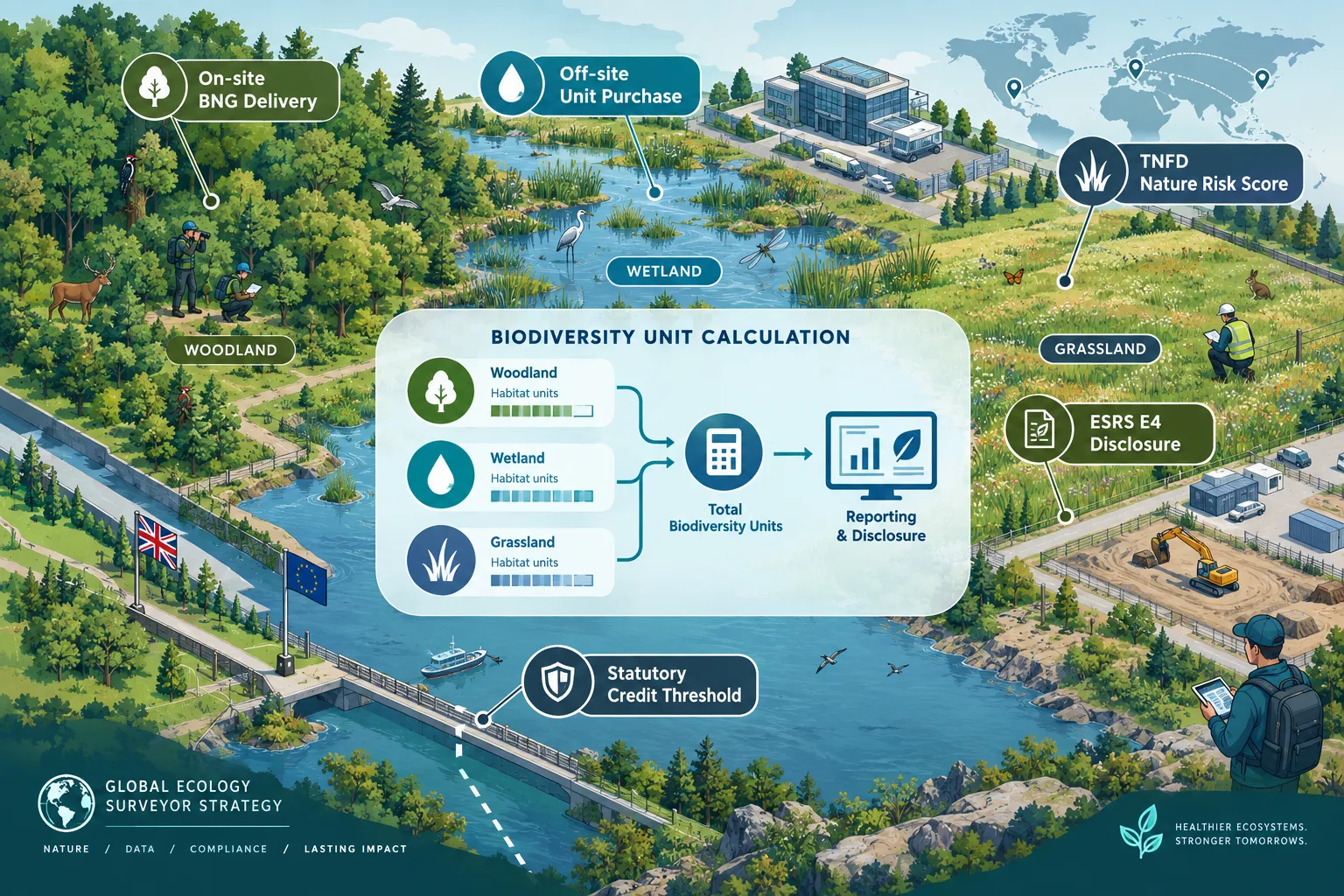
- Engage biodiversity credit and unit markets where off-site delivery is required, ensuring that biodiversity units purchased are documented in a way that satisfies both ESRS additionality requirements and ISSB materiality thresholds.
Aligning EU and ISSB Standards: The Role of TNFD as a Practical Bridge
EFRAG's 2024 draft interoperability mapping between ESRS and TNFD is one of the most practically useful documents available to global ecology surveyors [1]. It demonstrates that the TNFD's LEAP (Locate, Evaluate, Assess, Prepare) methodology generates data that satisfies large portions of ESRS E4, which in turn satisfies the anticipated ISSB nature standard requirements.
This three-way alignment, TNFD feeding ESRS feeding ISSB, means that surveyors who adopt TNFD-structured field assessments are, in effect, future-proofing their methodology against all three regulatory layers simultaneously.
Key TNFD-ESRS-ISSB alignment points for surveyors:
- Location of nature dependencies and impacts (TNFD Locate) maps directly to ESRS E4 disclosure requirements on significant sites.
- Evaluation of nature-related risks (TNFD Evaluate) provides the dependency and impact analysis required under both ESRS and anticipated ISSB nature standards.
- Assessment of material risks and opportunities (TNFD Assess) generates the financial materiality data that ESRS requires in quantitative form and ISSB requires at minimum in qualitative form [10][11].
- Preparation of disclosures (TNFD Prepare) produces a report structure that can be reformatted for both ESRS and ISSB outputs.
For developers seeking to understand how biodiversity obligations interact with project planning, the guide on how to create a biodiversity plan for developers building projects in England provides a useful operational framework that can be extended to incorporate TNFD-ESRS-ISSB alignment.
Conclusion
The convergence of EU and ISSB standards is not a future event, it is the operational reality facing global ecology surveyors in 2026. The institutional commitments made by EFRAG and the IFRS Foundation [4][9], the ISSB's active biodiversity research programme [2][4], and the ESRS amendments submitted in December 2025 [11][14] collectively signal that nature-related disclosures will soon carry the same cross-border weight as climate disclosures already do.
Actionable next steps for ecology surveyors and their clients:
- Audit current field survey protocols against ESRS E4 requirements and TNFD LEAP methodology to identify data gaps before the next project cycle.
- Establish a dual-output reporting template that produces both an ESRS-compliant disclosure and an ISSB-aligned summary from a single ecological data set, using the interoperability guidance as a reference [4][9].
- Invest in financial materiality translation skills, the ability to express biodiversity impacts in monetary terms is now a core competency, not an optional extra, for surveyors advising CSRD-regulated clients.
- Monitor ISSB's biodiversity standard development closely; when formal requirements are published, surveyors who have already aligned their protocols with TNFD and ESRS E4 will be best placed to adapt quickly.
- Engage proactively with clients on off-site delivery options, ensuring that biodiversity net gain strategies are structured to satisfy both the ecological outcome requirements and the disclosure obligations of whichever reporting regime applies.
The surveyors who treat aligning EU and ISSB Standards: 2026 Biodiversity Net Gain Strategies for Global Ecology Surveyors as a core professional competency, rather than a compliance afterthought, will be the ones best positioned to serve multinational clients as nature reporting becomes as mandatory and as scrutinised as financial reporting itself.
References
[1] 08 02%20draft%20esrs Tnfd%20interoperability%20mapping%20part%201%20srb%20meeting%2024%20january%202024 – efrag.org
[2] Isrb 2024 06 Final – bdo.global
[3] Eu Sustainability Reporting Unpacked 5134689 – jdsupra.com
[4] Ap2a Interoperability – ifrs.org
[6] Corporate Sustainability Reporting En – finance.ec.europa.eu
[7] Esg Regulatory Tracker December 2025 – spglobal.com
[8] Navigating The Sustainability Reporting Landscape – sustainabilityeconomics.net
[9] 66bf6a1bac59f En – europeanissuers.eu
[10] Eu Sustainability Reporting Less Is More – traverssmith.com