

Ninety-seven more days. That is roughly how long developers of Nationally Significant Infrastructure Projects (NSIPs) now have before Biodiversity Net Gain becomes a legal requirement on their schemes. What was meant to arrive in May 2026 has been pushed to 2 November 2026, and the Biodiversity Net Gain changes September 2026 NSIP extension planning update is reshaping how promoters, ecologists and land agents sequence their work for the rest of the year. Far from a minor administrative tweak, this shift touches metric calculations, temporary habitat rules, market supply and the entire pre-application timeline for major infrastructure.
This article breaks down what changed, why Defra delayed the NSIP start date, and what developers, ecologists and land agents should be doing right now.
Key Takeaways
- BNG becomes mandatory for all new NSIP Development Consent Order applications submitted on or after 2 November 2026, requiring a minimum 10% biodiversity uplift.[3][4]
- Defra has confirmed BNG policy itself will not be strengthened or weakened; changes are targeted fixes for early implementation friction.[1][8]
- A 0.2-hectare area-based exemption for minor development took effect from 6 August 2026, alongside disapplication of the biodiversity gain hierarchy for small sites.[8][9]
- The small-scale self-build and custom-build exemption has been removed, bringing more minor schemes into scope.[8][9]
- The BNG habitat market has scaled sharply: 197 registered sites covering roughly 7,000 hectares and 28,000 habitat units, up from just 46 sites a year earlier.[9]
Why the NSIP Start Date Moved to November 2026
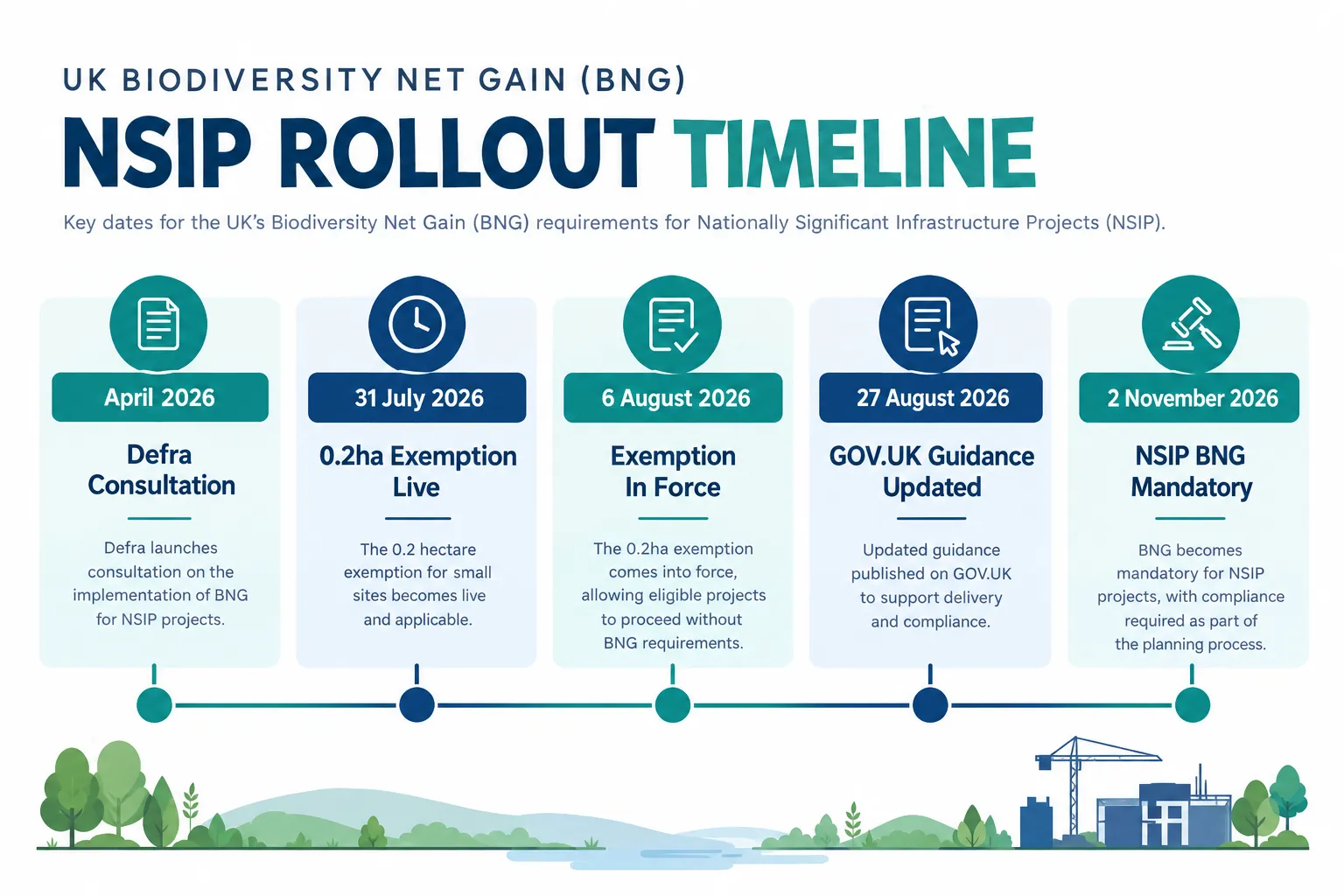
Defra's April 2026 consultation on BNG for major infrastructure signalled that industry needed more runway before mandatory compliance began.[8] Following that consultation and the government's subsequent guidance updates through summer 2026, ministers confirmed a six-month extension, moving the NSIP start date from May to 2 November 2026.[2][6][11][13] Legal commentators describe this window as a critical opportunity for promoters to align schemes already in the pipeline and front-load ecological surveys before the duty becomes binding.[3][6]
Crucially, the duty attaches to the date of application submission, not the date construction begins. NSIP applications submitted before 2 November 2026 fall outside the new regime entirely, while anything submitted on or after that date must demonstrate a minimum 10% net gain against a formal biodiversity gain statement.[3][4]
What Counts as an NSIP Under the New Regime
GOV.UK guidance, last refreshed in late August 2026, clarifies the geographic and legal boundaries of the NSIP BNG duty:
- BNG applies to NSIP components down to the mean low-water mark, including intertidal zones, but stops short of the offshore marine environment.[4][13]
- Schemes consented through Hybrid Bills are excluded.[4][13]
- The regime is England-only; cross-border and offshore elements of a project will need separate strategies since BNG obligations end at the English NSIP boundary.[1][7][12]
- Sector-specific biodiversity gain statements, such as those for energy NSIPs published in June 2026, take effect as though embedded within relevant National Policy Statements like EN-1 from 2 November 2026.[10][14]
For developers running multi-jurisdictional or coastal projects, this boundary detail matters as much as the headline date. Understanding exactly what is in a Biodiversity Net Gain assessment early is now essential groundwork for any DCO submission strategy.
Defra's Position: Refinement, Not Reform
A recurring theme in the Biodiversity Net Gain changes September 2026 NSIP extension planning debate is Defra's insistence that core BNG policy is not being weakened or strengthened. Instead, the department has focused on resolving practical friction points that emerged during the first eighteen months of mandatory BNG for town and country planning schemes.[1][8]
That means the 10% minimum gain requirement remains untouched. What has shifted is the machinery around it: exemptions, hierarchy rules and technical metric treatment for specific development types. Defra's own environment blog frames these as targeted fixes rather than policy reversals, aimed squarely at reducing avoidable delay for smaller developments while NSIP promoters prepare for their own November deadline.[1]
The New 0.2ha Exemption and Hierarchy Changes
From 6 August 2026, developments affecting less than 0.2 hectares of onsite habitat qualify for an area-based exemption, unless priority habitats are present.[8][12][15] This sits alongside two further changes for minor development:
- Disapplication of the biodiversity gain hierarchy for minor schemes, meaning offsite gains now sit on equal footing with onsite delivery rather than being a fallback option.[9]
- Removal of the small-scale self-build and custom-build exemption, which previously let individual plot developers avoid BNG obligations altogether.[8][9]
The net effect pulls more small sites into the system while giving those developers greater flexibility over where gains are delivered. Land agents advising SME clients should revisit assumptions built into earlier feasibility studies, particularly around buying biodiversity units as an offsite compliance route now that the hierarchy no longer forces onsite-first thinking for minor development.
A Front-Loaded NSIP Regime: What Developers Must Do Now
One of the most consequential technical changes for NSIPs is the extended temporary-loss rule. Habitats of low or very low distinctiveness that are temporarily disturbed and then restored to their prior type and condition can be treated as retained if restoration happens within five years, compared with the two-year window used under the standard Town and Country Planning Act regime.[2][8][9] This matters enormously for long-duration construction compounds, lay-down areas and temporary diversions common on major infrastructure schemes.
Gains must also be secured and maintained for a minimum of 30 years, with explicit encouragement for promoters to exceed that where feasible through mechanisms such as conservation covenants or binding DCO requirements.[4][12][14]
Practically, this pushes ecological work earlier into the project lifecycle. Recommended actions from legal and ecological advisors include:
- Running early biodiversity metric assessments at route-selection stage.
- Distinguishing onsite versus offsite habitat options before design freezes.
- Securing habitat bank capacity ahead of the November 2026 surge in demand.
- Building 30-year (or longer) management costs into business cases now.
These steps mirror advice already circulating for standard planning applications, covered in 8 Biodiversity Net Gain points on planning your project and how to achieve 10% Biodiversity Net Gain.
Market Growth: A Rapidly Maturing Habitat Bank Sector
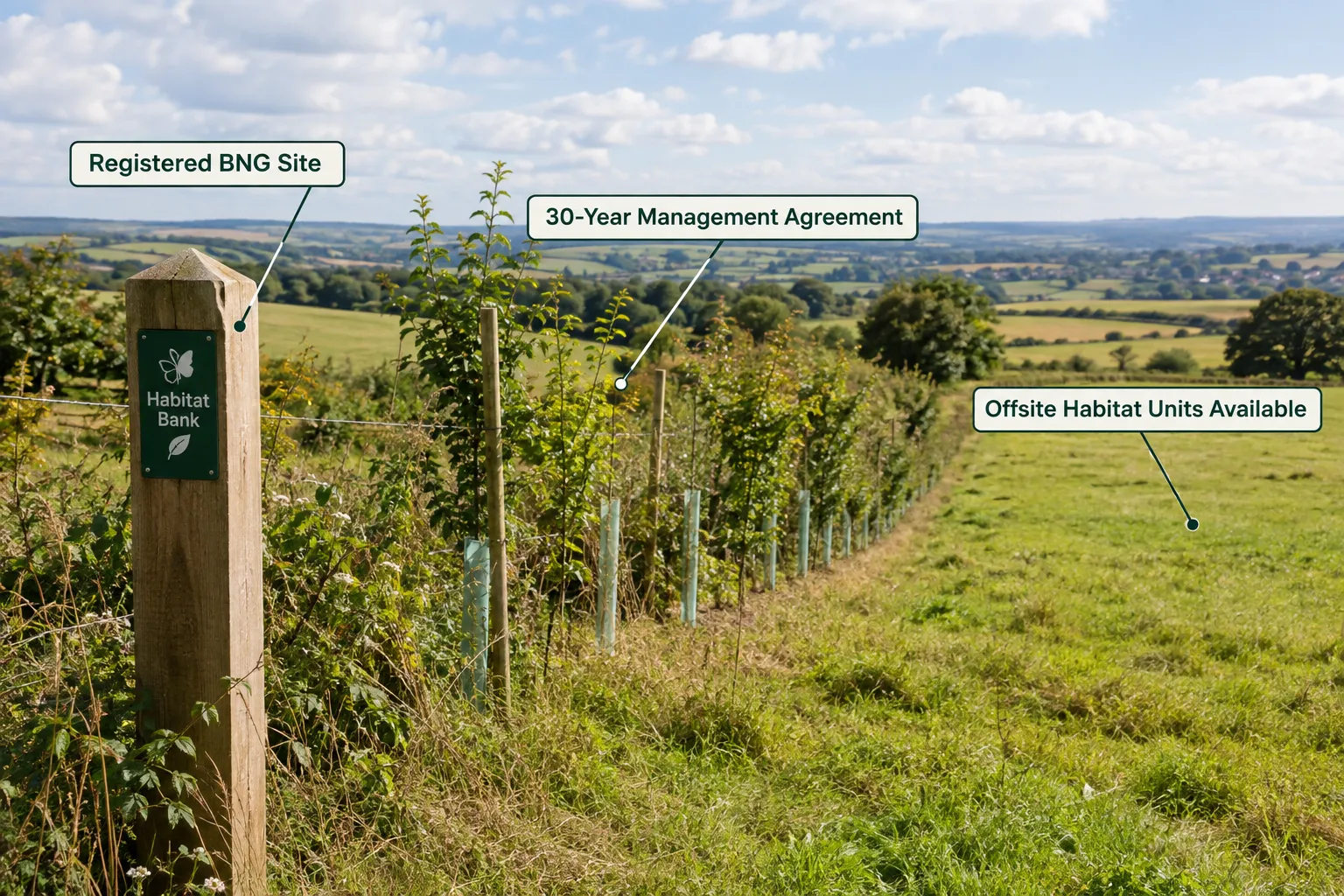
The scale of market expansion underpinning these changes is striking. The number of registered BNG sites has grown from 46 a year ago to 197 sites, covering approximately 7,000 hectares and offering around 28,000 habitat units.[9] This growth gives NSIP promoters far more supply-side options as they race to secure units before November 2026, and it strengthens the case for treating offsite biodiversity net gain delivery as a mainstream, not niche, compliance route.
For ecologists and land agents, this expansion also means more competition among habitat bank operators and growing sophistication in the cost of biodiversity units and statutory credits. Early engagement with reputable, registered sites is increasingly a commercial advantage rather than just a compliance checkbox.
Implications by Role
| Role | Key Implication |
|---|---|
| Developers (NSIP) | Must finalise biodiversity gain statements and metric evidence before 2 November 2026 submissions |
| Developers (minor/SME) | New 0.2ha exemption and equal offsite/onsite footing reduce barriers, but self-build exemption loss adds obligations |
| Ecologists | Longer 5-year temporary-loss window for NSIPs changes metric modelling for compounds and lay-down areas |
| Land agents | Growing habitat bank supply (197 sites) creates new brokerage and unit-sales opportunities |
FAQ
When exactly does BNG become mandatory for NSIPs?
From 2 November 2026, for DCO applications submitted on or after that date.[3][4]
Has the 10% net gain requirement changed?
No. Defra has confirmed the statutory minimum remains 10%, with changes focused on implementation mechanics, not the core target.[1][8]
Does the 0.2ha exemption apply to NSIPs?
No. It applies to minor Town and Country Planning developments, not major infrastructure schemes.[5][8]
What happened to the self-build exemption?
It has been removed, meaning small-scale self-build and custom-build projects can no longer automatically bypass BNG requirements.[8][9]
How long must NSIP biodiversity gains be maintained?
A minimum of 30 years, with encouragement to exceed this where practical.[4][12]
Conclusion
The Biodiversity Net Gain changes September 2026 NSIP extension planning story is one of calibration rather than upheaval. Defra has held the line on the 10% gain requirement while buying the infrastructure sector six extra months, tightening exemptions for minor development, and letting the habitat bank market mature into a genuinely competitive supply base. Developers with NSIP applications approaching the pipeline should treat the coming weeks as the final window to secure units and finalise metrics. Ecologists should revisit temporary-loss modelling now, and land agents should map habitat bank capacity before autumn demand accelerates. Review what a Biodiversity Net Gain report needs to contain and speak with an accredited ecologist before the 2 November deadline arrives.
References
[1] Biodiversity Net Gain For Major Infrastructure Projects New Guidance – defraenvironment.blog.gov.uk
[2] Bng For Nsips Guide – integratedlm.co.uk
[3] Biodiversity Net Gain Requirements Extended Nov 2026 – pinsentmasons.com
[4] Biodiversity Net Gain Nationally Significant Infrastructure Projects – gov.uk
[5] Biodiversity Net Gain Changes September 2026 Nsip Rollout What Developers And Ecologists Need To Know Now – Biodiversity net gain changes september 2026 nsip rollout what developers and ecologists need to know now
[6] Bng For Major Infrastructure Projects – gowlingwlg.com
[7] Biodiversity Net Gain Guidance For Developers Land Managers And Authorities – gov.uk
[8] Biodiversity Net Gain Whats Changing And What It Means For You – defraenvironment.blog.gov.uk
[9] Bng Changes 2026 Exemptions Metric Updates – landbng.uk
[10] New Environmental Delivery Guidance What Developers Need To Know About Bng For N – irwinmitchell.com
biodiversity net gain, BNG NSIP, Nationally Significant Infrastructure Projects, Defra guidance, habitat units, offsite biodiversity gains, UK planning policy, environmental surveyors, habitat banks, biodiversity metric, planning consultants, DCO applications