Biodiversity Net Gain Explained
Image: surveyor holding paper and looking over river. The Government’s 25-year Environment Plan has, as one of its objectives, “to leave the environment in a better state than we found

Image: surveyor holding paper and looking over river. The Government’s 25-year Environment Plan has, as one of its objectives, “to leave the environment in a better state than we found

Image: drone hovering over river in field. The Environment Act’s biodiversity net gain (BNG) legislation has a 2-year phasing-in period, which ends in November 2023. That means developers must ensure

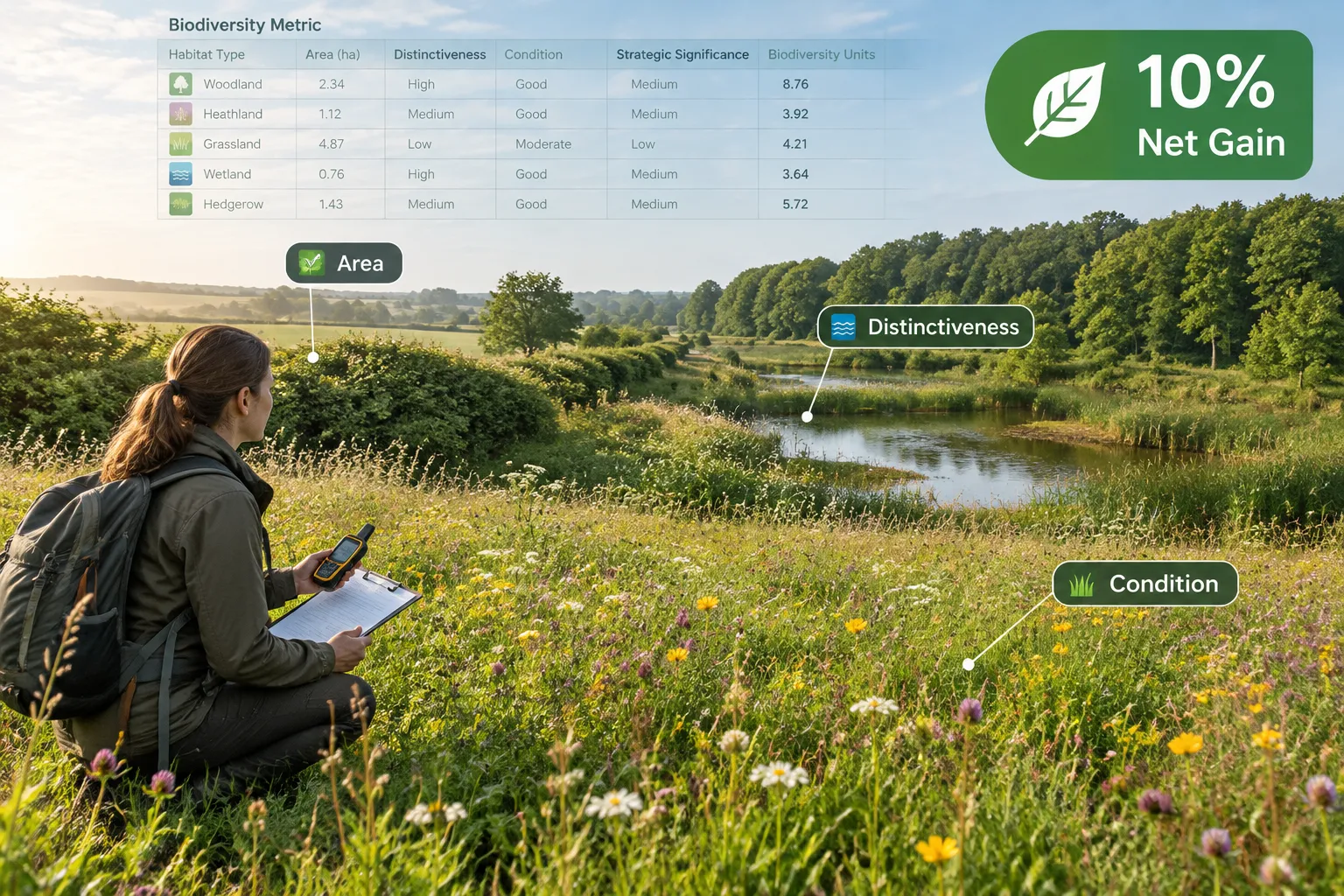
About Biodiversity Net Gain BNG is a concept that could dramatically change the environmental planning scene. It now obligates all developers to ensure that their projects do not diminish the
Last updated: August 28, 2026 Quick Answer: From 6 August 2026, planning applications for development sites with a red-line boundary of 0.2 hectares or less are exempt from mandatory Biodiversity Net Gain requirements in England, provided the site does not contain or negatively affect onsite priority habitat. This exemption, introduced…
Last updated: August 27, 2026 Quick Answer: From 6 August 2026, planning applications for developments on sites of 0.2 hectares or less are exempt from mandatory Biodiversity Net Gain (BNG) requirements in England, provided no on-site priority habitat is affected. This exemption applies only to applications submitted on or after…
Last updated: August 27, 2026 Quick Answer: Three weeks after the 6 August 2026 BNG reforms came into force, UK developers are operating under a materially different biodiversity net gain regime. The 0.2 ha small-site exemption has removed a large share of minor residential applications from mandatory BNG, the self/custom-build…
Last updated: August 27, 2026 Quick Answer: From 6 August 2026, wholly temporary developments granted planning permission for five years or less, with a legal obligation to reinstate the land within that period and no impact on onsite priority habitat, are exempt from mandatory Biodiversity Net Gain requirements. This Biodiversity…
Last updated: August 27, 2026 Quick Answer: From 2 November 2026, biodiversity net gain (BNG) becomes a legal requirement for all Nationally Significant Infrastructure Projects (NSIPs) in England. Any Development Consent Order (DCO) application submitted on or after that date must demonstrate at least 10% biodiversity net gain. Developers who…
Last updated: August 27, 2026 Quick Answer: From 2 November 2026, all Nationally Significant Infrastructure Projects (NSIPs) in England that receive a Development Consent Order (DCO) must deliver a mandatory 10% biodiversity net gain, maintained for at least 30 years. This NSIP Biodiversity Net Gain November 2026 mandatory deadline for…
Published: 27 August 2026 Fewer than ten weeks remain before mandatory Biodiversity Net Gain lands on the UK's largest and most complex infrastructure schemes. As of 27 August 2026, the 2 November 2026 commencement date for BNG Nationally Significant Infrastructure Projects is confirmed in law, and NSIP developers who have…
Fewer than 90 days remain before the most significant expansion of mandatory biodiversity net gain in England takes effect. From 2 November 2026, every Nationally Significant Infrastructure Project submitted under the Development Consent Order regime must demonstrate a minimum 10% biodiversity net gain, with no exemptions, no opt-outs, and a…
Last updated: August 27, 2026 Quick Answer: From 2 November 2026, all Nationally Significant Infrastructure Projects (NSIPs) submitted under the Development Consent Order regime must demonstrate a mandatory 10% biodiversity net gain. The BNG NSIPs November 2026 mandatory deadline applies to any DCO application accepted by the Planning Inspectorate on…
Last updated: August 27, 2026 Quick Answer: From 6 August 2026, a new 0.2-hectare small sites exemption means that many urban brownfield and infill developments no longer need to demonstrate biodiversity net gain. The BNG August 2026 urban brownfield developer impact small sites exemption also removes the on-site delivery hierarchy…
Last updated: August 27, 2026 Quick Answer: From 2 November 2026, biodiversity net gain becomes mandatory for Nationally Significant Infrastructure Projects in England. Any DCO application submitted to the Planning Inspectorate on or after that date must demonstrate a minimum 10% BNG uplift. With approximately 10 weeks remaining as of…
Last updated: August 27, 2026 Quick Answer: Three weeks after the 6 August 2026 Biodiversity Net Gain reforms, the most significant change for small developers is the new 0.2 hectare area-based exemption: applications for sites under 0.2 ha with no priority habitat, submitted on or after 6 August 2026, are…
Last updated: August 26, 2026 Quick Answer: On 6 August 2026, Statutory Instruments amending the Biodiversity Gain Requirements came into force in England, introducing a new de minimis exemption for small sites, a temporary development exemption, and greater flexibility for minor development applications. Critically, the self-build and custom-build housing exemption…
Last updated: August 26, 2026 Quick Answer From 6 August 2026, a new 0.2 hectare area-based exemption is live in England, meaning most planning applications for sites with a red-line boundary of 0.2 hectares or less are exempt from mandatory Biodiversity Net Gain requirements, provided no on-site priority habitat is…
Last updated: August 26, 2026 Quick Answer: Mandatory Biodiversity Net Gain (BNG) for Nationally Significant Infrastructure Projects applies to all DCO applications submitted on or after 2 November 2026. Every NSIP, transport, energy, water, and waste, must demonstrate a minimum 10% net gain against its pre-development biodiversity baseline, with no…
Last updated: August 26, 2026 Quick Answer: On 6 August 2026, the government amended England's Biodiversity Net Gain (BNG) regulations, replacing the previous 25 m² de minimis threshold with a new 0.2 hectare (2,000 m²) small site exemption. Developments with a footprint at or below this threshold are now exempt…
As of 6 August 2026, a single regulatory amendment has quietly removed one of the most frustrating bottlenecks in small-scale planning: the obligation on minor development applicants to prove that on-site biodiversity delivery was impossible before turning to off-site options. The BNG minor development flexibility off-site equal on-site August 2026…
Fewer than ten weeks remain before the most significant expansion of mandatory biodiversity net gain in England takes effect. On 2 November 2026, Biodiversity Net Gain (BNG) becomes a legal requirement for Nationally Significant Infrastructure Projects (NSIPs), the power stations, motorways, reservoirs, and offshore wind farms that shape the country's…
On 6 August 2026, four targeted amendments to England's Biodiversity Net Gain framework came into force, and three weeks on, the implications are already reshaping how developers, planners, and ecologists approach live applications. Understanding the Biodiversity Net Gain changes 6 August 2026 what UK developers need to know is no…
Last updated: August 26, 2026 By Biodiversity Surveyors editorial team | This article is a news update only and does not constitute legal advice. Always consult a qualified ecologist or planning solicitor for project-specific guidance. Quick Answer: Three weeks after the 6 August 2026 BNG reforms took effect, developers and…
Last updated: August 26, 2026 Quick Answer: England's private biodiversity net gain (BNG) market has reached approximately £93 million in total unit value, with 197 registered habitat bank sites now listed on Natural England's Biodiversity Gain Sites Register as of mid-August 2026. [1][6] Private unit prices run significantly below statutory…
Last updated: August 26, 2026 Quick Answer: The BNG for Nationally Significant Infrastructure Projects November 2026 mandate requires all DCO applications submitted on or after 2 November 2026 to demonstrate a minimum 10% biodiversity net gain using the statutory biodiversity metric. This applies across energy, transport, water, and waste infrastructure…
Last updated: August 26, 2026 Quick Answer: From 6 August 2026, residential development sites under 0.2 hectares are exempt from mandatory Biodiversity Net Gain requirements in England, removing an estimated 50% of residential planning applications from BNG obligations [5][9]. Surveyors, ecologists, and small developers must immediately update their screening processes,…
Three weeks into the new regime, as of 26 August 2026, and the planning sector is still working through the implications of the most significant package of Biodiversity Net Gain amendments since the mandatory framework launched in February 2024. The BNG temporary development exemption 5 year rule August 2026 is…
Last updated: August 24, 2026 Quick Answer: On 6 August 2026, the Biodiversity Gain (Town and Country Planning) (Amendments and Transitional Provisions) (England) Regulations 2026 came into force, introducing a new 0.2-hectare site exemption, a temporary development exemption, and the removal of the self-build exemption. The core 10% net gain…
Last updated: August 24, 2026 Quick Answer: From 6 August 2026, the self-build and custom-build exemption from Biodiversity Net Gain (BNG) requirements has been formally withdrawn. Any planning application submitted on or after that date must comply with the mandatory 10% BNG requirement under the Environment Act 2021, unless the…
Last updated: August 24, 2026 Quick Answer: From 6 August 2026, planning applications in England for sites of 0.2 hectares or less that do not affect priority habitat are exempt from mandatory Biodiversity Net Gain requirements. For brownfield developers working on small schemes, this removes the obligation to commission a…
August 2026 analysis, updated to reflect the latest Defra guidance and biodiversity gain statements Only three months remain before the BNG Nationally Significant Infrastructure Projects 2 November 2026 deadline transforms how England's largest infrastructure schemes are consented. Any Development Consent Order (DCO) application submitted on or after that date must…
Last updated: August 24, 2026 Quick Answer: On 6 August 2026, four amendments to England's mandatory Biodiversity Net Gain regime came into force. The most significant is a new small-site exemption: sites of 0.2 hectares or smaller with no onsite priority habitat are no longer subject to mandatory BNG. The…
On 6 August 2026, four significant amendments to England's mandatory Biodiversity Net Gain (BNG) framework came into force, reshaping compliance obligations for thousands of planning applications. Government analysis suggests the new 0.2-hectare area exemption alone could remove approximately half of all residential planning permissions from mandatory BNG requirements, a shift…
Last updated: August 23, 2026 Quick Answer: Four targeted amendments to England's Biodiversity Net Gain framework took effect on 6 August 2026, following DEFRA's July 2026 announcement. The changes introduce a new 0.2-hectare small-site exemption, a temporary development exemption, greater flexibility in the mitigation hierarchy, and the removal of the…
Last updated: 23 August 2026 Quick Answer: From 2 November 2026, Biodiversity Net Gain becomes mandatory for Nationally Significant Infrastructure Projects in England. NSIP developers and DCO applicants have approximately ten weeks from today to complete baseline surveys, run Metric 4 assessments, draft biodiversity gain plans, and lock in off-site…
Last updated: August 23, 2026 Quick Answer: From 2 November 2026, mandatory Biodiversity Net Gain applies to Nationally Significant Infrastructure Projects in England under secondary legislation made under the Environment Act 2021. Any NSIP application submitted on or after that date must demonstrate a minimum 10% biodiversity net gain as…
Last updated: August 23, 2026 Quick Answer: From 2 November 2026, all Nationally Significant Infrastructure Project (NSIP) Development Consent Order applications submitted in England on or after that date must demonstrate a minimum 10% biodiversity net gain. Projects with DCO applications accepted before 2 November 2026 are exempt. With roughly…
Last updated: August 23, 2026 Quick Answer: The Bank of England's Monetary Policy Committee next meets on 17 September 2026, with consensus pointing to another hold at 3.75% following July's 6-3 vote. For small and mid-size UK property developers managing Biodiversity Net Gain obligations under the August 2026 SI 2026…
Last updated: August 22, 2026 Quick Answer: Rightmove's August 2026 House Price Index shows the average UK asking price fell 2.0% month-on-month to £364,999, the largest August decline since 2018. London led the fall with a 4.4% monthly drop. Rising mortgage rates, record-high supply, and geopolitical uncertainty are all pressing…
Last updated: August 22, 2026 Quick Answer: Six weeks after the 31 July 2026 small-site exemption took effect, and just over two weeks since the broader 6 August 2026 BNG amendments came into force, early signals suggest the 0.2-hectare threshold is reshaping how small housebuilders approach planning, but it is…
Last updated: August 22, 2026 Quick Answer: Mandatory Biodiversity Net Gain for Nationally Significant Infrastructure Projects goes live on 2 November 2026. Every NSIP application accepted on or after that date must demonstrate a minimum 10% biodiversity net gain via a biodiversity gain statement. With exactly 10 weeks remaining as…
Last updated: August 22, 2026 Quick Answer: As of August 2026, private off-site BNG units for medium-distinctiveness habitats typically trade between £20,000 and £35,000 per unit, while high-distinctiveness habitats reach £40,000,£90,000+ and priority river habitats can exceed £200,000 per unit. Government statutory credits start at around £42,000 and rise to…
Last updated: August 22, 2026 Quick Answer: As of 22 August 2026, the BNG small site exemption two weeks later is showing real traction for qualifying minor schemes, but early feedback from developers, planners and ecologists points to a learning curve around the 0.2-hectare threshold, priority habitat checks, and what…
Last updated: August 22, 2026 Quick Answer: The DEFRA BNG Statutory Credits Report 2025-2026 UK developers August 2026 reveals that total statutory credit payments reached approximately £426,100 for the year ending 31 March 2026, with Natural England administrative costs of £76,306. From 6 August 2026, significant regulatory changes reshape who…
Last updated: August 22, 2026 Quick Answer: From 2 November 2026, Biodiversity Net Gain becomes mandatory for all Nationally Significant Infrastructure Projects (NSIPs) in England, requiring a minimum 10% net gain on any DCO application submitted on or after that date. With the BNG NSIP November 2026 deadline habitat bank…
Last updated: August 22, 2026 Quick Answer: Two weeks after the 6 August 2026 BNG reforms, off-site habitat bank units remain significantly cheaper than statutory credits for most habitat types. Medium-distinctiveness units trade at roughly £20,000,£35,000 per unit, while statutory credits start at £42,000. The removal of the self-build exemption…
Last updated: August 22, 2026 Quick Answer: From 6 August 2026, planning applications for non-major developments where the entire site area within the red-line boundary is 0.2 hectares or less are exempt from mandatory biodiversity net gain requirements, provided the site contains no on-site priority habitat. This is the core…
Last updated: August 22, 2026 Quick Answer: As of 22 August 2026, UK SME developers face a double squeeze: Rightmove reports the largest August asking-price drop since 2018 (average now £364,999, down roughly 2% month-on-month), while statutory biodiversity net gain (BNG) credits carry a hard floor of £42,000 per credit,…
Last updated: August 21, 2026 Quick Answer: Off-site BNG habitat bank unit prices in August 2026 range from approximately £8,000 to £65,000+ per unit for most terrestrial habitats, with priority river units reaching £140,000,£200,000+ per unit. The August 6 regulatory changes, particularly the removal of the self-build exemption and the…
Last updated: August 21, 2026 Quick Answer: The 2 November 2026 deadline makes Biodiversity Net Gain mandatory for all Nationally Significant Infrastructure Project DCO applications. With only 197 registered biodiversity gain sites and roughly 28,000 biodiversity units currently on Natural England's register, NSIP-scale demand is expected to absorb a significant…
Last updated: August 21, 2026 Quick Answer: From 2 November 2026, all onshore Nationally Significant Infrastructure Projects (NSIPs) in England must demonstrate a minimum 10% biodiversity net gain as a condition of their Development Consent Order (DCO). The trigger is the date a DCO application is submitted, not when consent…
Last updated: August 21, 2026 Quick Answer: From 2 November 2026, every Nationally Significant Infrastructure Project (NSIP) application for development consent submitted in England must demonstrate at least 10% biodiversity net gain. With just ten weeks remaining, NSIP promoters who have not yet commissioned baseline surveys, metric calculations, or a…
Last updated: August 21, 2026 Quick Answer: Asking prices for newly listed homes fell 2.0% in August 2026 to £364,999, the largest August drop in eight years, squeezing margins for small developers at the exact moment new BNG rules took effect on 6 August 2026. Under SI 2026 No. 790,…