
What is in a Biodiversity Net Gain Assessment?
Image: photograph of biodiversity surveyor. Biodiversity Net Gain Survey Introduction Biodiversity Net Gain (BNG) is a legal necessity in today’s planning world and it became a part of planning law


Image: photograph of biodiversity surveyor. Biodiversity Net Gain Survey Introduction Biodiversity Net Gain (BNG) is a legal necessity in today’s planning world and it became a part of planning law

Image: surveyor sitting and making notes on notepad. 1. DEFRA’s commitment to the natural environment DEFRA says it continues to prioritize on-site delivery and, in so doing, misses an opportunity

Biodiversity Net Gain is a phrase we are likely to hear with increasing frequency due to its introduction as a requirement in the 2021 Environment Act. Now, all new development

Image: female surveyor writing on notepad in field The biodiversity net gain (BNG) policy, which was created under the Environment Act of 2021, has been implemented. Biodiversity net gain (BNG)
A wetland designed to sell biodiversity units was refused planning permission because the council could not tell whether it would work as a biodiversity gain site. The HMMP was missing. On 24 November 2026 a planning inspector allowed the appeal, but refused the appellant's claim for costs on the same…
The applicant's ecologists said the scheme would deliver a gain of about 33% in habitat units. The council's own ecology consultant called that figure "counterintuitive" and showed that, on other data, the same scheme could produce a net loss of about 21.65%. The planning committee was told about the first…
The design was acceptable. The location was acceptable. The protected species surveys raised no objection. A fallback under permitted development rights was given substantial weight. The appeal was still dismissed, and the only reason was biodiversity net gain. Appeal decision 6010511, issued on 25 November 2026, is one of the…
Seven houses, sixteen appendices and one biodiversity metric that the appellant itself agreed was wrong. On 25 November 2026 a planning Inspector dismissed appeal 6014850 for the redevelopment of Gorse Farm, Lazy Hill Road, Aldridge, in Walsall [1]. Green Belt harm was the heaviest factor. But the decision also contains…
{"content":[]} Twenty-five square metres is roughly the footprint of two parked cars. It is also the line between a development that escapes the statutory biodiversity gain condition and one that does not. In appeal decision 6006756, issued on 14 October 2026, a planning inspector allowed an appeal for a stable…
The habitat survey covered the wrong area. That single mismatch, between the land an ecologist walked and the red line on the planning application, was enough for North Yorkshire Council to refuse a small equestrian scheme at Moor Farm, Kelfield, near Selby. On 4 November 2026 a Planning Inspector allowed…
An unfinished building that is not airtight or watertight, with mature trees and a hedge close by, is exactly where a bat might roost. A two-home scheme in Slough proposed to demolish one without any bat survey. The Planning Inspector dismissed the appeal. In the same decision, the council's attack…
A council refused even to register a planning application until it received updated bat surveys and a preliminary ecological appraisal. On 20 November 2026 a Planning Inspector decided the application had been valid all along, and granted outline permission. The Croydon decision, appeal reference 6011675, is a rare ruling on…
A planning inspector has removed two ecology conditions from a retrospective permission for a farm building near Wakefield, finding that the statutory biodiversity gain requirement was never brought into force for development authorised after the event. The decision, dated 19 November 2026, has already been widely discussed among planners and…
An eight-home scheme in Surrey cleared the Green Belt hurdle, had no fatal problem with Biodiversity Net Gain, and was proposed in a district with a housing shortfall. It was still refused. On 12 November 2026 a planning inspector dismissed appeal 6010654 at Rook Lane, Chaldon, because of two ecology…
An outline scheme for nine self-build homes on the edge of a Wiltshire village has been refused on appeal, even though the council could show only 2.8 years of housing land supply. Planning Inspectorate appeal 6013972, concerning land east of Yarnbrook Road, West Ashton, was dismissed on 18 November 2026.…
{"content":[]} Two documents from the same applicant disagreed about whether trees on a site could hold roosting bats, and a signed legal undertaking could not make up for great crested newt evidence that was never gathered. That is the short story of the latest great crested newt survey appeal lesson…
The planting was acceptable. The lowered bunds were acceptable. The biodiversity metric showed a 12% uplift and the inspector was satisfied with it. The appeal was still dismissed. On 17 November 2026 a planning inspector refused to approve a landscape and biodiversity enhancement scheme for a storage site at Lostock…
Two claimed exemptions, and neither survived. On 16 November 2026 a planning Inspector dismissed a self-build BNG exemption appeal for a replacement house at 132 Carr Road, Walkley, Sheffield (appeal reference 6013010) [1][2]. The appellant said biodiversity net gain did not apply because the site was under 0.2 hectares and…
A levy of £2,675 per new home could unlock up to 15,780 houses in Norfolk [1]. That is the headline of England's first draft Environmental Delivery Plan. The smaller print matters just as much. The plan deals with one thing only, nutrient pollution, so Norfolk Environmental Delivery Plan ecology surveys,…
A 30.04 per cent biodiversity gain on paper could not be secured in Harrow, yet the appellant still won and the council was ordered to pay its full costs. Appeal 6004526, decided on 30 September 2026, shows how biodiversity net gain private gardens small sites metric questions are now decided…
The appellant's own ecological appraisal said the ponds needed testing. The council's ecologist said the same. The great crested newt eDNA survey was still never done, and on 12 November 2026 a Planning Inspector dismissed an appeal for up to five homes in rural Essex, refusing to let the missing…
{"content":[]} More than 10,000 hectares of off-site habitat now sit on England's national biodiversity gain sites register. That is the headline number in Defra's post-legislative scrutiny memorandum on the Environment Act 2021, published on 3 November 2026 [1]. Yet the same document admits that "the evidence base is not yet…
Two semi-detached homes on previously developed land, in a borough without a five-year housing land supply, should have been a strong appeal. It was dismissed anyway. On 11 November 2026, Inspector K Craddock refused appeal 6011672 at Moorbeck, Butt Lane Close, Hinckley, because the statutory biodiversity metric was unreadable and…
A development site that straddles two river catchments can now source off-site watercourse units in either of them without a spatial penalty. That is the practical effect of version 1.1.0 of the statutory biodiversity metric 1.1.0 calculation tool, which Defra released on 3 November 2026 alongside a revised user guide…
{"content":[]} England's off-site Biodiversity Net Gain (BNG) market is now estimated at £143 million, up from £93 million in July 2026, according to the November 2026 report from broker Biodiversity Units UK, reported by The Dirt on 10 November 2026 [1]. The figure landed eight days after the 10% net…
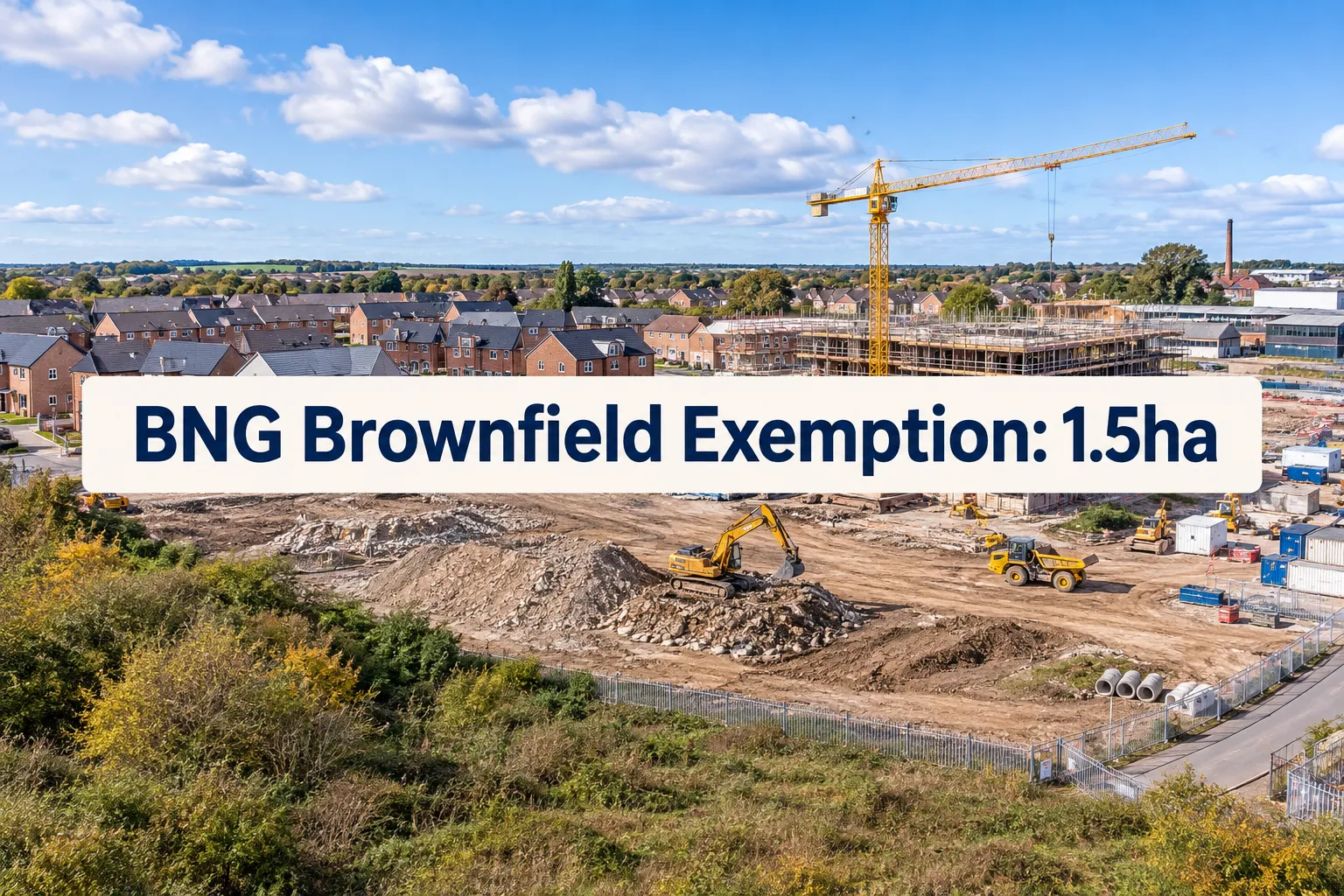
The Autumn Budget of 28 October 2026 confirmed that residential developments on brownfield sites of up to 1.5 hectares in England will be exempt from mandatory biodiversity net gain [1][2]. Planning Resource described it as a 650 per cent increase in the maximum size of brownfield site that can escape…
{"content":[]} Government-imposed costs make up 57% of the minimum viable selling price of a typical inner London new-build flat, according to a Centre for Policy Studies (CPS) report covered by Property Industry Eye on 10 November 2026 [1]. The report names Biodiversity Net Gain (BNG) as one of the costs…
{"content":[]} More than 10,000 hectares of created or enhanced habitat now sit on England's national biodiversity gain register. That figure comes from a new Defra review of the Environment Act 2021, published on 3 November 2026 [1]. In the same week, mandatory biodiversity net gain (BNG) started to apply to…
Last updated: November 10, 2026 Five years after the Environment Act 2021 received Royal Assent, Defra has published its verdict on mandatory biodiversity net gain, and the headline is a cautious "broadly successful." But bury yourself in the detail of the 3 November 2026 memorandum and a messier picture emerges:…
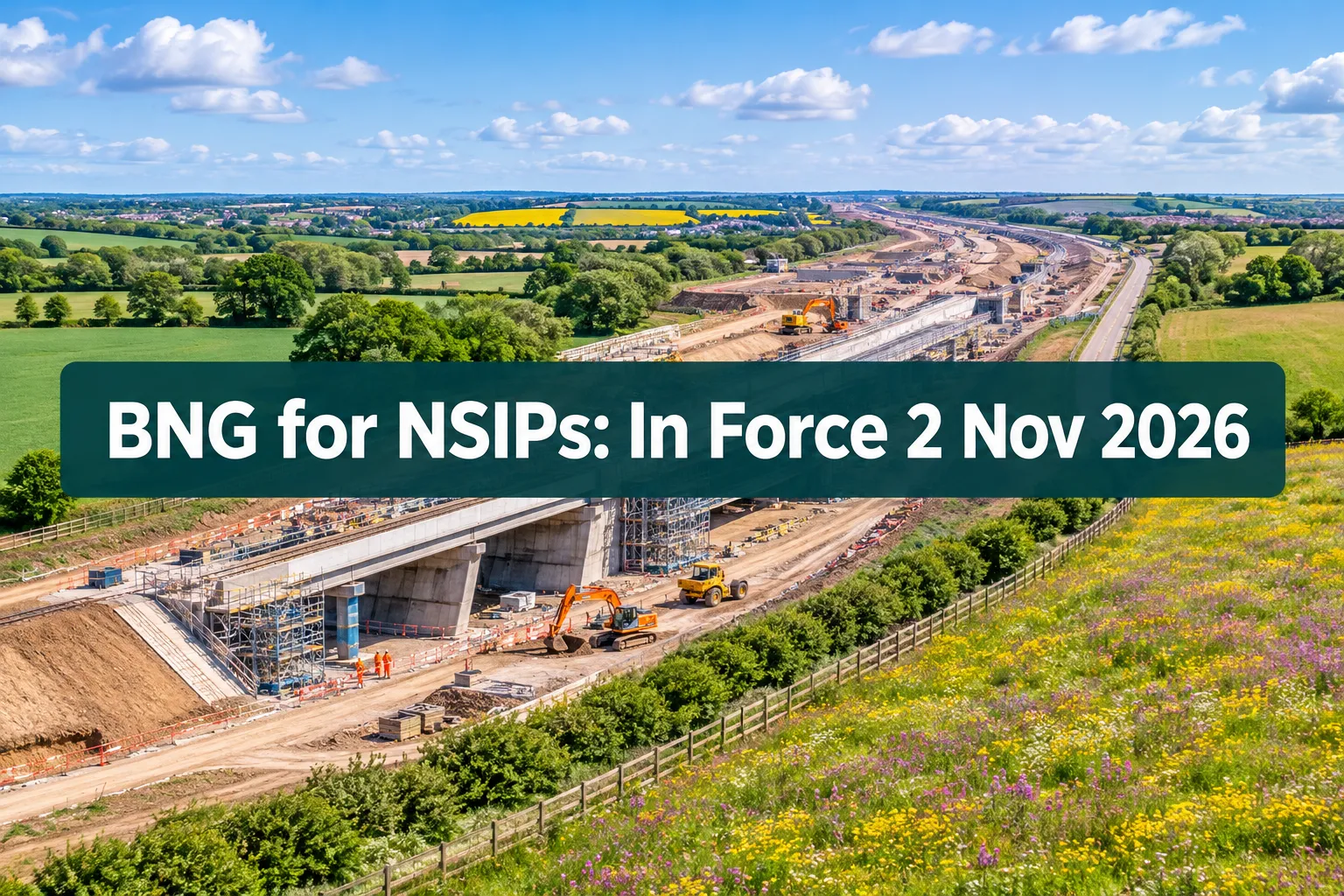
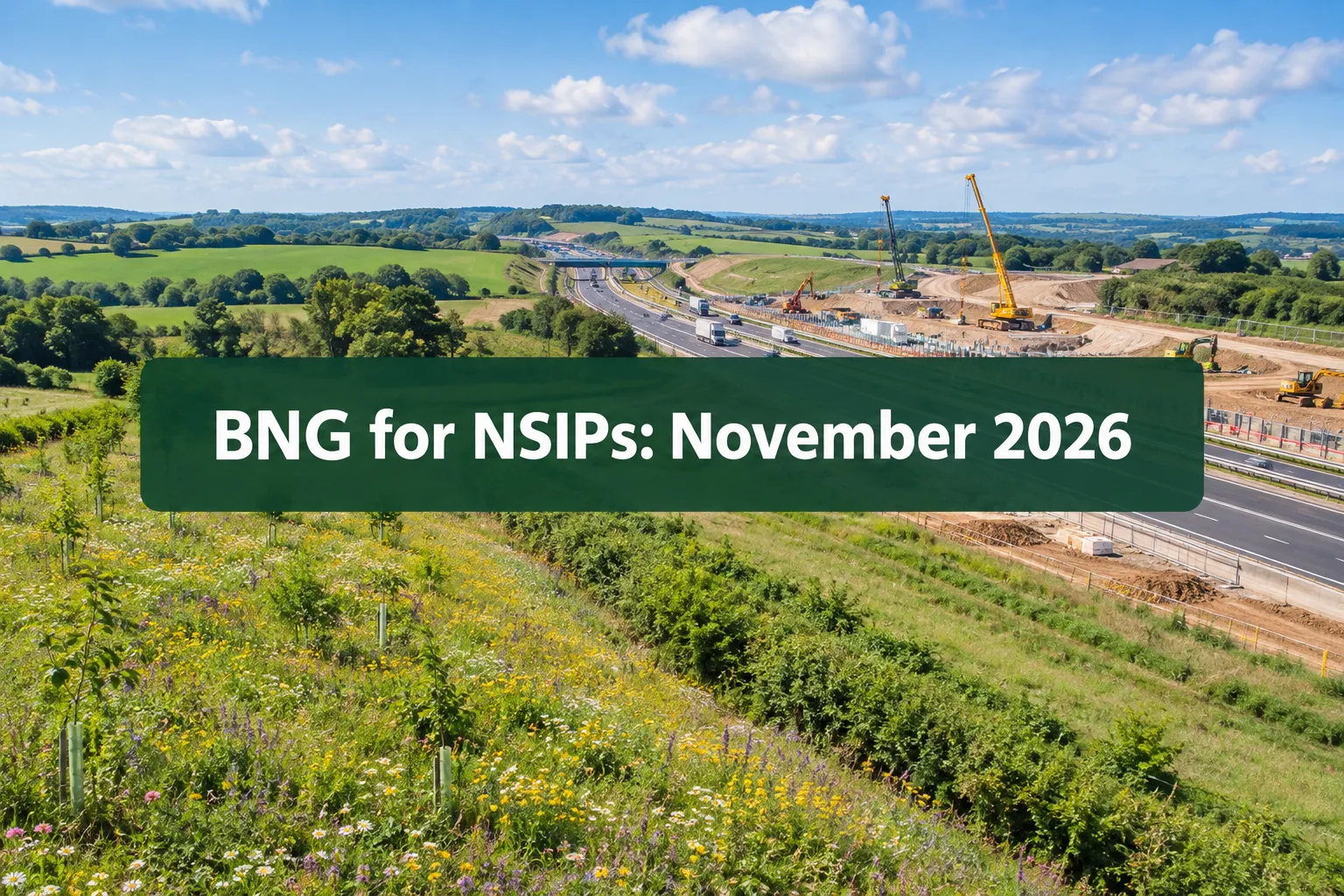
Last updated: November 9, 2026 Seven days ago, on 2 November 2026, the biodiversity net gain duty extended into the world of nationally significant infrastructure projects. No grace period, no sector exemptions, no soft launch. If a developer submitted a Planning Act 2008 application for development consent on or after…
Housebuilders have pulled back from the market faster than many expected, and the numbers released this week prove it. On 6 November 2026, Rightmove confirmed that new-home developments on site were 6% lower at the end of October 2026 than they were back in December 2025. At almost the same…
Five years on from Royal Assent, Defra has published its own assessment of how the Environment Act 2021 is working. The post-legislative scrutiny memorandum, published on 3 November 2026, is cautiously positive about biodiversity net gain, but far from unqualified. For anyone working in planning, development or ecology in England,…
Nearly 50 decisions. Almost two weeks of talks. One blunt conclusion: the world is off track on 22 of its 23 nature targets for 2030. That is the headline from COP17 of the UN Convention on Biological Diversity, which closed in Yerevan, Armenia, on 31 October 2026. For UK developers…
Two days ago, every nationally significant infrastructure project seeking development consent in England crossed a threshold that cannot be undone. Five days before that, the Budget opened a door that may let many smaller residential brownfield sites bypass biodiversity net gain altogether. This is the week NSIP biodiversity net gain…
One line in the Autumn Budget has the power to reshape biodiversity net gain economics for thousands of small and medium housing sites across England, yet nobody can act on it yet. That is the paradox facing developers this week. The headline change, the biodiversity net gain brownfield exemption 1.5…
Ten percent is no longer a target on a future horizon. As of today, 2 November 2026, it is a legal minimum. Every Development Consent Order application for a Nationally Significant Infrastructure Project submitted from this date must show at least 10% biodiversity net gain before consent can be granted.…
Two thousand six hundred seventy-five pounds. That is the flat charge Natural England has proposed for every new home built across three protected Norfolk catchments, and as of 9.29am on 27 October 2026, the public's chance to comment on it has officially ended. The Norfolk Environmental Delivery Plan nutrient levy…
Fewer than half. That is the share of global nature targets currently judged "on track" as the UN Biodiversity Conference, COP17, concludes in Yerevan, Armenia, on 30 October 2026. For a framework built around 23 specific targets for 2030, that is not a minor shortfall, it is a warning shot…
A single line in the Autumn Budget documents has changed the planning arithmetic for small urban housing schemes across England. On 28 October 2026, the government confirmed that residential brownfield sites up to 1.5 hectares will be exempt from mandatory Biodiversity Net Gain. The Biodiversity Net Gain brownfield exemption Budget…
One sentence buried in paragraph 6.119 of a 300-page Budget document just reshaped the biodiversity net gain brownfield exemption Budget 2026 landscape for thousands of housing sites across England. No fanfare, no dedicated press release, just a quiet confirmation that residential brownfield developments up to 1.5 hectares will be exempt…
Nine months after biodiversity net gain became business as usual for housing and commercial schemes, England's biggest infrastructure projects are about to catch up. From 2 November 2026, every Nationally Significant Infrastructure Project (NSIP), new power stations, rail lines, reservoirs, roads, must deliver a measurable 10% biodiversity uplift before the…
Six days. That is all the time left before biodiversity net gain NSIP 2 November 2026 obligations become law for every nationally significant infrastructure project in England. For promoters still treating this as a distant policy footnote, the clock has nearly run out. From 2 November 2026, development consent order…
Ten weeks is not long. But it is long enough for a flawed exemption to expose its cracks. The biodiversity net gain small sites exemption October 2026 regime has now been live since 6 August, and planning officers, ecologists and developers are discovering that "exempt" rarely means "exempt from thinking…
Two words buried in a technical amendment can decide whether a housebuilder owes thousands of pounds in biodiversity credits or nothing at all. That is exactly what happened on 21 October 2026, when the Joint Committee on Statutory Instruments met to scrutinise one of this year's most consequential planning instruments.…
Ten days. That is all that stands between the current voluntary approach to biodiversity net gain on major infrastructure and a legal requirement that will reshape how every nationally significant infrastructure project is designed, consented and delivered. From 2 November 2026, any development consent order application submitted in England must…
Forty-five thousand, three hundred and fifteen. That is the number of homes approved across England between April and June 2026, and it is the lowest quarterly figure since 2012. Not since the aftermath of the financial crisis has England's planning system produced so few approvals in a single quarter. For…
Forty-eight councils just got a combined £26 million pay rise for one job: telling everyone exactly where nature matters most. That job now has direct consequences for your biodiversity net gain budget. In late September 2026, Environment Secretary Angela Eagle used her Labour conference speech in Liverpool to announce £79…
Six days. That is all the time left for developers, landowners and ecologists to respond to a consultation that could determine whether 15,780 homes in Norfolk proceed without site-specific nutrient assessments, or whether the entire Environmental Delivery Plan model collapses under legal challenge before it has built a single home.…
Last updated: October 20, 2026 Quick Answer The Norfolk Environmental Delivery Plan consultation, published by Natural England on 17 September 2026, closes at 9.29am on Tuesday 27 October 2026. It proposes a £2,675-per-dwelling Nature Restoration Levy (before indexation and VAT) to address nutrient pollution affecting The Broads SAC, the Broadland…
A single English river could unlock £7.33 in value for every £1 spent fixing it. That is the headline finding behind Rivers 2040, a report that lands at the exact moment ministers are testing a new levy system for nutrient pollution. For anyone working on riverside or floodplain sites, the…
Nine days. That is all the time left for developers, planners and landowners to respond before Natural England closes the consultation on the first Environmental Delivery Plan (EDP) ever published under the Planning and Infrastructure Act 2025. The Norfolk Environmental Delivery Plan nature restoration levy is not a theoretical reform…
Three-quarters of the world's countries have written national biodiversity targets into law. Almost none of them are on track to hit a single one of the 23 global goals by 2030. That gap between promise and delivery is the backdrop against which COP17 biodiversity October 2026 UK developers must now…
One rule change, 268 habitat banks, and a national infrastructure pipeline worth billions are about to collide. From November 2026, every Nationally Significant Infrastructure Project in England must deliver biodiversity net gain NSIP November 2026 rules in full, and analysts at Barclays are already warning of a "step change" that…
Two hundred and fifty-five pages. That is the length of the first draft Environmental Delivery Plan (EDP) that Natural England published on 17 September 2026, and it covers a single issue in a single county: nutrient pollution affecting protected habitats in Norfolk. The consultation window is short, closing on 27…