

Nearly 50 decisions. Almost two weeks of talks. One blunt conclusion: the world is off track on 22 of its 23 nature targets for 2030. That is the headline from COP17 of the UN Convention on Biological Diversity, which closed in Yerevan, Armenia, on 31 October 2026. For UK developers and ecologists already navigating mandatory biodiversity net gain, the COP17 Yerevan Pathway biodiversity net gain outcome is not a new law, but it is a clear signal about where global and domestic nature policy is heading next.
This article breaks down what was agreed, why it matters even though it changes nothing in English planning law overnight, and what practical steps developers, local planning authorities and ecologists should take now.
Key Takeaways
- COP17 closed in Yerevan on 31 October 2026 with the "Yerevan Pathway," a response to the first global review of the Kunming-Montreal Global Biodiversity Framework.
- The review found the world is failing on almost all 2030 biodiversity targets, with finance, subsidy reform and monitoring identified as the weakest links.
- Developed countries missed the $20bn-a-year finance target for 2025; Target 19 now aims for $200bn a year from all sources by 2030.
- Nearly $2bn in new funding was announced, alongside new State of Nature Indicators to strengthen monitoring worldwide.
- COP17 does not create new UK legal duties, but it reinforces the direction England is already moving in with mandatory BNG, 30-year habitat management plans and the 10% NSIP requirement from 2 November 2026.
What Is the COP17 Yerevan Pathway for Biodiversity Net Gain
The Yerevan Pathway is the negotiated outcome of COP17's first global stocktake of progress against the Kunming-Montreal Global Biodiversity Framework, agreed at COP15 in 2022. Parties commissioned a State of Biodiversity Action report to check progress against the framework's 23 targets. The verdict was stark: progress is falling behind on 22 of the 23 targets, according to Carbon Brief's analysis of the review text.
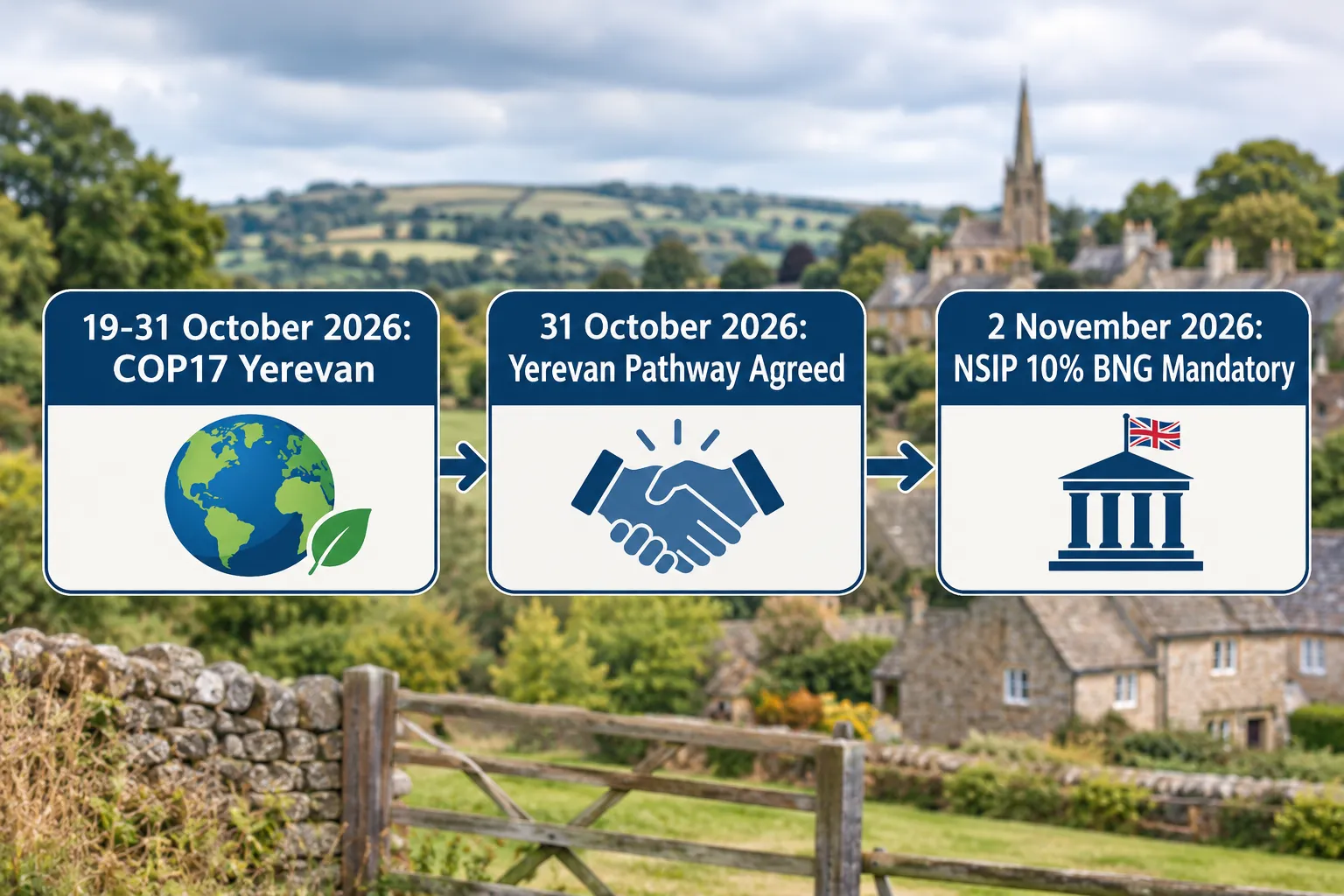
The agreed text "notes with deep concern" that the 2030 goals "will not be achieved" unless action is "rapidly accelerated." Rather than rewriting targets, the Yerevan Pathway sets four priorities through 2030:
- Tackling nature-harmful subsidies and incentives
- Increasing financial, scientific and technical support for developing countries
- Aligning national budgets and economic decisions with the Global Biodiversity Framework
- Strengthening implementation, monitoring, reporting and review
Astrid Schomaker, Executive Secretary of the CBD Secretariat, put it plainly: "We cannot protect nature while continuing to finance its destruction." Her closing remark is arguably the most important line for developers to remember: "Ultimately, the test is not what governments agreed in Yerevan, but what they change when they return home."
The Finance Gap Behind the COP17 Yerevan Pathway Biodiversity Net Gain Agenda
Money dominated the Yerevan talks, and the numbers explain why. Developed countries missed their commitment of at least $20bn a year by 2025. Target 19 of the framework now calls for at least $200bn a year from all sources by 2030, while Target 18 aims to cut harmful subsidies by at least $500bn a year over the same period. Decisions on a permanent post-2030 financial mechanism were deferred to COP18, due in Quito, Ecuador, in 2028.
Still, fresh money was announced in Yerevan, totalling close to $2bn:
| Fund | Amount | Purpose |
|---|---|---|
| GEF-9 replenishment and Global Biodiversity Framework Fund | $560m | Core framework implementation |
| Species Recovery Alliance | $500m | Targeted species protection |
| Value Nature Fund | $330m+ | Mobilising private capital for nature |
New State of Nature Indicators and Metrics were also launched, designed to give countries, and by extension, markets, a clearer way to measure whether nature commitments are translating into real outcomes. Only 45% of countries had published their national biodiversity strategies and action plans in time for the review, underlining why monitoring and reporting became such a central theme.
David Cooper, chair of the UK's Joint Nature Conservation Committee, noted that countries have "openly and clearly recognised" the need to increase action. The UK was among the nations pushing for stronger language on reforming harmful subsidies.
Why English Developers Should Still Pay Attention
To be clear: COP17 decisions do not alter English planning law. Biodiversity net gain remains governed by domestic legislation, not UN treaty text. But the direction of travel matters for anyone preparing a planning application, calculating a biodiversity metric or managing a habitat bank.
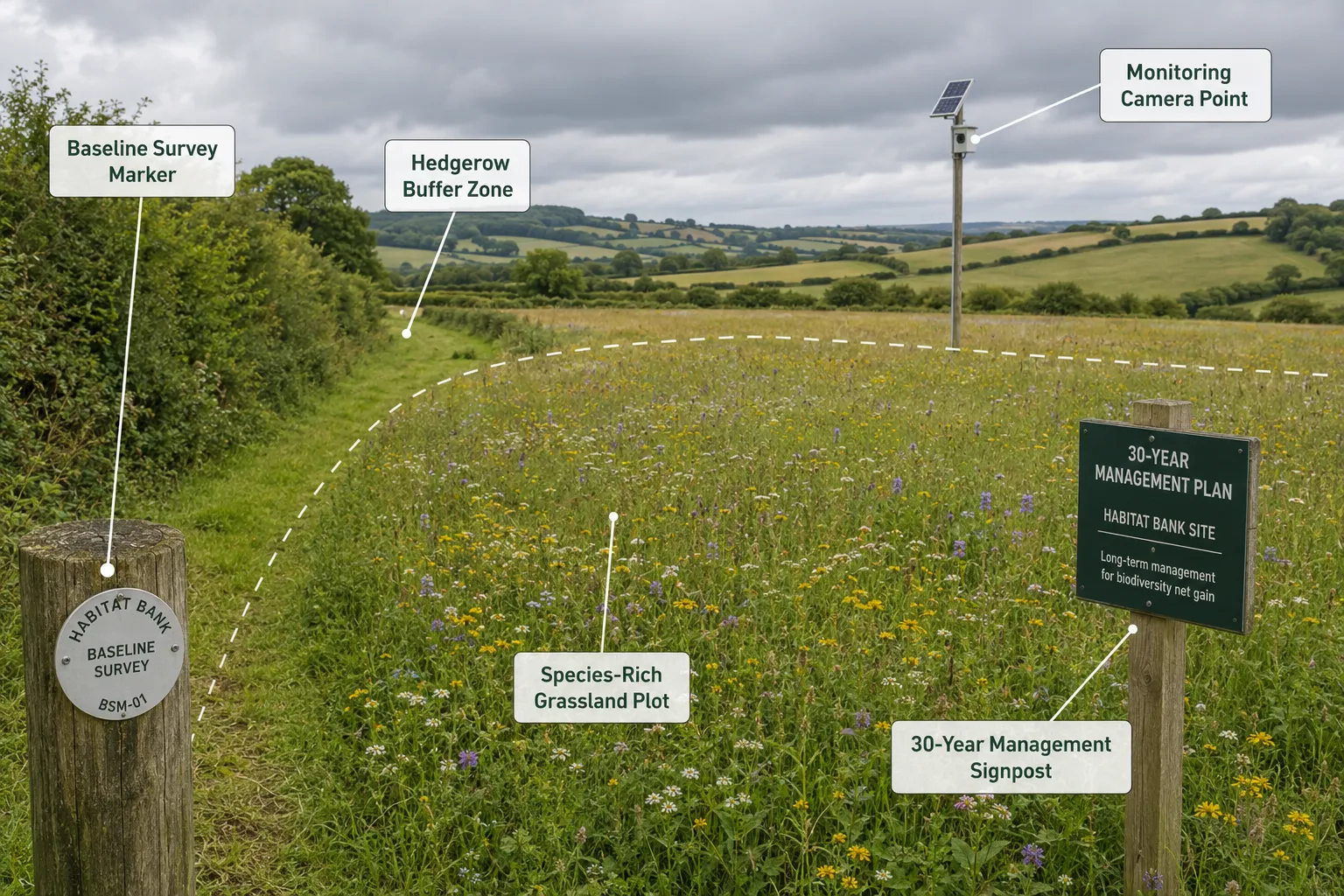
The Yerevan Pathway's emphasis on measurable outcomes, robust monitoring and private nature finance mirrors exactly what England's BNG system already demands. Consider the timing:
- At least 10% BNG became mandatory for nationally significant infrastructure project (NSIP) development consent order applications made on or after 2 November 2026, two days after COP17 closed.
- BNG has applied to most Town and Country Planning Act development since February 2024.
- Sites of 0.2 hectares or less have been exempt since 6 August 2026, unless priority habitat is affected.
- Significant biodiversity gains must be secured and managed for at least 30 years.
- The government remains committed to protecting 30% of land for nature by 2030.
"The test is not what governments agreed in Yerevan, but what they change when they return home.", Astrid Schomaker, CBD Executive Secretary
That quote applies just as well to a planning committee in England as it does to a national government. The global push for credible monitoring and long-term accountability reinforces why detailed baseline surveys, accurate metric calculations and well-resourced 30-year management plans matter more than ever.
Practical Implications for Ecologists and BNG Practitioners
For ecologists and BNG consultants, the Yerevan Pathway is less about legal change and more about professional standards and reputational expectations. Three practical takeaways stand out.
First, expect greater scrutiny of monitoring data. With new State of Nature Indicators emerging internationally, clients, lenders and planning authorities are likely to expect more rigorous, verifiable evidence that habitats are actually delivering the gains promised on paper, not just at year one, but across the full 30-year commitment period.
Second, private finance for nature is scaling up globally through vehicles like the Value Nature Fund. This trend supports the growing role of habitat banking and off-site BNG units in England, where credible, well-documented sites are more attractive to investors and landowners alike.
Third, subsidy and incentive reform discussed in Yerevan may eventually filter into UK agricultural and land-use policy, affecting how farmers and landowners think about entering habitat creation or enhancement schemes that feed BNG markets.
Frequently Asked Questions
Does COP17 change UK biodiversity net gain rules?
No. COP17 is a UN-level agreement between countries. It does not directly alter England's BNG legislation, but it reinforces the policy direction England has already taken.
What is the Yerevan Pathway in simple terms?
It is the agreed set of priorities from COP17 for accelerating action on the Global Biodiversity Framework's 2030 targets, focusing on finance, subsidy reform and better monitoring.
Why did the world miss its biodiversity targets?
The State of Biodiversity Action report found progress lagging on 22 of 23 targets, citing insufficient finance, weak subsidy reform and incomplete national strategies, only 45% of countries had published theirs in time.
What happened to the $20bn-a-year nature finance target?
Developed countries missed the goal of at least $20bn a year by 2025. Target 19 now seeks at least $200bn a year from all sources by 2030.
When is the next COP?
COP18 will be held in Quito, Ecuador, in 2028, where decisions on a post-2030 financial mechanism are expected.
Should developers change their BNG approach because of COP17?
Not legally required, but developers should expect continued tightening of monitoring, reporting and long-term management expectations, consistent with global trends highlighted in Yerevan.
Conclusion
COP17 did not rewrite English planning law, but the Yerevan Pathway confirms what UK developers and ecologists already sense on the ground: nature policy worldwide is shifting toward measurable outcomes, long-term accountability and serious private finance for habitat restoration. The COP17 Yerevan Pathway biodiversity net gain outcome should be read as a signpost, not a statute.
Developers preparing NSIP or Town and Country Planning Act applications should treat this moment as a prompt to tighten baseline surveys, stress-test 30-year management plans, and ensure metric calculations will withstand growing scrutiny. Ecologists and BNG consultants should get ahead of rising monitoring expectations rather than wait for them to become mandatory. The direction of travel, both globally and in England, points one way, toward credible, long-term, verifiable biodiversity outcomes.