

One line in the Autumn Budget has the power to reshape biodiversity net gain economics for thousands of small and medium housing sites across England, yet nobody can act on it yet. That is the paradox facing developers this week. The headline change, the biodiversity net gain brownfield exemption 1.5 hectares Budget 2026, has been announced but not switched on, leaving live applications stuck under the existing 10% rule while the industry waits for detail that the government says will come "in due course."
On 28 October 2026, Chancellor John Healey told Parliament that residential brownfield developments on sites up to 1.5 hectares will be exempt from the mandatory 10% biodiversity net gain requirement. It is a significant move, but a narrower one than many headlines suggest. This article sets out exactly what has changed, what has not, and what to do with a sub-1.5ha brownfield site right now.
Key Takeaways
- The Budget 2026 brownfield exemption applies only to residential development on sites up to 1.5 hectares, not all brownfield sites and not all development types.
- No start date, regulations, or impact assessment have been published; the government response is still pending.
- Current BNG rules, including an approved biodiversity gain plan before commencement, remain fully in force today, 3 November 2026.
- Ecological surveys, protected species assessments and the NPPF biodiversity hierarchy still apply even once the 10% metric exemption takes effect, exemption from BNG is not exemption from ecology law.
- Habitat bank operators and landowners selling off-site units face real demand risk, with the CLA warning of up to a 48% fall in off-site unit transactions.
What the Biodiversity Net Gain Brownfield Exemption 1.5 Hectares Budget 2026 Actually Says
The Budget text is deliberately narrow. It exempts residential brownfield developments of up to 1.5 hectares from the 10% BNG requirement, with the stated aim of lowering the cost of building homes on previously developed land. It does not exempt:
- Brownfield sites used for commercial, industrial or mixed-use schemes where housing is not the primary use.
- Sites above 1.5 hectares, even if entirely brownfield.
- Sub-1.5ha sites that are not predominantly previously developed land.
Crucially, the Budget document states: "The full government response to the consultation and impact assessment will be published in due course." There is no commencement date, no transitional period, and no confirmation of the detailed tests Defra had floated earlier in the year.
Background: the consultation that shaped this decision
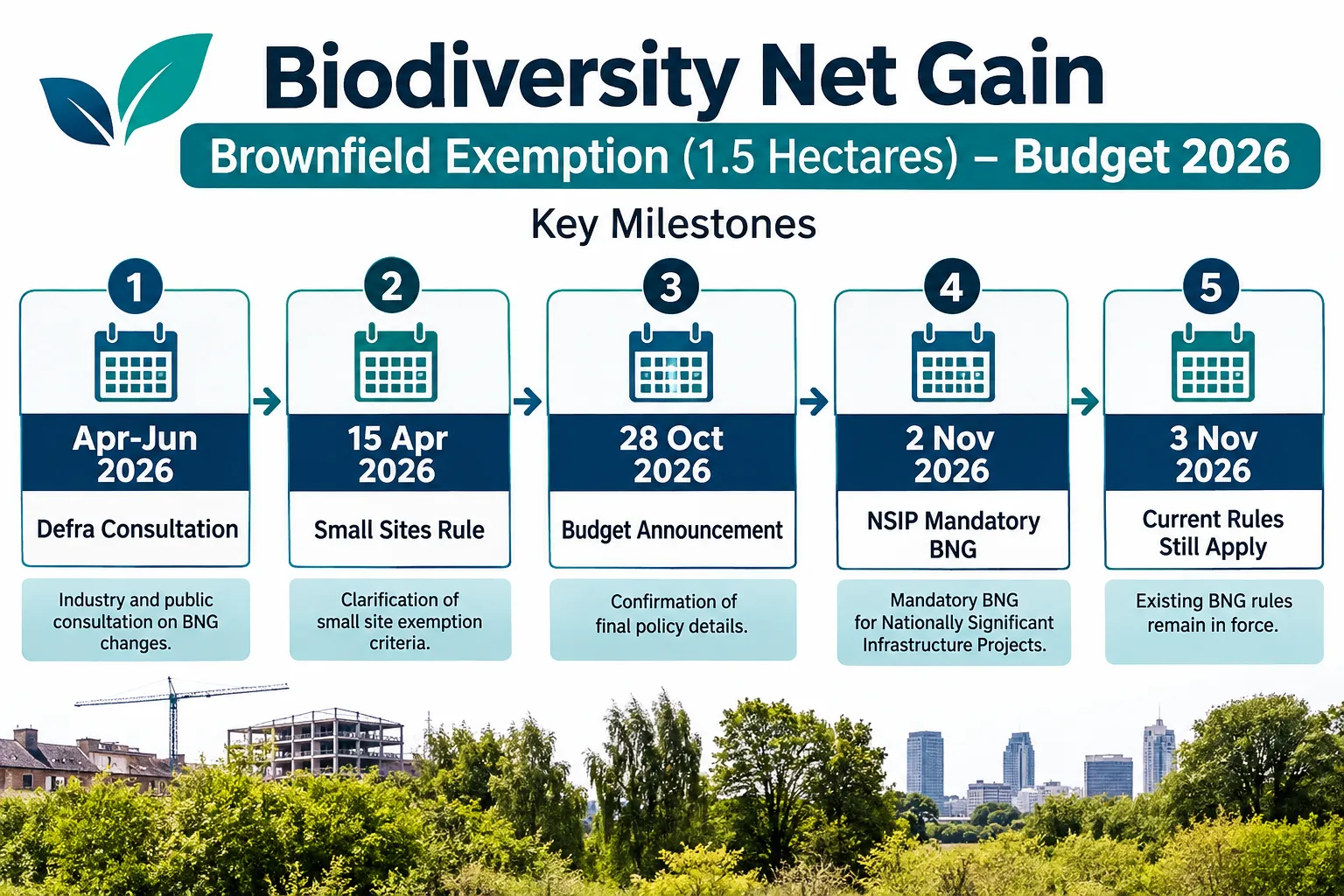
Defra ran a consultation from 15 April to 10 June 2026 on a targeted brownfield residential exemption. It tested thresholds ranging from 0.5 to 2.5 hectares and floated a requirement that at least 75% of a site be previously developed land, alongside safeguards protecting priority habitats. The Budget settled on the 1.5 hectare threshold but did not confirm the 75% test or the priority habitat safeguards. Those details, and whether they survive into the final regulations, remain open questions.
This sits alongside Defra's 15 April 2026 response to its 2025 consultations, which confirmed a separate small-sites exemption for qualifying sites of 0.2 hectares or below, ended the self- and custom-build exemption, made temporary development of five years or less exempt, and set out plans for future exemptions covering conservation-led development and public green spaces. Readers tracking that earlier change can review our detailed breakdown of the small sites 0.2 hectare exemption now in force.
Timeline: What Is in Force Today, 3 November 2026
It helps to separate announced policy from applicable law. As of 3 November 2026:
| Status | Rule |
|---|---|
| In force | Mandatory 10% BNG for all qualifying planning applications in England |
| In force | Approved biodiversity gain plan required before commencement |
| In force | Small sites exemption for qualifying sites of 0.2 hectares or below (applications made since summer 2026) |
| In force | Self- and custom-build exemption ended; temporary development of five years or less exempt |
| In force | Mandatory 10% BNG for Nationally Significant Infrastructure Projects, effective 2 November 2026 |
| Announced, NOT in force | Brownfield residential exemption for sites up to 1.5 hectares |
The NSIP mandate is a useful reminder of how these things actually land: that rule was confirmed well in advance, with a fixed commencement date and published guidance. The brownfield exemption has none of that yet. For context on how the infrastructure rule was rolled out, see our coverage of the mandatory BNG rules for Nationally Significant Infrastructure Projects.
Who Is Likely to Qualify Once the Exemption Takes Effect
Based on the consultation framing and the Budget wording, likely qualifying sites will be:
- Wholly residential developments.
- On sites of 1.5 hectares or less.
- Substantially previously developed (brownfield) land, though the exact proportion test has not been confirmed.
Sites that mix housing with significant employment or retail floorspace, or that include a meaningful proportion of greenfield land, are less likely to qualify once final rules are published. Developers should not assume eligibility, wait for the government response before relying on this exemption in a planning strategy.
Exemption From the Metric Is Not Exemption From Ecology
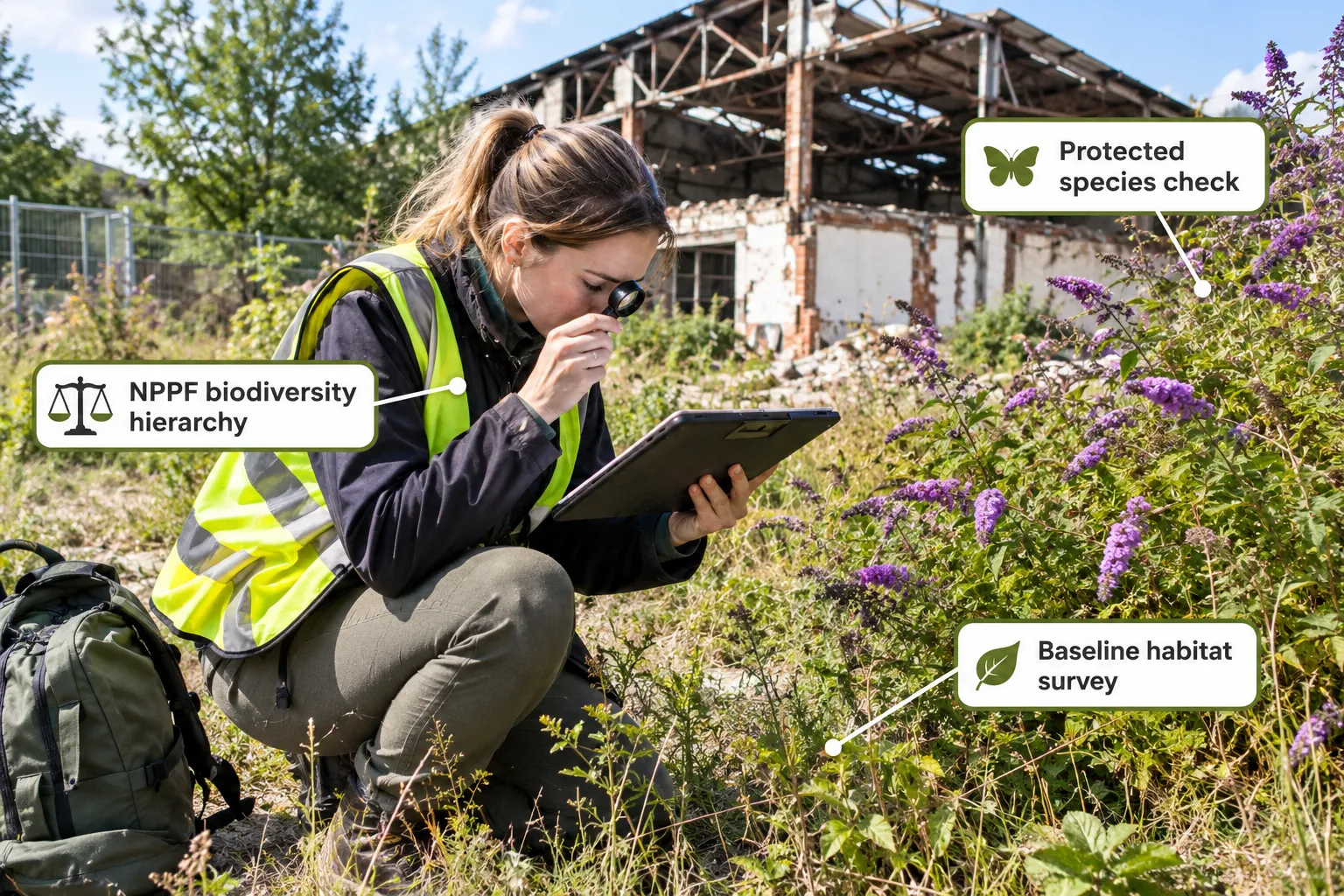
This is the point many non-specialists miss. Even where the 10% net gain calculation no longer applies, a site still sits within the normal planning and wildlife legal framework. In practice, exempt brownfield sites will still typically require:
- A Preliminary Ecological Appraisal to identify habitats and constraints.
- Protected species surveys (bats, great crested newts, reptiles, nesting birds) where habitat features suggest presence.
- Application of the NPPF biodiversity hierarchy, avoid, mitigate, compensate, regardless of the BNG metric.
- Compliance with the Wildlife and Countryside Act, Habitats Regulations and other species-level protections, which operate independently of BNG.
LPAs retain the ability to impose planning conditions requiring habitat enhancement, landscaping schemes, or biodiversity features even on exempt sites, particularly where local plan policies go beyond the statutory BNG minimum. Expect case officers to ask for ecological evidence as a matter of course, exemption or not.
Reaction From Industry and the Environmental Sector
The announcement has split opinion sharply.
"To restore confidence, smaller developers need targeted action.", Neil Jefferson, Home Builders Federation, 27 October 2026
The Wildlife Trusts and Wildlife and Countryside Link, represented by Matt Browne and Philip Box, had already warned in May 2026 that "BNG cannot function as a 'win-win' policy for nature and development if it is riddled with loopholes", a comment made during the consultation period but now looking prescient given the scale of the Budget exemption.
The CLA has gone further, warning that a 1.5 hectare brownfield exemption combined with the existing 0.2 hectare small sites exemption could cut off-site biodiversity unit transactions by up to 48%. Planning Geek noted on 28 October that this risks undermining the private nature-finance market the government itself promoted just two days earlier, on 26 October.
Implications for Habitat Bank Operators and Landowners
This is where the exemption bites hardest financially. Landowners who have invested in habitat banks, creating or restoring habitat to sell biodiversity units to developers, rely on a steady pipeline of demand from sites needing to buy off-site units. If a large share of smaller brownfield housing schemes no longer need units at all, demand could fall materially, consistent with the CLA's 48% warning.
Practical considerations for habitat bank operators and landowners:
- Reassess forward demand projections against a scenario where sub-1.5ha brownfield housing is exempt.
- Diversify buyer pipelines towards NSIP developers, who face mandatory 10% BNG from 2 November 2026, and larger greenfield schemes unaffected by the exemption.
- Monitor Defra's full response closely, the final eligibility tests will determine how large the demand reduction actually is.
Those managing or considering a habitat bank should also review our wider analysis of the biodiversity net gain units market and landowner considerations.
What Developers With Sub-1.5ha Brownfield Sites Should Do Now
Until regulations are made, current law applies in full. Practical steps:
- Do not pause BNG work on live applications. An approved biodiversity gain plan is still required before commencement; delaying it risks stalling the whole project.
- Continue instructing baseline habitat surveys and Preliminary Ecological Appraisals. These remain necessary for planning decisions regardless of the BNG metric outcome.
- Model both scenarios. Keep a BNG-compliant cost case and a "no 10% requirement" case side by side so the scheme's viability assessment is ready either way.
- Watch for the Defra response and impact assessment. These will confirm the previously-developed-land threshold, any priority habitat safeguards, and the commencement date.
- Engage early with the LPA on whether local plan policy will still expect habitat enhancement conditions on exempt sites, many authorities are likely to retain some expectation.
- Keep biodiversity unit agreements flexible where a scheme might fall within the future exemption, to avoid being locked into unnecessary off-site purchases.
Developers who track parallel reforms, including the small sites and temporary development exemptions already live, can read our guide to biodiversity net gain changes affecting small-site developers and our update on the temporary development exemption introduced in August 2026.
A Note for Local Planning Authorities
LPAs should expect confusion from applicants assuming the exemption already applies. Officers should continue to require approved biodiversity gain plans on all qualifying applications until regulations are formally made, and should flag to members that local policy may still justify habitat enhancement conditions on sites that later fall outside the statutory 10% requirement. Authorities handling NSIP-adjacent or infrastructure-linked applications should also note the separate mandatory regime that began on 2 November 2026, covered in our analysis of the NSIP mandatory BNG rollout.
Get Specialist Support Now
Whether a scheme might ultimately qualify for the brownfield exemption or needs to proceed under current BNG rules today, professional ecological input is essential at this stage. Biodiversity Surveyors provides baseline habitat surveys, Preliminary Ecological Appraisals, protected species surveys and biodiversity gain plans for sites across England. Contact Biodiversity Surveyors to discuss how the Budget 2026 announcement affects a specific brownfield site and to keep applications moving while the detail is finalised.
FAQ
Does the brownfield exemption apply to my site today?
No. The exemption was announced in the Budget on 28 October 2026 but has no commencement date. Current 10% BNG rules apply to qualifying applications until regulations are made.
Will all brownfield sites under 1.5 hectares be exempt?
Only residential developments are covered, and the final eligibility tests, including any previously-developed-land percentage, have not been confirmed. Not every sub-1.5ha brownfield site will qualify.
If my site becomes exempt, do I still need an ecological survey?
Yes. Exemption from the 10% BNG metric does not remove the need for Preliminary Ecological Appraisals, protected species surveys, or compliance with the NPPF biodiversity hierarchy and wildlife legislation.
What should I do with a live planning application right now?
Continue preparing or securing an approved biodiversity gain plan as normal. Do not delay BNG work in anticipation of an exemption that has no start date.
Conclusion
The biodiversity net gain brownfield exemption 1.5 hectares Budget 2026 marks a genuine policy shift, but one still waiting on regulations, an impact assessment and a commencement date. Until then, current BNG law governs every qualifying application, including the requirement for an approved biodiversity gain plan before works start. Developers, LPAs and landowners should treat the announcement as a strong signal of direction rather than a usable rule, keep ecological survey work moving on live sites, and watch closely for Defra's full response. For tailored advice on how this affects a specific brownfield housing scheme, contact Biodiversity Surveyors.
biodiversity net gain, BNG brownfield exemption, Budget 2026, Defra consultation, habitat survey, biodiversity gain plan, planning policy England, NSIP biodiversity net gain, habitat bank, small sites exemption, ecological survey, housing development