

Fifty-six days. That is roughly how much runway remains before mandatory Biodiversity Net Gain rules bite for every Nationally Significant Infrastructure Project still moving through the planning system. For an industry used to multi-year consenting timetables, that is a remarkably tight window, and one that many project teams have not yet fully mapped against their own Development Consent Order schedules.
The Biodiversity Net Gain NSIP November 2026 deadline: what UK developers must do now is no longer a distant compliance date on a risk register. It is a live, statutory obligation landing on 2 November 2026, and it follows hot on the heels of a separate change on 6 August 2026 that reshaped exemptions for small sites and self-build homes. Together, these two shifts mean September 2026 is the moment for developers, ecologists and legal teams to lock down their approach.
Key Takeaways
- Mandatory Biodiversity Net Gain for Nationally Significant Infrastructure Projects takes effect on 2 November 2026, requiring a minimum 10% biodiversity gain measured against the statutory biodiversity metric [1][3].
- The NSIP BNG start date was pushed back from the original November 2025 timetable to give developers, Natural England and local planning authorities more preparation time [1].
- From 6 August 2026, small sites and self-build developments gained clarified exemption treatment, distinct from the NSIP regime, reducing burden on householders while large infrastructure remains squarely in scope [2].
- Applicants must submit a Biodiversity Gain Statement with their Development Consent Order application, evidencing how the 10% gain will be achieved and secured [5][6].
- With roughly eight weeks left, developers should audit live DCO applications now, commission or update ecological baselines, and confirm delivery and monitoring mechanisms before the deadline.
Understanding the Biodiversity Net Gain NSIP November 2026 Deadline
The core legal requirement is straightforward on paper: from 2 November 2026, biodiversity gain condition rules under the Environment Act 2021 framework extend to Nationally Significant Infrastructure Projects consented under the Planning Act 2008 [1][3]. Every qualifying DCO application submitted after that date must demonstrate a measurable biodiversity gain of at least 10%, calculated using the statutory biodiversity metric, and secured for a minimum 30-year period [4].
This is not a brand-new concept. Town and Country Planning Act developments have operated under mandatory BNG since February 2024. What changes now is the extension of that same underlying principle, no net loss is not good enough, developers must leave habitats measurably better than they found them, into the world of major infrastructure: transport corridors, energy generation, water treatment works, and other projects of national significance [3][4].
Crucially, the government has confirmed this deadline was deliberately moved from an earlier proposed date in 2025 to give the market, and Natural England, more time to prepare guidance, metric tools and habitat management planning routes [1]. Defra and Natural England have both stated that the delay was designed to provide developers with "certainty," rather than a rushed and inconsistently applied regime [2][10].
Scope: Which Projects Are Captured
Not every scheme touching UK land is caught. The NSIP BNG regime applies specifically to projects requiring development consent under the Planning Act 2008, broadly, projects of a scale and type defined as nationally significant, spanning England. Applications submitted before 2 November 2026 are generally expected to proceed under the previous framework, while applications submitted from that date onward must include a Biodiversity Gain Statement as a mandatory component of the DCO submission [3][6].
Developers already mid-way through pre-application consultation should check carefully which side of that line their project sits on, since the transitional provisions matter enormously for programme risk.
What Changed on 6 August 2026 and What Developers Must Do Now
On 6 August 2026, the government issued updated guidance clarifying exemptions for small sites and self-build development, tightening the distinction between householder-scale projects and the mandatory regime applying to larger schemes, including NSIPs [2]. This matters for developers running mixed portfolios: a housebuilder delivering a self-build plot alongside a grid connection scheme now needs to apply two different compliance pathways within the same corporate group.
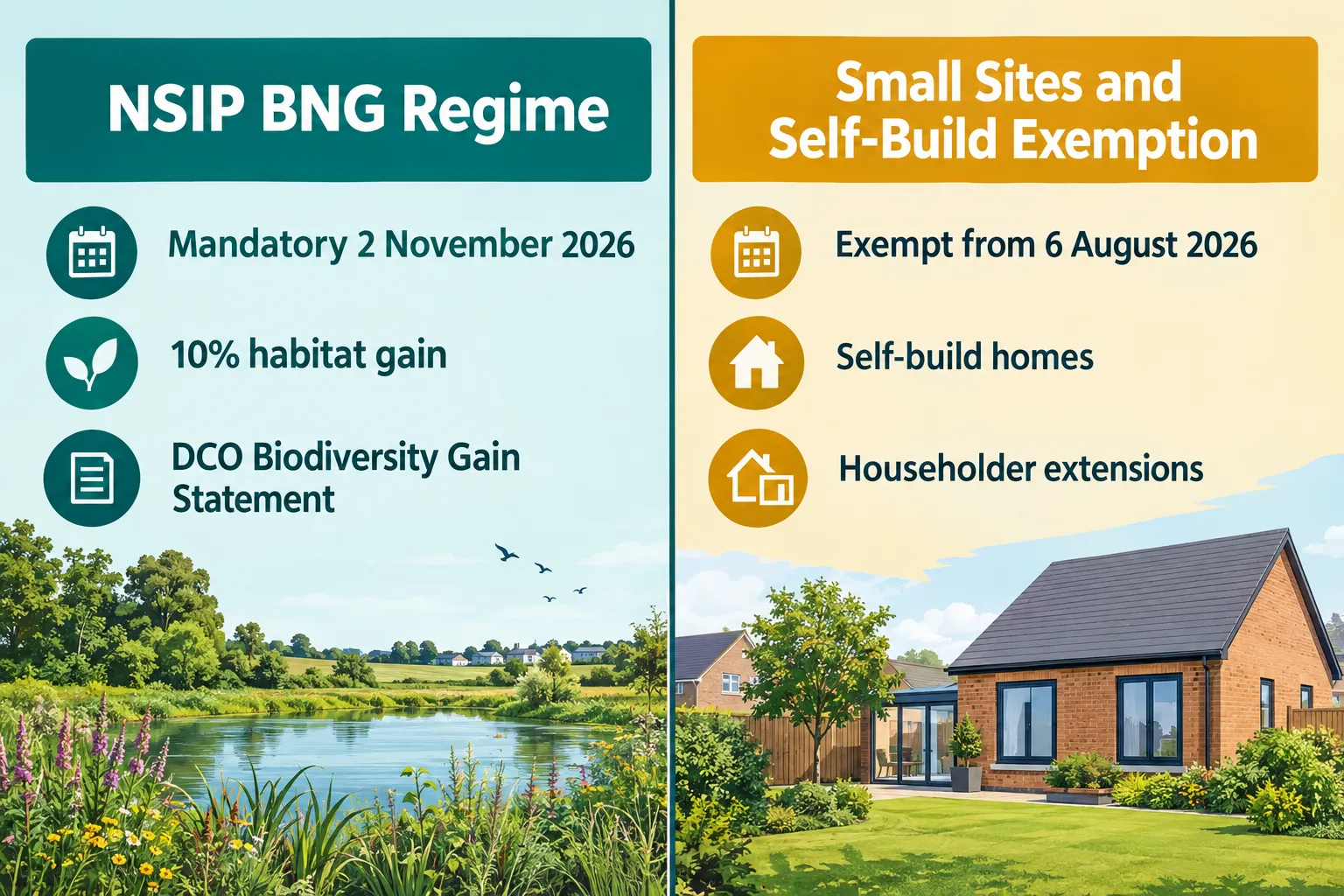
The practical effect is this: small-scale exemptions do not dilute or delay the NSIP obligation. If anything, the clarified exemption boundary sharpens focus on infrastructure promoters, who have no equivalent carve-out and must treat 2 November 2026 as immovable [2][9].
"The extension of the NSIP timetable was about giving industry certainty, not giving it an excuse to wait until the last minute," is the essential message coming through recent Defra and Natural England communications [2][10].
Biodiversity Gain Statements: The New Paperwork Reality
At DCO application stage, promoters must now prepare a Biodiversity Gain Statement setting out:
- The pre-development biodiversity value of the site, calculated using the statutory metric
- The post-development target value, demonstrating at least a 10% net gain
- How habitat units will be delivered, on-site, off-site, or through statutory biodiversity credits
- Evidence of long-term management and monitoring arrangements, typically secured through conservation covenants or planning obligations [5][6][7]
Recent government-published collections of guidance documents and consultation outcomes give worked examples of what evidence examiners will expect to see, and legal commentators have flagged that biodiversity gain statements will face close scrutiny during examination, much as habitat regulations assessments do now [5][6].
Timing, Delivery and Securing Gains Across Project Phases
One of the trickiest issues industry experts keep raising is timing. Infrastructure projects often take years between consent and construction, and years more before habitats mature. The statutory approach requires developers to secure biodiversity gains, not merely promise them, at the point of consent, with delivery and monitoring mechanisms locked in through legal agreements before construction substantially begins [4][6].
Practically, this means:
| Project Phase | BNG Requirement |
|---|---|
| Pre-application | Baseline habitat survey using statutory metric |
| DCO submission | Biodiversity Gain Statement included |
| Examination | Evidence tested by Examining Authority |
| Post-consent | Habitat management and monitoring plan secured legally |
| Operation | 30-year minimum monitoring and reporting |
Consultants advising on Habitat Management and Monitoring Plans warn that off-site unit availability is patchy in some regions, and early booking of habitat banks or biodiversity credits is now essential, since demand is expected to spike as the November deadline approaches [9].
Transitional Provisions and Exemptions
Government guidance confirms that certain projects remain outside scope of the NSIP BNG regime, including those with a DCO application submitted before the 2 November 2026 commencement, and those falling under specific exemptions set out in secondary legislation [3][10]. However, developers should not assume automatic exemption, each case depends on the precise submission date and category of consent sought. Legal advisers increasingly recommend a formal scope assessment memo for every live or pipeline NSIP, cross-referencing submission dates against the statutory commencement date [1][5].
Eight-Week Action Plan for Developers and Consultants
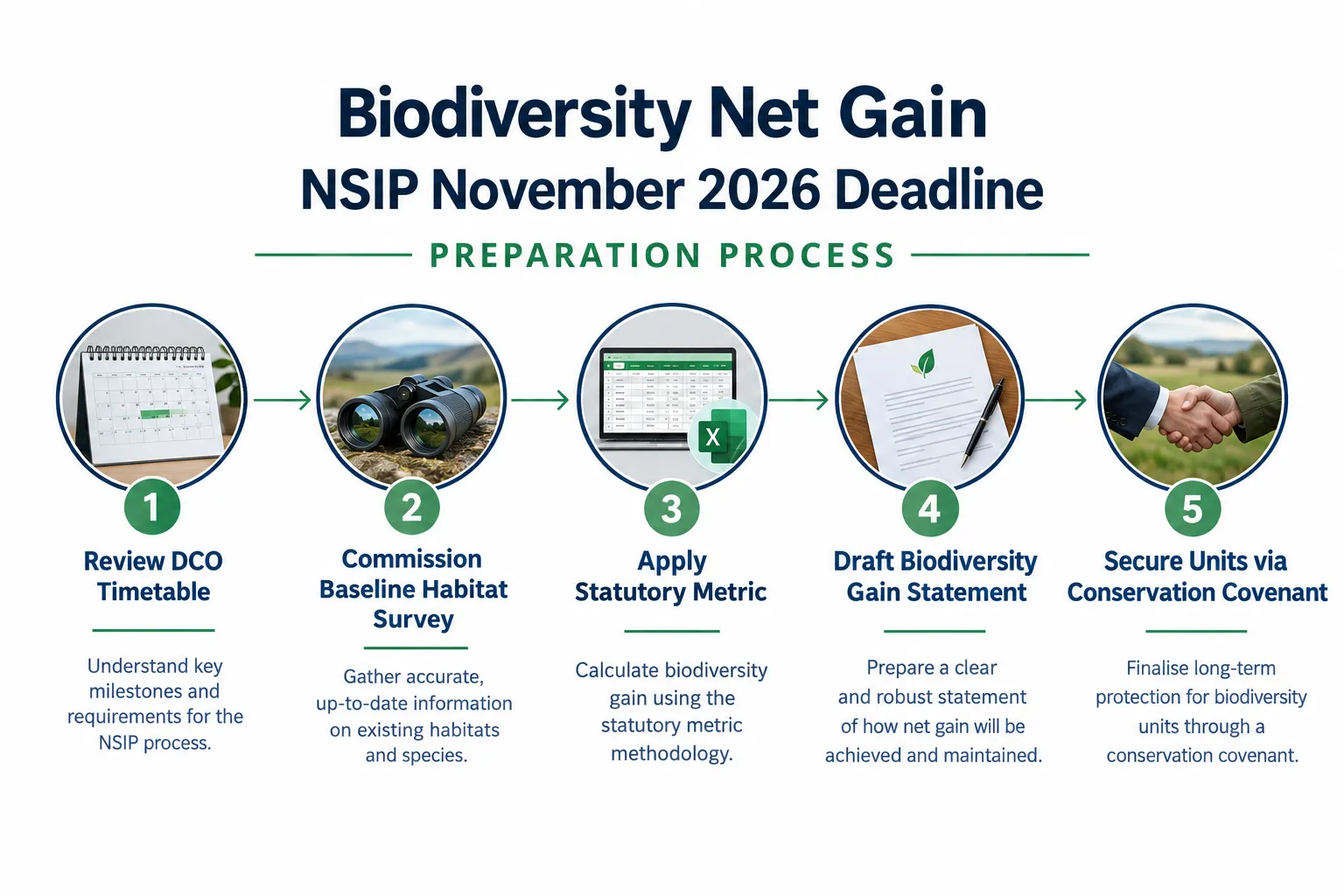
With the Biodiversity Net Gain NSIP November 2026 deadline: what UK developers must do now fast approaching, the practical priorities for September and October 2026 are:
- Map every live DCO application against the 2 November 2026 commencement date to confirm regime applicability.
- Commission or refresh ecological baseline surveys using the current statutory biodiversity metric version.
- Draft or finalise Biodiversity Gain Statements, aligning them with Natural England guidance published in the government's biodiversity gain statement collection [6].
- Secure off-site habitat units or biodiversity credits early, given anticipated demand pressure near the deadline [9].
- Review legal mechanisms, conservation covenants, planning obligations, for the required 30-year monitoring commitment.
- Brief internal teams and external consultants on the distinction between NSIP obligations and the small sites/self-build exemption clarified on 6 August 2026 [2].
Frequently Asked Questions
When does mandatory BNG apply to NSIPs?
From 2 November 2026, biodiversity gain requirements become mandatory for qualifying Nationally Significant Infrastructure Projects under the Planning Act 2008 [1][3].
What percentage gain is required?
A minimum 10% biodiversity net gain, measured using the statutory biodiversity metric, in line with the wider BNG framework introduced under the Environment Act 2021 [3][4].
Does the 6 August 2026 change affect large infrastructure projects?
No. That update clarified exemptions for small sites and self-build developments; NSIPs remain fully subject to the mandatory regime from 2 November 2026 [2].
What must be submitted with a DCO application?
A Biodiversity Gain Statement evidencing the baseline, target gain, delivery method and long-term securing mechanism [5][6].
Are any projects exempt from the NSIP BNG rules?
Yes, transitional provisions exempt certain applications submitted before the commencement date, alongside statutory exemptions, each case should be individually assessed [3][10].
How does this relate to Town and Country Planning Act BNG rules?
It mirrors the existing regime that has applied to TCPA developments since February 2024, extending the same underlying principle to major infrastructure consented under the Planning Act 2008 [1][4].
Conclusion
The Biodiversity Net Gain NSIP November 2026 deadline: what UK developers must do now has moved from policy discussion to operational reality. With 2 November 2026 fixed and the 6 August 2026 exemption clarifications already in force, the margin for delay has narrowed sharply. Developers running live or pipeline NSIP applications should treat the next eight weeks as a compliance sprint: confirm scope, commission baselines, draft Biodiversity Gain Statements, and secure delivery mechanisms before the commencement date arrives. Consultants should prioritise clients with applications straddling the transitional boundary, since misjudging submission timing carries real programme risk. Acting now, rather than in late October, is the only realistic route to a smooth transition into the mandatory regime.
References
[1] Biodiversity Net Gain Requirements Extended Nov 2026 – pinsentmasons.com
[2] Biodiversity Net Gain For Major Infrastructure Projects New Guidance – defraenvironment.blog.gov.uk
[3] Biodiversity Net Gain Nationally Significant Infrastructure Projects – gov.uk
[4] Understanding Biodiversity Net Gain – gov.uk
[5] Bng For Nsips Impact Of Biodiversity Gain Statements And Guidance – cms.law
[6] Biodiversity Gain Statements For Nationally Significant Infrastructure Projects – gov.uk
[7] Biodiversity Net Gain For Nationally Significant Infrastructure Projects – gov.uk
[8] Biodiversity Net Gain Guidance For Developers Land Managers And Authorities – gov.uk
[9] Bng For Nsips – arbtech.co.uk
[10] Summary Of Responses And Government Response – gov.uk