

Two days ago, every nationally significant infrastructure project seeking development consent in England crossed a threshold that cannot be undone. Five days before that, the Budget opened a door that may let many smaller residential brownfield sites bypass biodiversity net gain altogether. This is the week NSIP biodiversity net gain stopped being a future date on a calendar and became the live operating reality for England's planning system.
For ecological consultants, developers and infrastructure promoters, the gap between these two announcements matters. One is law, with a hard commencement date. The other is a policy intention without a start date, a mechanism, or a confirmed threshold.
Key Takeaways
- Mandatory 10% biodiversity net gain now applies to all NSIP development consent applications submitted on or after 2 November 2026, with no sector exemptions.
- The Budget (28 October 2026) announced a future exemption for residential brownfield sites up to 1.5 hectares, but gave no start date or legislation.
- Defra's own consultation warned the brownfield exemption, combined with the existing 0.2-hectare rule, could cut off-site BNG market transactions by up to 48%.
- Until legislated, developers must still secure an approved biodiversity gain plan before works start, the Budget announcement changes nothing on the ground yet.
- NSIP promoters should commission baseline UKHab and condition surveys now, given limited seasonal survey windows and the 30-year habitat security requirement.
NSIP Biodiversity Net Gain Is Now In Force: What Actually Changed on 2 November
From 2 November 2026, any application for development consent for a Nationally Significant Infrastructure Project under the Planning Act 2008 must demonstrate a 10% biodiversity net gain. This is measured against the pre-development baseline using the statutory metric, and it applies to onshore elements of projects down to the mean low-water mark. Marine net gain will follow in a later phase.
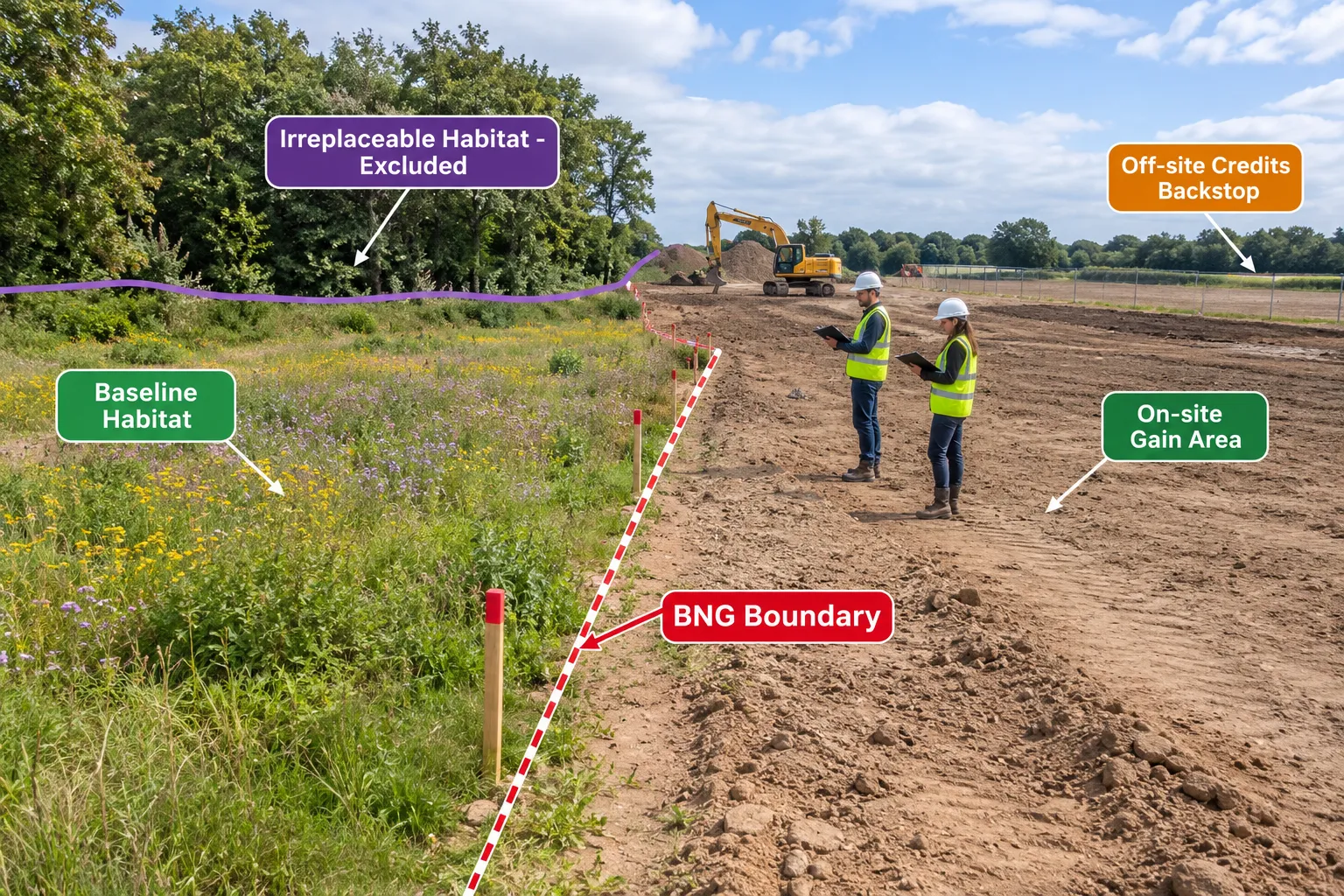
There are no sector-specific exemptions. Every NSIP promoter, regardless of project type, now works within the same framework. A new concept, the "BNG boundary", defines which habitats count in the baseline: only those negatively impacted within land that is permanently or temporarily affected by the project. Irreplaceable habitats sit outside this baseline entirely and cannot be offset using statutory credits, reflecting their legal status as not meaningfully replaceable.
Promoters have flexibility on where gains are delivered. Off-site gains can be provided in any of the local planning areas touched by the project corridor, rather than being tied to a single authority. The process itself runs in two stages: an outline biodiversity gain plan accompanies the development consent application, with a fully updated plan requiring approval before development begins. Statutory credits remain a backstop, usable only when on-site and off-site options are exhausted.
Fiona Ross of Pinsent Masons has observed that the way BNG will operate for NSIPs is distinct from the Town and Country Planning Act regime, and that promoters should be stress-testing their schemes against the new requirements now rather than after submission. For background on how this regime diverges from standard BNG, see our earlier coverage of NSIP biodiversity net gain rules for November 2026 and the 50-day countdown to the 2 November deadline.
Budget 2026's Brownfield Exemption: Why It Is Causing Confusion
The Autumn Budget, delivered on 28 October 2026, announced that residential brownfield developments on sites up to 1.5 hectares in England will be exempt from biodiversity net gain requirements. On paper this sounds decisive. In practice, the Budget document gives no start date for the exemption and states that the full consultation response and impact assessment will be published in due course.
That matters because Defra's consultation, which ran from 15 April to 10 June 2026, tested a range of thresholds between 0.5 and 2.5 hectares, not a single fixed figure. The consultation also proposed that at least 75% of a qualifying site be previously developed land, with safeguards to protect priority habitats where they exist. None of this detail was confirmed in the Budget.
Perhaps most striking is a warning buried in Defra's own consultation: combined with the existing 0.2-hectare small sites exemption, a brownfield exemption could reduce off-site BNG market transactions by as much as 48%. That is a significant contraction in a market that ecological consultants, landowners and habitat bank operators have been building since mandatory BNG began. Readers tracking the smaller exemption already in force should review our analysis of the 0.2-hectare exemption now in force and the brownfield exemption consultation details.
Reaction: A Clear Tension Between Housing Delivery and Nature Markets
Reaction to the brownfield announcement has been sharply divided. Penny Simpson of Freeths called it disappointing, noting that brownfield sites can be rich in biodiversity and warning of a "clear tension" between the exemption and the government's stated aim of growing private demand for nature markets.
The Wildlife Trusts' Dom Higgins argued the exemption removes chances to add trees, ponds, habitats and parks to urban communities. The Bumblebee Conservation Trust echoed similar concerns, pointing out that some brownfield sites support flower-rich pollinator habitat.
Not all reaction was critical. The Local Government Association broadly supports measures that make brownfield development easier, but it wants more detail on the implications for councils and local nature recovery.
Key Dates at a Glance
| Date | What Happened |
|---|---|
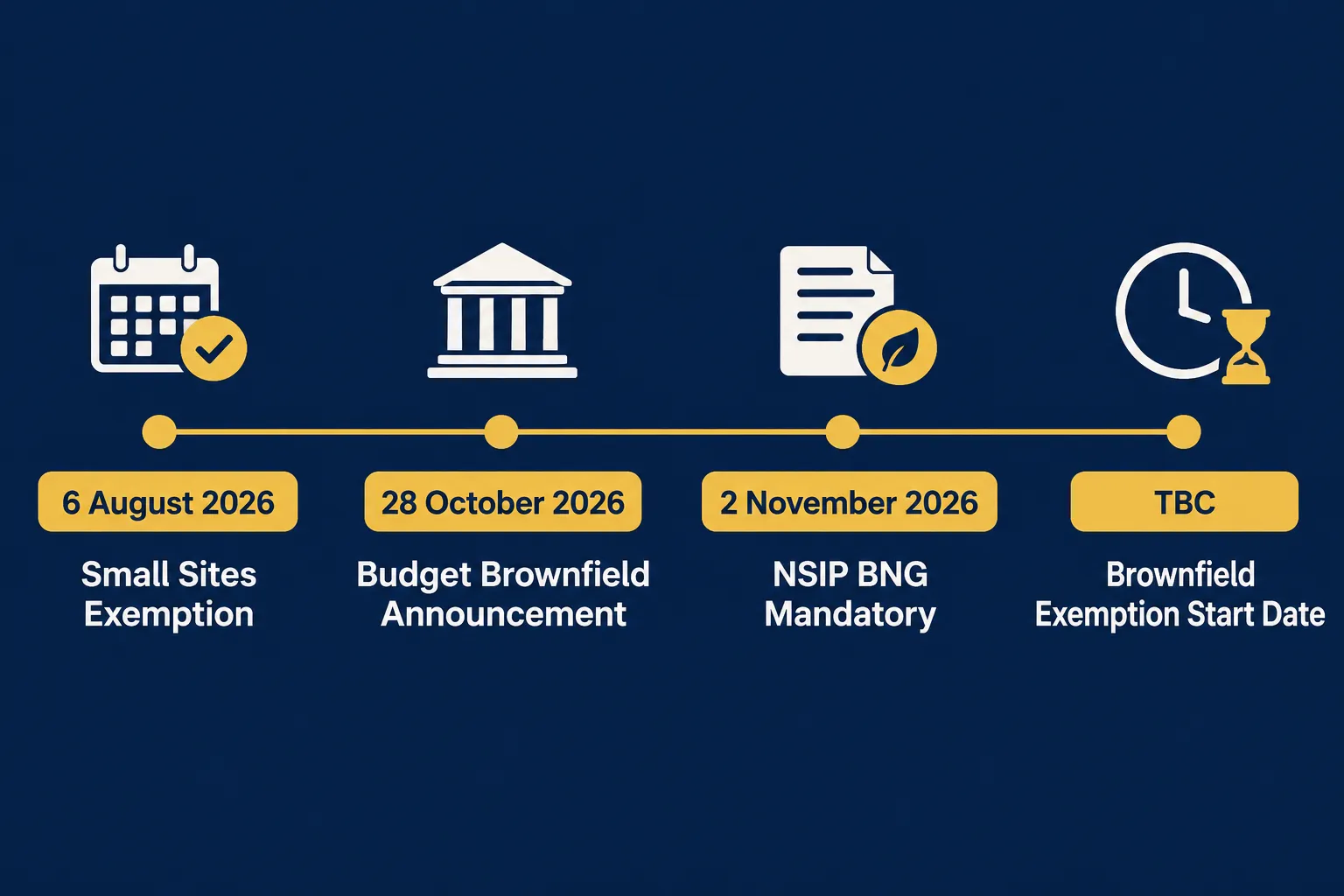
| 6 August 2026 | SI 2026/790 small sites exemption (up to 0.2 hectares) applies to new applications, conditional on no priority habitat impact |
| 28 October 2026 | Autumn Budget announces future brownfield exemption (up to 1.5 hectares) for residential development |
| 2 November 2026 | Mandatory 10% BNG becomes law for NSIP development consent applications |
| TBC | Start date for the 1.5-hectare brownfield exemption, pending consultation response and legislation |
Practical Advice for Developers and Promoters This Week
Until the brownfield exemption is actually legislated, nothing changes operationally. A biodiversity gain plan must still be approved before works start on any qualifying development. The existing 0.2-hectare exemption still demands evidence that priority habitats are not affected, it is not a blanket pass for small sites.
For NSIP promoters, the priority now is timing. Baseline UKHab and condition surveys should be commissioned early because seasonal survey windows constrain when accurate habitat assessments can be carried out, and delays here cascade into consenting timelines. Any habitat creation counted towards gains, on-site or off-site, must be secured for a minimum of 30 years, a long-term commitment that should factor into land strategy and legal agreements from the outset.
Consultants should also watch for divergence between the standard Town and Country Planning Act BNG regime and the NSIP-specific rules, particularly around the BNG boundary and irreplaceable habitat treatment. For more on preparing for approval stages, see guidance on what infrastructure developers must do now and the broader NSIP mandate guide for developers and surveyors.
FAQ
Does the brownfield exemption apply now?
No. The Budget announced the policy intention but gave no start date. Legislation and an impact assessment are still to come.
Which projects are affected by the 2 November NSIP rule?
Any Planning Act 2008 development consent application submitted on or after 2 November 2026, with no sector exemptions.
Are irreplaceable habitats included in NSIP baselines?
No. They are excluded from the baseline and cannot be compensated using statutory credits.
Can off-site NSIP gains be delivered anywhere?
They must be within one of the local planning areas affected by the project, not anywhere in England.
Does the 0.2-hectare exemption still require survey evidence?
Yes. It applies only where there is no impact on on-site priority habitat, which must be evidenced.
How long must created habitat be maintained?
A minimum of 30 years for gains to count towards the statutory requirement.
Conclusion
This week marks a genuine fork in England's biodiversity net gain story. The NSIP regime is now operational law, with firm obligations, survey timelines and a distinct boundary methodology that promoters cannot afford to treat as an afterthought. The brownfield exemption, by contrast, remains a policy announcement awaiting legislative substance, and one that has already drawn warnings about its potential impact on the off-site habitat market.
Developers, landowners and planning consultants navigating either side of this divide should seek current, project-specific advice before assuming any exemption applies. Contact Biodiversity Surveyors today for baseline UKHab surveys, biodiversity gain plan preparation, and expert guidance on how the NSIP regime and pending brownfield exemption affect your scheme.