

One rule change, 268 habitat banks, and a national infrastructure pipeline worth billions are about to collide. From November 2026, every Nationally Significant Infrastructure Project in England must deliver biodiversity net gain NSIP November 2026 rules in full, and analysts at Barclays are already warning of a "step change" that "threatens to create supply constraints" in the nature-credit market.
For infrastructure promoters, landowners and ecology consultants, this is not a distant policy footnote. It is a supply-and-demand problem with a hard deadline, and the window to prepare through early baseline surveys is closing fast.
Key Takeaways
- Mandatory 10% biodiversity net gain for NSIPs starts in November 2026, covering every NSIP type with no exemptions.
- Barclays warns the expansion could create "supply constraints" as infrastructure developers compete with housebuilders for a limited pool of nature credits.
- The registered habitat-bank market grew from 254 in May 2026 to 268 by August 2026, a 5.5% rise, but likely not enough to absorb NSIP-scale demand everywhere.
- Gains must be secured and maintained for at least 30 years, and temporary impacts now count toward the BNG boundary, widening the scope of what projects must offset.
- Early UKHab baseline surveys and metric calculations will be the deciding factor in whether promoters secure affordable units or face last-resort statutory credits.
What Changes for Biodiversity Net Gain NSIP November 2026 Rules
Mandatory BNG for ordinary development began in February 2024. NSIPs, major projects like new rail lines, reservoirs, energy infrastructure and large road schemes, were given a longer runway. That runway ends in November 2026.
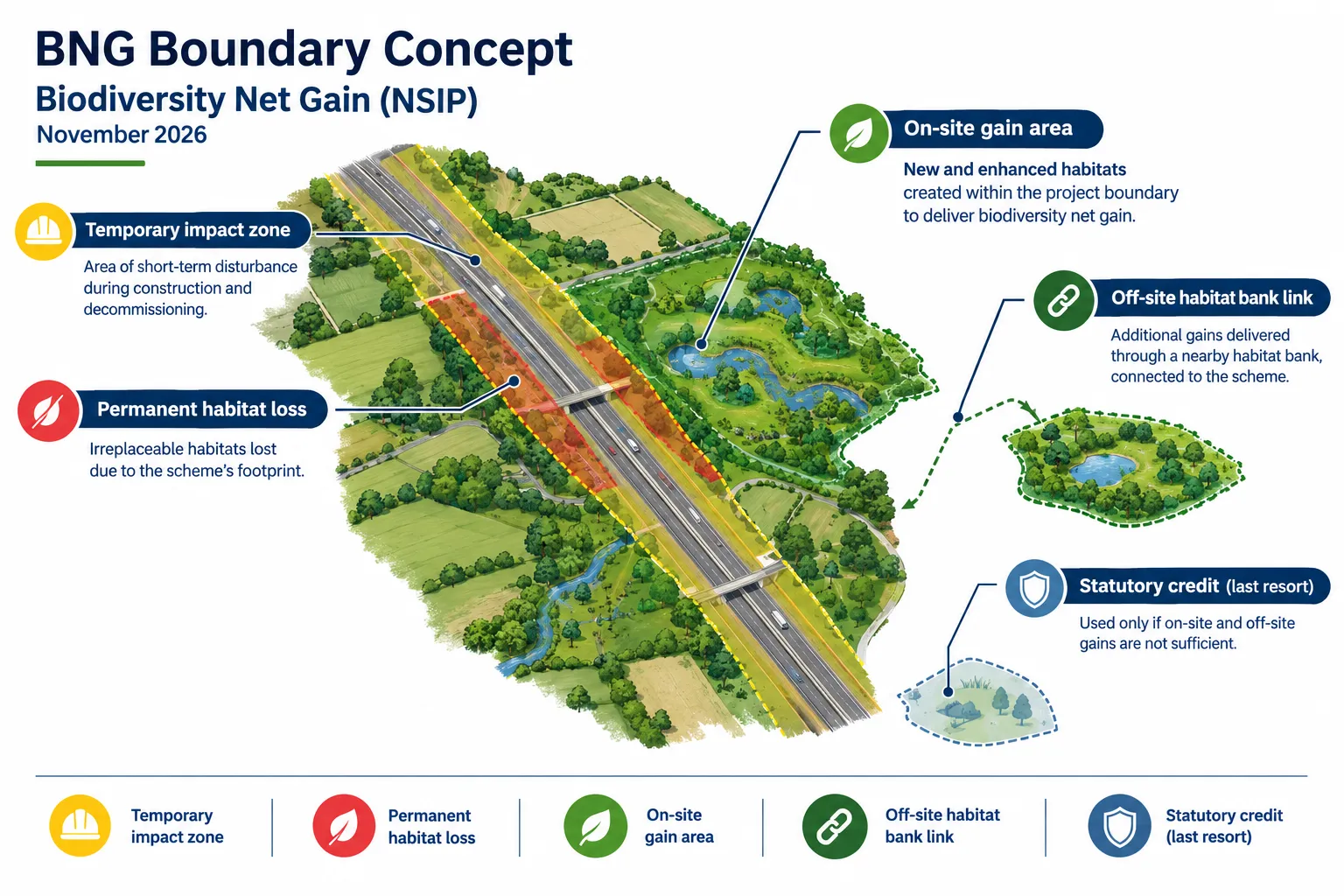
Per the government response summarised by CIEEM in April 2026, the new rules require:
- A 10% biodiversity net gain calculated against a pre-development baseline, applied to all NSIP types with no carve-outs.
- A defined BNG boundary that captures habitats negatively affected, whether temporarily or permanently, plus any land used to deliver gains.
- Recognition that temporary impacts count, a compound used for two years during construction still triggers an offsetting obligation.
- A mitigation hierarchy of on-site gains first, off-site gains second, and statutory biodiversity credits only as a genuine last resort.
- A 30-year minimum maintenance and monitoring commitment for any significant gains delivered.
This is a materially wider net than the rules applied to housing and commercial schemes. NSIPs often span many kilometres, cross multiple National Character Areas, and disturb habitats at a scale few single housing developments ever approach.
Why Barclays Sees a Bottleneck Risk
Barclays' October 2026 insight, "Two years in, this is what the Biodiversity Net Gain market needs to mature," lands squarely on this question. According to BusinessGreen's analysis, the bank expects NSIP entry to sharply increase competition for a limited supply of nature credits, pushing infrastructure promoters into the same marketplace that housebuilders, small developers and local planning authorities already use.
"A step change that threatens to create supply constraints", Barclays, as reported by BusinessGreen, October 2026
The concern is straightforward. Habitat banks are not interchangeable commodities. A unit of lowland meadow in one county cannot necessarily substitute for lowland meadow lost in another, because strategic significance and local character area weightings affect the metric score. NSIPs, by their linear or large-footprint nature, tend to impact a wide range of habitat types across many geographies simultaneously, exactly the pattern that strains localised supply.
Biodiversity Units UK's market data gives some reassurance, but also shows the scale of the challenge. Registered habitat-bank suppliers rose from 254 in May 2026 to 268 by August 2026, a 5.5% increase in just three months. That is genuine growth. Whether it is growth in the right habitat types and the right regions to match NSIP demand is a separate, unanswered question.
Reading the Current Nature-Credit Market
Before NSIP demand even enters the picture, the existing market is still finding its footing. Biodiversity Units UK's July 2026 pricing report, based on 254 habitat banks, roughly 95% of the registered market, gives the clearest snapshot available of how supply is distributed.
Its BNG Experience Survey 2026, covering 107 customers, found that 73% of developers report growing confidence in the BNG system. That is a positive signal for market maturity. It suggests habitat banks, brokers and metric assessors have, on balance, made the process workable for ordinary development.
Separately, Defra's August 2026 reforms allow minor developments to choose off-site units as their first option, rather than defaulting to on-site delivery. That flexibility eases pressure on small sites but, logically, nudges more buyers toward the same off-site unit pool that NSIPs will now also be drawing from.
The practical risk is concentration, not total scarcity. Certain habitat types, species-rich grassland, wetland and watercourse-linked habitats in particular, and certain National Character Areas along major transport or energy corridors could see unit demand spike well ahead of supply, even while the national market average looks comfortable.
What This Means for Ecology Surveys and Metric Timing
For anyone sponsoring, promoting or advising on an NSIP, the operational lesson is simple: the earlier the baseline survey, the more options remain on the table.
| Action | Why it matters under biodiversity net gain NSIP November 2026 rules |
|---|---|
| Early UKHab baseline survey | Establishes the true pre-development condition before the November deadline tightens unit competition |
| Metric calculation and scenario testing | Identifies which habitat types and NCAs carry the biggest gain obligation, before procurement begins |
| Off-site unit reservation | Secures supply ahead of rival NSIP and housing-sector demand in the same corridor |
| Temporary-impact mapping | Captures construction-phase land take, now explicitly inside the BNG boundary |
| 30-year management planning | Confirms long-term delivery partners and legal agreements are in place early |
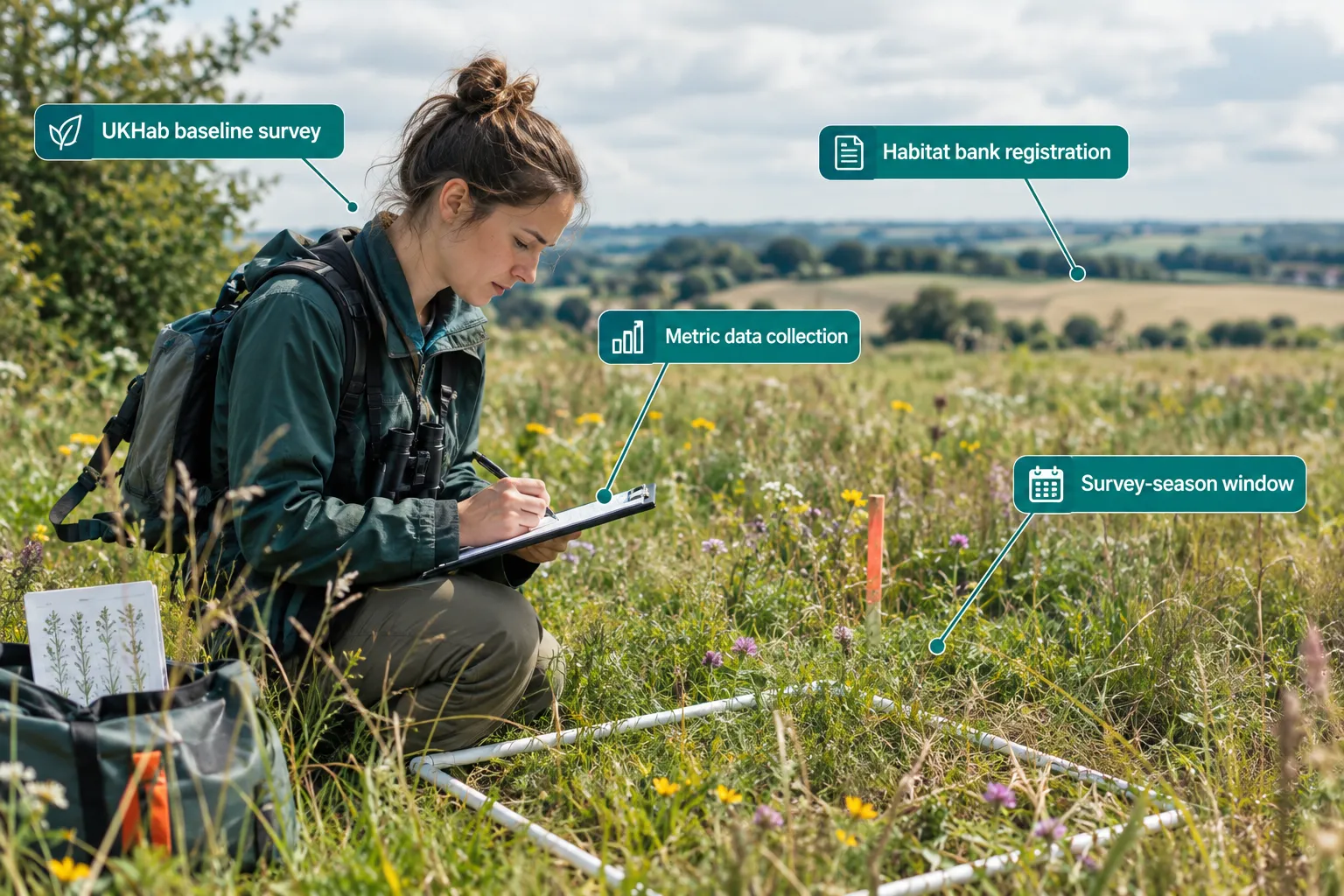
Survey-season timing adds another layer of urgency. Many of the habitat surveys that feed a robust UKHab baseline, botanical surveys, protected species assessments, bat and bird activity surveys, are season-dependent, typically running from spring through early autumn. Projects targeting late-2026 or 2027 applications that have not already commissioned baseline work risk missing the current survey window entirely, pushing their metric submission, and their unit procurement, into next year.
Promoters who commission baseline ecology surveys and metric calculations now, ahead of the November 2026 commencement, are effectively buying themselves negotiating room, both in unit price discovery and in choice of habitat bank location.
Practical Steps for Developers and Landowners
- Commission baseline surveys this season. Do not wait for planning submission deadlines to start ecological fieldwork.
- Map the full BNG boundary early, including temporary construction land and any haul roads or compounds.
- Model multiple delivery scenarios, on-site, off-site and blended, rather than assuming statutory credits as a fallback.
- Engage habitat-bank suppliers directly in the National Character Areas the project will affect, rather than relying solely on national averages.
- Build 30-year management costs into the business case, not just the upfront unit purchase price.
Frequently Asked Questions
When does mandatory BNG start for NSIPs?
From November 2026, all Nationally Significant Infrastructure Projects in England must deliver a minimum 10% biodiversity net gain, with no exemptions by project type.
Does BNG for NSIPs cover temporary construction impacts?
Yes. The defined BNG boundary includes habitats affected temporarily, such as construction compounds and haul roads, as well as permanent habitat loss.
Why are analysts warning about a bottleneck?
Barclays expects NSIP entry into the market to intensify competition for a limited pool of nature credits, particularly in habitat types and regions where supply is already thin.
How long must biodiversity gains be maintained?
A minimum of 30 years for any significant habitat gains secured to meet the net gain requirement.
Can NSIPs use statutory biodiversity credits instead of habitat banks?
Only as a last resort, after on-site and off-site options have genuinely been explored and the mitigation hierarchy has been followed.
Is the habitat-bank market growing fast enough?
Registered suppliers rose 5.5% between May and August 2026, which is encouraging, but growth may not be evenly matched to the specific habitat types and corridors NSIPs will affect.
Conclusion
The expansion of biodiversity net gain NSIP November 2026 rules marks the most significant test yet of England's nature-credit market. Two years after mandatory BNG began for ordinary development, confidence is rising, 73% of developers now report growing comfort with the system, but infrastructure-scale demand is a different order of magnitude from a housing estate's obligation.
The organisations best placed to navigate the change will be those who treat ecology survey timing as a commercial decision, not a compliance afterthought. Commissioning UKHab baseline surveys and metric calculations now, ahead of peak NSIP demand, is the clearest lever available to control cost, secure the right habitat types, and avoid being pushed toward statutory credits as a last resort. Act during this survey season, not after the November 2026 deadline has already reshaped the market.
biodiversity net gain, BNG NSIP November 2026, nature credits, habitat banks, UKHab survey, ecology surveys, nationally significant infrastructure projects, biodiversity metric, off-site biodiversity units, statutory biodiversity credits, Defra BNG rules, infrastructure planning UK