

The future of wildlife monitoring isn't found in massive data centers or expensive cloud infrastructure—it's happening in the palm of your hand. TinyML devices, no larger than a matchbox, are revolutionizing how ecologists track endangered species, detect illegal logging, and monitor ecosystem health in the world's most remote locations. This TinyML Devices for Remote Biodiversity Surveys: Practical Deployment Guide for 2026 Ecology Fieldwork explores how low-power artificial intelligence is transforming conservation efforts by enabling real-time species detection in areas where traditional monitoring methods fail.
Unlike conventional AI systems that require constant internet connectivity and substantial computing power, TinyML operates entirely offline using pre-trained models stored directly on microcontroller units (MCUs) with mere kilobytes of memory and milliwatt power budgets[2]. This breakthrough technology allows researchers to deploy autonomous monitoring stations deep in rainforests, mountain ranges, and other inaccessible ecosystems where biodiversity assessment has traditionally been prohibitively expensive or logistically impossible.
Key Takeaways
✅ TinyML devices enable autonomous wildlife monitoring in remote locations without internet access, running sophisticated AI models on battery power for months or even years[2]
✅ Real-time species identification through bioacoustic and image analysis achieves 92-98% accuracy while consuming minimal energy compared to cloud-based systems[1][3]
✅ Hybrid edge-cloud architectures deliver the most effective conservation outcomes by processing data locally and transmitting only critical alerts[1]
✅ Hardware costs have dropped dramatically in 2026, with AI accelerators like Raspberry Pi AI HATs making multimodal sensor deployments accessible to field researchers[2]
✅ Successful deployment requires collaboration between ecologists, engineers, and data scientists to align model development with specific ecological research questions[2]
Understanding TinyML Technology for Biodiversity Applications
What Makes TinyML Different from Traditional AI?
TinyML represents a fundamental shift in how artificial intelligence operates in conservation contexts. Traditional machine learning systems require substantial computational resources, constant power supplies, and reliable internet connectivity—luxuries rarely available in remote field sites. TinyML flips this paradigm by compressing sophisticated neural networks into models small enough to run on microcontrollers that cost less than £10 and consume less power than a digital watch.
The technology achieves this efficiency through several key innovations:
- Model quantization reduces neural network precision from 32-bit to 8-bit or even 4-bit representations
- Pruning techniques remove unnecessary connections in neural networks
- Knowledge distillation transfers learning from large models to compact versions
- Hardware-specific optimization tailors models to particular microcontroller architectures
Recent implementations demonstrate these trade-offs clearly. MegaDetector v6-compact, designed specifically for wildlife camera trap analysis, reduces parameters to 22 million while accepting a modest precision decrease (96% to 92%) to achieve improved recall (73% to 85%) and faster inference speeds suitable for edge deployment[2].
Core Components of TinyML Biodiversity Monitoring Systems
A complete TinyML biodiversity monitoring system comprises several interconnected elements:
| Component | Function | Typical Specifications |
|---|---|---|
| Microcontroller Unit (MCU) | Runs inference models | 256KB-2MB RAM, 32-bit ARM Cortex |
| Sensors | Captures environmental data | Microphones, cameras, environmental sensors |
| Power System | Provides energy | Solar panels, lithium batteries, energy harvesting |
| Storage | Logs detections | MicroSD cards, onboard flash memory |
| Communication Module | Transmits alerts | LoRaWAN, satellite, cellular (optional) |
| Weatherproof Housing | Protects electronics | IP67-rated enclosures |
The sensor selection determines what biodiversity data the system can capture. Acoustic sensors excel at monitoring vocalizing species like birds, amphibians, and primates. Camera modules detect visual patterns and can identify species through morphological features. Environmental sensors (temperature, humidity, air quality) provide ecological context that enhances species distribution modeling.
Practical Hardware Selection for 2026 Ecology Fieldwork
Recommended TinyML Platforms for Different Survey Scenarios
Choosing the right hardware platform depends on your specific biodiversity monitoring objectives, power constraints, and budget. Here are the most reliable options for 2026 fieldwork:
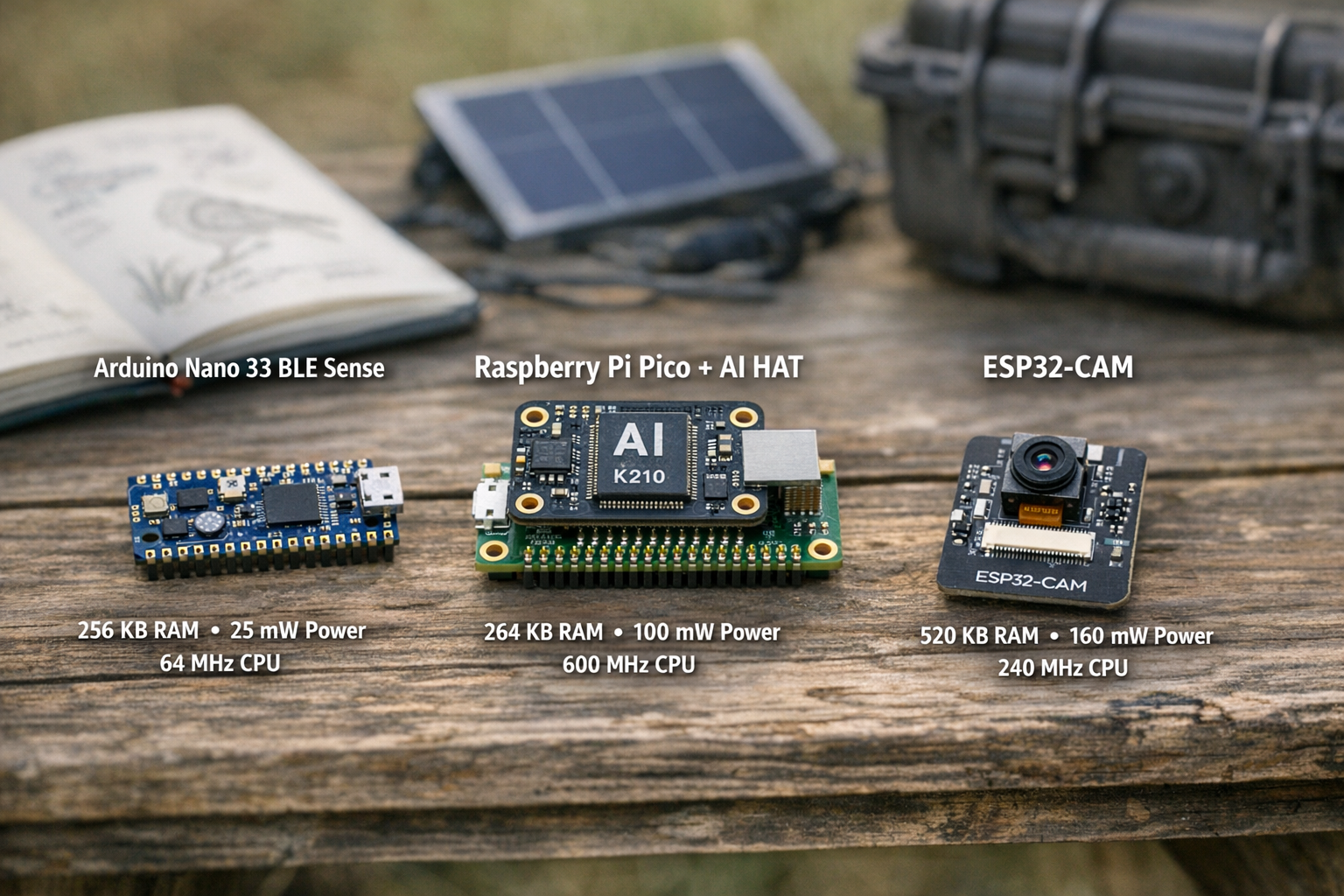
🔷 Arduino Nano 33 BLE Sense
- Best for: Acoustic monitoring of bird and amphibian calls
- Strengths: Built-in microphone, temperature, humidity, and pressure sensors; excellent power efficiency
- Limitations: Limited processing power for complex image analysis
- Typical deployment: Automated bird song identification in forest canopy monitoring
🔷 Raspberry Pi Pico with AI HAT+
- Best for: Multimodal monitoring combining audio and visual detection
- Strengths: Affordable AI acceleration, expandable sensor ecosystem, strong community support
- Limitations: Higher power consumption than pure microcontroller solutions
- Typical deployment: Camera trap systems with on-device species classification
🔷 ESP32-CAM
- Best for: Visual wildlife detection with wireless connectivity
- Strengths: Integrated camera, Wi-Fi capability, extremely low cost (under £5)
- Limitations: Limited RAM for complex models
- Typical deployment: Perimeter monitoring for illegal activity detection in protected areas
🔷 Coral Dev Board Micro
- Best for: High-accuracy species identification requiring fast inference
- Strengths: Dedicated Edge TPU accelerator, excellent performance-per-watt
- Limitations: Higher cost (approximately £40-50)
- Typical deployment: Critical conservation applications requiring maximum accuracy
The emerging Raspberry Pi AI HATs (HAT+ and HAT+ 2) represent particularly exciting developments for 2026, offering hardware acceleration that expands the feasibility of multimodal sensor deployments on edge devices[2]. These accelerators enable researchers to run more sophisticated models without proportionally increasing power consumption.
Power Management Strategies for Extended Deployments
Power availability often represents the primary constraint in remote biodiversity monitoring. Successful deployments in 2026 employ several proven strategies:
Solar Power Systems: The PV-Pi system and similar solar charging solutions enable indefinite deployment in locations with adequate sunlight[2]. Properly configured solar arrays with battery buffering can maintain continuous operation even through multiple cloudy days.
Duty Cycling: Rather than running continuously, TinyML devices can activate sensors on schedules aligned with target species' activity patterns. For example, bat monitoring systems might operate only during twilight and nighttime hours, dramatically extending battery life.
Wake-on-Event Triggers: Advanced systems use low-power sensors as triggers. A simple motion detector consuming microamps can wake the main processing system only when potential wildlife activity occurs, reducing average power consumption by 90% or more.
Energy Harvesting: Beyond solar, some deployments incorporate piezoelectric generators, thermoelectric generators, or even kinetic energy harvesting from animal movement for specialized applications like the tortoise tracking systems deployed in Argentina[3].
Model Development and Optimization for TinyML Devices in Remote Biodiversity Surveys
Training Effective Species Recognition Models
Creating accurate species identification models for TinyML deployment requires balancing accuracy, model size, and inference speed. The process typically follows these stages:
1. Dataset Collection and Preparation
Start with high-quality, labeled training data representing the species and conditions you'll encounter in the field. For bioacoustic monitoring, this means audio recordings capturing target species calls across various environmental conditions (rain, wind, distance variations). For visual identification, collect images showing species from multiple angles, lighting conditions, and life stages.
2. Model Architecture Selection
Choose architectures specifically designed for resource-constrained devices:
- MobileNet variants for image classification
- EfficientNet-Lite for balanced accuracy and efficiency
- Temporal Convolutional Networks (TCN) for audio analysis
- YOLO-Nano for object detection tasks
3. Training with Compression in Mind
Apply quantization-aware training, which simulates the effects of reduced precision during the training process. This produces models that maintain accuracy even when compressed to 8-bit or 4-bit representations required for TinyML deployment.
4. Model Conversion and Optimization
Convert trained models to TensorFlow Lite format, then apply optimization techniques:
- Post-training quantization
- Weight pruning (removing least important connections)
- Clustering (grouping similar weights)
Real-world implementations demonstrate impressive results. Researchers have achieved 96-98% accuracy identifying coffee plant diseases using TinyML systems, including fungal diseases and pest damage, deployable as handheld devices for farmer use[3]. Similarly, hornbill call identification systems in Malaysia's forests achieve high accuracy on edge devices, enabling real-time biodiversity monitoring without constant data transmission[1].
Validation and Field Testing Protocols
Before full deployment, rigorous validation ensures your TinyML system performs reliably under actual field conditions. This TinyML Devices for Remote Biodiversity Surveys: Practical Deployment Guide for 2026 Ecology Fieldwork emphasizes these critical testing phases:
Laboratory Validation:
- Test against held-out datasets not used in training
- Calculate precision, recall, and F1 scores for each target species
- Identify confusion patterns (which species are mistaken for each other)
- Measure inference latency and power consumption under various scenarios
Pilot Deployment:
- Install 3-5 devices in representative field locations
- Run parallel monitoring with traditional survey methods (human observers, conventional recording equipment)
- Compare automated detections against expert verification
- Document false positive and false negative rates in real conditions
Environmental Stress Testing:
- Expose devices to temperature extremes expected in deployment areas
- Test waterproofing through simulated rain events
- Verify solar charging performance under cloudy conditions
- Assess battery degradation over accelerated cycling
For biodiversity assessments that feed into formal processes like biodiversity impact assessments, validation rigor becomes even more critical, as data quality directly affects regulatory compliance and conservation outcomes.
Deployment Strategies for Remote Field Sites
Site Selection and Installation Best Practices
Strategic placement of TinyML monitoring devices maximizes detection probability while minimizing maintenance requirements. Consider these factors when selecting installation locations:
Ecological Considerations:
- Species habitat preferences: Install acoustic monitors near known breeding sites, feeding areas, or travel corridors
- Detection range: Position cameras and microphones to optimize coverage based on sensor specifications (typically 10-30m for cameras, 50-100m for microphones)
- Environmental interference: Avoid locations with constant background noise (waterfalls, roads) that complicate acoustic analysis
Technical Requirements:
- Solar exposure: Ensure panels receive 4-6 hours of direct sunlight daily for sustainable operation
- Cellular/LoRaWAN coverage: If using wireless data transmission, verify signal strength before installation
- Physical security: Select locations that minimize tampering risk while remaining accessible for maintenance
- Mounting stability: Use secure attachment methods that withstand wind, animal interference, and vegetation growth
Installation Techniques:
For tree-mounted systems, use non-invasive strapping rather than nails or screws that damage bark and create disease entry points. Position devices 2-4 meters above ground to reduce vandalism risk while maintaining accessibility for battery replacement and data retrieval.
Camera trap positioning follows the "rule of thirds"—aim the detection zone to intersect likely wildlife paths at approximately one-third frame height. This composition maximizes detection probability while providing clear species identification angles.
Data Management and Transmission Protocols
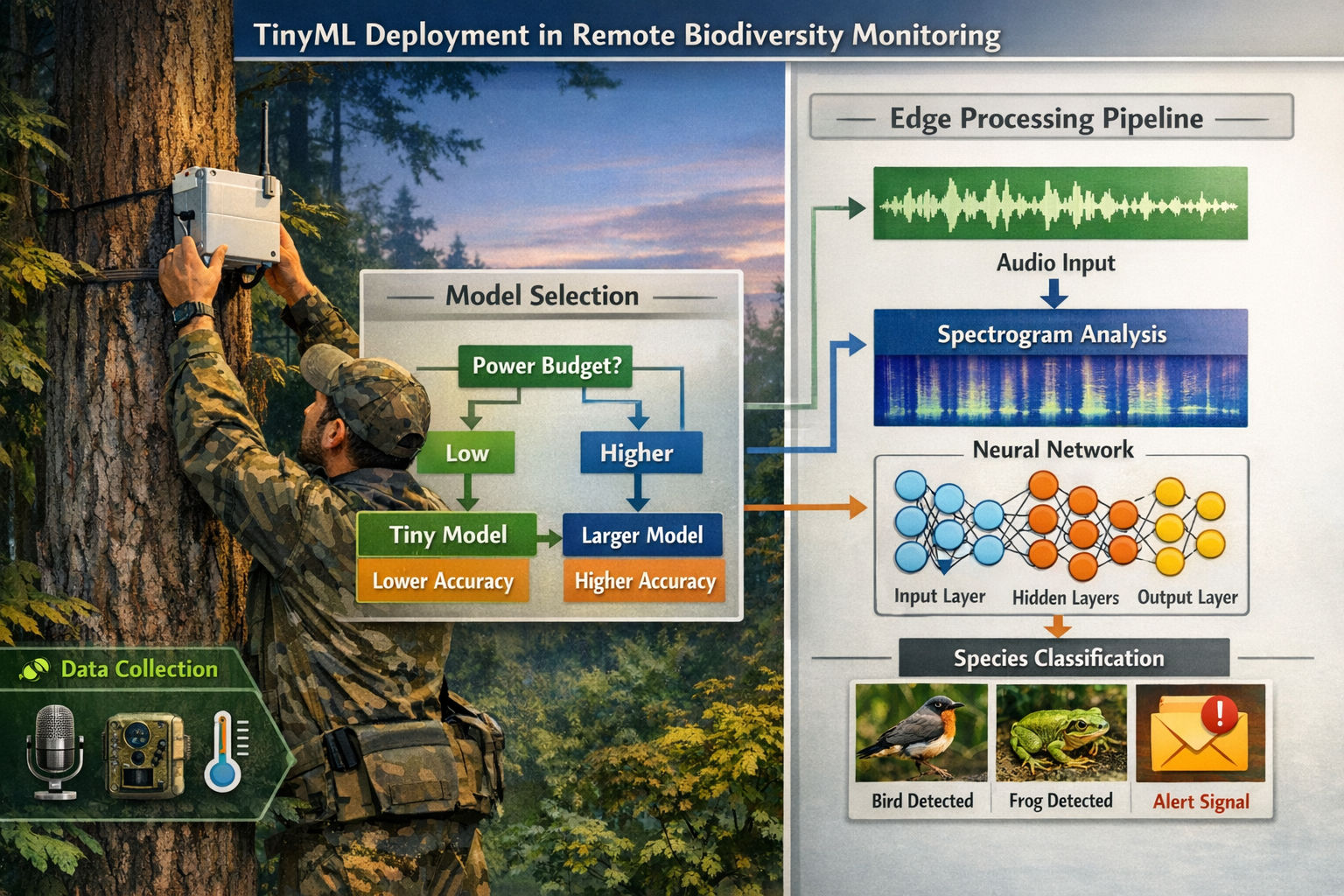
TinyML systems excel precisely because they process data locally and transmit only meaningful results rather than raw sensor streams. This approach dramatically reduces bandwidth costs and energy consumption compared with continuous cloud-dependent systems[1].
Edge Processing Workflow:
- Sensor captures environmental data (audio snippet, image)
- TinyML model performs inference on-device
- System evaluates confidence score against threshold
- Only detections exceeding threshold trigger storage or transmission
- Metadata (timestamp, GPS coordinates, confidence score) accompanies detection
Data Transmission Options:
📡 LoRaWAN (Long Range Wide Area Network)
- Range: 2-15km depending on terrain
- Power consumption: Extremely low (ideal for battery operation)
- Data rate: Low (suitable for detection alerts, not raw images)
- Best for: Sparse networks covering large protected areas
📡 Cellular (4G/5G)
- Range: Limited by tower coverage
- Power consumption: Moderate to high
- Data rate: High (can transmit images if needed)
- Best for: Sites with existing cellular infrastructure
📡 Satellite Communication
- Range: Global coverage
- Power consumption: High
- Data rate: Low to moderate
- Cost: Expensive per message
- Best for: Truly remote locations without terrestrial options
The most effective conservation systems deliberately distribute intelligence across edge and cloud based on context and constraints, rather than relying entirely on local processing[1]. For example, a system might perform initial species classification on-device, transmit detection alerts via LoRaWAN, then retrieve full audio recordings during periodic site visits for detailed analysis and model improvement.
Organizations working on biodiversity net gain projects can integrate TinyML monitoring data into baseline assessments and long-term effectiveness monitoring, providing quantitative evidence of habitat enhancement outcomes.
Real-World Applications and Case Studies
Successful TinyML Biodiversity Monitoring Projects
🌳 Hornbill Conservation in Malaysian Rainforests
Researchers deployed TinyML-enabled acoustic monitors throughout Malaysia's forests to track hornbill populations, which serve as indicator species for forest health. The system identifies hornbill calls with high accuracy on edge devices, enabling real-time biodiversity monitoring without constant data transmission to centralized servers[1]. This approach proved particularly valuable in areas where cellular connectivity is unreliable or nonexistent.
The project demonstrated that on-device analysis eliminates cloud round-trip delays, enabling faster response cycles critical for adaptive management decisions. When hornbill activity patterns shifted unexpectedly, researchers could quickly deploy additional sensors to investigate potential causes without waiting for centralized data processing.
🐢 Tortoise Movement Tracking in Argentina
Field biologists attached miniaturized TinyML devices directly to tortoise shells to study movement patterns and habitat use in remote Argentine ecosystems[3]. The ultra-low power consumption allowed devices to operate for entire field seasons without battery replacement, while GPS logging combined with accelerometer data revealed detailed behavioral patterns.
This deployment highlighted the importance of ruggedization—devices needed to withstand not just weather exposure but also the physical stresses of being carried through dense vegetation and occasional impacts as tortoises navigated rocky terrain.
💧 Water Quality Monitoring for Indigenous Communities
Solar-powered water quality sensors paired with TinyML inference devices were deployed in Malaysian lakes (Tasik Chini Lake) to assess pollution and provide predictions accessible to Indigenous communities relying on the water supply[3]. The system analyzes multiple parameters (turbidity, dissolved oxygen, pH, temperature) and uses machine learning to predict water quality trends, triggering alerts when conditions deteriorate.
This application demonstrates TinyML's potential beyond traditional wildlife monitoring, supporting ecosystem health assessment that directly benefits human communities while informing conservation priorities.
Illegal Activity Detection for Protected Area Management
Conservation teams increasingly embed TinyML models into sound- and image-sensing nodes to recognize patterns such as chainsaw noise or unauthorized vehicle movement. These systems trigger alerts only when specific signatures occur, reducing false positives while conserving battery life[1].
Key advantages over traditional security systems:
- No need for continuous video streaming (privacy-preserving)
- Immediate local analysis without internet dependency
- Dramatically lower false alarm rates through AI filtering
- Weeks or months of operation on battery power
One protected area in Southeast Asia reported a 70% reduction in illegal logging incidents after deploying TinyML acoustic monitoring that detected chainsaw activity and automatically notified rangers via satellite messaging. The system's ability to distinguish chainsaw sounds from similar natural noises (falling branches, animal activity) proved crucial for operational effectiveness.
For developers and landowners working to achieve biodiversity net gain, TinyML monitoring provides robust evidence of habitat creation success and can verify that enhancement areas remain protected from disturbance over required monitoring periods.
Troubleshooting Common Deployment Challenges
Technical Issues and Solutions
❌ Problem: High False Positive Rates
Symptoms: System detects target species when none are present, overwhelming researchers with incorrect alerts.
Solutions:
- Increase confidence threshold for triggering alerts (trade recall for precision)
- Retrain model with additional negative examples from actual deployment environment
- Implement multi-stage verification (require detections in consecutive time windows)
- Add environmental context filters (e.g., don't report nocturnal species during daylight)
❌ Problem: Insufficient Power Generation
Symptoms: Batteries drain faster than solar panels recharge them, causing system shutdowns.
Solutions:
- Increase solar panel capacity or add additional panels
- Implement more aggressive duty cycling (reduce active monitoring hours)
- Optimize model inference frequency based on species activity patterns
- Switch to lower-power sensors or MCU platforms
- Consider alternative energy sources (wind, thermoelectric) for specific environments
❌ Problem: Memory Overflow Errors
Symptoms: Device crashes or fails to complete inference due to insufficient RAM.
Solutions:
- Further compress model through quantization or pruning
- Process data in smaller chunks (sliding windows for audio analysis)
- Reduce input resolution (lower image dimensions, reduced audio sample rate)
- Upgrade to MCU with larger memory capacity
- Offload some processing to periodic cloud analysis during data retrieval
Environmental and Biological Considerations
🌧️ Weather-Related Challenges
Heavy rain creates acoustic interference that degrades bioacoustic monitoring accuracy. Advanced systems incorporate rain detection (through audio pattern recognition or dedicated rain sensors) and automatically pause species detection during precipitation events, conserving power and avoiding false classifications.
Extreme temperatures affect both electronics and battery performance. Deployments in desert environments may require thermal insulation and passive cooling strategies, while cold-climate installations benefit from battery warmers and low-temperature battery chemistry.
🦎 Wildlife Interference
Curious animals may investigate, chew, or nest in monitoring equipment. Effective deterrents include:
- Capsaicin-treated cable sheathing (deters rodents)
- Smooth, rounded enclosure designs (prevent perching)
- Strategic placement away from natural perches or travel routes
- Protective cages that allow sensor function while blocking access
🌿 Vegetation Growth
Rapidly growing vegetation can obscure cameras or block solar panels within weeks in tropical environments. Plan installation locations considering seasonal growth patterns, and schedule maintenance visits to coincide with peak growth periods. Some teams use vegetation management zones around installations, carefully trimming growth without significantly altering the monitoring area's ecological character.
Integration with Broader Conservation Strategies
Contributing to Biodiversity Assessment Frameworks
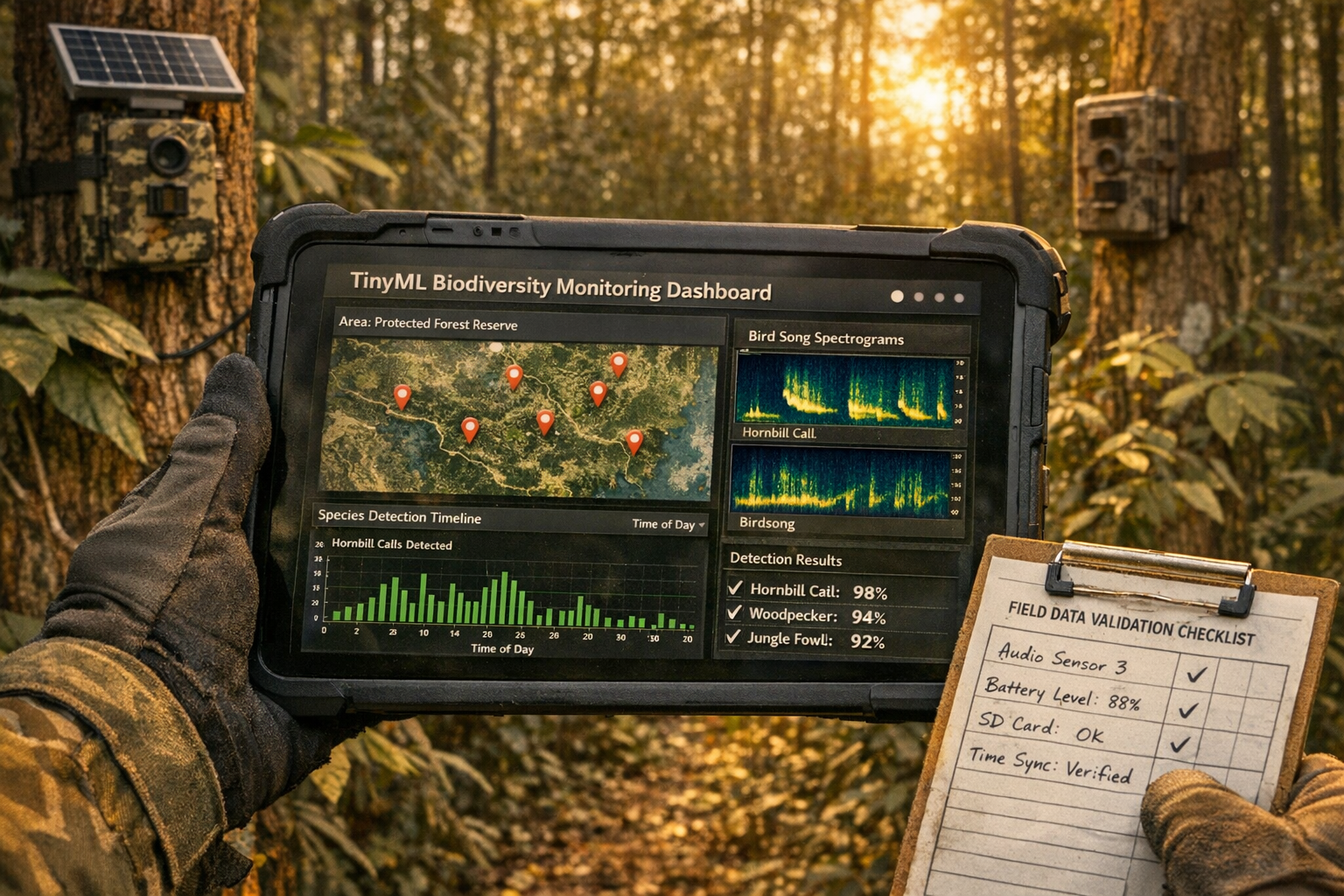
TinyML monitoring data provides quantitative evidence that strengthens formal biodiversity assessments. When integrated with established frameworks, automated monitoring delivers:
Baseline Documentation: Continuous pre-development monitoring establishes robust species presence and abundance baselines more comprehensively than traditional point surveys. This data supports accurate biodiversity impact assessments by documenting seasonal variation and rare species that might be missed in limited survey windows.
Mitigation Effectiveness Monitoring: After habitat creation or enhancement, TinyML devices provide ongoing verification that target species are utilizing new resources. This evidence supports biodiversity net gain compliance by demonstrating measurable improvements in biodiversity value.
Long-term Trend Analysis: Automated systems maintain consistent monitoring protocols across years or decades, eliminating observer bias and enabling robust statistical analysis of population trends. This capability proves particularly valuable for biodiversity credit schemes that require verified habitat quality improvements over extended periods.
Collaborative Development and Knowledge Sharing
Field implementations reveal that effective edge computing solutions require increased collaboration between ecologists, engineers, and data scientists to align model development with ecological questions and field constraints[2]. The most successful deployments emerge from interdisciplinary teams where:
- Ecologists define priority species, optimal survey timing, and validation protocols
- Engineers design robust hardware, power systems, and weatherproofing
- Data scientists develop and optimize models, establish confidence thresholds, and create analysis pipelines
- Local communities provide ecological knowledge, assist with installation, and benefit from monitoring outcomes
The TinyML4D initiative and similar programs specifically target conservation applications in biodiversity-rich regions, providing training, hardware, and technical support to researchers who might otherwise lack access to these technologies[4]. Participating in such collaborative networks accelerates learning and helps avoid common pitfalls that have already been solved elsewhere.
Future Developments and Emerging Technologies
Horizon Scan: TinyML Advances for 2026-2028
The TinyML landscape continues evolving rapidly, with several developments poised to enhance biodiversity monitoring capabilities:
🔬 Multimodal Fusion Models
Next-generation systems will seamlessly integrate audio, visual, environmental, and even olfactory sensors, creating comprehensive ecological portraits. A single device might combine bird song identification, insect visual detection, temperature monitoring, and air quality assessment, using cross-modal validation to improve overall accuracy.
🔬 Federated Learning at the Edge
Rather than training models centrally and deploying them, federated learning allows TinyML devices to collaboratively improve models while data remains distributed. Devices share model updates rather than raw data, preserving privacy while enabling continuous learning from real-world deployments.
🔬 Neuromorphic Computing
Emerging neuromorphic chips mimic biological neural architectures, achieving even lower power consumption than current TinyML platforms. Early prototypes demonstrate the potential for years-long deployments on coin-cell batteries for specific monitoring applications.
🔬 Biodegradable Electronics
Experimental biodegradable sensors address the environmental impact of lost or abandoned monitoring equipment. These devices function for programmed durations (months to years) then decompose into environmentally benign materials, eliminating electronic waste concerns in sensitive ecosystems.
Scaling from Pilot Projects to Landscape-Level Monitoring
As TinyML technology matures and costs continue declining, conservation organizations are shifting from small pilot deployments to landscape-scale monitoring networks comprising hundreds or thousands of coordinated devices. These networks enable:
- Spatial ecology analysis tracking how species move across fragmented landscapes
- Early warning systems for invasive species or disease outbreaks
- Ecosystem health dashboards providing real-time conservation status updates
- Adaptive management triggers automatically alerting managers when intervention thresholds are crossed
Successfully scaling requires standardized data formats, interoperable hardware platforms, and shared analysis infrastructure—challenges the conservation technology community is actively addressing through collaborative initiatives and open-source development.
Conclusion
TinyML Devices for Remote Biodiversity Surveys: Practical Deployment Guide for 2026 Ecology Fieldwork represents a transformative approach to conservation monitoring, enabling autonomous species detection in locations where traditional methods prove impractical or impossible. By processing data locally on ultra-low-power microcontrollers, these systems overcome the connectivity and power constraints that have historically limited remote biodiversity assessment.
The technology has matured significantly, with proven deployments demonstrating 92-98% accuracy for species identification while operating for months on battery power[1][3]. Hardware costs have dropped to accessible levels, with capable TinyML platforms available for under £50, and emerging AI accelerators expanding capabilities without proportionally increasing power consumption[2].
Successful implementation requires:
✅ Careful hardware selection aligned with specific monitoring objectives
✅ Rigorous model validation combining laboratory testing and field verification
✅ Strategic deployment considering ecological, technical, and logistical factors
✅ Hybrid architectures that intelligently distribute processing between edge and cloud[1]
✅ Interdisciplinary collaboration between ecologists, engineers, and data scientists[2]
Actionable Next Steps
For researchers planning TinyML deployments:
- Start small with a pilot deployment of 3-5 devices testing your target species and environment
- Validate rigorously by running parallel traditional surveys to verify automated detection accuracy
- Document everything including false positives, environmental challenges, and power consumption patterns
- Engage local communities who can provide ecological knowledge and assist with maintenance
- Share findings through open-source repositories and conservation technology networks
For organizations supporting biodiversity goals:
Consider how TinyML monitoring can strengthen biodiversity net gain strategies, provide evidence for biodiversity unit transactions, or enhance the credibility of conservation claims through continuous, automated verification.
The convergence of affordable hardware, sophisticated yet compact AI models, and growing collaborative networks positions 2026 as a pivotal year for TinyML adoption in conservation. By following the practical guidance in this deployment guide, ecologists can harness these technologies to expand biodiversity monitoring into previously inaccessible frontiers while maintaining scientific rigor and data quality.
The future of biodiversity conservation increasingly depends on our ability to monitor ecosystems continuously, comprehensively, and cost-effectively. TinyML devices provide the technological foundation to achieve these goals, transforming how we understand, protect, and restore the natural world.
References
[1] Tiny Machine Learning Tinyml In The Wild Offline Environmental Ai – https://www.ignitec.com/insights/tiny-machine-learning-tinyml-in-the-wild-offline-environmental-ai/
[2] arxiv – https://arxiv.org/html/2602.13496v1
[3] What S Tinyml Global South S Alternative Power Hungry Pricey Ai – https://www.science.org/content/article/what-s-tinyml-global-south-s-alternative-power-hungry-pricey-ai
[4] Tinyml Challenge – https://aiforgood.itu.int/about-us/tinyml-challenge/