

Imagine tracking every environmental impact of a product—from raw material extraction to final disposal—with the precision of a biodiversity surveyor mapping rare species habitats. In 2026, this vision is becoming reality as Product Passports for Supply Chain Biodiversity: Surveyor Tools for 2026 Circular Tracking and BNG revolutionize how ecologists, developers, and sustainability professionals measure and mitigate supply chain impacts on nature. These digital tools are transforming Biodiversity Net Gain (BNG) reporting from educated guesswork into data-driven science.
As the European Union's central Digital Product Passport (DPP) registry becomes operational by mid-2026[3], a new era of environmental accountability emerges. For biodiversity professionals, these passports offer unprecedented visibility into how products affect ecosystems throughout their lifecycle—enabling more accurate impact assessments and stronger Biodiversity Net Gain strategies.
Key Takeaways
✅ Digital Product Passports provide lifecycle environmental data that ecologists use to map supply chain biodiversity impacts with unprecedented accuracy
🌿 BNG reporting gains precision through standardized environmental footprint data, including carbon, water, and land use metrics tied to specific products and suppliers
📊 Three-phase implementation (2027-2033) progressively expands from basic disclosure to comprehensive circular economy tracking with full biodiversity impact documentation
🔗 Interoperable systems using GS1 Digital Link and EPCIS 2.0 standards enable surveyors to trace product origins and verify sustainability claims at unit level
⚡ Early adopters in batteries and textiles sectors (2027-2028) establish templates for biodiversity impact assessment that other industries will follow
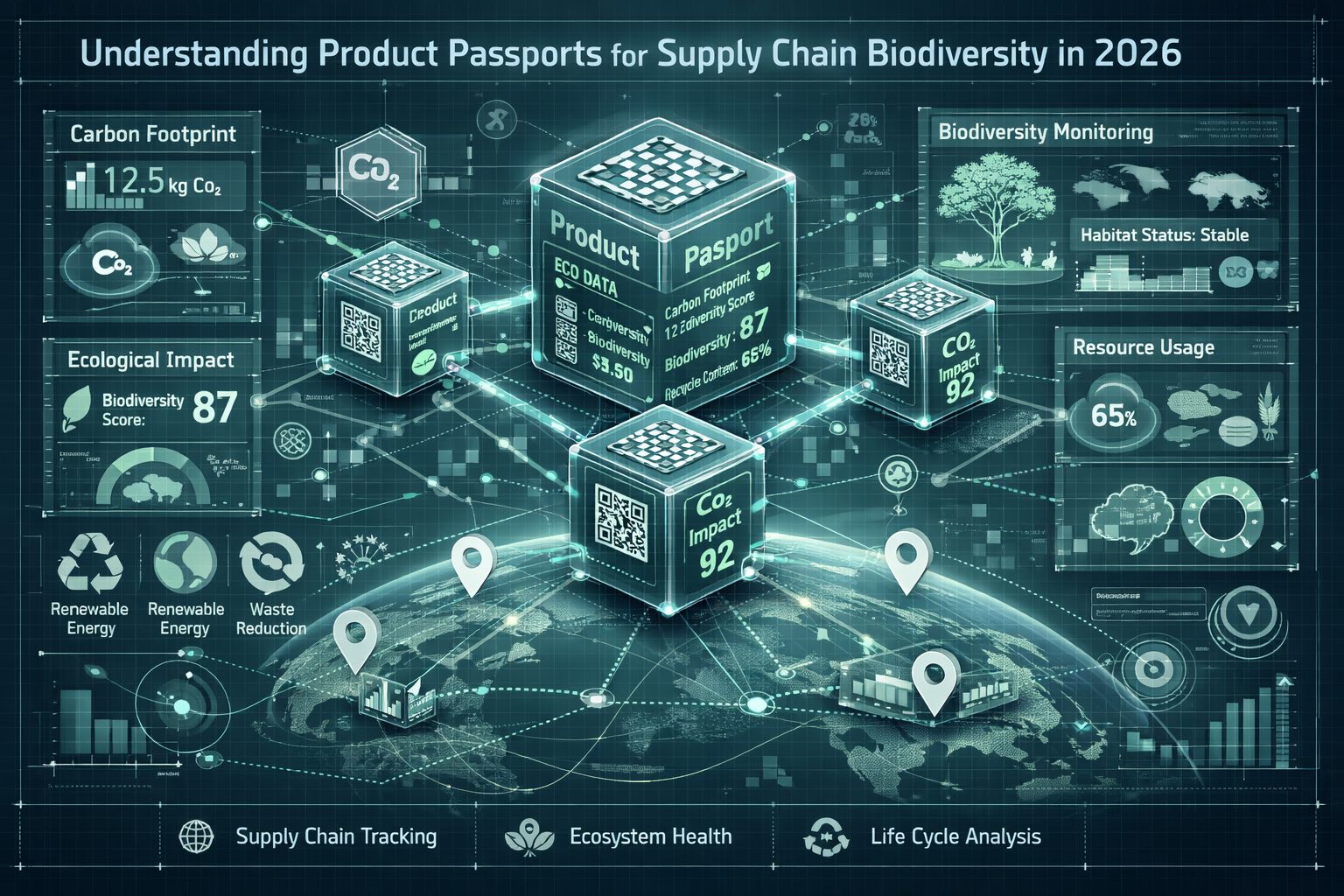
Understanding Product Passports for Supply Chain Biodiversity in 2026
What Are Digital Product Passports?
Digital Product Passports (DPPs) are comprehensive digital records that document a product's entire lifecycle—from raw material sourcing through manufacturing, distribution, use, and end-of-life disposal. Think of them as detailed "birth certificates" for products that track environmental impacts, material composition, and sustainability credentials[2].
For biodiversity surveyors and ecological consultants, DPPs represent a game-changing data source. Instead of relying on generic industry averages or supplier self-reporting, professionals can now access verified information about:
- 🌍 Geographic origin of raw materials and associated habitat impacts
- 💧 Water footprint across production stages
- 🏭 Carbon emissions from manufacturing and transport
- ♻️ Circularity metrics including recyclability and material recovery potential
- ⚠️ Hazardous substance presence affecting ecosystem health
The central EU DPP registry, expected to be fully operational by mid-2026, will establish the foundational data infrastructure for this verified lifecycle product data[3]. This centralized system ensures consistency and prevents greenwashing by requiring third-party verification of environmental claims.
How DPPs Connect to Biodiversity Net Gain
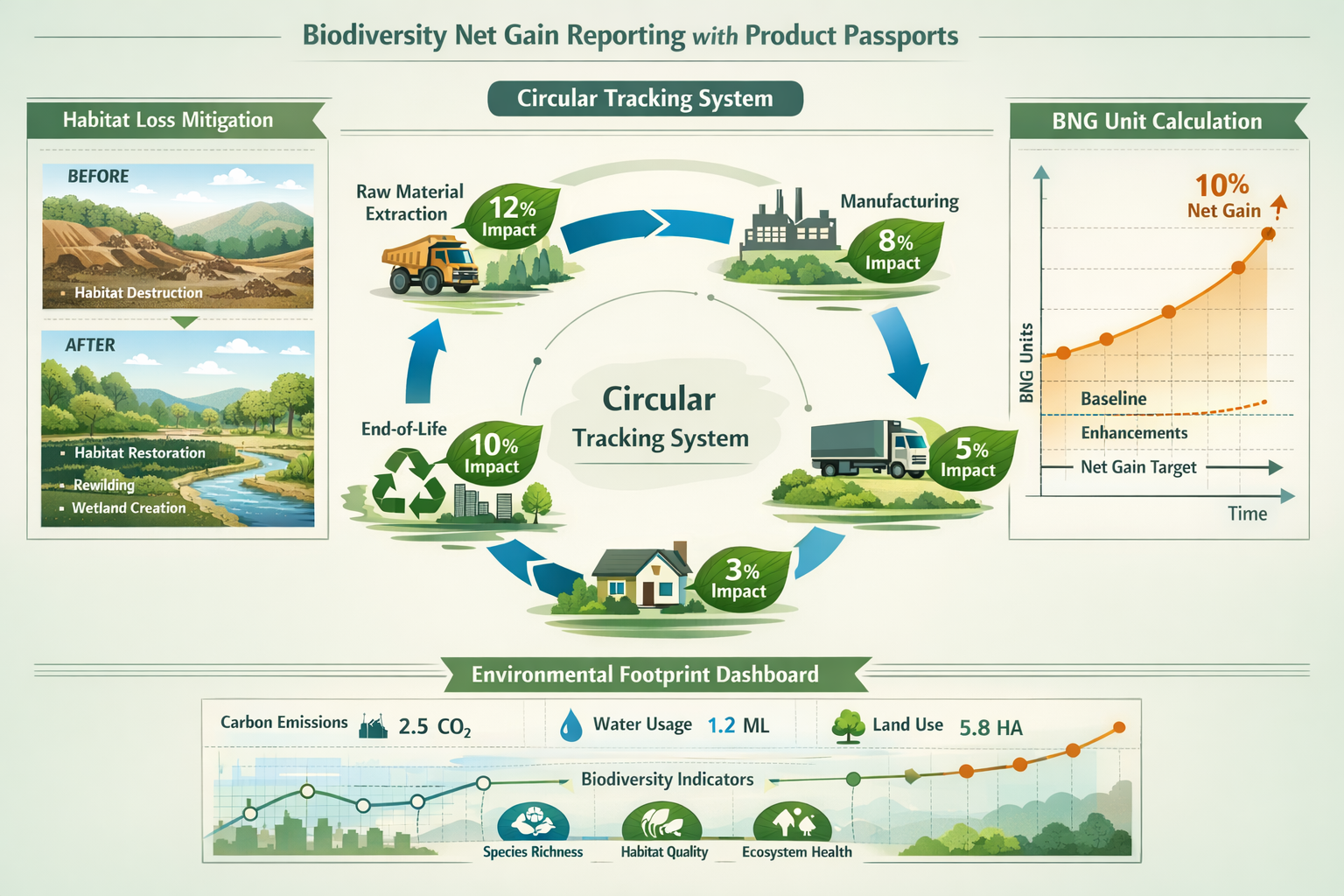
Biodiversity Net Gain (BNG) requires development projects to deliver measurable improvements to biodiversity—typically a 10% increase compared to pre-development conditions. Traditionally, BNG assessments focused primarily on direct land use changes at project sites.
However, supply chain impacts often dwarf on-site effects. Consider a construction project: the concrete, steel, timber, and other materials may have caused deforestation, habitat fragmentation, or water pollution thousands of miles away. Product passports make these hidden impacts visible and quantifiable.
When conducting a biodiversity impact assessment, ecologists can now:
- Scan product QR codes to access DPP data
- Extract environmental footprint metrics standardized to EU Product Environmental Footprint Category Rules (PEFCR)[6]
- Map supply chain biodiversity hotspots where materials originated
- Calculate cumulative ecosystem impacts across the entire project
- Identify alternative suppliers with lower biodiversity footprints
This comprehensive approach transforms BNG from a site-focused exercise into a holistic sustainability assessment that addresses both direct and indirect ecological impacts.
The 2026 Implementation Timeline for Product Passports and Biodiversity Tracking
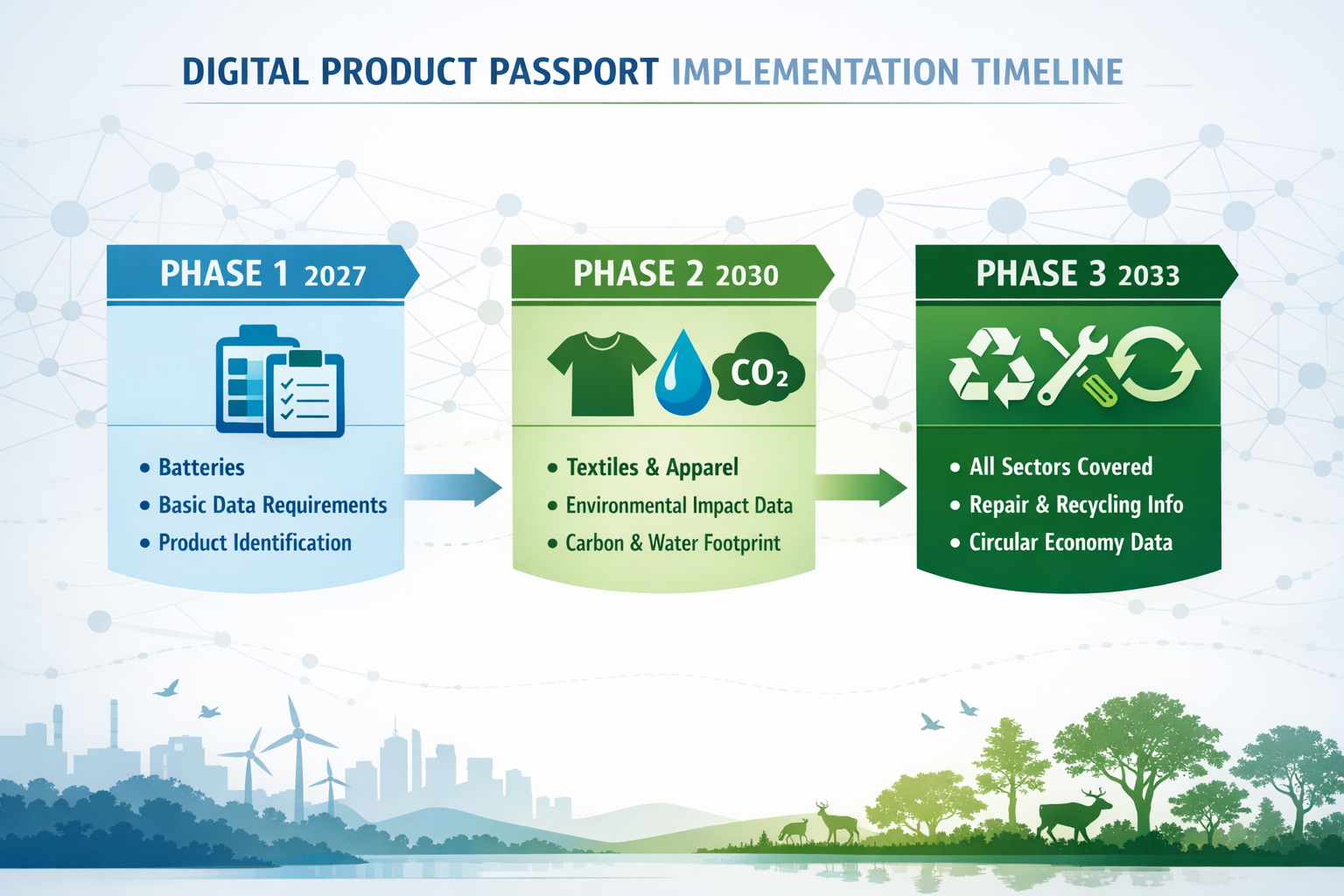
Phase 1 (2027): Foundation Building
The batteries sector leads adoption, with Digital Product Passports becoming mandatory beginning in 2027[4]. This reflects batteries' high environmental impact and complex supply chains involving mineral extraction from biodiversity-sensitive regions.
Phase 1 focuses on minimal and simplified DPP requirements[5]:
- ✔️ Fiber composition and material disclosure
- ✔️ Hazardous substances presence
- ✔️ Basic regulatory labeling
- ✔️ Manufacturer and origin information
For biodiversity surveyors, even this basic information proves valuable. Knowing that lithium originated from South American salt flats versus Australian hard rock mines, for example, indicates vastly different habitat impacts. Ecologists can cross-reference origin data with global biodiversity databases to assess ecosystem sensitivity.
Textiles and apparel follow shortly after batteries, with implementation anticipated within approximately one year as data standards and infrastructure mature[4]. The fashion industry's notorious environmental footprint—including water pollution, pesticide use, and land conversion—makes textile DPPs particularly relevant for supply chain biodiversity assessments.
Phase 2 (2030): Environmental Impact Integration
By 2030, DPPs expand significantly to include advanced environmental impact assessments[5]:
- 🌡️ Carbon footprint calculations
- 💦 Water consumption and pollution metrics
- 🗺️ Detailed supply chain mapping
- 📊 Life Cycle Assessment (LCA) data
- 🌱 Land use change documentation
This phase represents a quantum leap for achieving Biodiversity Net Gain. Surveyors gain access to standardized environmental data that can be directly integrated into biodiversity metric calculations.
The emphasis on Life Cycle Assessment (LCA) standardized to EU Product Environmental Footprint Category Rules (PEFCR) ensures data consistency across products and industries[6]. These data-intensive requirements necessitate sophisticated modeling tools that biodiversity professionals must master.
Phase 3 (2033): Full Circular Economy Tracking
The ultimate vision arrives in 2033 with Full Circular DPP implementation[5]:
| Feature | Biodiversity Application |
|---|---|
| Repair history | Extends product lifespan, reducing replacement material extraction |
| Resale information | Tracks secondary markets, minimizing new production impacts |
| Material recovery instructions | Enables habitat restoration through recovered materials |
| End-of-life tracking | Documents disposal impacts on ecosystems |
| Circular supply chain data | Maps closed-loop systems reducing virgin resource extraction |
For biodiversity surveyors working on long-term BNG monitoring, Phase 3 data enables tracking of cumulative environmental benefits over decades. Products designed for circularity demonstrably reduce pressure on natural habitats compared to linear "take-make-dispose" alternatives.
Surveyor Tools: Practical Applications of Product Passports for Biodiversity Tracking
EPCIS-Compliant Architecture and Interoperable Standards
Modern biodiversity surveying increasingly relies on digital tools and data integration. Product passports leverage EPCIS-compliant architectures with interoperable standards like GS1 Digital Link and EPCIS 2.0 to provide unit-level, legally auditable data[1].
What does this mean in practice?
Imagine conducting a site survey for a commercial development. Using a tablet or smartphone, the ecologist can:
- Scan GS1 Digital Link QR codes on construction materials delivered to site
- Access real-time DPP data including origin, environmental footprint, and supply chain traceability
- Export data directly into biodiversity metric calculators
- Generate automated reports linking material choices to ecosystem impacts
- Verify sustainability claims through blockchain-backed audit trails
This unit-level tracking means surveyors can assess individual product batches rather than relying on manufacturer averages. A timber shipment from certified sustainable forests receives different biodiversity scoring than wood from recently cleared rainforest—even if both come from the same supplier.
Enhanced Supply Chain Visibility for Risk Management
Supply chain traceability improvements through DPPs enhance visibility for traceability, quality control, risk management, and supplier collaboration[4]. For biodiversity professionals, this translates to:
🔍 Traceability Benefits:
- Identify materials sourced from protected areas or biodiversity hotspots
- Track products through multiple processing stages
- Verify chain-of-custody for certified sustainable materials
⚠️ Risk Management Applications:
- Flag suppliers with poor environmental compliance records
- Detect supply chain disruptions affecting habitat conservation programs
- Assess reputational risks from biodiversity-damaging sourcing
🤝 Supplier Collaboration Opportunities:
- Share biodiversity impact data with suppliers to drive improvements
- Collaborate on habitat restoration projects in sourcing regions
- Develop preferred supplier lists based on ecosystem performance
When preparing biodiversity net gain reports, this enhanced visibility enables surveyors to provide evidence-based recommendations for material substitutions that reduce ecological footprints while meeting project specifications.
Integration with BNG Metric Calculations
The UK's Biodiversity Metric 4.0 (and future iterations) calculates net gain using habitat distinctiveness, condition, and strategic significance scores. Product passport data enhances these calculations by:
Expanding assessment boundaries beyond site perimeters to include supply chain impacts
Providing quantitative data for previously qualitative assessments
Enabling scenario modeling comparing different material choices and their biodiversity consequences
Supporting off-site compensation calculations when purchasing biodiversity units
For example, a surveyor assessing a residential development can now quantify that specifying recycled steel (tracked via DPP) avoids 2.5 hectares of habitat disturbance compared to virgin steel—equivalent to 0.8 biodiversity units. This precision helps developers achieve the required 10% Biodiversity Net Gain more cost-effectively.
Regulatory Compliance and Future-Proofing BNG Strategies
Aligning with 2026 Regulatory Frameworks
The regulatory landscape for both product passports and biodiversity protection is evolving rapidly in 2026. Organizations must navigate:
- EU Ecodesign for Sustainable Products Regulation (ESPR) mandating DPPs
- UK Environment Act 2021 requiring mandatory BNG for developments
- Corporate Sustainability Reporting Directive (CSRD) requiring supply chain environmental disclosure
- Task Force on Nature-related Financial Disclosures (TNFD) recommendations
Product passports provide the data infrastructure to comply with these overlapping requirements efficiently[7]. Rather than maintaining separate reporting systems for product sustainability, biodiversity impacts, and financial disclosures, organizations can draw from the unified DPP database.
For biodiversity surveyors advising clients on BNG strategy, understanding DPP requirements helps future-proof recommendations. Materials and suppliers selected today based on DPP data will remain compliant as regulations tighten through 2033.
Challenges and Limitations
Despite their promise, Product Passports for Supply Chain Biodiversity face several challenges:
📉 Data Quality Concerns:
- Smaller suppliers may lack resources for comprehensive data collection
- Verification costs could be prohibitive for low-margin products
- Standardization across global supply chains remains incomplete
🔒 Proprietary Information Tensions:
- Companies resist disclosing commercially sensitive sourcing details
- Balancing transparency with competitive advantage
- Data security and privacy considerations
🌐 Global Supply Chain Complexity:
- Products with components from dozens of countries
- Multiple tiers of suppliers with varying data capabilities
- Developing nations may lack digital infrastructure
💰 Implementation Costs:
- Initial investment in data systems and training
- Ongoing maintenance and verification expenses
- Small businesses face disproportionate burden
Biodiversity surveyors must acknowledge these limitations when using DPP data. Cross-referencing multiple sources, conducting field verification where feasible, and applying professional judgment remain essential practices.
Case Studies: Early Adopters and Best Practices
Battery Industry: Setting the Standard
As the first sector with mandatory DPPs (2027), battery manufacturers are pioneering biodiversity tracking approaches. Leading companies now document:
- Cobalt sourcing from Democratic Republic of Congo and biodiversity impacts in mining regions
- Lithium extraction effects on flamingo populations in South American salt flats
- Nickel mining impacts on Indonesian rainforest ecosystems
- Recycling programs reducing need for virgin material extraction
These detailed records enable ecologists to calculate the biodiversity cost of energy storage systems and recommend alternatives with lower ecological footprints. For instance, sodium-ion batteries sourced from abundant materials may score better on biodiversity metrics than lithium-ion equivalents.
Textile Sector: Addressing Fashion's Footprint
Fashion brands implementing early DPP systems demonstrate biodiversity applications:
- Organic cotton tracking shows reduced pesticide impacts on pollinator populations
- Wool traceability documents grazing management effects on grassland biodiversity
- Synthetic fiber production links to petroleum extraction habitat impacts
- Dyeing processes water pollution effects on aquatic ecosystems
Surveyors working with retail developments can now assess the biodiversity implications of tenant mix. A shopping center anchored by brands with transparent, low-impact supply chains (verified through DPPs) demonstrates better overall environmental performance than one dominated by fast-fashion retailers.
Construction Materials: Building with Biodiversity in Mind
Forward-thinking construction material suppliers are voluntarily adopting DPP-style documentation:
- Timber certification enhanced with habitat condition data from harvest areas
- Aggregate extraction linked to quarry restoration and biodiversity enhancement plans
- Concrete production documenting cement alternatives that reduce limestone quarrying impacts
- Insulation materials comparing petrochemical versus natural fiber ecosystem footprints
When creating biodiversity plans for development projects, specifying materials with comprehensive DPP documentation strengthens the evidence base and demonstrates commitment to measurable environmental outcomes.
Actionable Steps for Biodiversity Surveyors in 2026
Building DPP Competency
Professional development priorities for surveyors include:
- Learn GS1 standards and QR code scanning protocols
- Master EPCIS data interpretation and integration with biodiversity metrics
- Understand PEFCR methodologies for environmental footprint analysis
- Develop supply chain mapping skills using digital traceability tools
- Stay current with evolving DPP requirements across sectors and jurisdictions
Integrating DPPs into Assessment Workflows
Practical integration steps:
Pre-development phase:
- Request DPP data for proposed materials during design review
- Model biodiversity impacts of different material scenarios
- Identify high-impact products requiring substitution
Construction phase:
- Conduct on-site verification of delivered materials via QR scanning
- Document actual products used versus specifications
- Track changes and their biodiversity implications
Post-development monitoring:
- Assess long-term performance of circular products
- Verify end-of-life handling and material recovery
- Calculate realized biodiversity benefits versus projections
Advising Clients on Strategic Material Selection
Surveyors can add value by:
- Developing preferred material lists based on DPP biodiversity data
- Quantifying cost-benefit trade-offs between conventional and low-impact alternatives
- Identifying suppliers with superior environmental performance
- Recommending pilot projects to test innovative materials with strong DPP credentials
For clients exploring off-site versus on-site BNG delivery, DPP data can inform whether supply chain optimization or habitat creation delivers greater biodiversity value per pound invested.
The Future: 2027-2033 and Beyond
Emerging Technologies
The next phase of Product Passports for Supply Chain Biodiversity will likely incorporate:
🤖 Artificial Intelligence:
- Automated biodiversity impact scoring from DPP data
- Predictive modeling of supply chain ecosystem risks
- Machine learning identification of optimal material combinations
🛰️ Remote Sensing Integration:
- Satellite imagery verification of sourcing region habitat condition
- Real-time monitoring of supplier environmental performance
- Automated alerts for deforestation or habitat degradation
🔗 Blockchain Enhancement:
- Immutable audit trails preventing data manipulation
- Smart contracts triggering payments based on verified biodiversity outcomes
- Decentralized verification reducing certification costs
📱 Consumer-Facing Applications:
- Public access to product biodiversity scores
- Market pressure driving supplier improvements
- Citizen science contributions to supply chain monitoring
Expanding Scope and Ambition
As DPP systems mature, expect:
- Positive impact documentation beyond harm reduction—products that actively restore ecosystems
- Biodiversity credits embedded in product pricing, funding conservation
- Cross-sector collaboration linking construction, manufacturing, and agriculture
- Global harmonization extending EU standards worldwide
For biodiversity surveyors, these developments promise a future where ecological considerations are embedded in every product decision—making supply chain biodiversity tracking as routine as checking a product's price or availability.
Conclusion
Product Passports for Supply Chain Biodiversity: Surveyor Tools for 2026 Circular Tracking and BNG represent a fundamental shift in how ecological professionals assess and mitigate environmental impacts. By providing verified, standardized lifecycle data, DPPs transform biodiversity surveying from a site-focused discipline into a comprehensive supply chain science.
The phased implementation from 2027 through 2033 gives surveyors time to build competency while early adopters in batteries and textiles establish best practices. EPCIS-compliant architectures and interoperable standards ensure data accessibility and reliability, while integration with BNG metrics enables precise quantification of ecosystem impacts.
Next Steps for Biodiversity Professionals
Immediate Actions (2026):
- ✅ Invest in training on DPP standards and data interpretation
- ✅ Pilot DPP integration on select projects
- ✅ Build relationships with suppliers providing comprehensive product passport data
Medium-Term Goals (2027-2030):
- ✅ Develop standardized workflows incorporating DPP data into all assessments
- ✅ Contribute to industry guidance on biodiversity applications of product passports
- ✅ Expand service offerings to include supply chain biodiversity auditing
Long-Term Vision (2030-2033):
- ✅ Lead industry adoption of circular economy principles in biodiversity practice
- ✅ Influence policy development linking product passports to BNG requirements
- ✅ Demonstrate measurable biodiversity improvements through supply chain optimization
The convergence of digital product passports and Biodiversity Net Gain creates unprecedented opportunities for ecological professionals to drive meaningful environmental outcomes. By mastering these surveyor tools for circular tracking, biodiversity experts position themselves at the forefront of sustainable development—protecting ecosystems not just on project sites, but throughout global supply chains.
Ready to integrate product passport data into your biodiversity assessments? Contact our expert team to learn how cutting-edge digital tools can enhance your BNG reporting and deliver superior environmental outcomes for your projects.
References
[1] Supply Chain Trends 2026 – https://psqr.eu/publications-resources/supply-chain-trends-2026/
[2] Digital Product Passport – https://www.arbor.eco/blog/digital-product-passport
[3] Eu Digital Product Passports What S New In 2025 2026 – https://www.iticp.org/l/eu-digital-product-passports-what-s-new-in-2025-2026/
[4] Digital Product Passports Redefining Transparency And Sustainability – https://kowideoutdoors.com/blog/2026/2/9/digital-product-passports-redefining-transparency-and-sustainability
[5] Eu Digital Product Passport Dpp Guide – https://greenstitch.io/blogs/eu-digital-product-passport-dpp-guide/
[6] 01 19 The Digital Product Passport Revolution – https://www.intertek.com/blog/2026/01-19-the-digital-product-passport-revolution/
[7] Regulatory Compliance 2026 – https://psqr.eu/publications-resources/regulatory-compliance-2026/