

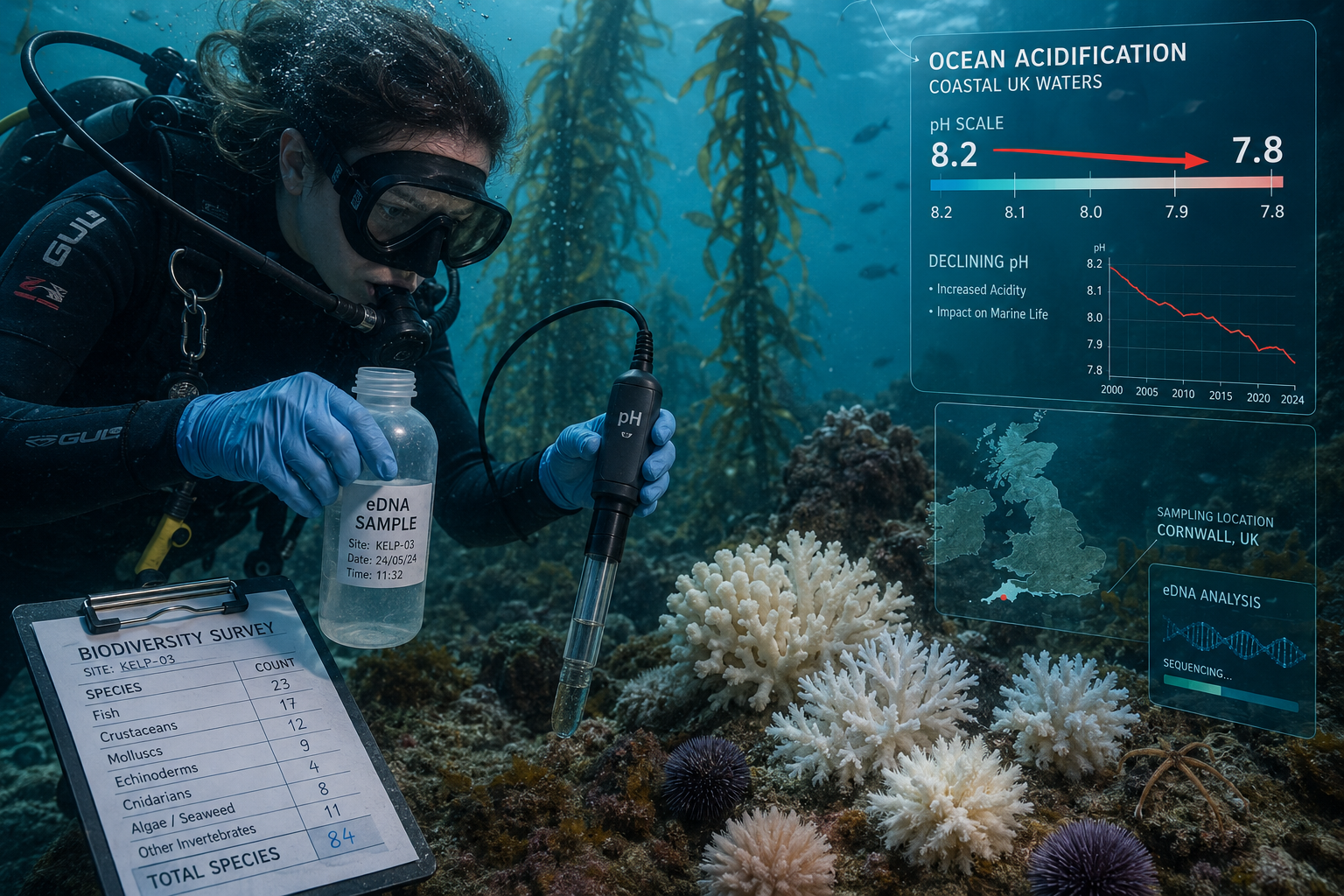
Since the Industrial Revolution, ocean pH has dropped from approximately 8.2 to 8.1 — a shift that sounds small but represents a 26% increase in ocean acidity. For marine ecologists tasked with measuring biodiversity in coastal and offshore environments, this chemical transformation is not a distant forecast. It is already reshaping which species survive, which habitats persist, and — critically — how accurate any biodiversity survey can be when baseline conditions are shifting beneath the surface.
This article addresses the intersection of ocean acidification effects on marine biodiversity surveys: protocols for BNG compliance in acidifying waters. It is written for ecologists, developers, planners, and environmental consultants who need to understand how rising acidity alters survey outcomes, and what adaptive techniques — including pH-integrated eDNA sampling — can ensure that Biodiversity Net Gain (BNG) assessments remain scientifically defensible and legally compliant in 2026 and beyond.
Key Takeaways 📋
- Ocean acidification is actively distorting marine biodiversity baselines, making standard survey protocols increasingly unreliable without pH correction.
- BNG compliance in marine environments requires adaptive protocols that account for habitat condition changes driven by acidification.
- pH-integrated eDNA sampling is emerging as a gold-standard technique for capturing accurate species presence data in chemically unstable waters.
- Habitat condition metrics used in BNG assessments must be recalibrated to reflect acidification-driven species loss and community shifts.
- Proactive survey design — including multi-season sampling, carbonate chemistry monitoring, and reference site benchmarking — is essential for defensible BNG reporting.
Why Ocean Acidification Disrupts Traditional Marine Biodiversity Surveys
Standard marine biodiversity survey methods — point-count transects, trawl sampling, visual census, and acoustic monitoring — were designed for chemically stable environments. Ocean acidification undermines these methods in several interconnected ways.
The Chemistry Behind the Problem
When CO₂ dissolves in seawater, it forms carbonic acid, which dissociates into bicarbonate and hydrogen ions. This lowers pH and reduces the availability of carbonate ions — the building blocks of shells, skeletons, and reef structures. The effects cascade through food webs:
| Organism Group | Acidification Impact | Survey Implication |
|---|---|---|
| Calcifying invertebrates (mussels, oysters, urchins) | Shell dissolution, reduced recruitment | Species counts underestimate true decline |
| Coral and coralline algae | Bleaching, structural weakening | Habitat condition scores inflated |
| Larval fish | Sensory disruption, altered behaviour | Acoustic surveys yield inconsistent data |
| Phytoplankton | Community composition shifts | eDNA libraries become outdated |
| Seagrass | Mixed response; may initially benefit | Habitat unit calculations skewed |
"A biodiversity survey conducted without accounting for ambient pH conditions is like measuring flood risk without a rainfall gauge."
For BNG purposes, this matters enormously. If a baseline survey captures a habitat already degraded by acidification — but the assessor uses pre-acidification condition criteria — the habitat will be scored too generously, and the resulting BNG calculation will understate the actual ecological deficit.
Core Protocols for BNG Compliance in Acidifying Marine Waters
Achieving biodiversity net gain in marine and coastal environments requires surveyors to go beyond standard terrestrial BNG frameworks. The Biodiversity Metric (currently version 4.0 in England) was designed primarily for terrestrial habitats. Its application to marine intertidal and subtidal zones demands careful adaptation — especially where acidification is measurably altering habitat condition.
Step 1: Pre-Survey Carbonate Chemistry Profiling 🔬
Before any biodiversity data is collected, establish the carbonate chemistry baseline of the survey site. This means measuring:
- pH (total scale, not NBS scale)
- Total alkalinity (TA)
- Dissolved inorganic carbon (DIC)
- Partial pressure of CO₂ (pCO₂)
- Aragonite and calcite saturation states (Ω)
These measurements should be taken at multiple depths and across tidal cycles. Sites with aragonite saturation states below 1.5 Ω are considered high-risk zones for calcifying species, and this must be flagged in any BNG assessment report.
Recommended equipment:
- Submersible pH sensors (spectrophotometric, not glass electrode)
- Portable alkalinity titration kits
- Continuous data loggers deployed for minimum 30 days pre-survey
Step 2: pH-Integrated eDNA Sampling
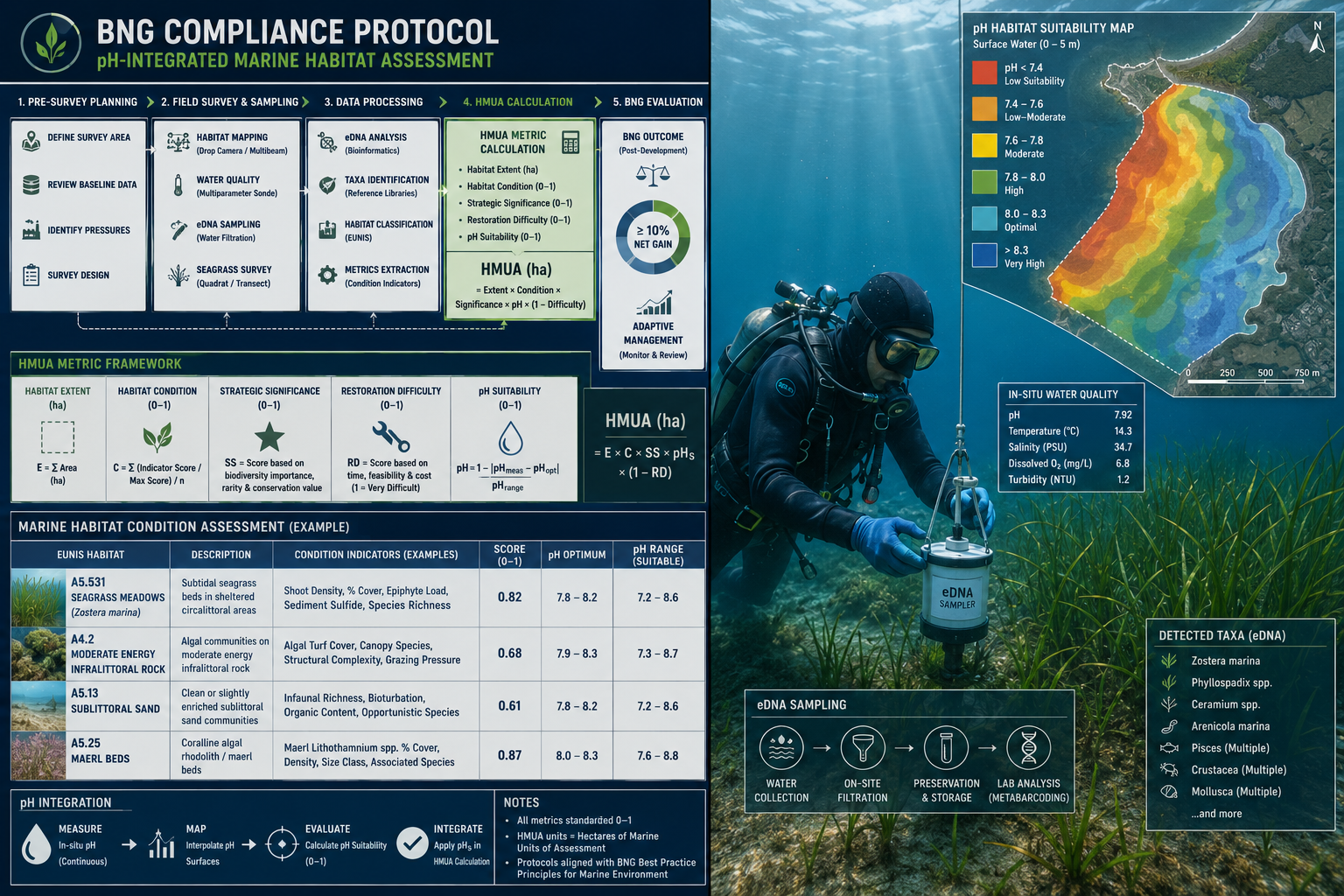
Environmental DNA (eDNA) sampling captures genetic material shed by organisms into the water column. In acidifying waters, however, DNA degradation rates increase as pH drops, and community composition shifts rapidly. Standard eDNA protocols must be adapted:
- Increase sample volume from 1L to 3–5L per replicate to compensate for lower DNA concentrations
- Adjust preservation buffers — use Longmire's solution rather than ethanol in low-pH waters to prevent further DNA degradation
- Pair each eDNA sample with a simultaneous pH reading logged to the nearest 0.01 pH unit
- Use pH-stratified analysis: process eDNA results separately for samples collected at pH ≥ 8.05 versus pH < 8.05 to detect community shifts
- Update reference libraries — acidification-driven range shifts mean that species previously absent from UK waters (e.g., warm-water invertebrates) may now appear in eDNA results
This pH-integrated eDNA approach is central to the broader challenge of ocean acidification effects on marine biodiversity surveys: protocols for BNG compliance in acidifying waters, and it represents the most significant methodological advance available to marine ecologists in 2026.
Step 3: Habitat Condition Assessment with Acidification Adjustment
The BNG metric scores habitats on a condition scale that determines their unit value. For marine habitats, condition criteria typically include:
- Species richness relative to benchmark
- Structural complexity (e.g., reef rugosity, canopy density)
- Presence of key indicator species
- Absence of invasive or stress-indicator species
In acidifying waters, each of these criteria requires adjustment:
Species richness: Apply a pH correction factor when comparing observed richness to benchmark values. If ambient pH is 0.1–0.2 units below the site's historical average, expect a 10–25% reduction in calcifying species richness. This should be documented, not penalised in the baseline score.
Structural complexity: Biogenic reef structures (oyster beds, maerl beds, horse mussel reefs) lose structural integrity under acidification. Use 3D photogrammetry or multibeam sonar rather than visual estimates to quantify rugosity objectively.
Indicator species: Revise indicator species lists for acidification-sensitive environments. Species such as Nucella lapillus (dog whelk) and Echinus esculentus (sea urchin) are early-warning indicators of acidification stress and should be weighted accordingly.
Understanding what is in a biodiversity net gain assessment helps contextualise why these adjustments are not optional — they are fundamental to producing an assessment that reflects ecological reality.
Step 4: Multi-Season and Multi-Year Baseline Surveys
A single-season survey in marine environments is rarely sufficient for BNG compliance. In acidifying waters, it is even less defensible. pH variability is highly seasonal in coastal UK waters:
- Winter: Lower pH due to increased CO₂ solubility in cold water
- Spring/Summer: Higher pH during phytoplankton blooms (biological drawdown of CO₂)
- Autumn: Transitional, often with upwelling events bringing low-pH deep water to the surface
Minimum recommended survey programme for marine BNG:
| Season | Survey Type | pH Monitoring |
|---|---|---|
| Spring | eDNA + visual transect | Continuous logger |
| Summer | Trawl/dredge + eDNA | Continuous logger |
| Autumn | Visual transect + acoustic | Spot measurements |
| Winter | eDNA only (weather permitting) | Continuous logger |
This multi-season approach aligns with best practice guidance for how to conduct a biodiversity impact assessment and ensures that the biodiversity baseline captures the full range of ecological conditions.
Applying BNG Metrics to Marine Habitats Under Acidification Stress
The practical challenge of ocean acidification effects on marine biodiversity surveys: protocols for BNG compliance in acidifying waters comes into sharp focus when calculating habitat units. The BNG metric assigns unit values based on area × distinctiveness × condition × strategic significance. In marine environments under acidification stress, each multiplier is affected.
Distinctiveness and Condition in Flux
Marine habitats such as maerl beds, subtidal mixed sediments, and intertidal rocky shores carry high distinctiveness scores. But if acidification has already reduced species richness and structural complexity, the condition score may have declined — even if the habitat looks superficially intact.
This creates a compliance risk: developers or landowners who use outdated condition benchmarks may calculate inflated baseline unit values, leading to insufficient offsetting. When the development proceeds and monitoring reveals lower-than-expected biodiversity, the BNG target is missed.
The solution is transparent acidification disclosure:
- Document ambient pH and saturation state in the BNG report
- Justify condition scores with reference to acidification-adjusted benchmarks
- Include a sensitivity narrative explaining how continued acidification may affect habitat condition over the 30-year BNG monitoring period
Calculating Additionality in Acidifying Environments 📊
BNG requires a minimum 10% net gain above the pre-development baseline. For marine projects, achieving this in acidifying waters means selecting enhancement interventions that are acidification-resilient:
| Intervention | Acidification Resilience | BNG Unit Potential |
|---|---|---|
| Seagrass restoration | Moderate-High (CO₂ buffering effect) | High |
| Oyster reef restoration | Moderate (localised pH buffering) | High |
| Kelp forest enhancement | High (strong CO₂ drawdown) | Moderate-High |
| Maerl bed protection | Low (highly acidification-sensitive) | High if protected |
| Artificial reef deployment | High (structural, species-independent) | Moderate |
Seagrass meadows deserve special attention. They are among the few marine habitats that can locally buffer pH through photosynthetic CO₂ uptake, creating microenvironments where calcifying species persist even as surrounding waters acidify. Prioritising seagrass restoration in BNG offset strategies is both ecologically sound and strategically wise for long-term compliance.
For projects where on-site marine enhancement is not feasible, off-site BNG delivery through habitat banking may be appropriate — provided that off-site habitats are also assessed using pH-adjusted protocols.
The 30-Year Monitoring Challenge
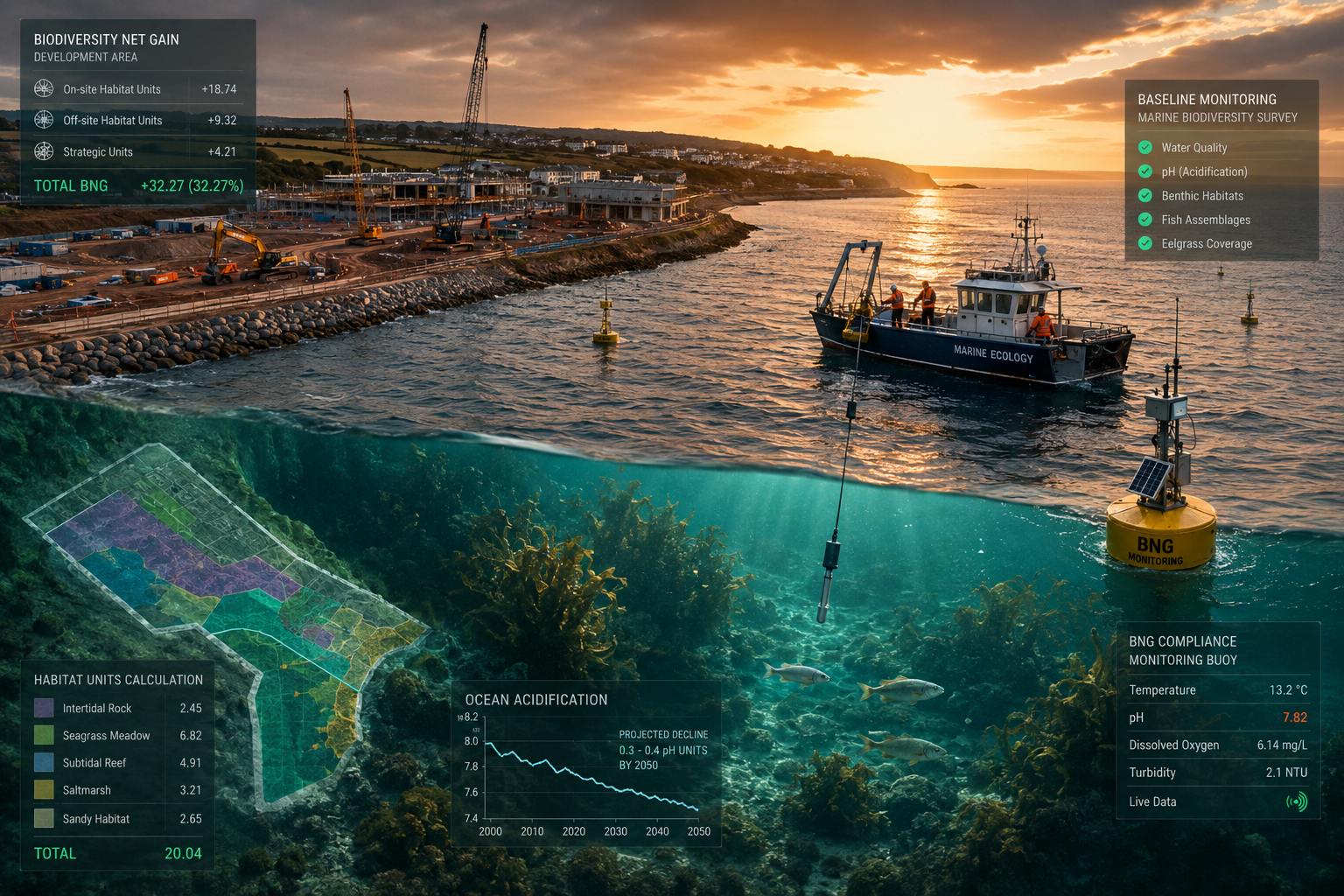
BNG commitments run for a minimum of 30 years. Over that timeframe, ocean pH in UK coastal waters is projected to decline by a further 0.1–0.15 units under moderate emissions scenarios. This means that habitats that meet BNG condition targets in 2026 may fail to do so by 2040 — not because of management failure, but because of background acidification.
BNG monitoring plans for marine sites should therefore include:
- Annual pH and alkalinity measurements at monitoring stations
- Trigger thresholds: if pH drops below a defined level, an adaptive management review is initiated
- Contingency interventions: pre-agreed responses such as additional seagrass planting or shellfish reef expansion
- Reporting to the local planning authority with acidification context included
Understanding why biodiversity net gain is important to the UK helps frame why this long-term thinking is not bureaucratic box-ticking — it is the difference between genuine ecological recovery and paper compliance.
Practical Guidance for Ecologists, Developers, and Planners 🌊
For Ecologists Conducting Marine BNG Surveys
- Invest in calibrated pH instrumentation before any marine BNG survey. Spectrophotometric sensors are more accurate than glass electrodes in low-pH, high-salinity conditions.
- Build acidification context into every survey report — not as a caveat, but as a core section of the baseline characterisation.
- Collaborate with oceanographers for sites in open coastal or offshore environments where carbonate chemistry is more complex.
- Maintain updated eDNA reference libraries that include species newly recorded in UK waters due to poleward range shifts driven by warming and acidification.
For Developers and Project Managers
- Commission marine BNG surveys early — multi-season programmes take 12–18 months and cannot be rushed without compromising data quality.
- Budget for pH monitoring equipment as a standard project cost, not an optional extra.
- Engage with BNG planning early to understand how marine habitat assessments differ from terrestrial ones and what offset options are available.
- Consider the cost of biodiversity units for marine habitats, which may be higher than terrestrial equivalents due to the complexity of restoration and monitoring.
For Planners and Local Authorities
- Require acidification disclosure as part of marine BNG submissions — this should be standard practice in coastal local planning authority areas.
- Apply precautionary condition scoring where ambient pH data is absent or insufficient.
- Recognise that marine BNG monitoring reports will need to include carbonate chemistry data, not just species count data.
- Consult resources on what you need for a biodiversity net gain report to ensure marine submissions meet the same rigour as terrestrial ones.
The Regulatory Landscape in 2026
The Environment Act 2021 mandated BNG for most developments in England, with mandatory requirements phased in from 2024. However, the legislative framework for marine and coastal BNG remains less clearly defined than for terrestrial habitats. The Marine and Coastal Access Act 2009 and the UK Marine Policy Statement provide the overarching framework, but specific BNG metric guidance for subtidal habitats is still evolving.
In 2026, the key regulatory realities are:
- Intertidal habitats (saltmarsh, mudflat, intertidal rocky shore) are increasingly included in BNG assessments for coastal development projects.
- Subtidal habitats remain largely outside mandatory BNG scope but are subject to Habitats Regulations Assessment (HRA) for projects near Marine Protected Areas (MPAs).
- Natural England is developing updated marine habitat condition criteria that are expected to incorporate acidification sensitivity — surveyors should monitor these updates closely.
- The UK Shared Prosperity Fund and Blue Carbon initiatives are creating financial incentives for marine habitat restoration that can complement BNG compliance strategies.
The intersection of ocean acidification effects on marine biodiversity surveys: protocols for BNG compliance in acidifying waters will only grow in regulatory significance as marine BNG frameworks mature and acidification continues to accelerate.
Conclusion: Adaptive Surveys for a Changing Ocean
Ocean acidification is not a future problem for marine biodiversity surveys — it is a present one. Every pH unit decline reshapes species communities, degrades habitat condition, and introduces uncertainty into biodiversity baselines that BNG compliance depends upon.
The path forward requires ecologists to treat carbonate chemistry as a core survey parameter, not an afterthought. It requires developers to commission longer, more sophisticated marine baseline programmes. And it requires planners to demand acidification-aware reporting as a standard element of coastal BNG submissions.
Actionable Next Steps ✅
- Audit existing marine BNG surveys — if pH data was not collected, commission supplementary carbonate chemistry monitoring before finalising baseline scores.
- Adopt pH-integrated eDNA sampling as standard protocol for all marine and intertidal biodiversity surveys from 2026 onwards.
- Update habitat condition benchmarks to reflect acidification-adjusted species richness expectations for your survey region.
- Design 30-year monitoring plans with pH trigger thresholds and pre-agreed adaptive management responses.
- Engage specialist marine ecologists with carbonate chemistry expertise — this is a multidisciplinary challenge that goes beyond standard ecological survey skills.
- Explore how to achieve 10% biodiversity net gain in marine contexts by prioritising acidification-resilient habitats like seagrass and kelp in offset strategies.
The ocean is acidifying. Marine biodiversity surveys must evolve to keep pace — and BNG compliance in coastal waters depends on that evolution happening now.