

The nature finance revolution is here. As biodiversity loss accelerates and regulatory frameworks tighten, biodiversity credits from circular restoration have emerged as the cornerstone of a new economic paradigm. For surveyors navigating the complex landscape of Biodiversity Credits from Circular Restoration: Surveyor Strategies for Habitat Gains in 2026 Nature Finance Markets, the stakes have never been higher—or the opportunities more promising.
With the Verra Nature Framework now fully operational and the EU Roadmap towards Nature Credits establishing robust integrity standards, 2026 marks the transition from experimental pilots to scalable, bankable biodiversity markets[1][2]. Surveyors stand at the frontline of this transformation, tasked with verifying and quantifying the habitat gains that underpin credit generation from peatland rewetting, regenerative agriculture, and circular ecosystem restoration.
This comprehensive guide explores how biodiversity professionals can leverage emerging circular economy trends, navigate new verification protocols, and position themselves as essential partners in the $200 billion annual investment needed to meet Global Biodiversity Framework targets[2].
Key Takeaways
- 🌍 The Verra Nature Framework became fully operational on January 1, 2026, opening global certification for biodiversity credit projects and establishing standardized verification protocols for surveyors[2]
- 💰 Biodiversity credits are now bankable assets, with the first credit-backed loan secured in 2025, signaling institutional acceptance and creating new opportunities for verified habitat restoration[3]
- 🔄 Circular restoration practices—including peatland rewetting, regenerative agriculture, and forest mosaics—are prioritized over traditional remediation, requiring surveyors to master new assessment methodologies[1]
- 📊 Place-based, like-for-like credit design demands precise baseline establishment, transparent monitoring, and local ecological expertise rather than generic offset calculations[1]
- ✅ Surveyor verification is critical for BNG compliance and credit integrity, positioning biodiversity professionals as gatekeepers of nature finance market credibility
Understanding the 2026 Biodiversity Credit Landscape
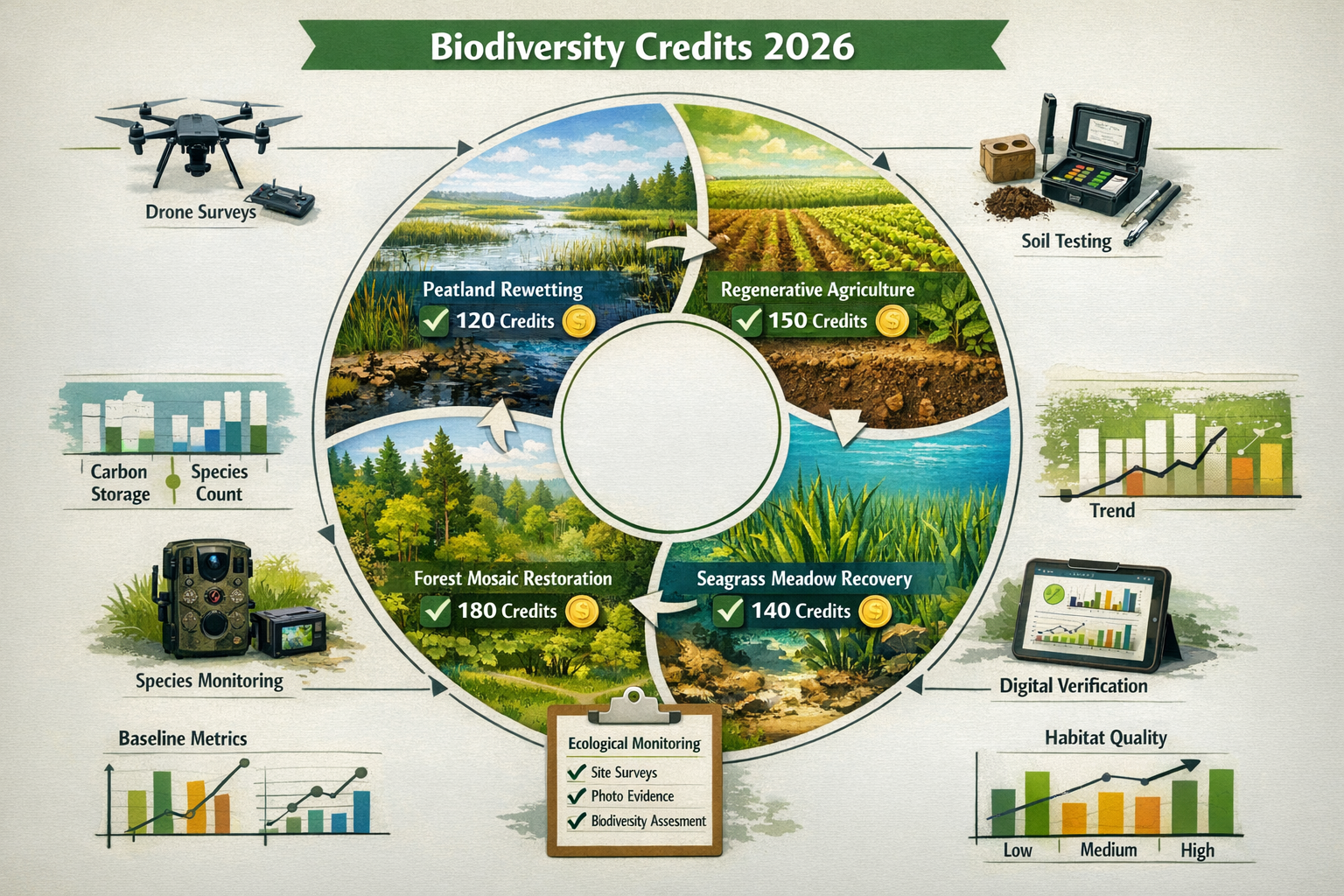
The Evolution from Offsets to Verified Habitat Credits
Traditional biodiversity offsets have given way to a more sophisticated model. Unlike carbon credits that track invisible atmospheric emissions, biodiversity credits fund tangible ecological outcomes—species population growth, habitat quality improvements, and ecosystem functionality—verified within specific geographic boundaries[1].
The shift reflects hard-learned lessons from carbon markets. Generic offsets that allowed companies to "buy their way out" of local environmental damage have been replaced by place-based instruments that require like-for-like habitat restoration in ecologically relevant locations.
For surveyors, this means:
- Baseline assessments must capture site-specific habitat conditions with unprecedented precision
- Monitoring protocols need to track multiple biodiversity indicators, not just area measurements
- Verification standards demand third-party validation and transparent data sharing
- Community engagement becomes essential, as local and Indigenous governance shapes credit legitimacy
Regulatory Frameworks Driving Market Growth
Three major developments have formalized biodiversity credit markets in 2026:
1. Verra Nature Framework (Operational January 2026)
The full operationalization of Verra's certification process provides the infrastructure for global credit generation[2]. Projects can now access standardized methodologies for:
- Habitat restoration verification
- Species population monitoring
- Ecosystem service quantification
- Long-term management commitment validation
2. EU Nature Credits Roadmap (Finalized July 2025)
The European Union's comprehensive framework establishes design rules for credit integrity, rewarding verified nature-positive actions while preventing greenwashing[1]. Key provisions include:
- Mandatory additionality testing (credits only for gains beyond business-as-usual)
- Permanence requirements with monitoring periods extending 30+ years
- Stakeholder governance including Indigenous Peoples and Local Communities
- Integration with existing BNG regulations
3. Common Nature Finance Taxonomy
Multilateral development banks have created a standardized classification system for nature investments, enabling surveyors to align assessments with international financial reporting standards[1].
Understanding these frameworks is essential for surveyors seeking to guide developers through biodiversity credit compliance.
Biodiversity Credits from Circular Restoration: Core Principles for Surveyors
What Makes Restoration "Circular"?
Circular restoration goes beyond simply fixing damaged ecosystems. It integrates regenerative design principles that create self-sustaining ecological cycles while reducing resource extraction pressure.
Key circular restoration practices include:
| Restoration Type | Circular Principle | Surveyor Verification Focus |
|---|---|---|
| Peatland Rewetting | Water retention, carbon sequestration, biodiversity recovery | Hydrology restoration, vegetation succession, species colonization |
| Regenerative Agriculture | Soil health, on-farm biodiversity, reduced chemical inputs | Soil structure, pollinator populations, habitat connectivity |
| Forest Mosaics | Mixed-age stands, native species diversity, wildlife corridors | Canopy complexity, species richness, structural diversity |
| Seagrass Meadows | Coastal protection, nursery habitat, carbon storage | Coverage density, species composition, water quality |
| Bio-circular Materials | Regenerative feedstocks, low-toxicity design | Feedstock sourcing verification, ecosystem impact assessment |
These practices prevent habitat degradation rather than merely compensating for it, creating higher-quality credits with stronger market demand[1].
Quantifying Habitat Gains: The Surveyor's Toolkit
Generating credible biodiversity credits requires precise measurement of habitat improvements. Surveyors must master:
Baseline Condition Assessment
Before any restoration begins, establish:
- Habitat distinctiveness (common, moderate, high, very high)
- Habitat condition using standardized metrics (poor, moderate, good)
- Strategic significance (location within ecological networks)
- Species presence through systematic surveys
This baseline becomes the reference point for all future credit calculations, making accuracy paramount for achieving biodiversity net gain.
Monitoring Protocol Design
Effective monitoring tracks:
- 🌱 Vegetation structure (canopy layers, native species composition)
- 🦋 Indicator species (pollinators, birds, amphibians)
- 💧 Ecosystem function (water infiltration, nutrient cycling)
- 🔗 Connectivity (wildlife corridor functionality)
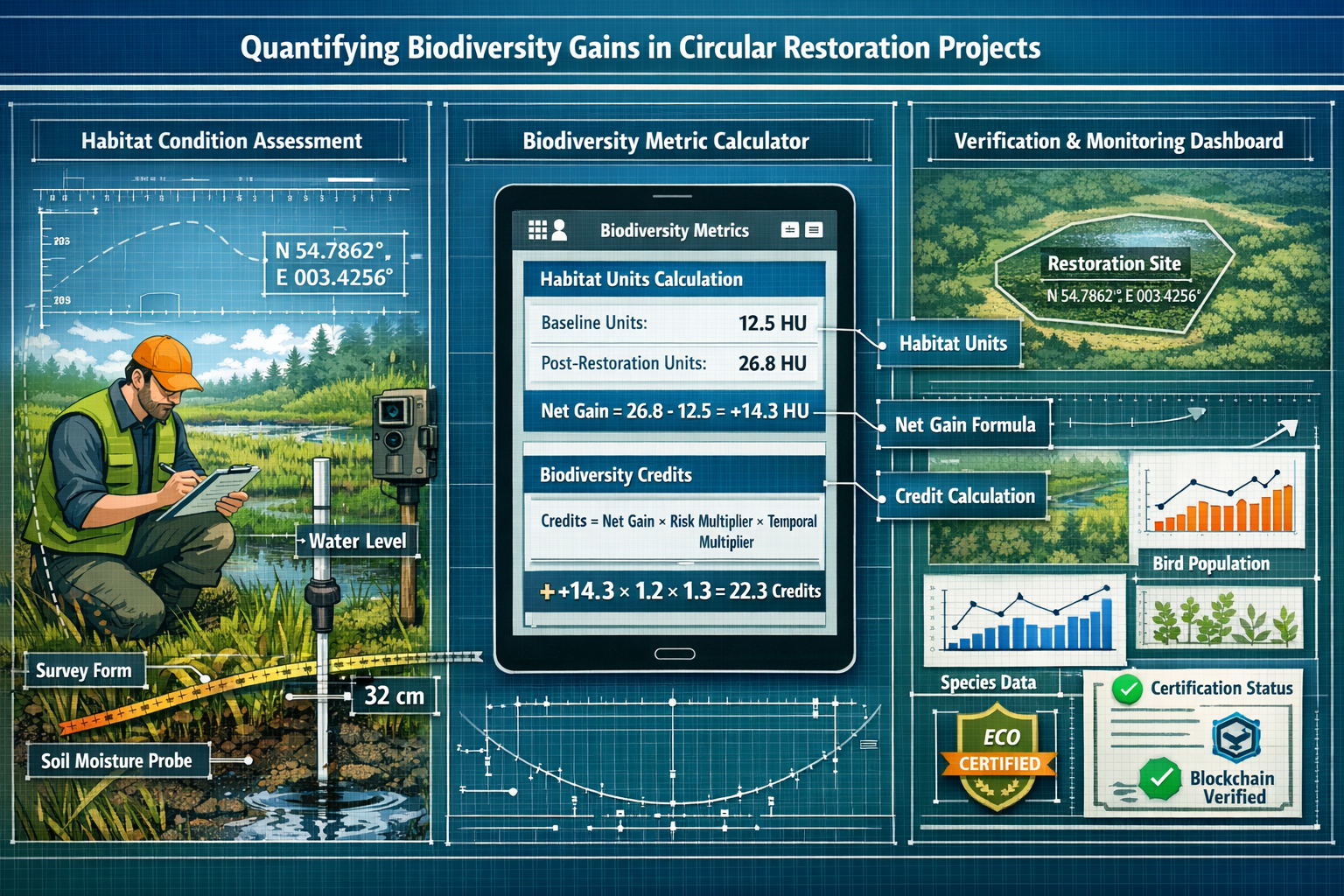
Biodiversity Unit Calculation
Credits are typically calculated using the formula:
Biodiversity Units = Habitat Area × Habitat Distinctiveness × Habitat Condition × Strategic Significance
Post-restoration gains generate credits based on the increase in total biodiversity units compared to baseline, adjusted for:
- Time to target condition (temporal discounting)
- Spatial risk factors (location, management capacity)
- Additionality verification (gains beyond regulatory requirements)
For detailed guidance on these calculations, review our biodiversity impact assessment guide.
Surveyor Strategies for Habitat Gains in 2026 Nature Finance Markets
Strategy 1: Master Circular Restoration Assessment Methodologies
Traditional habitat surveys focused on static snapshots. Circular restoration demands dynamic assessment of ecosystem trajectories.
Peatland Rewetting Verification
Peatlands store massive carbon reserves while supporting unique biodiversity. Successful rewetting projects require surveyors to:
- Measure water table restoration (depth, seasonal variation)
- Monitor Sphagnum moss colonization (coverage, species diversity)
- Track specialist species return (bog rosemary, sundews, dragonflies)
- Assess carbon flux (transition from source to sink)
- Document hydrological function (water retention capacity)
Regenerative Agriculture Certification
Agricultural lands represent enormous biodiversity potential. Verification protocols include:
- Soil health testing (organic matter, structure, microbial activity)
- Pollinator surveys (abundance, species richness)
- Field margin assessment (hedgerow quality, buffer strip functionality)
- Integrated pest management (reduced chemical dependency)
- Water quality monitoring (runoff reduction, infiltration improvement)
These assessments align with emerging frameworks like the Sustainable Farming Incentive, creating synergies between agricultural subsidies and biodiversity markets.
Strategy 2: Leverage Technology for Verification Credibility
The 2026 nature finance market demands transparent, verifiable data. Cutting-edge surveyor practices include:
Remote Sensing Integration
- 🛰️ Satellite imagery for landscape-scale habitat change detection
- 🚁 Drone surveys for high-resolution vegetation mapping
- 📡 LiDAR for canopy structure and terrain analysis
- 🌡️ Multispectral sensors for vegetation health assessment
Digital Monitoring Platforms
- 📱 Mobile data collection with GPS-tagged observations
- 🔗 Blockchain verification for tamper-proof audit trails
- 📊 Real-time dashboards for stakeholder transparency
- 🤖 AI-powered species identification from camera trap imagery
Continuous Monitoring Systems
- 📷 Automated camera traps for wildlife population tracking
- 🎤 Acoustic sensors for bird and bat monitoring
- 💧 Water quality loggers for aquatic ecosystem health
- 🌱 Permanent vegetation plots for long-term succession analysis
These technologies enhance both efficiency and credibility, critical factors as institutional investors demand rigorous verification standards.
Strategy 3: Navigate BNG Compliance and Credit Markets
In the UK, Biodiversity Net Gain regulations create mandatory demand for habitat improvements. Surveyors can bridge compliance requirements with voluntary credit markets by:
Understanding On-site vs. Off-site Dynamics
Developers must achieve 10% net gain, preferably on-site. When this isn't feasible, off-site delivery creates opportunities for:
- Habitat banking where landowners create advance credits
- Land banking where sites are secured for future restoration
- Bespoke arrangements between developers and landowners
Surveyors facilitate these transactions by:
- Assessing site suitability for credit generation
- Calculating potential unit yields
- Designing management plans that maximize gains
- Verifying delivery against commitments
Pricing and Market Positioning
Understanding biodiversity unit costs helps surveyors advise clients effectively. Factors affecting credit value include:
- Habitat type (rare habitats command premium prices)
- Location (strategic sites near development pressure)
- Quality (higher condition scores increase value)
- Permanence (longer commitment periods enhance credibility)
- Co-benefits (carbon, water quality, recreation)
Statutory vs. Voluntary Markets
The UK's statutory credit system provides a safety net when other options fail, but voluntary markets offer:
- Higher prices for quality credits
- Flexibility in delivery mechanisms
- Opportunities for innovative financing
- Integration with corporate sustainability commitments
For developers, understanding these options is crucial—explore our guidance for developers for comprehensive planning support.
Strategy 4: Engage Indigenous and Local Community Governance
The Cali Fund's commitment to direct Indigenous Peoples and Local Communities funding reflects a fundamental market shift[6]. Credits generated without community consent or benefit-sharing face increasing scrutiny.
Surveyors should:
- Establish early stakeholder engagement in project design
- Incorporate traditional ecological knowledge in baseline assessments
- Design participatory monitoring that employs local expertise
- Ensure equitable benefit distribution through governance structures
- Document community consent as part of verification protocols
This approach not only enhances social legitimacy but often improves ecological outcomes, as local knowledge identifies restoration priorities and management practices that external experts might miss.
Emerging Opportunities in Nature Finance Markets
Biodiversity Credits as Bankable Assets
The first biodiversity credit-backed loan secured by Ponterra in 2025 demonstrates that financial institutions now view verified habitat gains as collateral[3]. This creates new opportunities:
For Landowners:
- Access to capital for restoration projects
- Revenue streams from credit sales
- Enhanced land values through ecological improvement
For Developers:
- Predictable compliance pathways
- Portfolio diversification through nature assets
- Enhanced ESG credentials
For Surveyors:
- Expanded service offerings (due diligence, ongoing verification)
- Long-term monitoring contracts
- Advisory roles in credit structuring
Learn more about selling biodiversity units or buying biodiversity units to understand market mechanics.
Integration with Corporate Sustainability Commitments
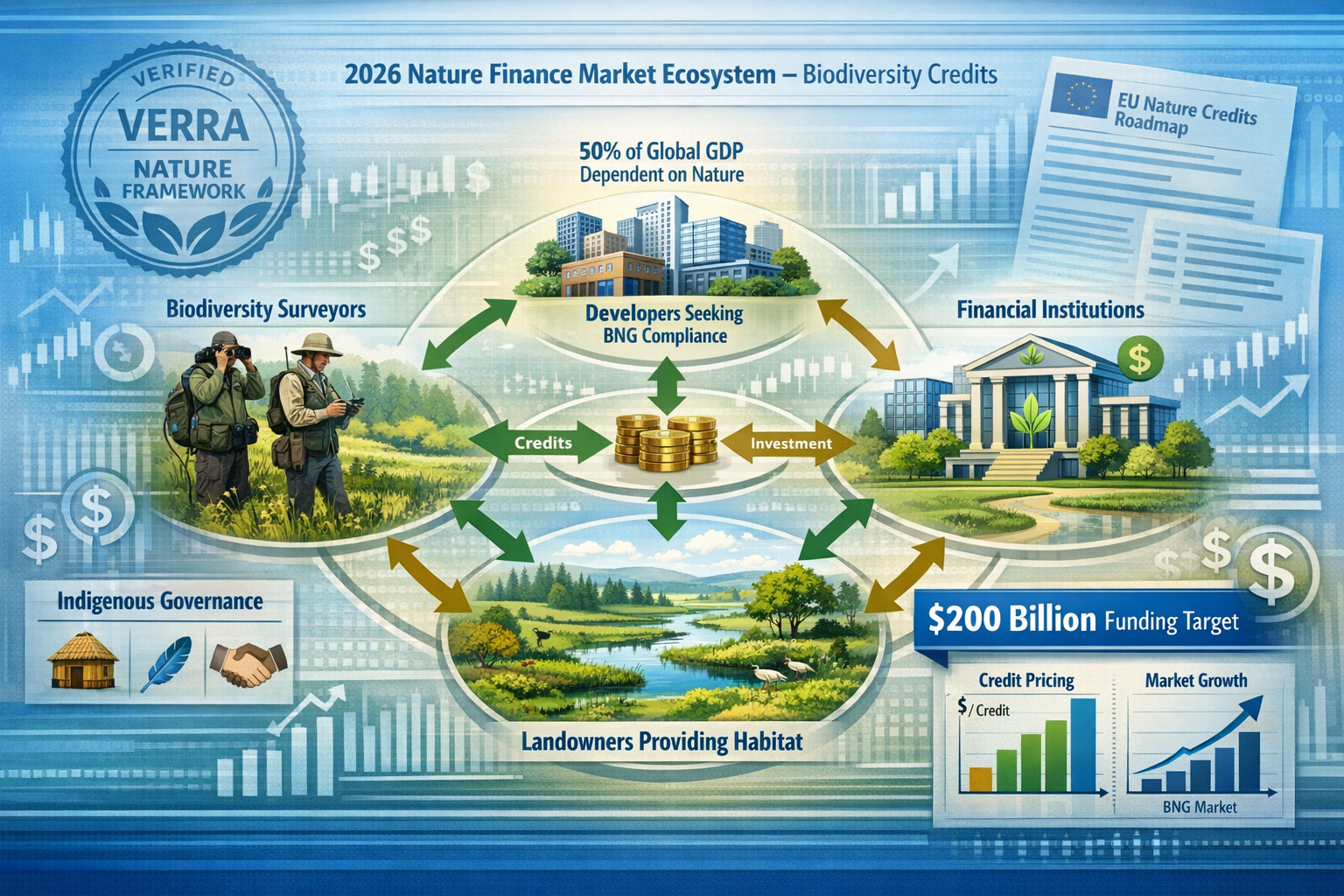
Over 50% of global GDP depends on nature and ecosystem services[2], making biodiversity risk a material financial concern. Companies are increasingly:
- Setting science-based targets for nature (SBTN framework)
- Reporting under Taskforce on Nature-related Financial Disclosures (TNFD)
- Purchasing biodiversity credits to address scope 3 environmental impacts
- Integrating nature considerations into supply chain management
Surveyors who understand corporate reporting requirements can position biodiversity assessments as strategic business intelligence rather than mere compliance exercises.
Blended Finance and Risk-Sharing Mechanisms
The $200 billion annual funding gap for biodiversity targets requires innovative financing[2]. Emerging models include:
- Public-private partnerships combining grant funding with credit revenues
- Outcome-based payments where investors receive returns tied to verified gains
- Insurance products protecting against restoration failure risks
- Green bonds backed by portfolios of biodiversity projects
Surveyors provide the verification infrastructure that makes these instruments credible to investors, creating opportunities to work with financial institutions, development banks, and impact investors.
Practical Implementation: A Step-by-Step Framework
Phase 1: Project Scoping and Feasibility (Weeks 1-4)
✅ Conduct preliminary site assessment
- Desktop review of habitat types, condition, and strategic location
- Identify potential restoration interventions
- Estimate biodiversity unit generation potential
✅ Engage stakeholders
- Landowner objectives and constraints
- Community interests and concerns
- Developer compliance requirements
✅ Assess market opportunities
- Statutory credit demand in local planning authority area
- Voluntary market interest from corporate buyers
- Pricing benchmarks for comparable credits
Phase 2: Baseline Establishment (Weeks 5-12)
✅ Execute comprehensive surveys
- Habitat condition assessments using standardized metrics
- Species inventories (flora, fauna, fungi)
- Ecosystem function measurements (soil, water, air quality)
- Photographic documentation and mapping
✅ Calculate baseline biodiversity units
- Apply appropriate metric (UK Biodiversity Metric 4.0 or equivalent)
- Document assumptions and data sources
- Establish monitoring plot locations
✅ Develop restoration plan
- Define target habitat conditions
- Specify management interventions and timeline
- Project biodiversity unit gains at target condition
For detailed assessment requirements, see our guide on what's included in a biodiversity net gain assessment.
Phase 3: Implementation and Monitoring (Years 1-30+)
✅ Execute restoration interventions
- Implement according to approved management plan
- Document activities with photos, dates, and methods
- Adapt to ecological responses and unforeseen challenges
✅ Conduct regular monitoring
- Annual surveys during establishment phase (years 1-5)
- Biennial surveys during maturation phase (years 6-15)
- Quinquennial surveys during maintenance phase (years 16-30+)
✅ Generate verification reports
- Compare current condition to baseline and targets
- Calculate biodiversity unit gains
- Identify management adjustments needed
- Submit to certification body (Verra, etc.)
Phase 4: Credit Generation and Market Transaction (Ongoing)
✅ Obtain certification
- Submit verification reports to approved certification body
- Address any non-conformances or data gaps
- Receive credit issuance authorization
✅ Market and sell credits
- List credits on approved registries
- Negotiate with buyers (developers, corporations)
- Execute credit transfer agreements
- Maintain registry records
✅ Ensure permanence
- Continue management and monitoring per commitments
- Maintain liability insurance or financial guarantees
- Report annually to registry and stakeholders
Overcoming Common Challenges
Challenge 1: Establishing Credible Baselines on Degraded Sites
Problem: Severely degraded sites may have minimal current biodiversity, making baseline assessments seem trivial.
Solution:
- Document historical condition using aerial imagery, ecological surveys, and local knowledge
- Assess reference ecosystems in the region to establish restoration targets
- Focus on potential rather than current state when calculating credit value
- Use trajectory analysis showing the degradation trend without intervention
Challenge 2: Demonstrating Additionality
Problem: Credits should only be issued for gains beyond what would happen anyway.
Solution:
- Establish business-as-usual scenarios based on land use economics
- Document financial barriers that prevent restoration without credit revenue
- Show regulatory gaps where legal requirements don't mandate improvement
- Provide counterfactual analysis demonstrating that credit financing enables the project
Challenge 3: Managing Long-Term Monitoring Costs
Problem: 30-year monitoring commitments create significant financial obligations.
Solution:
- Front-load credit pricing to create monitoring endowments
- Automate data collection using remote sensing and sensor networks
- Integrate with land management so monitoring serves multiple purposes
- Pool monitoring resources across multiple projects for efficiency
Challenge 4: Navigating Regulatory Uncertainty
Problem: Biodiversity credit regulations continue evolving, creating compliance risks.
Solution:
- Exceed minimum standards to provide buffer against tightening requirements
- Maintain flexible methodologies that can adapt to new guidance
- Engage with regulators through consultation processes
- Join industry associations to stay informed of policy developments
For planners navigating these complexities, our guide on 8 things planners need to know about BNG provides essential context.
The Future of Biodiversity Credits from Circular Restoration
Trends Shaping 2026 and Beyond
Bio-circular Materials Integration
Mycelium packaging, algae-based concretes, and agricultural-waste composites are advancing from pilots to production[1]. Surveyors may soon verify:
- Regenerative feedstock sourcing (ensuring material production enhances habitat)
- Ecosystem impact assessments for novel bio-materials
- Circular supply chain certification linking products to verified restoration
Nature-Positive Asset Class Emergence
Regenerative agriculture is becoming a distinct investment category, unlocked through blended finance and outcome verification[1]. This creates opportunities for:
- Agricultural land conversion to biodiversity-friendly practices
- Working landscape credits from farms, forests, and fisheries
- Integrated carbon-biodiversity projects with dual revenue streams
Global South Market Development
While early markets concentrated in Europe and North America, the Common Nature Finance Taxonomy enables investment flows to biodiversity-rich developing nations[1]. Surveyors with international experience will find growing opportunities in:
- Tropical forest restoration
- Mangrove and seagrass conservation
- Savanna and grassland management
- Coral reef rehabilitation
Technology-Enabled Verification
Artificial intelligence, satellite monitoring, and environmental DNA (eDNA) sampling will continue reducing verification costs while improving accuracy. Surveyors who embrace these tools will:
- Increase project capacity
- Enhance data quality
- Reduce field time requirements
- Improve stakeholder transparency
Conclusion: Positioning Surveyors for Success in Nature Finance Markets
The convergence of regulatory mandates, financial innovation, and ecological urgency has created unprecedented opportunities for biodiversity professionals. Biodiversity Credits from Circular Restoration: Surveyor Strategies for Habitat Gains in 2026 Nature Finance Markets represent not just a compliance obligation but a fundamental restructuring of how society values and invests in nature.
Surveyors who master circular restoration assessment, leverage verification technologies, navigate BNG compliance pathways, and engage communities authentically will position themselves as indispensable partners in the $200 billion nature finance ecosystem.
Actionable Next Steps
For Biodiversity Surveyors:
- Upskill in circular restoration methodologies (peatland, regenerative agriculture, forest mosaics)
- Invest in verification technology (drones, remote sensing, digital platforms)
- Build relationships with credit market actors (developers, landowners, brokers, certifiers)
- Pursue relevant certifications (Verra VVB accreditation, professional ecology credentials)
- Engage with policy development through consultation responses and industry associations
For Landowners:
- Assess restoration potential on your property with professional surveyor support
- Explore credit generation opportunities through landowner guidance resources
- Engage communities early in project design
- Secure baseline assessments before land use changes occur
- Develop long-term management capacity for credit delivery
For Developers:
- Integrate biodiversity planning early in project design phases
- Evaluate on-site vs. off-site options with expert surveyor input
- Budget appropriately for both compliance and voluntary credit purchases
- Consider strategic land acquisition for habitat banking opportunities
- Align with corporate sustainability commitments to maximize credit value
The nature finance revolution is not coming—it has arrived. With the Verra Nature Framework operational, EU regulations finalized, and institutional capital flowing into biodiversity assets, 2026 marks the year when habitat restoration became a mainstream financial instrument.
Surveyors hold the keys to market integrity. By delivering rigorous verification, embracing circular restoration principles, and championing community-led conservation, biodiversity professionals can ensure this market transformation delivers genuine ecological gains alongside financial returns.
The question is no longer whether biodiversity credits will scale, but whether surveyors will lead the way in making them work for nature, communities, and the economy alike.
Ready to explore how biodiversity credits can benefit your project? Contact our expert team to discuss your specific needs and opportunities in the 2026 nature finance landscape.
References
[1] Circular Economy 2026 Biodiversity – https://www.intelligentliving.co/circular-economy-2026-biodiversity/
[2] Verra To Open Nature Framework Certification Process Widely – https://verra.org/verra-to-open-nature-framework-certification-process-widely/
[3] New Green Shoots 2026 Annex Table Of Nature Related Finance Launches 2025 – https://www.financeforbiodiversity.org/wp-content/uploads/2026/01/New-Green-Shoots-2026-Annex-Table-of-nature-related-finance-launches-2025.pdf
[6] Action On Nature What Can Financial Institutions Expect In 2026 – https://www.unepfi.org/themes/ecosystems/action-on-nature-what-can-financial-institutions-expect-in-2026/