

The world stands at a critical juncture. 🌍 As monitored wildlife populations have plummeted by an average of 73% over the past 50 years[5], and key earth systems approach irreversible tipping points within the next two decades[2], the urgency for effective biodiversity survey strategies has never been greater. The 2026 Global Risks Report: Biodiversity Survey Strategies for Ecosystem Collapse Prevention translates global risk rankings into concrete field actions, providing surveyors, developers, and conservationists with the tools needed to prevent catastrophic ecosystem collapse.
The latest intelligence assessments paint a sobering picture: the Amazon and Congo Basin rainforests, North American and Eurasian boreal forests, the Himalayan biome, and Southeast Asian and South Pacific mangroves and coral reefs all face imminent collapse risks[2]. Yet amid this crisis lies opportunity—over 100 policy actions have been identified to help measure, manage, and reduce biodiversity impacts while contributing to restoration[1]. The question is no longer whether we need to act, but how to translate these global warnings into effective survey methodologies and field-based prevention strategies.
Key Takeaways
- Critical tipping points approaching: Key earth systems could cross irreversible thresholds within 20 years, requiring immediate biodiversity survey interventions in high-risk zones[2]
- Massive investment gap: €6.12 trillion flows into harmful sectors versus only €184.58 billion for conservation—a 33-fold disparity that survey strategies must address through better data[1]
- Every business depends on biodiversity: Systematic assessments confirm that healthy ecosystems underpin food production, raw materials, water supply, climate resilience, and tourism[1]
- Survey data remains disconnected: While biodiversity data collection has improved, integration into operational decision-making remains fragmented, limiting prevention effectiveness[6]
- New finance mechanisms emerging: Biodiversity-linked bonds and habitat banking models create opportunities for surveyors to provide critical baseline and monitoring data[3]
Understanding the 2026 Global Risks Report: Biodiversity Survey Strategies for Ecosystem Collapse Prevention Framework
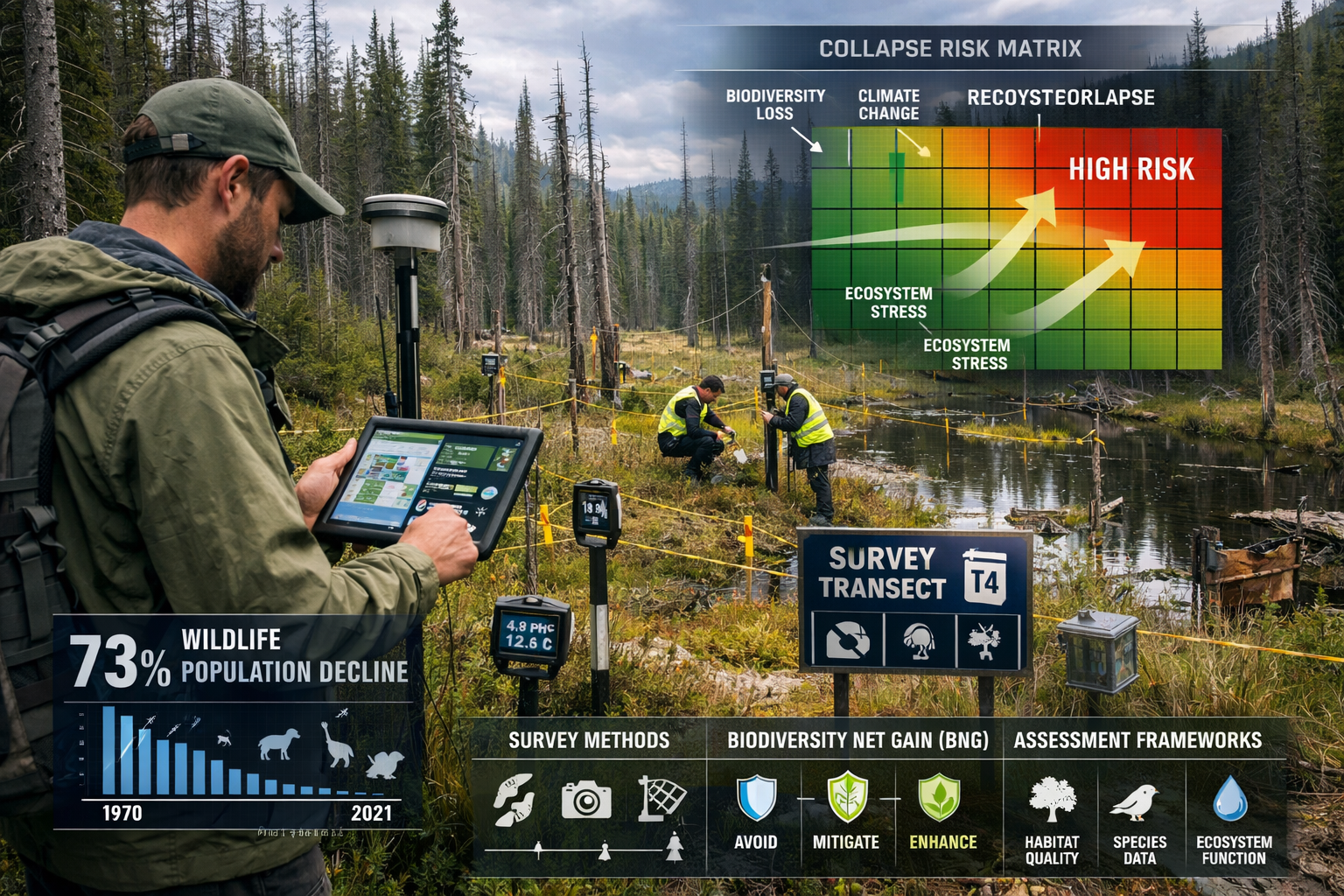
The Global Risk Landscape and Ecosystem Tipping Points
Environmental risks have dominated long-term threat assessments since 2017, with three-quarters of experts describing the environmental outlook as "turbulent" or "stormy"—the most pessimistic assessment across all risk categories[4]. This pessimism reflects hard data: the UK joint intelligence committee's January 2026 security threat assessment identifies specific ecosystems at imminent risk of collapse, including:
🌳 Amazon and Congo Basin rainforests – Carbon storage and biodiversity hotspots
🌲 North American and Eurasian boreal forests – Climate regulation systems
🏔️ Himalayan biome – Water security for billions
🌊 Southeast Asian and South Pacific mangroves and coral reefs – Coastal protection and marine biodiversity
These aren't abstract future scenarios. The IPBES Business and Biodiversity Assessment, endorsed by over 150 governments in February 2026, confirms that every business depends on biodiversity and every business impacts it[1]. For biodiversity surveyors, this creates both responsibility and opportunity—the data collected in the field directly informs prevention strategies that can halt ecosystem collapse.
Understanding what you need in a biodiversity net gain report becomes critical when translating global risks into local action. Survey methodologies must now account for tipping point indicators, resilience metrics, and collapse prevention thresholds that go beyond traditional habitat assessments.
The Finance-Biodiversity Disconnect
Perhaps the most striking finding from the 2026 assessments is the financial imbalance: €6.12 trillion invested in high-impact sectors in 2023 compared to only €184.58 billion in conservation and restoration[1]. This 33-fold disparity reveals why ecosystem collapse risks continue to escalate despite growing awareness.
| Financial Flow Category | Amount (2023) | Percentage |
|---|---|---|
| Harmful investments (high-impact sectors) | €6.12 trillion | 97.1% |
| Conservation and restoration | €184.58 billion | 2.9% |
| Investment gap | €5.94 trillion | 33:1 ratio |
Biodiversity surveyors play a crucial role in closing this gap by providing the credible baseline data that financial instruments require. Chile's launch of the first-ever sovereign biodiversity-linked bond in February 2026 demonstrates how survey data can be directly integrated into financial mechanisms[3]. These bonds connect national debt to nature-positive outcomes, but they depend entirely on robust monitoring and verification systems—exactly what professional biodiversity surveys provide.
For developers seeking to navigate these new financial landscapes, achieving biodiversity net gain without the risk requires understanding how survey data translates into bankable biodiversity credits and investment-grade conservation outcomes.
Implementing Survey Strategies in High-Collapse Risk Zones
Priority Ecosystem Assessment Methodologies
The 2026 Global Risks Report: Biodiversity Survey Strategies for Ecosystem Collapse Prevention identifies specific survey methodologies tailored to high-risk ecosystems. Traditional habitat surveys must evolve to capture tipping point indicators and resilience metrics that predict ecosystem collapse before it becomes irreversible.
Essential Survey Components for Collapse Prevention:
- Baseline Biodiversity Metrics – Establishing current species richness, abundance, and distribution patterns
- Tipping Point Indicators – Monitoring threshold species, keystone populations, and ecosystem function markers
- Resilience Assessment – Evaluating ecosystem capacity to recover from disturbance
- Connectivity Mapping – Identifying critical corridors and fragmentation risks
- Climate Vulnerability Analysis – Assessing exposure to extreme weather and temperature shifts
For rainforest ecosystems like the Amazon and Congo Basin, survey strategies must prioritize canopy biodiversity assessments, soil carbon monitoring, and hydrological function measurements. The February 2026 exit of major soy traders from the Brazil soy moratorium[3] demonstrates how quickly conservation progress can reverse—making rapid, accurate baseline surveys essential for protecting gains.
Boreal forest surveys require different approaches, focusing on fire resilience indicators, permafrost stability markers, and carbon sequestration capacity. The Himalayan biome demands altitudinal gradient surveys, water source mapping, and endemic species monitoring to protect the water security of billions downstream.
When conducting surveys in these high-risk zones, professionals should reference comprehensive guides on how to conduct a biodiversity impact assessment to ensure methodologies meet both scientific standards and regulatory requirements.
Integrating BNG Metrics with Global Risk Data
Biodiversity Net Gain (BNG) frameworks provide the perfect mechanism for translating global risk assessments into actionable local interventions. The 2026 Global Risks Report emphasizes that survey strategies must bridge the gap between international risk identification and site-specific prevention measures.
BNG Integration Framework for Collapse Prevention:
✅ Risk-Weighted Baseline Surveys – Prioritize detailed assessments in ecosystems identified as high-collapse risk
✅ Enhanced Metric Calculations – Apply multipliers to biodiversity units in tipping point zones
✅ Long-Term Monitoring Protocols – Establish 30+ year monitoring commitments in critical areas
✅ Adaptive Management Triggers – Define thresholds that activate intervention responses
✅ Connectivity Bonuses – Reward habitat creation that links fragmented high-risk ecosystems
The UK's mandatory BNG requirements create a regulatory framework that can be leveraged for collapse prevention. By understanding what's in a biodiversity net gain assessment, surveyors can ensure their methodologies capture the resilience and tipping point data needed for effective risk mitigation.
Developers working in or near high-risk ecosystems should consult resources on how to achieve 10% biodiversity net gain while simultaneously contributing to ecosystem collapse prevention through strategic habitat creation and restoration.
Data Quality and Decision-Making Integration
Despite improved data collection capabilities, a critical gap persists: biodiversity data remains fragmented and largely disconnected from operational decision-making[6]. Biodiversa+ reports released during Davos 2026 highlight this challenge—companies increasingly use biodiversity data for risk identification but fail to integrate findings into strategic planning and project execution.
Bridging the Data-Decision Gap:
Survey Design Phase:
- Align survey scope with specific decision points in project timelines
- Include decision-maker stakeholders in methodology development
- Define clear data deliverables tied to planning milestones
Data Collection Phase:
- Use standardized metrics that translate across business functions
- Collect data at scales relevant to operational decisions
- Document uncertainty and confidence levels explicitly
Reporting Phase:
- Present findings in decision-ready formats (dashboards, risk matrices, scenario models)
- Link biodiversity metrics directly to financial, regulatory, and reputational outcomes
- Provide clear action recommendations with cost-benefit analysis
For planners navigating these complexities, reviewing top questions about biodiversity net gain can clarify how survey data should inform planning decisions and approval processes.
Actionable Survey Strategies for Developers and Landowners
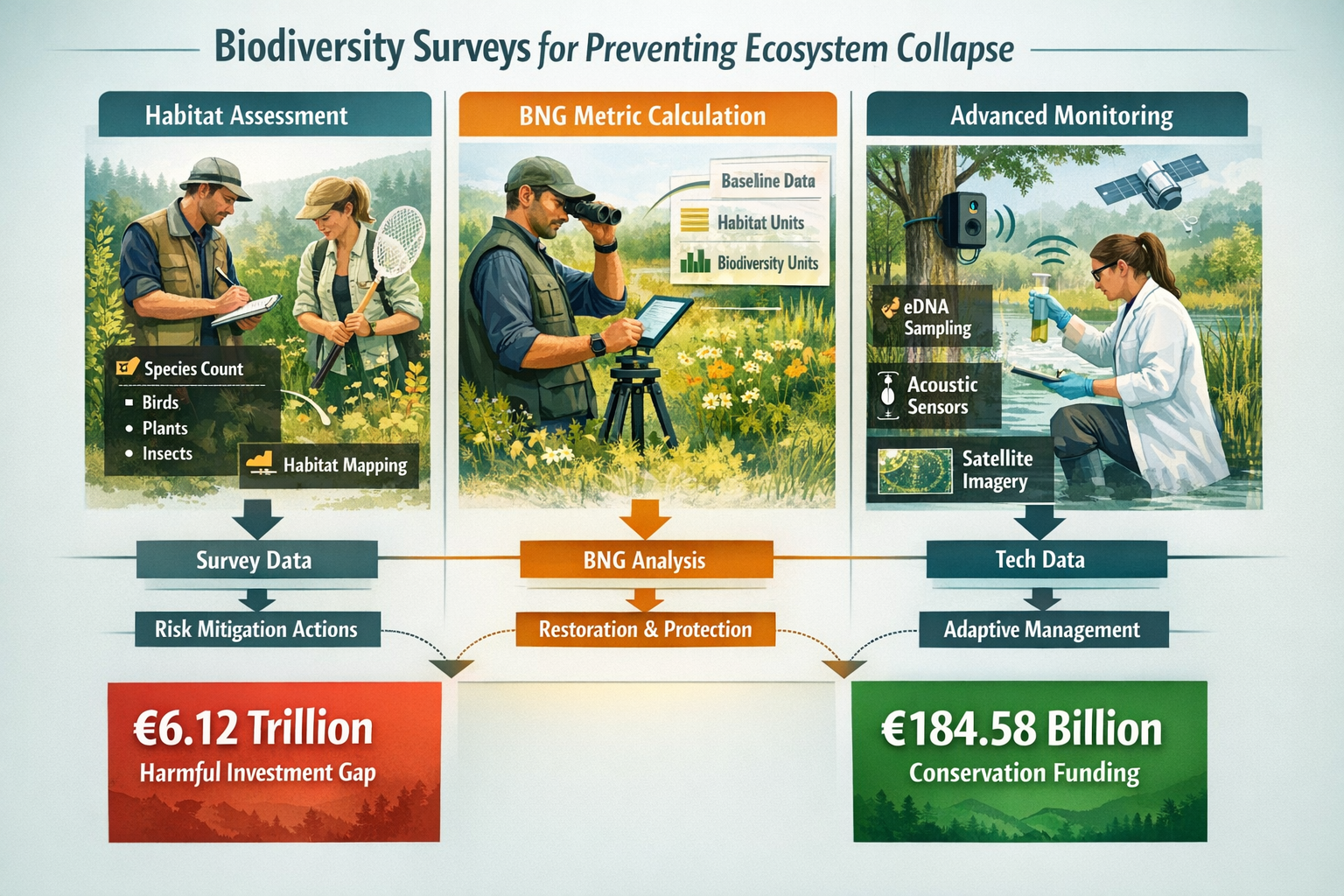
Developer-Focused Collapse Prevention Strategies
The IPBES assessment confirms that every business impacts biodiversity[1], making developer engagement essential for ecosystem collapse prevention. Survey strategies must provide developers with clear pathways to contribute positively while meeting regulatory requirements and managing financial risks.
Strategic Survey Approaches for Development Projects:
Pre-Development Phase:
- Commission comprehensive baseline surveys in all high-risk ecosystem types
- Identify opportunities for on-site versus off-site BNG delivery
- Map connectivity corridors that could be protected or enhanced
- Assess potential for contributing to 30×30 conservation targets
Design Phase:
- Integrate survey findings into site layout and building placement
- Explore how architects can solve biodiversity net gain through design innovation
- Calculate biodiversity unit requirements using risk-weighted metrics
- Identify opportunities for habitat creation that addresses collapse risks
Construction Phase:
- Implement adaptive monitoring protocols during ground works
- Protect identified high-value habitats and connectivity corridors
- Document baseline conditions for long-term monitoring commitments
Post-Development Phase:
- Establish 30-year monitoring programs aligned with global risk timelines
- Report outcomes to contribute to landscape-scale collapse prevention data
- Participate in habitat banking schemes that support critical ecosystem protection
Smaller projects shouldn't assume exemption from these responsibilities. Resources on BNG for small development projects demonstrate how even modest developments can contribute meaningfully to collapse prevention when surveys are properly scoped.
Landowner Opportunities in Ecosystem Restoration
The High Seas Treaty's entry into force in February 2026 enables creation of the first international networks of protected areas in high seas, helping meet Target 3 of the Global Biodiversity Framework to conserve 30% of land, waters, and seas by 2030[3]. This creates unprecedented opportunities for landowners to participate in ecosystem collapse prevention through habitat banking and biodiversity credit markets.
Landowner Survey Strategy Framework:
📊 Baseline Assessment
- Commission professional surveys to establish current biodiversity value
- Identify restoration potential and tipping point recovery opportunities
- Calculate potential biodiversity unit generation capacity
💰 Financial Modeling
- Understand the cost of biodiversity units and statutory credits
- Explore opportunities to sell biodiversity units through habitat banking
- Investigate biodiversity-linked financing options modeled on Chile's sovereign bond
🌱 Restoration Planning
- Design habitat creation targeting high-collapse risk ecosystem types
- Prioritize connectivity enhancements between fragmented habitats
- Align restoration with land banking versus habitat banking strategies
📈 Long-Term Monitoring
- Establish monitoring protocols that meet 30-year BNG requirements
- Contribute data to landscape-scale collapse prevention initiatives
- Document ecosystem resilience improvements over time
Landowners should review comprehensive guidance for landowners to understand how professional surveys unlock financial value while contributing to global ecosystem collapse prevention goals.
Emerging Technologies and Methodological Innovations
The 2026 Global Risks Report highlights that while traditional survey methods remain foundational, technological innovations are essential for scaling collapse prevention efforts to match the urgency of identified risks.
Innovative Survey Technologies:
🔬 Environmental DNA (eDNA) Sampling
- Rapidly assess species presence across large areas
- Detect rare and cryptic species missed by visual surveys
- Monitor ecosystem health through biodiversity proxy metrics
📡 Remote Sensing and Satellite Analysis
- Track habitat extent and fragmentation at landscape scales
- Monitor vegetation health and ecosystem productivity
- Identify early warning signs of tipping point approaches
🎤 Acoustic Monitoring Networks
- Continuously monitor species activity patterns
- Detect population declines through soundscape changes
- Provide cost-effective long-term monitoring data
🤖 AI-Powered Species Identification
- Accelerate data processing from camera traps and acoustic sensors
- Improve identification accuracy for difficult species groups
- Enable real-time analysis for adaptive management
📱 Citizen Science Integration
- Expand survey coverage through structured public participation
- Validate professional survey findings with community observations
- Build public engagement in collapse prevention efforts
These technologies complement rather than replace professional expertise. The most effective survey strategies combine traditional field methods with technological innovations, ensuring data quality while achieving the scale needed to address global risks.
Policy Integration and Regulatory Compliance
Aligning Surveys with International Conservation Targets
The 30×30 target—conserving 30% of land, waters, and seas by 2030—provides a clear framework for aligning biodiversity surveys with global collapse prevention goals. Survey strategies must explicitly connect site-level data collection with landscape-scale conservation planning.
Survey Alignment Checklist:
- Identify whether survey area falls within priority conservation zones for 30×30 targets
- Assess contribution potential to ecological networks and protected area connectivity
- Document ecosystem services that support climate resilience and adaptation
- Quantify carbon storage and sequestration alongside biodiversity metrics
- Map survey findings to Global Biodiversity Framework indicators
The February 2026 policy developments—including the High Seas Treaty enforcement and Chile's biodiversity-linked bond launch—demonstrate how international frameworks are rapidly evolving[3]. Survey methodologies must remain adaptable to capture emerging metrics required by these new policy instruments.
Navigating UK BNG Requirements in Global Context
While UK BNG regulations focus on domestic development impacts, the 2026 Global Risks Report: Biodiversity Survey Strategies for Ecosystem Collapse Prevention emphasizes that local actions contribute to global outcomes. Survey strategies should position BNG compliance as the foundation for broader collapse prevention contributions.
Integrated Compliance Framework:
Mandatory Requirements:
- Meet statutory 10% BNG minimum through credible metric calculations
- Complete baseline surveys using approved methodologies
- Secure 30-year habitat management and monitoring commitments
- Register biodiversity gains on national registry systems
Voluntary Enhancements:
- Apply risk-weighted multipliers for habitats in high-collapse ecosystems
- Extend monitoring periods beyond 30 years for critical sites
- Contribute data to international biodiversity monitoring networks
- Participate in landscape-scale conservation partnerships
Developers can explore guidance for developers to understand how exceeding minimum BNG requirements creates competitive advantages while contributing meaningfully to ecosystem collapse prevention.
Business Risk Management Through Survey Investment
The IPBES assessment's conclusion that every business depends on biodiversity[1] transforms biodiversity surveys from regulatory compliance exercises into essential risk management tools. The €6.12 trillion in harmful financial flows versus €184.58 billion in conservation investment[1] reveals massive exposure to ecosystem collapse risks across global supply chains.
Survey-Based Risk Mitigation:
Supply Chain Resilience:
- Survey biodiversity dependencies in raw material sourcing regions
- Identify alternative sources in ecosystems with lower collapse risk
- Invest in habitat protection for critical supply chain ecosystems
Asset Valuation:
- Document ecosystem services supporting property values
- Quantify biodiversity contributions to operational continuity
- Assess exposure to regulatory changes and carbon pricing
Reputational Protection:
- Demonstrate proactive biodiversity stewardship through survey investment
- Contribute transparently to collapse prevention initiatives
- Build social license through measurable conservation outcomes
Financial Opportunity:
- Position for biodiversity-linked financing at favorable rates
- Access emerging biodiversity credit markets
- Benefit from regulatory incentives for nature-positive outcomes
Japan's February 2026 decision to proceed with deep-sea mining trials near Minamitori Island despite scientific warnings[3] illustrates the financial risks of ignoring biodiversity data. Companies that invest in comprehensive surveys position themselves to avoid similar reputational and financial damage.
Conclusion: From Global Risks to Field Action
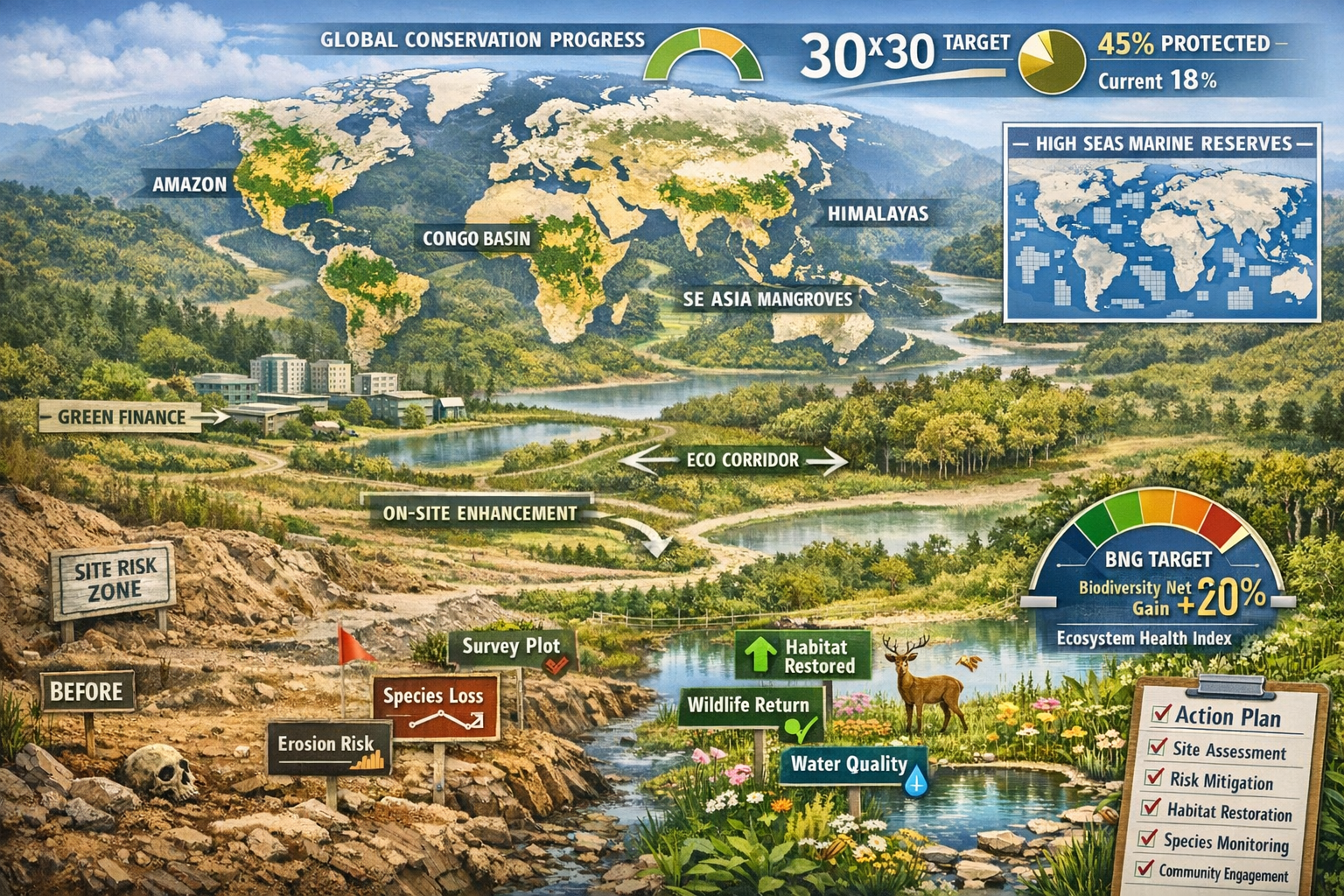
The 2026 Global Risks Report: Biodiversity Survey Strategies for Ecosystem Collapse Prevention delivers an unambiguous message: the time for incremental action has passed. With key earth systems approaching irreversible tipping points within two decades[2], monitored wildlife populations down 73%[5], and a 33-fold investment gap between harmful activities and conservation[1], biodiversity surveyors stand at the frontline of ecosystem collapse prevention.
Immediate Action Steps:
- Prioritize High-Risk Ecosystems – Commission comprehensive surveys in Amazon, Congo Basin, boreal forests, Himalayan biome, and mangrove/coral reef systems
- Integrate BNG Metrics – Use biodiversity net gain frameworks to translate global risks into site-specific prevention measures
- Bridge Data-Decision Gaps – Design surveys that deliver decision-ready outputs integrated into operational planning
- Leverage Financial Innovations – Position survey data to access biodiversity-linked bonds, habitat banking, and conservation finance
- Commit to Long-Term Monitoring – Establish 30+ year monitoring protocols aligned with tipping point timelines
- Contribute to 30×30 Targets – Align survey efforts with landscape-scale conservation planning and protected area networks
The pessimistic outlook reflected in global risk assessments[4] need not become reality. Professional biodiversity surveys provide the foundation for evidence-based prevention strategies that can halt ecosystem collapse. By translating WEF risk rankings into surveyor action plans, integrating BNG metrics, and prioritizing field resilience, the biodiversity survey community can deliver the data and insights needed to shift the €6.12 trillion in harmful investments toward nature-positive outcomes.
For developers, landowners, planners, and businesses, the path forward is clear: invest in comprehensive biodiversity surveys today to prevent catastrophic ecosystem collapse tomorrow. The tools, frameworks, and financial mechanisms are now in place—what remains is the collective will to act at the scale and speed the crisis demands.
Ready to contribute to ecosystem collapse prevention? Contact biodiversity survey professionals to develop survey strategies aligned with 2026 global risk priorities and BNG requirements. The data you collect today may prevent the tipping points of tomorrow.
References
[1] New Global Science Highlights Business Risks Nature Loss 2026 02 10 En – https://environment.ec.europa.eu/news/new-global-science-highlights-business-risks-nature-loss-2026-02-10_en
[2] New Environmental Intelligence Assessment Points To Catastrophic Security Risks – https://www.energypolicy.columbia.edu/new-environmental-intelligence-assessment-points-to-catastrophic-security-risks/
[3] February Nature Policy Bulletin – https://www.businessfornature.org/news/february-nature-policy-bulletin
[4] 2026 Global Risks Report Environmental Risks Remain Urgent – https://www.weforum.org/stories/2026/02/2026-global-risks-report-environmental-risks-remain-urgent/
[5] Sciadv – https://www.science.org/doi/10.1126/sciadv.aee6950
[6] New Reports Show How Biodiversity Data Can Move Business From Commitment To Action – https://www.biodiversa.eu/2026/01/22/new-reports-show-how-biodiversity-data-can-move-business-from-commitment-to-action/