

The silent threat hanging over our natural landscapes isn't always visible from the ground. As biodiversity surveyors conduct habitat assessments across development sites in 2026, a new environmental challenge has emerged from an unexpected source: fibre optic drone cables. These durable plastic strands, initially deployed in conflict zones but now raising concerns for wider infrastructure applications, have been identified by the UN Environment Programme World Conservation Monitoring Centre as a priority conservation issue requiring immediate attention.[2] For developers, ecologists, and land managers navigating Fibre Optic Drone Cables: Assessing Biodiversity Impacts in 2026 Aerial Infrastructure Surveys, understanding these risks has become essential to comprehensive environmental planning.
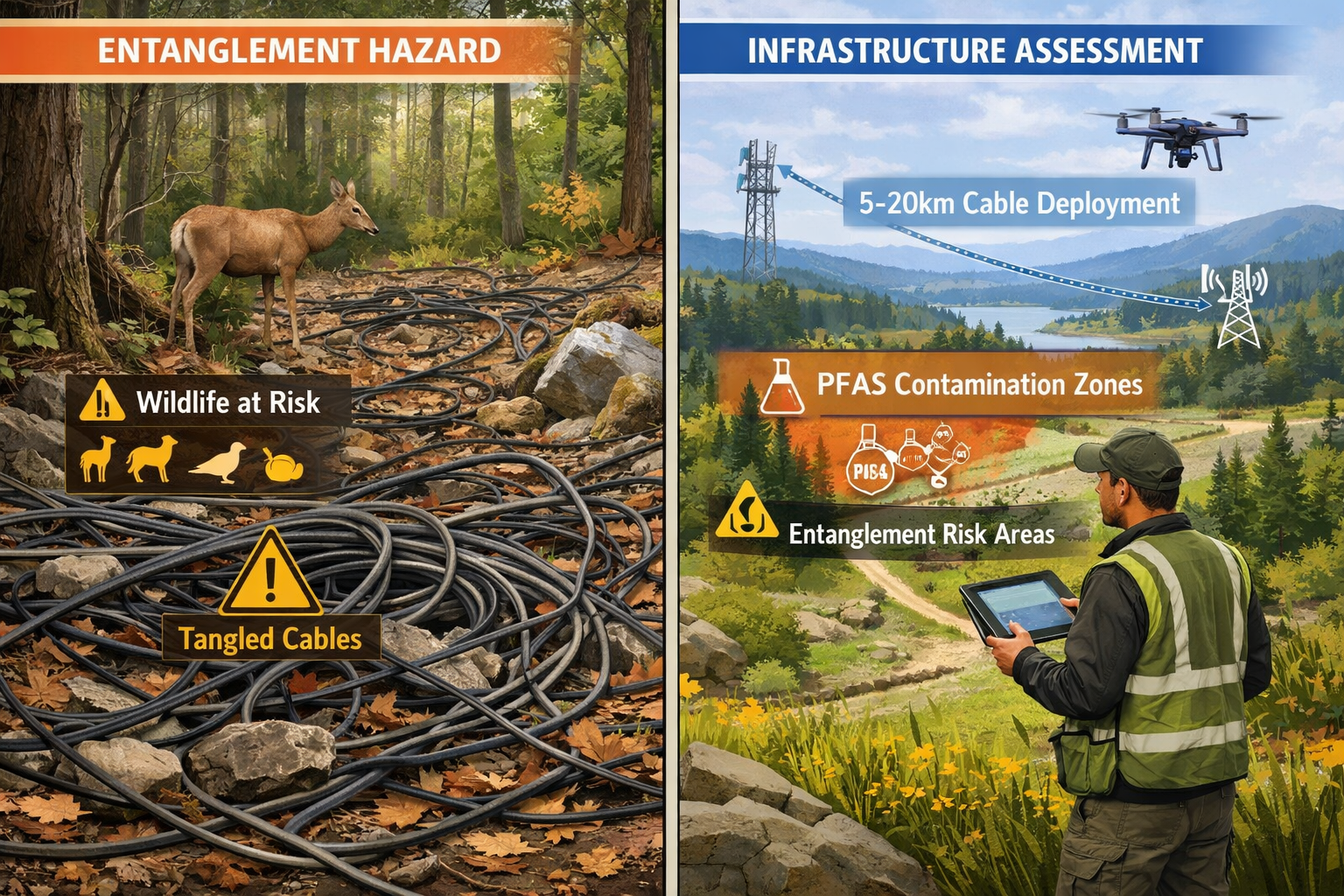
The scale of the problem is staggering. Individual drones can carry between 5-20 kilometres of cable per flight, with documented cases reporting spools as long as 41 kilometres.[1] When multiple drones operate simultaneously across the same areas, the cumulative impact creates vast networks of persistent plastic infrastructure that can remain in the environment for over 600 years.[1] This emerging issue demands new protocols for biodiversity professionals conducting site evaluations.
Key Takeaways
- 🌍 Fibre optic drone cables have been identified as an emerging biodiversity threat in the UN's 2026 Horizon Scan, requiring integration into standard environmental impact assessments
- 🦅 Wildlife entanglement risks mirror those of ghost fishing gear, with documented cases including birds, deer, and bats becoming trapped in cable webs that persist for centuries
- 🔬 Microplastic contamination and PFAS pollution from degrading cables threaten soil ecosystems, crop yields, and water quality across affected landscapes
- 📊 Biodiversity surveyors must now incorporate aerial infrastructure risk assessments into site evaluations to ensure compliance with net gain requirements
- ✅ Proactive mitigation protocols including pre-deployment habitat mapping and wildlife corridor protection can minimize impacts while supporting conservation goals
Understanding the Emerging Threat: Fibre Optic Drone Cables in Aerial Infrastructure
What Are Fibre Optic Drone Cables?
Fibre optic drone cables represent a technological solution that has created an unintended environmental consequence. These cables allow operators to maintain secure communications with unmanned aerial vehicles over extended distances, providing advantages over radio-controlled systems that can be jammed or intercepted. The cables themselves consist of durable plastic materials designed to withstand harsh conditions, including temperature fluctuations, physical abrasion, and environmental exposure.[1]
The composition of these cables includes:
- Polymer-based outer sheaths for protection and durability
- Fluoropolymer cladding containing PFAS (per- and polyfluoroalkyl substances)
- Optical fibres for data transmission
- Reinforcement materials to prevent breakage during deployment
This robust construction, while necessary for operational purposes, creates significant environmental persistence. The materials can remain intact in natural environments for over 600 years, making them comparable to ghost fishing gear in terms of long-term ecological impact.[1]
Scale of Deployment and Environmental Presence
The deployment scale of fibre optic drone cables has exceeded initial projections. Current operational data reveals:
| Deployment Metric | Scale |
|---|---|
| Cable per flight | 5-20 km typical |
| Maximum documented spool | 41 km |
| Environmental persistence | 600+ years |
| Multiple simultaneous operations | Common in active zones |
When conducting Fibre Optic Drone Cables: Assessing Biodiversity Impacts in 2026 Aerial Infrastructure Surveys, professionals must account for the cumulative effect of multiple deployments across the same landscape. This creates extensive networks of persistent plastic that intersect with critical wildlife corridors, nesting sites, and foraging areas.[1]
Why 2026 Marks a Critical Assessment Year
The inclusion of fibre optic drone cable impacts in the UN Environment Programme World Conservation Monitoring Centre's 2026 Horizon Scan represents a watershed moment for biodiversity professionals.[2] This designation places the issue alongside other emerging conservation priorities requiring integrated approaches and immediate action.
Several factors have converged to make 2026 a pivotal year:
- Increased documentation of wildlife impacts and entanglement cases
- Growing awareness among conservation scientists and field ecologists
- Regulatory evolution as environmental frameworks adapt to new threats
- Technological proliferation beyond initial deployment contexts
For developers working within biodiversity net gain frameworks, this recognition means that aerial infrastructure risks must now be factored into comprehensive site assessments.
Documented Biodiversity Impacts of Fibre Optic Drone Cables
Wildlife Entanglement and Direct Mortality Risks
The most visible impact of fibre optic drone cables involves direct wildlife entanglement. As of February 2026, documented cases include:
- 🐦 Birds building nests from recovered fibre strands
- 🦌 Deer found with cables tangled around antlers
- 🕊️ Ukrainian soldiers cutting birds free from fibre webs in conflict zones
- 🦇 Potential bat entanglement in nocturnal flight paths[4]
Charlie Russell from the University of East Anglia warns that these cables "will pose a significant risk of entanglement and death to many species, including threatened birds and bats, for years to come."[1] The mechanisms of harm mirror those documented in ghost fishing gear research:
- Amputation from constricting fibres around limbs or wings
- Asphyxiation when cables wrap around necks or respiratory structures
- Starvation when entangled animals cannot access food sources
- Predation vulnerability for immobilized wildlife
When conducting biodiversity impact assessments, surveyors must now evaluate aerial infrastructure as a potential mortality source comparable to other anthropogenic threats.
Barriers to Movement and Ecosystem Connectivity
Beyond direct entanglement, fibre optic cables create physical barriers that disrupt wildlife movement patterns across multiple landscape strata:
Ground Level Impacts:
- Obstruction of small mammal corridors
- Interference with amphibian migration routes
- Barriers across woodland floor habitats
Canopy and Mid-Story Impacts:
- Disruption of bird flight paths
- Obstacles in bat foraging territories
- Interference with arboreal mammal movement
Aquatic and Riparian Impacts:
- Cables spanning waterways
- Barriers in wetland edge habitats
- Disruption of riparian corridors
These barriers reduce access to high-quality habitat patches and essential resources, thereby diminishing ecosystem functioning across wooded and edge habitats.[1] For developers planning projects near woodland corridors or water features, understanding these connectivity impacts is crucial for achieving biodiversity net gain requirements.
Microplastic Pollution and Soil Ecosystem Degradation
As fibre optic cables degrade under environmental stressors—including blasts, fires, UV radiation, abrasion, and temperature fluctuations—they fragment into microplastics that infiltrate soil ecosystems.[1] German and international research has established clear links between microplastics in soil and:
- ⚠️ Reduced crop yields in agricultural systems
- 🦠 Disrupted microbial ecosystems essential for nutrient cycling
- 💨 Increased nitrogen oxide emissions, a potent greenhouse gas contributing to climate change[4]
The soil contamination pathway operates through multiple mechanisms:
- Physical degradation of cable materials into smaller fragments
- Distribution through soil movement, plowing, and bioturbation
- Accumulation in topsoil layers where biological activity concentrates
- Interference with root development and microbial communities
Some experts argue that agricultural plowing may break up and disperse fibre strands, potentially limiting direct harm to crops.[4] However, this dispersion actually exacerbates microplastic contamination by distributing fragments more widely throughout the soil profile.
PFAS Contamination: A Persistent Chemical Threat
The fluoropolymer cladding used in fibre optic cables contains highly persistent per- and polyfluoroalkyl substances (PFAS) that do not readily degrade in natural environments.[1] These "forever chemicals" represent an additional military and infrastructure-related PFAS source alongside munitions and firefighting foams.
PFAS contamination pathways include:
- Leaching into soil as cables degrade
- Transport into groundwater systems
- Uptake by vegetation and entry into food webs
- Bioaccumulation in wildlife tissues
- Persistence across decades or centuries
For land managers and developers, PFAS contamination from aerial infrastructure adds complexity to site remediation efforts and long-term environmental liability. This concern is particularly acute for projects near water sources or on sites intended for biodiversity unit generation.
Impacts on Agricultural and Land Management Operations
Beyond ecological concerns, abandoned fibre optic cables create practical challenges for land management:
Agricultural Complications:
- Entanglement in plowing equipment
- Interference with harvesting machinery
- Damage to irrigation systems
- Complications for precision agriculture technology
Conservation Management Barriers:
- Entanglement of protected area vehicles
- Interference with forestry equipment
- Complications for firefighting vehicles used in landscape fire suppression
- Hazards for ecological monitoring equipment[1]
Mine Clearance and Remediation:
- Novel challenges for mechanical mine clearance operations
- Complications for mine flails and detection equipment
- Increased complexity in post-conflict landscape restoration[1]
These operational impacts extend the consequences of cable deployment beyond immediate wildlife concerns, affecting the practical implementation of conservation and land management strategies.
Integrating Aerial Infrastructure Assessment into Biodiversity Surveys
Developing Assessment Protocols for Fibre Optic Drone Cables: Assessing Biodiversity Impacts in 2026 Aerial Infrastructure Surveys
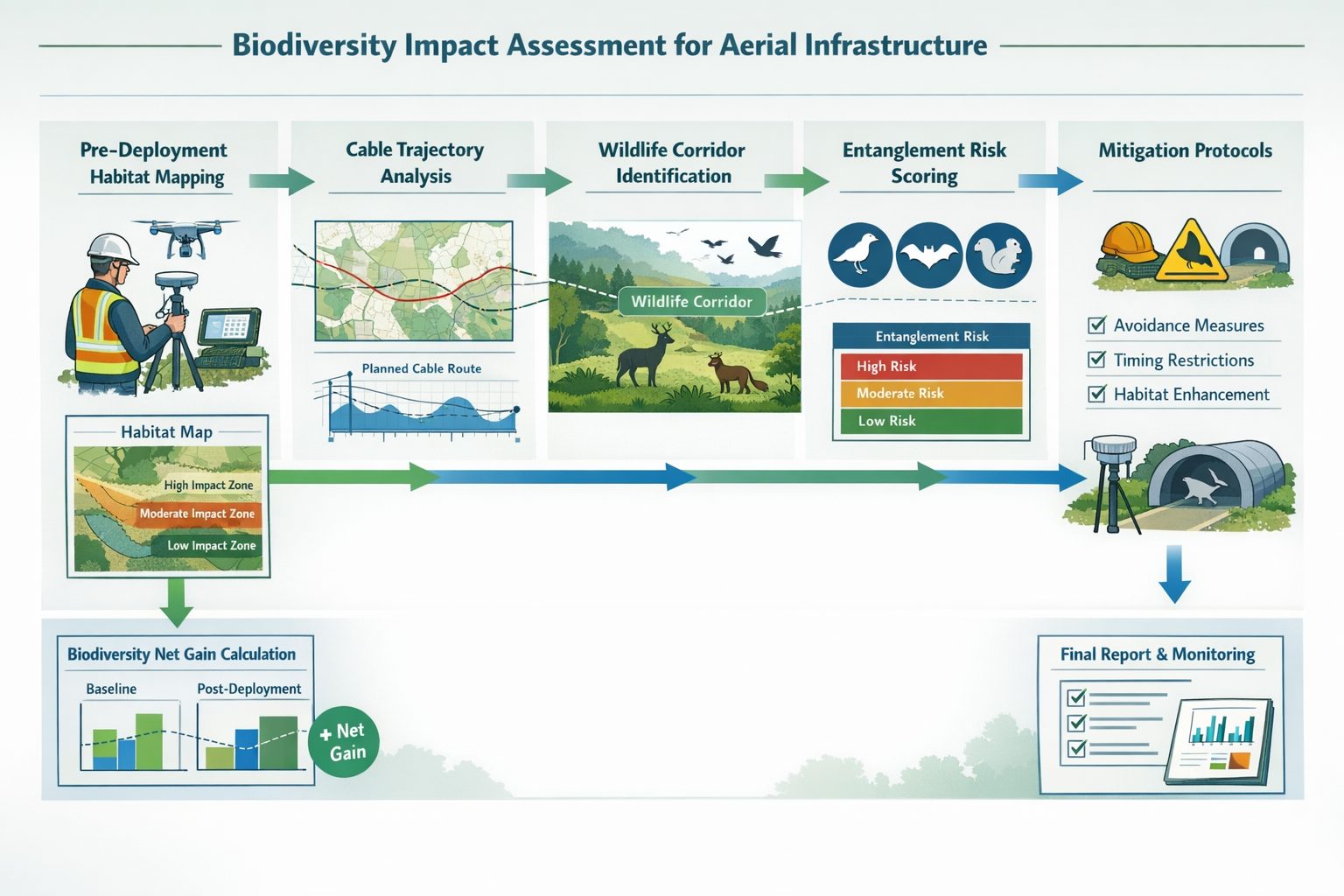
As biodiversity professionals adapt to this emerging threat, new assessment protocols must be developed and integrated into standard survey methodologies. A comprehensive approach to Fibre Optic Drone Cables: Assessing Biodiversity Impacts in 2026 Aerial Infrastructure Surveys should include:
Phase 1: Pre-Survey Intelligence Gathering
- Review historical aerial activity records
- Consult with local authorities on infrastructure deployments
- Examine satellite imagery for visible cable networks
- Interview land managers about observed cable presence
Phase 2: Field Assessment Methods
- Systematic transect surveys across site boundaries
- Focused searches in high-risk areas (woodland edges, water crossings)
- Documentation of cable density, distribution, and condition
- Assessment of entanglement evidence and wildlife impacts
Phase 3: Risk Characterization
- Mapping cable locations relative to habitat features
- Identifying wildlife corridors intersected by cables
- Evaluating proximity to protected species territories
- Assessing degradation status and microplastic risk
Phase 4: Impact Quantification
- Estimating affected habitat area
- Calculating connectivity disruption metrics
- Projecting long-term persistence and degradation timeline
- Quantifying implications for biodiversity net gain calculations
Key Habitat Features Requiring Enhanced Scrutiny
Certain landscape features warrant heightened attention during Fibre Optic Drone Cables: Assessing Biodiversity Impacts in 2026 Aerial Infrastructure Surveys:
🌳 Woodland Edges and Ecotones
- High wildlife activity zones
- Critical for edge-specialist species
- Frequent cable deployment corridors
- Maximum entanglement risk areas
💧 Riparian Corridors and Wetlands
- Essential wildlife movement routes
- High biodiversity concentration
- Cable spanning across water features
- Aquatic ecosystem contamination risk
🦅 Raptor Nesting Sites and Hunting Territories
- Low-altitude flight paths
- Vulnerable species populations
- Long-term site fidelity
- Protected species considerations
🦇 Bat Foraging Areas and Commuting Routes
- Nocturnal activity patterns
- Echolocation interference potential
- Linear feature following behavior
- Conservation priority species
Technology-Enhanced Detection Methods
Modern survey technology offers new capabilities for detecting and mapping aerial infrastructure:
Drone-Based Survey Approaches:
- High-resolution aerial photography
- LiDAR scanning for cable detection
- Thermal imaging for degraded material identification
- Systematic grid coverage of large sites
Ground-Based Technologies:
- GPS mapping of cable locations
- Photographic documentation protocols
- Cable condition assessment tools
- Microplastic sampling equipment
Data Integration Platforms:
- GIS mapping of cable networks
- Overlay with habitat quality assessments
- Integration with species distribution data
- Compatibility with biodiversity net gain reporting requirements
Incorporating Findings into Biodiversity Net Gain Assessments
The presence of fibre optic drone cables affects multiple aspects of biodiversity net gain planning:
Baseline Habitat Condition Scoring:
- Cables reduce habitat distinctiveness scores
- Connectivity impacts lower condition assessments
- Contamination affects soil quality metrics
- Wildlife hazards influence habitat functionality ratings
Impact Prediction and Mitigation:
- Cable removal as part of site preparation
- Enhanced buffer zones around retained cables
- Connectivity restoration through targeted removal
- Long-term monitoring of degradation impacts
Enhancement and Creation Strategies:
- Prioritizing cable-free areas for habitat creation
- Incorporating removal into on-site delivery strategies
- Designing wildlife corridors to avoid cable zones
- Planning for long-term cable degradation management
Off-Site Compensation Considerations:
- Evaluating biodiversity unit purchase needs
- Accounting for cable-related habitat deficits
- Calculating biodiversity unit costs with cable impacts included
- Ensuring compensation adequately addresses aerial infrastructure risks
Mitigation Strategies and Best Practice Recommendations
Pre-Deployment Prevention Measures
The most effective approach to managing Fibre Optic Drone Cables: Assessing Biodiversity Impacts in 2026 Aerial Infrastructure Surveys involves preventing problematic deployments before they occur:
Habitat-Sensitive Flight Planning:
- Avoiding deployment over high-value habitats
- Routing flights away from protected species territories
- Minimizing crossings of wildlife corridors
- Scheduling operations outside sensitive breeding periods
Alternative Technology Consideration:
- Evaluating non-cable communication systems
- Assessing biodegradable cable materials
- Implementing cable retrieval protocols
- Designing for minimal environmental footprint
Stakeholder Coordination:
- Consulting with conservation authorities
- Engaging biodiversity professionals in planning
- Coordinating with land managers
- Establishing environmental monitoring requirements
Active Cable Removal and Remediation
Where cables have already been deployed, systematic removal becomes essential for landscape recovery:
Removal Prioritization Framework:
| Priority Level | Criteria | Timeframe |
|---|---|---|
| Critical | Protected species territories, water crossings, ancient woodland | Immediate (0-3 months) |
| High | Wildlife corridors, high-quality habitats, agricultural land | Short-term (3-12 months) |
| Medium | Edge habitats, secondary woodland, grasslands | Medium-term (1-2 years) |
| Low | Degraded habitats, developed areas, low biodiversity zones | Long-term (2-5 years) |
Removal Methodology Considerations:
- Manual collection to minimize habitat disturbance
- Systematic transect-based approaches
- Specialized equipment for canopy removal
- Proper disposal of collected materials
- Documentation for biodiversity net gain verification
Habitat Restoration Following Cable Removal
Cable removal creates opportunities for targeted habitat enhancement:
Soil Remediation:
- Testing for microplastic contamination levels
- PFAS assessment and monitoring
- Organic matter addition to improve soil structure
- Microbial community restoration
Vegetation Recovery:
- Native species planting in disturbed areas
- Structural diversity enhancement
- Connectivity restoration through green corridors
- Monitoring of natural regeneration
Wildlife Corridor Restoration:
- Removing barriers to movement
- Enhancing habitat quality along corridors
- Creating stepping-stone habitats
- Monitoring wildlife use patterns
Long-Term Monitoring and Adaptive Management
Effective management of aerial infrastructure impacts requires ongoing monitoring:
Monitoring Parameters:
- Cable degradation rates and fragment generation
- Wildlife entanglement incident documentation
- Microplastic accumulation in soils
- PFAS contamination levels in water and soil
- Habitat condition recovery trajectories
Adaptive Management Triggers:
- Evidence of ongoing wildlife mortality
- Detection of new cable deployments
- Changes in protected species populations
- Emerging contamination concerns
- Regulatory requirement updates
Regulatory Frameworks and Policy Implications for 2026
Current Regulatory Landscape
As of 2026, the regulatory framework for addressing fibre optic drone cable impacts remains under development in most jurisdictions. However, several existing frameworks provide relevant context:
Environmental Impact Assessment Requirements:
- Integration into standard EIA protocols
- Consideration under habitat regulations
- Assessment within protected area management plans
- Inclusion in strategic environmental assessments
Biodiversity Net Gain Legislation:
- Mandatory consideration under UK BNG requirements
- Habitat condition assessment implications
- Impact quantification for net gain calculations
- Monitoring and reporting obligations
Waste and Contamination Regulations:
- Classification as persistent plastic pollution
- PFAS contamination reporting requirements
- Duty of care for cable deployment operators
- Remediation liability frameworks
Emerging Policy Developments
The identification of cable impacts in the 2026 UN Horizon Scan signals likely policy evolution:[2]
International Conservation Frameworks:
- Integration into biodiversity convention protocols
- Consideration in protected area management guidelines
- Inclusion in military environmental impact standards
- Development of international best practice guidance
National Regulatory Responses:
- Specific cable deployment regulations
- Enhanced environmental assessment requirements
- Cleanup and remediation mandates
- Liability and compensation frameworks
Ukraine's EcoZagroza Portal:
Launched in 2025, this platform tracks environmental conditions and documents potential ecocide cases, providing a model for systematic environmental monitoring.[3] While no formal cleanup framework exists as of 2026, this infrastructure demonstrates growing governmental recognition of the issue.[3]
Implications for Developers and Land Managers
Understanding the evolving regulatory landscape is essential for developers planning projects:
Due Diligence Requirements:
- Aerial infrastructure surveys during site assessment
- Documentation of cable presence and impacts
- Consultation with ecological specialists
- Integration into environmental management plans
Liability Considerations:
- Long-term contamination responsibility
- Wildlife mortality incident reporting
- Remediation cost allocation
- Insurance and risk management implications
Compliance Strategies:
- Proactive cable removal before development
- Enhanced biodiversity offsetting for affected sites
- Ongoing monitoring and reporting protocols
- Stakeholder engagement and transparency
Case Studies and Practical Applications
Agricultural Land Development with Cable Contamination
A hypothetical development scenario illustrates practical assessment approaches:
Site Context:
- 50-hectare agricultural site with woodland edges
- Historical aerial activity documented
- Cable fragments discovered during initial surveys
- Proximity to protected bat foraging areas
Assessment Approach:
- Systematic transect surveys identified cable presence across 30% of site
- Focused searches along woodland edges revealed entanglement evidence
- Soil sampling detected microplastic contamination in upper horizons
- Habitat condition scoring adjusted to reflect cable impacts
Mitigation Implementation:
- Priority removal from woodland edges and bat corridors
- Agricultural area cables addressed during soil preparation
- Enhanced buffer zones established around retained natural features
- Monitoring program established for degradation tracking
Biodiversity Net Gain Outcomes:
- Baseline condition scores reduced by cable presence
- Removal activities contributed to enhancement calculations
- Off-site compensation increased to address residual impacts
- Long-term management plan incorporated cable monitoring
Woodland Conservation Site Assessment
Another scenario demonstrates assessment in high-value habitats:
Site Context:
- Ancient woodland with high biodiversity value
- Multiple protected species present
- Dense cable network from historical aerial operations
- Designation as local wildlife site
Assessment Findings:
- Cables present throughout canopy and ground layers
- Evidence of bird entanglement in multiple locations
- Disruption of bat commuting routes documented
- Microplastic contamination in woodland soils
Management Response:
- Phased removal prioritizing protected species territories
- Specialist arborists engaged for canopy cable removal
- Habitat restoration following removal operations
- Enhanced monitoring of protected species populations
Conservation Outcomes:
- Improved habitat connectivity for woodland specialists
- Reduced mortality risk for protected species
- Enhanced site value for biodiversity offsetting
- Model protocol for similar sites regionally
Future Directions: Advancing Fibre Optic Drone Cables: Assessing Biodiversity Impacts in 2026 Aerial Infrastructure Surveys
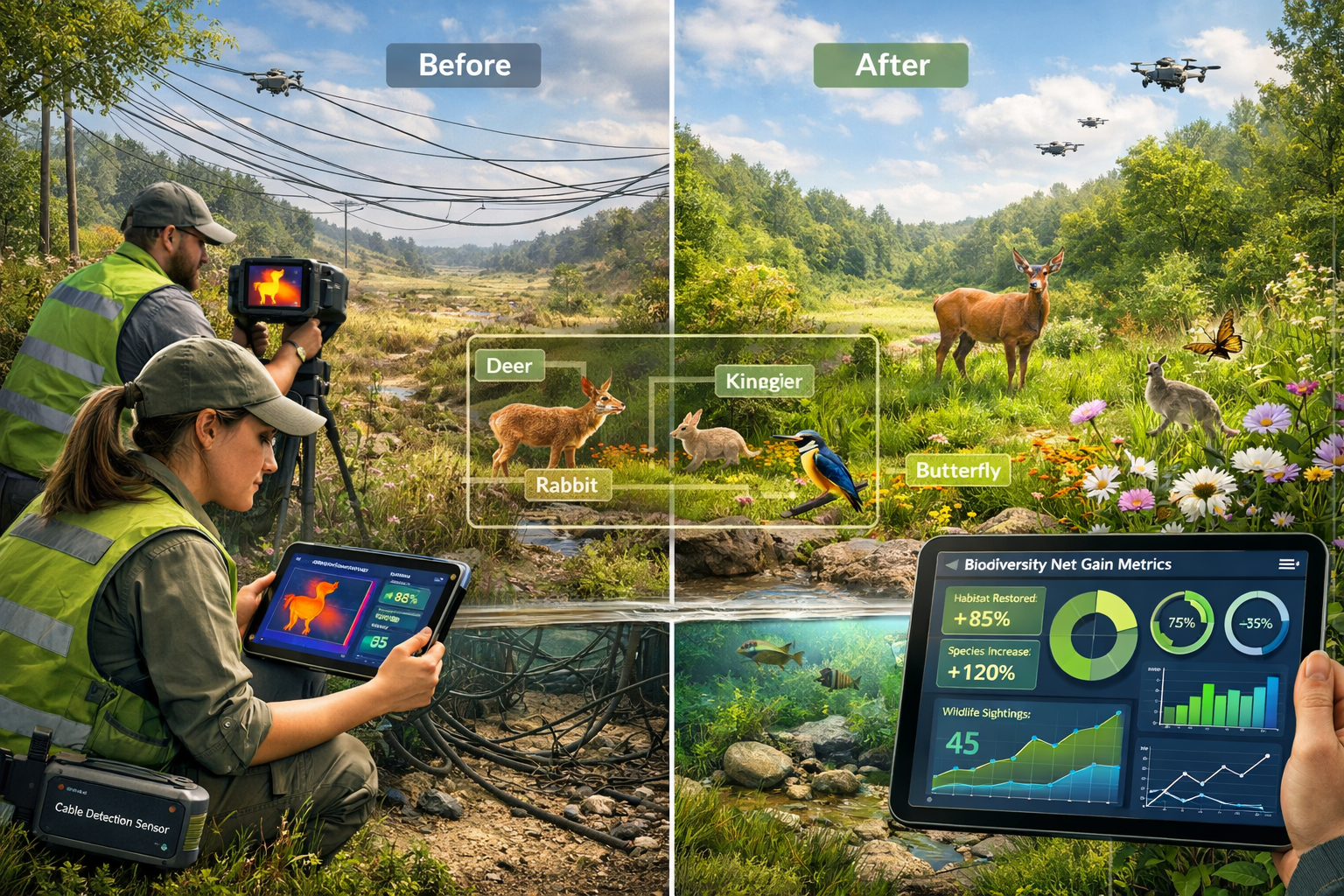
Research Priorities
Significant knowledge gaps remain regarding cable impacts, requiring targeted research:
Ecological Impact Studies:
- Quantifying mortality rates across taxa
- Assessing population-level effects on vulnerable species
- Evaluating ecosystem function disruption
- Comparing impacts across habitat types
Contamination Research:
- Characterizing microplastic generation rates
- Assessing PFAS leaching and transport
- Evaluating soil ecosystem recovery timelines
- Investigating bioaccumulation pathways
Mitigation Effectiveness:
- Comparing removal methodology outcomes
- Assessing habitat recovery trajectories
- Evaluating prevention measure effectiveness
- Developing cost-benefit frameworks
Technology Development Needs
Innovation can support both assessment and mitigation:
Detection Technologies:
- Automated cable detection algorithms
- Remote sensing applications
- AI-powered impact assessment tools
- Integrated monitoring platforms
Mitigation Technologies:
- Biodegradable alternative materials
- Efficient removal equipment
- Soil remediation techniques
- Habitat restoration technologies
Professional Development and Capacity Building
Biodiversity professionals require specialized training to address this emerging issue:
Core Competencies:
- Cable detection and mapping skills
- Impact assessment methodologies
- Mitigation planning expertise
- Regulatory compliance knowledge
Training Opportunities:
- Professional development workshops
- Field methodology courses
- Technology application training
- Case study learning programs
Integration with Broader Conservation Goals
Addressing cable impacts supports multiple conservation objectives:
Climate Change Mitigation:
- Reducing nitrogen oxide emissions from soil degradation
- Protecting carbon-storing habitats
- Maintaining ecosystem resilience
- Supporting nature-based solutions
Biodiversity Recovery:
- Removing barriers to species movement
- Enhancing habitat quality and connectivity
- Supporting protected species populations
- Contributing to nature recovery networks
Sustainable Development:
- Enabling responsible infrastructure deployment
- Supporting biodiversity net gain achievement
- Facilitating landscape-scale conservation
- Promoting environmental stewardship
Conclusion: Taking Action on Aerial Infrastructure Impacts
The emergence of fibre optic drone cables as a recognized biodiversity threat in 2026 represents both a challenge and an opportunity for conservation professionals. As documented through the UN Horizon Scan and growing field evidence, these persistent plastic infrastructures pose significant risks to wildlife, ecosystem function, and habitat quality across affected landscapes.[1][2]
For biodiversity surveyors, developers, and land managers, integrating Fibre Optic Drone Cables: Assessing Biodiversity Impacts in 2026 Aerial Infrastructure Surveys into standard practice is no longer optional—it is essential for comprehensive environmental stewardship and regulatory compliance. The documented impacts on wildlife entanglement, ecosystem connectivity, soil contamination, and land management operations demand systematic assessment and proactive mitigation.
Actionable Next Steps
For Biodiversity Professionals:
✅ Develop and implement cable detection protocols in standard survey methodologies
✅ Integrate aerial infrastructure assessment into biodiversity impact assessments
✅ Build expertise in cable impact quantification and mitigation planning
✅ Contribute to knowledge development through documentation and research
For Developers and Project Managers:
✅ Commission comprehensive aerial infrastructure surveys during site assessment
✅ Budget for cable removal and remediation in project planning
✅ Engage specialists early to address cable-related biodiversity impacts
✅ Incorporate long-term monitoring into environmental management plans
For Land Managers and Conservation Organizations:
✅ Conduct baseline assessments of cable presence across managed lands
✅ Prioritize removal in high-value habitats and protected species territories
✅ Establish monitoring programs for ongoing impact assessment
✅ Advocate for policy development and regulatory frameworks
For Policy Makers and Regulators:
✅ Develop specific guidance for aerial infrastructure environmental assessment
✅ Integrate cable impacts into biodiversity net gain frameworks
✅ Establish cleanup and remediation requirements
✅ Support research into impacts, mitigation, and alternative technologies
The challenges posed by fibre optic drone cables are significant, but they are not insurmountable. Through systematic assessment, evidence-based mitigation, and collaborative action across sectors, the biodiversity impacts of aerial infrastructure can be effectively managed. As we advance through 2026 and beyond, the integration of these considerations into standard conservation practice will be essential for protecting wildlife, maintaining ecosystem function, and achieving meaningful biodiversity net gain.
The time for action is now. By addressing this emerging threat proactively, we can prevent long-term ecological damage while supporting responsible infrastructure development and landscape-scale conservation goals.
References
[1] Plastic Pollution From Fibre Optic Drones May Threaten Wildlife For Years – https://ceobs.org/plastic-pollution-from-fibre-optic-drones-may-threaten-wildlife-for-years/
[2] Whats Next For Biodiversity Conservation Insights From The 2026 Horizon Scan – https://www.unep-wcmc.org/en/news/whats-next-for-biodiversity-conservation-insights-from-the-2026-horizon-scan
[3] Tangled Battlefields Addressing The Environmental Concerns Of Fiber Optic Drones In Ukraine – https://www.napforum.org/policy-briefs/tangled-battlefields-addressing-the-environmental-concerns-of-fiber-optic-drones-in-ukraine
[4] Fiber Optic Drone Ukraine Battlefields – https://dronexl.co/2026/02/10/fiber-optic-drone-ukraine-battlefields/