

High-rise developments in England now face a biodiversity challenge that traditional ground-level surveys cannot solve. With over 68% of urban land already developed and vertical expansion accelerating across major cities in 2026, ecologists must adapt their survey methodologies to measure biodiversity gains on building facades—not just at ground level. Vertical Greening Systems in Urban Biodiversity Surveys: Protocols for BNG Compliance on High-Rise Developments represent a critical evolution in how the built environment contributes to nature recovery targets.
The integration of living walls and vertical gardens into Biodiversity Net Gain (BNG) assessments demands specialized field protocols that account for three-dimensional habitat creation, plant-insect interactions at height, and microclimate variations across building elevations. As mandatory BNG requirements continue to reshape development planning, understanding how to properly survey and quantify vertical greening systems has become essential for developers, ecologists, and planning authorities alike.
Key Takeaways
✅ Vertical greening systems deliver measurable biodiversity benefits including pollinator habitat, microclimate regulation, and air quality improvements in dense urban areas where ground space is limited[1]
✅ Substrate depth, vegetation diversity, and structural complexity are the three primary design factors that determine biodiversity outcomes and BNG unit calculations for vertical installations[1]
✅ Specialized survey protocols must account for seasonal variations, height-dependent microclimates, and plant-insect interactions across multiple building elevations
✅ Integration with digital monitoring tools including remote sensing and IoT sensors enables continuous compliance documentation beyond traditional survey windows[1]
✅ Proper baseline assessment and post-installation monitoring are critical for demonstrating genuine biodiversity uplift and meeting BNG compliance requirements
Understanding Vertical Greening Systems in the BNG Context
What Are Vertical Greening Systems? 🌿
Vertical greening systems encompass a range of technologies that bring vegetation onto building facades, walls, and vertical surfaces. These systems include:
- Living walls (green facades): Modular panels with integrated growing media and irrigation
- Climbing plant systems: Ground-rooted or container-based plants trained on support structures
- Modular pocket systems: Pre-vegetated panels that create immediate habitat
- Hydroponic vertical gardens: Soil-free systems with nutrient solution delivery
Modern vertical garden technologies now serve multiple specialized functions beyond aesthetics, including heating and cooling regulation, pollution stripping, wind management, sound attenuation, water processing, and habitat production[3]. This multifunctionality makes them particularly valuable for high-rise developments seeking to maximize biodiversity gains within limited footprints.
Why Vertical Systems Matter for Urban BNG
In 2026, urban densification continues to intensify pressure on remaining green spaces. Vertical greening systems offer a solution by creating habitat in the "vertical dimension"—transforming previously barren building surfaces into functioning ecosystems. Research confirms that green walls deliver multiple measurable urban biodiversity and microclimatic benefits in dense urban areas where ground-level space is limited, including cooling effects, improved air quality, and habitat provision for species including pollinators and birds[1].
For developers working on high-rise projects, vertical greening systems can contribute significantly toward achieving the mandatory 10% BNG requirement, particularly when ground-level habitat creation is constrained by building footprints, parking requirements, or site boundaries.
Key biodiversity benefits include:
| Benefit Category | Specific Outcomes | Survey Implications |
|---|---|---|
| Pollinator habitat | Flowering plant species support bees, butterflies, hoverflies | Requires seasonal insect surveys at multiple heights |
| Bird nesting sites | Structural complexity provides nesting opportunities | Breeding bird surveys adapted for vertical surfaces |
| Microclimate regulation | Temperature and humidity moderation creates microclimates | Requires environmental monitoring equipment |
| Air quality improvement | Particulate matter capture and filtration | Baseline and post-installation air quality measurements |
| Connectivity corridors | Vertical linkages between ground and roof habitats | Ecological network mapping across building elevations |
Field Survey Protocols for Vertical Greening Systems in Urban Biodiversity Surveys
Pre-Installation Baseline Assessment
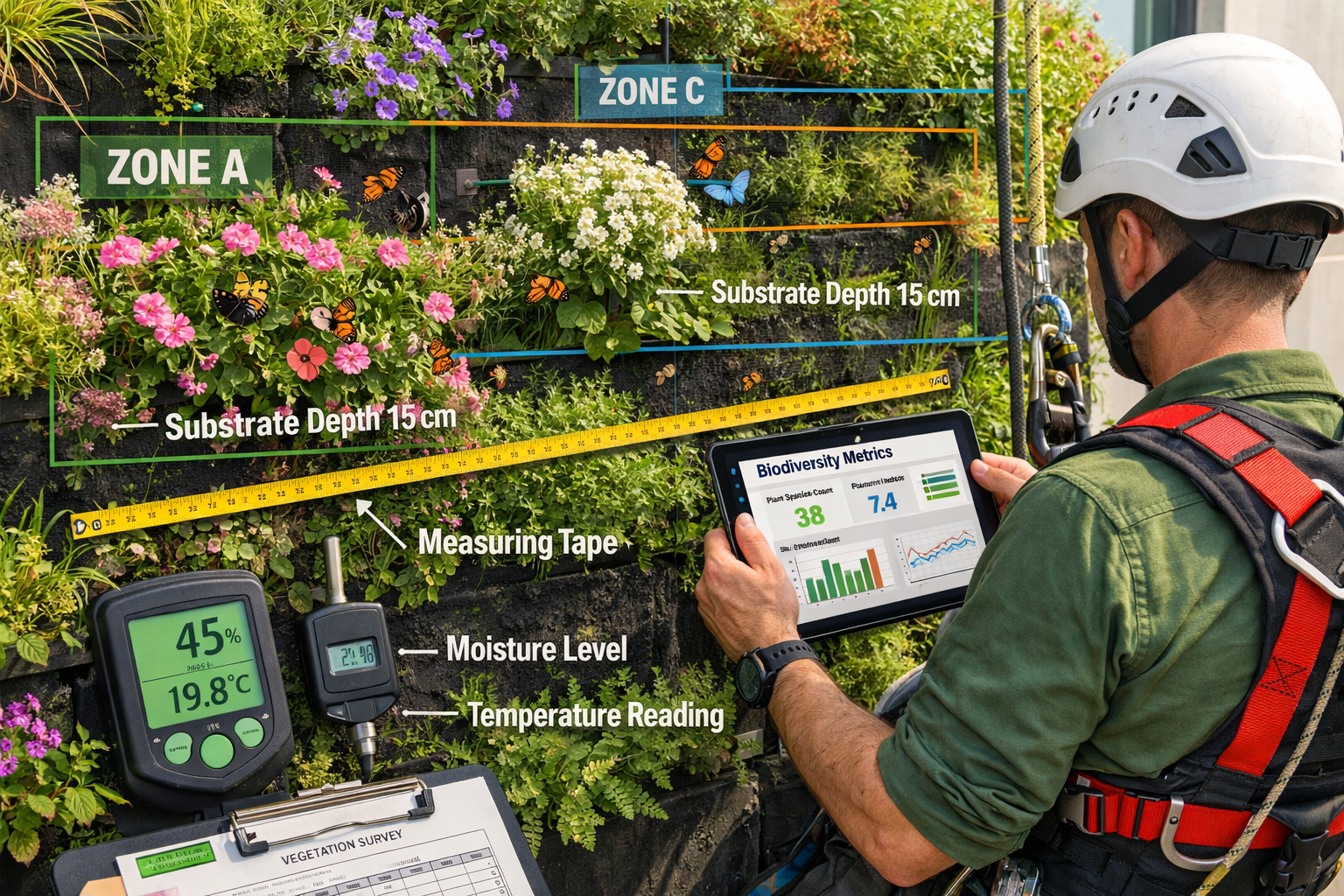
Establishing an accurate baseline is fundamental to demonstrating genuine biodiversity uplift. For Vertical Greening Systems in Urban Biodiversity Surveys: Protocols for BNG Compliance on High-Rise Developments, the baseline assessment must document:
1. Existing Facade Conditions
- Current substrate type (concrete, brick, glass, metal)
- Existing vegetation (if any): spontaneous colonization by mosses, lichens, or opportunistic plants
- Current habitat value using the Biodiversity Metric 4.0 criteria
- Microclimatic conditions: temperature, humidity, wind exposure, solar radiation
- Existing wildlife use: roosting birds, invertebrates in crevices
2. Site Context Analysis
- Proximity to existing green infrastructure and habitat patches
- Connectivity potential with nearby parks, gardens, or green corridors
- Local species pools: which pollinators, birds, and invertebrates are present in the surrounding area
- Urban matrix characteristics: traffic intensity, pollution levels, light pollution
3. Building-Specific Factors
- Facade orientation (north, south, east, west aspects)
- Height zones: ground level (0-5m), mid-level (5-15m), upper levels (>15m)
- Shading patterns throughout the day and across seasons
- Water availability and irrigation infrastructure
- Maintenance access considerations
Survey Timing and Seasonal Considerations ⏰
Unlike ground-level habitat surveys, vertical greening systems require adapted timing protocols:
Optimal Survey Windows:
- Spring (April-June): Peak flowering period for pollinator activity assessment
- Summer (July-August): Maximum vegetation development and insect diversity
- Autumn (September-October): Seed production, late-season pollinators, bird use assessment
- Winter (November-February): Structural integrity, evergreen component evaluation, roosting site identification
Minimum Survey Requirements:
- Baseline assessment: Two visits minimum (one in growing season, one dormant season)
- Post-installation monitoring: Quarterly visits for first two years, then annual assessments
- Compliance verification: Annual surveys throughout the 30-year BNG commitment period
Plant-Insect Interaction Monitoring
Understanding how vertical greening systems support pollinator populations is central to quantifying biodiversity value. Survey protocols should include:
Pollinator Survey Methodology:
- Transect establishment: Vertical transects at different heights (ground, mid-level, upper)
- Timed observations: 15-minute observation periods per transect section
- Species identification: Record all pollinator species visiting flowers (bees, butterflies, hoverflies, beetles)
- Flower resource assessment: Count and identify flowering plant species and abundance
- Weather recording: Temperature, wind speed, cloud cover (surveys only conducted in suitable conditions)
Invertebrate Habitat Assessment:
- Substrate sampling for soil invertebrates in deeper growing media
- Visual searches for web-building spiders, beetles, and other arthropods
- Pitfall traps (where accessible) in modular systems with sufficient substrate depth
- Photographic documentation of species and habitat features
Microclimate Benefit Measurement 🌡️
Substrate depth, vegetation diversity, and structural complexity are the primary design factors that strongly influence biodiversity outcomes in vertical greening systems[1]. Measuring these factors requires:
Environmental Monitoring Equipment:
- Temperature and humidity sensors at multiple heights
- Light intensity measurements (photosynthetically active radiation)
- Substrate moisture probes
- Wind speed anemometers (particularly for exposed high-rise locations)
Data Collection Protocol:
- Continuous monitoring via IoT sensors with data logging
- Baseline measurements on bare facade before installation
- Comparative measurements post-installation at equivalent positions
- Seasonal variation documentation
Biodiversity-Microclimate Correlations:
Document relationships between microclimate conditions and species presence:
- Which plant species thrive in specific microclimate zones
- How temperature moderation affects invertebrate activity patterns
- Correlation between humidity levels and moss/lichen colonization
- Impact of wind exposure on pollinator foraging behavior
Calculating BNG Units for Vertical Greening Systems in Urban Biodiversity Surveys
Applying the Biodiversity Metric to Vertical Habitats
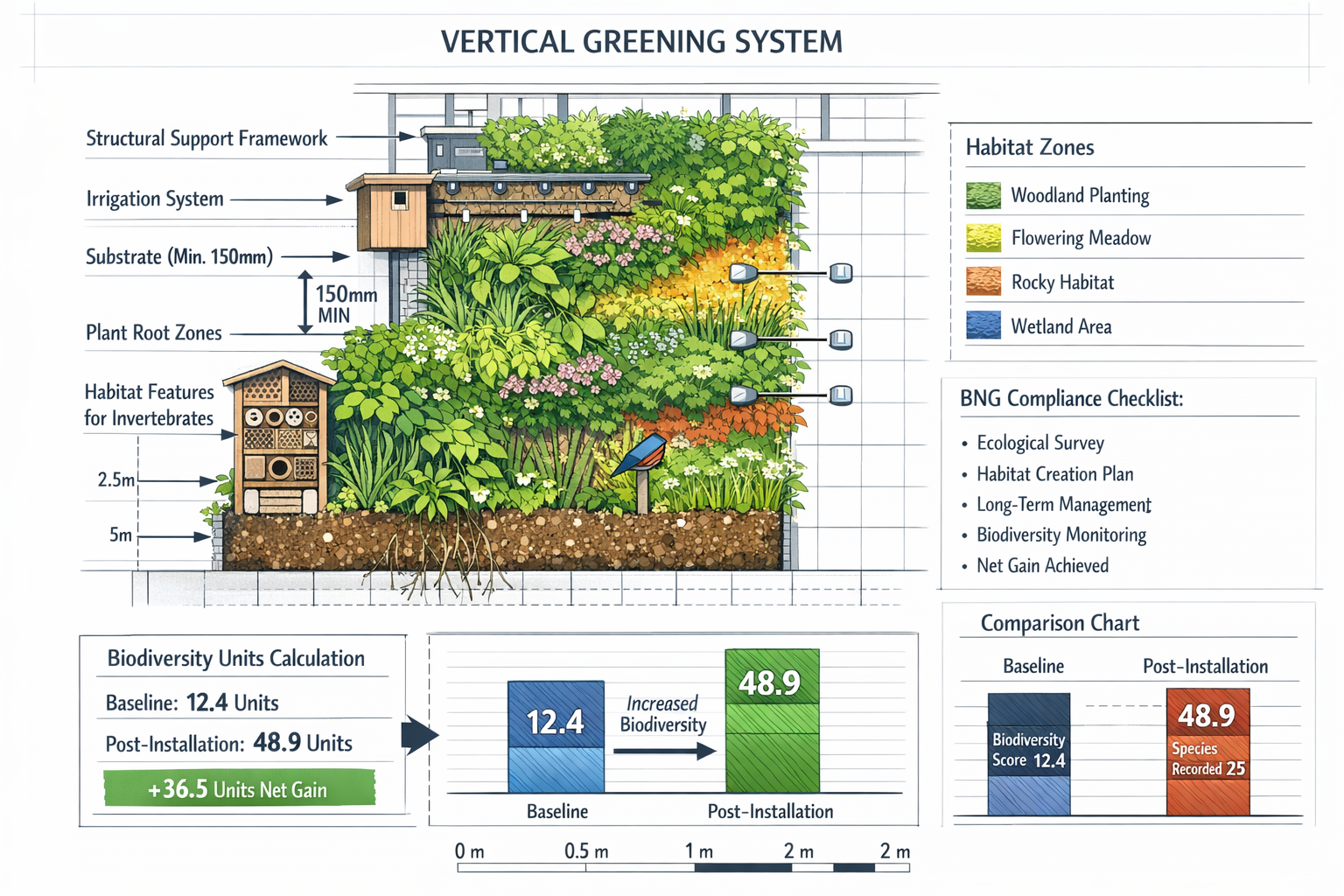
The UK Biodiversity Metric 4.0 was primarily designed for ground-level habitats, creating challenges when quantifying vertical greening systems. Ecologists must adapt the metric while maintaining methodological rigor:
Habitat Classification Approaches:
Option 1: Modified Urban Habitat Classification
- Classify vertical greening as "urban habitat – vegetated garden"
- Apply condition assessment criteria adapted for vertical orientation
- Adjust distinctiveness scores based on substrate depth and plant diversity
Option 2: Mosaic Habitat Approach
- Break vertical system into component habitat types
- Deep substrate zones (>150mm): "Modified grassland" or "Other neutral grassland"
- Shallow substrate zones (<150mm): "Vegetated garden" or "Introduced shrub"
- Calculate proportional area for each component
Option 3: Bespoke Habitat Creation
- Develop site-specific habitat description for unique vertical systems
- Justify habitat classification through ecological function equivalency
- Provide detailed evidence of biodiversity value through survey data
Area Calculation Methodology
Critical Question: How do you measure "area" for a vertical surface?
Standard Approach:
Calculate the actual facade area covered by vegetation:
- Height × Width = Total vertical area (m²)
- Apply this area to the Biodiversity Metric calculation
- Document clearly in BNG assessment reports
Enhanced Approach (Three-Dimensional Calculation):
For systems with significant depth and structural complexity:
- Base calculation: Height × Width (facade coverage)
- Complexity multiplier: Adjust for substrate depth and structural features
- Shallow systems (<100mm): 1.0× multiplier
- Medium systems (100-200mm): 1.2× multiplier
- Deep systems (>200mm): 1.5× multiplier
- Rationale: Deeper substrates support greater species diversity and ecological function
Example Calculation:
- Vertical greening system: 20m height × 10m width = 200m²
- Substrate depth: 150mm (medium)
- Adjusted area: 200m² × 1.2 = 240m² equivalent habitat area
- Habitat type: Modified grassland (moderate distinctiveness)
- Condition: Good (based on plant diversity and structural complexity)
- Strategic significance: High (within urban area with limited habitat)
Condition Assessment Criteria for Vertical Systems
Adapt standard condition assessment criteria to vertical context:
Good Condition Indicators:
✓ Plant species diversity: >15 species per 100m²
✓ Structural complexity: Multiple vegetation layers and heights
✓ Substrate depth: >150mm allowing deep-rooted species
✓ Flowering abundance: >30% coverage during peak season
✓ Native species component: >40% of plant palette
✓ Invertebrate presence: Multiple pollinator species observed
✓ Minimal invasive species: <5% coverage
✓ Healthy plant vigor: <10% dead or dying vegetation
Moderate Condition Indicators:
- Plant species diversity: 8-15 species per 100m²
- Limited structural variation
- Substrate depth: 80-150mm
- Flowering coverage: 15-30%
- Native species: 20-40%
- Some invertebrate activity observed
Poor Condition Indicators:
- Plant species diversity: <8 species per 100m²
- Monoculture or very limited diversity
- Substrate depth: <80mm
- Minimal flowering: <15%
- Predominantly non-native ornamentals
- Little to no invertebrate activity
Implementation Protocols for BNG Compliance on High-Rise Developments
Design Specifications for Maximum Biodiversity Value
When specifying Vertical Greening Systems in Urban Biodiversity Surveys: Protocols for BNG Compliance on High-Rise Developments, design choices directly impact biodiversity outcomes:
Substrate Specifications:
- Minimum depth: 150mm for herbaceous plants; 300mm+ for shrubs
- Composition: Organic-rich growing media with good water retention
- Drainage: Adequate drainage to prevent waterlogging while maintaining moisture
- Nutrient profile: Supports diverse plant communities without excessive fertility
Plant Selection Criteria:
- Native species priority: Minimum 40% native UK species
- Flowering diversity: Continuous flowering from March to October
- Structural variety: Mix of grasses, herbaceous perennials, and small shrubs
- Pollinator value: Species proven to support bees, butterflies, and other pollinators
- Climate resilience: Drought-tolerant species adapted to facade microclimates
Habitat Features:
- Nesting opportunities: Cavity features for solitary bees and small birds
- Overwintering sites: Dense vegetation for invertebrate hibernation
- Water features: Integrated water sources where feasible
- Connectivity elements: Design to link with ground-level and roof habitats
Governance and Implementation Challenges
Governance and financing are identified as major barriers to wider implementation of vertical greening systems, with fragmented regulations and skills gaps limiting adoption[1]. Addressing these challenges requires:
Planning and Approval Process:
- Early engagement with Local Planning Authority (LPA) ecologists
- Clear documentation of how vertical systems contribute to BNG targets
- Integration with landscape and architectural drawings
- Specification of monitoring and maintenance protocols
- Legal agreements securing 30-year habitat management
Maintenance and Management Commitments:
- Year 1-2: Monthly inspections, irrigation adjustment, plant replacement
- Year 3-5: Quarterly inspections, seasonal pruning, pest/disease management
- Year 6-30: Biannual inspections, renovation pruning, species composition adjustment
- Ongoing: Annual biodiversity monitoring surveys to verify BNG delivery
Skills and Training Requirements:
- Ecologists trained in vertical habitat assessment
- Horticulturists with green wall expertise
- Building maintenance staff with ecological awareness
- Collaboration between ecological and building management teams
Digital Tools and Remote Sensing Integration
Emerging design innovations include digital tools and remote sensing supporting monitoring[1]. These technologies enhance survey efficiency and compliance documentation:
Remote Sensing Applications:
- Drone surveys: High-resolution imagery of facade vegetation at multiple heights
- Thermal imaging: Microclimate mapping and irrigation system performance
- Multispectral analysis: Vegetation health assessment and species distribution mapping
- 3D photogrammetry: Structural complexity measurement and volume calculation
IoT Monitoring Systems:
- Continuous environmental data collection (temperature, humidity, light, moisture)
- Automated alerts for irrigation failures or plant stress
- Long-term dataset development for biodiversity-environment correlations
- Remote access for ecologists and building managers
Data Management Platforms:
- Centralized biodiversity data storage linked to specific developments
- Integration with BNG reporting requirements
- Automated compliance reporting for LPA submission
- Transparent evidence trail for 30-year monitoring period
Case Study Applications and Practical Examples
Small-Scale Development Integration
Even small development projects can incorporate vertical greening effectively:
Example: 4-Storey Residential Building
- Site constraints: Limited ground-level space due to parking and access requirements
- Solution: 80m² living wall on south-facing facade
- Plant palette: 18 species including native wildflowers and ornamental perennials
- Baseline habitat value: Bare brick facade (0.5 biodiversity units)
- Post-installation value: Modified grassland equivalent (3.2 biodiversity units)
- Net gain: 2.7 biodiversity units contributing to overall project BNG target
Large-Scale High-Rise Application
Example: 20-Storey Mixed-Use Development
- Site context: Urban center with minimal green space
- Vertical greening strategy: Multi-elevation approach
- Ground-level (0-5m): Deep substrate system (300mm) with shrubs and small trees
- Mid-levels (5-15m): Modular panels (150mm) with herbaceous perennials
- Upper levels (15m+): Climbing plant systems on support structures
- Total vertical area: 450m² across multiple facades
- Survey protocol: Quarterly monitoring with drone-assisted surveys
- Biodiversity outcomes:
- 12 pollinator species recorded in first year
- 3 bird species using structure for nesting
- 4.2°C temperature reduction on facade during summer
- 15.8 biodiversity units generated
Integration with Blue-Green Infrastructure
Emerging design innovations include bio-solar roofs and blue-green roofs for enhanced water retention[1]. Combining vertical greening with other sustainable urban drainage systems (SuDS) creates synergistic benefits:
Integrated Design Approach:
- Vertical greening: Facade-mounted living walls
- Green roofs: Extensive or intensive roof vegetation
- Rainwater harvesting: Captured rainwater irrigates vertical systems
- Bioswales: Ground-level water management features
- Connectivity: Vertical systems link ground and roof habitats
This integrated approach maximizes biodiversity value while addressing multiple urban challenges including flood risk, urban heat island effect, and habitat fragmentation.
Monitoring, Reporting, and Long-Term Compliance
Annual Monitoring Protocol
To maintain BNG compliance throughout the 30-year commitment period, establish a robust monitoring framework:
Year 1-5 (Establishment Phase):
- Frequency: Quarterly surveys
- Focus: Plant establishment success, species colonization, early habitat use
- Adjustments: Plant replacement, species composition refinement, irrigation optimization
Year 6-15 (Maturity Phase):
- Frequency: Biannual surveys
- Focus: Stable community composition, sustained biodiversity value, structural integrity
- Management: Renovation pruning, substrate replenishment if needed
Year 16-30 (Long-Term Maintenance):
- Frequency: Annual surveys
- Focus: Continued habitat function, compliance verification, adaptation to climate change
- Documentation: Comprehensive evidence trail for LPA review
Reporting Requirements and Documentation
Comprehensive documentation ensures transparency and facilitates compliance verification:
Essential Report Components:
- Executive summary: BNG unit calculations and compliance status
- Survey methodology: Detailed protocols and survey dates
- Species lists: Flora and fauna recorded with abundance data
- Photographic evidence: Time-series images showing establishment and development
- Environmental data: Microclimate measurements and trends
- Condition assessment: Habitat condition scoring with justification
- Management actions: Maintenance activities and interventions
- Recommendations: Adaptive management suggestions
Digital Submission:
- Integration with Local Nature Recovery Strategy (LNRS) data systems
- Compatibility with national BNG register
- Accessible format for LPA ecologists and planning officers
Adaptive Management and Climate Resilience
As climate conditions shift, vertical greening systems must adapt to maintain biodiversity value:
Climate Adaptation Strategies:
- Species selection: Gradual introduction of drought-tolerant species
- Irrigation adjustment: Modified watering regimes responding to changing rainfall patterns
- Substrate enhancement: Improved water retention capacity
- Shading integration: Strategic placement to reduce heat stress
- Monitoring intensification: Increased survey frequency during extreme weather events
Biodiversity Resilience:
- Maintain species diversity to ensure functional redundancy
- Incorporate climate-adapted native species
- Provide microclimate refugia within the vertical system
- Enhance connectivity to facilitate species movement and colonization
Conclusion: Advancing Urban Biodiversity Through Vertical Innovation
Vertical Greening Systems in Urban Biodiversity Surveys: Protocols for BNG Compliance on High-Rise Developments represent a paradigm shift in how the built environment contributes to nature recovery. As urban densification continues in 2026 and beyond, the vertical dimension offers unprecedented opportunities to create meaningful habitat where ground-level space is constrained.
Key success factors include:
🌱 Robust survey protocols adapted specifically for vertical habitats, accounting for height-dependent microclimates and three-dimensional ecological function
🌱 Rigorous baseline assessment and long-term monitoring to demonstrate genuine biodiversity uplift and maintain compliance throughout the 30-year commitment period
🌱 Design excellence prioritizing substrate depth, plant diversity, and structural complexity—the three factors that most strongly influence biodiversity outcomes[1]
🌱 Digital integration leveraging remote sensing, IoT monitoring, and data management platforms to enhance survey efficiency and compliance documentation
🌱 Collaborative implementation bringing together ecologists, architects, horticulturists, and building managers to overcome governance and skills barriers[1]
Next Steps for Developers and Ecologists
For developers planning high-rise projects:
- Engage ecological consultants early in the design process
- Review guidance for developers on BNG requirements
- Allocate adequate budget for vertical greening installation and 30-year maintenance
- Explore on-site and off-site BNG delivery options to optimize compliance strategy
- Consider buying biodiversity units if on-site delivery is insufficient
For ecological consultants:
- Develop expertise in vertical habitat assessment methodologies
- Invest in survey equipment suitable for high-rise applications (drones, IoT sensors)
- Build relationships with green wall designers and horticulturists
- Contribute to evolving best practice guidance for vertical greening BNG assessment
- Contact specialist BNG advisors for complex high-rise projects
For planning authorities:
- Develop clear guidance on vertical greening BNG assessment within local plans
- Build internal capacity to review vertical habitat proposals
- Establish monitoring and compliance verification protocols
- Share learning and case studies across local authorities
- Integrate vertical greening into Local Nature Recovery Strategies
The integration of vertical greening systems into urban biodiversity surveys and BNG compliance frameworks is still evolving. As more high-rise developments implement these innovative solutions and generate long-term monitoring data, protocols will continue to refine. The ecological potential of our vertical urban surfaces is only beginning to be realized—transforming the facades of tomorrow's cities into thriving corridors for urban wildlife and meaningful contributions to national biodiversity targets.
References
[1] 2026 03 Introductory Green Roofs Walls – https://phys.org/news/2026-03-introductory-green-roofs-walls.html
[2] Tfocoll.2025.0.issue Affordable And Clean Energy – https://www.tandfonline.com/doi/full/10.1080/14786451.2024.2411831@10.1080/tfocoll.2025.0.issue-Affordable-and-Clean-Energy
[3] Vertical Garden Biodiversity – https://www.greenroofs.com/2022/06/27/vertical-garden-biodiversity/