

Tropical flowering phenology has shifted by an average of 2.04 days per decade over the past two centuries, with some species accelerating by more than 14 days per decade.[5] As climate-driven changes reshape the timing of natural events across ecosystems worldwide, ecologists face an unprecedented challenge: traditional snapshot surveys designed for Biodiversity Net Gain (BNG) assessments may now miss critical biodiversity components entirely. In 2026, as the UK government confirms mandatory 10% BNG requirements for major infrastructure projects from November onwards,[1] the need for climate-adaptive survey protocols has never been more urgent.
Phenological Shifts in BNG Monitoring: Survey Protocols for Ecologists Amid Earlier Blooming and Migration in 2026 represents a fundamental evolution in how biodiversity professionals approach field assessments. When flowering plants bloom weeks earlier than historical norms and migratory species arrive at unpredictable times, single-season surveys risk producing baseline data that fundamentally misrepresents site biodiversity value.
Key Takeaways
- 🌸 Climate-driven phenological shifts are causing species to bloom and migrate earlier, making traditional single-season BNG surveys inadequate for capturing true biodiversity baselines
- 📅 Multi-season survey protocols spanning the entire active period are now essential for accurate biodiversity assessments under the mandatory 10% BNG requirement
- 🔄 Adaptive monitoring frameworks must account for temporal variability and include contingency survey windows to capture shifted phenological events
- 📊 30-year maintenance obligations for BNG projects require monitoring protocols that can detect and respond to ongoing phenological changes
- 🌍 Evidence from tropical ecosystems demonstrates that phenological disruption affects species interactions and ecosystem function, requiring comprehensive survey approaches
Understanding Phenological Shifts and Their Impact on BNG Assessments
What Are Phenological Shifts?
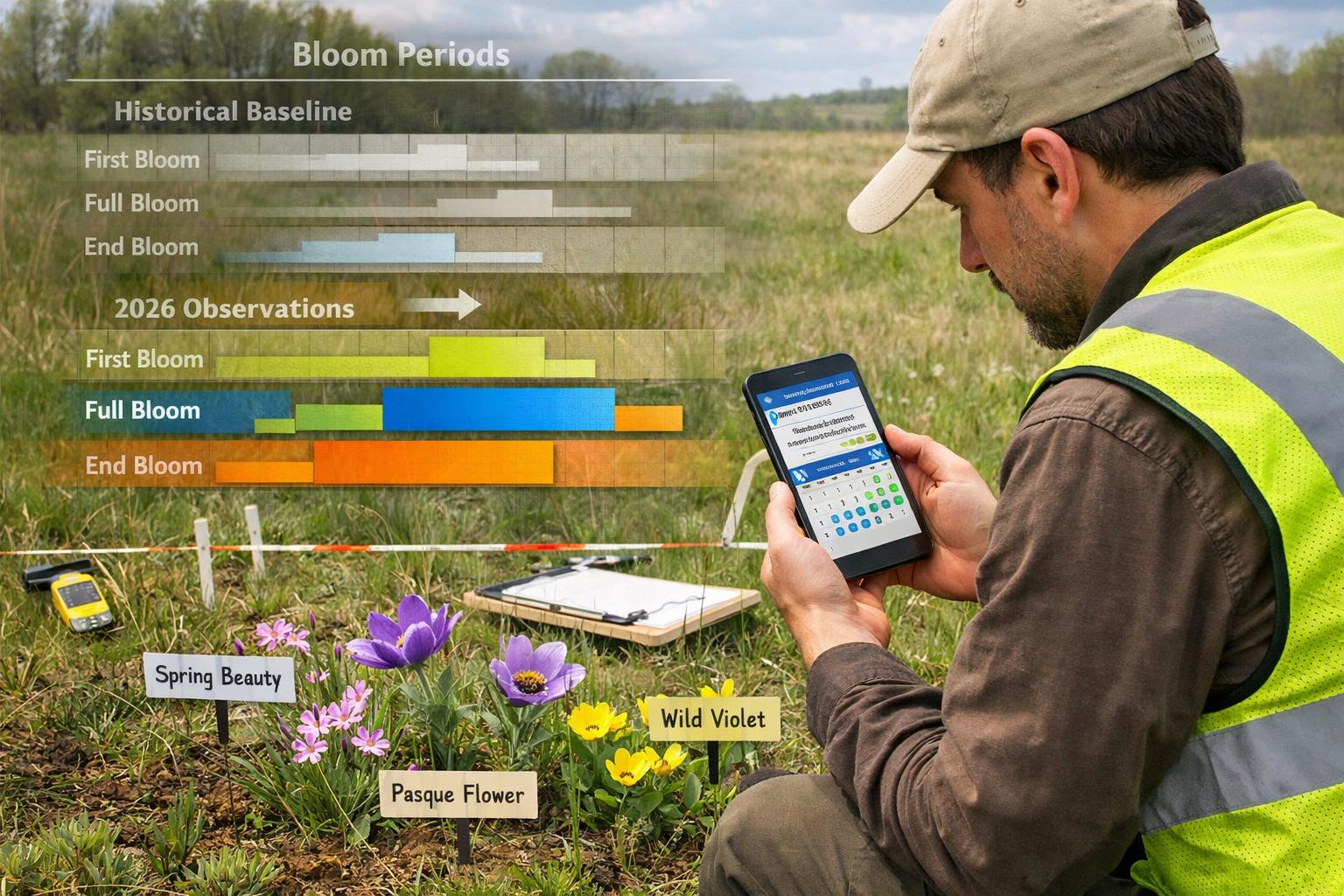
Phenology refers to the timing of recurring biological events in nature—when plants flower, when leaves emerge, when birds migrate, when insects emerge from pupation. These natural calendars have evolved over millennia, creating intricate synchronies between species and their environments.
Climate change is disrupting these ancient rhythms. Research analyzing 230 years of tropical plant data reveals that flowering phenology shifts are not uniform: they range from minimal changes of 0.037 days per decade to dramatic accelerations of 14.10 days per decade.[5] This variability creates a critical problem for biodiversity assessments—the timing of surveys matters more than ever before.
Why Traditional Survey Windows Are Failing
Historically, ecological survey protocols established standardized windows based on decades of phenological observations. For example:
- Botanical surveys: April to September
- Breeding bird surveys: March to July
- Bat activity surveys: May to September
- Invertebrate surveys: May to September
These windows assumed relatively stable seasonal patterns. However, in 2026, ecologists are encountering:
- 🌺 Wildflower species flowering in February that historically bloomed in April
- 🐦 Summer migrants arriving 2-3 weeks earlier than baseline data suggests
- 🦋 Insect emergence periods extending into previously inactive months
- 🍂 Autumn phenological events overlapping with what were distinct summer periods
When conducting biodiversity impact assessments, missing these shifted events means underestimating site biodiversity value, which directly affects BNG calculations and compliance with the mandatory 10% requirement.[1]
The BNG Boundary Challenge
The UK government's 2026 clarification on BNG boundaries adds another layer of complexity.[1] The 10% requirement now applies specifically to a defined "BNG boundary" including only habitats negatively impacted or used to deliver gains—not all habitats within project boundaries.
This precision demands accurate baseline assessments. If phenological shifts cause surveyors to miss key species or habitat features, the BNG boundary definition may be fundamentally flawed, leading to:
- ❌ Underestimated baseline biodiversity units
- ❌ Insufficient habitat creation or enhancement measures
- ❌ Non-compliance with statutory requirements
- ❌ Potential enforcement actions under new Defra guidance
Developing Climate-Adaptive Survey Protocols for Phenological Shifts in BNG Monitoring
Multi-Season Survey Frameworks
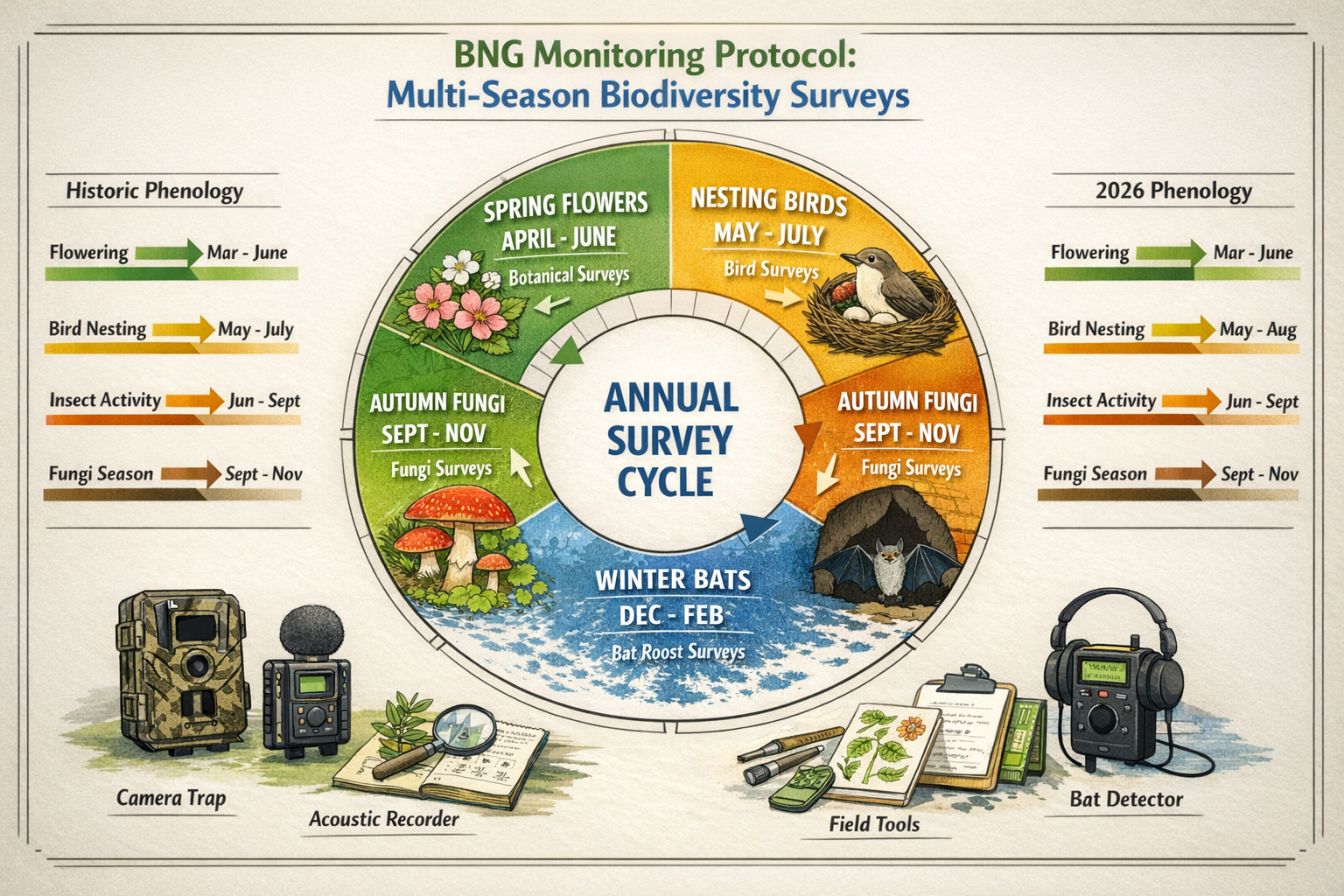
The solution to phenological uncertainty is temporal redundancy—conducting surveys across extended periods with multiple visits designed to capture shifted events. For BNG assessments in 2026, this means fundamentally redesigning survey schedules.
Recommended Multi-Season Protocol Structure
| Survey Type | Traditional Window | 2026 Climate-Adaptive Window | Minimum Visits |
|---|---|---|---|
| Botanical | April-September | February-October | 4-6 visits |
| Breeding Birds | March-July | February-August | 3-5 visits |
| Wintering Birds | November-February | October-March | 2-3 visits |
| Bats | May-September | April-October | 3-4 visits |
| Invertebrates | May-September | April-October | 4-6 visits |
| Amphibians | March-June | February-July | 3-4 visits |
Implementing Phenological Monitoring Indicators
Rather than relying solely on calendar dates, climate-adaptive protocols should incorporate phenological indicators—observable environmental cues that signal optimal survey timing:
🌡️ Temperature accumulation models: Use growing degree days (GDD) rather than fixed dates to trigger survey windows
🌱 Indicator species: Monitor early-responding species (e.g., hazel catkins, blackthorn blossom) to predict broader community phenology
📊 Local climate data: Integrate site-specific temperature and precipitation data to adjust survey schedules dynamically
🔔 Citizen science networks: Leverage phenology observation networks to identify regional shifts in real-time
Contingency Survey Planning
Phenological Shifts in BNG Monitoring: Survey Protocols for Ecologists Amid Earlier Blooming and Migration in 2026 require built-in flexibility. Ecologists should develop contingency protocols that include:
- Reserve survey dates: Budget for additional visits if phenological events occur outside predicted windows
- Rapid response capacity: Maintain surveyor availability for opportunistic surveys when unexpected events occur
- Multi-year baselines: Where possible, conduct surveys across multiple years to capture inter-annual variability
- Adaptive triggers: Establish clear criteria for extending or modifying survey schedules based on emerging observations
This approach aligns with the guidance for developers seeking to ensure BNG compliance while managing project timelines and budgets.
Integrating Phenological Data into 30-Year BNG Monitoring Requirements
Long-Term Monitoring Under BNG Legislation
The UK government's confirmation that all significant BNG gains must be secured and maintained for at least 30 years[1] creates a unique challenge and opportunity for phenological monitoring.
Over three decades, climate change will continue reshaping phenological patterns. Monitoring protocols established in 2026 must be designed to:
✅ Detect ongoing phenological shifts in created or enhanced habitats
✅ Trigger adaptive management responses when shifts threaten biodiversity outcomes
✅ Document compliance with BNG commitments despite changing baselines
✅ Provide early warning of ecological mismatches or community disruption
Adaptive Management Frameworks
Defra has committed to publishing guidance on adaptive management over the 30-year period[1] in 2026. This guidance will likely emphasize:
Threshold-based interventions: Establishing phenological metrics that, when exceeded, trigger management actions
Rolling baseline adjustments: Periodically updating reference conditions to account for directional climate change while maintaining BNG integrity
Ecosystem function monitoring: Shifting focus from species presence/absence to functional relationships and phenological synchrony
Technology integration: Employing automated monitoring (camera traps, acoustic sensors, remote sensing) to capture phenological events continuously
For landowners selling biodiversity units, demonstrating robust long-term monitoring capacity will become a key value proposition.
Data Management and Reporting Systems
Effective phenological monitoring generates substantial data volumes. BNG projects require:
- 📱 Digital data collection tools: Mobile apps with phenological event recording, photo documentation, and GPS tagging
- ☁️ Cloud-based databases: Centralized systems allowing multi-year data comparison and trend analysis
- 📈 Automated reporting: Dashboards that flag phenological anomalies and compliance issues
- 🔗 Integration with national systems: Compatibility with Defra's BNG registry and reporting requirements
Case Study: Phenological Monitoring in Practice
Consider a hypothetical 50-hectare grassland creation project in southern England, part of off-site BNG delivery:
Year 1 (2026): Baseline surveys conducted February-October capture early-flowering species (cowslip, primrose) blooming 3 weeks earlier than historical records. Breeding bird surveys detect skylarks nesting in March rather than April.
Year 5 (2030): Monitoring reveals continued phenological advancement. Adaptive management introduces later-flowering species to extend nectar availability for insects whose emergence has not shifted as rapidly.
Year 15 (2040): Phenological data shows stabilization at new timing patterns. Management prescriptions (hay cutting dates, grazing regimes) are adjusted to align with observed phenology rather than historical calendars.
Year 30 (2055): Final compliance assessment demonstrates maintained biodiversity value despite significant phenological shifts, validating the adaptive monitoring approach.
This scenario illustrates why Phenological Shifts in BNG Monitoring: Survey Protocols for Ecologists Amid Earlier Blooming and Migration in 2026 must be designed for decades, not just initial assessments.
Practical Implementation: Tools and Techniques for Ecologists
Essential Survey Equipment for Phenological Monitoring
Modern phenological monitoring requires technology that captures temporal dynamics:
- 📷 Trail cameras with time-lapse capability: Document flowering progression, leaf-out, and animal activity patterns
- 🎤 Acoustic monitoring devices: Record bird song and bat activity continuously, allowing post-hoc analysis of temporal patterns
- 🌡️ Environmental sensors: Log temperature, humidity, and soil moisture to correlate with phenological events
- 📱 Specialized survey apps: Tools like iRecord, Nature's Calendar, and custom BNG monitoring platforms
- 🛰️ Remote sensing data: Satellite imagery (Sentinel, Landsat) provides landscape-scale phenological information
Training and Professional Development
As phenological complexity increases, ecologists require enhanced skills:
- Climate science literacy: Understanding climate projections and their ecological implications
- Statistical analysis: Analyzing phenological trends and variability in long-term datasets
- Adaptive management: Designing flexible protocols that respond to emerging patterns
- Technology proficiency: Operating and maintaining automated monitoring equipment
Professional biodiversity surveyors should pursue continuing education in these areas to maintain competence in climate-adaptive BNG monitoring.
Collaboration and Data Sharing
Phenological shifts are landscape-scale phenomena. Individual projects benefit from:
- 🤝 Regional phenology networks: Sharing observations across projects to identify broad patterns
- 📚 Academic partnerships: Collaborating with universities conducting phenological research
- 🌐 National phenology schemes: Contributing to and utilizing data from programs like the UK Phenology Network
- 💼 Cross-sector coordination: Engaging with agriculture, forestry, and conservation sectors experiencing similar challenges
Cost Considerations and Budget Planning
Climate-adaptive survey protocols require additional investment. When planning BNG projects, budget for:
- Extended survey periods: 20-40% more field days than traditional protocols
- Technology infrastructure: Initial equipment costs (£5,000-£15,000) and annual maintenance
- Data management systems: Software subscriptions and IT support (£2,000-£5,000 annually)
- Contingency reserves: 10-15% buffer for additional surveys if phenological events shift unexpectedly
However, these costs must be weighed against the risk of non-compliance with BNG requirements, which could result in enforcement actions, project delays, or requirement to purchase additional biodiversity units at premium prices.
Policy Context and Future Directions
The 2026 Regulatory Landscape
The confirmation of BNG for Nationally Significant Infrastructure Projects (NSIPs) from November 2026[1] represents a major expansion of biodiversity monitoring requirements. With no exemptions across all NSIP types, projects ranging from energy infrastructure to transport networks must now demonstrate 10% BNG.
These large-scale, long-duration projects face particular phenological challenges:
- Multi-year construction phases: Baseline conditions may shift during project delivery
- Landscape-scale impacts: Phenological effects across diverse habitats and regions
- Complex stakeholder coordination: Multiple ecological consultancies requiring standardized protocols
The Defra guidance expected in 2026 on monitoring and enforcement[1] will likely establish minimum standards for phenological considerations in BNG assessments.
Emerging Research and Innovation
The scientific community is rapidly advancing phenological monitoring capabilities:
- 🔬 Machine learning applications: AI-powered image recognition identifying flowering stages and species from camera trap data
- 🛰️ Satellite phenology products: Operational systems providing near-real-time vegetation phenology metrics
- 🧬 Environmental DNA (eDNA): Temporal eDNA sampling detecting species presence across phenological windows
- 📡 IoT sensor networks: Distributed environmental monitoring providing high-resolution phenological triggers
These innovations will progressively integrate into standard BNG monitoring protocols, enhancing accuracy while potentially reducing costs.
Global Context: Learning from International Experience
While this article focuses on UK BNG requirements, phenological shifts are global phenomena. Ecologists can learn from international approaches:
- 🇪🇺 European Union: The EU Biodiversity Strategy for 2030 emphasizes climate-adaptive monitoring
- 🇺🇸 United States: The USA National Phenology Network provides frameworks for standardized phenological observation
- 🇦🇺 Australia: Climate-adaptive biodiversity monitoring in response to rapid warming and phenological disruption
Research from tropical ecosystems—where phenological shifts of 2.04 days per decade are documented[5]—provides critical insights into the ecological consequences of temporal mismatches and the importance of comprehensive monitoring.
The Role of Small Development Projects
While much attention focuses on major infrastructure, BNG for small development projects also faces phenological challenges. Smaller budgets and tighter timelines make multi-season surveys more difficult, yet the ecological principles remain identical.
Solutions for small projects include:
- Collaborative surveys: Multiple nearby projects sharing survey costs and data
- Streamlined protocols: Focused monitoring of key indicator species rather than comprehensive inventories
- Technology leverage: Using automated monitoring to reduce field time requirements
- Phased assessments: Conducting initial rapid assessments followed by targeted phenological surveys for high-value habitats
Conclusion: Embracing Adaptive Approaches in BNG Monitoring
Phenological Shifts in BNG Monitoring: Survey Protocols for Ecologists Amid Earlier Blooming and Migration in 2026 represents more than a technical adjustment to survey timing—it embodies a fundamental shift toward climate-adaptive biodiversity conservation. As flowering plants bloom earlier, migratory species arrive on altered schedules, and ecological synchronies unravel, traditional snapshot surveys become increasingly inadequate for capturing true biodiversity value.
The mandatory 10% BNG requirement for major infrastructure projects from November 2026,[1] combined with 30-year monitoring obligations, creates both challenges and opportunities. Ecologists who embrace multi-season protocols, integrate phenological indicators, and design adaptive monitoring frameworks will deliver more accurate baselines, more robust BNG outcomes, and more resilient ecosystems.
Actionable Next Steps for Ecologists and Developers
- Review existing survey protocols: Assess whether current approaches adequately capture phenological variability at your project sites
- Invest in monitoring technology: Acquire trail cameras, acoustic monitors, and environmental sensors to supplement field surveys
- Establish phenological baselines: Begin documenting timing of key biological events now to build multi-year reference datasets
- Build flexibility into project timelines: Allow for extended survey periods and contingency visits in project planning
- Engage with regional networks: Join phenology observation schemes and share data with neighboring projects
- Pursue professional development: Attend training on climate-adaptive monitoring and phenological analysis
- Consult specialist guidance: Work with experienced biodiversity surveyors familiar with climate-adaptive protocols
The evidence is clear: phenological shifts are not theoretical future concerns—they are present realities reshaping ecosystems today. Research documenting shifts of up to 14 days per decade in some species[5] demonstrates the urgency of adaptive approaches. As Defra publishes new guidance on monitoring and adaptive management in 2026,[1] the ecological consulting sector must evolve rapidly to meet these challenges.
By implementing the protocols and principles outlined in this article, ecologists can ensure that BNG assessments accurately reflect site biodiversity value, that created habitats deliver genuine ecological benefits, and that 30-year monitoring commitments detect and respond to ongoing environmental change. In doing so, the UK's ambitious BNG framework can achieve its conservation potential even as climate change continues reshaping the natural world.
The future of biodiversity monitoring is adaptive, technology-enhanced, and phenologically informed. The time to implement these approaches is now.
References
[1] Government Confirms Biodiversity Net Gain For Major Infrastructure From November 2026 – https://cieem.net/government-confirms-biodiversity-net-gain-for-major-infrastructure-from-november-2026/
[5] Article – https://journals.plos.org/plosone/article?id=10.1371%2Fjournal.pone.0342105