

Only 18 months after mandatory Biodiversity Net Gain (BNG) came into force for major developments, the government has already moved to reshape the rules — and the changes arriving this summer are the most significant since the regime launched. The Biodiversity Net Gain 0.2ha exemption 2026 is the headline reform, but it sits alongside a cluster of other changes that will affect how thousands of planning applications are assessed across England.
Whether you are a developer managing a pipeline of minor schemes, a planner processing applications, or an ecologist advising clients on the statutory metric, understanding what changes, when, and why is now business-critical.
Key Takeaways
- 🟢 Developments of 0.2 hectares or below will be exempt from the 10% BNG requirement from 31 July 2026, replacing the existing self and custom build exemption.
- 🏗️ Three new exemptions cover temporary permissions (up to 5 years), biodiversity-enhancing developments, and improvements to parks and playing fields.
- 🔄 The biodiversity gain hierarchy for minor development is being amended so off-site gains are treated equally to on-site gains on constrained sites.
- 🏭 BNG becomes mandatory for NSIPs on 2 November 2026, a separate but equally important milestone.
- 🟤 A brownfield consultation opened on 10 June 2026, exploring a targeted exemption for residential brownfield sites up to 2.5 hectares.
Why the Government Is Reforming BNG in 2026
Mandatory BNG has been broadly welcomed by the ecological and planning community, but early implementation revealed real friction points. Small and minor developments — particularly those on tight urban plots — were struggling to demonstrate 10% net gain in a way that was proportionate to their scale or impact.
Defra's April 2026 consultation response acknowledged these concerns directly. The government confirmed it had received strong evidence that the existing small sites and self-build exemptions were not working as intended, and that a simpler, area-based threshold would be more transparent and easier to apply consistently across local planning authorities.
For a deeper grounding in how the current BNG framework operates, our BNG explained guide covers the fundamentals clearly.
The New Biodiversity Net Gain 0.2ha Exemption 2026: Full Detail
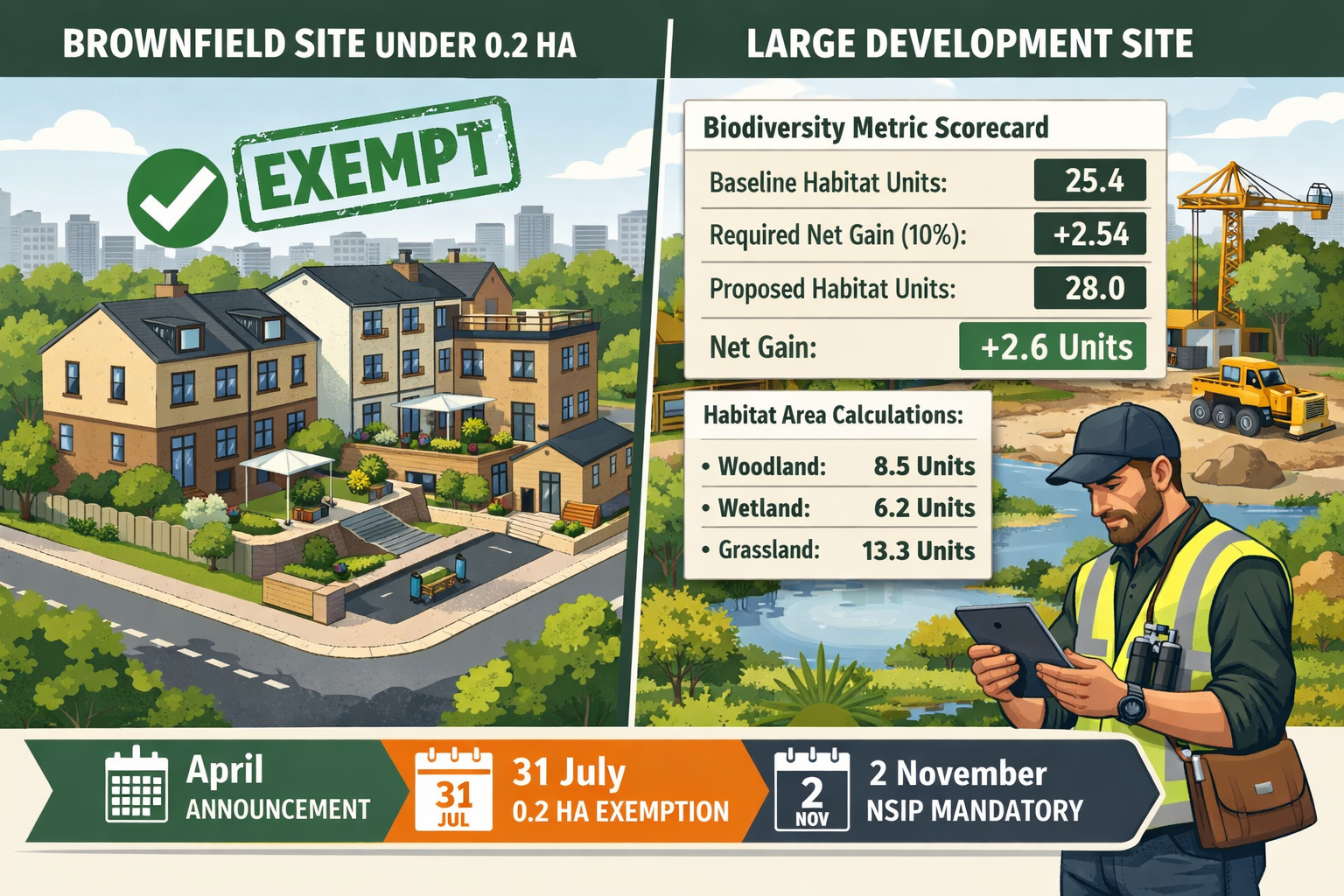
The centrepiece of the April 2026 reforms is the introduction of a new area-based exemption for developments where the total site area is 0.2 hectares or below. This replaces the previous self and custom build residential exemption, which will be removed from 31 July 2026 — the same date the new threshold comes into force, subject to parliamentary scheduling of secondary legislation.
What the 0.2ha Threshold Means in Practice
| Site Area | BNG Requirement from 31 July 2026 |
|---|---|
| ≤ 0.2 ha | Exempt from 10% net gain requirement |
| > 0.2 ha (minor development) | BNG applies; amended hierarchy available |
| > 0.2 ha (major development) | Full BNG applies as before |
| Priority habitats on site | Exemption does not apply regardless of size |
The 0.2ha threshold is broadly equivalent to approximately half an acre — large enough to capture most single-dwelling plots and small infill schemes, while remaining tight enough to exclude schemes with meaningful ecological footprints.
Critically, the exemption does not override environmental protections. Exempt developments will still be subject to the National Planning Policy Framework and wider regulatory requirements. Where onsite priority habitats would be affected, the exemption will not apply and planning applications can still be refused where significant biodiversity harm cannot be avoided, mitigated, or compensated.
💬 "The new area-based threshold offers genuine simplification — but it is not a green light to ignore ecology on small sites."
For developers unsure whether their project qualifies, our exempt projects guidance sets out the full picture.
Three Additional Exemptions Confirmed for 2026
Beyond the headline Biodiversity Net Gain 0.2ha exemption 2026, Defra confirmed three further exemptions that will benefit specific development types.
1. Temporary Planning Permissions (Up to 5 Years)
Developments granted temporary planning permission for a maximum of five years will be exempt from BNG. The rationale is straightforward: requiring a 30-year habitat management commitment for a reversible, short-term use is disproportionate. This will benefit temporary construction compounds, pop-up facilities, and similar uses.
2. Biodiversity-Enhancing Developments
A new exemption applies where the primary objective of the development is to conserve or enhance biodiversity — for example, habitat creation schemes, wetland restoration projects, or rewilding initiatives. Requiring such schemes to demonstrate net gain against themselves would be circular and counterproductive.
3. Parks, Public Gardens, and Playing Fields
A targeted exemption covers development that enhances parks, public gardens, and playing fields, provided no onsite priority habitats are impacted. This removes a perverse barrier that had been discouraging investment in publicly accessible green infrastructure.
Amended Biodiversity Gain Hierarchy for Minor Development
One of the most practically significant changes for minor development is the amendment to the biodiversity gain hierarchy. Under the existing rules, developers must demonstrate they have maximised on-site gains before considering off-site options. On constrained urban plots, this requirement was proving disproportionately burdensome.
From 31 July 2026, for minor development only, off-site gains will be treated as equal to on-site gains in the hierarchy. This gives developers and their ecologists genuine flexibility when on-site habitat creation is simply not viable.
New BNG boundary definitions will also allow more flexibility on where aggregated biodiversity gain is sited — with one important exception: water-related impacts must still be addressed within the relevant catchment.
This is a meaningful shift. Our article on off-site versus on-site BNG delivery explores the strategic considerations in detail, and remains highly relevant in light of these changes.
The Brownfield Consultation: What We Know So Far
While no blanket brownfield exemption has been introduced, Defra opened a further targeted consultation on 10 June 2026 exploring a specific exemption for residential brownfield development up to 2.5 hectares. This is a significant potential change for urban regeneration schemes.
The consultation recognises that brownfield sites — particularly those with low existing biodiversity value — can face disproportionate BNG burdens relative to the ecological benefit achieved. A targeted exemption, if confirmed, would remove a barrier to housing delivery on previously developed land without undermining the broader intent of the BNG regime.
Responses to this consultation are expected to shape secondary legislation later in 2026. Developers with brownfield residential schemes in their pipeline should monitor this closely and consider engaging with the consultation process.
BNG for NSIPs: Mandatory from 2 November 2026
Separate from the exemption changes, Biodiversity Net Gain becomes mandatory for Nationally Significant Infrastructure Projects (NSIPs) on 2 November 2026. This is a major expansion of the regime's scope, bringing large-scale energy, transport, and water infrastructure projects fully within the BNG framework.
NSIP applicants will need to apply the statutory metric, demonstrate compliance with the biodiversity gain hierarchy, and secure appropriate habitat management agreements. Given the scale and complexity of NSIP projects, early ecological survey work and metric preparation will be essential.
The Role of Ecological Surveyors and the Statutory Metric
Even with the new exemptions, the statutory biodiversity metric remains central to the BNG regime for the vast majority of developments. Accurate baseline surveys — typically a Phase 1 Habitat Survey followed by detailed condition assessments — are the foundation on which every metric calculation rests. Errors at the survey stage propagate through the entire BNG assessment.
For non-exempt projects, understanding what goes into a BNG assessment is essential reading for developers and planners alike. The metric calculates habitat units based on area, distinctiveness, condition, and strategic significance — and getting those inputs right requires qualified ecological surveyors with field experience.
For minor developments navigating the amended hierarchy, the ability to demonstrate that on-site delivery is genuinely constrained — and to identify suitable off-site or statutory credit options — will depend on robust ecological evidence. Our guide to biodiversity credits for developers explains how statutory credits function as a last resort within the hierarchy.
Planners processing applications under the new rules will also need to be confident in assessing BNG submissions — our top questions from planners about BNG addresses the most common points of uncertainty.
Conclusion: Actionable Next Steps for 2026
The Biodiversity Net Gain 0.2ha exemption 2026 and its accompanying reforms represent a genuine recalibration of the BNG regime — one that reduces burden on small-scale development while maintaining meaningful ecological protections. Here is what you should do now:
✅ Developers: Audit your pipeline against the 0.2ha threshold. Identify which schemes become exempt from 31 July 2026 and which still require full BNG compliance. Check for priority habitats on all sites regardless of size.
✅ Planners: Update your pre-application advice templates and validation checklists to reflect the new exemptions and amended hierarchy for minor development. Engage with the brownfield consultation if relevant to your authority's context.
✅ Ecologists: Prepare to advise clients on the amended hierarchy for minor development and the new exemption categories. Ensure your survey methodologies and metric calculations are current.
✅ NSIP applicants: Begin ecological baseline surveys now — 2 November 2026 is closer than it appears.
The rules are changing. The ecological imperative is not.
Ready to navigate BNG with confidence? The team at Biodiversity Surveyors provides expert ecological surveys, statutory metric calculations, and BNG strategy support for developers, planners, and landowners across England. Contact us today to discuss your project.