

The UK government’s Biodiversity Net Gain (BNG) regime has just undergone its most significant shake-up since mandatory requirements came into force in 2024. On 20 April 2026, Defra published a landmark policy update confirming sweeping changes to the Biodiversity Net Gain April 2026 reform small sites brownfield exemptions framework — changes that will remove BNG obligations from roughly half of all residential planning permissions currently in scope. If you’re a developer, ecologist, planning consultant or landowner, the next few months will demand careful attention.
Here’s what’s changed, what’s coming, and what you need to do now.
Key Takeaways 📋
- A new 0.2 hectare area-based exemption will remove BNG requirements from approximately 50% of residential planning permissions by 31 July 2026.
- The small-scale self-build exemption is being removed, though most self-build projects will qualify under the new 0.2ha threshold instead.
- Temporary planning permissions of up to five years will be exempt from BNG requirements.
- Nationally Significant Infrastructure Projects (NSIPs) will be brought into mandatory BNG scope from 2 November 2026.
- A brownfield consultation closes 10 June 2026 — developers and landowners should respond before the deadline.
The New 0.2 Hectare Exemption: What It Means for Small Sites
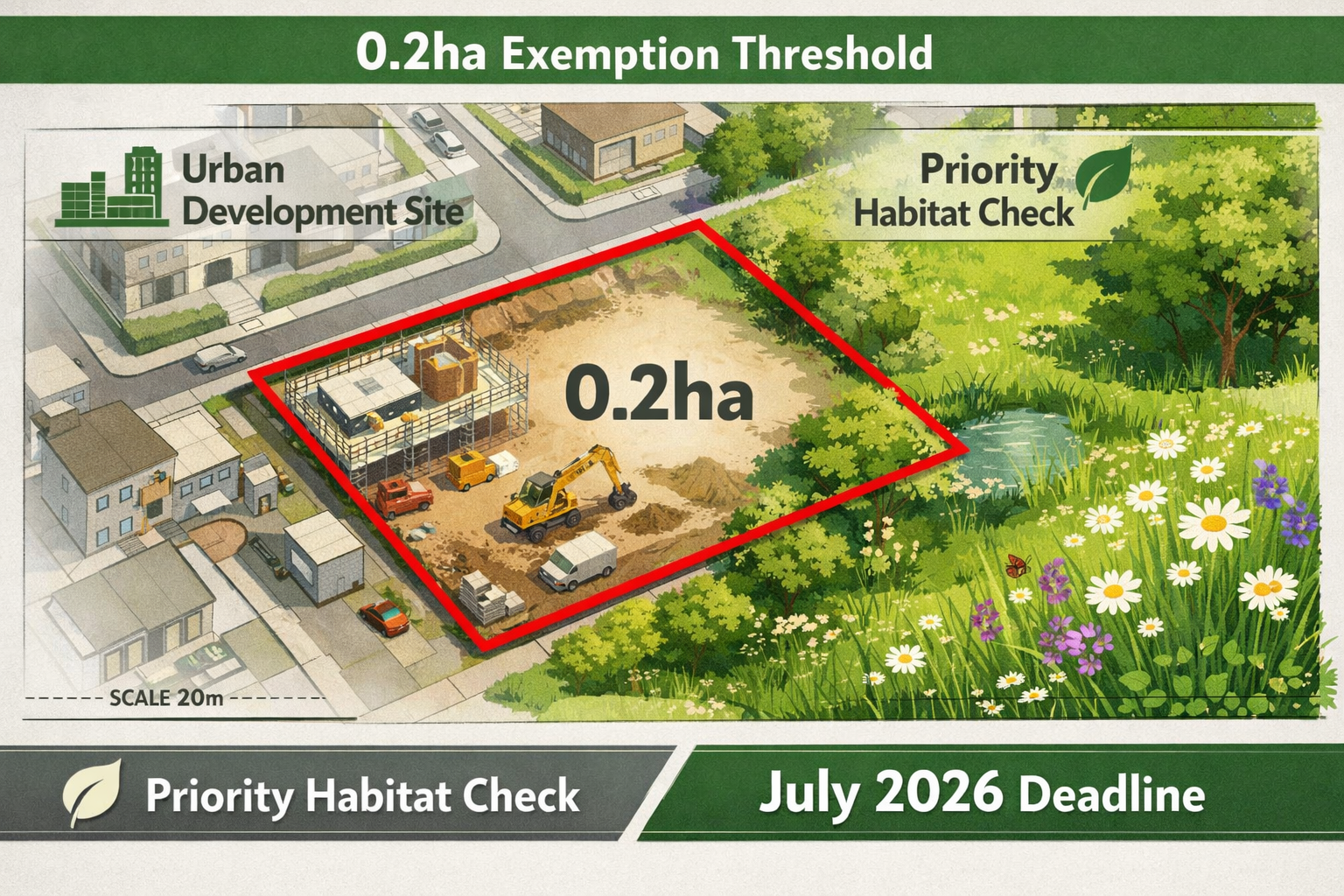
The headline change in the Biodiversity Net Gain April 2026 reform small sites brownfield exemptions package is the introduction of a new area-based exemption threshold. By 31 July 2026 — subject to parliamentary scheduling — any development on a site of 0.2 hectares or below, measured by the red-line planning boundary, will be exempt from the mandatory 10% BNG requirement.
This is a substantial policy shift. The government estimates this single change will remove BNG obligations from around half of all residential planning permissions that were previously in scope. For small housebuilders, infill developers and urban regeneration projects, this represents a meaningful reduction in compliance burden.
💬 “The 0.2 hectare exemption is the single biggest simplification of BNG since mandatory requirements were introduced — but it comes with important caveats that developers must not overlook.”
The Priority Habitat Caveat ⚠️
The exemption is not a blanket free pass. If priority habitats — habitats of principal importance for conserving or enhancing biodiversity — are present within the development site, the 0.2ha exemption does not apply. Developers must therefore commission a robust habitat survey before assuming exemption status applies.
This is where specialist ecological advice becomes critical. Understanding whether your site contains priority habitats — from lowland meadow to urban brownfield mosaic — requires a qualified ecologist, not a desktop assumption. Our guide on what you need for a Biodiversity Net Gain report explains the survey evidence needed at each stage.
Removal of the Self-Build Exemption
The existing exemption for small-scale self-build and custom-build development is being removed as part of the same legislative package. In practice, many self-build projects will qualify under the new 0.2ha threshold, so the real-world impact may be limited. However, larger self-build plots above 0.2ha that previously relied on the self-build exemption will now need to demonstrate BNG compliance or qualify under another exemption route. For a fuller picture of how exemptions work, see our exempt projects guidance.
New Exemptions Being Introduced
Alongside the area-based threshold, the April 2026 reform introduces several targeted new exemptions:
| Exemption Type | Key Condition |
|---|---|
| Temporary planning permissions | Maximum permission duration of 5 years |
| Biodiversity-focused development | Primary objective must be to conserve or enhance biodiversity |
| Green space enhancement | Development enhancing parks, playing fields or public gardens |
These additions reflect a more nuanced approach — recognising that not all development types carry the same ecological risk, and that applying BNG uniformly was creating friction without proportionate environmental benefit.
Amended Biodiversity Gain Hierarchy, NSIPs and the Brownfield Consultation
The April 2026 update goes well beyond exemptions. The Biodiversity Net Gain April 2026 reform small sites brownfield exemptions package also amends the biodiversity gain hierarchy for minor development and signals a major expansion of the BNG regime to infrastructure.
Amended Biodiversity Gain Hierarchy for Minor Development
The biodiversity gain hierarchy — which prioritises on-site delivery, then off-site habitat creation, then statutory credits as a last resort — is being amended for minor development. The precise mechanics of this change are still being worked through in secondary legislation, but the intent is to give minor development applicants more proportionate and workable pathways to compliance. If you’re weighing up on-site versus off-site delivery options, our detailed breakdown of off-site or on-site BNG delivery is a useful starting point.
BNG for Nationally Significant Infrastructure Projects from November 2026
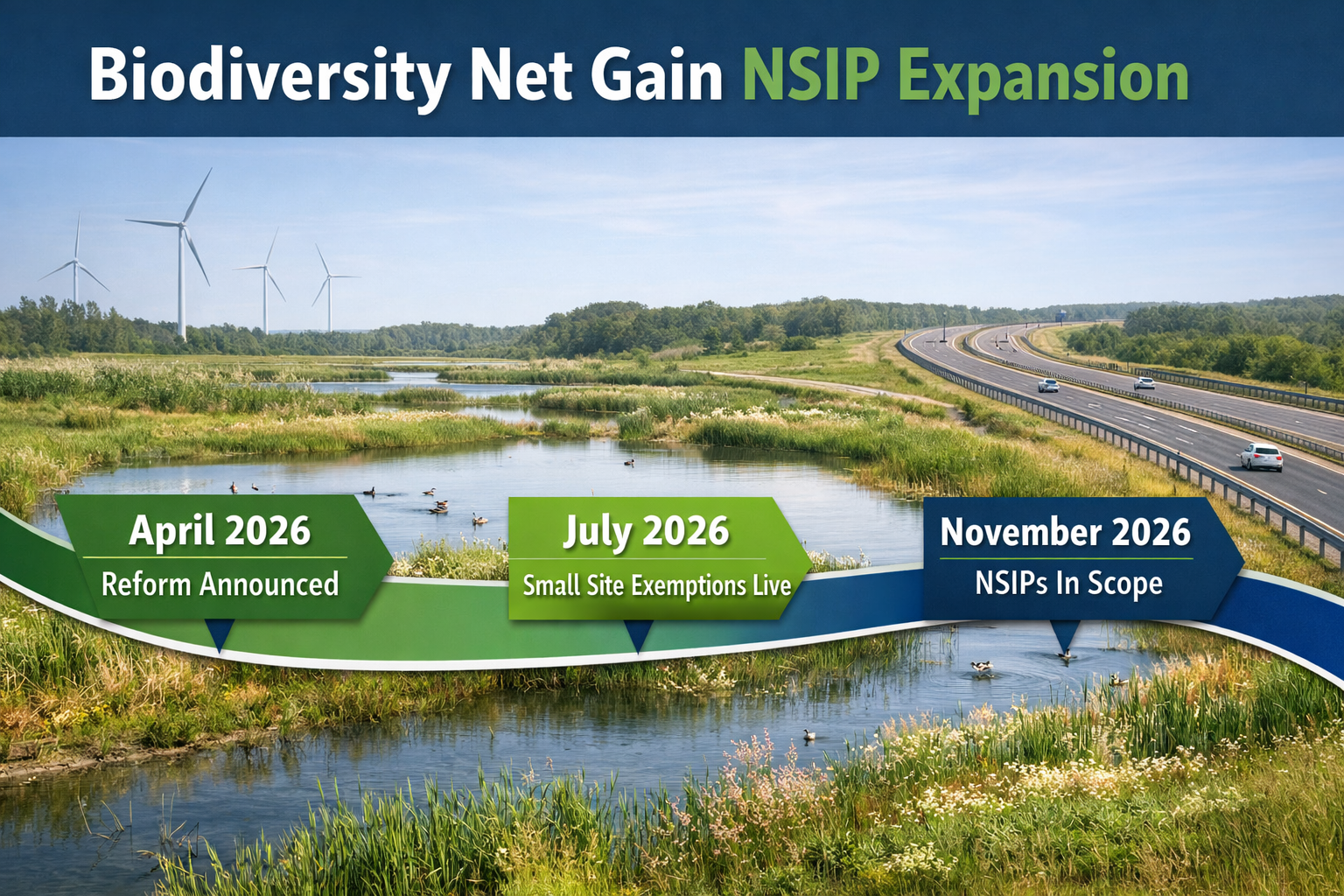
From 2 November 2026, mandatory BNG will apply to Nationally Significant Infrastructure Projects (NSIPs) — covering major roads, railways, energy infrastructure, ports and airports. This is a significant expansion of the scheme, bringing some of the UK’s largest and most ecologically complex projects within scope for the first time.
For NSIP promoters and their ecological teams, early engagement with BNG strategy will be essential. The scale of habitat impact — and the corresponding unit requirements — on infrastructure projects can be substantial, and the off-site market will need time to respond. The reforms are projected to reduce demand for off-site biodiversity units by approximately 10% as a result of the new small-site exemptions, which may improve market availability ahead of the NSIP expansion.
The Brownfield Consultation: Act Before 10 June 2026 🗓️
A separate consultation on BNG requirements for brownfield development closes on 10 June 2026. This consultation is exploring how BNG should apply to previously developed land — a long-running debate in the sector, given that brownfield sites often support significant ecological value (particularly for invertebrates and specialist species) despite their degraded appearance.
Developers, landowners and planning consultants with an interest in brownfield regeneration should submit responses before the deadline. The outcome of this consultation will shape how BNG applies to urban regeneration projects later in 2026 and beyond.
💬 “Brownfield sites are not ecological wastelands — they frequently support priority species and habitats. How BNG applies to them matters enormously for urban regeneration viability.”
What the Numbers Tell Us
The cumulative effect of the April 2026 reforms is significant at a market level:
- 📉 ~12% fewer baseline biodiversity units will need to be compensated for across the scheme
- 📉 ~10% reduction in demand for off-site biodiversity units is projected
- 🏠 ~50% of residential planning permissions previously in scope will be exempt under the 0.2ha threshold
For developers active in the off-site market — whether buying biodiversity units or selling biodiversity units — these shifts in supply and demand dynamics are worth factoring into project economics now.
Implementation Timeline at a Glance
| Measure | Expected Date |
|---|---|
| 0.2ha area exemption | By 31 July 2026 |
| Self-build exemption removal | By 31 July 2026 |
| Temporary permissions exemption | By 31 July 2026 |
| Amended biodiversity gain hierarchy | By 31 July 2026 |
| Brownfield consultation closes | 10 June 2026 |
| BNG mandatory for NSIPs | 2 November 2026 |
Secondary legislation is expected before the summer 2026 parliamentary recess. Further brownfield and targeted exemption measures will follow later in the year.
How Biodiversity Surveyors Can Help You Navigate the Reformed BNG Regime
The April 2026 reforms simplify BNG for some developers — but they also introduce new complexity. Knowing whether your site qualifies for the 0.2ha exemption, whether priority habitats are present, and how the amended hierarchy affects your compliance pathway requires specialist ecological expertise.
At Biodiversity Surveyors, we work with developers, planning consultants, architects and landowners across England to deliver robust, commercially aware BNG assessments and strategies. Whether you’re assessing a small urban infill site, a major brownfield regeneration scheme or preparing for NSIP requirements from November 2026, we can help you navigate the reformed framework with confidence.
Our services include:
- Habitat surveys and priority habitat identification — essential for confirming exemption eligibility
- Biodiversity Net Gain assessments — using the statutory biodiversity metric to calculate your BNG position
- On-site and off-site delivery strategy — helping you achieve 10% BNG cost-effectively
- NSIP ecological support — early-stage BNG strategy for infrastructure promoters
For developers new to the system, our complete guide to BNG for small development projects is an excellent starting point. Landowners interested in generating income from habitat creation can explore our guidance for landowners.
Conclusion: Act Now, Not Later
The Biodiversity Net Gain April 2026 reform small sites brownfield exemptions package is broadly good news for smaller developers — but it is not a reason to disengage from BNG planning. The priority habitat caveat on the 0.2ha exemption means that ecological surveys remain essential. The brownfield consultation deadline of 10 June 2026 is fast approaching. And the NSIP expansion in November 2026 signals that BNG is becoming more embedded in UK planning, not less.
Your immediate action checklist:
- ✅ Confirm whether your site falls below 0.2ha (red-line boundary measurement)
- ✅ Commission a habitat survey to check for priority habitats before assuming exemption
- ✅ Submit a response to the brownfield BNG consultation before 10 June 2026
- ✅ If you’re an NSIP promoter, begin BNG strategy work now — don’t wait until November
- ✅ Speak to a specialist ecologist to understand your compliance pathway under the amended hierarchy
Contact Biodiversity Surveyors today to discuss how the April 2026 reforms affect your specific project — and how we can help you achieve BNG compliance efficiently and cost-effectively.