

The race to protect global biodiversity has entered a new era. While species disappear at unprecedented rates, ecologists now possess something their predecessors could only dream of: the ability to predict biodiversity shifts before they occur. AI-Driven Predictive Analytics for Biodiversity Surveys: Tools and Protocols for Ecologists in 2026 represents a fundamental transformation in conservation science, where real-time data streams from environmental DNA (eDNA), acoustic sensors, and satellite imagery converge with machine learning algorithms to enable proactive rather than reactive survey design. 🌍
This convergence addresses a critical challenge that has plagued conservation efforts for decades: by the time traditional surveys document biodiversity loss, intervention opportunities have often passed. Today's AI-powered tools process ecological data at speeds that match the pace of environmental change, creating unprecedented opportunities for timely conservation action.
Key Takeaways
- Real-time monitoring capabilities: AI-powered tools like TinyML devices and edge computing systems enable biodiversity detection in remote locations without internet connectivity, processing data locally for immediate decision-making [2]
- Multi-source data integration: Harmonized satellite vegetation indices, eDNA metabarcoding, and acoustic monitoring now combine through AI frameworks to provide comprehensive biodiversity assessments at scales previously impossible [1][3]
- Predictive power transforms survey design: Machine learning models analyze historical patterns and current trends to forecast biodiversity shifts, allowing ecologists to position surveys strategically before changes occur [4]
- Accessibility democratizes conservation: AI is lowering barriers to spatial data analysis, enabling smaller organizations and developing nations to conduct sophisticated biodiversity assessments [1]
- Institutional capacity remains the bottleneck: While technology has advanced rapidly, the primary challenge in 2026 is building analytics capacity, establishing data standards, and creating governance frameworks [3]
Understanding AI-Driven Predictive Analytics for Biodiversity Surveys in 2026
The foundation of AI-Driven Predictive Analytics for Biodiversity Surveys: Tools and Protocols for Ecologists in 2026 rests on three technological pillars that have matured simultaneously: advanced data collection methods, powerful analytical frameworks, and accessible deployment platforms.
The Data Revolution in Biodiversity Monitoring
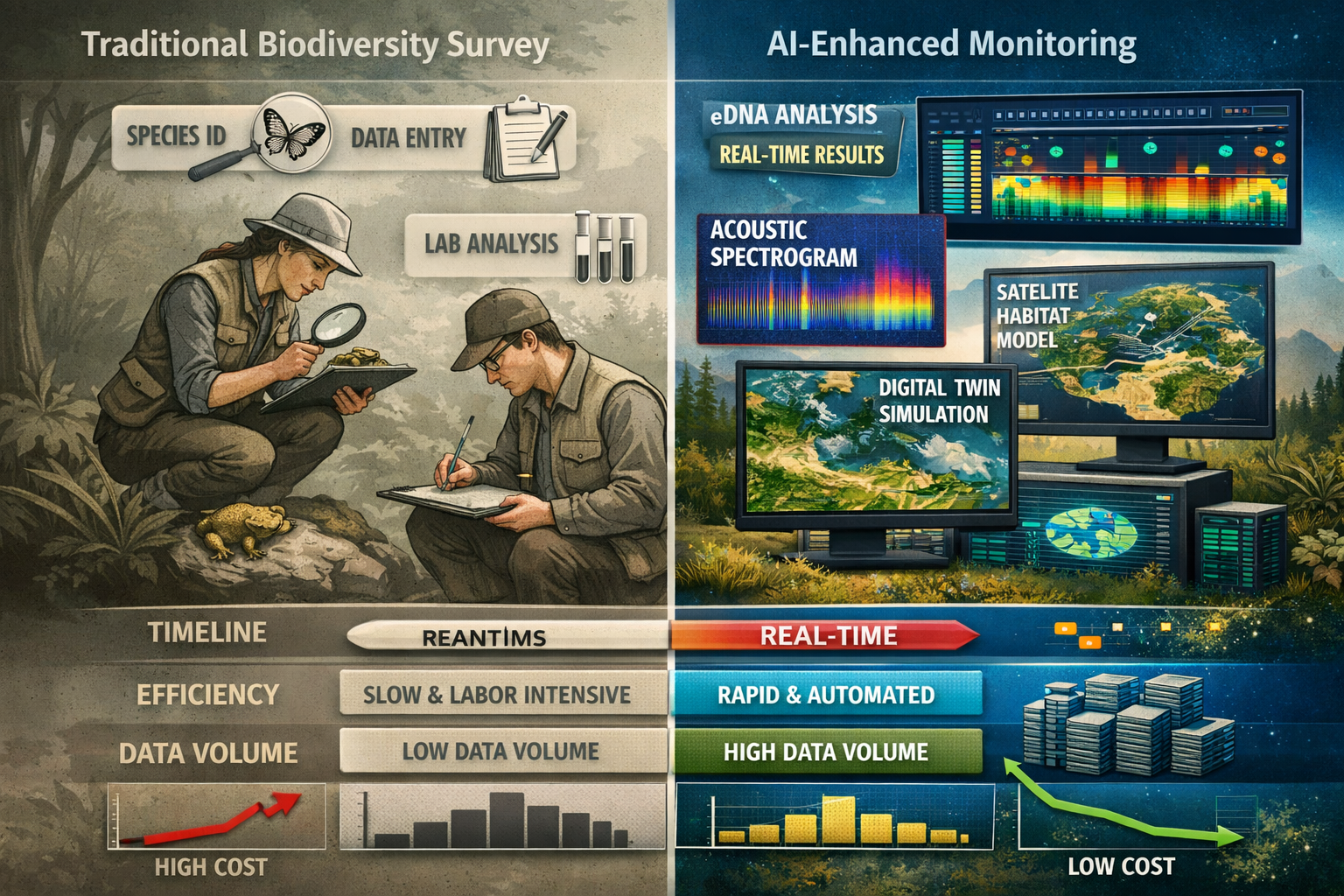
Traditional biodiversity surveys relied heavily on direct observation, specimen collection, and manual species identification—methods that remain valuable but are no longer sufficient on their own [3]. The 2026 landscape integrates these established approaches with complementary technologies that dramatically expand spatial and temporal coverage.
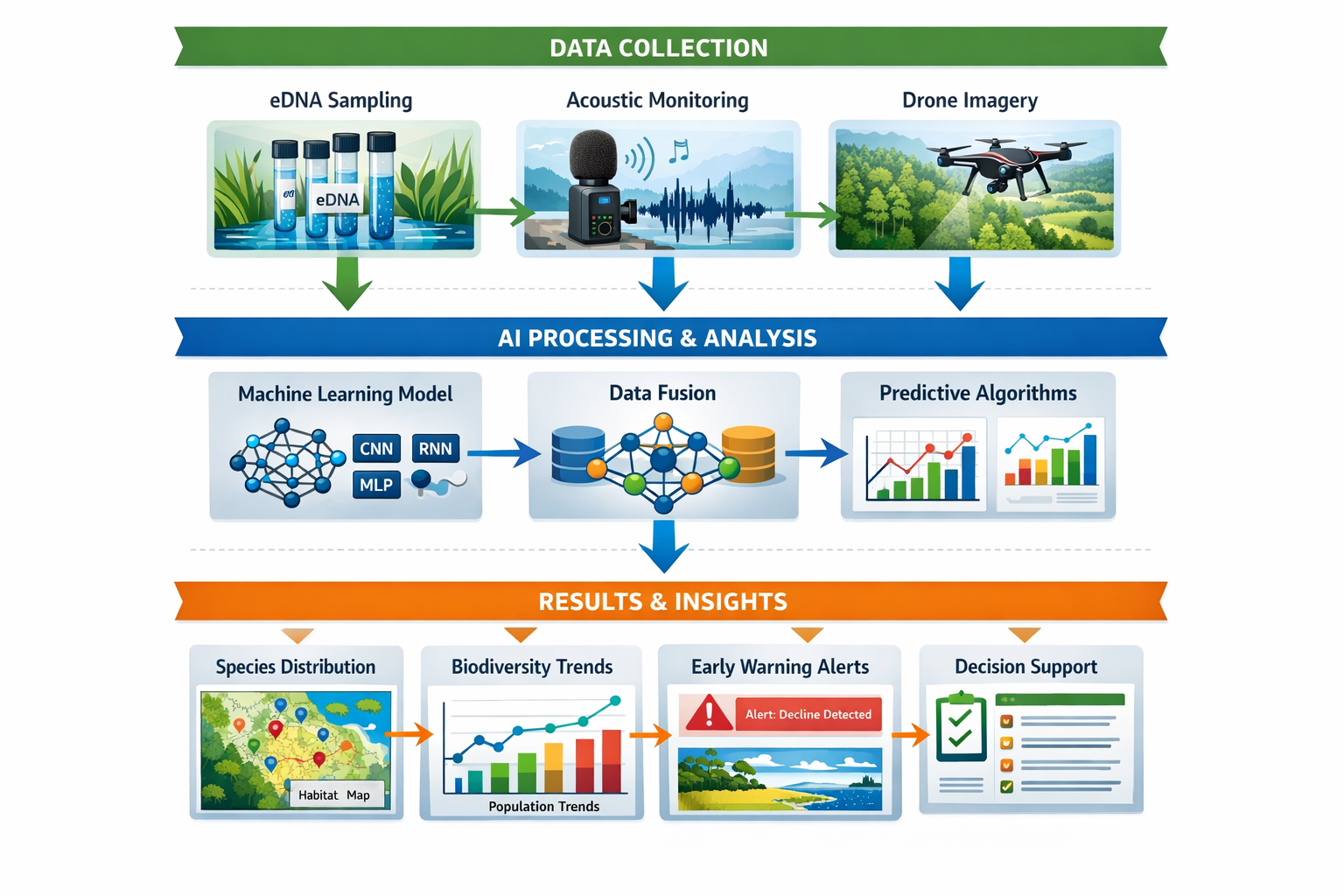
eDNA metabarcoding has emerged as a game-changing methodology, generating automated, high-throughput, taxonomically broad biodiversity data at spatial scales that were unimaginable just years ago [3]. When water, soil, or air samples are collected and analyzed, the genetic material left behind by organisms reveals community composition without requiring direct observation of every species. Paired with appropriate analytical frameworks, rapid eDNA surveys now support national reporting under global biodiversity targets and provide scalable monitoring for biodiversity impact assessments.
Satellite remote sensing has undergone its own transformation. NASA's release of harmonized satellite vegetation indices combining data from Landsat 8, 9, and ESA's Sentinel-2A, 2B, and 2C satellites delivers high-resolution, harmonized vegetation data that resolves long-standing challenges with inconsistent baselines across satellite sources [1]. This harmonization enables reliable multi-temporal analysis—essential for tracking biodiversity changes over time and validating predictive models.
Acoustic monitoring complements visual and genetic methods by capturing species presence through vocalizations. Modern AI systems process millions of audio recordings that would take years to analyze manually, identifying species-specific calls and detecting subtle changes in soundscape ecology that signal ecosystem shifts [5].
Machine Learning Breaks the Annotation Bottleneck
One of the most significant advances in 2026 is the application of machine learning to overcome what researchers call the "annotation bottleneck." Microsoft Research's work with motion-triggered camera traps, aerial cameras, and microphones exemplifies this breakthrough [5]. Previously, ecologists faced a paradox: deploying sensors was relatively inexpensive, but analyzing the resulting millions of images or audio recordings could take years, delaying critical conservation decisions.
Modern AI systems trained on labeled datasets can now:
- Classify species from camera trap images with accuracy approaching or exceeding human experts
- Detect rare species by identifying subtle visual or acoustic patterns humans might miss
- Track individual animals across multiple images to estimate population sizes
- Flag anomalies that warrant human expert review, optimizing researcher time
This acceleration transforms survey workflows from data-limited to insight-limited scenarios, where the challenge shifts from collecting information to interpreting it effectively.
Predictive Models Enable Proactive Conservation
The true power of AI-driven approaches lies not just in faster analysis of current conditions, but in forecasting future biodiversity patterns. Predictive analytics in 2026 combines:
| Model Component | Function | Data Sources |
|---|---|---|
| Species Distribution Models | Predict suitable habitat based on environmental variables | Climate data, topography, land cover, historical occurrence records |
| Population Dynamics Models | Forecast population trends under different scenarios | Time-series abundance data, demographic parameters, threat assessments |
| Threat Assessment Models | Identify areas at highest risk of biodiversity loss | Land use change projections, climate models, human pressure indices |
| Connectivity Analysis | Map corridors and barriers for species movement | Landscape resistance surfaces, genetic data, movement tracking |
These models integrate real-time monitoring data with historical patterns to generate forecasts that guide survey placement. Rather than surveying areas randomly or based solely on past biodiversity hotspots, ecologists can now position efforts where models predict significant changes are likely to occur—enabling early detection and intervention.
Essential Tools for AI-Driven Predictive Analytics for Biodiversity Surveys
The practical implementation of AI-Driven Predictive Analytics for Biodiversity Surveys: Tools and Protocols for Ecologists in 2026 requires understanding the specific tools available and their appropriate applications. The technology landscape has diversified significantly, offering solutions for different environments, budgets, and technical capacities.
Tiny Machine Learning (TinyML) for Remote Monitoring
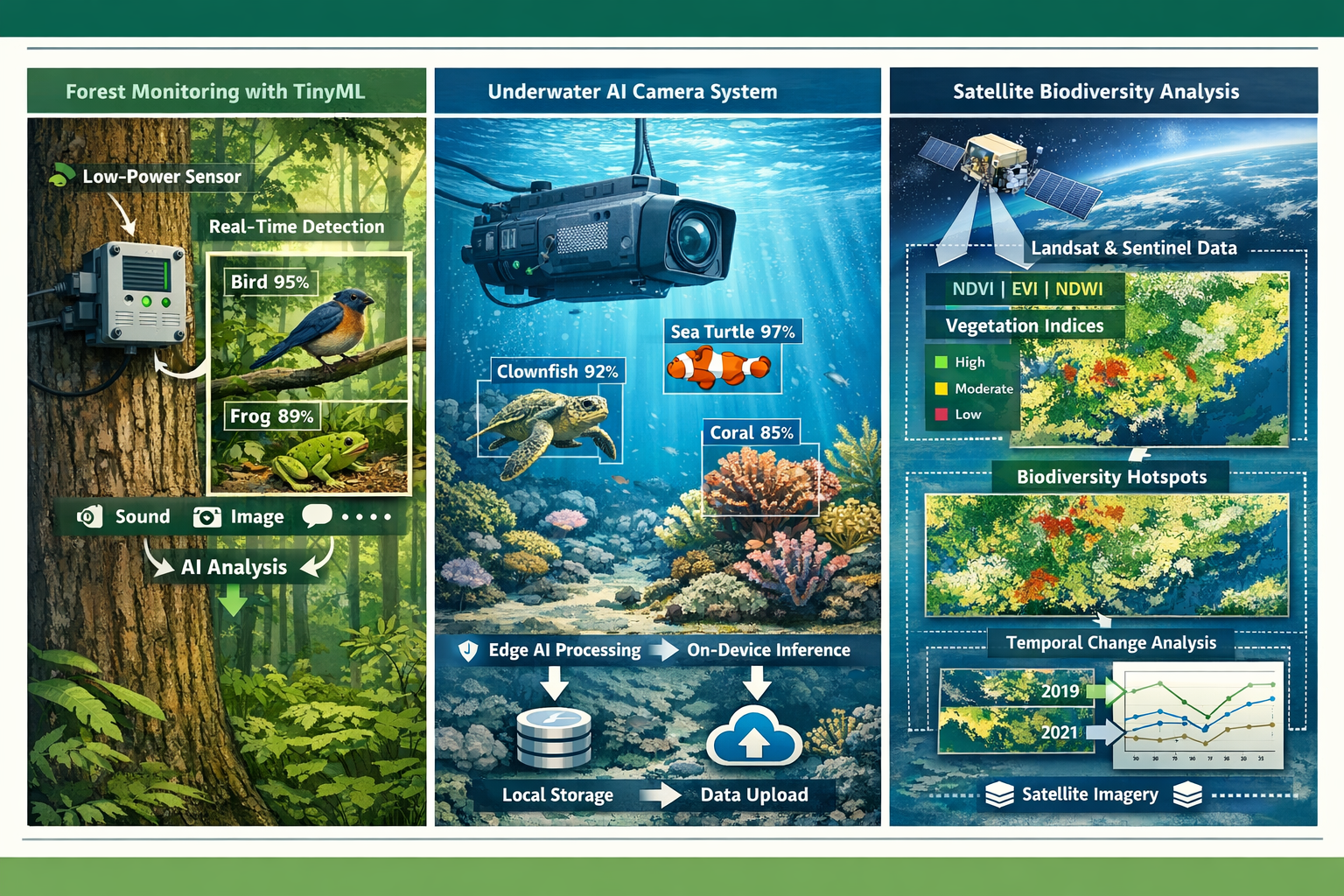
TinyML devices represent a breakthrough for biodiversity monitoring in remote landscapes where connectivity is limited or non-existent. These low-power systems run machine learning models directly on edge devices without requiring internet connections [2]. Optical AI chips requiring minimal energy enable real-time biodiversity detection while operating for months on battery power.
Key applications include:
- 🦜 Autonomous bird monitoring in remote forests with on-device song recognition
- 🐾 Wildlife corridor tracking with camera traps that classify species locally
- 🌊 River health assessment with acoustic sensors detecting aquatic species
- 🦗 Insect population monitoring using wingbeat frequency analysis
The primary advantage of TinyML is deployment flexibility—these systems function in locations where cloud-based solutions would be impractical. However, they also raise important questions about transparency and data access that the conservation community continues to address [2].
Embedded Marine Biodiversity Monitoring Systems
Marine environments present unique challenges for biodiversity surveys due to accessibility constraints and the complexity of underwater ecosystems. A new generation of embedded computer vision systems analyzes imagery locally rather than relying on expensive cloud infrastructure [6].
These systems integrate:
- Edge-AI sensors for benthic feature classification that process video streams in real-time
- Hyperspectral imaging to detect species-specific health indicators invisible to standard cameras
- Autonomous deployment platforms including fixed installations and mobile underwater vehicles
- Local processing capabilities that reduce data transmission costs and enable immediate alerts
This approach makes continuous marine monitoring economically feasible for research institutions and conservation organizations that previously couldn't afford cloud processing costs for high-resolution video streams.
Satellite-Derived Biodiversity Indicators
The harmonization of satellite data sources has created powerful tools for landscape-scale biodiversity assessment. Beyond NASA's vegetation indices, specialized products now serve specific monitoring needs:
Restor's mangrove data layers exemplify targeted ecosystem monitoring, providing four data products built from satellite imagery, machine learning, and field measurements covering a consistent 20-year time series [1]. These layers support:
- Identification of priority restoration areas
- Change tracking to assess protection effectiveness
- Biomass and carbon potential assessment for biodiversity net gain calculations
- Long-term trend analysis for policy evaluation
Similar specialized products now exist for grasslands, wetlands, coral reefs, and other critical ecosystems, each optimized for the specific spectral signatures and temporal dynamics of those habitats.
Digital Twin Ecosystems for Scenario Planning
Digital Twins—virtual replicas of real ecosystems—represent the frontier of predictive biodiversity analytics [4]. These sophisticated models simulate ecosystem processes and predict biodiversity responses to various interventions or threats.
Digital Twins integrate:
- Real-time sensor data from field monitoring networks
- Historical biodiversity records and environmental conditions
- Climate projections and land use scenarios
- Species interaction networks and trophic relationships
Ecologists can test "what-if" scenarios before implementing interventions, optimizing biodiversity net gain strategies by simulating outcomes of different habitat management approaches. However, these tools depend on advanced infrastructure, robust metadata, and open data standards that remain unevenly distributed globally [4].
Accessible AI Platforms Democratizing Analysis
A significant shift in 2026 is the democratization of AI-powered biodiversity analysis through user-friendly platforms. Global Nature Watch and similar initiatives exemplify how AI is "lowering the floor" on who can use spatial data [1].
Examples of accessible platforms include:
- iNaturalist's Google AI Accelerator partnership providing automated species identification from smartphone photos
- World Bank machine-learning species maps offering free access to predicted distributions
- Cloud-based eDNA analysis pipelines that process raw sequencing data without requiring bioinformatics expertise
- Automated acoustic analysis services accepting audio uploads and returning species lists
These platforms make sophisticated analysis accessible to community conservation groups, indigenous land managers, and organizations in developing nations—groups that possess critical local ecological knowledge but may lack technical infrastructure.
Implementing Protocols for AI-Driven Predictive Analytics in Biodiversity Surveys
Understanding available tools is only the first step. Effective implementation of AI-Driven Predictive Analytics for Biodiversity Surveys: Tools and Protocols for Ecologists in 2026 requires structured protocols that ensure data quality, analytical rigor, and actionable outcomes.
Protocol Design: Integrating Multiple Data Streams
The optimal approach in 2026 combines faster, cheaper complementary tools with established ecological research methods [3]. A comprehensive protocol typically includes:
Phase 1: Baseline Assessment and Model Training
- Conduct traditional surveys (camera traps, expert fieldwork, long-term plots) to establish ground truth
- Collect eDNA samples to validate genetic detection against visual observations
- Deploy acoustic sensors to capture temporal patterns in species activity
- Gather satellite imagery and environmental covariates for the study area
Phase 2: AI Model Development and Validation
- Train species classification models on labeled camera trap and acoustic data
- Develop species distribution models using occurrence records and environmental predictors
- Create predictive models forecasting biodiversity changes under different scenarios
- Validate model performance using holdout datasets and cross-validation approaches
Phase 3: Predictive Survey Design
- Use predictive models to identify priority monitoring locations
- Optimize sensor placement to maximize detection probability for target species
- Schedule surveys to coincide with predicted periods of maximum biodiversity activity
- Allocate resources based on forecasted risk levels across the landscape
Phase 4: Adaptive Monitoring and Refinement
- Implement real-time data collection with edge-AI processing where feasible
- Continuously update models as new data becomes available
- Adjust survey protocols based on emerging patterns and anomaly detection
- Feed results back into predictive models to improve future forecasts
Data Quality and Standardization Protocols
The convergence of diverse data streams creates both opportunities and challenges for data quality management. Standardized protocols in 2026 address:
Metadata requirements: Every dataset must include comprehensive metadata documenting collection methods, processing steps, quality control measures, and known limitations. This enables appropriate integration across sources and prevents misinterpretation.
Taxonomic harmonization: Different monitoring methods may use different taxonomic classifications. Protocols must specify how to reconcile these differences, typically by mapping to standardized taxonomic authorities like the Catalogue of Life or GBIF Backbone Taxonomy.
Spatial and temporal alignment: Combining satellite data collected every 5-16 days with eDNA samples collected quarterly and continuous acoustic monitoring requires careful temporal matching and explicit handling of asynchronous observations.
Quality control thresholds: Establish minimum standards for:
- Image quality and resolution for camera trap analysis
- Audio signal-to-noise ratios for acoustic monitoring
- eDNA sample replication and contamination controls
- Satellite imagery cloud cover and atmospheric correction
These standards ensure that AI models receive consistent, high-quality inputs that support reliable predictions.
Integrating AI Predictions with Conservation Decision-Making
The ultimate value of predictive analytics lies in improved conservation outcomes. Effective protocols bridge the gap between model outputs and management actions:
Early warning systems: Configure models to generate alerts when predicted biodiversity changes exceed specified thresholds, triggering rapid response protocols. This is particularly valuable for biodiversity impact assessments where early detection of negative trends enables corrective action before significant harm occurs.
Scenario evaluation for planning: Use predictive models to evaluate biodiversity outcomes of different development scenarios, informing decisions about on-site versus off-site biodiversity net gain delivery and optimal habitat creation strategies.
Adaptive management frameworks: Implement structured decision-making processes that:
- Define clear biodiversity objectives
- Identify management alternatives
- Use predictive models to forecast outcomes of each alternative
- Select actions based on predicted performance
- Monitor results and update models accordingly
Uncertainty communication: AI predictions always include uncertainty. Protocols must specify how to communicate prediction confidence to decision-makers, ensuring that management actions appropriately account for model limitations.
Addressing Ethical Considerations and Data Governance
As AI systems become more powerful and pervasive in biodiversity monitoring, protocols must address emerging ethical concerns:
Data access and sovereignty: Who owns biodiversity data collected on indigenous lands or in developing nations? Protocols should respect Free, Prior, and Informed Consent (FPIC) principles and ensure that data benefits flow to communities where monitoring occurs.
Algorithm transparency: TinyML and edge-AI systems may operate as "black boxes" where decision-making processes are opaque [2]. Protocols should require documentation of model architectures, training data sources, and performance limitations.
Bias in training data: AI models trained predominantly on data from well-studied regions may perform poorly in underrepresented ecosystems. Protocols must acknowledge geographic and taxonomic biases and specify appropriate validation before deploying models in new contexts.
Privacy and security: High-resolution monitoring systems may inadvertently capture sensitive information about human activities. Protocols should include data anonymization procedures and access controls protecting both human privacy and preventing poaching of endangered species through location data.
Capacity Building and Knowledge Transfer
The institutional challenge in 2026 is no longer technological capability but rather building analytics capacity, establishing standards, and creating governance frameworks [3]. Effective protocols include:
Training programs: Develop curricula that equip ecologists with AI literacy—not necessarily the ability to build models from scratch, but sufficient understanding to:
- Evaluate model appropriateness for specific applications
- Interpret model outputs and uncertainty estimates
- Identify when expert consultation is needed
- Communicate results to non-technical stakeholders
Collaborative networks: Establish communities of practice where ecologists share protocols, validated models, and lessons learned. This accelerates adoption and prevents duplication of effort.
Open-source tools and documentation: Prioritize platforms with transparent methodologies, accessible code, and comprehensive documentation that enable independent validation and local adaptation.
Phased implementation: Recognize that full implementation of AI-driven protocols requires significant investment. Design phased approaches that deliver value at each stage while building toward comprehensive systems.
The Future Landscape: Opportunities and Challenges Ahead
The rapid evolution of AI-Driven Predictive Analytics for Biodiversity Surveys: Tools and Protocols for Ecologists in 2026 continues to create new opportunities while surfacing challenges that require ongoing attention.
Emerging Opportunities
Real-time decision-making convergence: The gap between biodiversity data collection, analysis, and decision-making continues to narrow [3]. As processing speeds increase and models improve, conservation decisions increasingly occur at timescales matching ecological processes rather than administrative cycles.
Financial disclosure reshaping development: New biodiversity data products are increasingly built for supply chain transparency and financial disclosure rather than traditional conservation monitoring [1]. This shift brings substantial new funding to biodiversity data infrastructure while potentially redirecting development priorities toward corporate rather than conservation needs.
Multi-method data fusion: The 2026 Global Horizon Scan highlights how big data methods including eDNA, ancient DNA (aDNA), remote sensing, and image analysis couple with advanced AI techniques to track species via drones and autonomous submarines while processing massive ecological datasets in real time [4].
Persistent Challenges
Institutional capacity gaps: While technology has advanced dramatically, many conservation organizations lack the infrastructure, expertise, and resources to effectively deploy AI-driven tools [3]. Bridging this gap requires sustained investment in training, infrastructure, and collaborative support networks.
Data standardization: The proliferation of monitoring methods and analytical platforms creates interoperability challenges. Without common standards for data formats, metadata, and quality control, integrating diverse data streams remains difficult and time-consuming.
Validation and ground-truthing: AI models require extensive validation against field observations to ensure accuracy. As monitoring scales increase, maintaining sufficient ground-truth data for validation becomes increasingly challenging and expensive.
Equity and access: While AI democratizes some aspects of biodiversity analysis, it also creates new digital divides. Organizations and nations with advanced computational infrastructure, high-speed internet, and technical expertise gain advantages over those without such resources.
Conclusion
AI-Driven Predictive Analytics for Biodiversity Surveys: Tools and Protocols for Ecologists in 2026 represents more than technological advancement—it embodies a fundamental shift in how humanity monitors and protects the natural world. The ability to predict biodiversity changes before they occur transforms conservation from a reactive discipline to a proactive one, creating unprecedented opportunities for effective intervention.
The convergence of eDNA metabarcoding, satellite remote sensing, acoustic monitoring, and edge-AI processing has made routine biodiversity measurement feasible at scales that seemed impossible just years ago. Machine learning breaks the annotation bottleneck that previously limited survey throughput, while predictive models guide strategic survey placement to maximize early detection of critical changes.
Yet technology alone is insufficient. The primary challenge facing the conservation community in 2026 is institutional rather than technical: building analytics capacity, establishing data standards, creating governance frameworks, and ensuring equitable access to these powerful tools. Success requires sustained investment in training, infrastructure, and collaborative networks that connect technological capability with ecological expertise and local knowledge.
Actionable Next Steps for Ecologists
For individual researchers and practitioners:
- 🎓 Invest in AI literacy training to understand model capabilities and limitations
- 🤝 Join collaborative networks sharing protocols and validated models
- 📊 Start with accessible platforms before building custom solutions
- 🔍 Pilot AI-driven approaches on small scales before full deployment
For organizations and institutions:
- 💰 Allocate resources for computational infrastructure and technical expertise
- 📋 Develop data governance policies addressing ownership, access, and ethics
- 🌐 Participate in standardization efforts to ensure interoperability
- 🔗 Establish partnerships bridging technological and ecological expertise
For the broader conservation community:
- 📖 Demand transparency in AI systems used for biodiversity assessment
- ⚖️ Advocate for equitable access to tools and training across regions
- 🎯 Support validation studies ensuring model accuracy across ecosystems
- 🗣️ Communicate uncertainty appropriately to decision-makers
The tools and protocols described in this article provide ecologists with unprecedented power to understand and protect biodiversity. By combining these technologies with sound ecological principles, ethical frameworks, and collaborative approaches, the conservation community can rise to meet the biodiversity crisis with evidence-based, proactive strategies that match the scale and urgency of the challenge. For developers and planners seeking to integrate these approaches into biodiversity net gain strategies, the time to engage with AI-driven predictive analytics is now.
References
[1] On Our Radar New Biodiversity And Nature Data Products In Early 2026 – https://www.naturetechcollective.org/stories/on-our-radar-new-biodiversity-and-nature-data-products-in-early-2026
[2] Whats Next For Biodiversity Conservation Insights From The 2026 Horizon Scan – https://www.unep-wcmc.org/en/news/whats-next-for-biodiversity-conservation-insights-from-the-2026-horizon-scan
[3] Closing Gap Between Biodiversity Commitments And Measuring Nature – https://sps.columbia.edu/news/closing-gap-between-biodiversity-commitments-and-measuring-nature
[4] Sbdi Days 2026 Artificial Intelligence In Ecology And Biodiversity Research – https://biodiversitydata.se/news/2025/sbdi-days-2026-artificial-intelligence-in-ecology-and-biodiversity-research/
[5] Accelerating Biodiversity Surveys – https://www.microsoft.com/en-us/research/project/accelerating-biodiversity-surveys/
[6] 2026 Lu07 Embedded Ai Powered Marine Biodiversity Monitoring – https://centa.ac.uk/studentship/2026-lu07-embedded-ai-powered-marine-biodiversity-monitoring/