

Roughly half of all residential planning permissions in England are about to fall outside mandatory Biodiversity Net Gain requirements — a seismic shift driven by a single measurement: 0.2 hectares. If your site sits at or below that threshold, the rules from 31 July 2026 are fundamentally different. At the same time, the largest infrastructure projects in the country are being pulled into the BNG regime for the first time. Understanding the Biodiversity Net Gain 2026 small site exemption NSIP changes is no longer optional for developers, SME builders, ecologists or landowners — it is essential planning intelligence.
Key Takeaways 📋
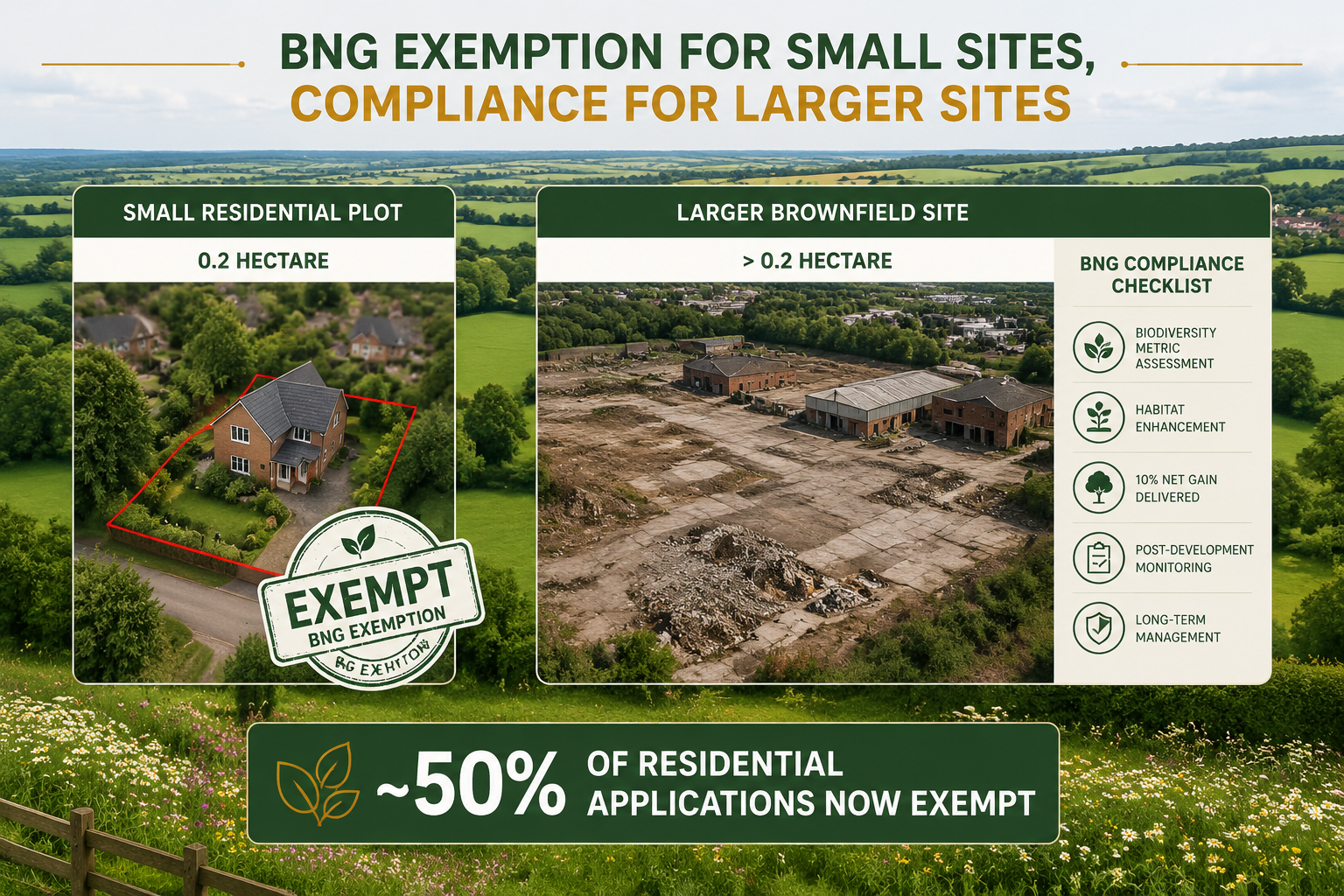
- From 31 July 2026, any development with a red-line site area of 0.2 hectares or below is exempt from mandatory BNG — removing roughly 50% of residential applications from the regime.
- The self-build and custom-build exemption is being removed, closing a previous loophole.
- For minor developments, off-site biodiversity gains now carry equal weight to on-site delivery — a significant hierarchy change.
- From 2 November 2026, BNG becomes mandatory for Nationally Significant Infrastructure Projects (NSIPs), the largest change to the regime since its launch.
- A brownfield residential exemption of up to 2.5 hectares is currently under consultation and could further reshape compliance obligations.
What the BNG Regime Looks Like Right Now
Before unpacking the 2026 reforms, it helps to establish the baseline. Biodiversity Net Gain became mandatory for major developments on 12 February 2024, and for small and minor sites on 2 April 2024. Every qualifying development must deliver a minimum 10% net gain in biodiversity, secured for 30 years through either a Section 106 agreement or a conservation covenant.
The delivery hierarchy runs: on-site habitat creation → mixed on-site and off-site → statutory biodiversity credits as a last resort. Developers must submit a completed Biodiversity Metric assessment and a Biodiversity Gain Plan before planning permission is granted. If you are new to this process, our guide on what goes into a Biodiversity Net Gain assessment is a useful starting point.
The regime has been broadly welcomed but has also created friction — particularly for SME builders working on small plots where compliance costs can feel disproportionate to project scale. The 2026 changes are a direct government response to that feedback.
The 2026 Small Site Exemption: A Game-Changer for SME Developers
The 0.2 Hectare Threshold Explained
From 31 July 2026, any development with a red-line area of 0.2 hectares (2,000 m²) or below will be exempt from mandatory BNG. To put that in perspective, this represents an 80-fold increase from the previous 25 m² de minimis threshold. Government analysis estimates this single change will exempt approximately 50% of residential planning permissions that previously required BNG compliance.
For an SME builder constructing a small cluster of homes on a tight urban plot, this is transformative. The time, cost and complexity of producing a full Biodiversity Metric calculation and securing a 30-year habitat management plan simply disappears for qualifying sites.
💡 Important caveat: The exemption does not apply where on-site priority habitats are impacted. If your 0.2 ha site contains a priority habitat — such as ancient hedgerow, lowland meadow or chalk grassland — full BNG compliance still applies.
For developers unsure whether their site qualifies, our dedicated page on exempt projects sets out the current and forthcoming criteria clearly.
What Happens to Off-Site Demand?
The knock-on effect for the habitat banking market is measurable. The 0.2 ha exemption is projected to result in approximately 12% fewer baseline biodiversity units requiring compensation across the sector, and a reduction of around 10% in overall demand for off-site biodiversity units. Landowners and habitat bank operators should factor this into their long-term revenue projections.
Self-Build Exemption: Gone
One change that catches many developers off guard: the self-build and custom-build exemption is being removed as part of the July 2026 reforms. This temporary exemption had allowed individual self-builders to sidestep BNG requirements. From 31 July 2026, self-build projects will need to comply — unless they fall under the new 0.2 ha area-based exemption. If your self-build plot is 2,000 m² or less, you are likely still covered. If it is larger, BNG obligations now apply.
Other New Exemptions Coming in 2026
Beyond the headline 0.2 ha threshold, several additional exemptions are being introduced:
| Exemption | Detail | Expected Date |
|---|---|---|
| Area-based small site | Sites ≤ 0.2 ha | 31 July 2026 |
| Temporary development | Permissions lasting ≤ 5 years | 31 July 2026 |
| Biodiversity-focused development | Primary purpose is conservation/enhancement | Later in 2026 |
| Parks, playing fields & public gardens | Enhancement of these spaces | Later in 2026 |
| Brownfield residential | Up to 2.5 ha (under consultation) | TBC |
The brownfield residential exemption deserves particular attention. A live consultation is exploring exempting residential development on brownfield land up to 2.5 hectares, with practical implementation likely to land around 1.5 hectares. This could significantly reduce BNG obligations for urban regeneration projects — a sector where on-site habitat delivery is notoriously difficult.
Hierarchy Changes for Minor Development & the NSIP Expansion
Off-Site Gains Get Equal Footing for Minor Development
One of the most practically significant Biodiversity Net Gain 2026 small site exemption NSIP changes for ecologists and developers alike is the amendment to the biodiversity gain hierarchy for minor developments. Currently, the hierarchy firmly prioritises on-site delivery. From July 2026, for minor development specifically, off-site biodiversity gains will carry equal preference to on-site habitat creation.
This is a pragmatic recognition that small sites — terraced infill plots, urban mews developments, tight brownfield parcels — often have genuinely limited scope for meaningful on-site habitat creation. Forcing developers to shoehorn green roofs or pocket meadows onto constrained sites can produce poor ecological outcomes. Allowing direct access to off-site or on-site delivery options on equal terms gives ecologists and developers more flexibility to find the best solution for nature.
🌿 For major developments, the existing hierarchy — on-site first, then mixed, then statutory credits — remains unchanged.
BNG Becomes Mandatory for NSIPs: 2 November 2026
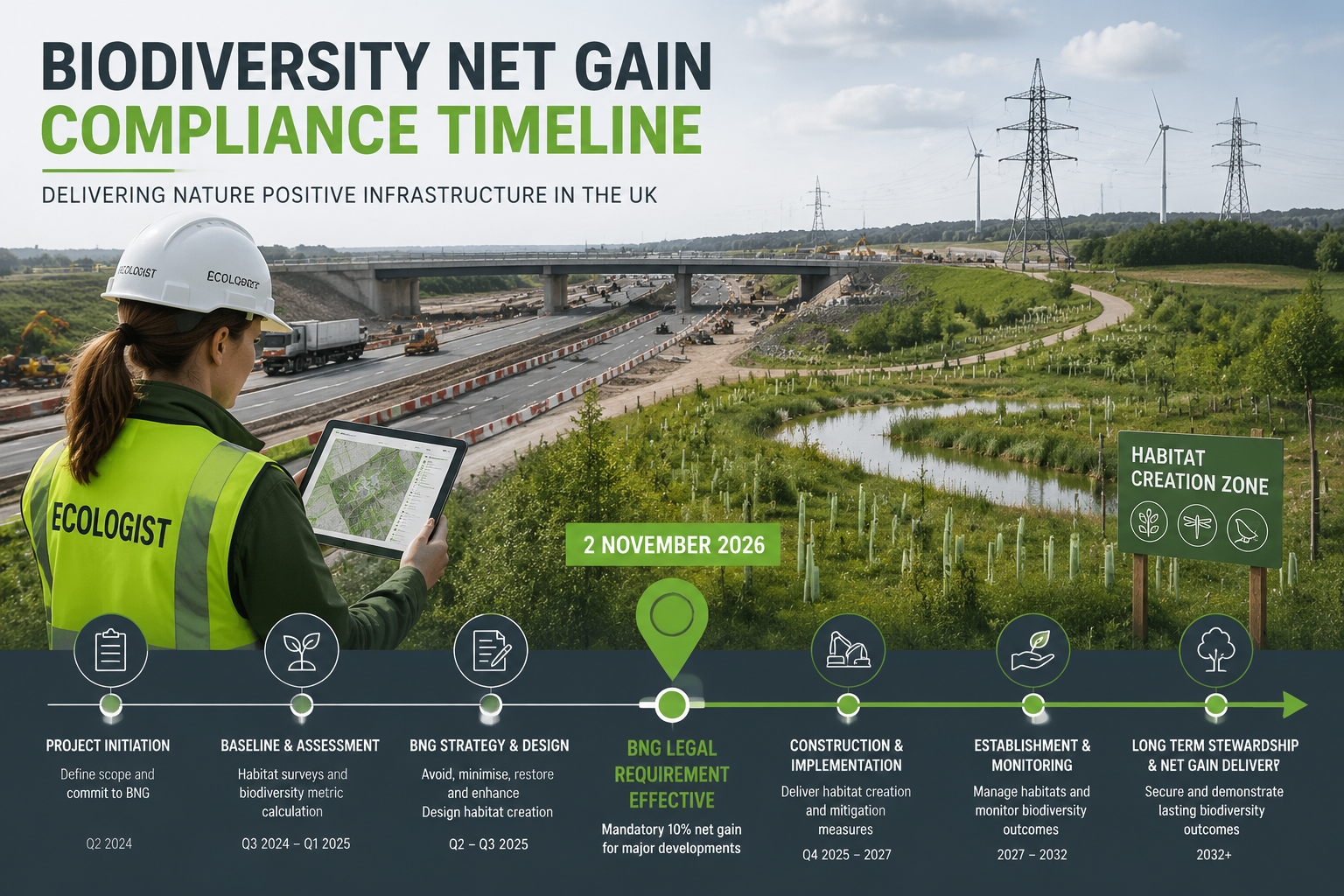
The single largest expansion of the BNG regime in 2026 is its extension to Nationally Significant Infrastructure Projects. From 2 November 2026, NSIPs — which include major road schemes, airports, energy generation facilities, water infrastructure and large-scale renewable energy projects — must comply with mandatory BNG requirements.
This was originally proposed for May 2026 but has been pushed back to November to allow the sector adequate preparation time. The implications are substantial:
- Project timelines for NSIPs will need to incorporate early ecological baseline surveys and Biodiversity Metric assessments.
- Off-site habitat banking demand from the NSIP sector is expected to be significant, given the scale of land disturbance involved and the limited on-site habitat creation potential at many infrastructure sites.
- Ecologists and environmental consultants working in the infrastructure sector need to build BNG expertise urgently — the 2 November deadline is firm.
For developers and project managers navigating these obligations, understanding how to achieve 10% Biodiversity Net Gain across large, complex sites will be a core competency requirement.
Practical Implications: What Should You Do Now?
For SME Builders and Small Developers 🏗️
- Check your red-line area immediately. If it is 0.2 ha or below, you may be exempt from 31 July 2026. But do not assume — confirm whether priority habitats are present on site.
- Do not rely on the self-build exemption. If your project is larger than 0.2 ha, BNG compliance is coming for you.
- Factor the brownfield consultation into your pipeline planning. If you are developing brownfield residential sites between 0.2 ha and 2.5 ha, watch the consultation outcome closely.
Our guide on BNG for small development projects covers the compliance landscape in more detail for smaller schemes.
For Ecologists and Ecological Consultants 🔬
- Recalibrate your workflow. The hierarchy change for minor development means you should be presenting off-site options to clients earlier in the process, not as a fallback.
- Expect a shift in assessment volumes. With ~50% of residential applications potentially exempt, your BNG workload profile will change — but NSIP work will grow substantially from November 2026.
- Priority habitat screening becomes more critical, not less. The exemption threshold makes it even more important to identify priority habitats early, as their presence overrides the area-based exemption.
For Landowners and Habitat Bank Operators 🌾
- Anticipate a modest reduction in off-site unit demand from the residential sector due to the small site exemption, but expect this to be partially offset by NSIP demand from November 2026.
- NSIP projects may seek large, long-term habitat banking agreements — an opportunity for landowners with suitable land. Our guidance for landowners explains how to position land for off-site BNG delivery.
Conclusion: Act Before the Deadlines, Not After
The Biodiversity Net Gain 2026 small site exemption NSIP changes represent the most significant recalibration of the BNG regime since it launched. For SME builders, the 0.2 ha exemption offers genuine relief — but it comes with important caveats around priority habitats and the removal of the self-build exemption. For the infrastructure sector, the November 2026 NSIP deadline is a hard stop that demands immediate preparation.
Actionable next steps:
- ✅ Audit your current and pipeline projects against the 0.2 ha threshold now.
- ✅ Commission a preliminary ecological appraisal to identify any priority habitats that would override the exemption.
- ✅ If you are working on NSIPs, begin ecological baseline surveys and BNG strategy planning without delay.
- ✅ Monitor the brownfield consultation outcome for its impact on urban regeneration projects.
- ✅ Speak to a qualified ecologist before assuming any exemption applies — the cost of getting it wrong at planning is far higher than the cost of early advice.
At Biodiversity Surveyors, we work with developers, architects, planners and landowners across England to navigate BNG compliance efficiently and cost-effectively. Whether you need a Biodiversity Net Gain report for a planning application or strategic advice on NSIP compliance, get in touch with our team today.