

When scientists analyzed over 16,000 hours of rainforest sounds across Costa Rica's Nicoya Peninsula, they discovered something remarkable: the acoustic fingerprint of recovering ecosystems could reveal biodiversity return at unprecedented scales. This groundbreaking research into Acoustic Monitoring for Biodiversity Recovery: Survey Techniques from Costa Rica's Large-Scale Restoration Projects demonstrates how sound-based tracking transforms our ability to measure ecological restoration success, offering practical protocols that ecology surveyors worldwide can adapt to quantify habitat recovery in tropical environments.
The study examined Costa Rica's Payment for Ecosystem Services (PES) program—one of the world's most ambitious reforestation initiatives—using passive acoustic monitoring to evaluate biodiversity recovery across 119 sites. The findings provide rare empirical evidence that large-scale restoration can successfully bring wildlife back, moving beyond small-scale case studies to demonstrate ecosystem recovery across entire landscapes.[3]
Key Takeaways
🎯 Large-Scale Evidence: Analysis of 16,658 hours of recordings from 119 sites proves acoustic monitoring can track biodiversity recovery across landscape-level restoration projects
🌳 Natural Regeneration Success: Naturally regenerating forests show 1.4 times greater acoustic similarity to mature reference forests compared to degraded pastures, with strongest recovery signals in bird and insect frequencies
📊 Monoculture Limitations: Timber plantations demonstrate only partial recovery (1.24 times similarity to reference forests) with quieter, less complex soundscapes than naturally regenerated areas
🔊 Dusk Equivalence: At peak activity periods, naturally regenerated forests become virtually indistinguishable from protected areas in their acoustic signatures
⚙️ Scalable Methodology: Passive acoustic monitoring combined with advanced statistical analysis provides cost-effective, replicable protocols for measuring restoration outcomes across large geographic areas
Understanding Acoustic Monitoring for Biodiversity Recovery in Costa Rica's Context
Costa Rica's transformation from having one of the world's highest deforestation rates to a nation where more than half the territory is now covered in forest represents one of conservation's greatest success stories.[1] The nearly 30-year-old PES program has driven this remarkable reversal by compensating local landowners approximately 70 USD per hectare to protect and restore forests. However, demand for the program outstrips available budget by almost 10:1, highlighting both its popularity and the need for effective monitoring to demonstrate ecological outcomes.[1]
The Challenge of Measuring Restoration Success
Traditional biodiversity surveys face significant limitations when evaluating large-scale restoration projects. Manual species counts require extensive field time, specialized taxonomic expertise, and repeated site visits—making comprehensive assessment across hundreds of locations financially and logistically prohibitive. These constraints have left a critical knowledge gap: while we can measure forest cover change through satellite imagery, understanding whether biodiversity actually returns to restored habitats has remained difficult to verify at landscape scales.
Acoustic monitoring addresses these challenges by capturing the sounds of ecosystems—the calls, songs, and vocalizations of birds, insects, amphibians, and mammals that indicate biodiversity presence and activity. This approach offers several advantages:
- Continuous data collection without human presence
- Standardized recordings enabling objective comparisons
- Cost-effective deployment across multiple sites simultaneously
- Permanent documentation allowing retrospective analysis
- Detection of cryptic species rarely observed through visual surveys
The Research Framework
Led by Giacomo Delgado, a doctoral student at ETH Zurich's Department of Environmental Systems Science, in collaboration with the Institute of Integrative Biology and Costa Rica's civil servants administering the PES program, the research team deployed passive acoustic recorders across a carefully designed recovery gradient.[2] This gradient included:
- Degraded pastures representing baseline conditions before restoration
- Monoculture timber plantations (primarily teak) established through active planting
- Naturally regenerating secondary forests recovering through passive restoration
- Protected mature reference forests representing target ecosystem conditions
The study's publication in Global Change Biology employed advanced statistical methods to identify ecological signals of ecosystem recovery, distinguishing restoration-driven changes from natural variation.[1][3]
Survey Techniques from Costa Rica's Large-Scale Restoration Projects: Methodological Innovations
The survey techniques from Costa Rica's large-scale restoration projects demonstrate how passive acoustic monitoring can be systematically deployed to evaluate biodiversity recovery across extensive geographic areas. Understanding these methodological innovations provides ecology surveyors with replicable protocols for similar assessments.
Equipment Deployment and Data Collection
The research team strategically positioned acoustic recorders at 119 sites across the Nicoya Peninsula, capturing the full spectrum of restoration conditions. This deployment strategy prioritized:
Site Selection Criteria
- Representation of all restoration types within the PES program
- Geographic distribution across the study region
- Accessibility for equipment maintenance and data retrieval
- Matching of environmental conditions (elevation, rainfall, soil type) across restoration categories
Recording Protocols
- Continuous or scheduled recording intervals capturing dawn, midday, and dusk periods
- High-quality audio capture across frequencies relevant to tropical biodiversity (typically 0-20 kHz)
- Weather-resistant housing protecting equipment during tropical storms
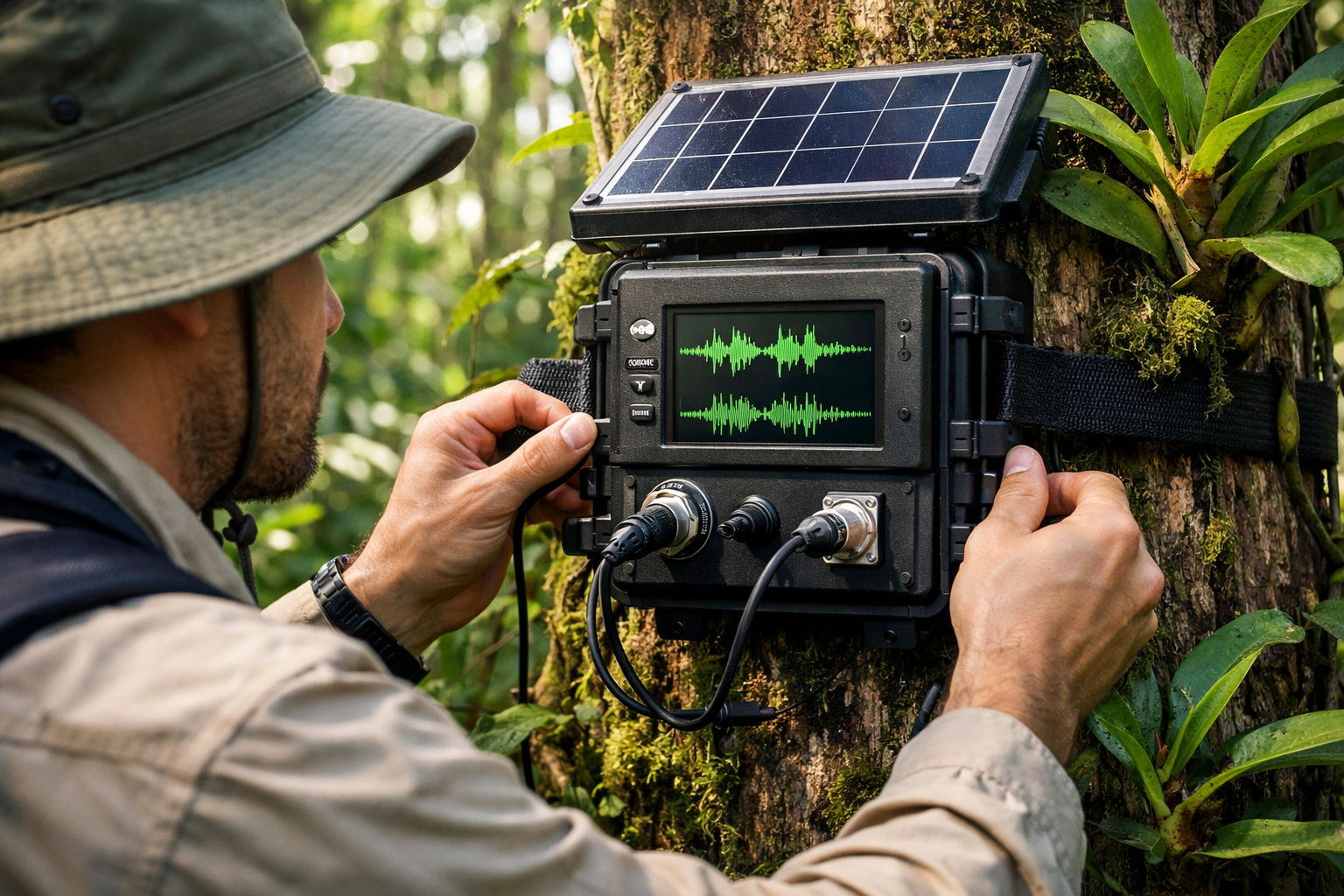
- Solar-powered systems enabling long-term autonomous operation
The 16,658 hours of audio recordings represent an enormous dataset—equivalent to nearly two years of continuous sound—providing statistical power to detect subtle differences in biodiversity recovery patterns.[2][3]
Acoustic Analysis Techniques
Transforming thousands of hours of recordings into meaningful ecological insights requires sophisticated analytical approaches. The research employed several complementary techniques:
Spectral Analysis
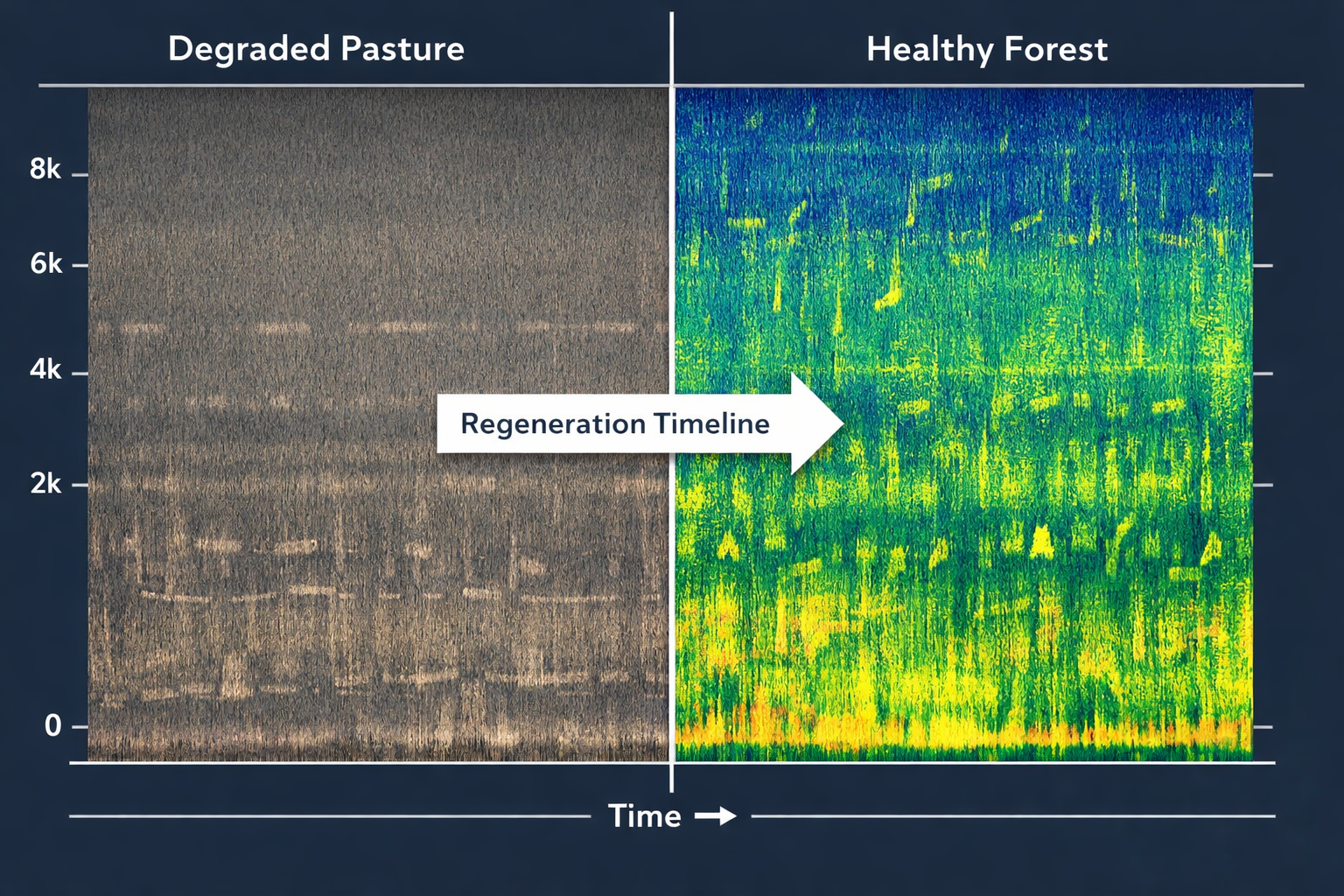
Acoustic recordings were converted into spectrograms—visual representations showing sound frequency over time. These spectrograms reveal distinct patterns:
- Bird vocalizations typically appear as discrete elements in mid-to-high frequencies (2-8 kHz)
- Insect choruses create continuous bands in higher frequencies (4-12 kHz)
- Amphibian calls occupy lower frequencies (0.5-3 kHz)
- Mammal vocalizations vary widely depending on species
Acoustic Indices
Researchers calculated multiple acoustic indices quantifying soundscape characteristics:
- Acoustic Complexity Index (ACI): Measures temporal variation in sound intensity
- Acoustic Diversity Index (ADI): Quantifies evenness of sound distribution across frequency bands
- Bioacoustic Index: Focuses specifically on biological sound sources
- Acoustic Evenness: Assesses balance among different sound components
Statistical Modeling
Advanced statistical methods compared acoustic signatures across the restoration gradient, controlling for confounding variables such as time of day, season, weather conditions, and geographic location. This rigorous approach isolated the specific effects of restoration type on soundscape characteristics.
Key Findings on Biodiversity Recovery Patterns
The analysis revealed striking patterns in how different restoration approaches support biodiversity return:
Natural Regeneration Superiority
Naturally regenerating PES forests demonstrated acoustic signatures 1.4 times more similar to mature reference forests than to the degraded pastures they replaced.[2] This substantial shift indicates successful biodiversity colonization, with native animal communities re-establishing populations in recovering habitats. The strongest recovery signals appeared in frequencies associated with birds and insects—key indicator groups for tropical ecosystem health.
Temporal Dynamics
Perhaps most remarkably, at dusk—when many tropical species are most vocally active—naturally regenerated forests became virtually indistinguishable from protected areas in their acoustic characteristics.[1] This temporal pattern suggests that while some differences may persist throughout the day, peak biodiversity activity in restored forests matches that of undisturbed reference sites.
Plantation Limitations
Monoculture timber plantations showed partial recovery, with acoustic similarity to reference forests 1.24 times greater than pastures.[2] However, these plantations harbored quieter and less complex soundscapes than naturally regenerated forests, indicating lower biodiversity density and reduced community complexity. This finding has important implications for restoration planning, suggesting that while active planting provides some biodiversity benefits, passive natural regeneration may deliver superior outcomes for wildlife recovery.
The research demonstrates that biodiversity impact assessments can leverage acoustic monitoring to provide objective, quantifiable evidence of restoration success—a capability increasingly valuable for verifying ecological outcomes in conservation programs.
Implementing Acoustic Monitoring Protocols: Practical Applications for Surveyors
The acoustic monitoring for biodiversity recovery techniques pioneered in Costa Rica offer ecology surveyors practical protocols adaptable to diverse restoration contexts. Implementing these approaches requires careful attention to study design, equipment selection, and data management.
Study Design Considerations
Successful acoustic monitoring programs begin with robust study design addressing specific research or monitoring questions:
Defining Objectives
Clear objectives guide all subsequent decisions. Common monitoring goals include:
- Tracking biodiversity recovery over time at restoration sites
- Comparing restoration techniques (active planting vs. natural regeneration)
- Assessing restoration success against reference conditions
- Detecting presence of target species or functional groups
- Evaluating seasonal or temporal patterns in biodiversity activity
Establishing Reference Conditions
The Costa Rica study's power derived partly from including mature forest reference sites alongside restoration areas. This gradient approach enables:
- Quantitative targets for restoration success
- Context for interpreting recovery trajectories
- Statistical comparisons revealing restoration effectiveness
- Identification of which biodiversity components recover fastest
Sample Size and Replication
The 119 sites examined in Costa Rica provided sufficient statistical power to detect differences among restoration types while accounting for environmental variation. Surveyors should consider:
- Minimum 10-15 sites per restoration category for robust comparisons
- Stratification by environmental gradients (elevation, moisture, soil type)
- Temporal replication capturing seasonal variation
- Control sites documenting baseline conditions
Equipment Selection and Deployment
Modern passive acoustic recorders vary widely in capabilities, costs, and suitability for different applications:
Recorder Specifications
- Sampling rate: Minimum 44.1 kHz for comprehensive bird and insect detection
- Storage capacity: Sufficient for planned recording duration (typically 64-256 GB)
- Power supply: Solar panels for long-term deployment, batteries for short-term surveys
- Weather resistance: IP66 or higher rating for tropical environments
- Scheduling flexibility: Programmable recording intervals optimizing battery life and data volume
Deployment Strategies
- Height: 1.5-2 meters above ground captures most terrestrial and arboreal species
- Orientation: Microphone directed away from dominant noise sources (roads, rivers)
- Spacing: Minimum 250-500 meters between recorders prevents spatial pseudoreplication
- Duration: At least 72 continuous hours per site captures temporal variation
- Timing: Include dawn chorus (peak bird activity) and dusk periods (amphibian, insect activity)
Cost Considerations
Professional acoustic recorders range from £200-£1,000 per unit. A monitoring program assessing 30 sites might require:
- 10-15 recorders rotated among sites: £3,000-£15,000
- Data storage and processing infrastructure: £500-£2,000
- Personnel time for deployment and retrieval: Variable
- Analysis software licenses: £0-£5,000 (free open-source options available)
This represents substantial cost savings compared to traditional surveys requiring specialized taxonomists conducting repeated site visits. Similar to how biodiversity net gain assessments optimize survey effort, acoustic monitoring maximizes data collection efficiency.
Data Processing and Analysis Workflows
The volume of acoustic data generated—potentially thousands of hours—necessitates efficient processing workflows:
Initial Processing
- Data transfer and backup: Secure storage with redundant copies
- Quality control: Identify and exclude recordings compromised by equipment malfunction or extreme weather
- Metadata organization: Systematic cataloging with site identifiers, dates, times, environmental conditions
Analysis Approaches
Automated Detection
Machine learning algorithms can identify target species calls, substantially reducing manual review time. Training datasets enable computers to recognize specific vocalizations with high accuracy.
Acoustic Indices
Calculating standardized indices (ACI, ADI, bioacoustic index) provides quantitative metrics comparable across sites and time periods without requiring species-level identification.
Manual Validation
Expert review of automated detections or representative recording samples ensures accuracy and identifies species missed by algorithms.
Statistical Analysis
The Costa Rica research employed sophisticated statistical models comparing acoustic patterns across restoration types while controlling for confounding variables. Surveyors can apply similar approaches using widely available statistical software packages.
Integration with Biodiversity Net Gain Frameworks
The acoustic monitoring techniques demonstrated in Costa Rica align well with emerging biodiversity net gain requirements in the UK and globally. As developers and landowners seek to demonstrate biodiversity net gain outcomes, acoustic monitoring offers:
- Objective baseline documentation before development or restoration
- Quantitative tracking of biodiversity change over time
- Verification of restoration success at off-site compensation areas
- Long-term monitoring fulfilling 30-year management requirements
- Cost-effective compliance with regulatory reporting obligations
For projects requiring biodiversity unit calculations, acoustic data can supplement traditional habitat assessments, providing additional evidence of ecological condition and trajectory.
Scaling Acoustic Monitoring: Lessons from Costa Rica's National Program

The survey techniques from Costa Rica's large-scale restoration projects demonstrate that acoustic monitoring can scale from individual sites to national programs. This scalability offers important lessons for conservation practitioners and policymakers.
The PES Program Structure and Monitoring Integration
Costa Rica's PES program operates at a scale that would be prohibitively expensive to monitor through traditional biodiversity surveys. The program's structure provides insights into effective monitoring integration:
Financial Mechanisms
The PES program directs financial flows to local land stewards, compensating them for ecosystem services including biodiversity conservation, carbon storage, watershed protection, and scenic beauty.[2] This payment structure creates incentives for forest protection and restoration while addressing social inequality by providing income to rural landowners.
Monitoring Requirements
Verifying that payments deliver intended ecological outcomes requires monitoring systems that are:
- Cost-proportionate: Monitoring costs must remain small relative to program budgets
- Scientifically rigorous: Evidence must withstand scrutiny from funders and stakeholders
- Operationally feasible: Methods must work within existing institutional capacities
- Transparent: Results should be accessible to participants and public
Acoustic monitoring meets these criteria more effectively than labor-intensive traditional surveys, enabling evidence-based program management at national scales.
Data Democratization and Public Accessibility
A particularly innovative aspect of the Costa Rica research involves data sharing through the Restor platform. All 2,498+ restoration sites from the study, including all PES sites evaluated, are now publicly visible on Restor through its partnership with Costa Rica's National Forestry Financing Fund (FONAFIFO).[1]
This democratization of scientific insights provides multiple benefits:
Transparency and Accountability
Public data access enables:
- Independent verification of program outcomes
- Stakeholder confidence in restoration investments
- Identification of successful approaches worth replicating
- Detection of underperforming sites requiring intervention
Knowledge Sharing
Making data publicly available accelerates learning across the restoration community, allowing practitioners worldwide to:
- Compare their projects against Costa Rica's results
- Adapt successful techniques to local contexts
- Avoid approaches showing limited effectiveness
- Contribute to global restoration knowledge
Policy Development
Evidence from large-scale monitoring informs policy decisions about:
- Optimal restoration approaches (natural regeneration vs. active planting)
- Payment levels needed to incentivize participation
- Geographic targeting of restoration investments
- Long-term management requirements
Similar transparency principles underpin the UK's biodiversity net gain framework, where public registers document habitat creation and management commitments.
Implications for Global Restoration Initiatives
The Costa Rica study provides rare empirical evidence at large spatial scales that ecosystem restoration can successfully recover biodiversity, moving beyond previous local case studies.[3] This evidence carries significant implications for global restoration efforts:
UN Decade on Ecosystem Restoration
The United Nations has designated 2021-2030 as the Decade on Ecosystem Restoration, calling for massive scaling of restoration efforts worldwide. Acoustic monitoring offers a practical tool for tracking progress toward restoration targets across diverse ecosystems and geographic regions.
Climate Change Mitigation
Beyond biodiversity recovery, the PES program has achieved increased carbon storage.[2] Acoustic monitoring can verify that carbon-focused reforestation also delivers biodiversity co-benefits, ensuring climate mitigation doesn't compromise conservation goals.
Biodiversity Offsetting
As biodiversity offsetting mechanisms expand globally, acoustic monitoring provides verification that off-site biodiversity compensation delivers promised ecological outcomes. This verification capability increases confidence in offsetting as a conservation tool.
Technical Innovations and Future Directions
The Costa Rica research represents current best practice, but acoustic monitoring continues evolving:
Artificial Intelligence
Machine learning algorithms increasingly automate species identification from recordings, reducing analysis time and costs while improving detection accuracy for rare or cryptic species.
Real-Time Monitoring
Cellular-enabled recorders can transmit data in real-time, enabling rapid detection of biodiversity changes or threats requiring management response.
Multi-Sensor Integration
Combining acoustic recorders with camera traps, environmental sensors, and satellite imagery creates comprehensive monitoring systems capturing multiple dimensions of ecosystem recovery.
Standardization Efforts
International working groups are developing standardized protocols for acoustic monitoring, facilitating comparisons across studies and regions—similar to how biodiversity metric calculations follow standardized methodologies.
Challenges and Limitations of Acoustic Monitoring Approaches
While acoustic monitoring offers substantial advantages, ecology surveyors should understand its limitations and challenges:
Taxonomic Biases
Acoustic monitoring excels at detecting vocally active species—birds, amphibians, insects, some mammals—but provides limited information about:
- Silent taxa (many reptiles, most invertebrates, plants)
- Species with infrequent or seasonal vocalizations
- Visually conspicuous but acoustically cryptic organisms
Comprehensive biodiversity assessment often requires combining acoustic monitoring with complementary survey methods addressing these taxonomic gaps.
Technical Expertise Requirements
Effective acoustic monitoring demands expertise in:
- Equipment operation: Proper recorder configuration and deployment
- Acoustic ecology: Understanding how sound propagates through different habitats
- Data management: Handling large datasets efficiently
- Bioacoustics: Interpreting spectrograms and identifying species calls
- Statistical analysis: Applying appropriate analytical methods
Building this expertise requires training and experience, though increasing availability of automated analysis tools is reducing barriers to entry.
Environmental Noise Interference
Anthropogenic noise from roads, aircraft, industrial activities, or nearby settlements can mask biological sounds, reducing detection effectiveness. Site selection should consider noise sources, and analysis must account for varying noise levels across sites.
Cost-Benefit Considerations
While generally more cost-effective than traditional surveys at large scales, acoustic monitoring involves upfront equipment investment and ongoing data management costs. Projects must evaluate whether these costs are justified by monitoring objectives and available budgets.
For smaller projects, traditional survey methods may remain more appropriate. However, for large-scale restoration initiatives or long-term monitoring programs, acoustic approaches often provide superior value.
Adapting Costa Rican Techniques to Other Contexts
The acoustic monitoring for biodiversity recovery protocols developed in Costa Rica can be adapted to diverse geographic and ecological contexts:
Temperate Forest Applications
While the Costa Rica study focused on tropical forests, similar approaches apply to temperate restoration projects:
- Seasonal considerations: Temperate regions show stronger seasonal variation in vocal activity, requiring surveys timed to breeding seasons
- Species composition: Different focal taxa (fewer insects, more mammals in some regions) may require adjusted recording schedules
- Climate challenges: Cold temperatures affect battery performance, requiring larger power supplies or more frequent servicing
Grassland and Wetland Restoration
Acoustic monitoring has proven effective in non-forest habitats:
- Wetlands: Amphibian and waterbird vocalizations provide strong recovery signals
- Grasslands: Insect choruses and grassland bird species indicate habitat quality
- Coastal habitats: Seabird colonies and marine mammal vocalizations can be monitored
Urban Biodiversity Monitoring
Acoustic monitoring increasingly supports urban ecology research:
- Green infrastructure assessment: Evaluating biodiversity value of urban parks and green spaces
- Noise pollution impacts: Quantifying how urban noise affects wildlife
- Restoration verification: Documenting biodiversity response to urban habitat creation
These applications align with growing interest in biodiversity enhancement in development projects, where acoustic monitoring can verify that urban developments deliver promised biodiversity outcomes.
Conclusion
The groundbreaking research on Acoustic Monitoring for Biodiversity Recovery: Survey Techniques from Costa Rica's Large-Scale Restoration Projects demonstrates that sound-based tracking can revolutionize how we measure and verify ecosystem restoration success. By analyzing 16,658 hours of recordings from 119 sites, researchers provided compelling evidence that naturally regenerating forests can recover biodiversity to levels approaching mature reference forests—with acoustic signatures at dusk becoming virtually indistinguishable from protected areas.
These findings carry profound implications for conservation practice and policy. The survey techniques pioneered in Costa Rica offer ecology surveyors, restoration practitioners, and conservation managers practical, scalable protocols for quantifying biodiversity recovery across large geographic areas. The methodology's cost-effectiveness, standardization potential, and ability to generate objective evidence make it particularly valuable for verifying outcomes in payment-for-ecosystem-services programs, biodiversity offsetting schemes, and restoration initiatives worldwide.
Key Implementation Steps for Practitioners
Ecology surveyors seeking to implement acoustic monitoring for biodiversity recovery assessment should:
- Define clear monitoring objectives aligned with restoration goals and stakeholder needs
- Establish reference conditions providing targets and context for recovery assessment
- Design robust sampling protocols with adequate replication across restoration gradients
- Select appropriate equipment balancing capabilities, costs, and deployment requirements
- Develop efficient data workflows leveraging automated analysis tools where appropriate
- Integrate with existing frameworks such as biodiversity net gain requirements
- Share results transparently contributing to collective learning and program improvement
The Costa Rica study's integration with the Restor platform exemplifies how data sharing can amplify research impact, democratizing scientific insights and accelerating global restoration progress. As restoration efforts scale globally during the UN Decade on Ecosystem Restoration, acoustic monitoring provides an essential tool for ensuring that ambitious targets translate into genuine biodiversity recovery on the ground.
The evidence is clear: ecosystems can recover, biodiversity can return, and we now have the tools to track this recovery at unprecedented scales. For ecology surveyors, conservation practitioners, and anyone involved in restoration planning, the techniques demonstrated in Costa Rica offer a proven pathway to evidence-based restoration that delivers measurable outcomes for both nature and people. 🌿🎧
References
[1] A New Study From Costa Rica Uses Sound To Track Biodiversity Returning At Scale – https://about.restor.eco/blog/a-new-study-from-costa-rica-uses-sound-to-track-biodiversity-returning-at-scale
[2] Ecoacoustics – https://usys.ethz.ch/en/news-events/news/archive/2026/02/ecoacoustics.html
[3] Pmc12869352 – https://pmc.ncbi.nlm.nih.gov/articles/PMC12869352/