

The corporate world stands at a critical crossroads in 2026. With only 8% of companies globally having established biodiversity protection commitments[1], the gap between environmental necessity and business action has never been more apparent. As S&P 2026 Sustainability Trends: Biodiversity Survey Integration for Corporate Ecology Compliance takes center stage, organizations face mounting pressure to transform abstract ecological goals into measurable, verifiable outcomes. The question is no longer whether companies will integrate biodiversity considerations into their operations—but how quickly they can adapt their workflows to meet escalating regulatory demands while maintaining long-term ecological integrity.
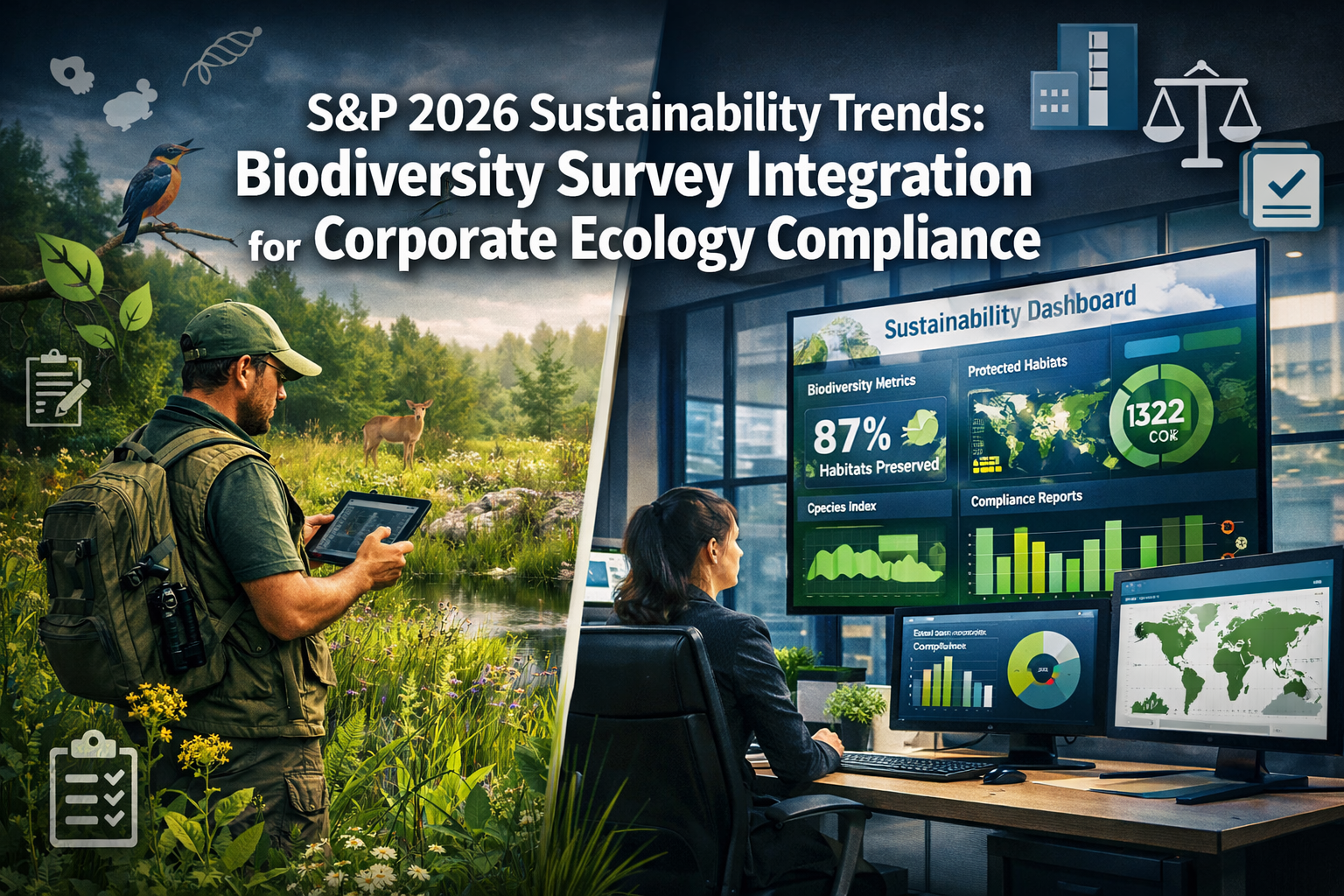
The shift toward mandatory nature-related disclosures represents more than regulatory compliance—it signals a fundamental transformation in how businesses measure success. As nature loss becomes increasingly financially material[1], biodiversity surveyors find themselves at the intersection of ecological science and corporate accountability, tasked with bridging the gap between immediate reporting requirements and decades-long conservation objectives.
Key Takeaways
- 🌍 Only 8% of global companies currently have biodiversity protection commitments, creating massive opportunity for surveyor integration and compliance services[1]
- 📊 EUDR implementation begins end of 2026 for large companies, requiring demonstrable proof that products don't originate from deforested land[1]
- 💰 Water stress alone could cost S&P Global 1200 companies $265 billion annually by 2050, emphasizing the financial materiality of nature loss[1]
- 📅 ISSB nature disclosure standard exposure draft expected October 2026 at COP17, establishing global reporting frameworks[1]
- 🔄 Surveyor workflows must balance short-term compliance reporting with long-term biodiversity net gain metrics to meet evolving corporate ecology requirements
Understanding the S&P 2026 Sustainability Trends Landscape
The sustainability landscape in 2026 reflects a dramatic evolution from voluntary environmental initiatives to mandatory, financially material reporting requirements. S&P Global's latest analysis reveals that cross-border standards and regulations are fundamentally altering how corporations approach nature-related risks[1].
The Financial Materiality of Nature Loss
Nature loss has transitioned from an environmental concern to a core financial risk. As land available for economic activity diminishes, nature's capacity to provide essential ecosystem services—including water for drinking and irrigation, plant and animal fibers, timber, and carbon sequestration—decreases proportionally[1]. This degradation directly impacts corporate operations and profitability.
The numbers tell a compelling story:
| Risk Category | Projected Annual Cost by 2050 | Primary Impact |
|---|---|---|
| Water Stress | $265 billion | Second-largest climate physical risk contributor[1] |
| Total Climate Physical Risk | $1.2 trillion | Comprehensive operational disruption |
| Ecosystem Service Loss | Varies by sector | Supply chain vulnerabilities |
For biodiversity surveyors, this financial materiality creates unprecedented demand for accurate, defensible ecological assessments that can inform corporate risk management strategies.
Regulatory Drivers Reshaping Corporate Ecology
Two major regulatory frameworks dominate the 2026 compliance landscape:
EU Deforestation Regulation (EUDR)
The EUDR becomes effective for larger companies by the end of 2026, with mid-2027 implementation for smaller and medium-sized companies (those with 250 or fewer employees)[1]. This regulation requires businesses selling agricultural commodities in or through the EU to demonstrate products don't come from deforested land or contribute to forest degradation.
For surveyors, this means developing robust traceability systems that can verify land-use history and current ecological status across complex supply chains. Understanding how to conduct a biodiversity impact assessment becomes essential for corporate clients seeking EUDR compliance.
ISSB Nature Disclosure Standard
The International Sustainability Standards Board (ISSB) is expected to publish an exposure draft for its nature-related disclosure standard to coincide with COP17 in October 2026 in Armenia[1]. This framework will establish globally recognized reporting standards for nature-related dependencies, impacts, risks, and opportunities.
The Current Compliance Gap
With 90% of S&P 500 companies now releasing ESG reports[6], yet only 8% having biodiversity protection commitments[1], a significant implementation gap exists. This disparity presents both a challenge and an opportunity for biodiversity professionals who can translate ecological data into compliance-ready reporting formats.
Integrating Biodiversity Survey Workflows for S&P 2026 Sustainability Trends Compliance
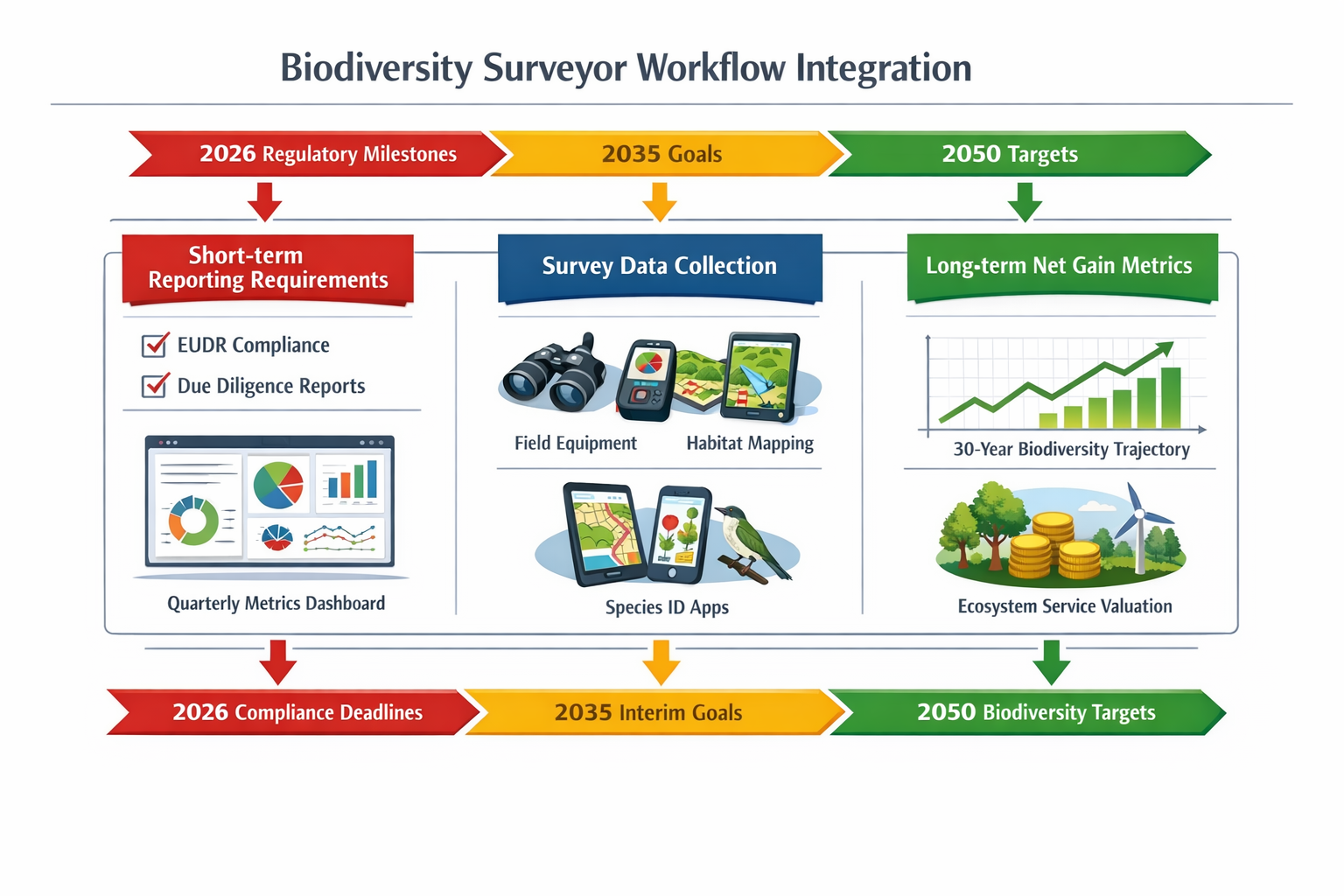
The integration of biodiversity survey methodologies into corporate compliance frameworks requires a fundamental reimagining of traditional surveyor workflows. Companies increasingly recognize that sustainability initiatives must link to risk management, operational resilience, and profitability rather than relying solely on ESG narratives[2].
Balancing Short-Term Reporting with Long-Term Metrics
The core challenge facing biodiversity surveyors in 2026 centers on delivering data that satisfies both immediate regulatory requirements and long-term ecological objectives. This dual mandate requires sophisticated data architecture and strategic planning.
Short-Term Reporting Requirements (2026-2027)
Immediate compliance needs include:
- ✅ Baseline habitat assessments for EUDR verification
- ✅ Species inventory documentation for disclosure frameworks
- ✅ Supply chain traceability data for deforestation-free certification
- ✅ Quarterly monitoring reports for corporate sustainability dashboards
- ✅ Risk assessment updates for financial materiality analysis
These requirements demand rapid data collection, standardized reporting formats, and clear communication of ecological status to non-technical stakeholders.
Long-Term Net Gain Metrics (2026-2050)
Simultaneously, surveyors must establish monitoring frameworks that track:
- 🌱 Biodiversity trajectory over 30-year timeframes
- 🌱 Ecosystem service valuations and trends
- 🌱 Habitat connectivity improvements
- 🌱 Species population dynamics across project lifecycles
- 🌱 Carbon sequestration and climate resilience indicators
Organizations seeking to achieve 10% biodiversity net gain must implement survey protocols that capture both immediate status and long-term potential.
Workflow Integration Strategies
Strategy 1: Modular Data Collection
Design survey protocols that collect data serving multiple purposes simultaneously. A single habitat assessment can generate:
- Immediate compliance documentation for EUDR
- Baseline metrics for ISSB disclosure requirements
- Long-term monitoring benchmarks for net gain tracking
- Risk assessment inputs for financial materiality calculations
Strategy 2: Technology-Enabled Efficiency
Modern surveyor workflows leverage:
- Remote sensing for landscape-scale habitat mapping
- AI-powered species identification for rapid biodiversity inventories
- Blockchain verification for supply chain traceability
- Cloud-based data platforms for real-time corporate reporting
These technologies enable surveyors to meet increased demand without proportional increases in field time.
Strategy 3: Stakeholder-Specific Reporting
The same ecological data must be packaged differently for various audiences:
| Stakeholder | Reporting Focus | Key Metrics |
|---|---|---|
| Corporate Executives | Financial risk, compliance status | Materiality scores, regulatory gaps |
| Sustainability Teams | Progress toward targets | Net gain percentages, habitat quality |
| Investors | Portfolio nature impact | Dependencies, risk exposure |
| Regulators | Legal compliance | Verification documentation, traceability |
Understanding what's in a biodiversity net gain assessment helps surveyors tailor deliverables to specific stakeholder needs.
Practical Implementation for Corporate Clients
For companies navigating S&P 2026 Sustainability Trends: Biodiversity Survey Integration for Corporate Ecology Compliance, surveyors should recommend:
Phase 1: Dependency and Impact Assessment (Q1-Q2 2026)
Identify which business operations depend on or impact biodiversity. This includes:
- Supply chain mapping for nature-dependent inputs
- Site-level habitat assessments for operational facilities
- Water source vulnerability analysis
- Ecosystem service dependency quantification
Phase 2: Baseline Establishment (Q2-Q3 2026)
Conduct comprehensive biodiversity surveys establishing:
- Current species richness and abundance
- Habitat quality and connectivity metrics
- Ecosystem service baseline values
- Deforestation-free verification documentation
Developers and corporate clients benefit from understanding how to create a biodiversity plan that satisfies both immediate and future requirements.
Phase 3: Monitoring Framework Design (Q3-Q4 2026)
Establish protocols for ongoing measurement that:
- Align with ISSB disclosure requirements
- Track progress toward net gain targets
- Provide early warning of ecological degradation
- Support adaptive management decisions
Phase 4: Integration and Reporting (Ongoing)
Develop systems that automatically translate ecological data into compliance-ready formats for multiple frameworks simultaneously.
Corporate Ecology Compliance: Measuring and Reporting Nature Impact in 2026
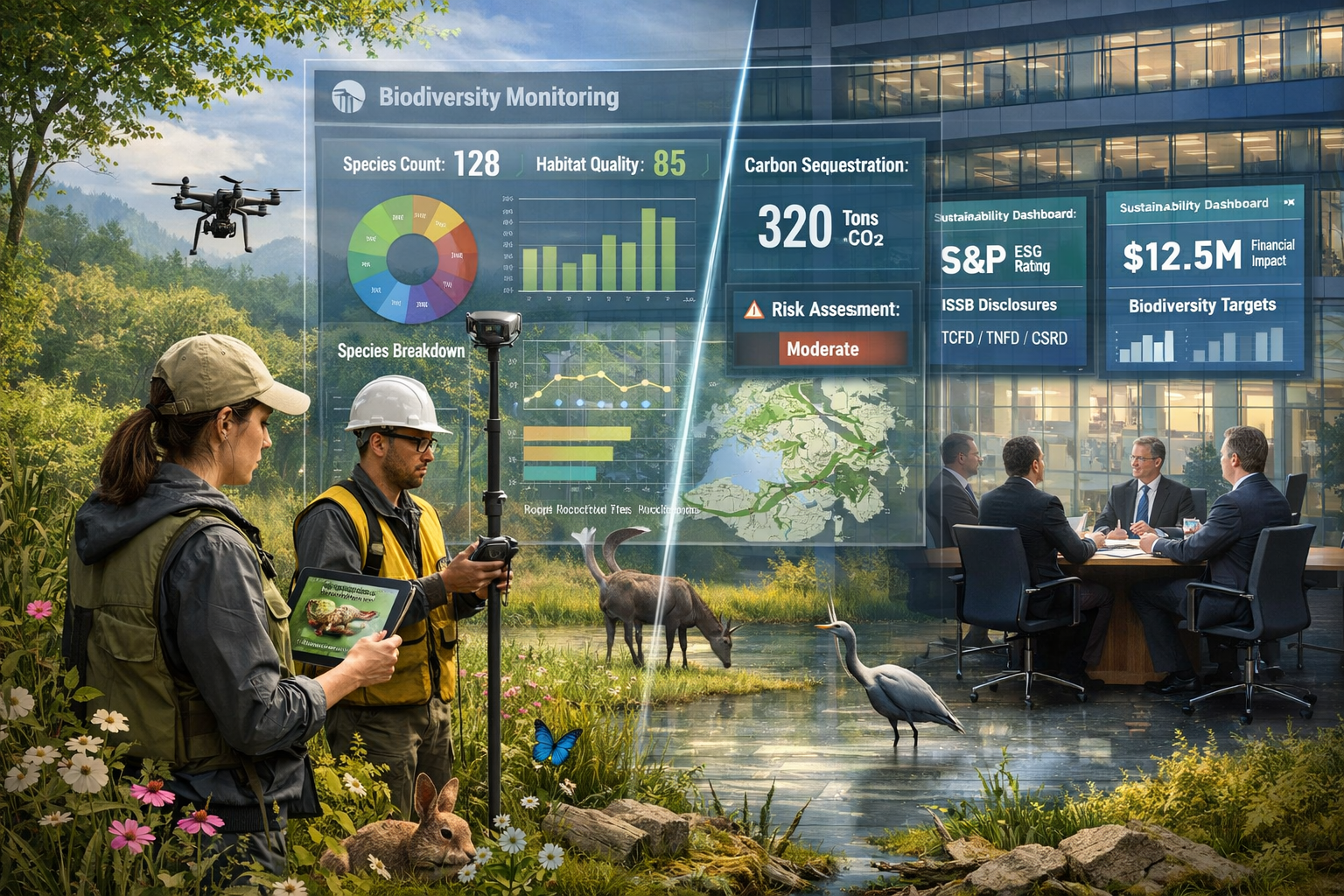
As more companies begin measuring their dependence and impact on nature and setting related goals[1], the demand for standardized, verifiable biodiversity metrics has intensified. S&P Global expects this trend to accelerate, supporting investors' measurement and reporting of nature impact in their portfolios[1].
The Measurement Challenge
Traditional biodiversity surveys focused on ecological science—species identification, habitat classification, and conservation status assessment. Corporate compliance in 2026 requires additional dimensions:
Financial Valuation of Ecosystem Services
Companies must quantify the economic value of nature's contributions to their operations. This includes:
- 💧 Water provision and purification services
- 🌾 Pollination for agricultural supply chains
- 🌳 Timber and fiber production
- 🌊 Flood regulation protecting infrastructure
- ☁️ Carbon sequestration supporting climate targets
With water stress alone projected to cost S&P Global 1200 companies $265 billion annually by 2050[1], accurate valuation of these services becomes financially critical.
Dependency Mapping
Surveyors must help clients identify which business activities fundamentally depend on specific ecosystem services. This dependency analysis informs:
- Supply chain resilience planning
- Facility location risk assessment
- Product portfolio vulnerability analysis
- Strategic investment decisions
Impact Quantification
Beyond dependencies, companies need clear metrics showing how their operations affect biodiversity:
- Habitat loss or degradation from operations
- Species population impacts from pollution or disturbance
- Ecosystem service disruption from resource extraction
- Positive contributions from conservation initiatives
The biodiversity net gain framework provides a standardized approach to quantifying these impacts.
Reporting Frameworks and Standards
ISSB Nature-Related Disclosures
The anticipated October 2026 exposure draft will likely require companies to report:
- Governance: Board oversight of nature-related risks
- Strategy: Business model implications of nature dependencies
- Risk Management: Processes for identifying and managing nature risks
- Metrics and Targets: Quantitative measures of nature impact and progress
Surveyors must design data collection protocols that directly feed these disclosure categories.
EUDR Compliance Documentation
For companies in agricultural supply chains, EUDR compliance requires:
- Geolocation data for commodity sourcing
- Deforestation-free verification documentation
- Traceability systems linking products to specific land parcels
- Due diligence procedures demonstrating legal compliance
S&P Corporate Sustainability Assessment
Companies seeking improved S&P sustainability ratings must demonstrate:
- Formal biodiversity protection commitments
- Measurable biodiversity targets and progress
- Integration of nature considerations into business strategy
- Stakeholder engagement on nature-related issues
Technology and Data Infrastructure
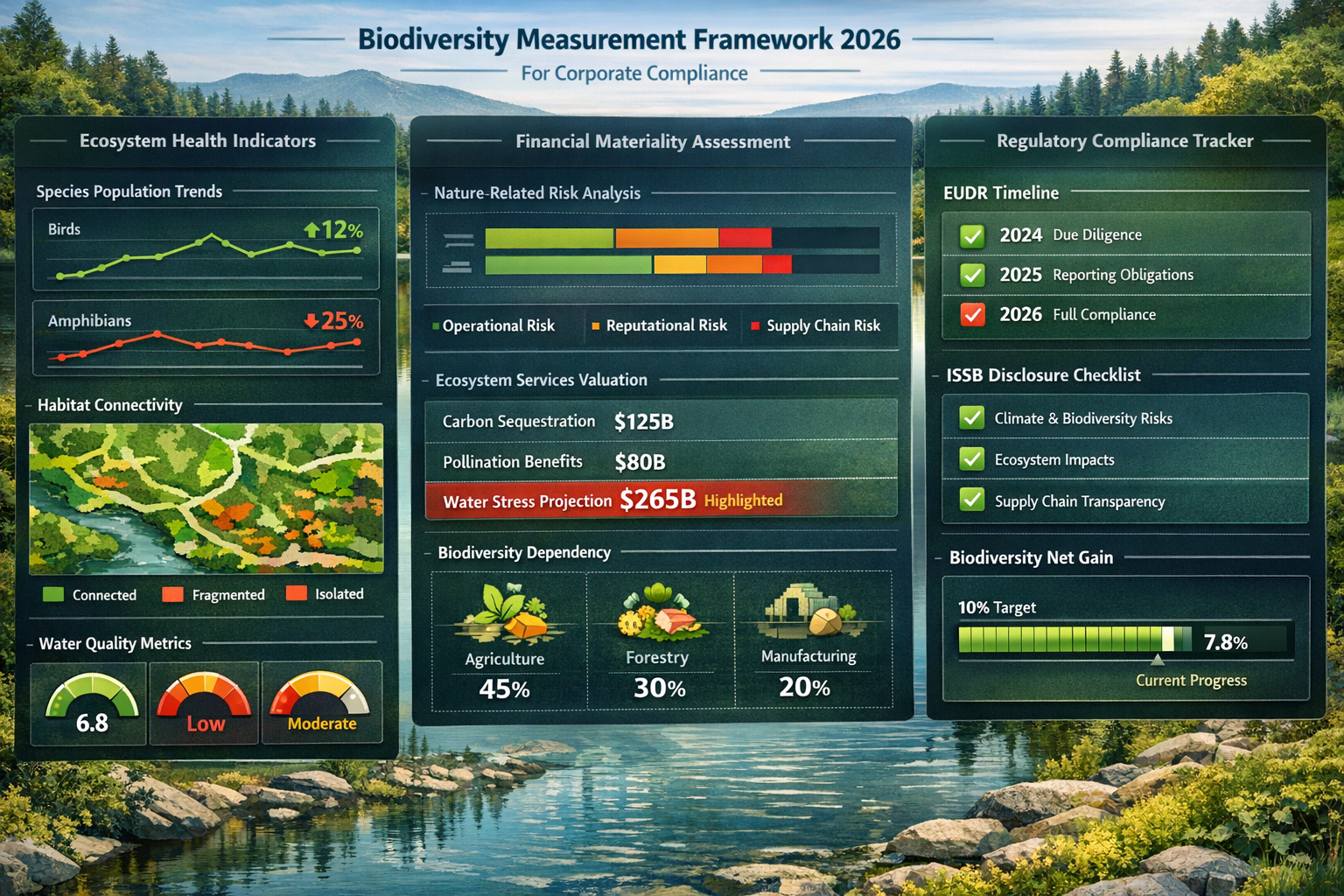
Meeting these reporting requirements demands robust data infrastructure:
Centralized Biodiversity Data Platforms
Modern corporate compliance requires:
- Single source of truth for all biodiversity data
- Multi-user access for surveyors, sustainability teams, and executives
- Automated reporting generation for various frameworks
- Historical tracking showing trends over time
- Integration capabilities with existing corporate systems
Quality Assurance and Verification
As biodiversity data becomes financially material, verification standards intensify:
- Third-party audit requirements
- Standardized survey methodologies
- Peer review of assessment conclusions
- Transparent documentation of assumptions and limitations
Organizations working with professional biodiversity surveyors gain access to quality-assured data that withstands regulatory scrutiny.
Practical Metrics for Corporate Clients
Recommended Measurement Framework
| Metric Category | Specific Measures | Reporting Frequency |
|---|---|---|
| Biodiversity Intactness | Species richness, habitat quality scores | Annual baseline, quarterly monitoring |
| Ecosystem Services | Water volume, carbon storage, pollination capacity | Annual valuation |
| Dependencies | % revenue dependent on nature, critical service identification | Annual assessment |
| Impacts | Habitat area affected, species populations impacted | Project-specific, annual aggregate |
| Net Gain Progress | Biodiversity unit change, trajectory toward targets | Quarterly |
Setting Meaningful Targets
Rather than generic commitments, companies in 2026 need SMART targets (Specific, Measurable, Achievable, Relevant, Time-bound):
- ❌ Weak: "Improve biodiversity across operations"
- ✅ Strong: "Achieve 10% biodiversity net gain across all UK development sites by 2028, measured using Defra Metric 4.0"
Understanding biodiversity credits and units helps companies establish quantifiable targets aligned with emerging markets.
Integration with Broader Sustainability Goals
Nature and biodiversity don't exist in isolation from other sustainability priorities. Effective integration requires:
Climate-Nature Synergies
- Nature-based carbon sequestration contributing to net-zero targets
- Climate adaptation through ecosystem resilience
- Avoiding nature solutions that harm biodiversity (e.g., monoculture tree plantations)
The connection between biodiversity and net zero demonstrates these interdependencies.
Social Dimensions
- Community benefits from improved ecosystem services
- Indigenous and local knowledge integration
- Just transition considerations for nature-dependent livelihoods
Economic Considerations
- Cost-benefit analysis of conservation investments
- Natural capital accounting in financial statements
- Risk-adjusted returns incorporating nature-related factors
Sector-Specific Applications and Case Studies
Different industries face unique challenges in implementing S&P 2026 Sustainability Trends: Biodiversity Survey Integration for Corporate Ecology Compliance:
Agriculture and Food Production
Key Challenges:
- EUDR compliance for commodity sourcing
- Pollinator dependencies for crop production
- Soil biodiversity and agricultural productivity
Survey Integration:
- Supply chain traceability verification
- On-farm biodiversity assessments
- Pollinator habitat monitoring
- Soil health and microbial diversity analysis
Real Estate and Development
Key Challenges:
- Mandatory biodiversity net gain requirements
- Habitat loss from construction activities
- Long-term site management obligations
Survey Integration:
- Pre-development baseline assessments
- On-site versus off-site delivery decision support
- 30-year monitoring program design
- Biodiversity unit purchasing for offset requirements
Planners benefit from understanding the top questions about biodiversity net gain to streamline approval processes.
Manufacturing and Industrial Operations
Key Challenges:
- Water dependency and stress risks
- Pollution impacts on local ecosystems
- Facility location in biodiversity-sensitive areas
Survey Integration:
- Water source vulnerability assessments
- Facility-specific biodiversity baselines
- Pollution impact monitoring
- Ecosystem service dependency quantification
Financial Services and Investment
Key Challenges:
- Portfolio-level nature impact assessment
- Financed emissions and nature loss
- Stranded asset risk from nature degradation
Survey Integration:
- Client biodiversity due diligence
- Portfolio-wide dependency mapping
- Nature-related financial risk quantification
- Investment screening criteria development
Strategic Recommendations for Surveyors and Corporate Clients
For Biodiversity Surveyors
1. Expand Service Offerings
Move beyond traditional ecological surveys to provide:
- Compliance consulting for multiple frameworks (EUDR, ISSB, national regulations)
- Financial materiality assessments
- Long-term monitoring program management
- Verification and audit services
2. Invest in Technology
Adopt tools that increase efficiency and data quality:
- Remote sensing and GIS platforms
- AI-powered species identification
- Cloud-based data management systems
- Automated reporting generators
3. Develop Cross-Disciplinary Expertise
Successful surveyors in 2026 understand:
- Corporate sustainability reporting frameworks
- Financial risk assessment methodologies
- Supply chain management principles
- Regulatory compliance processes
4. Build Strategic Partnerships
Collaborate with:
- Sustainability consultancies for integrated service delivery
- Technology providers for platform development
- Financial advisors for materiality assessment
- Legal experts for compliance verification
For Corporate Clients
1. Start Immediately
With EUDR effective by end of 2026 and ISSB standards emerging, companies cannot afford delays:
- Commission baseline biodiversity assessments now
- Map nature dependencies across operations
- Establish preliminary monitoring frameworks
- Begin stakeholder engagement on nature commitments
2. Integrate Across Functions
Nature-related compliance shouldn't be siloed in sustainability departments:
- Engage finance teams in materiality assessment
- Involve procurement in supply chain traceability
- Connect operations teams to monitoring programs
- Link strategy teams to long-term target setting
3. Prioritize Material Risks
Not all nature impacts are equally material. Focus resources on:
- Operations with high nature dependencies
- Supply chains with deforestation risk
- Facilities in water-stressed regions
- Products requiring biodiversity-dependent inputs
4. Communicate Transparently
As disclosure requirements intensify:
- Report both progress and challenges honestly
- Explain methodologies and limitations clearly
- Engage stakeholders in target-setting processes
- Demonstrate continuous improvement
Organizations seeking guidance can explore comprehensive biodiversity net gain resources to understand available support.
Overcoming Implementation Barriers
Common Challenges
Data Availability and Quality
Many companies lack basic biodiversity data for their operations and supply chains. Solutions include:
- Phased assessment approaches prioritizing material areas
- Remote sensing for initial landscape-level analysis
- Third-party databases for supply chain screening
- Collaborative data sharing within industry sectors
Cost Concerns
Comprehensive biodiversity assessments require investment. Justification strategies:
- Quantify financial risks avoided through early action
- Demonstrate regulatory compliance cost savings
- Identify operational efficiency gains from nature-based solutions
- Access green finance premiums for verified nature-positive activities
Understanding the cost of biodiversity units and statutory credits helps companies budget appropriately.
Technical Complexity
Biodiversity science is complex, and corporate teams often lack ecological expertise. Approaches include:
- Engaging qualified biodiversity surveyors early
- Investing in staff training on basic ecological concepts
- Developing simplified internal communication materials
- Creating cross-functional teams bridging ecology and business
Standardization Gaps
Multiple frameworks with inconsistent requirements create confusion. Strategies:
- Focus on internationally recognized standards (ISSB, GRI)
- Design data collection serving multiple frameworks simultaneously
- Participate in industry working groups developing best practices
- Advocate for regulatory harmonization
Success Factors
Organizations successfully implementing S&P 2026 Sustainability Trends: Biodiversity Survey Integration for Corporate Ecology Compliance share common characteristics:
✅ Executive Commitment: Board-level oversight of nature-related risks
✅ Clear Accountability: Designated roles responsible for biodiversity outcomes
✅ Adequate Resources: Sufficient budget and personnel for implementation
✅ Long-Term Perspective: Recognition that biodiversity outcomes require decades
✅ Stakeholder Engagement: Collaboration with communities, NGOs, and experts
✅ Adaptive Management: Willingness to adjust approaches based on monitoring results
Future Outlook: Beyond 2026
While 2026 represents a critical milestone, the trajectory of corporate biodiversity integration extends far beyond:
Emerging Trends
Nature-Positive Targets
Moving beyond "net gain" to "nature-positive" commitments that deliver:
- Absolute increases in biodiversity across landscapes
- Restoration of degraded ecosystems
- Recovery of threatened species populations
Biodiversity Credit Markets
Maturation of trading platforms for biodiversity units, enabling:
- Efficient matching of conservation supply and corporate demand
- Price discovery for ecosystem services
- Standardized verification protocols
Landowners can explore opportunities to sell biodiversity units as markets develop.
AI and Automation
Advanced technologies transforming biodiversity monitoring:
- Autonomous drones for continuous habitat surveillance
- Machine learning for real-time species identification
- Predictive modeling for biodiversity trajectory forecasting
- Blockchain for immutable verification records
Integrated Reporting
Convergence of climate, nature, and social reporting into unified sustainability disclosures:
- Single materiality assessments across all ESG dimensions
- Integrated risk management frameworks
- Holistic target-setting addressing interdependencies
Preparing for the Next Decade
Organizations positioning themselves for long-term success should:
Build Adaptive Capacity
Regulations and standards will continue evolving. Create flexible systems that can accommodate:
- New disclosure requirements
- Updated scientific methodologies
- Emerging stakeholder expectations
- Technological innovations
Invest in Natural Capital
Early investment in biodiversity conservation delivers:
- Reduced future compliance costs
- Enhanced ecosystem service resilience
- Improved stakeholder relationships
- Competitive differentiation
Cultivate Expertise
As biodiversity integration becomes mainstream, talent with cross-disciplinary skills will be in high demand:
- Ecologists with business acumen
- Sustainability professionals with scientific literacy
- Financial analysts understanding natural capital
- Data scientists specializing in biodiversity metrics
Collaborate for Landscape-Scale Impact
Individual site-level actions have limited impact. Effective biodiversity conservation requires:
- Industry collaboration on shared landscapes
- Public-private partnerships for ecosystem restoration
- Multi-stakeholder governance of natural resources
- Transboundary cooperation for migratory species
Conclusion
The integration of biodiversity survey methodologies into corporate ecology compliance represents one of the most significant sustainability transformations of 2026. With only 8% of companies currently having biodiversity protection commitments[1], yet facing mounting regulatory requirements through EUDR and anticipated ISSB standards, the urgency for action has never been greater.
S&P 2026 Sustainability Trends: Biodiversity Survey Integration for Corporate Ecology Compliance demands that organizations move beyond abstract environmental commitments to establish measurable, verifiable systems that balance short-term reporting requirements with long-term ecological outcomes. As nature loss becomes increasingly financially material—with water stress alone projected to cost major corporations $265 billion annually by 2050[1]—the business case for comprehensive biodiversity integration strengthens daily.
For biodiversity surveyors, this transformation creates unprecedented opportunity to expand traditional ecological services into strategic consulting that directly informs corporate risk management and compliance strategies. By developing workflows that simultaneously serve immediate regulatory needs and decades-long monitoring requirements, surveyors position themselves as essential partners in corporate sustainability.
For companies, the path forward requires immediate action: commissioning baseline assessments, mapping nature dependencies, establishing monitoring frameworks, and setting meaningful biodiversity targets. Organizations that view these requirements as opportunities rather than burdens will discover competitive advantages through enhanced resilience, improved stakeholder relationships, and access to sustainability-linked capital.
Actionable Next Steps
For Biodiversity Surveyors:
- Review current service offerings against 2026 compliance requirements
- Invest in technology platforms enabling efficient multi-framework reporting
- Develop financial materiality assessment capabilities
- Build partnerships with sustainability consultancies and corporate clients
- Pursue professional development in corporate reporting standards
For Corporate Clients:
- Commission comprehensive biodiversity baseline assessments for material operations
- Map nature dependencies across supply chains and facilities
- Establish cross-functional teams integrating ecology, finance, and operations
- Set SMART biodiversity targets aligned with emerging disclosure standards
- Engage qualified biodiversity surveyors for ongoing monitoring and verification
For Both:
- Participate in industry working groups developing best practices
- Advocate for regulatory harmonization and standardization
- Share learnings and challenges to advance collective understanding
- Maintain long-term perspective recognizing biodiversity outcomes require decades
- Embrace adaptive management, adjusting approaches based on monitoring results
The convergence of ecological necessity, regulatory mandate, and financial materiality makes 2026 a pivotal year for corporate biodiversity integration. Organizations that act decisively—establishing robust survey workflows, transparent reporting systems, and meaningful conservation commitments—will not only achieve compliance but contribute to the fundamental transformation needed to address global nature loss.
The question is no longer whether companies will integrate biodiversity into their operations, but how effectively they will do so. Those who partner with qualified biodiversity professionals, invest in appropriate measurement systems, and commit to long-term ecological outcomes will emerge as leaders in the nature-positive economy taking shape in 2026 and beyond.
For comprehensive support in navigating these requirements, contact experienced biodiversity surveyors who can design tailored solutions balancing immediate compliance needs with long-term conservation objectives.
References
[1] 2026 Sustainability Trends – https://www.spglobal.com/sustainable1/en/insights/2026-sustainability-trends
[2] S P Global S Top Sustainability Trends Shaping 2026 – https://azzet.com/news/s-p-global-s-top-sustainability-trends-shaping-2026
[6] 50 Esg Statistics You Need To Know – https://www.keyesg.com/article/50-esg-statistics-you-need-to-know