

Marine ecosystems pulse with life across seasons—coral spawning events in spring, fish migrations in autumn, whale calving in winter. Yet traditional biodiversity surveys often capture only frozen moments in time, missing the dynamic rhythms that define healthy ocean ecosystems. In 2026, the marine conservation community is shifting from snapshot assessments to full-season marine baselines, recognizing that accurate trend detection requires continuous monitoring protocols that capture the complete annual cycle of biodiversity patterns.
Full-Season Marine Baselines: Optimizing 2026 Biodiversity Surveys Beyond Snapshots for Accurate Trends represents a fundamental transformation in how surveyors, developers, and conservation planners approach marine biodiversity assessment. This evolution moves beyond periodic visual observations that miss critical biological events occurring on shorter timelines, embracing integrated technologies that reveal whether populations are genuinely increasing or declining rather than simply responding to weather-driven variation.
Key Takeaways
- 🌊 Seasonal coverage matters: Full-season monitoring distinguishes long-term population trends from short-term weather variation and captures critical biological events like spawning and migration that snapshot surveys miss
- 🎵 Integrated technologies strengthen baselines: Combining bioacoustics, environmental DNA (eDNA), and traditional surveys creates robust datasets that answer "where," "when," and "who" questions about marine biodiversity
- 📊 2026 represents a midpoint assessment: The UN Ocean Decade positions this year as critical for evaluating baseline establishment progress and refining monitoring protocols for the remaining decade
- ⚠️ Snapshot surveys create false signals: Short-term disturbances can appear as recovery, while genuine interventions may seem ineffective without proper seasonal baseline data
- 🔬 Standardization gaps remain: Current protocols often lack consistent approaches for faunal community assessments across regions and temporal scales, highlighting the need for integrated full-season frameworks
Why Traditional Snapshot Surveys Fall Short in Marine Environments
Traditional marine biodiversity surveys typically involve periodic site visits—perhaps quarterly or biannually—where surveyors conduct visual observations, collect physical specimens, or deploy equipment for limited timeframes. While these approaches have established important foundational knowledge, they suffer from critical limitations that compromise their ability to detect accurate trends.
The Problem with Temporal Gaps
Marine ecosystems operate on multiple overlapping timescales. Plankton blooms may peak and decline within weeks. Fish spawning aggregations concentrate in specific locations for days or weeks annually. Marine mammal migrations follow seasonal corridors that shift based on prey availability and oceanographic conditions. A survey conducted in July will capture entirely different species assemblages and behaviors than one conducted in January at the same location.
Without continuous or frequent sampling across seasons, surveyors face several challenges:
- Missed biological events: Critical reproductive periods, migration peaks, and seasonal habitat use patterns occur between survey intervals
- Weather confounding: A single storm event or temperature anomaly during a survey period can create population signals that appear as trends rather than temporary disturbances
- Behavioral variation: Many marine species exhibit different behaviors, vocalizations, and habitat preferences across seasons that single-visit surveys cannot characterize
- Incomplete species inventories: Migratory, elusive, or seasonally active species remain undetected, leading to underestimation of true biodiversity
As emphasized in current marine monitoring discussions, continuous monitoring from early spring through full seasons enables detection of whether populations are increasing or declining, reveals whether activity is stable or concentrated in short peaks, and distinguishes long-term trends from weather-driven variation [2].
False Signals and Misinterpreted Trends
Perhaps most concerning, snapshot surveys can generate false signals that mislead conservation decisions. A population decline observed during a single survey may reflect normal seasonal movement rather than genuine population loss. Conversely, an apparent population increase might represent temporary aggregation rather than actual population growth.
Without proper baseline data spanning full seasons, short-term disturbances can appear as recovery, while conservation interventions may seem ineffective when they are actually working [2]. This creates risk for both developers seeking to demonstrate biodiversity net gain outcomes and conservation managers attempting to evaluate restoration success.
Full-Season Marine Baselines: Optimizing 2026 Biodiversity Surveys with Continuous Protocols
The shift toward full-season marine baselines fundamentally changes survey design from episodic assessment to continuous characterization. Rather than asking "what species are present today?" surveyors now ask "how does this ecosystem function across the complete annual cycle?"
Defining Full-Season Monitoring Approaches
Full-season monitoring encompasses several complementary strategies:
Continuous deployment protocols involve placing autonomous monitoring equipment—acoustic recorders, eDNA samplers, environmental sensors—that collect data 24/7 throughout the year. These systems capture baseline conditions across all seasons without requiring constant human presence.
Intensive seasonal campaigns conduct focused surveys during critical biological periods identified through preliminary continuous monitoring. For example, surveyors might increase sampling frequency during known spawning seasons or migration windows.
Multi-year baseline establishment recognizes that single-year datasets may not represent typical conditions. Establishing robust baselines requires monitoring across multiple annual cycles to account for interannual variation driven by climate oscillations, prey availability shifts, and population dynamics.
Benefits of Year-Round Data Collection
Full-season approaches deliver several advantages over traditional snapshot surveys:
| Benefit | Description | Impact |
|---|---|---|
| Seasonal pattern detection | Captures migration timing, spawning periods, habitat use shifts | Reveals ecosystem function rather than static presence |
| Trend accuracy | Distinguishes genuine population changes from seasonal variation | Prevents false conclusions about conservation status |
| Rare event documentation | Records infrequent but important events (mass spawning, unusual species visits) | Improves understanding of ecosystem resilience and connectivity |
| Intervention evaluation | Provides before/after data across full annual cycles | Enables accurate assessment of conservation effectiveness |
| Regulatory compliance | Demonstrates comprehensive baseline establishment | Supports biodiversity impact assessments and planning requirements |
For developers and planners working to achieve biodiversity net gain targets, full-season baselines provide the robust data foundation necessary to demonstrate genuine improvements rather than seasonal fluctuations.
Capturing Critical Seasonal Pulses
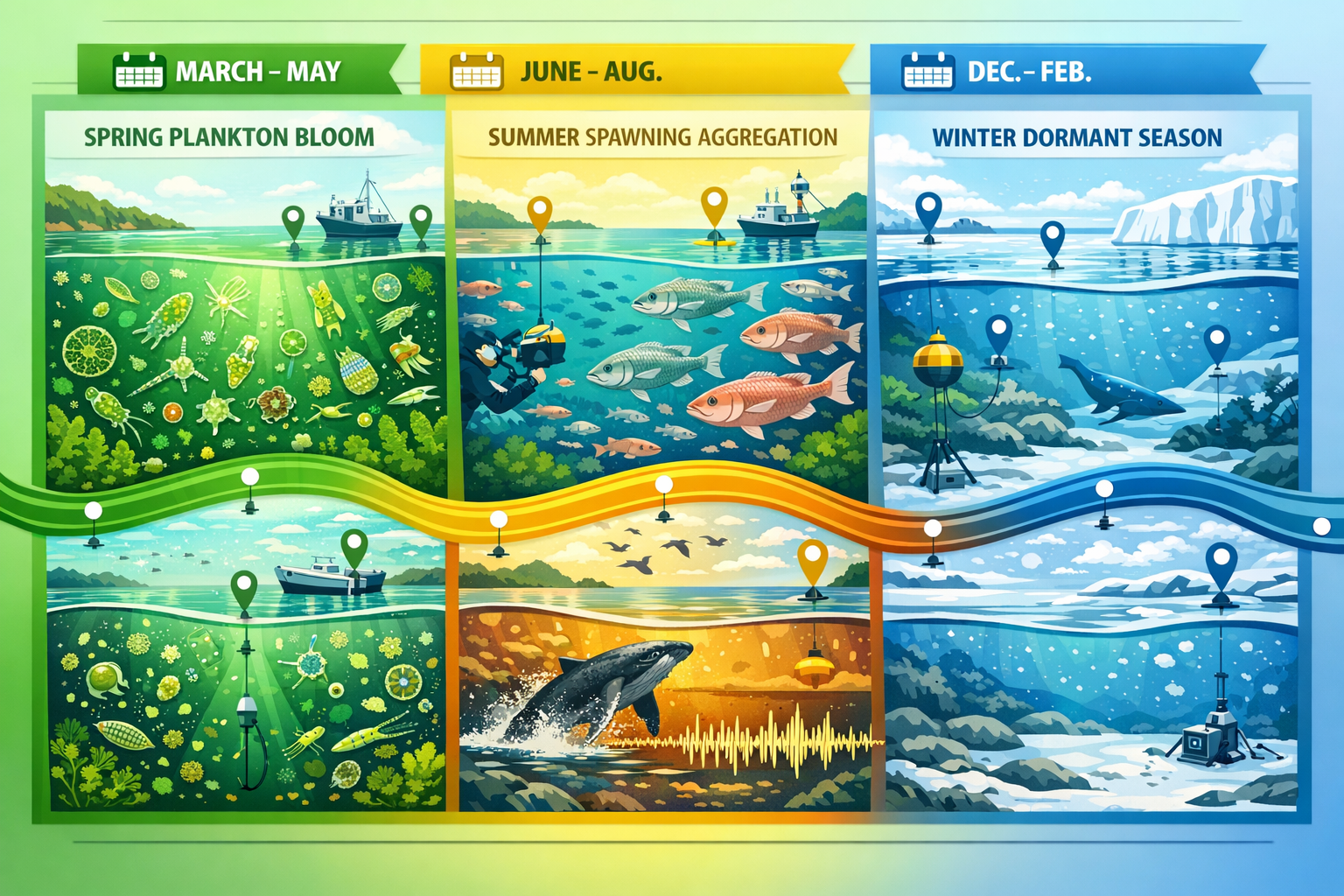
Marine ecosystems exhibit distinct seasonal pulses—periods of concentrated biological activity that disproportionately influence annual productivity and ecosystem function. These include:
- 🌸 Spring plankton blooms: Foundation of marine food webs, timing and magnitude vary annually
- 🐟 Summer spawning aggregations: Critical reproductive periods for many fish species
- 🐋 Autumn migrations: Seasonal movements of marine mammals, sea turtles, and pelagic fish
- ❄️ Winter dormancy patterns: Reduced activity periods that still reflect habitat quality and species persistence
Capturing these pulses requires survey protocols that extend across complete seasons rather than targeting arbitrary calendar dates. The 7th World Conference on Marine Biodiversity, convening November 17-20, 2026 in Bruges, Belgium, emphasizes that "understanding biodiversity baselines and tracking long-term trends is essential for guiding conservation, fisheries management, and climate adaptation strategies" [3][4].
Integrated Technologies: Bioacoustics, eDNA, and Traditional Methods
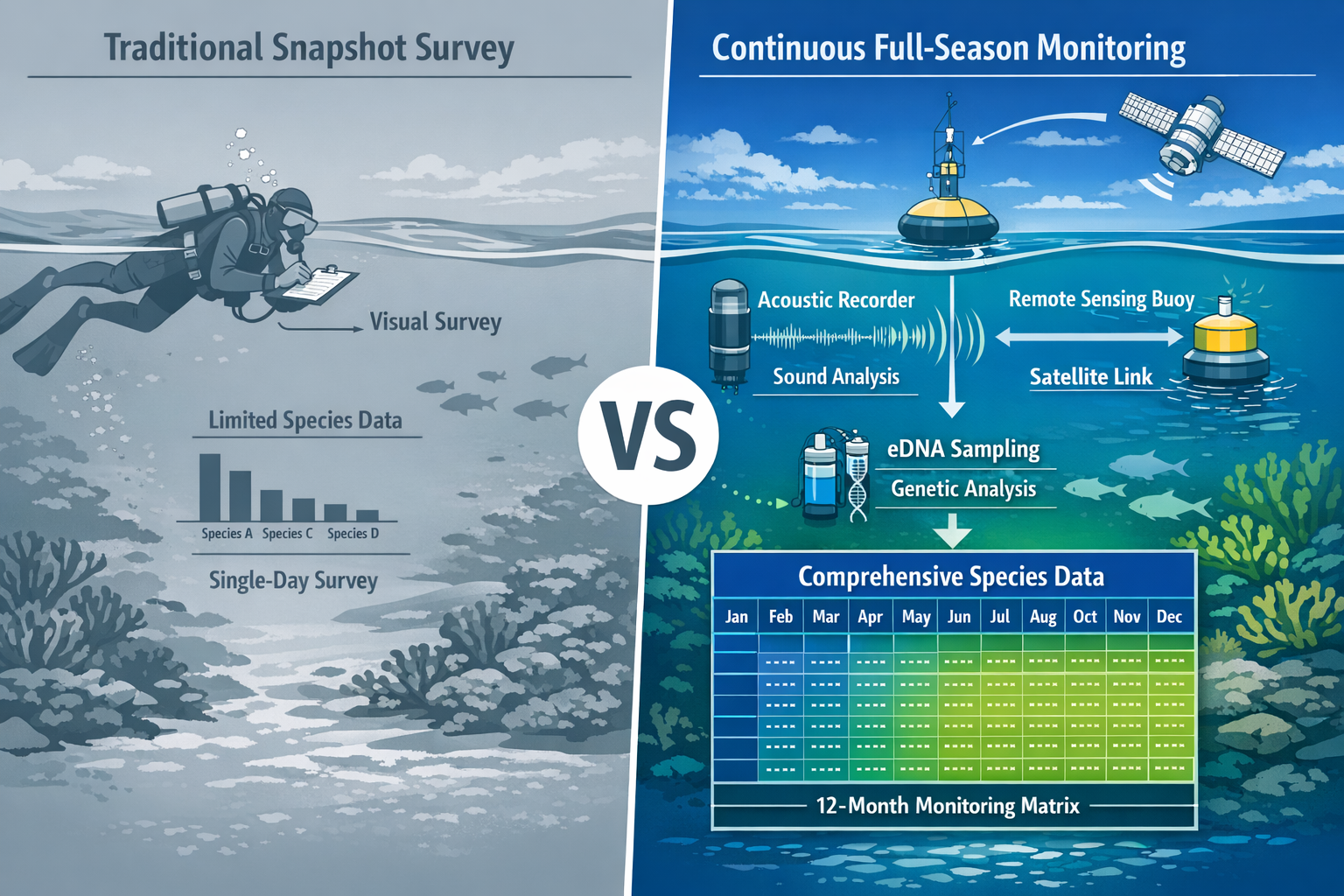
Full-Season Marine Baselines: Optimizing 2026 Biodiversity Surveys Beyond Snapshots for Accurate Trends relies on integrating multiple monitoring technologies that complement each other's strengths while compensating for individual limitations. The 2026 marine monitoring landscape emphasizes combining bioacoustics and environmental DNA (eDNA) with advanced marine survey expertise as a critical shift in biodiversity monitoring [1].
Bioacoustics: Listening to Seasonal Soundscapes
Passive acoustic monitoring captures the natural acoustic signatures of marine mammals, fish, and invertebrates to map habitat use, track seasonal patterns, and understand ecosystem dynamics across large areas while reducing survey disturbance compared to traditional methods [1].
Underwater acoustic recorders deployed for full seasons reveal:
- Species presence and abundance: Vocalizing marine mammals (whales, dolphins, seals) can be detected, identified, and counted through call analysis
- Behavioral patterns: Feeding, mating, and social vocalizations indicate activity types and intensity
- Seasonal timing: Migration arrivals and departures, spawning chorus timing, and seasonal habitat use patterns
- Diel patterns: Day-night activity cycles that single-visit surveys miss entirely
- Anthropogenic impacts: Vessel noise, construction activities, and other human sounds documented in relation to biological activity
Bioacoustics excels at answering the "when?" question—revealing temporal patterns of ecosystem use that are invisible to visual surveys [1]. For projects requiring biodiversity net gain assessments, acoustic baselines provide quantitative metrics of ecosystem function before, during, and after development activities.
Environmental DNA: Detecting the Invisible
eDNA monitoring detects elusive or fast-moving species, provides broad taxonomic coverage from single samples, and tracks change across hours, days, or seasons—complementing acoustic methods' strength in capturing behavioral and seasonal patterns [1].
Water samples collected throughout seasons contain genetic material shed by all organisms present in the environment. Laboratory analysis reveals:
- Comprehensive species inventories: Detection of fish, invertebrates, marine mammals, sea turtles, and even plankton from single samples
- Elusive species documentation: Species rarely observed visually but present in the ecosystem
- Temporal community shifts: Changes in species assemblages across seasons and years
- Early detection: Arrival of new species or disappearance of expected species before visual confirmation
- Non-invasive sampling: No need to capture, handle, or disturb organisms
eDNA answers the "who?" question—identifying broader species spectra including rarely observed species that traditional surveys miss [1]. This technology proves particularly valuable for establishing baselines in complex habitats like seagrass beds, where faunal communities often lack standardized assessment protocols due to regional and temporal inconsistencies [4].
Traditional Visual and Geophysical Surveys: The "Where" Foundation
While emerging technologies capture temporal and taxonomic dimensions, traditional survey methods remain essential for answering the "where?" question [1]. Visual surveys by divers or remotely operated vehicles (ROVs), geophysical habitat mapping, and benthic sampling establish the spatial foundation upon which temporal patterns overlay.
Integrated approaches combine:
- Habitat mapping: Multibeam sonar, side-scan sonar, and video surveys characterize seafloor structure and vegetation
- Visual species surveys: Diver transects and ROV surveys document species presence, abundance, and size distributions
- Benthic sampling: Physical samples verify habitat types and collect invertebrate community data
- Environmental sensors: Temperature, salinity, dissolved oxygen, and current measurements contextualize biological patterns
The Triple-Question Framework
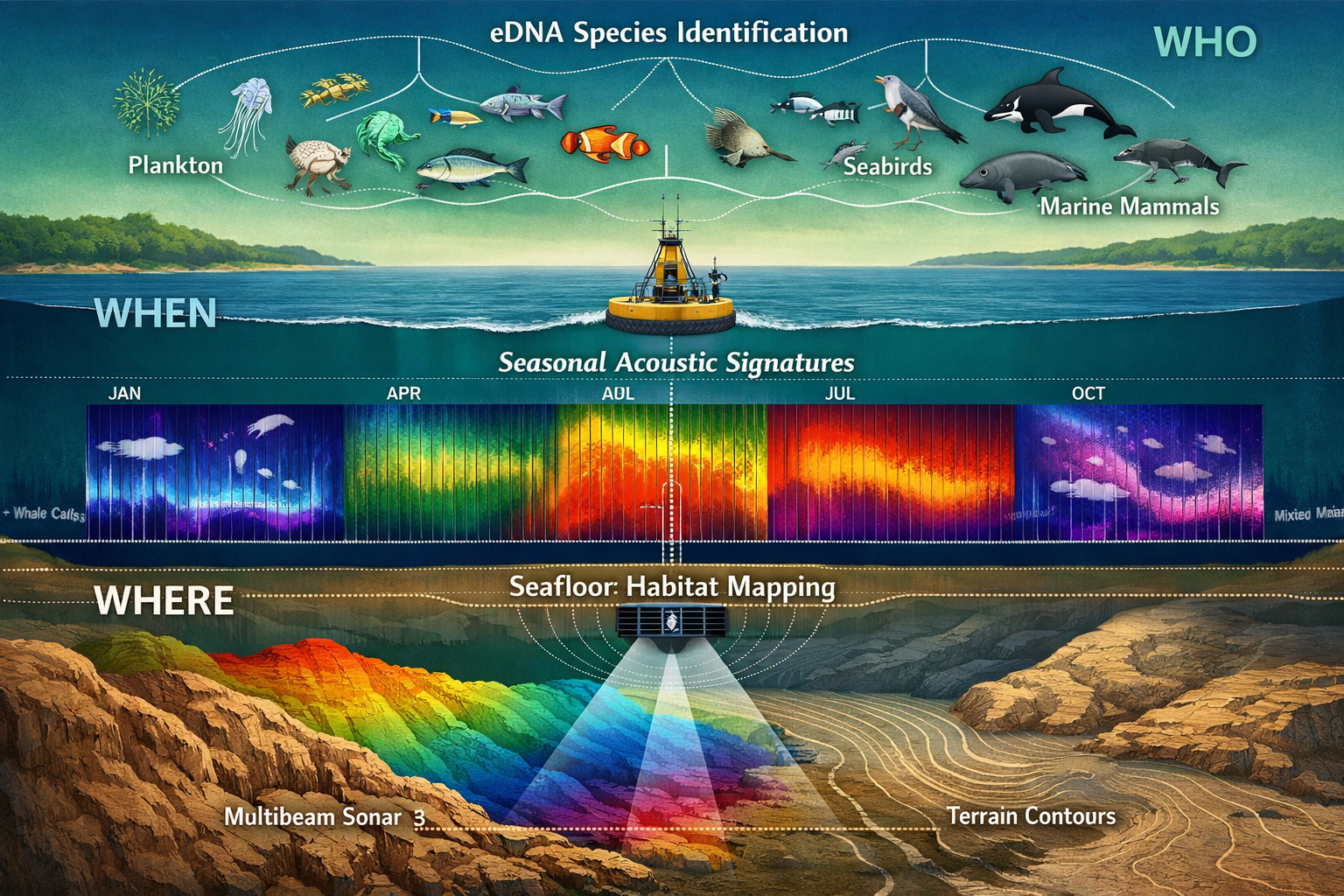
Holistic full-season approaches now address three complementary questions [1]:
- "Where?" → Traditional visual and geophysical surveys mapping habitat structure and spatial distribution
- "When?" → Bioacoustics revealing seasonal and behavioral patterns across time
- "Who?" → eDNA identifying comprehensive species assemblages including cryptic taxa
Combined approaches—such as those delivered through integrated platforms—create long-term, high-quality datasets that provide more complete ecosystem behavior understanding [1]. For developers and planners creating biodiversity plans for projects, this integrated framework ensures baselines capture the full complexity of marine ecosystems.
Implementing Full-Season Protocols: Practical Considerations for 2026
Transitioning from snapshot surveys to full-season marine baselines requires practical adjustments to survey design, equipment deployment, data management, and analysis workflows. For surveyors, developers, and conservation planners working in 2026, several considerations guide effective implementation.
Survey Design and Equipment Selection
Planning phase considerations:
- Baseline duration: Minimum one full annual cycle (12 months), preferably 2-3 years for robust baseline establishment
- Deployment timing: Start monitoring before project activities to establish pre-impact conditions
- Equipment selection: Choose autonomous systems with sufficient battery life, data storage, and environmental protection for long-term deployment
- Maintenance schedules: Plan regular servicing intervals that balance data recovery needs with deployment continuity
- Spatial coverage: Deploy multiple monitoring stations to capture spatial variation and habitat-specific patterns
Technology combinations for different contexts:
| Project Type | Recommended Technologies | Deployment Duration |
|---|---|---|
| Offshore wind development | Acoustic recorders + eDNA + visual surveys | 24+ months pre-construction |
| Coastal restoration | eDNA + benthic sampling + acoustic monitoring | 12 months baseline + ongoing |
| Marine protected area | Acoustic arrays + eDNA + citizen science visual surveys | Continuous long-term |
| Port expansion | Acoustic recorders + water quality sensors + eDNA | 18+ months pre-construction |
Data Management and Analysis Workflows
Full-season monitoring generates substantially larger datasets than traditional snapshot surveys, requiring robust data management systems:
Data volume considerations:
- Acoustic recorders: 10-50 GB per month per recorder
- eDNA samples: 5-10 GB per sample after sequencing
- Video surveys: 100+ GB per survey day
- Environmental sensors: 1-5 GB per month per sensor
Analysis requirements:
- Automated species identification algorithms for acoustic data
- Bioinformatics pipelines for eDNA sequence analysis
- Statistical methods for temporal trend detection
- Data visualization tools for communicating seasonal patterns
Cost-Benefit Analysis
While full-season monitoring requires higher upfront investment than single-visit surveys, the benefits often justify costs:
Cost factors:
- Equipment purchase or rental
- Deployment and recovery logistics
- Data storage and processing
- Specialized analysis expertise
- Extended project timelines
Benefit factors:
- Reduced risk of false trend conclusions
- Stronger regulatory compliance documentation
- Better-informed conservation decisions
- Improved biodiversity net gain demonstration
- Enhanced stakeholder confidence in results
For many projects, particularly those with significant environmental risk or regulatory scrutiny, the cost of inadequate baseline data—leading to project delays, mitigation failures, or legal challenges—far exceeds the investment in comprehensive full-season monitoring.
Standardization and Protocol Development
The marine monitoring community in 2026 continues working toward standardized protocols that enable comparison across projects, regions, and time periods. Key standardization needs include [4]:
- Sampling frequency guidelines: How often should eDNA samples be collected across seasons?
- Acoustic analysis standards: Which detection algorithms and metrics enable cross-study comparison?
- Taxonomic reference libraries: Comprehensive genetic databases for eDNA species identification
- Quality assurance protocols: Standards for equipment calibration, data validation, and uncertainty quantification
Organizations working on biodiversity credits and units particularly benefit from standardized approaches that enable credible baseline-to-outcome comparisons across different habitat types and geographic regions.
2026 as a Pivotal Year: Ocean Decade Midpoint and Global Baseline Assessment
The year 2026 holds special significance for marine biodiversity monitoring as the midpoint of the UN Ocean Decade (2021-2030). This global initiative aims to catalyze transformative ocean science and generate the knowledge needed for sustainable ocean management.
World Conference on Marine Biodiversity 2026
The 7th World Conference on Marine Biodiversity will convene November 17-20, 2026 in Bruges, Belgium under the theme "The marine biodiversity insights we need, for the ocean we want," serving as a UN Ocean Decade-endorsed event to assess progress halfway through the decade with scientists, policymakers, conservationists, and stakeholders [3].
Conference sessions emphasize that understanding biodiversity baselines and tracking long-term trends is essential for guiding conservation, fisheries management, and climate adaptation strategies, with particular focus on establishing historical baselines for key species and habitats across spatial and temporal scales [4].
Addressing Critical Knowledge Gaps
The 2026 midpoint assessment highlights several persistent challenges:
Seagrass monitoring integration: Current protocols are expanding to integrate genetic diversity and remote sensing technologies with ecological field assessments, moving beyond traditional cover, biomass, and shoot density measures to establish standardized biodiversity baselines for faunal communities that current assessments often lack due to regional and temporal inconsistencies [4].
Climate-driven shifts: Arctic and temperate ecosystems show strong signs of poleward migration across plankton, seaweed, fish, and marine mammals, with documented phenology shifts in developmental cycles, blooming events, and grazing interactions. Establishing full-season baselines becomes critical for distinguishing climate-driven range shifts from natural variation.
Data accessibility: Making baseline datasets openly accessible to researchers, managers, and policymakers remains a challenge despite technological advances in data collection.
Implications for UK Biodiversity Net Gain
For UK-based developers and planners, the global emphasis on robust baseline establishment aligns with domestic Biodiversity Net Gain requirements. While BNG regulations primarily focus on terrestrial and freshwater habitats, marine and coastal projects increasingly face scrutiny regarding their biodiversity impacts.
Full-season marine baselines provide the evidence base necessary to:
- Demonstrate genuine biodiversity improvements rather than seasonal fluctuations
- Support off-site or on-site delivery decisions with robust impact quantification
- Enable credible biodiversity unit transactions backed by verified baseline data
- Address planner questions about BNG implementation with comprehensive monitoring evidence
Challenges and Solutions in Full-Season Marine Baseline Implementation
Despite clear benefits, implementing full-season marine baselines faces practical challenges that require thoughtful solutions.
Challenge 1: Equipment Reliability and Biofouling
Problem: Marine environments are harsh. Equipment faces corrosion, biofouling (organisms growing on sensors), and physical damage from storms or marine life.
Solutions:
- Anti-fouling coatings and copper guards on sensors
- Protective housings rated for extended deployment
- Redundant equipment deployment
- Regular maintenance schedules with backup equipment
- Robust mooring designs that withstand extreme conditions
Challenge 2: Data Analysis Expertise
Problem: Acoustic and eDNA data require specialized analysis skills that many traditional survey teams lack.
Solutions:
- Partnerships with specialized laboratories and consultancies
- Training programs for survey staff in emerging technologies
- Automated analysis tools with user-friendly interfaces
- Collaborative analysis platforms that connect field teams with experts
- Standardized analysis protocols that reduce expertise barriers
Challenge 3: Regulatory Recognition
Problem: Some regulatory frameworks still emphasize traditional survey methods and may not fully recognize acoustic or eDNA data.
Solutions:
- Pilot projects demonstrating integrated approach value
- Engagement with regulators during protocol development
- Publication of method validation studies
- Integration of traditional methods alongside emerging technologies
- Clear communication of how new data types answer regulatory questions
Challenge 4: Cost and Timeline Constraints
Problem: Development projects often face tight timelines and budgets that seem incompatible with year-round monitoring.
Solutions:
- Early planning that incorporates monitoring into project schedules
- Phased approaches that begin with rapid assessment followed by targeted full-season monitoring
- Leveraging existing regional monitoring data where available
- Cost-sharing across multiple projects in the same region
- Demonstrating long-term cost savings from reduced uncertainty
Future Directions: Beyond 2026
The evolution toward full-season marine baselines continues beyond 2026, with several emerging trends shaping the next phase of biodiversity monitoring:
Artificial Intelligence and Machine Learning
AI-powered species identification increasingly automates analysis of acoustic recordings, video surveys, and eDNA sequences, reducing analysis time and costs while improving accuracy and consistency.
Citizen Science Integration
Community-based monitoring programs engage coastal residents, recreational users, and indigenous communities in data collection, expanding spatial and temporal coverage while building conservation awareness.
Real-Time Monitoring Networks
Connected sensor networks transmit data in real-time, enabling adaptive management responses to detected changes and providing early warning of ecosystem disturbances.
Climate Adaptation Monitoring
Long-term baseline datasets established through full-season monitoring provide the foundation for detecting climate-driven ecosystem shifts and evaluating adaptation strategy effectiveness.
Cross-Sector Data Sharing
Collaborative platforms enable sharing of baseline data across research institutions, government agencies, conservation organizations, and private sector projects, maximizing return on monitoring investments.
Conclusion
Full-Season Marine Baselines: Optimizing 2026 Biodiversity Surveys Beyond Snapshots for Accurate Trends represents more than a technical evolution—it reflects a fundamental shift in how the conservation community understands and values marine ecosystems. By capturing the complete annual cycle of biodiversity patterns rather than frozen moments in time, full-season approaches reveal the true dynamics of ecosystem health and enable confident detection of genuine trends versus seasonal variation.
For surveyors, the transition from one-off assessments to continuous monitoring protocols requires investment in new technologies, data management systems, and analytical expertise. Yet this investment delivers substantial returns: more accurate trend detection, stronger regulatory compliance, reduced project risk, and better-informed conservation decisions.
For developers and planners working to demonstrate biodiversity net gain and minimize environmental impacts, full-season baselines provide the robust evidence foundation that regulators, stakeholders, and communities increasingly expect. The integration of bioacoustics, eDNA, and traditional survey methods creates comprehensive datasets that answer where, when, and who questions about marine biodiversity.
As 2026 marks the midpoint of the UN Ocean Decade, the global marine community is assessing progress toward transformative ocean knowledge. The shift toward full-season baselines represents tangible progress—moving from asking "what's there?" to understanding "how does it function?" across the seasonal pulses that define marine ecosystem health.
Actionable Next Steps
For survey practitioners:
- ✅ Evaluate current survey protocols for seasonal coverage gaps
- ✅ Investigate integrated technology options (acoustic recorders, eDNA sampling)
- ✅ Develop partnerships with specialized analysis laboratories
- ✅ Pilot full-season approaches on upcoming projects
- ✅ Engage with standardization efforts in your region
For developers and planners:
- ✅ Incorporate full-season baseline requirements into early project planning
- ✅ Budget for 12-24 month baseline establishment periods
- ✅ Engage biodiversity surveyors with integrated monitoring expertise
- ✅ Consider how seasonal baseline data strengthens biodiversity impact assessments
- ✅ Explore opportunities for regional monitoring collaboration
For conservation managers:
- ✅ Transition from snapshot assessments to continuous monitoring programs
- ✅ Establish multi-year baseline datasets for priority habitats
- ✅ Integrate citizen science with professional monitoring
- ✅ Make baseline data accessible to researchers and managers
- ✅ Use seasonal patterns to optimize intervention timing
The ocean's seasonal pulses will continue whether we measure them or not. The question for 2026 and beyond is whether biodiversity surveys will capture these rhythms accurately enough to guide the conservation decisions our marine ecosystems desperately need. Full-season baselines provide the answer—transforming snapshots into comprehensive portraits of ecosystem health that reveal accurate trends and enable confident action.
References
[1] Holistic Biodiversity Monitoring Combining Bioacoustics And Edna To Deepen Our Understanding Of Marine Life – https://www.fugro.com/news/long-reads/2026/holistic-biodiversity-monitoring-combining-bioacoustics-and-edna-to-deepen-our-understanding-of-marine-life
[2] Why Monitor Biodiversity In 2026 – https://evolito.earth/stories/why-monitor-biodiversity-in-2026
[3] wcmb2026 – https://www.wcmb2026.org
[4] 2 Marine Biodiversity Its All About Baselines And Trends – https://www.wcmb2026.org/2-marine-biodiversity-its-all-about-baselines-and-trends