

Imagine standing in a threatened ecosystem, knowing that invasive species, habitat loss, and pollution are all pushing native wildlife toward local extinction. Which threat should conservation teams tackle first? In 2026, biodiversity surveyors face this complex question daily. What-If Threat Removal Scenarios: Bayesian Modeling for Biodiversity Surveyors in 2026 offers a powerful solution: using statistical models to simulate what would happen if specific threats were removed, helping ecologists prioritize interventions that deliver the fastest population recovery.
Recent research, including groundbreaking studies from Bristol and other institutions, demonstrates how Bayesian hierarchical models can predict species responses to threat reduction with quantifiable uncertainty. This approach transforms guesswork into evidence-based decision-making, equipping surveyors with tools to answer critical questions before investing limited conservation resources.
Key Takeaways
- 🎯 Bayesian models simulate threat removal scenarios to predict species population recovery before implementing costly interventions
- 📊 Multi-threat protocols reveal synergistic effects that single-threat assessments miss, leading to more effective conservation strategies
- 🔬 Hierarchical modeling incorporates uncertainty through credible intervals, helping surveyors communicate risk to stakeholders
- 🌱 Integration with Biodiversity Net Gain assessments strengthens planning applications and demonstrates measurable conservation outcomes
- ⚡ 2026 tools and training programs make advanced Bayesian methods accessible to field ecologists without extensive statistical backgrounds
Understanding What-If Threat Removal Scenarios in Biodiversity Surveys
The Foundation of Scenario-Based Modeling
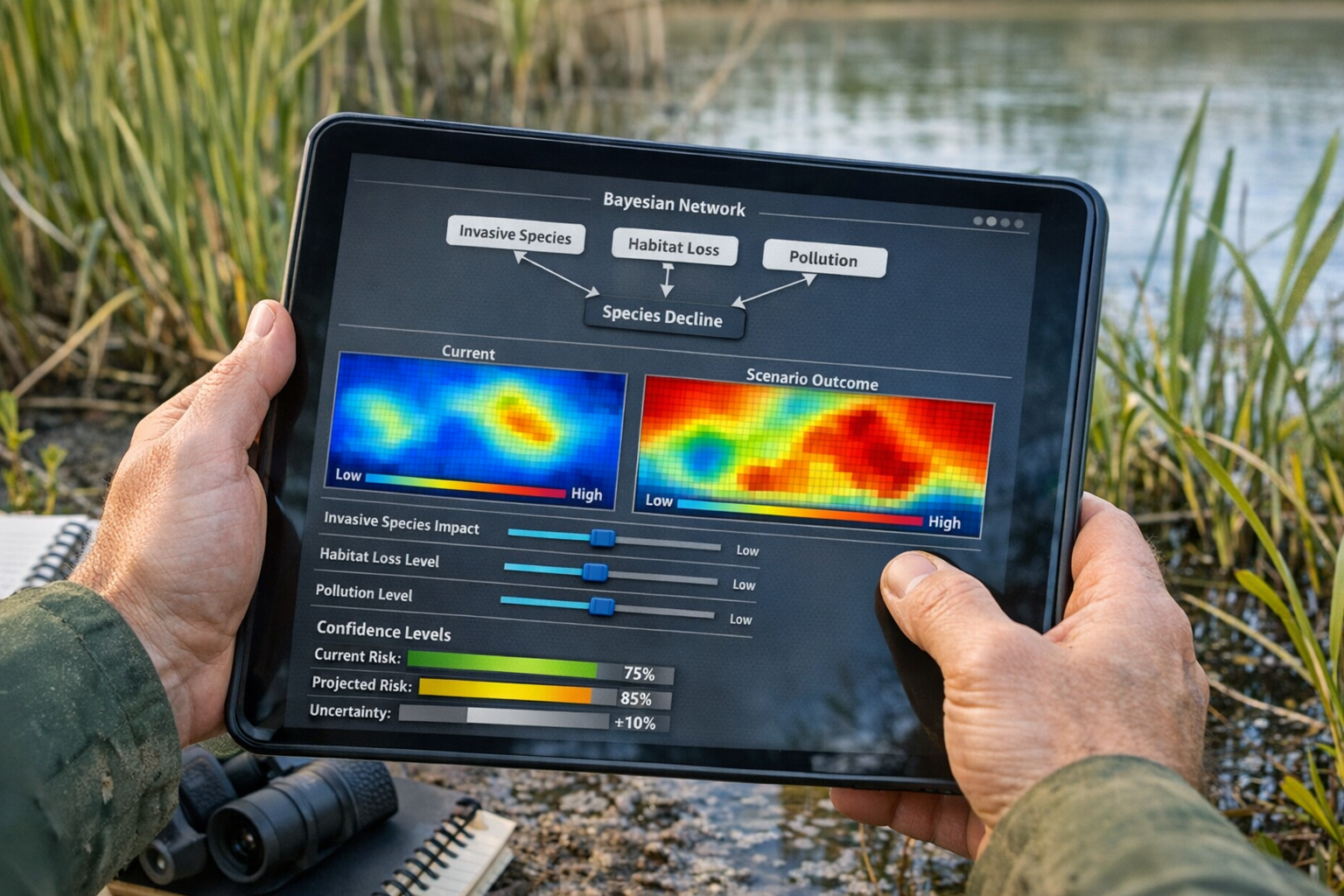
What-if threat removal scenarios represent a shift from reactive to proactive conservation planning. Instead of waiting to see what happens after removing a threat, Bayesian modeling allows surveyors to simulate outcomes beforehand. This statistical framework combines prior knowledge (from literature, expert opinion, or historical data) with current field observations to generate probability distributions of future states.
For biodiversity surveyors conducting Biodiversity Net Gain assessments, this approach provides quantitative evidence to support habitat management decisions. The model outputs show not just a single predicted outcome, but a range of possible futures with associated probabilities—critical information when presenting conservation strategies to developers and planning authorities.
Why Bayesian Methods Excel for Threat Assessment
Traditional statistical approaches often struggle with the small sample sizes and complex ecological interactions typical of biodiversity surveys. Bayesian methods overcome these limitations by:
- Incorporating prior information: Previous studies on similar species or habitats inform current predictions
- Handling uncertainty explicitly: Models produce credible intervals showing the range of plausible outcomes
- Updating predictions: As new survey data arrives, models refine their estimates without starting from scratch
- Modeling hierarchical structures: Species nested within habitats, habitats within landscapes—all captured in one framework
Research in species distribution modeling demonstrates how Bayesian hierarchical models can predict species abundance under different environmental conditions [3]. These same principles apply directly to threat removal scenarios, where environmental conditions change as threats are eliminated.
Key Threats Addressed in 2026 Modeling Frameworks
Biodiversity surveyors typically encounter multiple simultaneous threats:
| Threat Category | Examples | Modeling Considerations |
|---|---|---|
| Invasive Species | Non-native predators, competitive plants | Population dynamics, dispersal rates |
| Habitat Loss | Development, agriculture expansion | Spatial configuration, edge effects |
| Pollution | Nutrient runoff, pesticides | Dose-response relationships, bioaccumulation |
| Climate Change | Temperature shifts, precipitation changes | Long-term trends, extreme events |
| Direct Exploitation | Overharvesting, poaching | Harvest rates, enforcement effectiveness |
The power of what-if scenarios lies in testing single-threat removal versus multi-threat removal strategies. Often, removing one threat produces minimal recovery because other threats remain limiting factors. Bayesian models reveal these interactions, showing which threat combinations must be addressed together for meaningful biodiversity gains.
Implementing Bayesian Modeling for What-If Threat Removal Scenarios in 2026
Step-by-Step Workflow for Biodiversity Surveyors
Implementing what-if threat removal scenarios follows a structured process that integrates field survey data with statistical modeling:
1. Define the Conservation Question
Start with a specific, testable question: "If we remove invasive predators from this wetland, will native amphibian populations recover to pre-decline levels within five years?" Clear questions guide data collection and model structure.
2. Collect Baseline Survey Data
Standard biodiversity survey protocols provide the foundation. This includes:
- Species occurrence and abundance data
- Habitat quality measurements
- Threat intensity assessments (e.g., invasive species density, pollution levels)
- Environmental covariates (temperature, moisture, vegetation structure)
For projects requiring Biodiversity Net Gain compliance, this data collection aligns with existing assessment requirements, making Bayesian modeling an extension rather than a separate process.
3. Specify Prior Distributions
Prior distributions encode existing knowledge about parameters. For a threat removal scenario, priors might include:
- Expected population growth rates from literature on similar species
- Dispersal distances from telemetry studies
- Survival rates under different threat levels
Surveyors without extensive statistical training can work with collaborators or use standardized priors from published studies. The Ecological Forecasting Initiative offers training through their Statistical Methods Seminar Series, featuring sessions on species occurrence modeling using Bayesian approaches [1].
4. Build the Hierarchical Model
Bayesian hierarchical models typically include multiple levels:
- Observation model: How survey data relates to true species abundance (accounting for detection probability)
- Process model: How populations change over time under different threat scenarios
- Parameter model: How parameters vary across space or species groups
Software tools in 2026 have made this more accessible. The R package ecosystem, including tools highlighted in professional training programs, provides templates for common biodiversity modeling scenarios.
5. Run Simulations for Different Threat Removal Scenarios
With the model specified, run simulations comparing:
- Baseline: No intervention, current threat levels persist
- Single-threat removal: Each threat removed individually
- Multi-threat removal: Various combinations of threats removed
- Partial reduction: Threats reduced but not eliminated (more realistic for some threats like climate change)
Each scenario produces a posterior distribution of outcomes—essentially, a probability distribution showing how likely different population trajectories are.
6. Interpret Results and Communicate Uncertainty
Model outputs include:
- Median predictions: The most likely outcome
- Credible intervals: The range containing 95% of probable outcomes
- Probability of success: The chance of meeting specific conservation targets
This uncertainty quantification is crucial when presenting findings to stakeholders involved in achieving Biodiversity Net Gain without risk.

Tools and Software for 2026 Biodiversity Surveyors
The technical barrier to Bayesian modeling has decreased substantially by 2026. Key resources include:
Software Platforms:
- R with Stan/JAGS: Industry-standard for custom models, with extensive documentation
- Unmarked package: Specialized for occupancy and abundance modeling from survey data [1]
- NIMBLE: Flexible framework combining R with compiled code for faster computation
- Cloud-based platforms: Services offering pre-built biodiversity models with user-friendly interfaces
Training Opportunities:
- Columbia University's Bayesian Modeling for Environmental Health Workshop (August 5-7, 2026) covers hierarchical modeling, spatial-temporal modeling, and exposure-response functions—all applicable to threat assessment [2]
- Online courses focusing specifically on ecological applications
- Professional development through conservation organizations
Data Integration:
- Compatibility with standard biodiversity databases
- Integration with GIS platforms for spatial modeling
- Connections to climate data repositories for long-term projections
Case Study: Multi-Threat Protocol for Faster Population Recovery
Consider a grassland ecosystem where biodiversity surveyors documented declining populations of ground-nesting birds. Initial assessments identified three major threats:
- Invasive grass species reducing nesting habitat quality
- Increased predation from subsidized predator populations near human development
- Pesticide drift from adjacent agricultural land
A traditional approach might address threats sequentially, starting with the most obvious. However, a Bayesian what-if analysis revealed:
- Removing invasive grass alone: 15% probability of population recovery to target levels within 10 years
- Predator control alone: 22% probability of recovery
- Reducing pesticide exposure alone: 8% probability of recovery
- Removing grass + predator control: 68% probability of recovery
- All three threats addressed: 89% probability of recovery
The model showed synergistic effects—removing multiple threats together produced outcomes far better than the sum of individual interventions. This insight allowed conservation managers to prioritize a coordinated approach, securing funding for integrated management rather than piecemeal efforts.
The credible intervals also revealed important timing information. While the median prediction showed recovery within 10 years, the 95% credible interval extended to 15 years, helping managers set realistic expectations and plan for long-term monitoring.
Connecting What-If Scenarios to Biodiversity Net Gain and Conservation Planning
Integration with Statutory Requirements
In 2026, Biodiversity Net Gain (BNG) requirements create both challenges and opportunities for developers and landowners. What-if threat removal scenarios strengthen BNG strategies by:
Demonstrating Measurable Outcomes:
BNG assessments require demonstrating at least 10% net gain in biodiversity value. Bayesian models provide quantitative predictions of habitat improvement following threat removal, supporting how to achieve 10% Biodiversity Net Gain targets with evidence-based projections.
Supporting Off-Site Delivery:
When on-site BNG delivery is insufficient, developers may pursue off-site delivery options. What-if scenarios help evaluate potential off-site locations by modeling which threat removal interventions will produce the greatest biodiversity uplift, ensuring investments deliver promised gains.
Reducing Risk:
Planning authorities increasingly scrutinize BNG proposals for feasibility. Bayesian models with explicit uncertainty quantification show that proposed interventions have high probability of success, reducing the risk of failed habitat creation or enhancement projects.
Long-Term Management Planning:
BNG obligations typically extend 30 years. What-if scenarios project long-term trajectories under different management regimes, helping landowners and developers plan sustainable interventions that maintain biodiversity gains throughout the obligation period.
Prioritizing Survey Efforts
Biodiversity surveys are resource-intensive. What-if threat removal modeling helps prioritize where to focus survey effort by:
- Identifying data gaps: Models reveal which parameters have the largest influence on predictions but the weakest empirical support, guiding targeted data collection
- Adaptive monitoring: As early intervention results arrive, models update predictions, showing whether additional surveys are needed or resources can shift elsewhere
- Multi-species approaches: Hierarchical models can simultaneously assess multiple species, identifying which are most likely to benefit from specific threat removal scenarios
This efficiency is particularly valuable for projects navigating BNG for small development projects, where survey budgets are constrained.

Communicating Results to Stakeholders
Effective communication transforms complex Bayesian outputs into actionable insights:
Visual Presentations:
- Probability distributions shown as intuitive graphics
- Before-and-after scenario comparisons
- Maps showing spatial variation in predicted outcomes
- Timeline graphics illustrating recovery trajectories with uncertainty bands
Plain Language Summaries:
Translate statistical findings into clear statements: "There is an 85% chance that removing invasive species will increase butterfly abundance by at least 30% within five years, with continued improvement expected over the following decade."
Risk Communication:
Present credible intervals as risk assessments: "While the most likely outcome is full recovery, there remains a 10% chance that additional interventions may be needed if environmental conditions prove less favorable than expected."
Decision Support:
Frame results in terms of management choices: "Investing in predator control provides the best return on conservation investment, with 70% probability of meeting biodiversity targets compared to 40% for alternative strategies."
For developers working with biodiversity impact assessments, this clear communication helps justify proposed mitigation measures to planning authorities.
Advanced Applications and Future Directions
Spatial-Temporal Modeling for Landscape-Scale Planning
Advanced what-if scenarios incorporate spatial heterogeneity and temporal dynamics simultaneously. These models address questions like:
- How will threat removal in one location affect biodiversity in connected habitats?
- What is the optimal timing sequence for multi-site interventions?
- How do dispersal corridors influence recovery rates following threat removal?
Spatial-temporal Bayesian models, covered in specialized workshops [2], allow surveyors to optimize conservation strategies across entire landscapes, particularly relevant for creating biodiversity plans for large building projects.
Climate Change Integration
Climate change represents a non-removable threat that modifies how other threats impact biodiversity. Advanced what-if scenarios in 2026 incorporate climate projections to answer:
- Will threat removal strategies remain effective under future climate conditions?
- How do climate trends interact with removable threats like invasive species?
- What is the optimal timing for interventions given projected climate trajectories?
These climate-integrated models align with broader conservation goals discussed at international forums like COP27, linking site-level management to global biodiversity targets.
Machine Learning and AI Enhancement
Computer vision and AI technologies are increasingly integrated with Bayesian modeling workflows [1]. Applications include:
- Automated species identification from camera trap data, reducing data processing time
- Habitat quality assessment from drone imagery, providing high-resolution spatial data for models
- Real-time model updating as new survey data streams in from automated sensors
These technologies make continuous adaptive management feasible, where models constantly refine predictions as new information arrives.
Economic Valuation of Threat Removal Scenarios
Bayesian models can incorporate cost-benefit analysis by linking biodiversity outcomes to economic values:
- Cost of implementing different threat removal strategies
- Economic value of ecosystem services gained through biodiversity recovery
- Return on investment timelines for different intervention scenarios
This economic dimension is increasingly important for guidance to developers seeking to optimize conservation investments while meeting regulatory requirements.
Practical Considerations and Limitations
Data Requirements and Quality
Bayesian models require adequate data, though they handle small samples better than traditional methods. Key considerations:
- Minimum sample sizes: While flexible, models still need sufficient observations to estimate parameters reliably
- Data quality: Measurement error and detection probability must be accounted for
- Temporal coverage: Long-term datasets improve predictions, but models can work with shorter time series by borrowing strength from prior information
Surveyors should balance model complexity with available data—overly complex models with insufficient data produce unreliable predictions.
Model Validation and Uncertainty
Cross-validation techniques test model performance by:
- Holding out portions of data to test predictions
- Comparing predictions to independent datasets
- Checking whether credible intervals contain appropriate proportions of observations
Sensitivity analysis examines how results change when assumptions vary, identifying which model components most influence conclusions.
Honest communication about uncertainty builds trust. When models indicate high uncertainty, this itself is valuable information—it may justify additional survey effort before committing to expensive interventions.
Computational Demands
While more accessible in 2026, Bayesian modeling still requires:
- Computing power: Complex hierarchical models may take hours or days to run
- Statistical expertise: Interpreting diagnostics and troubleshooting convergence issues requires training
- Software proficiency: Learning R, Stan, or similar platforms involves a learning curve
Collaborations between field ecologists and quantitative specialists often produce the best outcomes, combining ecological knowledge with statistical rigor.
Ethical and Regulatory Considerations
What-if scenarios inform decisions but don't make them. Ethical considerations include:
- Precautionary principle: When models show high uncertainty, conservative management approaches may be warranted
- Stakeholder engagement: Local communities and indigenous knowledge should inform model assumptions and interpretation
- Transparency: Model code, data, and assumptions should be documented and available for review
- Regulatory compliance: Ensure modeling approaches align with requirements for Biodiversity Net Gain reports
Conclusion
What-If Threat Removal Scenarios: Bayesian Modeling for Biodiversity Surveyors in 2026 represents a transformative approach to conservation decision-making. By simulating the outcomes of threat removal before implementing interventions, biodiversity surveyors can prioritize actions that deliver the greatest benefit for species and habitats. The integration of Bayesian hierarchical models with standard survey protocols provides quantitative, uncertainty-aware predictions that strengthen Biodiversity Net Gain assessments, support planning applications, and optimize limited conservation resources.
The Bristol study and similar research demonstrate that multi-threat protocols reveal synergistic effects often missed by single-threat assessments, leading to faster population recovery when threats are addressed in combination rather than isolation. As training programs and software tools make these methods increasingly accessible, biodiversity surveyors in 2026 have unprecedented capacity to transform field observations into actionable conservation strategies.
Next Steps for Biodiversity Surveyors
Getting Started:
- Assess current data: Review existing survey datasets to determine if sufficient information exists for initial modeling attempts
- Seek training: Enroll in workshops like Columbia University's Bayesian Modeling program or the Ecological Forecasting Initiative's seminar series
- Start simple: Begin with basic occupancy or abundance models before progressing to complex threat removal scenarios
- Collaborate: Partner with quantitative ecologists or statistical consultants for initial projects
- Document thoroughly: Maintain clear records of model assumptions, data sources, and decision-making processes
For Developers and Landowners:
- Engage biodiversity surveyors early in project planning to integrate what-if scenario modeling into Biodiversity Net Gain strategies
- Request uncertainty quantification in habitat management proposals to understand risks
- Consider long-term monitoring programs that allow adaptive management as model predictions are tested against reality
For Conservation Organizations:
- Invest in staff training on Bayesian methods to build internal capacity
- Develop standardized modeling protocols for common conservation scenarios
- Share model code and data to build collective knowledge across the conservation community
The future of biodiversity conservation lies in evidence-based decision-making that acknowledges uncertainty while providing clear guidance for action. What-if threat removal scenarios using Bayesian modeling equip surveyors with the tools to meet this challenge, ensuring that every conservation intervention is informed by the best available science and has the highest probability of success.
References
[1] Statistical Methods Seminar Series – https://ecoforecast.org/workshops/statistical-methods-seminar-series/
[2] Bayesian Modeling – https://www.publichealth.columbia.edu/academics/non-degree-special-programs/professional-non-degree-programs/skills-health-research-professionals-sharp-training/trainings/bayesian-modeling
[3] 80c36588 5223 4ca3 83ba 23cb4e245dfb – https://vtechworks.lib.vt.edu/items/80c36588-5223-4ca3-83ba-23cb4e245dfb