

The corporate world is experiencing a seismic shift in how businesses measure and manage their relationship with nature. As 2026 unfolds, Corporate Sustainability Trends in Biodiversity Net Gain: Surveyor Action Plans for 2026 Reporting have moved from aspirational targets to mandatory action. Surveyors and ecologists now find themselves at the frontline of this transformation, translating complex sustainability commitments into measurable field data that satisfies both regulatory requirements and investor expectations.
With the introduction of ISO 17298:2025—the first global standard for biodiversity impact assessment—and the alignment of the Taskforce on Nature-related Financial Disclosures (TNFD) with the International Sustainability Standards Board (ISSB), the technical requirements for biodiversity reporting have crystallized [3]. For ecological professionals, this means adapting survey methodologies to capture metrics that align with international frameworks while delivering the granular data corporations need for credible nature-positive claims.
Key Takeaways
🌿 Regulatory convergence: TNFD, ISSB, and ISO 17298:2025 standards now provide unified frameworks for biodiversity measurement, requiring surveyors to adapt field protocols accordingly.
📊 Metrics expansion: Corporate commitments now span multiple nature dimensions beyond carbon, with nutrients and NOx commitments jumping from 21% to 48% among Fortune Global 500 companies [1].
✅ Action-oriented planning: Successful 2026 reporting demands comprehensive surveyor action plans that connect baseline assessments to long-term monitoring and verification protocols.
🔍 Investor scrutiny: Biodiversity loss is now treated as systemic financial risk, elevating the importance of robust, auditable field data in corporate sustainability disclosures [4].
💼 Strategic value: Buildings and developments with strong biodiversity credentials achieve 7-12% rent premiums, making quality ecological surveys a direct value driver [5].
Understanding Corporate Sustainability Trends in Biodiversity Net Gain for 2026
The Evolution of Corporate Nature Commitments
The landscape of corporate environmental responsibility has transformed dramatically. Fortune Global 500 companies with targets across three or more nature dimensions increased by two percentage points in 2025, signaling broader commitment despite minimal list turnover [1]. However, the gap between commitment and action remains significant—only 8% of companies globally assessed in the S&P Global Corporate Sustainability Assessment currently have biodiversity protection commitments [2].
This disparity creates both challenge and opportunity for ecological surveyors. As companies expand their nature-based commitments, the demand for credible baseline data and monitoring frameworks has never been higher. Understanding what you need for a Biodiversity Net Gain report is now essential knowledge for corporate sustainability teams.
Key Regulatory Drivers Shaping 2026 Reporting
Several regulatory developments are fundamentally reshaping how corporations approach biodiversity:
International Standards
- ISO 17298:2025: Provides standardized methodologies for biodiversity impact assessment, creating consistency across jurisdictions
- TNFD Framework: Now aligned with ISSB, offering sector-specific guidance for food and drink, pharmaceuticals, metals, mining, and oil and gas industries [3]
- EU Deforestation Regulation (EUDR): Driving forest-related commitments, which saw the largest increase since 2022 [1]
Financial Disclosure Requirements
- ISSB sustainability disclosure standards integrate nature-related risks into financial reporting
- Investors increasingly treat biodiversity as a strategic lever for risk management rather than compliance burden [4]
- Over half of global economic output depends on nature and ecosystem services, making biodiversity material to financial performance [3]
The "Nature Positive" Movement
Approximately 30% of Fortune Global 500 companies now include "nature positive" language and acknowledgments of alignment with the Global Biodiversity Framework in their reports—nearly double previous years [1]. This linguistic shift reflects substantive changes in corporate strategy, with businesses recognizing that biodiversity considerations must be integrated into development planning, supply chain management, and habitat restoration efforts.
For surveyors, this means field assessments must capture data that supports nature-positive claims with scientific rigor. The Biodiversity Net Gain explained framework provides the foundation for these measurements, requiring precise habitat condition assessments and long-term monitoring protocols.

Translating 2026 Trends into Surveyor Action Plans
From Corporate Targets to Field Metrics
The critical challenge for 2026 is translating high-level corporate commitments into actionable field survey protocols. This requires understanding how different sustainability frameworks map to specific biodiversity metrics:
| Corporate Framework | Required Surveyor Data | Field Protocol |
|---|---|---|
| TNFD Disclosure | Dependency and impact assessment | Habitat baseline survey with ecosystem service valuation |
| ISSB Standards | Material biodiversity risks | Site-specific threat analysis and vulnerability mapping |
| ISO 17298:2025 | Standardized impact metrics | Condition assessment using approved methodologies |
| BNG Requirements | 10% net gain demonstration | Pre- and post-development biodiversity unit calculations |
Understanding what is in a Biodiversity Net Gain assessment provides the technical foundation for delivering data that satisfies multiple frameworks simultaneously.
Essential Components of 2026 Surveyor Action Plans
Comprehensive surveyor action plans for 2026 reporting must address five critical phases:
1. Pre-Development Baseline Assessment
Objective: Establish credible baseline data aligned with international standards
Key Actions:
- Conduct habitat surveys using UK Habitat Classification or equivalent systems
- Calculate baseline biodiversity units using approved metric tools
- Document ecosystem services and dependencies
- Identify protected species and statutory designations
- Assess habitat distinctiveness and condition scores
Deliverables:
- Baseline biodiversity metric report
- Habitat maps with GIS layers
- Species inventory with conservation status
- Photographic evidence with GPS coordinates
- Preliminary impact assessment
2. ISSB and TNFD Alignment
Objective: Ensure field data supports financial disclosure requirements
Key Actions:
- Map biodiversity risks to business operations and supply chains
- Quantify dependencies on ecosystem services
- Assess transition risks from regulatory changes
- Evaluate physical risks from biodiversity loss
- Document governance structures for nature-related decisions
Deliverables:
- Nature-related risk register
- Dependency and impact matrices
- Scenario analysis for biodiversity loss
- Governance and strategy documentation
The 8 things planners need to know about Biodiversity Net Gain provides context for how these assessments integrate into development planning processes.
3. EU Regulation Compliance
Objective: Address EUDR and other European biodiversity requirements
Key Actions:
- Verify sourcing regions for forest-risk commodities
- Document supply chain biodiversity footprints
- Assess nutrient and NOx impacts (critical given 48% of companies now have commitments in this dimension) [1]
- Establish traceability systems for nature-impacting materials
- Implement due diligence protocols
Deliverables:
- Supply chain biodiversity risk assessment
- Commodity sourcing verification
- Nutrient impact calculations
- Due diligence documentation
4. On-site vs. Off-site Delivery Strategy
Objective: Optimize biodiversity net gain delivery approach
Key Actions:
- Evaluate on-site enhancement opportunities
- Assess off-site habitat banking options
- Calculate biodiversity unit requirements
- Develop 30-year management and monitoring plans
- Secure legal agreements for long-term delivery
Deliverables:
- Delivery strategy report
- Cost-benefit analysis of delivery options
- Management and monitoring schedules
- Legal agreement templates
Developers should review guidance on off-site or on-site delivery to make informed strategic decisions.
5. Long-term Monitoring and Verification
Objective: Demonstrate sustained biodiversity outcomes over time
Key Actions:
- Establish baseline monitoring protocols
- Define success criteria and trigger thresholds
- Schedule regular condition assessments
- Implement adaptive management responses
- Prepare annual verification reports
Deliverables:
- Monitoring protocol document
- Annual condition assessment reports
- Adaptive management records
- Verification statements for disclosure
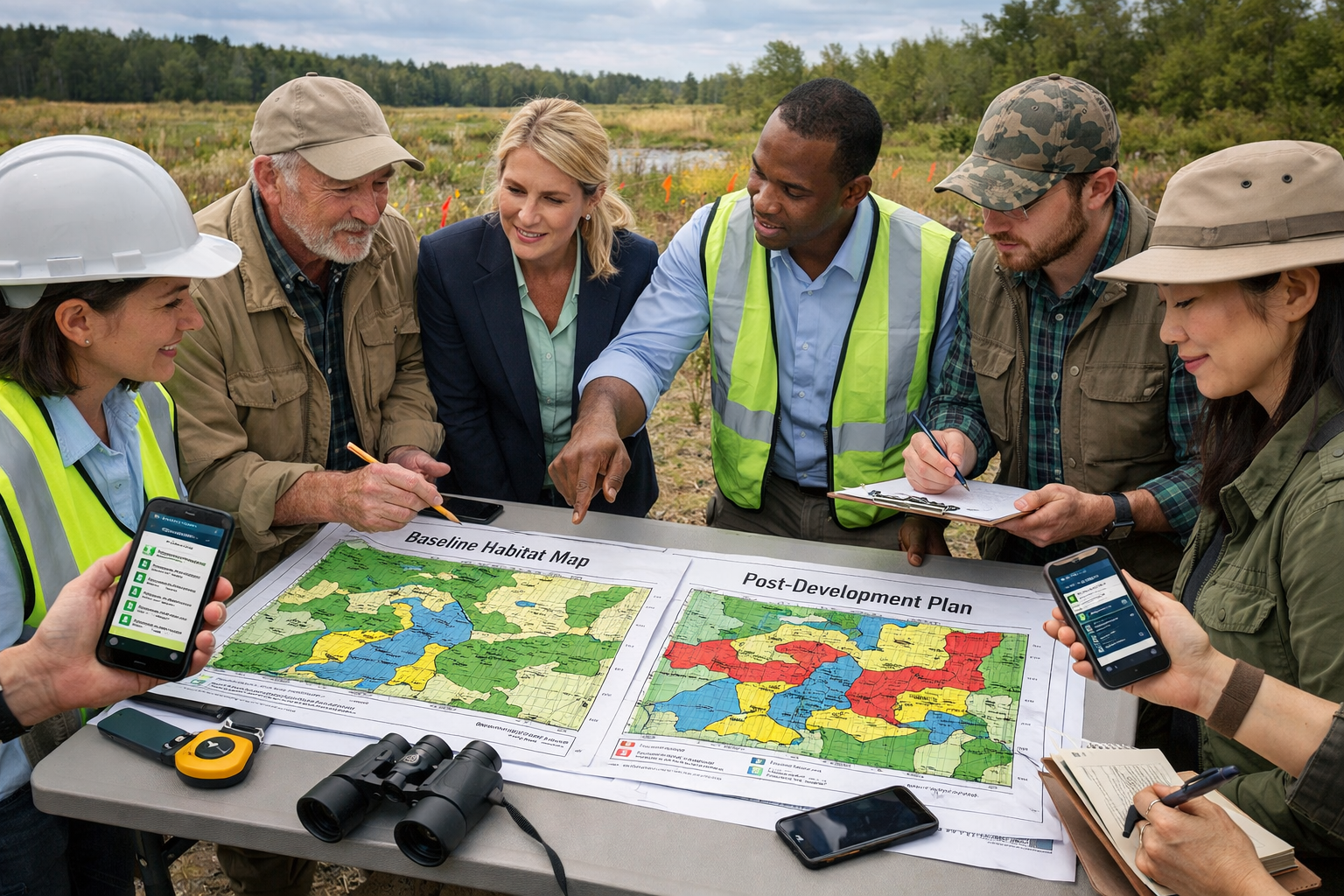
Practical Checklists for Ecologists Aligning with International Standards
ISSB Biodiversity Disclosure Checklist
✅ Governance
- Document board-level oversight of nature-related risks
- Define management responsibilities for biodiversity
- Establish integration with existing risk management systems
- Create stakeholder engagement protocols
✅ Strategy
- Identify material biodiversity risks and opportunities
- Conduct scenario analysis for nature loss
- Assess business model resilience to biodiversity decline
- Document dependencies on ecosystem services
- Quantify potential financial impacts
✅ Risk Management
- Integrate nature-related risks into enterprise risk framework
- Establish processes for identifying biodiversity threats
- Develop mitigation and adaptation strategies
- Implement monitoring and review procedures
✅ Metrics and Targets
- Select appropriate biodiversity metrics aligned with business impacts
- Set time-bound, measurable targets
- Report baseline and progress data
- Disclose methodology and assumptions
- Align with science-based targets where available
TNFD Field Survey Alignment Checklist
✅ LEAP Approach Implementation
- Locate interface with nature (identify sites, assets, and value chains)
- Evaluate dependencies and impacts (conduct field assessments)
- Assess material risks and opportunities (prioritize based on field data)
- Prepare response and reporting (develop action plans)
✅ Sector-Specific Requirements
- Apply relevant sector guidance (food/drink, pharmaceuticals, metals/mining, oil/gas)
- Address sector-specific impact pathways
- Use sector-appropriate metrics and indicators
- Benchmark against sector peers
✅ Data Quality Standards
- Ensure spatial precision (GPS coordinates for all survey locations)
- Document temporal aspects (survey timing, seasonality)
- Maintain data traceability and auditability
- Use qualified surveyors with appropriate credentials
- Implement quality assurance protocols
ISO 17298:2025 Compliance Checklist
✅ Assessment Scope Definition
- Define spatial boundaries (project footprint, buffer zones, wider landscape)
- Establish temporal scope (baseline, construction, operation phases)
- Identify biodiversity components to assess (habitats, species, ecosystems)
- Determine assessment scale and resolution
✅ Baseline Characterization
- Conduct comprehensive habitat surveys
- Assess habitat condition using standardized criteria
- Inventory protected and priority species
- Map ecosystem connectivity and corridors
- Document ecosystem services
✅ Impact Prediction
- Identify direct, indirect, and cumulative impacts
- Assess impact magnitude, extent, and duration
- Evaluate reversibility and likelihood
- Consider synergistic effects
- Apply precautionary principle where uncertainty exists
✅ Mitigation Hierarchy Application
- Prioritize avoidance measures
- Design minimization strategies
- Plan restoration activities
- Calculate residual impacts requiring offset
- Demonstrate net gain achievement
✅ Monitoring and Adaptive Management
- Design monitoring program aligned with impact predictions
- Establish baseline and target conditions
- Define monitoring frequency and methods
- Create adaptive management triggers
- Plan for long-term (30-year minimum) monitoring
For developers seeking to achieve 10% Biodiversity Net Gain, these checklists provide the technical framework for demonstrating compliance with multiple international standards simultaneously.
Emerging Trends Shaping Surveyor Practices in 2026
Technology Integration in Field Surveys
Modern biodiversity surveying increasingly leverages technology to improve data quality and efficiency:
Digital Data Capture
- Mobile apps for real-time habitat condition assessment
- GPS-enabled photography with automatic metadata tagging
- Cloud-based data synchronization for multi-site projects
- Integrated metric calculators for immediate biodiversity unit estimates
Remote Sensing and AI
- Drone surveys for habitat mapping and change detection
- Satellite imagery analysis for landscape-scale assessment
- Machine learning for species identification from acoustic or camera trap data
- Predictive modeling for impact forecasting
Blockchain for Verification
- Immutable records of baseline conditions
- Transparent tracking of biodiversity unit transactions
- Verification of long-term monitoring compliance
- Enhanced credibility for corporate disclosures
Supply Chain Biodiversity Footprinting
Organizations are increasingly expected to identify biodiversity risks linked to sourcing regions and commodities, transforming procurement into a strategic sustainability lever [3]. For surveyors, this creates opportunities to:
- Conduct biodiversity assessments of supplier operations
- Develop commodity-specific risk profiles
- Create traceability systems for nature-impacting materials
- Support due diligence for EUDR compliance
The Rise of Biodiversity Credits and Banking
The biodiversity credit market is maturing, with implications for surveyor practices:
- Standardized methodologies for credit quantification
- Third-party verification requirements
- Long-term monitoring obligations for credit sellers
- Integration with corporate offsetting strategies
Understanding the cost of biodiversity units and statutory credits helps surveyors advise clients on delivery strategy economics.
Financial Sector Engagement
Buildings with strong environmental and nature-aligned credentials achieve 7-12% rent premiums globally, while less sustainable assets face value erosion [5]. This creates direct financial incentives for robust biodiversity assessments that:
- Support green building certifications
- Demonstrate nature-positive credentials to tenants
- Reduce financing costs through sustainability-linked loans
- Enhance asset valuation and marketability
Financial institutions now treat biodiversity as a strategic lever for risk management and value creation [4], elevating the importance of credible, third-party verified ecological data.
Addressing Common Challenges in 2026 Reporting
Data Gaps and Uncertainty
Challenge: Baseline biodiversity data often incomplete or outdated
Solutions:
- Conduct phased surveys to fill knowledge gaps
- Use proxy indicators where direct measurement impractical
- Apply conservative assumptions and document uncertainty
- Implement adaptive management to address data limitations
- Leverage existing datasets (local records centers, national databases)
Multi-Framework Alignment
Challenge: Different reporting frameworks require different metrics and formats
Solutions:
- Design field surveys to capture data supporting multiple frameworks
- Use modular reporting templates adaptable to different standards
- Maintain comprehensive raw data repositories for flexible analysis
- Engage with framework developers to understand evolving requirements
- Consider integrated reporting approaches that address multiple standards
Long-term Monitoring Costs
Challenge: 30-year monitoring commitments create significant financial obligations
Solutions:
- Build monitoring costs into initial project budgets
- Explore technology solutions to reduce field visit frequency
- Develop risk-based monitoring approaches focusing on critical indicators
- Consider insurance products for long-term liability
- Establish endowments or escrow accounts for ongoing monitoring
Stakeholder Coordination
Challenge: Multiple parties involved in biodiversity net gain delivery
Solutions:
- Establish clear governance structures early in project lifecycle
- Define roles and responsibilities in legal agreements
- Create communication protocols for regular updates
- Develop shared data platforms for transparency
- Engage local communities and conservation organizations
For comprehensive guidance, developers can review how to create a biodiversity plan for building projects in England.
Strategic Recommendations for Surveyors
Invest in Professional Development
Stay current with evolving standards by:
- Pursuing certifications in TNFD and ISSB frameworks
- Attending training on ISO 17298:2025 methodologies
- Joining professional networks focused on nature-related financial disclosure
- Participating in pilot projects testing new assessment approaches
Build Multidisciplinary Capabilities
Effective 2026 reporting requires expertise beyond traditional ecology:
- Financial risk assessment skills
- Supply chain analysis capabilities
- Stakeholder engagement experience
- Data management and technology proficiency
- Regulatory compliance knowledge across jurisdictions
Develop Standardized Protocols
Create efficiency through standardization:
- Template survey methodologies aligned with multiple frameworks
- Quality assurance checklists for data collection
- Reporting templates adaptable to different disclosure requirements
- Client communication materials explaining technical concepts
- Pricing models reflecting full lifecycle costs
Foster Client Education
Help clients understand the strategic value of biodiversity:
- Demonstrate links between ecological data and financial performance
- Explain how quality assessments reduce regulatory and reputational risk
- Showcase case studies of developments achieving rent premiums
- Provide market intelligence on emerging requirements
- Position biodiversity as competitive advantage rather than compliance burden
Conclusion
Corporate Sustainability Trends in Biodiversity Net Gain: Surveyor Action Plans for 2026 Reporting represent a fundamental shift from aspirational environmental commitments to measurable, verifiable action. The convergence of TNFD, ISSB, and ISO 17298:2025 standards has created unprecedented clarity around biodiversity measurement requirements, while investor pressure and regulatory mandates ensure these frameworks translate into real-world implementation.
For ecological surveyors and environmental professionals, 2026 marks a pivotal moment. The technical expertise to conduct robust habitat assessments has always been valuable—but now it's essential for corporate financial disclosure, regulatory compliance, and competitive positioning. Organizations that recognize biodiversity loss as systemic financial risk are investing in quality baseline data, comprehensive monitoring programs, and credible verification systems.
The action plans outlined in this article provide a roadmap for translating corporate sustainability trends into practical field protocols. By aligning survey methodologies with international standards, implementing comprehensive checklists for ISSB and EU compliance, and leveraging emerging technologies, surveyors can deliver the granular, auditable data corporations need to substantiate their nature-positive claims.
Next Steps for Implementation
For Surveyors:
- Review and update field protocols to align with ISO 17298:2025 standards
- Develop TNFD and ISSB disclosure expertise through professional training
- Invest in digital tools for efficient data capture and reporting
- Build relationships with corporate sustainability teams and financial institutions
- Create standardized templates that address multiple frameworks simultaneously
For Corporations:
- Engage qualified ecological surveyors early in project planning
- Budget for comprehensive baseline assessments and long-term monitoring
- Integrate biodiversity metrics into financial risk management systems
- Establish governance structures for nature-related decision-making
- Set science-based targets aligned with the Global Biodiversity Framework
For Developers:
- Commission Biodiversity Net Gain assessments that support multiple disclosure frameworks
- Evaluate on-site versus off-site delivery strategies based on financial and ecological criteria
- Secure long-term monitoring arrangements with qualified professionals
- Position biodiversity credentials as value drivers in marketing and leasing
- Stay informed about evolving regulatory requirements across jurisdictions
The transition from targets to action in corporate biodiversity commitments creates unprecedented opportunities for ecological professionals who can bridge the gap between field science and financial disclosure. As nature-related risks become material to business performance, the demand for credible, standardized biodiversity data will only intensify. Those who develop comprehensive surveyor action plans aligned with 2026 reporting standards will be well-positioned to lead this transformation—delivering measurable nature-positive outcomes while supporting the financial transparency investors and regulators increasingly demand.
References
[1] Corporate Nature Commitments Have Expanded But Progress Is Uneven – https://www.mckinsey.com/capabilities/sustainability/our-insights/corporate-nature-commitments-have-expanded-but-progress-is-uneven
[2] 2026 Sustainability Trends – https://www.spglobal.com/sustainable1/en/insights/2026-sustainability-trends
[3] Major Sustainability Predictions And Outlook For 2026 – https://www.tunley-environmental.com/en/insights/major-sustainability-predictions-and-outlook-for-2026
[4] 2026 Corporate Sustainability Trends – https://eco-act.com/blog/2026-corporate-sustainability-trends/
[5] 2026 Sustainability Trends – https://verdani.com/sustainability-industry-insights/2026-sustainability-trends