

When a major UK developer discovered protected species on their £50 million construction site three months into the project, the resulting delays and mitigation costs exceeded £2.3 million—losses that could have been prevented with a £15,000 biodiversity survey conducted during the planning phase. This scenario plays out repeatedly across industries in 2026, as businesses discover too late that biodiversity loss represents a systemic economic threat that demands proactive assessment and quantification.
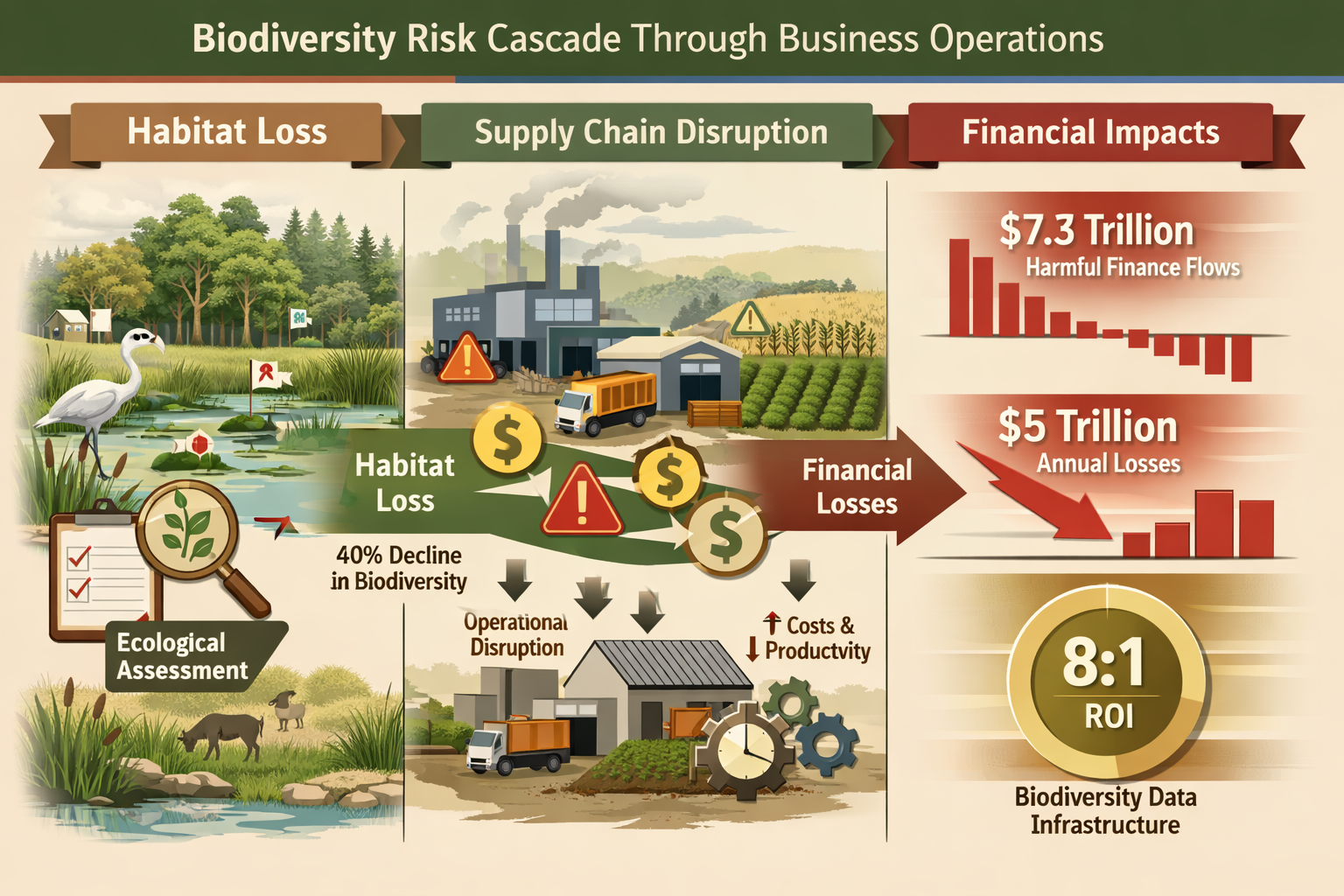
The Business Case for Biodiversity Surveys: Quantifying Economic Risks for 2026 Ecology Projects has never been more compelling. With recent global scientific assessments revealing that harmful finance flows into nature-damaging activities reached $7.3 trillion annually [1], and biodiversity loss generating over $5 trillion in global economic losses each year [3], the financial imperative for comprehensive ecological surveys has shifted from optional due diligence to essential risk management.
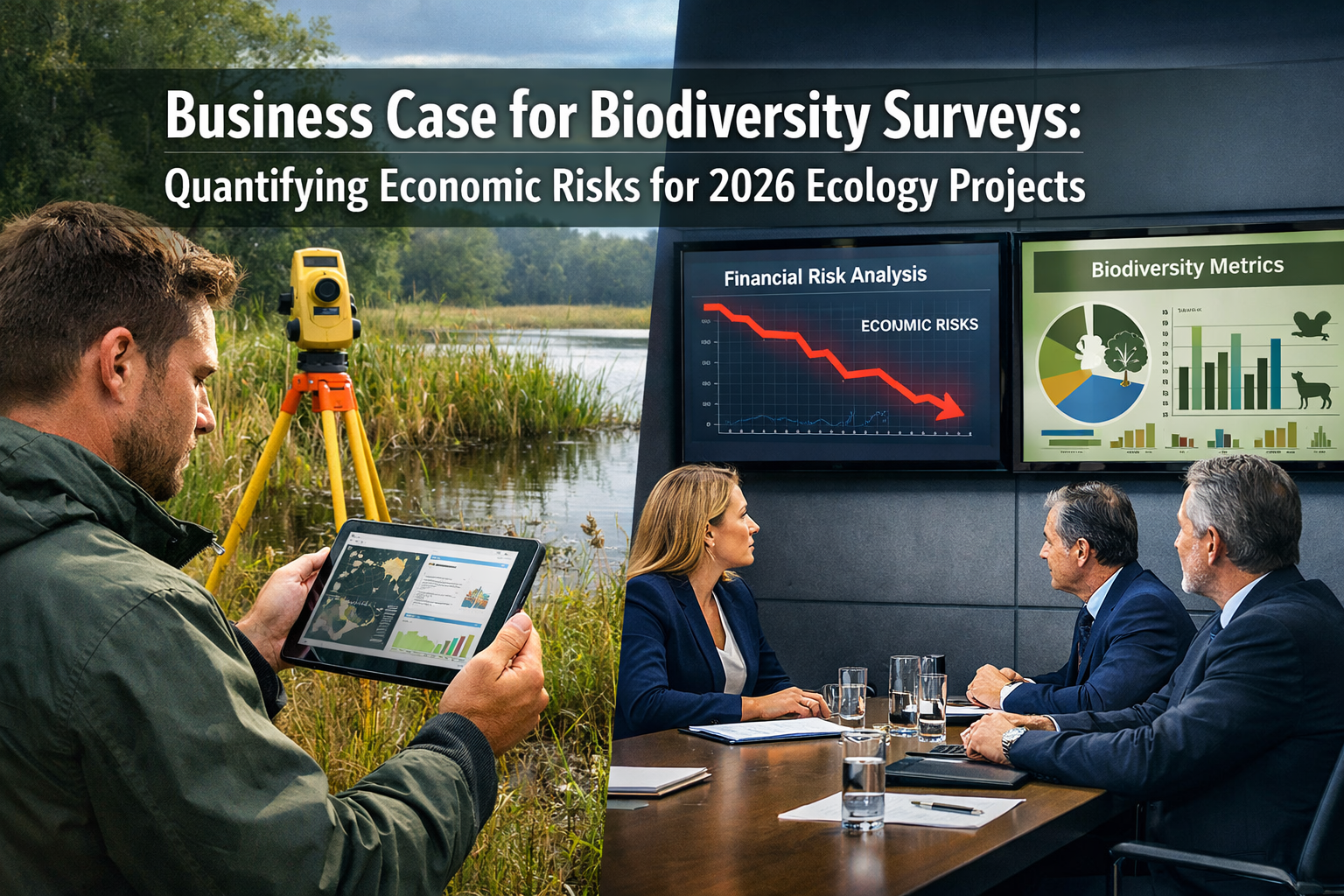
This article translates systemic biodiversity risks into practical, surveyor-led assessment strategies that help businesses link habitat loss to supply chain vulnerabilities, regulatory compliance costs, and Biodiversity Net Gain (BNG) investment returns. Understanding the Business Case for Biodiversity Surveys: Quantifying Economic Risks for 2026 Ecology Projects enables organizations to transform ecological data into actionable financial intelligence.
Key Takeaways
- 🌍 Biodiversity loss generates $5 trillion in annual global economic losses, making comprehensive surveys essential for risk quantification and mitigation strategies
- 📊 Biodiversity data infrastructure delivers an 8:1 benefit-cost ratio, demonstrating measurable returns on ecological survey investments for 2026 projects
- ⚖️ New regulatory frameworks including CSRD and TNFD are increasing disclosure requirements, making professional biodiversity assessments mandatory for compliance
- 🔗 Nearly all business activities affect biodiversity either directly or indirectly, establishing surveys as critical tools for identifying supply chain vulnerabilities
- 💰 Early-stage biodiversity surveys prevent costly project delays, with proactive assessments typically costing 1-2% of remediation expenses incurred after discovery
Understanding the Economic Scale of Biodiversity Risk in 2026
The $7.3 Trillion Problem: Harmful Finance Flows
The global economy currently channels an estimated $7.3 trillion annually into activities with direct negative impacts on nature [1], vastly outweighing conservation spending. This staggering figure, confirmed by the Intergovernmental Science-Policy Platform on Biodiversity and Ecosystem Services (IPBES) Business and Biodiversity Assessment adopted in February 2026, represents more than just environmental damage—it quantifies systemic economic risk embedded throughout business operations.
For developers, planners, and project managers working on 2026 ecology projects, this global context translates into tangible local risks:
- Supply chain disruptions when ecosystem services collapse
- Regulatory penalties for non-compliance with biodiversity protection laws
- Increased insurance premiums reflecting nature-related risks
- Project delays from unexpected protected species discoveries
- Reputational damage affecting investor confidence and consumer trust
Biodiversity Loss as a Top-Tier Global Threat
The World Economic Forum's 2026 Global Risks Report ranks biodiversity loss as the second-most severe long-term global threat, trailing only extreme weather events [4]. This ranking reflects growing recognition among business leaders and financial institutions that nature loss creates cascading economic consequences across sectors.
Over 150 governments have endorsed the IPBES assessment [2], signaling that nature loss is becoming a systemic risk for economies, supply chains, and financial stability. This governmental recognition translates into strengthening regulatory frameworks that directly impact how businesses must assess and disclose biodiversity impacts.
The $5 Trillion Annual Loss: Quantifying Business Impact
Research published in 2026 demonstrates that the biodiversity crisis generates global economic losses exceeding $5 trillion annually [3]. This figure encompasses:
- Lost ecosystem services (pollination, water purification, climate regulation)
- Productivity declines in agriculture, fisheries, and forestry
- Increased costs for resource extraction and processing
- Healthcare expenses from environmental degradation
- Disaster recovery costs from weakened natural buffers
For individual projects, these macro-level losses manifest as micro-level risks that biodiversity surveys help identify and quantify before they become financial liabilities.
The Business Case for Biodiversity Surveys: Quantifying Economic Risks for 2026 Ecology Projects Through Data
Mapping Business Activities to Biodiversity Impacts
The 2026 IPBES assessment reveals that nearly all business activities affect biodiversity either directly or indirectly [4], establishing biodiversity loss as a systemic business risk across industries. This comprehensive mapping demonstrates that no sector operates independently of natural systems.
Professional biodiversity surveys provide the essential data infrastructure to:
- Identify direct dependencies on ecosystem services
- Quantify indirect impacts through supply chains
- Assess vulnerability to biodiversity-related disruptions
- Establish baseline conditions for monitoring and reporting
- Calculate mitigation costs versus prevention investments
For developers creating biodiversity plans for building projects in England, these surveys transform abstract ecological concepts into concrete financial metrics that inform decision-making.
The Data Gap: Private Sector Contribution
Despite extensive data collection activities, private companies accounted for just 0.3% of global biodiversity datasets as of 2020, publishing only 7.8 million records to the Global Biodiversity Information Facility (GBIF) [3]. This represents a significant missed opportunity for both science and business strategy.
The data gap creates several business risks:
- Incomplete risk assessments based on insufficient baseline information
- Regulatory non-compliance from inadequate documentation
- Missed opportunities for nature-positive investments
- Competitive disadvantages compared to data-driven competitors
- Increased liability from undiscovered ecological constraints
Investing in professional biodiversity surveys addresses this gap while creating proprietary datasets that inform strategic planning and demonstrate regulatory compliance.
The 8:1 Return on Biodiversity Data Infrastructure
Research demonstrates that investments in biodiversity data infrastructure return an 8:1 benefit-cost ratio [3]. The Natural History Museum's £155.6 million digitisation programme is estimated to return £2 billion in economic value, illustrating the multiplier effect of quality biodiversity data.
For individual projects, this return manifests through:
| Investment Area | Cost Range | Potential Returns |
|---|---|---|
| Pre-development surveys | £5,000 – £50,000 | Avoid £100,000 – £2M+ in delays and remediation |
| Ongoing monitoring | £2,000 – £15,000/year | Early warning of compliance issues, preventing penalties |
| BNG assessments | £3,000 – £25,000 | Optimize unit allocation, reduce statutory credit costs |
| Habitat banking data | £10,000 – £100,000 | Demonstrate market value, attract investors |
These returns justify biodiversity surveys as strategic investments rather than regulatory expenses. When planning biodiversity net gain projects, early survey data enables cost-effective compliance strategies.
Regulatory Drivers Creating Economic Imperatives for Surveys
New Disclosure Requirements for 2026
Regulatory and voluntary frameworks are rapidly increasing expectations for biodiversity assessment and disclosure [4]:
- CSRD (Corporate Sustainability Reporting Directive): Mandates comprehensive biodiversity impact reporting for EU companies and large non-EU firms operating in Europe
- EU Taxonomy: Establishes technical screening criteria for biodiversity-related activities, requiring documented assessments
- TNFD (Taskforce on Nature-related Financial Disclosures): Provides framework for nature-related risk reporting, increasingly adopted by investors
- UK Biodiversity Net Gain requirements: Mandatory 10% BNG for most development projects, requiring professional assessments
These frameworks transform biodiversity surveys from optional investigations into mandatory compliance tools with direct financial consequences for non-compliance.
The Cost of Non-Compliance
Failing to conduct adequate biodiversity surveys exposes projects to escalating costs:
- Planning delays: 6-18 month extensions while ecological assessments are completed
- Mitigation requirements: Retrofitting biodiversity measures costs 3-5x more than integrated design
- Statutory biodiversity credits: Last-resort BNG compliance mechanism priced at premium rates
- Legal challenges: Judicial reviews from inadequate ecological assessments
- Reputational damage: Public opposition and investor concern over environmental practices
Understanding what's in a biodiversity net gain assessment helps project teams budget appropriately for comprehensive surveys that prevent these costly outcomes.
Colombia's Leadership: Lessons in Business Data Publishing
Colombia now leads globally in businesses publishing biodiversity data, with over 340 datasets and 3.6 million records uploaded [3]. This achievement demonstrates the strategic value of raising awareness through industry associations and establishing clear data-sharing protocols.
The Colombian model offers valuable lessons:
✅ Industry association engagement drives participation
✅ Standardized protocols reduce data collection costs
✅ Shared platforms maximize data utility
✅ Regulatory alignment creates compliance incentives
✅ Transparency builds stakeholder trust
UK businesses can adopt similar approaches, leveraging professional surveyors to generate high-quality datasets that serve multiple strategic purposes simultaneously.
Translating Survey Data into Investment Returns

Linking Habitat Loss to Supply Chain Vulnerabilities
Professional biodiversity surveys enable businesses to map habitat dependencies throughout supply chains, identifying vulnerabilities before they disrupt operations. This proactive approach quantifies risks that traditional financial analysis overlooks.
Key supply chain vulnerabilities revealed through biodiversity surveys:
- Agricultural inputs: 30% of cultivated lands lack biodiversity data [3], despite agriculture occupying over 50% of Earth's habitable surface
- Water resources: Ecosystem degradation affects water quality and availability
- Pollination services: Crop yields dependent on declining pollinator populations
- Raw material sourcing: Extraction activities in biodiverse regions face increasing restrictions
- Climate resilience: Degraded ecosystems provide reduced natural disaster protection
For developers achieving biodiversity net gain without risk, survey data identifies these dependencies early, enabling strategic mitigation planning.
BNG Investment Optimization Through Survey Data
Comprehensive biodiversity surveys optimize BNG compliance strategies by:
- Accurate baseline assessment: Prevents over-purchasing or under-purchasing biodiversity units
- On-site opportunity identification: Reveals cost-effective habitat creation possibilities
- Off-site unit selection: Informs strategic biodiversity unit purchasing decisions
- Temporal planning: Establishes realistic timelines for habitat establishment
- Risk mitigation: Identifies potential compliance obstacles before they become critical
The difference between strategic BNG planning based on quality survey data versus reactive compliance can represent 30-50% cost savings on total biodiversity obligations.
Habitat Banking and Nature Market Opportunities
For landowners and developers with suitable properties, biodiversity surveys unlock revenue opportunities through habitat banking. Professional assessments establish the baseline conditions necessary to sell biodiversity units in emerging nature markets.
Survey data enables:
- Market valuation: Quantify biodiversity unit potential
- Investment planning: Calculate habitat creation costs versus revenue
- Risk assessment: Identify management requirements and success probabilities
- Certification: Provide evidence for unit registration and verification
- Long-term monitoring: Demonstrate ongoing habitat quality for buyers
With understanding of biodiversity unit costs and statutory credits, survey data transforms ecological assets into financial instruments.
Surveyor-Led Assessment Tools for Risk Quantification
Standardized Assessment Methodologies
Professional biodiversity surveyors employ standardized methodologies that ensure data quality and regulatory acceptance:
- Phase 1 Habitat Surveys: Broad habitat classification and preliminary ecological value assessment
- Protected Species Surveys: Targeted investigations for bats, great crested newts, badgers, and other protected species
- Biodiversity Metric Calculations: Quantitative assessment using UK Biodiversity Metric 4.0
- Ecological Impact Assessments: Comprehensive analysis of project effects on biodiversity
- Mitigation Hierarchy Application: Systematic approach to avoiding, minimizing, and compensating impacts
These methodologies provide the defensible data foundation necessary for regulatory compliance and financial risk quantification.
Technology Integration for Enhanced Data Quality
Modern biodiversity surveys leverage technology to improve data quality and reduce costs:
- Remote sensing: Aerial imagery and LiDAR for habitat mapping
- Environmental DNA (eDNA): Species detection from water and soil samples
- Automated recording: Camera traps and acoustic monitors for wildlife documentation
- GIS integration: Spatial analysis linking biodiversity to project footprints
- Digital data management: Real-time field data capture and quality control
These technologies enable more comprehensive assessments at lower costs, improving the business case for proactive surveys.
Seasonal Considerations and Timeline Planning
Understanding survey seasonality prevents costly project delays:
| Survey Type | Optimal Season | Lead Time Required |
|---|---|---|
| Bat surveys | May – September | 6-8 months before planning submission |
| Great crested newt surveys | March – June, September – October | 6-12 months |
| Breeding bird surveys | March – July | 4-6 months |
| Botanical surveys | April – September | 3-6 months |
| Reptile surveys | April – September | 3-6 months |
Incorporating these timelines into project planning prevents the most common source of biodiversity-related delays. For small development projects, understanding seasonal constraints is particularly critical for maintaining tight schedules.
Sector-Specific Applications of Biodiversity Risk Quantification
Residential and Commercial Development
For property developers, biodiversity surveys quantify risks across the development lifecycle:
Pre-acquisition phase: Survey data informs land valuation by identifying ecological constraints that affect developable area and BNG obligations.
Planning phase: Comprehensive assessments support planning applications and demonstrate compliance with biodiversity impact assessment requirements.
Construction phase: Baseline data enables effective environmental management and demonstrates adherence to mitigation commitments.
Post-development phase: Monitoring data verifies BNG delivery and satisfies long-term management obligations.
Infrastructure and Energy Projects
Large-scale infrastructure projects face heightened biodiversity risks due to extensive footprints and long operational lifespans. Biodiversity surveys for these projects:
- Identify routing alternatives that minimize ecological impact
- Quantify compensation requirements for unavoidable losses
- Establish monitoring protocols for operational phase impacts
- Support stakeholder engagement with transparent data
- Demonstrate corporate sustainability commitments to investors
Agriculture and Land Management
Agricultural operations represent both the primary driver of biodiversity loss and the greatest opportunity for nature markets [3]. Biodiversity surveys enable farmers and land managers to:
- Access agri-environment schemes requiring baseline data
- Participate in habitat banking and biodiversity unit markets
- Demonstrate sustainable practices to supply chain partners
- Identify productivity improvements through ecosystem service enhancement
- Comply with evolving agricultural sustainability standards
Understanding Sustainable Farming Incentive requirements helps agricultural businesses leverage survey data for multiple funding streams.
Overcoming Barriers to Biodiversity Survey Investment
Addressing Cost Concerns
The perceived expense of biodiversity surveys represents the primary barrier to adoption. However, cost-benefit analysis consistently demonstrates positive returns:
Typical survey costs: £5,000 – £50,000 for comprehensive site assessments
Typical delay costs: £100,000 – £2,000,000+ for mid-project ecological discoveries
Risk-adjusted ROI: 10:1 to 100:1 depending on project scale and complexity
For budget-conscious projects, phased survey approaches prioritize critical assessments while deferring supplementary investigations until necessary.
Integrating Surveys into Existing Due Diligence
Biodiversity surveys integrate seamlessly with existing due diligence processes:
- Phase I Environmental Site Assessments: Add ecological components to contamination investigations
- Topographic surveys: Coordinate habitat mapping with boundary and elevation surveys
- Geotechnical investigations: Schedule ecological surveys during site access for soil testing
- Planning consultant engagement: Include ecologists in multidisciplinary design teams
This integration reduces mobilization costs and streamlines data collection.
Building Internal Capacity and Expertise
Organizations conducting multiple projects benefit from developing internal biodiversity expertise:
- Staff training: Ecological awareness for project managers and site supervisors
- Consultant relationships: Preferred provider agreements with qualified surveyors
- Data management systems: Centralized biodiversity data repositories
- Standard procedures: Templated survey specifications and assessment protocols
- Knowledge sharing: Internal case studies demonstrating survey value
These investments compound returns across project portfolios while reducing per-project assessment costs.
Future-Proofing 2026 Ecology Projects Through Strategic Surveys
Anticipating Regulatory Evolution
Biodiversity regulations continue strengthening globally. Strategic surveys position projects ahead of regulatory curves by:
- Establishing baseline data before requirements tighten
- Demonstrating proactive environmental stewardship
- Creating flexibility for design modifications
- Building stakeholder trust through transparency
- Reducing vulnerability to policy changes
Projects understanding biodiversity net gain requirements position themselves advantageously as frameworks evolve.
Climate Change and Biodiversity Interconnections
Climate change and biodiversity loss represent interconnected crises requiring integrated responses. Biodiversity surveys that consider climate resilience:
- Identify habitats providing climate adaptation services
- Assess species vulnerability to changing conditions
- Inform nature-based climate solutions
- Demonstrate alignment with net-zero commitments
- Support climate risk disclosure requirements
Understanding biodiversity and net zero connections helps projects address both challenges simultaneously.
Investor and Stakeholder Expectations
Financial institutions and investors increasingly scrutinize biodiversity performance. Quality survey data:
- Satisfies ESG (Environmental, Social, Governance) due diligence
- Supports green finance and sustainability-linked loans
- Demonstrates risk management competence
- Enhances corporate reputation and brand value
- Differentiates projects in competitive markets
As nature-related financial disclosure frameworks mature, comprehensive biodiversity data becomes a competitive advantage rather than a compliance burden.
Conclusion: Transforming Ecological Data into Financial Intelligence
The Business Case for Biodiversity Surveys: Quantifying Economic Risks for 2026 Ecology Projects rests on compelling evidence: biodiversity loss generates $5 trillion in annual global economic losses [3], while biodiversity data infrastructure delivers an 8:1 benefit-cost ratio [3]. These figures transform biodiversity surveys from environmental exercises into essential financial risk management tools.
Professional biodiversity surveys provide the data foundation necessary to:
✅ Identify and quantify supply chain vulnerabilities linked to habitat loss
✅ Optimize compliance strategies for mandatory biodiversity net gain requirements
✅ Prevent costly project delays through early detection of ecological constraints
✅ Access nature market opportunities including habitat banking and biodiversity units
✅ Satisfy regulatory disclosure requirements under CSRD, TNFD, and related frameworks
✅ Demonstrate environmental stewardship to investors, regulators, and stakeholders
With nearly all business activities affecting biodiversity either directly or indirectly [4], and over 150 governments recognizing nature loss as a systemic economic risk [2], the question for 2026 ecology projects is not whether to invest in biodiversity surveys, but how quickly to integrate them into standard project planning.
Actionable Next Steps
For developers, planners, and project managers ready to quantify biodiversity risks:
- Schedule pre-acquisition surveys for sites under consideration to inform land valuation and feasibility assessments
- Integrate seasonal survey requirements into project timelines to prevent avoidable delays
- Engage qualified ecological consultants early in the design process to identify cost-effective mitigation strategies
- Establish baseline monitoring for existing assets to support future compliance and reporting requirements
- Explore habitat banking opportunities on suitable properties to generate biodiversity unit revenue
- Develop internal biodiversity expertise through staff training and knowledge management systems
- Review guidance for developers to understand comprehensive assessment requirements
The economic imperative for biodiversity surveys in 2026 is clear. Organizations that translate ecological data into financial intelligence will navigate regulatory requirements efficiently, avoid costly surprises, and position themselves advantageously in emerging nature markets. The business case for biodiversity surveys represents not just risk mitigation, but strategic opportunity in an economy increasingly shaped by nature-related financial considerations.
References
[1] Media Release – https://www.ipbes.net/bba-report/media-release
[2] New Global Science Highlights Business Risks Nature Loss 2026 02 10 En – https://environment.ec.europa.eu/news/new-global-science-highlights-business-risks-nature-loss-2026-02-10_en
[3] ecoevorxiv – https://ecoevorxiv.org/repository/object/8492/download/20695/
[4] New Reports Show How Biodiversity Data Can Move Business From Commitment To Action – https://www.biodiversa.eu/2026/01/22/new-reports-show-how-biodiversity-data-can-move-business-from-commitment-to-action/