

The world's most biodiverse regions often exist far beyond cellular networks and reliable power grids. In 2026, conservation scientists face a persistent challenge: how can they monitor endangered species, detect illegal activities, and track ecosystem health in locations where traditional technology fails? The answer lies in TinyML devices for remote biodiversity surveys: deploying low-power AI in data-scarce regions during 2026—a breakthrough approach that brings artificial intelligence directly to the field without requiring internet connectivity or substantial power infrastructure.
Recent conservation horizon scans identify TinyML as a transformative technology that enables real-time biodiversity detection in the world's most remote landscapes.[2] These ultra-compact devices run sophisticated machine learning models on microcontrollers smaller than a credit card, consuming only milliwatts of power while delivering accurate species identification, poaching alerts, and environmental monitoring—all without sending a single byte to the cloud.
Key Takeaways
- 🔋 Ultra-low power consumption: TinyML devices operate for weeks on battery power or years with solar supplementation, making them ideal for extended field deployments in remote regions
- 🌐 Offline intelligence: On-device processing eliminates the need for internet connectivity, enabling real-time species identification and threat detection in data-scarce environments
- 🦜 Proven wildlife tracking: Current deployments monitor 30+ species from bats to elephants with high accuracy, demonstrating practical conservation applications
- ⚡ Real-time decision-making: Immediate on-device analysis enables time-sensitive responses to poaching, wildfires, and other environmental threats
- 🌍 Equity considerations: Successful implementation requires addressing deployment challenges, local capacity building, and ensuring technology benefits underserved communities
Understanding TinyML Technology for Biodiversity Conservation
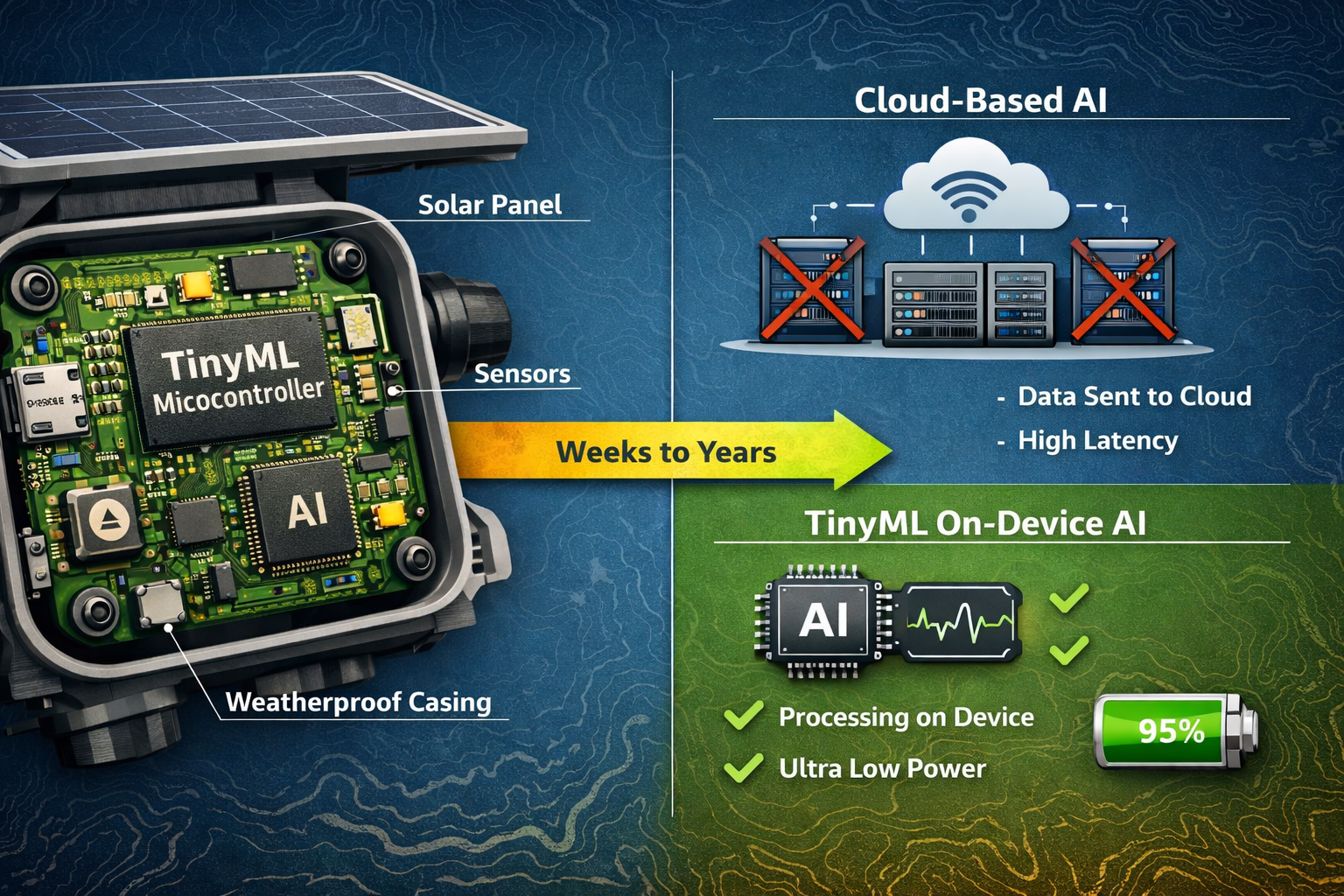
TinyML (Tiny Machine Learning) represents a fundamental shift in how artificial intelligence operates in conservation contexts. Unlike traditional AI systems that require powerful cloud servers and constant internet connectivity, TinyML runs complete machine learning models on ultra-low-power microcontrollers with only kilobytes of memory and milliwatt power budgets.[3]
Core Components of TinyML Systems
Modern TinyML biodiversity monitoring systems consist of several integrated components:
Hardware Platforms
- Cortex-M CPUs (STM32, Arduino MKR, Nano 33 BLE)
- EFM32 Gecko microcontrollers
- ESP32 devices with integrated wireless capabilities
- Custom sensor arrays (acoustic, visual, environmental)
Software Frameworks
- TensorFlow Lite Micro for model deployment
- CMSIS-NN for neural network optimization
- Edge Impulse for simplified model training
- Quantized neural networks (INT8) for memory efficiency
Power Management
- Solar energy harvesting systems
- Ultra-low-power sleep modes
- Event-driven processing to conserve battery
- Energy budgets measured in milliwatts rather than watts
How TinyML Differs from Cloud-Based AI
The distinction between TinyML and traditional cloud AI is crucial for understanding its conservation applications:
| Feature | Cloud-Based AI | TinyML |
|---|---|---|
| Processing Location | Remote servers | On-device |
| Internet Required | Yes | No |
| Power Consumption | Watts to kilowatts | Milliwatts |
| Latency | Seconds (network dependent) | Milliseconds |
| Deployment Duration | Limited by connectivity | Weeks to years |
| Model Complexity | Highly complex | Intentionally simplified |
| Accuracy | Very high | Sufficient for targeted tasks |
| Data Privacy | Data transmitted | Data stays local |
This architectural difference makes TinyML devices particularly valuable for biodiversity surveys in regions where traditional monitoring approaches fail. When conducting biodiversity impact assessments, understanding these technological capabilities helps surveyors choose appropriate monitoring strategies.
Real-Time Species Identification Without Connectivity
One of the most remarkable capabilities of TinyML devices for remote biodiversity surveys during 2026 is real-time species identification without internet connectivity.[1] These systems can:
- 🎵 Identify animal vocalizations (hornbill calls, bat echolocation, frog choruses)
- 📸 Detect specific wildlife through camera trap images
- 🌿 Monitor plant health through spectral analysis
- 🦟 Track insect populations through acoustic signatures
The devices achieve this by running trained neural networks directly on embedded processors. A microcontroller equipped with a microphone can continuously listen for specific bird calls, process the audio locally, and record only positive detections—dramatically reducing data storage requirements and power consumption compared to continuous recording approaches.
Practical Applications of TinyML Devices for Remote Biodiversity Surveys During 2026
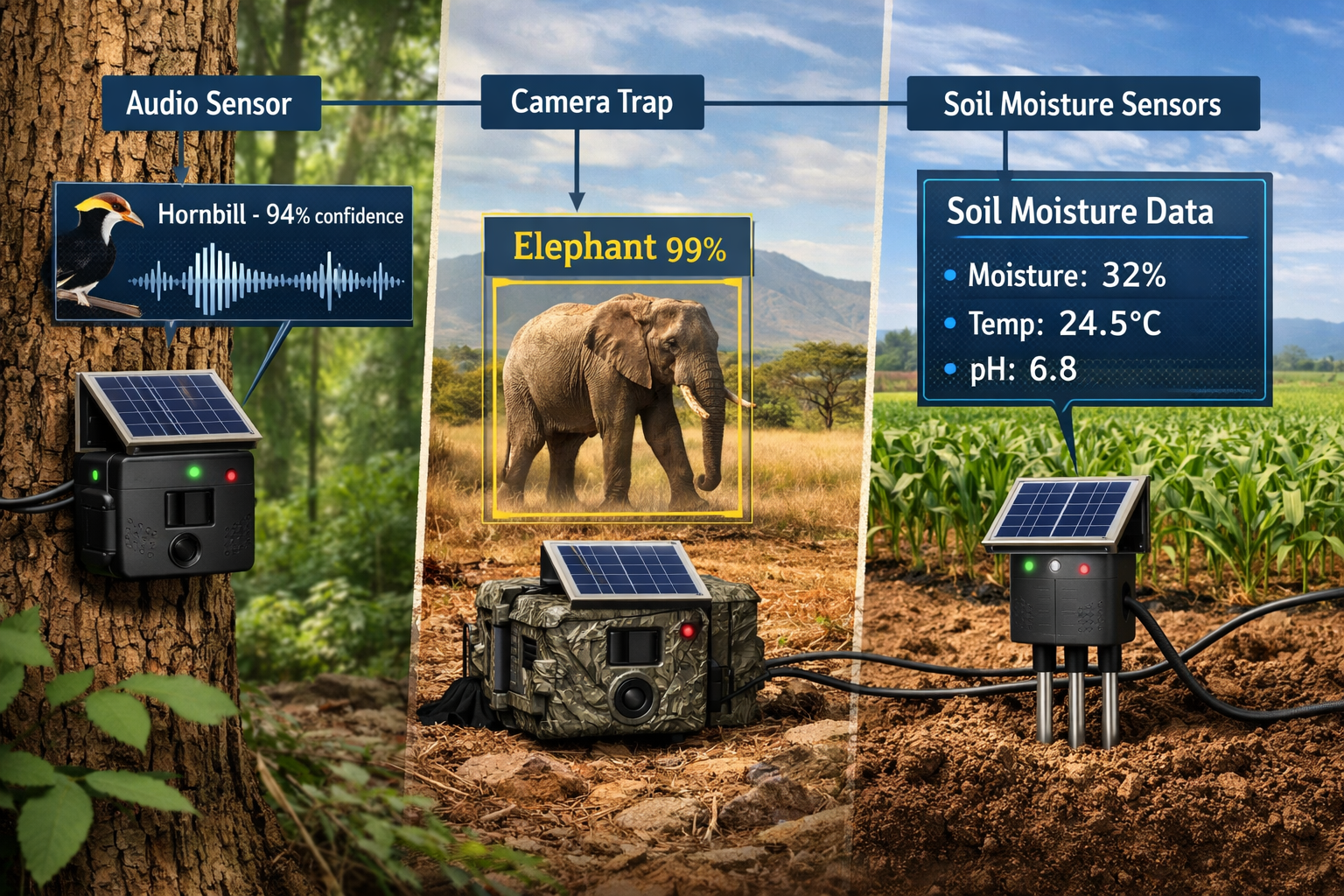
The transition from laboratory research to field deployment has accelerated dramatically in 2026, with TinyML devices now monitoring biodiversity across diverse ecosystems and conservation contexts.
Wildlife Tracking and Population Monitoring
Multi-species deployment networks currently track approximately 30 species ranging from bats to elephants using Sigfox-connected tags with on-device inference capabilities.[3] These systems provide unprecedented insights into animal behavior and population dynamics:
Acoustic Monitoring
- Continuous bat echolocation detection for population estimates
- Bird vocalization identification for migration pattern tracking
- Primate call recognition for territorial behavior studies
- Amphibian chorus monitoring for breeding season documentation
Visual Detection Systems
- Camera trap integration with on-device species classification
- Centimeter-scale localization systems for giant tortoises
- Near-continuous tracking of large mammals like bison using solar-augmented collars
- Automated counting and individual identification through pattern recognition
The biodiversity net gain framework increasingly relies on accurate baseline data that TinyML systems can provide continuously and cost-effectively.
Anti-Poaching and Illegal Activity Detection
Conservation teams embed TinyML models into sound- and image-sensing nodes to recognize specific threat patterns, triggering alerts only when unauthorized activities occur.[1] This targeted approach offers several advantages:
Threat Detection Capabilities
- ⚠️ Chainsaw noise recognition for illegal logging detection
- 🚗 Unauthorized vehicle movement identification
- 🔫 Gunshot detection and localization
- 🪓 Tool sound classification for mining or harvesting activities
Operational Benefits
- Reduced false positives compared to motion-only systems
- Battery conservation through event-driven processing
- Immediate local alerts without cloud dependency
- Privacy-preserving operation (no continuous video streaming)
These systems prove particularly valuable in remote protected areas where ranger patrols cannot maintain constant presence and where cellular connectivity is unreliable or nonexistent.
Environmental Monitoring and Climate Response
Beyond wildlife tracking, TinyML devices excel at continuous environmental monitoring that informs conservation decision-making:
Precision Agriculture Integration
- Soil moisture, pH, and temperature monitoring without cloud connectivity
- Highly accurate predictions of crop water requirements in off-grid settings
- Pest detection through acoustic and visual analysis
- Microclimate monitoring for habitat suitability assessment
Aquatic Ecosystem Monitoring
- Continuous pH, dissolved oxygen, temperature, and ammonia level tracking
- Anomaly detection for water quality events
- Fish population estimation through underwater acoustics
- Coral reef health monitoring through spectral imaging
Early Warning Systems
- Wildfire detection through smoke particle sensors and thermal imaging
- Flood risk assessment via water level and flow rate monitoring
- Drought stress detection in vegetation through spectral analysis
- Disease outbreak prediction through environmental condition tracking
These applications demonstrate how TinyML devices for remote biodiversity surveys in data-scarce regions during 2026 extend beyond simple species counting to comprehensive ecosystem health assessment.
Integration with Biodiversity Net Gain Strategies
For developers and landowners implementing biodiversity net gain requirements, TinyML devices offer compelling advantages:
✅ Baseline Documentation: Establish accurate pre-development biodiversity metrics
✅ Ongoing Monitoring: Track habitat creation and species colonization progress
✅ Verification: Provide objective evidence of biodiversity improvements
✅ Adaptive Management: Enable real-time adjustments based on monitoring data
Organizations working to achieve 10% biodiversity net gain can deploy TinyML networks across both on-site and off-site habitats to demonstrate compliance and measure conservation outcomes objectively.
Deployment Challenges and Equity Considerations in Data-Scarce Regions
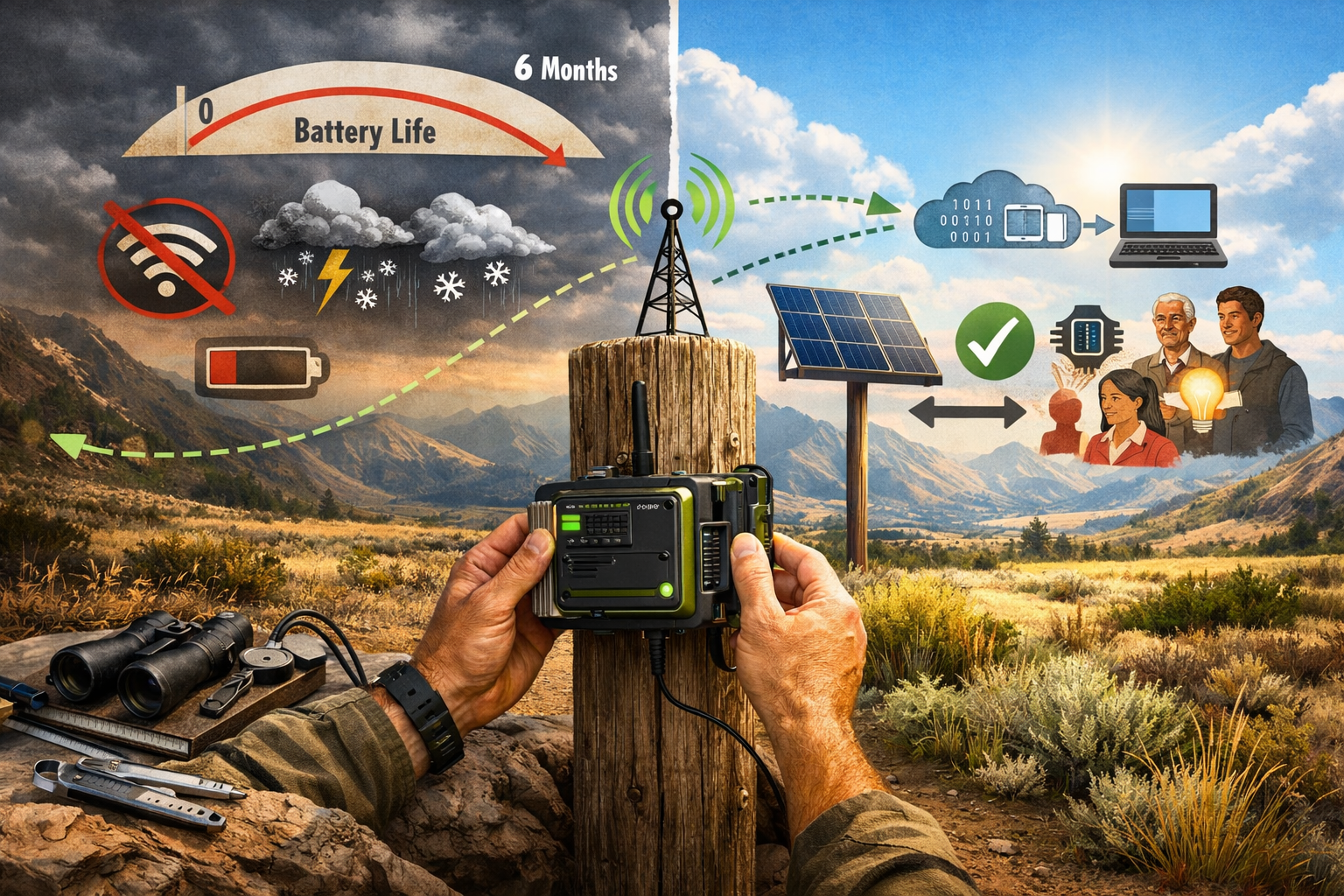
While TinyML technology offers transformative potential for biodiversity conservation, successful deployment in remote, data-scarce regions during 2026 requires addressing significant practical, technical, and ethical challenges.
Technical Deployment Challenges
Hardware Durability and Environmental Resistance
Remote biodiversity surveys demand equipment that withstands extreme conditions:
- 🌡️ Temperature fluctuations from -20°C to +50°C
- 💧 High humidity and direct precipitation exposure
- 🐜 Insect infiltration and biological degradation
- 🌪️ Physical damage from wind, falling debris, and wildlife interaction
Successful deployments require ruggedized enclosures, conformal coatings on circuit boards, and careful sensor placement that balances detection effectiveness with protection from the elements.
Power Management in Off-Grid Environments
Despite ultra-low power consumption, TinyML devices still face energy constraints:
- ☀️ Solar panel efficiency varies with canopy cover and latitude
- 🔋 Battery capacity degrades in extreme temperatures
- ⚡ Energy harvesting must match processing demands
- 🌙 Nighttime operation requires careful power budgeting
Deployment strategies must account for seasonal variations in solar availability, with some systems entering low-power modes during resource-scarce periods or prioritizing critical monitoring functions when energy reserves diminish.
Wireless Connectivity Trade-offs
While TinyML eliminates the need for continuous internet connectivity, periodic data retrieval and system management still require communication:
LPWAN Protocol Comparison
| Protocol | Range | Power | Data Rate | Best Use Case |
|---|---|---|---|---|
| LoRaWAN | 2-15 km | Very low | 0.3-50 kbps | Sparse sensor networks |
| Sigfox | 10-50 km | Ultra-low | 100 bps | Simple event alerts |
| NB-IoT | 1-10 km | Low | 250 kbps | Cellular coverage areas |
| Satellite | Global | Medium | 1-10 kbps | Extreme remote regions |
Selecting appropriate wireless infrastructure requires balancing coverage requirements, power budgets, data transmission needs, and infrastructure costs.[3]
Model Accuracy and Validation Challenges
TinyML models are intentionally less complex than large cloud-based models, creating accuracy trade-offs that conservation teams must understand and manage:
Known Limitations
- Reduced classification accuracy for visually or acoustically similar species
- Performance degradation with environmental conditions (wind noise, lighting changes)
- Limited ability to detect rare or previously unseen species
- Potential bias toward well-represented species in training datasets
Validation Requirements
- Regular comparison with expert human identification
- Periodic model updates as species distributions shift
- Cross-validation across different geographic regions
- Transparent reporting of confidence scores and error rates
Organizations planning biodiversity surveys must establish clear protocols for validating TinyML outputs and understanding when human expert review remains necessary.
Equity and Access Considerations
The 2026 conservation horizon scan emphasizes that emerging technologies like TinyML must benefit underserved communities and address existing inequities rather than exacerbate them.[2]
Digital Divide Challenges
- 🌍 Remote communities may lack technical expertise for deployment and maintenance
- 💰 Initial hardware costs create barriers despite long-term savings
- 📚 Training resources often assume technical backgrounds and internet access
- 🗣️ Documentation primarily available in English and other dominant languages
Community Engagement Principles
Successful TinyML deployment in data-scarce regions requires:
- Local Capacity Building: Training community members in device installation, maintenance, and data interpretation
- Participatory Design: Involving local stakeholders in determining monitoring priorities and deployment locations
- Benefit Sharing: Ensuring monitoring data serves local conservation goals, not just external research agendas
- Technology Transfer: Moving beyond extractive research models toward genuine knowledge and capability transfer
- Cultural Sensitivity: Respecting traditional ecological knowledge and integrating it with technological approaches
Data Sovereignty and Privacy
On-device processing offers privacy advantages by keeping sensitive location data local, but deployment teams must still address:
- 🔒 Who owns the biodiversity data collected on community lands?
- 📊 How will data be shared with external researchers or authorities?
- 🗺️ Could species location data enable poaching if compromised?
- ⚖️ What governance structures ensure ethical data use?
These considerations are particularly relevant when working with landowners who may be concerned about how monitoring data could affect land use decisions or property values.
Emerging Solutions and Best Practices
The conservation technology community has developed several approaches to address these challenges:
Open-Source Hardware and Software
- Edge Impulse and TensorFlow Lite Micro provide free development tools
- Open-source hardware designs reduce costs and enable local manufacturing
- Community forums facilitate knowledge sharing and troubleshooting
- Modular designs allow component replacement with locally available materials
Hybrid Deployment Models
- Combining TinyML devices with periodic expert verification visits
- Integrating traditional ecological monitoring with automated systems
- Using TinyML for continuous monitoring and directing human effort toward anomalies
- Partnering with local universities and technical schools for capacity building
Optical AI Chip Innovation
The 2026 horizon scan identifies optical AI chips requiring minimal energy as an emerging complement to TinyML devices.[2] These next-generation processors promise:
- Even lower power consumption through photonic computing
- Faster inference speeds for complex models
- Reduced heat generation in harsh environments
- Enhanced capability for visual processing tasks
As these technologies mature, they will further expand the capabilities of TinyML devices for remote biodiversity surveys in data-scarce regions.
Implementation Guide for Conservation Practitioners
For organizations ready to deploy TinyML devices for remote biodiversity surveys during 2026, the following framework provides practical guidance:
Phase 1: Planning and Assessment
Define Monitoring Objectives
- Identify target species or environmental parameters
- Establish baseline data requirements
- Determine acceptable accuracy thresholds
- Clarify how data will inform conservation decisions
Site Assessment
- Evaluate solar energy availability (canopy cover, latitude)
- Assess wireless connectivity options (LoRaWAN coverage, cellular availability)
- Identify physical security risks (vandalism, wildlife damage)
- Engage local communities and stakeholders
Technology Selection
- Choose appropriate sensors (acoustic, visual, environmental)
- Select microcontroller platform based on processing needs
- Determine power system requirements (battery capacity, solar panel size)
- Identify wireless communication protocol
Phase 2: Model Development and Testing
Data Collection
- Gather training data representative of deployment conditions
- Include diverse environmental conditions (weather, lighting, seasons)
- Ensure balanced representation of target and non-target species
- Consider data augmentation to expand limited datasets
Model Training and Optimization
- Train models using frameworks like TensorFlow Lite or Edge Impulse
- Apply quantization to reduce model size (INT8 or INT16)
- Test inference speed and memory usage on target hardware
- Validate accuracy against held-out test datasets
Field Testing
- Deploy prototype systems in representative locations
- Compare automated detections with expert human observations
- Identify failure modes and environmental challenges
- Iterate on model architecture and deployment configuration
Phase 3: Deployment and Monitoring
Installation
- Position devices to optimize sensor coverage and solar exposure
- Secure mounting to prevent theft or wildlife damage
- Configure power management and sleep schedules
- Test wireless connectivity and data transmission
Ongoing Maintenance
- Schedule periodic site visits for battery checks and cleaning
- Monitor device health through remote diagnostics when possible
- Update models as new training data becomes available
- Document and address failure patterns
Data Management
- Establish protocols for data retrieval and storage
- Implement quality control procedures for automated detections
- Create visualization dashboards for stakeholder communication
- Archive raw data for future reanalysis
Phase 4: Evaluation and Adaptation
Performance Assessment
- Compare monitoring outcomes with conservation objectives
- Calculate cost-effectiveness relative to traditional methods
- Evaluate community engagement and capacity building success
- Identify technical improvements for future deployments
Knowledge Sharing
- Document lessons learned and best practices
- Contribute to open-source hardware and software projects
- Publish results in accessible formats
- Train others through workshops and online resources
Organizations working on biodiversity plans for development projects can integrate TinyML monitoring into long-term management strategies, providing objective evidence of conservation outcomes.
Future Directions and Emerging Opportunities
As 2026 progresses, several trends are shaping the future of TinyML devices for remote biodiversity surveys:
Multi-Modal Sensor Fusion
Next-generation systems combine multiple sensor types for more comprehensive monitoring:
- 🎤 Acoustic sensors detect vocalizations
- 📷 Cameras confirm visual identification
- 🌡️ Environmental sensors provide habitat context
- 📡 Motion sensors trigger targeted data collection
This fusion approach improves accuracy while maintaining power efficiency by activating energy-intensive sensors only when preliminary detection occurs.
Federated Learning for Privacy-Preserving Model Improvement
Federated learning enables TinyML models to improve through collective learning without centralizing sensitive biodiversity data:
- Models train locally on each device
- Only model updates (not raw data) are shared
- Aggregated improvements benefit all deployed devices
- Location-sensitive species data remains private
This approach addresses both technical and ethical challenges in conservation technology.
Integration with Global Biodiversity Frameworks
TinyML monitoring data increasingly feeds into international conservation initiatives:
- Contributing to national biodiversity reporting obligations
- Supporting biodiversity net gain verification
- Informing protected area management decisions
- Enabling citizen science participation through accessible technology
Standardization and Interoperability
The conservation technology community is working toward:
- Standardized data formats for cross-platform compatibility
- Open hardware specifications for reproducible deployments
- Shared model repositories for common species and ecosystems
- Certification programs for device reliability and accuracy
These developments will accelerate adoption and reduce barriers for organizations new to TinyML technology.
Conclusion
TinyML devices for remote biodiversity surveys represent a transformative approach to conservation monitoring in data-scarce regions during 2026. By bringing artificial intelligence directly to the field—without requiring internet connectivity or substantial power infrastructure—these ultra-low-power systems enable continuous, real-time biodiversity detection in the world's most remote and ecologically critical landscapes.
The technology has moved beyond proof-of-concept to practical deployment, with systems currently monitoring 30+ species, detecting illegal activities, and tracking environmental conditions across diverse ecosystems.[3] From acoustic identification of hornbill calls in tropical rainforests to visual detection of elephants in African savannas, TinyML demonstrates that sophisticated AI can operate effectively in the harshest conditions.
However, successful implementation requires more than technical capability. Conservation practitioners must address deployment challenges including hardware durability, power management, model validation, and wireless connectivity. More fundamentally, they must ensure that technology deployment advances equity rather than exacerbates existing inequalities through genuine community engagement, local capacity building, and respect for data sovereignty.[2]
Actionable Next Steps
For conservation organizations, developers, and landowners ready to leverage TinyML technology:
- Start Small: Deploy pilot systems in accessible locations before scaling to remote regions
- Build Partnerships: Collaborate with local communities, technical experts, and conservation practitioners
- Prioritize Training: Invest in capacity building for long-term sustainability
- Share Knowledge: Contribute to open-source projects and document lessons learned
- Integrate Strategically: Connect TinyML monitoring with biodiversity assessment frameworks and conservation planning
The 2026 conservation horizon scan identifies TinyML as a game-changing technology for biodiversity protection.[2] As optical AI chips and other innovations emerge, the capabilities of low-power, offline monitoring will only expand. Organizations that begin building expertise now will be positioned to leverage these advances for more effective, equitable, and evidence-based conservation in the years ahead.
For guidance on integrating TinyML monitoring into your conservation strategy, contact biodiversity survey specialists who can help design monitoring programs aligned with your specific objectives and regulatory requirements.
References
[1] Tiny Machine Learning Tinyml In The Wild Offline Environmental Ai – https://www.ignitec.com/insights/tiny-machine-learning-tinyml-in-the-wild-offline-environmental-ai/
[2] Whats Next For Biodiversity Conservation Insights From The 2026 Horizon Scan – https://www.unep-wcmc.org/en/news/whats-next-for-biodiversity-conservation-insights-from-the-2026-horizon-scan
[3] arxiv – https://arxiv.org/html/2602.13496v1