

The world's biodiversity is disappearing at an alarming rate, yet conservation efforts face an unexpected obstacle: we cannot accurately compare the data we collect. Imagine trying to solve a global puzzle when every piece comes from a different puzzle box. That's the challenge facing biodiversity monitoring today. As nations prepare to report progress on the Kunming-Montreal Global Biodiversity Framework in 2026, the lack of standardized indicators threatens to undermine our ability to track whether conservation commitments are actually working.
Standardizing Biodiversity Indicators Across 2026 Surveys: Why Comparable Data Matters for Global Conservation Commitments has emerged as one of the most critical challenges in global conservation. With 196 countries required to submit progress reports by February 2026, the fragmented state of biodiversity data collection could make meaningful global assessment nearly impossible [2]. This isn't just an academic concern—it directly affects whether we can halt and reverse nature loss by 2030.
Key Takeaways
- 🌍 196 countries must report biodiversity progress by February 2026, but incomparable data across surveys makes global assessment extremely difficult
- 📊 The EU is on track for only 16 of 45 biodiversity targets, highlighting the urgent need for better monitoring and standardized indicators [2]
- 🔄 New mandatory reporting frameworks (GRI 101, TNFD, CSRD) are driving corporate biodiversity disclosure, but data fragmentation remains a major barrier [1][5]
- 📈 Standardized indicators from GEO BON and other initiatives enable cross-source harmonization and consistent monitoring at all scales [3]
- ⏰ Establishing baselines in 2026 is critical—without continuous, standardized monitoring from a clear starting point, we cannot assess intervention effectiveness [4]
The Current State of Biodiversity Data: A Fragmented Landscape
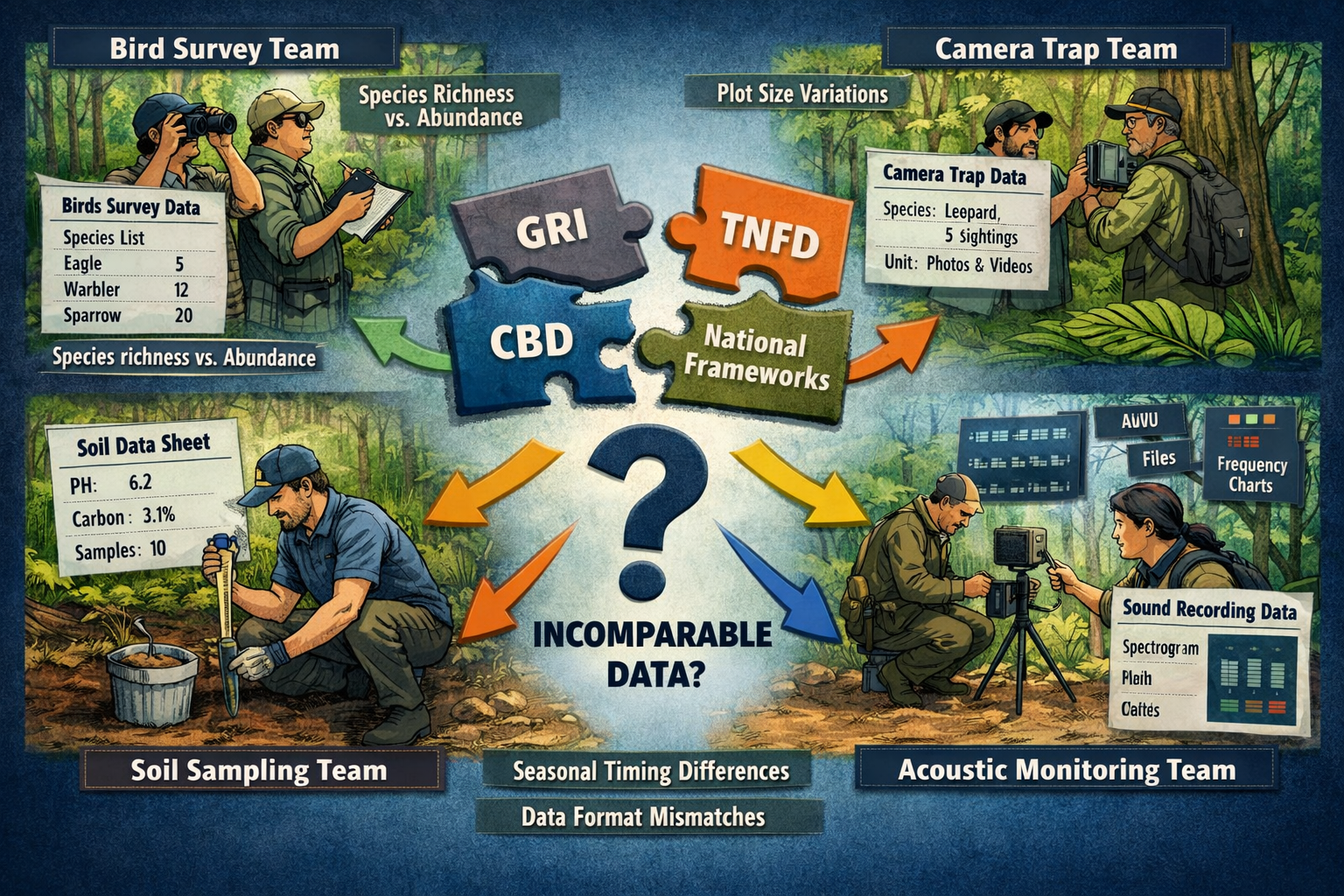
Why Different Surveys Use Different Indicators
Biodiversity monitoring has evolved organically across regions, disciplines, and organizations. A bird specialist in Brazil might focus on species richness and endemic populations. A soil ecologist in Scotland measures invertebrate abundance and functional diversity. A corporate sustainability officer tracks habitat area and ecosystem service values. Each approach is valid, but they're not comparable.
This fragmentation stems from several factors:
- Different scientific traditions and taxonomic expertise across regions
- Varying regulatory requirements at national and local levels
- Resource constraints that limit what can be measured
- Historical survey methods that predate modern standardization efforts
- Sector-specific needs (forestry vs. agriculture vs. urban development)
The World Economic Forum now ranks biodiversity loss as the second most severe long-term global threat [5], yet our monitoring systems remain disconnected. This creates a paradox: as the urgency increases, our ability to coordinate effective responses remains hampered by incomparable data.
The Cost of Incomparable Data
When biodiversity data cannot be compared across surveys, the consequences ripple through every level of conservation:
| Impact Area | Consequence | Example |
|---|---|---|
| Policy Effectiveness | Cannot determine which interventions work | Protected area expansion shows "success" in one metric but "failure" in another |
| Resource Allocation | Funding flows to measurable outcomes, not actual priorities | Projects with simple metrics get funded over complex ecosystem restoration |
| Global Commitments | Progress reporting becomes subjective | Countries report using different baselines and indicators |
| Scientific Understanding | Meta-analyses and synthesis become impossible | Research findings cannot be aggregated across studies |
| Corporate Accountability | Greenwashing becomes easier | Companies choose favorable metrics without standardized benchmarks |
Recent Biodiversa+ reports published in January 2026 document that biodiversity data remain fragmented, unevenly used, and largely disconnected from decision-making processes [5]. This isn't just inefficiency—it's an active barrier to meeting conservation goals.
For developers and planners working on projects requiring biodiversity net gain assessments, this fragmentation creates confusion about which metrics to prioritize and how to demonstrate genuine environmental improvement.
Standardizing Biodiversity Indicators Across 2026 Surveys: The Global Framework Response
The Kunming-Montreal Global Biodiversity Framework
Adopted at CBD COP15 in 2022, the Kunming-Montreal Global Biodiversity Framework established 23 global targets aimed at halting and reversing biodiversity loss by 2030. These targets require standardized monitoring to assess progress meaningfully.
The European Union has aligned its strategy with 45 targets that fully correspond to the global framework [2]. However, as of February 2026, the EU is on track to achieve only 16 of these 45 targets, with two already achieved. This sobering assessment demonstrates both the value of standardized reporting and the scale of the challenge ahead.
All 196 Parties to the Convention on Biological Diversity are required to report their progress by February 2026, with results feeding into a global review at CBD COP17 in October 2026 [2]. This creates an unprecedented opportunity—and pressure—to establish comparable monitoring systems.
Key Standardization Initiatives for 2026
Several major initiatives are converging to create more standardized biodiversity indicators:
GRI 101: Biodiversity 2024 Standard
Published on January 25, 2024, the updated Global Reporting Initiative biodiversity standard is now mandating nature impact reporting from companies starting in 2026 [1]. This represents a shift from voluntary to mandatory disclosure for many organizations, reshaping corporate biodiversity accountability.
The standard is now available in multiple languages, expanding accessibility for global implementation. By requiring standardized metrics, GRI 101 creates comparability across corporate biodiversity impacts—essential for understanding the business sector's role in nature loss.
TNFD Disclosure Recommendations
The Task Force on Nature-related Financial Disclosures provides a framework for organizations to report and act on evolving nature-related risks. In July 2024, GRI and TNFD released a joint interoperability mapping to help organizations understand correspondence between GRI Standards and TNFD recommendations [1].
This interoperability is crucial. Organizations can now align their reporting across multiple frameworks without duplicating effort, while stakeholders gain comparable data across different disclosure systems.
GEO BON Essential Biodiversity Variables
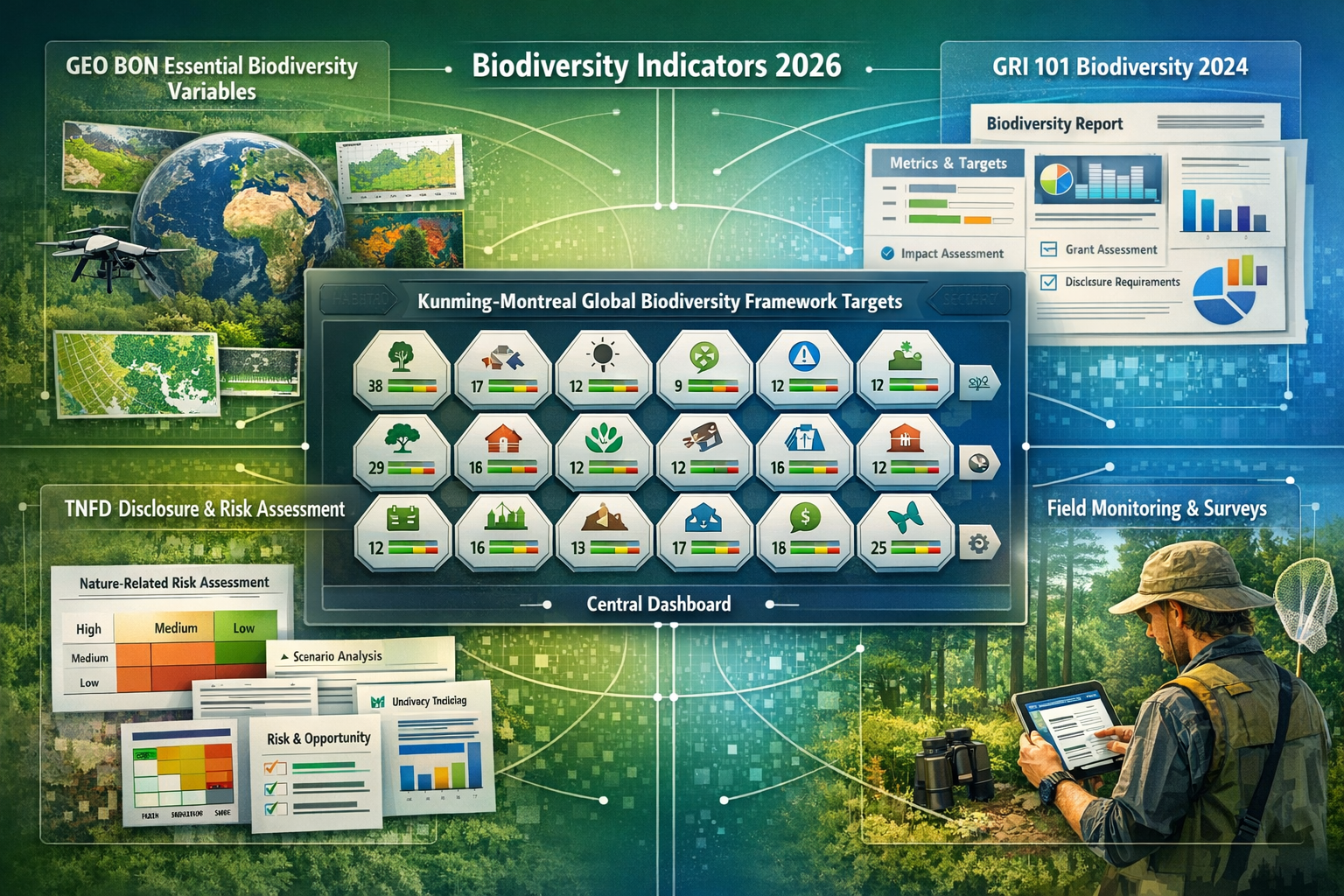
The Global Earth Observation Biodiversity Observation Network has developed standardized biodiversity indicators that harmonize observations across multiple data sources [3]. These Essential Biodiversity Variables (EBVs) use remote sensing data and are designed to support consistent monitoring at local, national, and global scales.
GEO BON's approach enables cross-source harmonization—combining field surveys, satellite data, citizen science observations, and automated monitoring into comparable metrics. This is particularly valuable for establishing the continuous monitoring needed for meaningful trend analysis.
For those working on biodiversity net gain projects, understanding these standardized frameworks helps ensure that assessments align with emerging global standards and can contribute to broader conservation monitoring.
Corporate Disclosure Requirements Driving Standardization
The Corporate Sustainability Reporting Directive (CSRD) and similar regulations are creating unprecedented pressure for standardized biodiversity data. The first global scientific assessment from the Intergovernmental Science-Policy Platform on Biodiversity and Ecosystem Services (IPBES), released February 9, 2026, provides guidance on how businesses depend on and impact biodiversity [5].
However, businesses face a significant challenge: while disclosure requirements are expanding rapidly, biodiversity data remain fragmented and largely disconnected from decision-making processes [5]. This gap between regulatory requirements and data availability is driving urgent demand for standardized indicators that can be practically implemented.
Why Surveyors Are Critical to Standardizing Biodiversity Indicators Across 2026 Surveys
The Baseline Establishment Imperative
Organizations and nations starting biodiversity monitoring in 2026 are establishing baselines that will determine all future comparisons [4]. This makes the standardization of current surveys absolutely critical—the decisions made today about which indicators to measure and how to measure them will shape conservation assessment for decades.
Without continuous, multi-season monitoring data from a clear starting point, several problems emerge:
- Weather-driven variation gets mistaken for long-term decline (or improvement)
- Intervention effectiveness cannot be properly assessed without pre-intervention baselines
- Natural population fluctuations obscure actual trends
- Seasonal differences make year-to-year comparisons invalid
Field surveyors establishing baselines in 2026 must adopt standardized protocols that enable:
✅ Temporal comparability (same site measured consistently over time)
✅ Spatial comparability (different sites measured using the same methods)
✅ Cross-taxonomic integration (linking species, habitat, and genetic diversity data)
✅ Multi-scale assessment (from local plots to landscape to national reporting)
Practical Steps for Implementing Standardized Indicators
Biodiversity surveyors can contribute to global standardization through several concrete actions:
1. Adopt Recognized Indicator Frameworks
Rather than creating custom metrics, align field surveys with established frameworks:
- GEO BON Essential Biodiversity Variables for ecological monitoring
- GRI 101 metrics for corporate site assessments
- TNFD-aligned indicators for nature-related risk assessment
- National biodiversity strategies that align with the Kunming-Montreal Framework
This doesn't mean abandoning specialized measurements—it means ensuring core indicators match global standards while supplementing with context-specific data.
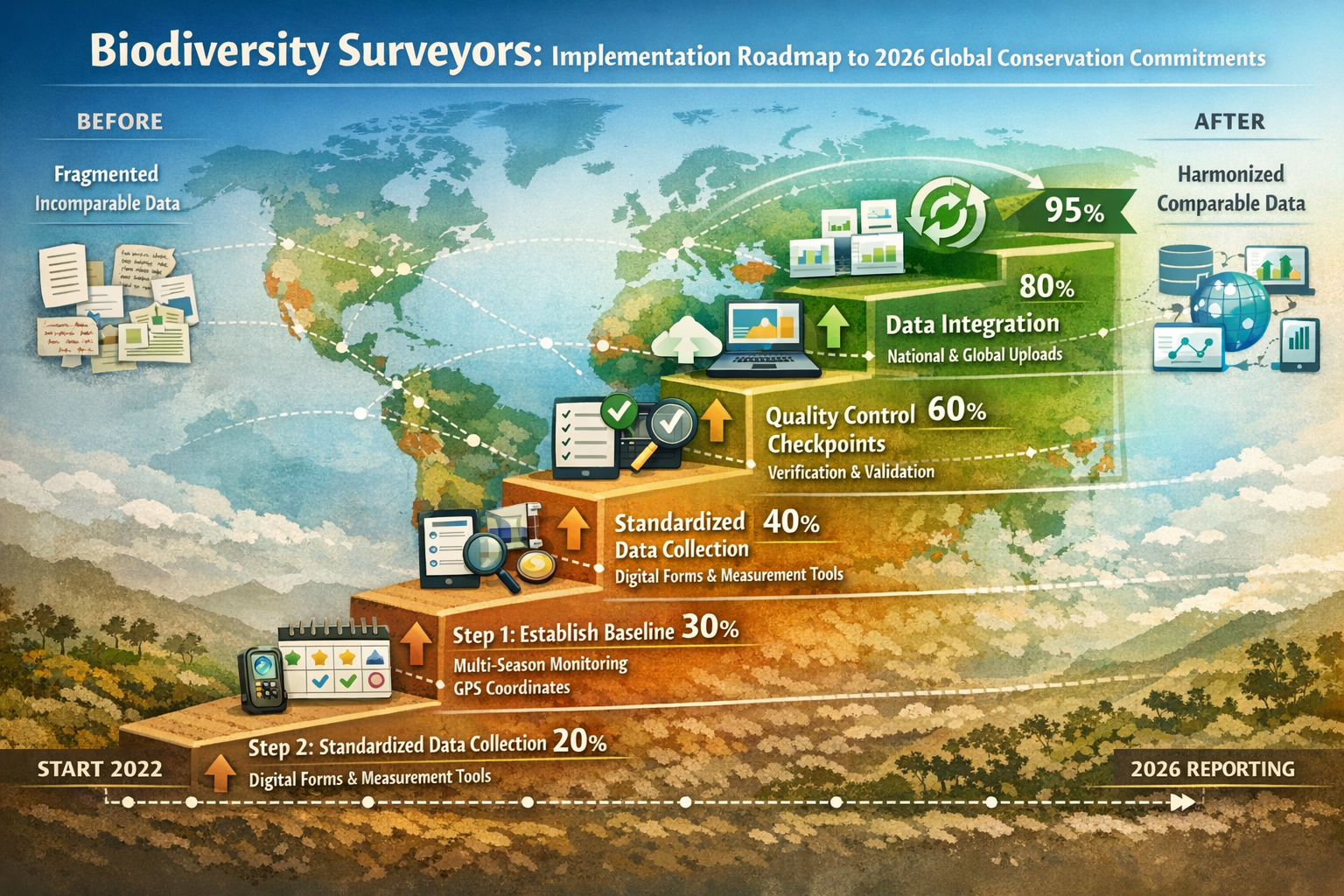
2. Implement Multi-Season Baseline Monitoring
Establish monitoring protocols that capture seasonal variation:
- Spring surveys for breeding bird populations and flowering plant diversity
- Summer surveys for peak invertebrate activity and vegetation structure
- Autumn surveys for seed production and migratory species
- Winter surveys for overwintering populations and structural habitat features
This comprehensive approach prevents mistaking seasonal variation for long-term trends and establishes robust baselines for future comparison [4].
3. Use Standardized Data Collection Tools
Digital data collection tools can enforce standardized protocols:
- Pre-programmed survey forms that match indicator frameworks
- GPS-enabled location tracking for precise spatial replication
- Photo documentation standards for habitat condition assessment
- Quality control checks built into data entry systems
These tools reduce human error and ensure that data collected by different surveyors remains comparable.
4. Document Methodology Thoroughly
Standardization requires transparency about methods:
- Survey effort (person-hours, area covered, detection methods)
- Environmental conditions during surveys
- Observer qualifications and experience levels
- Equipment specifications and calibration status
- Taxonomic authorities used for species identification
This documentation enables future surveyors to replicate methods precisely, maintaining comparability over time.
For developers seeking to achieve biodiversity net gain, working with surveyors who follow standardized protocols ensures that baseline assessments and post-development monitoring can be meaningfully compared.
Connecting Field Data to Global Commitments
The connection between individual field surveys and global conservation commitments might seem distant, but it's direct and essential. Every standardized biodiversity survey contributes to:
🌐 National reporting to the Convention on Biological Diversity
📊 Corporate disclosure under GRI, TNFD, and CSRD requirements
🔬 Scientific synthesis enabling meta-analyses and trend detection
💼 Investment decisions based on nature-related risks and opportunities
🏛️ Policy evaluation determining which conservation approaches work
When surveyors in England conduct biodiversity impact assessments for developers using standardized metrics, that data can contribute to national progress reporting on biodiversity targets. When corporate sites monitor biodiversity using GRI 101 indicators, those results become comparable across companies and sectors.
This aggregation only works with standardized indicators. Fragmented data cannot be aggregated into meaningful global assessments.
Overcoming Barriers to Standardization
Technical Challenges
Implementing standardized biodiversity indicators faces several technical obstacles:
Taxonomic expertise gaps: Standardized protocols often require species-level identification, but taxonomic expertise is unevenly distributed. Solutions include:
- Investing in taxonomic training programs
- Using DNA barcoding for difficult groups
- Accepting higher taxonomic levels (genus, family) where necessary
- Developing AI-assisted identification tools
Resource constraints: Comprehensive biodiversity monitoring is resource-intensive. Prioritization strategies include:
- Focusing on indicator species and functional groups
- Combining remote sensing with targeted field verification
- Leveraging citizen science for large-scale data collection
- Using cost-effective automated monitoring (camera traps, acoustic sensors)
Legacy data integration: Decades of biodiversity data exist in non-standardized formats. Approaches include:
- Developing crosswalk tools to translate between indicator systems
- Metadata standards that document historical methodology
- Accepting that some historical data cannot be directly compared
- Focusing standardization efforts on new data collection
Institutional and Political Challenges
Beyond technical issues, standardization faces institutional resistance:
- National sovereignty concerns about externally imposed monitoring requirements
- Sector-specific traditions resistant to changing established practices
- Short-term political cycles conflicting with long-term monitoring needs
- Competing framework proliferation creating confusion about which standards to follow
The GRI-TNFD collaboration and enhanced interoperability mapping represent important steps toward resolving these conflicts by creating bridges between frameworks rather than forcing a single universal standard [1].
For planners navigating these complexities, understanding the key aspects of biodiversity net gain within this evolving standardization landscape is increasingly important.
The Path Forward: Making 2026 a Turning Point
Immediate Actions for 2026
The February 2026 reporting deadline and CBD COP17 in October 2026 create a critical window for advancing standardization:
For National Governments:
- Align national biodiversity monitoring with Kunming-Montreal Framework indicators
- Invest in standardized data infrastructure and taxonomic capacity
- Coordinate across agencies to eliminate redundant, incompatible surveys
- Share methodologies and data openly to enable international comparison
For Businesses:
- Implement GRI 101 and TNFD-aligned biodiversity monitoring
- Establish multi-season baselines before 2026 reporting requirements take full effect
- Integrate biodiversity data into decision-making processes, not just disclosure
- Support standardized monitoring at operational sites globally
For Surveyors and Consultants:
- Adopt standardized indicator frameworks in all new baseline assessments
- Update existing monitoring programs to align with global standards
- Contribute data to national and global biodiversity databases
- Educate clients about the value of comparable, standardized data
For Researchers:
- Develop and validate standardized indicators for under-represented ecosystems
- Create accessible tools and training materials for standardized monitoring
- Conduct cross-site comparisons to demonstrate the value of standardization
- Bridge the gap between scientific indicators and practical implementation
Building Momentum Beyond 2026
Standardizing biodiversity indicators is not a one-time achievement but an ongoing process:
Adaptive management: As monitoring technologies advance and ecological understanding deepens, standardized indicators must evolve while maintaining backward compatibility.
Capacity building: Global standardization requires investment in training, equipment, and institutional capacity, particularly in biodiversity-rich developing nations.
Data infrastructure: Standardized indicators are only valuable if data can be aggregated, analyzed, and accessed. Investment in biodiversity data platforms and interoperability standards is essential.
Stakeholder engagement: Standardization succeeds when it serves the needs of diverse users—from field surveyors to corporate sustainability officers to national policymakers. Inclusive development of standards ensures practical adoption.
The enhanced collaboration between GRI and TNFD, announced in April 2024, demonstrates the kind of coordination needed [1]. Rather than competing frameworks fragmenting the landscape further, major initiatives are working toward interoperability and harmonization.
For those seeking to buy biodiversity units or sell biodiversity units, standardized indicators will increasingly become the foundation for credible biodiversity credit markets, ensuring that units represent genuine, comparable conservation value.
Conclusion
Standardizing Biodiversity Indicators Across 2026 Surveys: Why Comparable Data Matters for Global Conservation Commitments is not merely a technical challenge—it's a fundamental prerequisite for effective conservation in an interconnected world. As 196 countries prepare their February 2026 progress reports and businesses implement mandatory biodiversity disclosure, the fragmentation of biodiversity data threatens to undermine our ability to assess whether we're actually making progress toward halting nature loss.
The convergence of the Kunming-Montreal Global Biodiversity Framework, GRI 101 mandatory reporting, TNFD disclosure recommendations, and initiatives like GEO BON's Essential Biodiversity Variables creates an unprecedented opportunity to establish comparable monitoring systems. However, this opportunity will only be realized through deliberate action by surveyors, organizations, and governments to adopt standardized indicators.
The baselines established in 2026 will shape biodiversity assessment for decades to come. Field surveyors conducting biodiversity assessments today are not just documenting current conditions—they're creating the reference points against which all future conservation success will be measured. This makes the adoption of standardized, comparable indicators an urgent priority.
Next Steps
If you're a developer or landowner:
- Work with surveyors who use standardized biodiversity indicators aligned with global frameworks
- Establish comprehensive multi-season baselines before project implementation
- Ensure your biodiversity net gain strategy uses metrics that can contribute to broader conservation monitoring
- Contact biodiversity specialists to discuss how standardized assessments can strengthen your projects
If you're a surveyor or consultant:
- Familiarize yourself with GRI 101, TNFD, and GEO BON indicator frameworks
- Update survey protocols to align with standardized indicators while maintaining site-specific detail
- Contribute data to national biodiversity databases and monitoring programs
- Educate clients about the long-term value of comparable, standardized data
If you're involved in policy or planning:
- Advocate for standardized biodiversity monitoring requirements in planning frameworks
- Support capacity building for standardized data collection and analysis
- Ensure that national reporting aligns with global frameworks
- Explore our guidance resources to understand practical implementation
The biodiversity crisis demands coordinated global action. Standardized indicators transform fragmented local observations into a coherent global picture—enabling us to finally answer the question: are our conservation efforts working? The answer depends on the choices we make in 2026.
References
[1] Topic Standard For Biodiversity – https://www.globalreporting.org/standards/standards-development/topic-standard-for-biodiversity/
[2] Progress Made Biodiversity Swifter Action Needed 2026 02 12 En – https://environment.ec.europa.eu/news/progress-made-biodiversity-swifter-action-needed-2026-02-12_en
[3] Indicators – https://geobon.org/ebvs/indicators/
[4] Why Monitor Biodiversity In 2026 – https://evolito.earth/stories/why-monitor-biodiversity-in-2026
[5] New Reports Show How Biodiversity Data Can Move Business From Commitment To Action – https://www.biodiversa.eu/2026/01/22/new-reports-show-how-biodiversity-data-can-move-business-from-commitment-to-action/