

The ocean's soundscape tells stories that visual surveys alone cannot capture. As biodiversity surveyors gather for the 2026 World Conference on Marine Biodiversity (WCMB), a technological revolution in passive acoustic monitoring is transforming how professionals establish baseline data and track population trends for marine mammals. With climate shifts altering migration patterns and offshore development accelerating, Marine Mammal Acoustic Monitoring: Baselines and Trends for 2026 Biodiversity Surveyors at WCMB represents the cutting edge of conservation science—where artificial intelligence meets underwater acoustics to protect vulnerable species.
Recent investments demonstrate the field's momentum. The Regional Wildlife Science Collaborative for Offshore Wind allocated approximately $1.2 million for passive acoustic monitoring of marine mammals along the U.S. East Coast, supporting 18 months of continuous data collection.[1] Meanwhile, NOAA published breakthrough research in February 2026 showcasing three-dimensional acoustic tracking methods that reveal unprecedented details about beaked whale dive behavior.[2] These advances equip ecologists with powerful tools to establish robust marine baselines amid rapidly changing ocean conditions.
Key Takeaways
- AI-powered detection systems now automatically identify marine mammal vocalizations in real-time, enabling immediate conservation responses during industrial operations
- Passive acoustic monitoring networks track whale populations across 3,000+ kilometer migration routes, providing continuous baseline data on pod locations and behavioral changes
- Standardized protocols through initiatives like POWERON create unified baseline soundscape characterization across multiple offshore wind projects
- Autonomous underwater vehicles and gliders equipped with integrated listening capabilities enable continuous fleet-scale monitoring at reduced costs
- Three-dimensional acoustic tracking methods provide enhanced understanding of deep-diving species like beaked whales, previously difficult to monitor
Understanding Passive Acoustic Monitoring for Marine Mammals
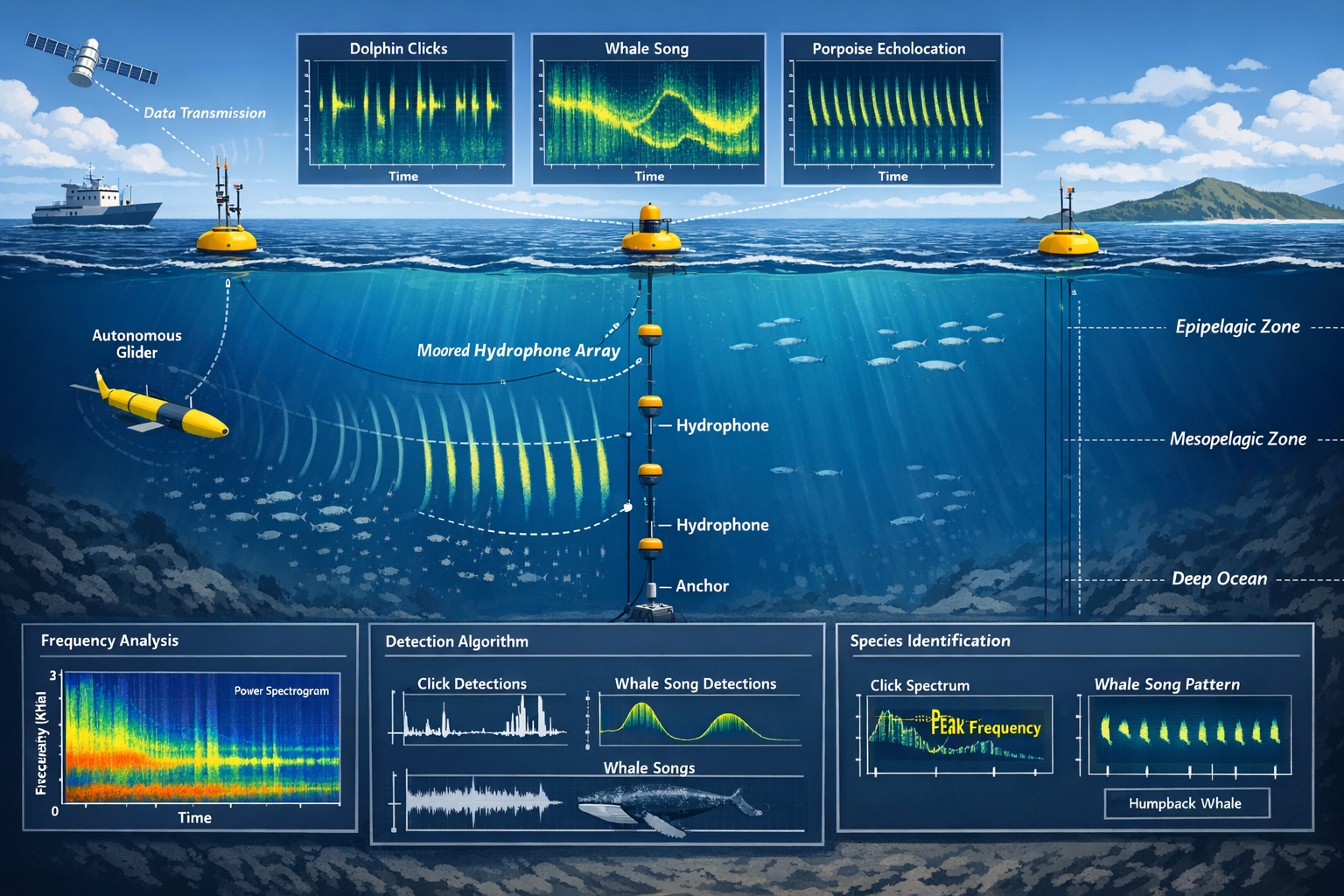
Passive acoustic monitoring (PAM) represents a non-invasive approach to studying marine mammals through their vocalizations. Unlike active sonar that emits sound pulses, PAM systems listen quietly to the underwater soundscape, capturing everything from dolphin echolocation clicks to the haunting songs of humpback whales.
How PAM Technology Works
PAM systems consist of hydrophones (underwater microphones) deployed on moorings, autonomous vehicles, or towed arrays. These devices record sound continuously or at programmed intervals, capturing frequencies ranging from the low-frequency calls of baleen whales (10-200 Hz) to the high-frequency echolocation of porpoises (100-150 kHz).
The recorded data undergoes analysis through:
- Spectrogram visualization showing frequency patterns over time
- Automated detection algorithms that identify species-specific call types
- Machine learning classifiers trained on thousands of verified vocalizations
- Real-time processing systems that trigger alerts for protected species
Why Acoustic Monitoring Matters for Biodiversity Assessments
Traditional visual surveys face significant limitations. Weather conditions, sea state, and daylight hours constrain observation windows. Marine mammals spend most of their time underwater, invisible to surface observers. Acoustic monitoring overcomes these challenges by operating continuously in all conditions, day and night, throughout the year.
For biodiversity surveyors conducting comprehensive assessments, PAM provides:
🔊 Continuous presence/absence data establishing which species inhabit an area
📊 Seasonal distribution patterns revealing migration timing and habitat use
📈 Population trend indicators through detection rate changes over time
⚠️ Early warning systems for protected species near development zones
Establishing Acoustic Baselines: Marine Mammal Acoustic Monitoring Protocols for 2026
Creating robust baseline data requires standardized methodologies that enable meaningful comparisons across time and space. The Partnership for an Offshore Wind Energy Regional Observation Network (POWERON) exemplifies this approach, establishing consistent protocols for PAM data collection, management, and analysis across multiple offshore wind projects.[1]
Key Components of Baseline Acoustic Surveys
Deployment Duration and Coverage
Effective baseline characterization requires minimum 12-month continuous recording to capture seasonal variations. The RWSC's 18-month monitoring commitment through POWERON reflects industry best practices, with expectations for multi-year extensions.[1]
| Monitoring Duration | Data Captured | Limitations |
|---|---|---|
| 3-6 months | Single season snapshot | Misses migration patterns |
| 12 months | Full annual cycle | Limited inter-annual variability |
| 24+ months | Multi-year trends | Captures climate impacts, population changes |
Spatial Array Design
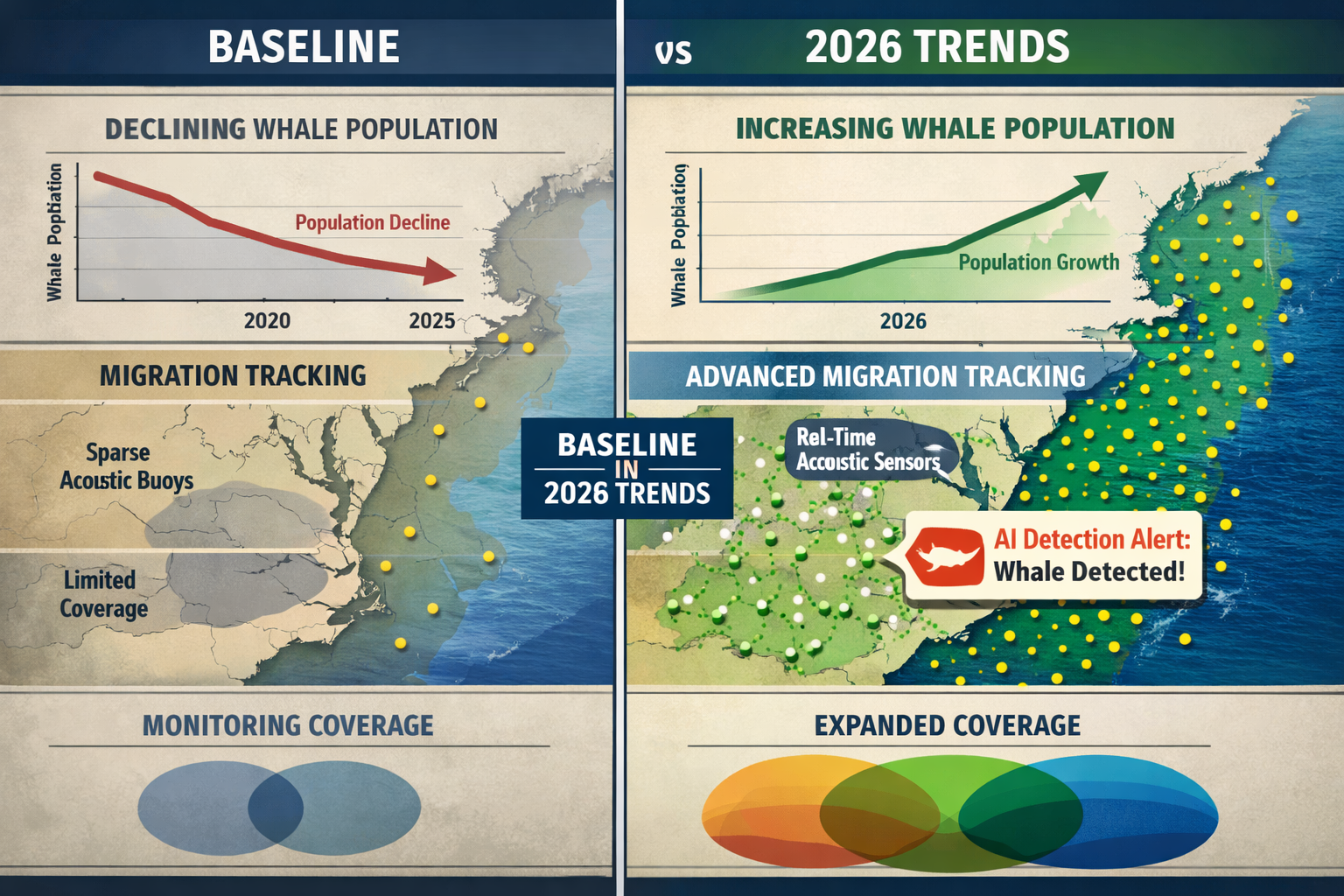
Acoustic monitoring networks must balance coverage with resource constraints. Recent advances enable tracking across 3,000+ kilometer migration routes with continuous real-time data on pod locations, sizes, and vocalizations.[5] This transforms baseline understanding of whale behavior and climate change impacts on migration patterns.
Standardized Detection and Classification Methods
Marine Mammal Acoustic Monitoring: Baselines and Trends for 2026 Biodiversity Surveyors at WCMB emphasizes consistent species identification protocols. AI-powered detection systems now automatically identify marine mammal vocalizations—dolphin clicks, whale songs—and autonomously trigger alerts.[3]
Modern classification systems incorporate:
- Validated call libraries for regional species assemblages
- Quality control protocols with manual verification of automated detections
- Confidence scoring systems that flag uncertain identifications
- Metadata standards documenting environmental conditions during recordings
Integration with Contaminant Assessment Protocols
WCMB sessions highlight the importance of combining acoustic baselines with contaminant assessments. Acoustic data reveals habitat use patterns, while tissue sampling from stranded animals or biopsies provides contaminant load information. Together, these datasets establish comprehensive ecosystem health baselines.
For professionals working on biodiversity net gain assessments, integrating multiple data streams strengthens impact predictions and mitigation strategies.
Current Trends in Marine Mammal Acoustic Monitoring for 2026
The underwater acoustics sector in 2026 prioritizes equipping autonomous underwater vehicles, gliders, and remotely operated vehicles with integrated listening capabilities to enable continuous fleet-scale monitoring at reduced costs and lower operational risk.[4]
AI and Machine Learning Revolution
Real-time Species Discrimination
AI-driven acoustics enable real-time distinction between marine life, vessels, and environmental noise, improving situational awareness and supporting data-driven conservation decision-making.[4] This capability proves essential during offshore construction, where immediate detection triggers mitigation measures like soft-start protocols or temporary work cessation.
Advanced machine learning models achieve:
- 95%+ accuracy for common species in optimal conditions
- Multi-species detection identifying overlapping vocalizations simultaneously
- Behavioral classification distinguishing feeding, socializing, and traveling calls
- Individual recognition for species with distinctive vocal signatures
Three-Dimensional Acoustic Tracking Advances
NOAA's February 2026 research demonstrates three-dimensional acoustic tracking methods providing enhanced understanding of beaked whale dive behavior.[2] These elusive deep-diving species rarely surface, making visual surveys nearly impossible. Acoustic tracking reveals:
- Dive depth profiles showing foraging behavior at 1,000+ meters
- Horizontal movement patterns during deep dives
- Group coordination through synchronized diving
- Response to anthropogenic noise including vessel traffic and sonar
This methodology applies to other deep-diving species and expands baseline knowledge for previously under-studied populations.
Fleet-Scale Autonomous Monitoring Networks
The shift toward autonomous platforms transforms monitoring economics and coverage. Underwater gliders operate for months on single deployments, covering thousands of kilometers while continuously recording acoustics. Benefits include:
✅ Reduced vessel time eliminating expensive ship-based surveys
✅ Persistent presence in remote or hazardous areas
✅ Adaptive sampling with vehicles responding to detections
✅ Multi-sensor integration combining acoustics with oceanographic measurements
Offshore Wind Development and Marine Mammal Monitoring
The $1.2 million POWERON investment reflects offshore wind's rapid expansion and associated monitoring requirements.[1] As developers pursue biodiversity net gain strategies, acoustic monitoring provides critical data for:
- Pre-construction baselines documenting existing marine mammal presence
- Construction phase monitoring detecting protected species in exclusion zones
- Operational phase assessments evaluating long-term habitat use changes
- Cumulative impact analysis across multiple development sites
POWERON's unified approach creates consistent baseline soundscape characterization for the Atlantic Outer Continental Shelf while monitoring baleen whale spatial-temporal distribution changes.[1] This collaborative model may expand to other regions facing similar development pressures.
Applying Marine Mammal Acoustic Monitoring to Biodiversity Surveys at WCMB
For biodiversity surveyors attending WCMB 2026 sessions, acoustic monitoring represents both an opportunity and a responsibility. As biodiversity impact assessments become more sophisticated, incorporating acoustic data strengthens scientific rigor and regulatory compliance.
Practical Implementation Strategies
Selecting Appropriate Equipment
Equipment choices depend on project objectives, budget, and deployment environment:
- Moored systems: Long-term fixed-location monitoring, ideal for baseline establishment
- Drifting buoys: Cost-effective wide-area surveys with limited spatial precision
- Autonomous gliders: Mobile platforms for migration tracking and large-scale coverage
- Towed arrays: Vessel-based real-time monitoring during construction activities
Data Management and Analysis Workflows
The volume of acoustic data presents significant challenges. A single hydrophone recording continuously at 96 kHz sample rate generates approximately 8 TB of data annually. Effective workflows require:
- Cloud-based storage with automated backup systems
- Automated pre-processing removing noise and detecting potential calls
- Prioritized manual review focusing on high-confidence detections
- Standardized reporting formats enabling cross-project comparisons
- Long-term archiving preserving raw data for future reanalysis
Integrating Acoustic Data with Traditional Survey Methods
Acoustic monitoring complements rather than replaces visual surveys, photo-identification studies, and tagging research. Comprehensive biodiversity plans integrate multiple data sources:
- Visual surveys provide species identification, group size, and behavioral observations
- Photo-ID studies track individual animals and population demographics
- Satellite tagging reveals fine-scale movement and dive patterns
- Acoustic monitoring fills temporal gaps and detects cryptic species
Addressing Climate Change Impacts on Marine Mammal Baselines
Climate shifts alter ocean temperatures, prey distribution, and habitat suitability. Acoustic baselines established today may not reflect future conditions. Surveyors must:
- Document environmental covariates (temperature, salinity, prey abundance) alongside acoustic data
- Establish trend monitoring programs rather than single-year snapshots
- Consider range shifts as species respond to changing conditions
- Collaborate regionally to understand population-level changes versus local variations
The importance of biodiversity monitoring extends beyond individual projects to ecosystem-scale conservation in the face of global change.
Regulatory Frameworks and Best Practices for 2026
Acoustic monitoring increasingly features in environmental regulations and permitting requirements. Understanding these frameworks ensures compliance and scientific defensibility.
International and National Guidelines
- Marine Mammal Protection Act (MMPA): U.S. regulations requiring monitoring during activities with potential for harassment
- Endangered Species Act (ESA): Enhanced protections for listed species including North Atlantic right whales
- European Marine Strategy Framework Directive: Requires member states to achieve Good Environmental Status, including marine mammal population monitoring
- International Maritime Organization (IMO): Guidelines for reducing underwater noise from commercial shipping
Quality Assurance and Quality Control (QA/QC)
Robust QA/QC protocols ensure data reliability:
Equipment Calibration
- Pre-deployment testing of hydrophone sensitivity
- Regular calibration checks during long-term deployments
- Documentation of equipment specifications and settings
Data Validation
- Manual verification of automated detections (minimum 10% sample)
- Inter-analyst reliability testing
- Blind review protocols for critical detections
Metadata Documentation
- Deployment locations and depths
- Recording schedules and duty cycles
- Environmental conditions
- Equipment malfunctions or data gaps
Ethical Considerations in Acoustic Monitoring
While PAM is non-invasive, ethical considerations include:
- Data privacy: Acoustic recordings may capture vessel traffic and human activities
- Indigenous rights: Consultation with coastal communities regarding traditional marine areas
- Data sharing: Balancing proprietary interests with scientific transparency
- Cumulative impacts: Ensuring monitoring itself doesn't contribute to ocean noise pollution
Future Directions: Beyond 2026 Baselines
The field continues evolving rapidly. Emerging technologies and methodologies will shape marine mammal monitoring in coming years.
Next-Generation Sensor Technologies
- Distributed acoustic sensing (DAS): Using fiber-optic cables as continuous hydrophone arrays
- Miniaturized tags: Acoustic recording tags deployable on smaller species
- Multi-modal sensors: Combining acoustics with video, environmental DNA, and oceanographic measurements
- Quantum sensors: Ultra-sensitive detection systems for low-frequency signals
Enhanced AI Capabilities
Future AI systems will:
- Predict behavior: Forecasting migration timing based on environmental cues
- Assess health: Detecting stress or illness through vocalization changes
- Identify individuals: Recognizing specific animals across years and locations
- Automate reporting: Generating regulatory compliance documents automatically
Global Acoustic Observing Networks
Initiatives like the International Quiet Ocean Experiment (IQOE) and Ocean Observatories Initiative (OOI) create interconnected monitoring networks. These enable:
- Ocean-basin scale tracking of highly migratory species
- Climate change indicators through long-term acoustic trends
- Rapid response systems for unusual mortality events
- Open data platforms democratizing access to acoustic datasets
For professionals seeking to benefit both nature and development, these advances create opportunities for more effective conservation within economic development frameworks.
Conclusion
Marine Mammal Acoustic Monitoring: Baselines and Trends for 2026 Biodiversity Surveyors at WCMB represents a critical juncture in marine conservation science. The convergence of AI-powered detection systems, autonomous monitoring platforms, and standardized protocols creates unprecedented opportunities to establish robust baselines and track population trends amid climate change and expanding offshore development.
The $1.2 million POWERON investment and NOAA's three-dimensional tracking breakthroughs demonstrate institutional commitment to advancing these methodologies. For biodiversity surveyors, mastering passive acoustic monitoring techniques is no longer optional—it's essential for conducting comprehensive assessments that meet regulatory requirements and support evidence-based conservation decisions.
Actionable Next Steps for Biodiversity Surveyors
- Attend WCMB 2026 acoustic monitoring sessions to learn latest protocols and network with experts
- Partner with acoustic specialists when planning marine biodiversity assessments
- Advocate for multi-year monitoring programs that capture inter-annual variability and climate trends
- Integrate acoustic data with traditional survey methods for comprehensive baseline characterization
- Contribute to standardized data repositories enabling regional and global trend analysis
- Stay current with emerging AI tools that improve detection accuracy and reduce analysis time
- Engage with regulatory frameworks ensuring compliance while advancing scientific best practices
The ocean's acoustic landscape holds vital information about ecosystem health and species conservation status. By embracing these advanced monitoring tools and standardized protocols, biodiversity surveyors can establish the robust baselines needed to protect marine mammals in an era of rapid environmental change. The work conducted in 2026 will shape marine conservation strategies for decades to come.
For additional guidance on integrating acoustic monitoring into broader conservation strategies, explore resources on achieving biodiversity net gain and conducting comprehensive biodiversity assessments.
References
[1] 1 2m Available For Marine Mammal Passive Acoustic Monitoring – https://rwsc.org/1-2m-available-for-marine-mammal-passive-acoustic-monitoring/
[2] Three Dimensional Acoustic Tracking Sheds Light Beaked Whale Dive Behavior And – https://www.fisheries.noaa.gov/feature-story/three-dimensional-acoustic-tracking-sheds-light-beaked-whale-dive-behavior-and
[3] Underwater Acoustic Monitoring Safeguarding 659150 – https://www.marinetechnologynews.com/news/underwater-acoustic-monitoring-safeguarding-659150
[4] The State Of Ocean Sound In 2026 – https://oceansonics.com/the-state-of-ocean-sound-in-2026/
[5] Underwater Acoustic Modems Are Revolutionizing Marine Species Tracking – https://www.marinebiodiversity.ca/underwater-acoustic-modems-are-revolutionizing-marine-species-tracking/