

Recent research spanning three continents has confirmed what Indigenous communities have known for generations: their observations of species decline and ecosystem changes align remarkably with scientific findings. As biodiversity loss accelerates globally in 2026, the integration of Indigenous knowledge with conventional scientific monitoring is no longer optional—it's essential for creating comprehensive, culturally grounded biodiversity surveys that capture the full picture of ecological health.
Leveraging Indigenous Knowledge in Biodiversity Surveys: Integrating Traditional Observations with Scientific Monitoring in 2026 represents a critical evolution in conservation practice. This approach combines centuries of place-based ecological wisdom with modern scientific methodologies to produce richer data sets and more effective conservation outcomes. Yet despite proven success, significant barriers prevent meaningful Indigenous participation in biodiversity planning processes worldwide.
Key Takeaways
- 🌍 Indigenous knowledge systems consistently deliver superior biodiversity outcomes compared to conventional conservation approaches, according to 2026 IUCN analysis [3]
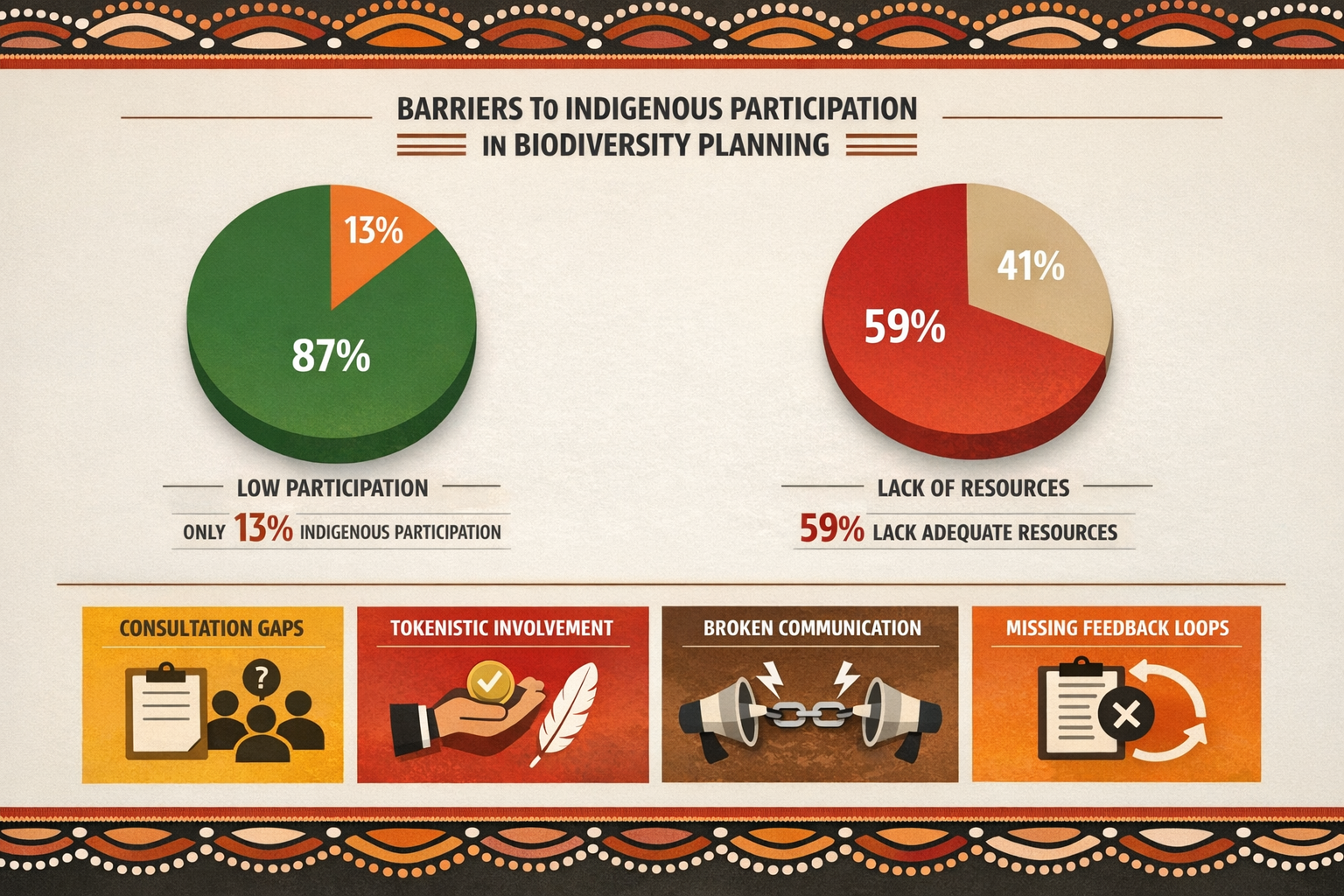
- 📊 Only 13% of Indigenous representatives participated meaningfully in national biodiversity planning across 15 Asian countries, revealing massive participation gaps [1]
- 🤝 Ethical integration requires genuine partnership, not tokenistic consultation—59% of Indigenous participants lacked sufficient resources for meaningful engagement [1]
- 📈 Indigenous-led monitoring systems are proving their empirical value through local data collection that validates historical conservation gains [1]
- 🔄 Successful integration frameworks emphasize free, prior and informed consent, equitable resource allocation, and transparent feedback mechanisms
Understanding the Value of Indigenous Ecological Knowledge
Indigenous peoples have stewarded biodiversity-rich landscapes for thousands of years, developing sophisticated ecological monitoring systems rooted in direct observation, intergenerational knowledge transfer, and deep place-based understanding. This traditional ecological knowledge (TEK) encompasses detailed information about species behavior, population trends, seasonal patterns, and ecosystem relationships that often extends far beyond the temporal scope of Western scientific studies.
What Makes Indigenous Knowledge Unique?
Traditional ecological knowledge differs fundamentally from conventional scientific approaches in several key ways:
- Temporal depth: Observations passed down through generations provide baseline data spanning centuries
- Holistic perspective: Indigenous knowledge views ecosystems as interconnected wholes rather than isolated components
- Adaptive management: Traditional practices evolve through continuous observation and adjustment
- Cultural integration: Ecological knowledge intertwines with spiritual, social, and governance systems
- Local specificity: Place-based wisdom captures micro-variations that broad scientific surveys may miss
According to 2026 research, projects rooted in Indigenous knowledge systems consistently deliver stronger biodiversity outcomes and more durable adaptation benefits compared to conventional conservation approaches [3]. This superior performance stems from the deep contextual understanding and long-term stewardship perspective inherent in Indigenous ecological practices.
Complementary Strengths of Scientific and Traditional Approaches
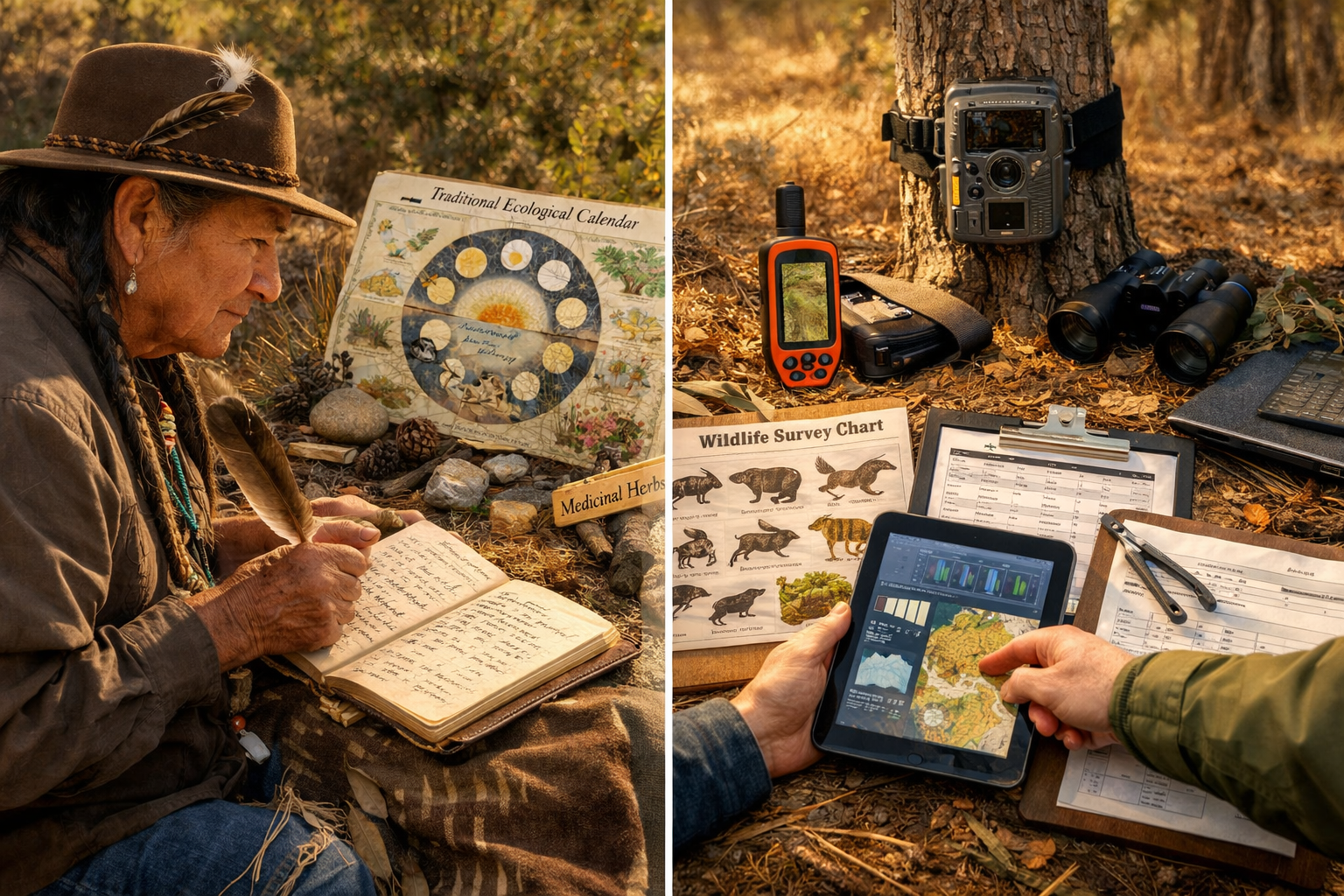
Rather than competing methodologies, scientific monitoring and Indigenous knowledge offer complementary strengths that enhance biodiversity surveys when properly integrated:
| Indigenous Knowledge | Scientific Monitoring |
|---|---|
| Long-term temporal perspective | Standardized measurement protocols |
| Holistic ecosystem understanding | Quantitative data collection |
| Qualitative observational richness | Statistical analysis capabilities |
| Adaptive local management | Reproducible methodologies |
| Cultural context and values | Peer-reviewed validation |
The most effective biodiversity surveys in 2026 leverage both approaches, creating data sets that are simultaneously rigorous, comprehensive, and culturally grounded. When conducting biodiversity impact assessments, integrating Indigenous observations can reveal ecological relationships and trends that purely technical surveys might overlook.
Current Challenges in Leveraging Indigenous Knowledge in Biodiversity Surveys
Despite the proven value of Leveraging Indigenous Knowledge in Biodiversity Surveys: Integrating Traditional Observations with Scientific Monitoring in 2026, significant systemic barriers prevent meaningful integration. A comprehensive 2026 survey by the Asia Indigenous Peoples Pact (AIPP) of 85 organizations across 15 Asian countries revealed troubling participation gaps [1].
Limited Meaningful Participation
The numbers paint a stark picture of exclusion:
- Only 13% of Indigenous representatives participated in state-led consultations for national biodiversity strategies and action plans (NBSAP) [1]
- Nearly 60% of those who did participate reported the engagement was not meaningful [1]
- Only 6% of national biodiversity targets mention Indigenous peoples' right to free, prior and informed consent [1]
These statistics reveal that most biodiversity planning processes continue to exclude the very communities whose knowledge and stewardship are most critical for conservation success.
Tokenistic Consultation Practices
Indigenous respondents described being invited to "tick boxes" rather than serving as equal partners in decision-making processes [1]. This tokenistic participation manifests in several ways:
- ❌ Last-minute invitations without adequate preparation time
- ❌ Consultation meetings held in inaccessible locations
- ❌ Technical jargon and documents not translated into Indigenous languages
- ❌ Predetermined outcomes with no genuine opportunity for input
- ❌ Failure to compensate Indigenous experts for their time and knowledge
Such practices reinforce technocratic conservation models rather than enabling genuine co-decision-making. When Indigenous knowledge holders are treated as informants rather than partners, the resulting biodiversity surveys miss crucial contextual understanding and fail to build the trust necessary for long-term conservation success.
Resource and Information Barriers
The AIPP survey revealed that 59% of Indigenous participants in NBSAP revision processes lacked sufficient time, information, and resources to participate meaningfully [1]. These barriers include:
- Financial constraints: No funding for travel, accommodations, or participation costs
- Information gaps: Limited access to technical documents and background materials
- Capacity limitations: Insufficient support for Indigenous organizations to engage effectively
- Language barriers: Documents and meetings conducted exclusively in dominant languages
- Time pressures: Rushed timelines that prevent community consultation
These resource disparities create fundamentally unequal participation conditions. While government agencies and scientific institutions have dedicated staff and budgets for biodiversity planning, Indigenous communities must often participate on a voluntary basis while managing numerous other pressing concerns.
Lack of Feedback and Accountability
Perhaps most troublingly, 49% of Indigenous participants did not know whether their inputs were reflected in final biodiversity planning documents [1]. This feedback vacuum indicates:
- Opaque decision-making processes
- No accountability for incorporating Indigenous knowledge
- Failure to communicate outcomes back to participants
- Missing mechanisms for ongoing dialogue
Only 9% of Indigenous participants received NBSAP update information directly from governments [1], demonstrating the one-way nature of most consultation processes. This lack of transparency undermines trust and discourages future participation.
For professionals working on biodiversity net gain projects, understanding these barriers is essential for designing more inclusive and effective survey methodologies.
Best Practices for Integrating Traditional Observations with Scientific Monitoring
Successfully Leveraging Indigenous Knowledge in Biodiversity Surveys: Integrating Traditional Observations with Scientific Monitoring in 2026 requires moving beyond tokenistic consultation toward genuine partnership. The following best practices emerge from successful integration efforts worldwide.
Establish Genuine Partnership from Project Inception
Effective integration begins before any survey work commences:
✅ Engage Indigenous communities early in project design, not after methodologies are predetermined
✅ Recognize Indigenous peoples as rights holders, not merely stakeholders or informants
✅ Obtain free, prior and informed consent through culturally appropriate processes
✅ Co-develop research questions and methodologies that address both scientific and community priorities
✅ Establish clear governance structures that ensure Indigenous decision-making authority
The 2026 Science Summit's Indigenous Knowledge Plenary emphasizes empowerment of Indigenous researchers and culturally safe research practices as foundational elements [2]. This means creating space for Indigenous leadership rather than extracting knowledge for external purposes.
Ensure Equitable Resource Allocation
Meaningful participation requires adequate resources:
- 💰 Fair compensation for Indigenous knowledge holders' time and expertise
- 🚗 Travel and accommodation funding for participation in meetings and fieldwork
- 📚 Capacity building support for Indigenous organizations and researchers
- 🔧 Access to monitoring equipment and technology when appropriate
- 📄 Translation services for all key documents and communications
Projects should budget specifically for Indigenous participation from the outset, treating it as essential infrastructure rather than an optional add-on. When planning biodiversity assessments, allocating resources for Indigenous partnership demonstrates genuine commitment to integration.
Create Culturally Appropriate Documentation Methods
Indigenous knowledge systems often rely on oral transmission, experiential learning, and holistic understanding that may not translate easily into conventional scientific documentation. Effective integration requires:
- 🎥 Multiple documentation formats: audio recordings, video, photographs, maps, and written notes
- 🗣️ Indigenous language preservation: documentation in native languages with translation
- 🎨 Cultural protocols: respect for knowledge that should not be shared publicly or with certain groups
- 📍 Place-based context: linking observations to specific locations and cultural landscapes
- 🌐 Community ownership: ensuring Indigenous communities retain control over their knowledge
Some Indigenous communities are developing their own local data systems to validate historical conservation gains and inform policies [1]. Supporting these community-led initiatives often proves more effective than imposing external documentation frameworks.
Integrate Multiple Knowledge Systems Respectfully
The goal is not to subordinate Indigenous knowledge to scientific frameworks or vice versa, but to create complementary data sets that enhance overall understanding:
Parallel documentation: Maintain separate Indigenous and scientific data streams that can be compared and cross-validated
Joint interpretation: Bring knowledge holders and scientists together to analyze findings collaboratively
Acknowledge uncertainties: Both knowledge systems have limitations and areas of uncertainty
Value different types of evidence: Recognize that qualitative observations and quantitative measurements both contribute valuable insights
Respect intellectual property: Establish clear agreements about data ownership, use, and attribution
The Philippines' publication of its Indigenous Peoples Biodiversity Strategy and Action Plan (IPBSAP) in 2025 provides a model for Indigenous-led planning that complements rather than replaces national biodiversity targets [1].
Establish Transparent Feedback Mechanisms
To address the accountability gaps identified in the AIPP survey, integration projects must:
- 📢 Communicate regularly with Indigenous partners throughout the survey process
- 📊 Share preliminary findings and invite interpretation and feedback
- 📝 Document how Indigenous knowledge influenced survey design, data collection, and conclusions
- 🔄 Provide final reports in accessible formats and languages
- 🤝 Maintain ongoing relationships beyond individual project timelines
Creating these feedback loops transforms one-off consultation into sustained partnership. For developers working on biodiversity net gain strategies, establishing these relationships early can provide valuable ecological insights throughout project lifecycles.
Support Indigenous-Led Monitoring Initiatives
The most powerful integration often occurs when Indigenous communities lead their own monitoring programs with scientific support rather than vice versa:
- 🌟 Community-based monitoring programs where Indigenous peoples design and implement surveys
- 🎓 Training and capacity building that respects existing knowledge while adding technical skills
- 💻 Technology transfer that empowers communities to use monitoring tools independently
- 📈 Long-term funding commitments that enable sustained monitoring efforts
- 🏛️ Policy influence pathways that connect community monitoring to decision-making
Indigenous women and knowledge holders are increasingly developing these local data systems, demonstrating the empirical success of Indigenous-led approaches [1]. Supporting these initiatives represents a more equitable and effective path forward than traditional top-down survey methodologies.
Policy and Institutional Frameworks Supporting Integration
Successful Leveraging Indigenous Knowledge in Biodiversity Surveys: Integrating Traditional Observations with Scientific Monitoring in 2026 requires supportive policy environments and institutional structures.
International Frameworks and Commitments
Several international agreements and frameworks establish foundations for Indigenous knowledge integration:
- Convention on Biological Diversity (CBD): Recognizes the importance of traditional knowledge for biodiversity conservation
- UN Declaration on the Rights of Indigenous Peoples (UNDRIP): Establishes rights to maintain traditional knowledge and participate in decision-making
- Kunming-Montreal Global Biodiversity Framework: Includes targets for Indigenous participation in conservation
- UN Sustainable Development Goals: Specifically address Indigenous knowledge in climate and biodiversity goals [2]
However, the gap between policy commitments and implementation remains substantial. Only 6% of national biodiversity targets mention free, prior and informed consent [1], indicating that international frameworks have not yet translated into meaningful national-level action.
Emerging Models and Precedents
Despite systemic challenges, promising models are emerging:
Indigenous Peoples Biodiversity Strategy and Action Plans (IPBSAPs): Following the Philippines' example, these Indigenous-led planning documents serve as both advocacy tools and practical guides for community conservation efforts [1]
Co-management agreements: Formal arrangements that share decision-making authority between Indigenous communities and government agencies
Indigenous Protected and Conserved Areas (IPCAs): Recognition of Indigenous-led conservation territories within national protected area systems
Traditional knowledge databases: Community-controlled repositories that document ecological knowledge while respecting cultural protocols
Academic-Indigenous research partnerships: University programs emphasizing equitable partnerships and culturally safe research practices [2]
These models demonstrate that genuine integration is possible when institutional structures support Indigenous leadership rather than merely extracting knowledge.
Advocacy and Capacity Building
The AIPP reports that developing Indigenous-led action plans serves as both an advocacy tool and planning guide for community struggles against extractive industries and mining projects that threaten biodiversity [1]. This dual function highlights how biodiversity monitoring intersects with broader Indigenous rights and self-determination.
Organizations and initiatives supporting integration include:
- Indigenous peoples' networks and advocacy organizations
- Academic institutions developing ethical research protocols
- Funding mechanisms specifically for Indigenous-led conservation
- Policy forums bringing together Indigenous leaders and decision-makers
- Training programs building capacity in both Indigenous communities and scientific institutions
When considering how to achieve biodiversity net gain, engaging with these support structures can facilitate more effective Indigenous knowledge integration.
Practical Applications for Developers and Conservation Professionals
For professionals conducting biodiversity surveys in 2026, integrating Indigenous knowledge offers practical benefits beyond ethical considerations.
Enhanced Data Quality and Comprehensiveness
Indigenous knowledge can fill critical gaps in biodiversity surveys:
- Historical baselines: Understanding pre-development ecosystem conditions
- Seasonal variations: Identifying species presence across annual cycles
- Rare species information: Locating elusive or infrequently observed species
- Behavioral patterns: Understanding animal movement, breeding, and feeding patterns
- Ecosystem relationships: Recognizing connections between species and habitats
This enhanced data quality directly supports more accurate biodiversity impact assessments and more effective conservation planning.
Risk Reduction and Social License
Projects that meaningfully engage Indigenous communities reduce several key risks:
- Regulatory delays: Proactive engagement prevents conflicts that can stall projects
- Reputational damage: Demonstrates commitment to ethical and inclusive practices
- Legal challenges: Respects Indigenous rights and reduces litigation risk
- Project opposition: Builds community support through genuine partnership
- Conservation failures: Leverages local knowledge for more effective outcomes
For developers navigating biodiversity net gain requirements, Indigenous partnership can provide valuable insights for both on-site and off-site delivery strategies.
Implementation Steps for Practitioners
Conservation professionals and developers can take concrete steps toward integration:
- Conduct Indigenous rights and presence research early in project planning
- Budget adequately for Indigenous engagement and partnership
- Engage cultural liaison specialists who can facilitate respectful communication
- Develop co-designed survey protocols that integrate multiple knowledge systems
- Establish data sharing agreements that respect Indigenous intellectual property
- Create feedback mechanisms that maintain ongoing communication
- Document integration processes to build institutional learning
These steps transform Indigenous knowledge integration from abstract principle to practical methodology.
The Path Forward: Building Equitable Partnerships in 2026 and Beyond
The evidence is clear: Leveraging Indigenous Knowledge in Biodiversity Surveys: Integrating Traditional Observations with Scientific Monitoring in 2026 produces superior conservation outcomes. Yet systemic barriers continue to prevent meaningful Indigenous participation in biodiversity planning and monitoring.
Moving forward requires fundamental shifts in how conservation institutions, government agencies, and development professionals approach Indigenous knowledge:
From consultation to partnership: Recognizing Indigenous peoples as rights holders and decision-makers, not merely sources of information
From extraction to reciprocity: Ensuring that Indigenous communities benefit from research and monitoring, not just contribute to it
From tokenism to transformation: Changing institutional structures and power dynamics, not just adding Indigenous voices to existing processes
From short-term projects to long-term relationships: Building sustained partnerships that extend beyond individual survey cycles
The 2026 Science Summit's focus on integration of traditional knowledge with modern science for addressing UN Sustainable Development Goals [2] reflects growing institutional recognition of these imperatives. Similarly, the IUCN's 2026 analysis confirming superior biodiversity outcomes from Indigenous knowledge-based projects [3] provides empirical validation for integration approaches.
For the conservation and development sectors, the question is no longer whether to integrate Indigenous knowledge, but how to do so ethically, effectively, and equitably. The frameworks, models, and best practices outlined in this article provide pathways forward—but success ultimately depends on genuine commitment to partnership and institutional change.
Conclusion
Leveraging Indigenous Knowledge in Biodiversity Surveys: Integrating Traditional Observations with Scientific Monitoring in 2026 represents both a practical necessity and an ethical imperative. As biodiversity loss accelerates globally, conservation efforts cannot afford to ignore the sophisticated ecological knowledge systems that Indigenous peoples have developed through millennia of careful stewardship.
The research is unequivocal: Indigenous knowledge-based projects deliver stronger biodiversity outcomes than conventional approaches. Yet systemic barriers—including limited participation, tokenistic consultation, resource inequities, and accountability gaps—continue to prevent meaningful integration. Addressing these barriers requires fundamental shifts in institutional approaches, moving from extraction to partnership, from consultation to co-decision-making, and from short-term projects to sustained relationships.
Actionable Next Steps
For conservation professionals and developers seeking to integrate Indigenous knowledge into biodiversity surveys:
✅ Begin with rights-based engagement: Research Indigenous presence and rights in project areas before designing survey methodologies
✅ Allocate adequate resources: Budget specifically for Indigenous partnership, including fair compensation, capacity support, and ongoing engagement
✅ Co-develop methodologies: Work with Indigenous communities to design survey approaches that respect both traditional knowledge and scientific standards
✅ Establish transparent processes: Create clear feedback mechanisms and accountability structures throughout the survey lifecycle
✅ Support Indigenous leadership: Prioritize Indigenous-led monitoring initiatives over extractive consultation models
✅ Build institutional capacity: Develop organizational competencies in culturally safe research practices and equitable partnership
✅ Advocate for policy change: Support Indigenous rights and meaningful participation requirements in biodiversity planning frameworks
The integration of Indigenous knowledge with scientific monitoring is not merely about improving data quality—though it demonstrably does so. It is about recognizing the rights, expertise, and leadership of Indigenous peoples in conserving the biodiversity upon which all life depends. As we navigate the biodiversity crisis in 2026 and beyond, this recognition must move from principle to practice.
For professionals working on biodiversity net gain projects or creating biodiversity plans, integrating Indigenous knowledge offers a pathway to more comprehensive, culturally grounded, and ultimately more successful conservation outcomes. The question is not whether to pursue this integration, but how quickly institutions can transform to make genuine partnership the standard rather than the exception.
References
[1] Many Indigenous Peoples In Asia Feel Excluded From Natl Biodiversity Planning Report – https://news.mongabay.com/2026/03/many-indigenous-peoples-in-asia-feel-excluded-from-natl-biodiversity-planning-report/
[2] Indigenous Knowledge – https://sciencesummitnyc.org/science-summit-unga79/indigenous-knowledge/
[3] Finance Forests And First Nations Partners Chart Nature Positive Future International – https://iucn.org/news/202602/finance-forests-and-first-nations-partners-chart-nature-positive-future-international