

The difference between capturing a single photograph and recording a full documentary often determines whether conservation efforts succeed or fail. In 2026, biodiversity monitoring stands at a critical crossroads where choosing between full-season continuous monitoring and snapshot surveys can mean the difference between detecting genuine population trends and missing crucial ecological signals entirely. As monitoring guides increasingly emphasize, the shift toward continuous monitoring from early spring through autumn captures complete biological activity cycles and conservation intervention responses—something single-moment surveys simply cannot achieve.
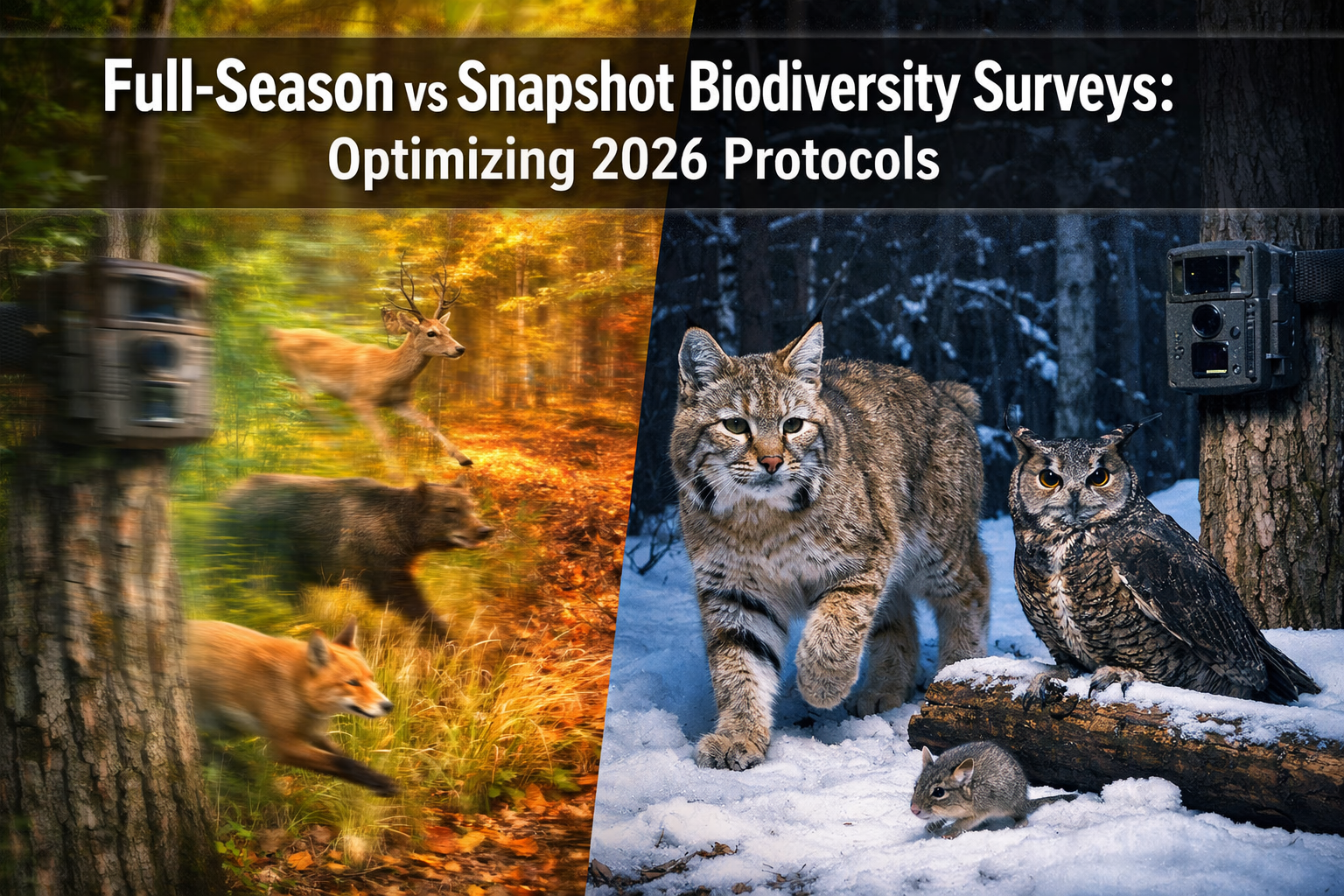
Understanding Full-Season vs Snapshot Biodiversity Surveys: Optimizing 2026 Protocols for Detecting Pulsed Ecological Dynamics has become essential for developers, conservation planners, and ecological consultants navigating increasingly sophisticated biodiversity requirements. With projects like Snapshot USA capturing nearly 6 million images in 2024 alone and protocols evolving based on rigorous analysis, the biodiversity monitoring landscape demands strategic decision-making grounded in scientific evidence.[1]
Key Takeaways
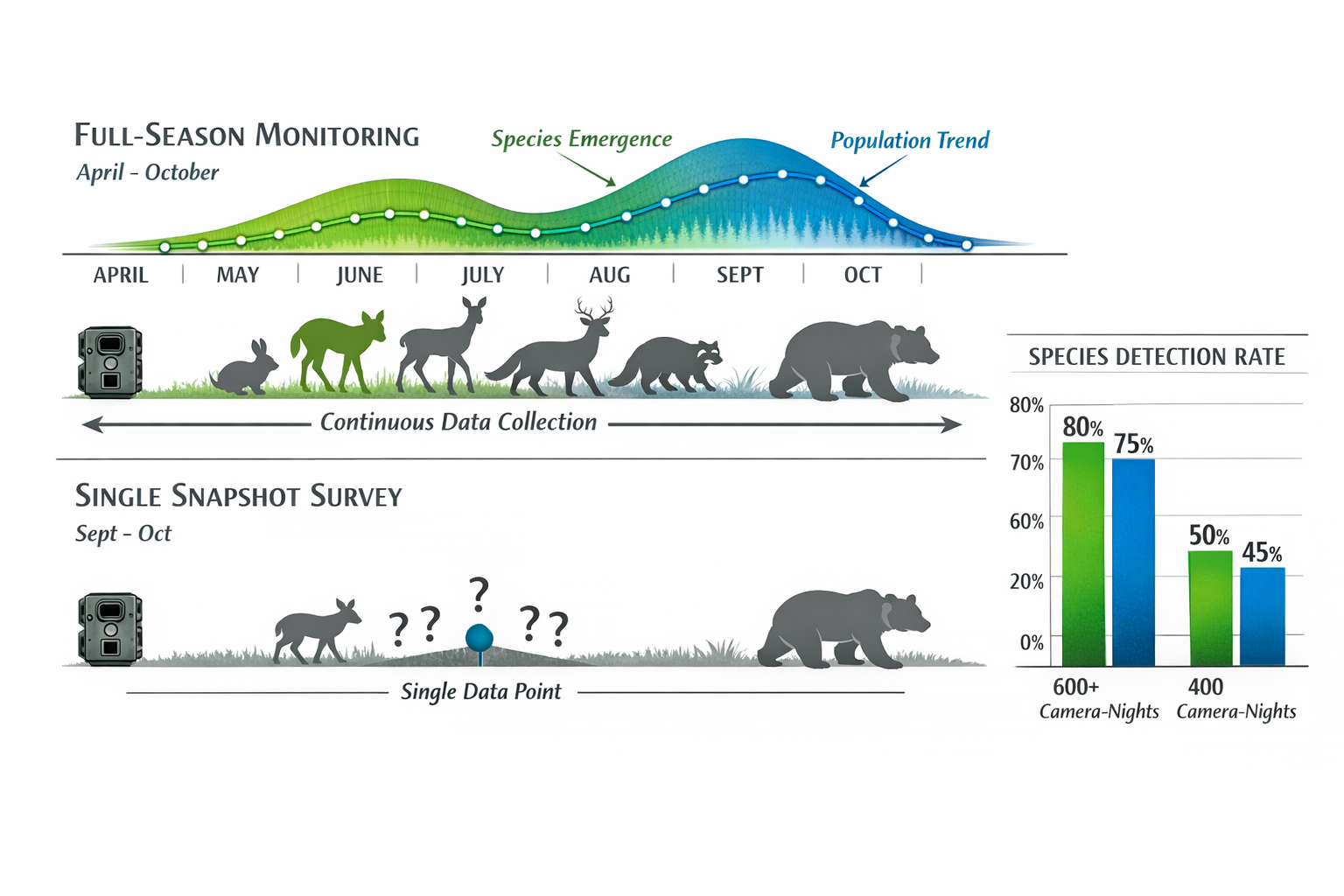
- 🔄 Full-season monitoring beginning in early spring captures complete biological activity arcs from species emergence through peak summer and seasonal decline, revealing ecosystem rhythms that snapshot surveys miss entirely
- 📊 Enhanced detection protocols now recommend 600+ camera-nights of data collection across 15 camera locations per array, significantly improving species detection rates compared to previous 400-night minimums
- 🎯 Continuous monitoring separates signal from noise, distinguishing genuine long-term population trends from weather-driven variation and enabling measurable assessment of conservation intervention effectiveness
- 🌍 Standardized protocols enable cross-ecosystem comparisons that support evidence-based conservation strategies tailored to regional conditions and specific ecological contexts
- ⚡ Pulsed ecological dynamics—including breeding seasons, migration patterns, and resource availability fluctuations—require temporal coverage that single-moment surveys cannot provide
Understanding the Fundamental Differences Between Full-Season and Snapshot Biodiversity Surveys
The core distinction between full-season and snapshot biodiversity surveys lies in temporal coverage and the ecological questions each approach can answer. Snapshot surveys represent concentrated monitoring efforts occurring during specific, limited timeframes—typically weeks or months—designed to capture biodiversity presence at a particular moment. Full-season monitoring, conversely, tracks ecosystems continuously from early spring through autumn or even year-round, documenting how species populations, behaviors, and ecological interactions change across complete seasonal cycles.[3]
What Snapshot Surveys Reveal (and What They Miss)
Snapshot surveys excel at generating rapid baseline inventories of species presence within defined geographic areas. The Snapshot USA project exemplifies this approach, conducting coordinated mammal surveys annually during September and October across 186 camera trap arrays nationwide.[1] Collaborators deploy minimum arrays of 8-15 camera traps, generating standardized datasets that enable cross-ecosystem comparisons impossible with isolated regional studies.
The five-year cumulative dataset from Snapshot USA now includes over 800,000 mammal captures from approximately 10.5 million raw images, providing unprecedented baseline data for regional conservation strategies.[1] This standardized approach offers remarkable spatial coverage and enables researchers to compare mammal communities across diverse U.S. ecosystems using consistent methodologies.
However, snapshot surveys face inherent limitations when detecting pulsed ecological dynamics:
- Seasonal activity patterns remain invisible when surveys occur during single timeframes
- Breeding seasons and juvenile recruitment may be entirely missed if surveys occur outside reproductive periods
- Migration timing and stopover habitat use cannot be documented without continuous monitoring
- Resource availability fluctuations and their effects on species distributions go undetected
- Weather-driven population variations become confused with genuine long-term trends
The Power of Full-Season Continuous Monitoring
Full-season monitoring beginning in early spring provides baseline datasets that evolve with ecosystems rather than capturing static snapshots.[3] This approach allows researchers to understand complex ecosystem functions when systems operate under natural conditions, revealing patterns that emerge only through sustained observation.
Continuous monitoring delivers several critical advantages:
Distinguishing Trends from Noise: Weather events, temporary food shortages, or isolated disturbances can dramatically affect species detections during brief survey windows. Full-season monitoring separates these short-term fluctuations from genuine population trends, enabling researchers to identify whether conservation interventions produce measurable ecological responses.[3]
Capturing Complete Biological Activity Arcs: Species emergence in spring, peak summer activity, breeding seasons, juvenile dispersal, and autumn preparation for winter represent interconnected ecological processes. Missing any phase means losing critical information about population dynamics, reproductive success, and ecosystem health.
Detecting Conservation Intervention Effectiveness: When conducting biodiversity impact assessments, determining whether management actions actually benefit target species requires temporal data showing population responses over time—something impossible to achieve with single-moment surveys.
Supporting Biodiversity Net Gain Requirements: As developers navigate biodiversity net gain obligations, demonstrating genuine habitat quality improvements requires evidence of sustained species use and population establishment, not merely presence during brief survey windows.
Optimizing 2026 Protocols for Full-Season vs Snapshot Biodiversity Surveys
The evolution of biodiversity monitoring protocols in 2026 reflects growing scientific understanding of what constitutes adequate sampling effort for reliable ecological inference. Recent analysis has fundamentally reshaped recommendations for both snapshot and continuous monitoring approaches.
Enhanced Camera-Night Requirements and Array Design
Analysis of Snapshot USA data revealed that minimum camera deployment recommendations increased from 8 to 15 locations per array based on evidence showing grids with 600+ camera-nights detected significantly more mammalian species than those meeting only the previous 400-night minimum across all physiographic regions.[2]
This finding has profound implications:
| Protocol Element | Previous Standard | 2026 Optimized Protocol | Improvement |
|---|---|---|---|
| Camera locations per array | 8 minimum | 15 recommended | +87.5% spatial coverage |
| Total camera-nights | 400 minimum | 600+ recommended | +50% detection probability |
| Deployment duration (snapshot) | 6-8 weeks | 8-10 weeks | Extended temporal window |
| Microhabitat diversity | Single habitat type acceptable | Multiple microhabitats required | Reduced sampling bias |
The 600 camera-nights threshold represents a critical inflection point where species detection rates substantially improve, indicating that minimal deployments may miss species actually present in surveyed ecosystems.[2] For developers and consultants working on biodiversity net gain assessments, meeting enhanced protocols ensures defensible baseline data that regulatory authorities will accept.
Addressing Urban Sampling Bias Through Microhabitat Diversity
Diverse green space sampling in developed areas has emerged as essential for avoiding urban sampling bias.[2] Rather than concentrating cameras in single habitat types, 2026 protocols require collaborators to sample multiple microhabitat types including:
- 🏞️ Public parks and nature reserves (traditional conservation focus areas)
- ⛪ Cemeteries and memorial gardens (often overlooked biodiversity refuges)
- 🏘️ Residential yards and community gardens (documenting human-wildlife coexistence)
- 🌳 Urban forest fragments and greenways (connectivity corridors)
- 💧 Stormwater retention areas and constructed wetlands (engineered habitat features)
This diversified approach reveals how wildlife actually uses urban landscapes rather than presenting idealized pictures based solely on protected spaces. For architects and planners solving biodiversity net gain challenges, understanding genuine habitat use patterns across diverse urban microhabitats informs more effective design interventions.
Standardized Data Processing and AI-Assisted Identification
The integration of Wildlife Insights AI platform for automated species identification has revolutionized data processing efficiency.[1] Rather than requiring manual review of millions of images—a prohibitively time-consuming task—AI-assisted identification enables:
- ⚡ Rapid processing of massive image datasets
- 🎯 Consistent identification standards across multiple survey locations
- 📊 Immediate data availability for conservation planning
- 🔍 Quality control flagging of uncertain identifications for expert review
However, AI platforms require standardized deployment protocols to function effectively. Camera placement, trigger settings, and image quality specifications must remain consistent to ensure AI algorithms perform reliably across diverse environments.
When to Choose Full-Season Monitoring vs Snapshot Surveys
Strategic protocol selection depends on specific project objectives and regulatory requirements:
Choose Snapshot Surveys When:
- Rapid baseline species inventories are needed
- Budget constraints limit extended monitoring
- Standardized cross-site comparisons are priority
- Regulatory requirements specify snapshot methodologies
- Initial site assessment precedes detailed studies
Choose Full-Season Monitoring When:
- Detecting pulsed ecological dynamics is essential
- Assessing conservation intervention effectiveness
- Supporting biodiversity net gain delivery with robust evidence
- Understanding seasonal habitat use patterns
- Distinguishing long-term trends from weather variation
- Documenting breeding success and juvenile recruitment
For most development projects requiring 10% biodiversity net gain achievement, full-season monitoring provides the robust evidence base needed to demonstrate genuine habitat improvements rather than temporary species presence during favorable conditions.
Detecting Pulsed Ecological Dynamics: Why Timing Matters in 2026 Protocols

Pulsed ecological dynamics refer to the rhythmic, often dramatic fluctuations in species activity, abundance, and ecological interactions that occur across seasonal cycles. These dynamics include breeding pulses, migration waves, resource availability fluctuations, and phenological shifts—all of which fundamentally shape ecosystem structure and function.
The Early Spring Monitoring Advantage
Starting monitoring efforts in early spring (April in temperate regions) captures critical ecological events that autumn-focused snapshot surveys completely miss:[3]
Species Emergence and Territory Establishment: Many species emerge from hibernation or return from migration in spring, establishing territories and breeding sites. Missing this period means failing to document which habitats species actually select for reproduction—arguably the most important habitat quality indicator.
Breeding Season Documentation: Reproductive success determines population viability. Full-season monitoring documents breeding attempts, nest site selection, and juvenile recruitment—information essential for assessing whether habitat management interventions support population persistence.
Resource Availability Tracking: Spring flowering, insect emergence, and vegetation growth create resource pulses that cascade through food webs. Understanding how species respond to these pulses reveals ecological relationships that static surveys cannot detect.
Baseline Evolution: Rather than assuming ecosystems remain static, early-season monitoring establishes baselines that evolve naturally with seasonal progression, providing context for interpreting later observations.[3]
Separating Signal from Noise in Population Trends
One of the most compelling arguments for full-season monitoring involves distinguishing genuine population trends from weather-driven variation.[3] Consider these scenarios:
Scenario 1: Snapshot Survey During Drought
A snapshot survey conducted during unusually dry September conditions detects low mammal activity near water sources. Conclusion: habitat quality is poor. Reality: temporary weather conditions temporarily displaced animals to areas with reliable water, but populations remain healthy and will return when normal conditions resume.
Scenario 2: Full-Season Monitoring Through Drought
Continuous monitoring documents normal spring and early summer activity, followed by temporary displacement during drought, then rapid recolonization when autumn rains arrive. Conclusion: habitat provides adequate resources under normal conditions and serves as important drought refuge once water returns. Management recommendation: enhance water retention features to improve drought resilience.
The second scenario provides actionable management insights that the first scenario completely misses. For developers implementing biodiversity plans, this distinction determines whether habitat creation efforts receive appropriate credit for genuine conservation value.
Multi-Year Data Aggregation for Robust Trend Detection
The shift toward multi-year data aggregation rather than individual year reporting represents a fundamental evolution in biodiversity monitoring philosophy.[1] Single-year datasets often reflect idiosyncratic weather patterns, temporary disturbances, or unusual ecological events. Multi-year aggregation provides:
- 📈 Greater statistical power for detecting genuine population trends
- 🔄 Context for interpreting annual variation as normal fluctuation versus concerning decline
- ⚙️ Identification of cyclical patterns in species abundance and distribution
- 🎯 More reliable baselines for assessing conservation intervention effectiveness
For projects requiring biodiversity impact assessments, multi-year datasets provide the robust evidence base that single-year snapshots cannot deliver.
Regional Ecological Response Patterns
Standardized protocols enable cross-ecosystem comparisons that reveal regionally-specific ecological responses.[1] The same conservation intervention may produce dramatically different results in different physiographic regions, soil types, or climatic zones. Understanding these regional patterns requires:
- 🗺️ Consistent methodologies across diverse locations
- 📊 Sufficient sample sizes within each region
- 🔬 Comparable data quality enabling statistical analysis
- 🌐 Collaborative networks sharing standardized datasets
The Snapshot USA project demonstrates how coordinated efforts using standardized protocols generate insights impossible to achieve through isolated regional studies. For conservation planners, understanding regional response patterns informs evidence-based strategies tailored to local ecological conditions rather than applying generic approaches that may prove ineffective in specific contexts.
Practical Implementation: Integrating Optimized Protocols into 2026 Biodiversity Assessments
Translating protocol optimization into practical implementation requires strategic planning that balances scientific rigor with project constraints. Whether working on development projects, conservation initiatives, or research programs, several key considerations shape successful biodiversity monitoring in 2026.
Budget Allocation and Cost-Effectiveness Analysis
Full-season monitoring requires greater upfront investment than snapshot surveys, but delivers substantially more valuable data per monitoring effort. Consider this cost-benefit framework:
Snapshot Survey Costs:
- Equipment deployment and retrieval (2-3 site visits)
- 8-10 weeks of data collection
- Data processing and species identification
- Single-season species inventory
- Limited temporal inference capability
Full-Season Monitoring Costs:
- Equipment deployment and retrieval (2-3 site visits)
- 6-8 months of data collection
- Data processing and species identification
- Complete seasonal activity documentation
- Robust trend detection and intervention assessment
While full-season monitoring involves longer equipment deployment, the incremental cost increase is modest compared to the exponential increase in data value. For projects where achieving biodiversity net gain without risk is essential, the additional investment provides insurance against regulatory challenges based on inadequate baseline data.
Regulatory Compliance and Evidence Standards
Different regulatory contexts establish varying evidence standards for biodiversity assessments. In 2026, regulators increasingly recognize that:
- Single-season snapshots provide limited evidence for habitat quality claims
- Multi-season monitoring demonstrates genuine habitat functionality rather than temporary species presence
- Documented population trends support biodiversity net gain claims more convincingly than species lists
- Intervention effectiveness assessment requires temporal data showing population responses
When planning monitoring programs for development projects, consulting with regulatory authorities early in project design clarifies evidence expectations and prevents costly protocol revisions later. Many developers benefit from early engagement with biodiversity specialists who understand both ecological requirements and regulatory expectations.
Technology Integration and Data Management
Modern biodiversity monitoring increasingly relies on technology integration across data collection, processing, and analysis phases:
Camera Trap Technology:
- High-resolution imaging with minimal false triggers
- Extended battery life supporting season-long deployment
- Weather-resistant housing for diverse environments
- Wireless data transmission for real-time monitoring
AI-Assisted Processing:
- Automated species identification reducing processing time
- Quality control flagging uncertain identifications
- Immediate data availability for adaptive management
- Consistent identification standards across locations
Data Management Platforms:
- Centralized storage with standardized metadata
- Collaborative access for research teams
- Integration with biodiversity metric calculators
- Long-term archiving supporting multi-year analysis
For organizations managing multiple projects, investing in robust data management infrastructure pays dividends through improved efficiency and data quality across entire project portfolios.
Adaptive Management and Protocol Refinement
The evolution from 400 to 600+ camera-nights demonstrates how evidence-based protocol refinement improves monitoring effectiveness over time.[2] Organizations should establish systematic processes for:
- 📊 Analyzing detection rates across different deployment configurations
- 🔄 Comparing results between standard and enhanced protocols
- 📈 Quantifying improvements in species detection and data quality
- ⚙️ Updating protocols based on empirical evidence
- 📚 Documenting lessons learned for future projects
This adaptive approach ensures monitoring programs continuously improve rather than perpetuating outdated methodologies that may miss important ecological signals.
Conclusion: Strategic Protocol Selection for Robust Biodiversity Evidence in 2026
The choice between Full-Season vs Snapshot Biodiversity Surveys: Optimizing 2026 Protocols for Detecting Pulsed Ecological Dynamics fundamentally shapes the quality of ecological evidence available for conservation decision-making. While snapshot surveys provide valuable rapid baseline inventories and enable standardized cross-ecosystem comparisons, full-season continuous monitoring captures the complete biological activity arcs, seasonal dynamics, and population trends that increasingly sophisticated biodiversity requirements demand.
The 2026 monitoring landscape reflects several critical shifts:
✅ Enhanced detection protocols now recommend 600+ camera-nights across 15 camera locations per array, substantially improving species detection rates compared to previous standards
✅ Early spring monitoring initiation captures complete seasonal cycles from species emergence through autumn preparation, revealing ecosystem rhythms that autumn-only surveys miss entirely
✅ Continuous monitoring separates genuine population trends from weather-driven variation, enabling evidence-based assessment of conservation intervention effectiveness
✅ Multi-year data aggregation provides statistical power for robust trend detection that single-year datasets cannot deliver
✅ Microhabitat diversity requirements address urban sampling bias and reveal actual wildlife habitat use patterns across complex landscapes
For developers, conservation planners, and ecological consultants navigating biodiversity net gain requirements, strategic protocol selection determines whether monitoring investments generate defensible evidence supporting regulatory compliance and genuine conservation outcomes. The shift toward continuous monitoring from early spring through autumn represents not merely a technical protocol change, but a fundamental evolution in how biodiversity science approaches ecosystem understanding.
Actionable Next Steps
Organizations seeking to optimize biodiversity monitoring protocols in 2026 should:
-
Assess project-specific monitoring objectives to determine whether rapid baseline inventories or comprehensive seasonal documentation better serves project needs
-
Consult with biodiversity specialists early in project planning to align monitoring protocols with regulatory evidence expectations and conservation goals
-
Invest in enhanced camera trap arrays meeting 600+ camera-night thresholds across diverse microhabitats to ensure adequate species detection
-
Implement early spring monitoring initiation for projects requiring robust evidence of habitat functionality and conservation intervention effectiveness
-
Establish data management infrastructure supporting multi-year aggregation and adaptive protocol refinement based on empirical results
-
Engage with collaborative monitoring networks to contribute to and benefit from standardized datasets enabling regional ecological comparisons
The ecological questions driving biodiversity monitoring in 2026 increasingly demand temporal data revealing how ecosystems function across complete seasonal cycles. While snapshot surveys retain important roles in specific contexts, the growing emphasis on detecting pulsed ecological dynamics, assessing conservation interventions, and demonstrating genuine habitat quality points clearly toward full-season continuous monitoring as the gold standard for robust biodiversity evidence.
References
[1] Scientists Team Up For Snapshot Usa Nationwide Mammal Survey – https://news.mongabay.com/2025/04/scientists-team-up-for-snapshot-usa-nationwide-mammal-survey/
[2] Snapshot Usa Better Methods Better Data – https://biodiversityworksmv.org/snapshot-usa-better-methods-better-data/
[3] Why Monitor Biodiversity In 2026 – https://evolito.earth/stories/why-monitor-biodiversity-in-2026