

The traditional approach to ecological surveys—sending teams into the field for a single snapshot during peak summer—is no longer sufficient for the complex biodiversity challenges facing developers, landowners, and conservation professionals in 2026. As regulatory frameworks like Biodiversity Net Gain (BNG) demand more robust evidence and climate variability makes seasonal patterns increasingly unpredictable, Continuous Full-Season Biodiversity Monitoring: Why 2026 Ecology Surveys Must Capture Spring-to-Fall Dynamics has emerged as the critical framework for understanding true ecosystem health.
Starting biodiversity monitoring in early spring and maintaining observations through fall provides datasets that reflect ecosystem rhythm rather than isolated peak moments.[2] This shift from snapshots to year-round monitoring enables detection of true net gain signals amid weather variability and establishes baselines that every future comparison will depend upon.[2]
Key Takeaways
- 🌱 Early spring monitoring captures the complete biological activity arc—from first emergence through peak summer and into seasonal decline—providing comprehensive ecosystem understanding rather than single-moment snapshots
- 📊 Continuous monitoring distinguishes natural seasonal variability from structural change, enabling accurate assessment of biodiversity trends required for robust Biodiversity Net Gain assessments
- 🦋 Spring and summer are critical windows for capturing insect activity, which forms the foundation of terrestrial food webs and responds quickly to environmental changes
- 🎯 Establishing baselines in 2026 is strategically valuable because every future comparison depends on the starting point, and early monitoring avoids collecting first data only when pressure appears
- 🌍 Europe's harmonized monitoring system uses 84 Essential Biodiversity Variables (EBVs), creating standardized metrics from bird abundance to genetic diversity that require full-season data collection[3]
Why Single-Season Surveys Fail to Capture Biodiversity Reality
Traditional ecological surveys typically concentrate field effort during a narrow window—often late May through July—when many species reach peak visibility. While this approach maximizes detection probability for certain taxa during limited budgets, it fundamentally misrepresents ecosystem dynamics.
The Problem with Snapshot Data
Single-season surveys cannot distinguish between:
- Natural seasonal variability versus structural ecosystem change
- Short-term disturbance effects versus long-term population trends
- Intervention impacts versus background environmental dynamics
These distinctions are impossible to achieve without continuous multi-season monitoring.[2] When developers need to demonstrate genuine biodiversity improvement for Biodiversity Net Gain compliance, snapshot data creates uncertainty that can delay projects or undermine conservation credibility.
Critical Species Miss Detection Windows
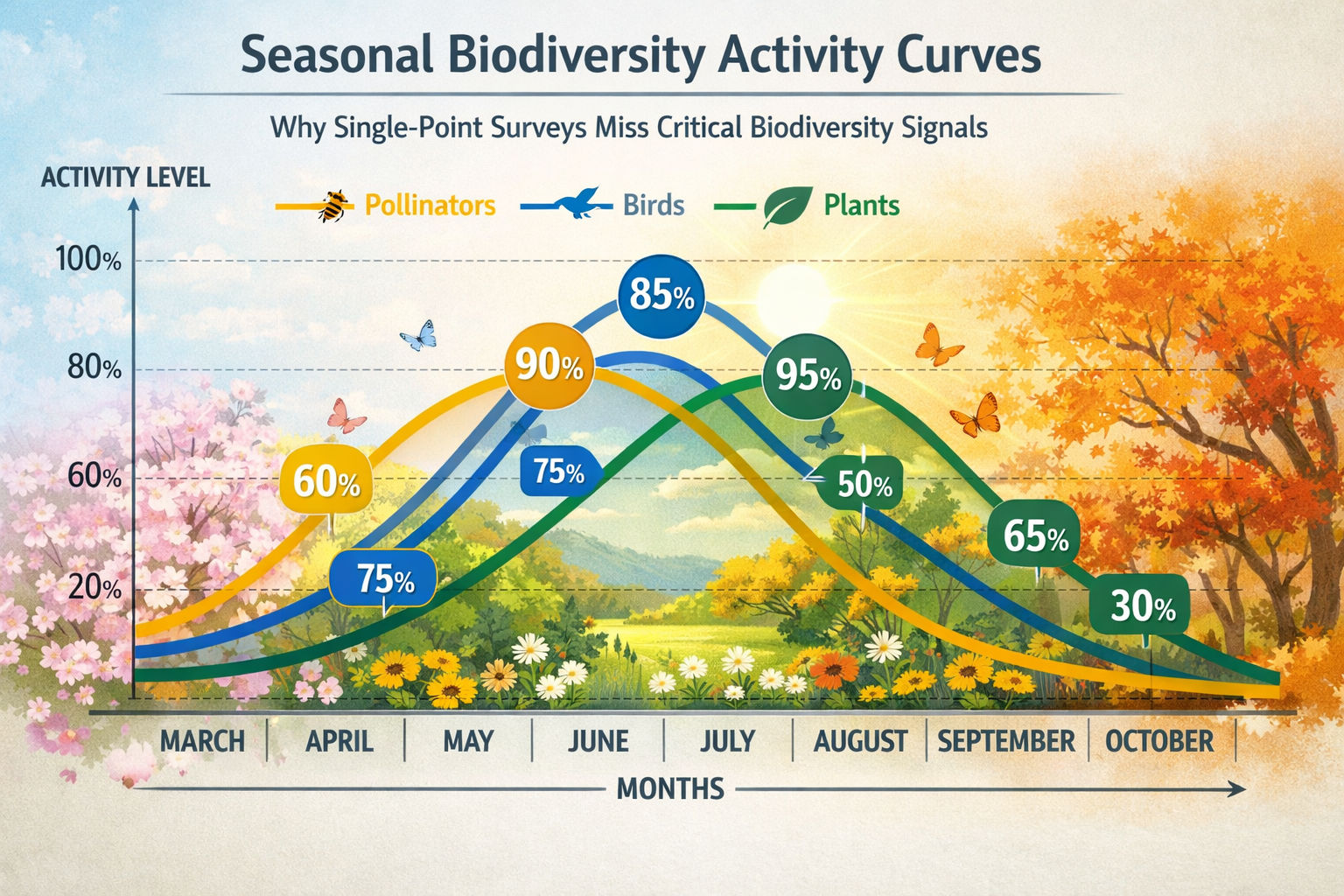
Different taxonomic groups exhibit peak activity at different times:
| Species Group | Peak Activity Period | Key Monitoring Requirements |
|---|---|---|
| Early pollinators | March – April | Capture first emergence, queen establishment |
| Breeding birds | April – June | Detect territory establishment, nesting behavior |
| Amphibians | February – May | Monitor breeding migrations, spawning events |
| Summer insects | June – August | Document peak abundance, diversity |
| Autumn migrants | August – October | Track passage populations, habitat use |
| Late-flowering plants | August – September | Assess full botanical diversity |
A survey conducted only in July would completely miss early pollinators, breeding bird establishment, amphibian reproduction, and autumn migration patterns—potentially underestimating site biodiversity value by 40-60%.
The Science Behind Continuous Full-Season Biodiversity Monitoring in 2026
The 2026 Global Horizon Scan, published in Trends in Ecology & Evolution, identified 15 emerging issues for biodiversity conservation, including widespread soil moisture decline and ocean darkening—large-scale biophysical changes already underway with implications for food production and ecosystem productivity.[4] These dynamic threats require equally dynamic monitoring approaches.
Spring as the Critical Starting Point
Starting biodiversity monitoring in early spring allows capture of the complete biological activity arc—from first emergence through peak summer and into seasonal decline.[2] This timing is essential because:
-
Early phenological events are climate-sensitive indicators: First flowering dates, insect emergence timing, and bird arrival dates shift with temperature changes, providing early warning signals of ecosystem stress
-
Baseline establishment requires full cycles: Annual species complete their entire life cycle within one season; missing early stages means missing entire populations
-
Intervention effects need temporal context: Habitat management impacts unfold across seasons; spring planting shows different results in summer establishment versus autumn persistence
For developers working on biodiversity plans for building projects, this comprehensive approach provides defensible evidence that single-season surveys cannot match.
The Insect Foundation: Why Summer Alone Isn't Enough
Spring and summer are critical windows for capturing full ecosystem signals, particularly insect activity, which forms the foundation of most terrestrial food webs and responds quickly to environmental changes.[2] Insects comprise approximately 75% of terrestrial biodiversity and provide essential ecosystem services including:
- Pollination for 87% of flowering plants
- Food resources for birds, bats, amphibians, and small mammals
- Decomposition and nutrient cycling
- Pest control through predation and parasitism
However, insect communities exhibit dramatic seasonal turnover. Spring specialists (mining bees, early butterflies, hoverflies) emerge when temperatures reach thresholds, reproduce rapidly, and disappear before summer species appear. A July survey would record summer abundance but completely miss spring diversity—potentially underestimating pollinator richness by 50% or more.
Distinguishing Signal from Noise
Continuous multi-season monitoring distinguishes natural seasonal variability from structural change, separates short-term disturbance from long-term trends, and isolates intervention effects from background dynamics—distinctions that single-season surveys cannot achieve.[2]
Consider a practical example: A developer implements meadow creation for achieving 10% Biodiversity Net Gain. A single July survey shows 15 butterfly species. Is this:
- Excellent performance (compared to typical 8-10 species)?
- Average performance (if the region naturally supports 20+ species)?
- Weather-driven anomaly (if July was unusually warm)?
- Temporary spike (before populations crash in August)?
Only continuous monitoring across multiple seasons and years can answer these questions with confidence.
Europe's Harmonized Monitoring Framework and the 2026 Imperative
BioMonWeek 2026, the first European Biodiversity Monitoring Week, will convene May 4-8 in Montpellier, France, bringing together experts from research, policy, NGOs, the private sector, and citizen science communities.[1] This landmark event emphasizes "mass biodiversity monitoring" as its overarching theme, reflecting the growing need for harmonized, large-scale, and policy-relevant monitoring across Europe.[1]
The 84 Essential Biodiversity Variables
84 Essential Biodiversity Variables (EBVs) form the backbone of Europe's harmonized monitoring system, including metrics ranging from bird abundance and insect phenology to seagrass extent, genetic diversity, and ecosystem productivity.[3] These variables create a standardized framework for measuring biodiversity change across scales and jurisdictions.
Key EBV categories requiring full-season monitoring include:
Genetic Composition
- Population genetic diversity (requires sampling across reproductive seasons)
- Genetic differentiation (needs multiple population comparisons over time)
Species Populations
- Species abundance (varies dramatically by season)
- Species distribution (shifts with phenology and migration)
Species Traits
- Phenology (inherently seasonal—emergence, flowering, breeding timing)
- Morphology (can vary with seasonal resource availability)
Community Composition
- Taxonomic diversity (different species assemblages by season)
- Community abundance (seasonal peaks and troughs)
Ecosystem Functioning
- Primary productivity (spring growth, summer peak, autumn decline)
- Nutrient retention (seasonal variation in uptake and release)
Ecosystem Structure
- Habitat structure (vegetation development across growing season)
- Ecosystem extent (seasonal wetlands, ephemeral habitats)
For professionals conducting Biodiversity Impact Assessments, aligning with EBV frameworks ensures data compatibility with national and international monitoring initiatives.
Nine Thematic Areas Shaping 2026 Monitoring
BioMonWeek 2026 is organized around 9 thematic areas, including terrestrial, marine, and freshwater monitoring; data management and monitoring infrastructures; mass monitoring approaches; governance and funding; private sector engagement; and capacity-building.[5] This comprehensive structure reflects the complexity of modern biodiversity monitoring and the need for integration across sectors.
The private sector engagement theme is particularly relevant for developers and landowners, as it addresses how commercial activities can contribute to—and benefit from—robust monitoring systems that support Biodiversity Net Gain delivery.
Emerging Technologies Enabling Full-Season Monitoring in 2026
The practical challenge of continuous monitoring—maintaining field presence across 6-8 months—has historically made full-season surveys prohibitively expensive. However, 2026 brings technological solutions that dramatically reduce costs while increasing data quality.
Tiny Machine Learning and Optical AI
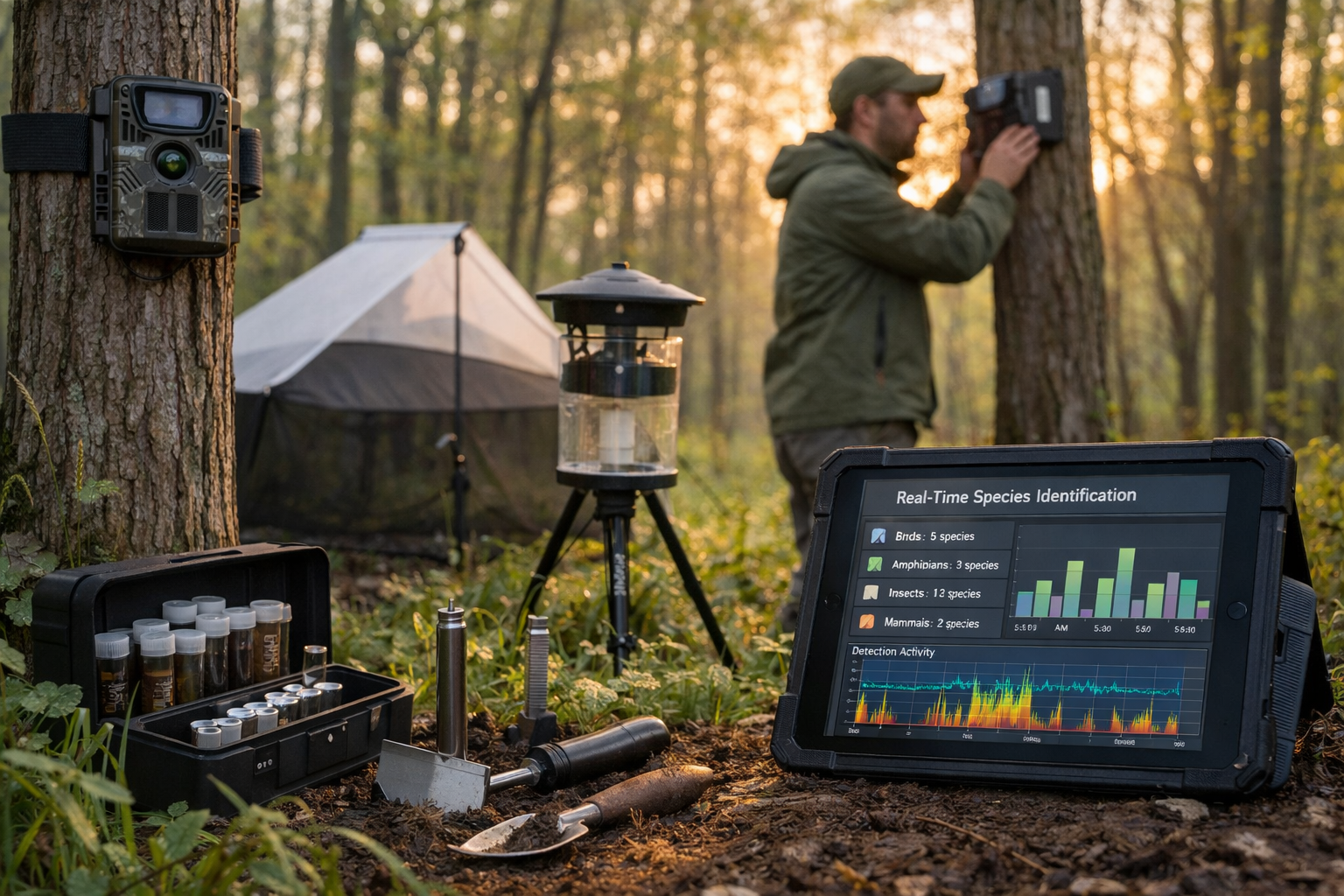
Tiny Machine Learning (TinyML) devices and optical AI chips are emerging technologies that will enable real-time biodiversity detection in remote landscapes without requiring internet connections or high energy demands.[4] These systems can:
- Identify species from images or sounds using on-device processing
- Operate for months on solar power or batteries
- Store data locally and transmit summaries periodically
- Function in areas without cellular or internet connectivity
For example, acoustic monitoring devices can now identify bird species from songs continuously from March through October, recording presence/absence and activity patterns without human observers visiting sites weekly. Similarly, camera traps with AI processing can distinguish between species in real-time, creating seasonal activity profiles automatically.
Digital Twins for Ecosystem Simulation
Digital twins (computer simulations of real-world ecosystems) have been identified as an emerging tool in the 2026 Horizon Scan for strengthening evidence-based conservation decisions.[4] These virtual ecosystem models can:
- Integrate continuous monitoring data to create dynamic representations
- Predict seasonal responses to management interventions
- Test "what-if" scenarios before implementing costly habitat creation
- Identify optimal timing for surveys to capture target species
When combined with full-season monitoring data, digital twins enable adaptive management that responds to actual ecosystem dynamics rather than theoretical assumptions.
Mass Monitoring and Citizen Science Integration
The "mass monitoring" emphasis at BioMonWeek 2026 recognizes that professional ecologists alone cannot deliver the spatial and temporal coverage needed for comprehensive biodiversity assessment.[1] Citizen science platforms, when properly designed and quality-controlled, can extend monitoring coverage across seasons and landscapes.
Successful integration requires:
- Standardized protocols that non-experts can follow reliably
- Quality assurance systems including expert verification of identifications
- Seasonal engagement strategies that maintain volunteer participation across months
- Data integration platforms that combine professional and citizen observations
For landowners considering selling biodiversity units, citizen science contributions can supplement professional surveys to demonstrate sustained habitat quality across seasons at lower cost.
Practical Implementation: Designing Full-Season Monitoring Protocols
Transitioning from single-season snapshots to continuous monitoring requires strategic planning, but the investment delivers proportional returns in data quality and regulatory confidence.
Seasonal Survey Windows and Target Taxa
Recommended monitoring schedule for temperate UK ecosystems:
Early Spring (March – April)
- Breeding amphibians (spawn surveys, migration counts)
- Early flowering plants (woodland herbs, spring bulbs)
- Queen bumblebees and solitary bees (establishment surveys)
- Resident and early migrant birds (territory mapping begins)
Late Spring (May – early June)
- Breeding bird surveys (peak territory establishment)
- Spring butterflies and day-flying moths
- Flowering plant diversity (meadow and grassland species)
- Bat emergence surveys (maternity roost establishment)
Summer (June – August)
- Peak insect diversity (butterflies, moths, hoverflies, beetles)
- Breeding bird confirmation (nesting evidence)
- Botanical surveys (full species list compilation)
- Reptile surveys (basking activity peaks)
Late Summer/Autumn (August – October)
- Autumn migrant birds (passage species, habitat use)
- Late-flowering plants (autumn specialists)
- Bat activity surveys (autumn swarming, feeding)
- Invertebrate abundance (harvest species, autumn specialists)
Balancing Effort and Information Gain
Not every taxon requires monthly surveys. Strategic deployment focuses intensive effort where seasonal variation is highest and ecological importance is greatest:
High-frequency monitoring (monthly or more)
- Birds (breeding season: weekly; migration periods: bi-weekly)
- Pollinators (weekly during flight seasons)
- Phenological markers (flowering, emergence events)
Medium-frequency monitoring (2-3 times per season)
- Bats (spring emergence, summer activity, autumn swarming)
- Reptiles (spring emergence, summer peak, autumn activity)
- Botanical surveys (spring, summer, autumn assemblages)
Low-frequency monitoring (once per season or annually)
- Habitat condition assessments
- Invasive species surveys
- Structural vegetation measurements
This tiered approach optimizes resource allocation while capturing critical seasonal dynamics. When planning biodiversity strategies for development projects, this framework provides clear guidance on survey timing and intensity.
Establishing 2026 Baselines: Strategic Value
Establishing baselines in 2026 is strategically valuable because every future comparison depends on the starting point, and early monitoring avoids collecting first data only when pressure or reporting requirements appear.[2] Starting now provides:
-
Multi-year datasets before intervention: Understand natural variability before habitat creation or development begins
-
Reference conditions for future assessments: Demonstrate genuine improvement rather than claiming credit for natural recovery
-
Adaptive management opportunities: Identify issues early when corrections are inexpensive rather than after failures become obvious
-
Regulatory confidence: Demonstrate proactive commitment to biodiversity rather than reactive compliance
-
Climate baseline documentation: Capture current conditions before climate impacts accelerate further
For developers and landowners engaging with Biodiversity Net Gain requirements, early baseline establishment provides competitive advantage by enabling faster project approvals and more credible enhancement claims.
Overcoming Barriers to Continuous Full-Season Biodiversity Monitoring
Despite clear scientific and regulatory advantages, several barriers slow adoption of full-season monitoring approaches.
Cost Perceptions Versus Long-Term Value
Initial survey costs for full-season monitoring are higher than single-visit surveys—typically 2.5-4 times the cost of a summer-only assessment. However, this comparison ignores:
- Reduced risk of survey failure: Weather-related survey failures in single-season approaches often require complete re-surveys the following year
- Avoided regulatory delays: Incomplete data leading to planning objections costs far more than comprehensive initial surveys
- Long-term monitoring efficiency: Established protocols and baseline data reduce costs in subsequent years
- Technology cost reductions: Automated monitoring systems have high initial costs but very low ongoing costs
When evaluated over project lifecycles, full-season monitoring often proves more cost-effective than repeated single-season surveys attempting to fill data gaps.
Expertise and Capacity Constraints
Full-season monitoring requires expertise across multiple taxa and seasonal specializations. Not all ecological consultancies maintain capacity for year-round deployment. Solutions include:
- Collaborative partnerships: Combining generalist consultancies with specialist taxonomic experts
- Technology augmentation: Using automated systems to extend limited specialist time
- Training investment: Developing in-house seasonal expertise rather than relying entirely on external specialists
- Strategic scheduling: Planning survey timing to align with consultant availability and weather windows
Organizations like Biodiversity Surveyors that specialize in comprehensive biodiversity assessment can provide the multi-seasonal expertise required for robust monitoring programs.
Data Management and Analysis Complexity
Full-season monitoring generates substantially more data than single-season surveys, creating challenges for storage, analysis, and interpretation. Effective solutions include:
- Standardized data formats: Using EBV-compatible structures ensures compatibility with analysis tools
- Cloud-based platforms: Centralized data storage with automated backup and version control
- Statistical expertise: Engaging quantitative ecologists for temporal trend analysis
- Visualization tools: Creating seasonal dashboards that communicate complex patterns to non-specialists
The investment in data infrastructure pays dividends when demonstrating biodiversity outcomes to planners and regulatory authorities.
Policy and Regulatory Drivers for Full-Season Monitoring
Regulatory frameworks increasingly recognize that robust biodiversity assessment requires temporal depth, not just spatial coverage.
Biodiversity Net Gain and Temporal Requirements
While current BNG guidance doesn't explicitly mandate full-season monitoring, the requirement to demonstrate genuine biodiversity improvement implicitly demands it. Key regulatory considerations include:
- Baseline accuracy: Underestimated baselines from incomplete surveys create false claims of net gain
- Habitat condition assessments: Many condition criteria (species diversity, structural complexity) vary seasonally
- Monitoring and reporting: 30-year management plans require evidence that habitats maintain quality across seasons and years
- Verification and validation: Independent assessors increasingly question single-season data reliability
Proactive adoption of full-season monitoring provides regulatory defensibility that snapshot surveys cannot match. Understanding what's required in BNG reports helps clarify where temporal data strengthens applications.
Emerging Monitoring Standards
The harmonization efforts culminating in BioMonWeek 2026 will likely influence UK monitoring standards, particularly as international biodiversity commitments (Convention on Biological Diversity targets, Global Biodiversity Framework) require standardized reporting.
Expected developments include:
- Standardized seasonal survey windows for priority habitats and species
- Minimum temporal coverage requirements for baseline assessments
- Quality assurance protocols that flag temporally inadequate datasets
- Data sharing requirements contributing to national monitoring schemes
Early adopters of comprehensive monitoring protocols will find themselves ahead of regulatory curves rather than scrambling to meet new requirements.
Conclusion: The 2026 Opportunity for Biodiversity Monitoring Excellence
Continuous Full-Season Biodiversity Monitoring: Why 2026 Ecology Surveys Must Capture Spring-to-Fall Dynamics represents more than a methodological improvement—it reflects a fundamental shift in how we understand, measure, and manage biodiversity in an era of rapid environmental change.
The convergence of scientific understanding, technological capability, policy frameworks, and international cooperation in 2026 creates an unprecedented opportunity to establish monitoring systems that genuinely serve both conservation and development objectives.
Key Actions for 2026
For Developers and Project Managers:
- Begin baseline monitoring in early spring 2026 to capture full seasonal cycles before project implementation
- Engage ecological consultants with full-season monitoring expertise and technological capabilities
- Budget for comprehensive temporal coverage rather than minimum-compliance snapshots
- Integrate monitoring data into adaptive management frameworks that respond to seasonal signals
For Landowners and Land Managers:
- Establish baseline conditions across full growing seasons to document habitat value for biodiversity unit sales
- Implement automated monitoring systems that reduce long-term costs while increasing data quality
- Participate in collaborative monitoring initiatives that pool resources across properties
- Document seasonal management impacts to demonstrate genuine biodiversity improvement
For Ecological Consultants and Practitioners:
- Invest in multi-seasonal expertise and technology platforms that enable efficient full-season monitoring
- Develop standardized protocols aligned with EBV frameworks and emerging regulatory requirements
- Build partnerships with taxonomic specialists to cover seasonal expertise gaps
- Communicate the value proposition of comprehensive monitoring to clients focused on initial costs
For Planners and Regulators:
- Recognize temporal adequacy as a quality criterion when evaluating biodiversity assessments
- Encourage early baseline establishment that enables genuine before-after comparisons
- Support data sharing initiatives that contribute to regional and national monitoring systems
- Provide guidance on minimum temporal coverage expectations for different habitat types
The Strategic Imperative
Starting biodiversity monitoring in early spring and maintaining observations through fall is no longer optional for projects seeking robust evidence of ecological value and improvement. The scientific case is clear, the technological tools are available, the regulatory trajectory is evident, and the international community is aligning around harmonized approaches.
Establishing baselines in 2026 provides the foundation for every future comparison, adaptive management decision, and biodiversity claim. Waiting until regulatory requirements explicitly mandate full-season monitoring means starting from behind—collecting first data only when pressure appears rather than building multi-year datasets that demonstrate genuine understanding of ecosystem dynamics.
The shift from snapshots to continuous monitoring represents an investment in ecological credibility, regulatory confidence, and ultimately, genuine biodiversity conservation. As Europe's first Biodiversity Monitoring Week convenes in Montpellier this May, the message is clear: comprehensive temporal coverage is the foundation of 21st-century biodiversity science and practice.
For organizations committed to biodiversity excellence rather than minimum compliance, 2026 is the year to begin. The ecosystems we seek to protect and enhance operate on seasonal rhythms—our monitoring systems must do the same.
References
[1] Biodiversity Monitoring Week 2026 To Take Place In Montpellier – https://www.gbif.se/news/2026/biodiversity-monitoring-week-2026-to-take-place-in-montpellier/
[2] Why Monitor Biodiversity In 2026 – https://evolito.earth/stories/why-monitor-biodiversity-in-2026
[3] Roadmap For Europes Biodiversity Monitoring System – https://www.idiv.de/roadmap-for-europes-biodiversity-monitoring-system/
[4] Whats Next For Biodiversity Conservation Insights From The 2026 Horizon Scan – https://www.unep-wcmc.org/en/news/whats-next-for-biodiversity-conservation-insights-from-the-2026-horizon-scan
[5] Biomonweek2026 – https://www.biodiversa.eu/2025/11/20/biomonweek2026/