

Last updated: June 12, 2026
Quick Answer: Defra's April 2026 policy package introduces the most significant updates to mandatory Biodiversity Net Gain (BNG) since the regime launched in 2024. The headline changes are a new 0.2ha area-based exemption (expected by 31 July 2026) that could remove roughly half of all residential planning permissions from BNG obligations, and a mandatory extension of BNG to Nationally Significant Infrastructure Projects (NSIPs) from 2 November 2026. These Biodiversity Net Gain 2026 changes — covering the 0.2ha exemption, NSIP November requirements, and hierarchy amendments — affect developers, ecologists, landowners, and BNG surveyors across England.
Key Takeaways
- A new 0.2ha area-based exemption replaces the self-build/custom-build exemption from 31 July 2026 (subject to parliamentary approval), potentially exempting around 50% of residential planning permissions from mandatory BNG.
- The 0.2ha exemption does NOT apply where onsite priority habitats are affected, regardless of site size.
- Temporary planning permissions granted for up to five years will be exempt from mandatory BNG from 31 July 2026.
- For minor development, the biodiversity gain hierarchy is being amended so offsite gains are treated equally to onsite habitat creation, removing the previous preference for onsite delivery.
- From 2 November 2026, BNG becomes mandatory for NSIPs (Development Consent Order applications submitted on or after that date), with a new "BNG boundary" definition and flexible aggregation rules.
- Water-related biodiversity impacts for NSIPs must still be addressed within the relevant catchment area — catchment rules are not relaxed.
- A consultation on a brownfield residential exemption closed on 10 June 2026; outcomes are pending.
- Landowners selling biodiversity units face both new demand from NSIPs and potential demand reduction from the broader 0.2ha exemption.
Table of Contents
- What Is Biodiversity Net Gain and Why Does It Matter?
- How Does the 0.2ha Exemption Work?
- Are Small Development Sites Completely Exempt from BNG?
- What Changes Are Happening in November 2026 for NSIPs?
- Which Projects Are Nationally Significant Infrastructure Projects?
- How the Gain Hierarchy Changes for Minor Development
- How Much Will BNG Compliance Cost Developers?
- What Happens If You Cannot Achieve BNG on Your Development Site?
- How to Calculate Biodiversity Units for Your Land or Project
- What Are the Most Common Mistakes Developers Make with BNG?
- Can Agricultural or Brownfield Sites Get BNG Credits?
- What Penalties Exist for Not Meeting BNG Requirements?
- Frequently Asked Questions
- References
What Is Biodiversity Net Gain and Why Does It Matter?
Biodiversity Net Gain is a planning requirement in England under the Environment Act 2021 that obliges most new developments to leave biodiversity in a measurably better state than before construction. Developers must deliver at least a 10% net gain in biodiversity units, assessed using the Defra Biodiversity Metric. For a full primer, see this biodiversity net gain explained guide.
BNG matters because England has lost significant wildlife habitat over decades. The policy creates a legal floor: development can still proceed, but nature must come out ahead. It also creates a functioning market for biodiversity units, giving landowners a new income stream and giving developers an offsite compliance route when onsite gains are insufficient.
The 2026 changes are not a retreat from that ambition. They are a calibration — reducing friction for genuinely small or low-impact projects while extending the regime to the largest infrastructure schemes in the country [2].
How Does the 0.2ha Exemption Work?
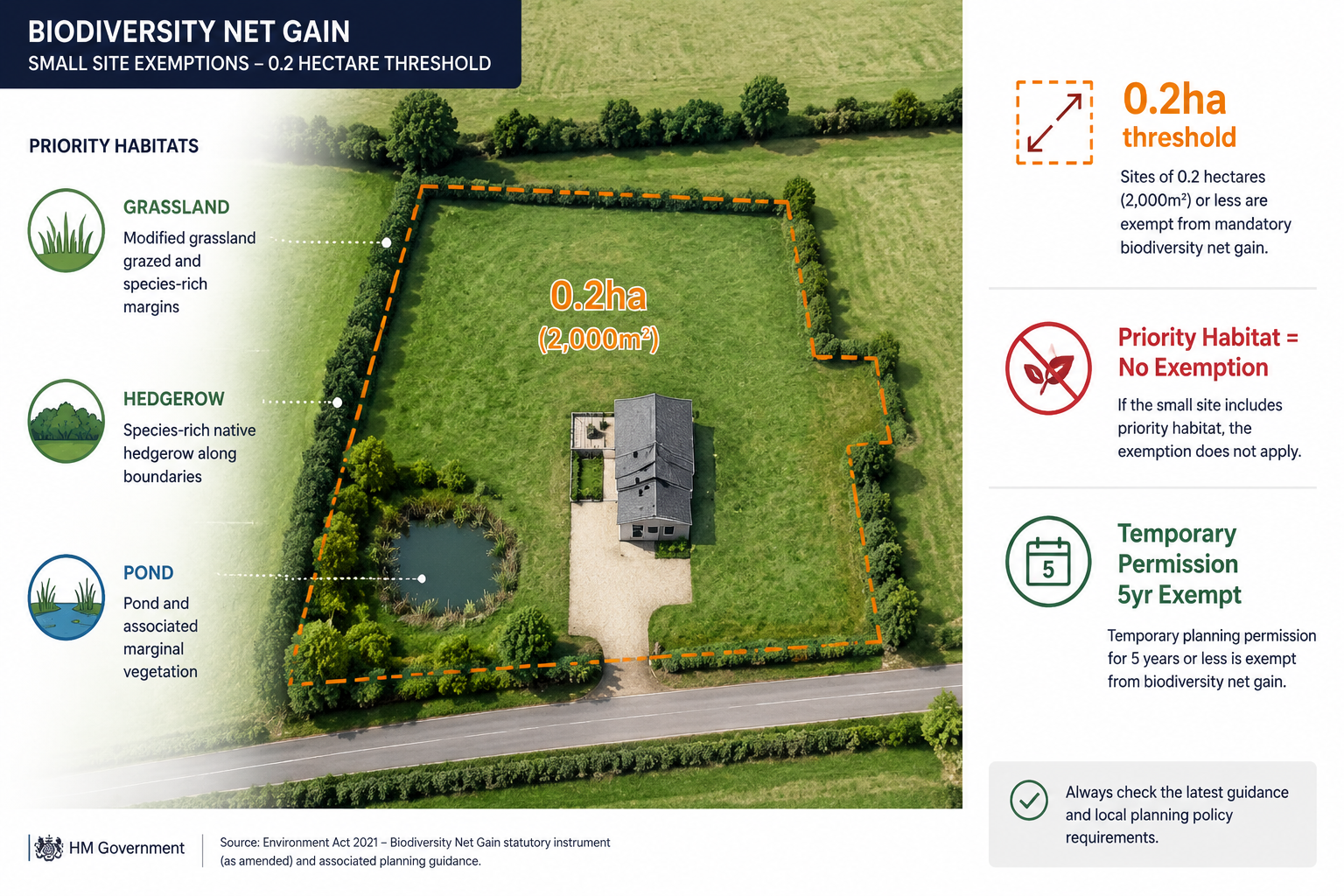
The new 0.2ha exemption means that any TCPA development on a site smaller than 0.2 hectares will be automatically exempt from mandatory BNG, provided no onsite priority habitats are affected [1][2]. Defra estimates this single change could exempt approximately 50% of residential planning permissions from the full BNG process [2].
Key details of the exemption:
- Applies to all development types under the Town and Country Planning Act on sites under 0.2ha.
- Does not apply where the development affects onsite priority habitats — even a small site with ancient grassland or a priority pond remains in scope.
- Replaces the self-build and custom-build exemption, which will be removed from 31 July 2026 [1][3].
- Temporary permissions of up to five years are separately exempt from the same date [1][2][6].
- Subject to parliamentary approval, the effective date is 31 July 2026.
For developers, this is a meaningful reduction in compliance burden for small infill plots, urban intensification schemes, and modest extensions. For a detailed look at which projects are already exempt and how the new rules interact, see the exempt projects guidance.
Common mistake: Assuming the exemption is automatic without checking for priority habitats. A site of 0.15ha with a section of marshy grassland or a hedgerow classified as a priority habitat will still require a full BNG assessment.
Are Small Development Sites Completely Exempt from BNG?
Not automatically. The 0.2ha threshold is a necessary but not sufficient condition for exemption. Sites under 0.2ha are exempt only when no priority habitats are present on the site [1][4].
Developers and their ecologists should still carry out a preliminary ecological appraisal on any site, regardless of size, to confirm whether priority habitats exist. Skipping this step and incorrectly claiming the exemption could result in enforcement action or planning conditions being imposed later.
For more on what a BNG assessment involves and when one is needed, see what is in a biodiversity net gain assessment.
What Changes Are Happening in November 2026 for NSIPs?
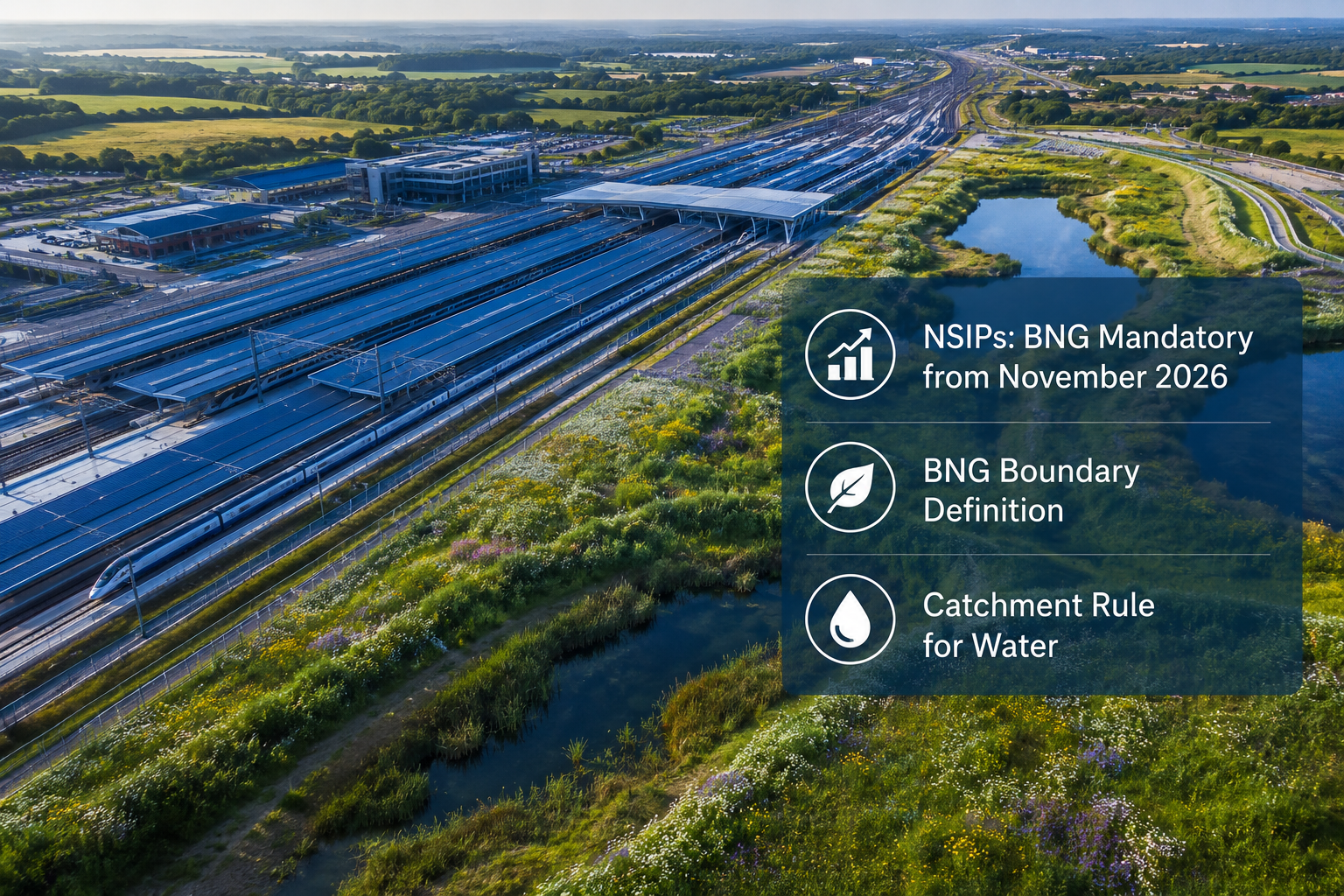
From 2 November 2026, BNG becomes mandatory for Nationally Significant Infrastructure Projects where a Development Consent Order (DCO) application is submitted on or after that date [1][3][5]. This is one of the most consequential Biodiversity Net Gain 2026 changes alongside the 0.2ha exemption and the NSIP November extension.
The NSIP BNG framework introduces two important new concepts:
- BNG boundary: A defined spatial limit within which biodiversity impacts and gains are assessed for a given NSIP. This gives promoters clarity on the geographic scope of their BNG obligations.
- Flexible aggregation: Biodiversity units from multiple habitat parcels can be aggregated across the BNG boundary — except for water-related impacts, which must remain within the relevant river catchment [1][5].
This catchment rule for water is significant. A major road scheme crossing several catchments cannot offset aquatic habitat losses in one catchment by creating wetland habitat in another. Water impacts stay local.
Which Projects Are Nationally Significant Infrastructure Projects?
NSIPs are large-scale infrastructure projects that require a Development Consent Order rather than standard planning permission. They include:
- Onshore generating stations above 50MW (or 350MW offshore)
- Major highways and rail schemes
- Large airports and airport extensions
- Nationally significant port developments
- Major water and waste water infrastructure
- Certain pipelines and electricity transmission lines
From November 2026, promoters of these schemes must embed BNG into their DCO applications from the outset. Given the scale of NSIP projects — often covering hundreds of hectares — the biodiversity unit volumes involved will be substantial, creating significant new demand in the biodiversity unit market [5].
How the Gain Hierarchy Changes for Minor Development
Under the original BNG framework, developers were expected to deliver gains onsite first, then look offsite, and only use statutory biodiversity credits as a last resort. For minor development specifically, Defra is amending this hierarchy so that offsite gains are treated on an equal footing with onsite habitat creation [2][6].
This is a practical concession. Minor development sites are often too small to create meaningful habitat onsite. Requiring onsite delivery first added cost and complexity without ecological benefit. The change allows developers of small sites to go directly to the offsite market without having to demonstrate that onsite delivery is impractical first.
For landowners and habitat bank operators, this is positive news — it broadens the pool of buyers for offsite biodiversity units. For a comparison of onsite and offsite delivery options, see biodiversity net gain: off-site or on-site delivery.
How Much Will BNG Compliance Cost Developers?
BNG compliance costs vary considerably by site, habitat type, and delivery route. There is no single fixed price, but the main cost components are:
- Ecological survey and metric calculation: Typically £1,500–£5,000+ for a standard residential site, depending on complexity.
- Onsite habitat creation: Costs embedded in landscaping and design; can be cost-neutral if planned early.
- Offsite biodiversity units: Market prices vary. For a current overview, see this guide to the cost of biodiversity units and statutory credits.
- Statutory biodiversity credits: Purchased from government as a last resort; priced at a deliberate premium to incentivise private market solutions.
The 0.2ha exemption will eliminate BNG compliance costs entirely for qualifying small sites, which Defra acknowledges was a disproportionate burden on minor development [2].
For NSIP promoters, costs will be substantial given project scale, but the flexible aggregation rules should reduce the premium paid for geographically constrained offsite units.
What Happens If You Cannot Achieve BNG on Your Development Site?
If onsite habitat creation cannot deliver the required 10% gain, developers have two further options in the gain hierarchy: purchase offsite biodiversity units from a registered habitat bank, or buy statutory biodiversity credits from government [7].
For minor development, the 2026 hierarchy change means offsite units are now the immediate next step — there is no longer a requirement to exhaust onsite options first [2][6]. For major development, the original hierarchy still applies.
Landowners interested in creating and selling offsite units can find guidance at sell biodiversity units, while developers looking to purchase units can explore options at buy biodiversity units.
How to Calculate Biodiversity Units for Your Land or Project
Biodiversity units are calculated using the Defra Biodiversity Metric (currently version 4.0). The metric scores each habitat parcel on three dimensions: distinctiveness, condition, and strategic significance. It then applies multipliers for spatial risk (onsite vs. offsite vs. statutory credits) and temporal risk (time to reach target condition).
The steps are:
- Survey all habitat parcels on the site (pre-development baseline).
- Score each parcel using the metric.
- Model post-development habitat parcels and score them.
- Calculate the percentage change — the development must show at least +10%.
- Identify any shortfall and source offsite units or statutory credits to cover it.
For a practical walkthrough, see how to achieve 10% biodiversity net gain and the guide on how to conduct a biodiversity impact assessment.
What Are the Most Common Mistakes Developers Make with BNG?
The most frequent errors in BNG compliance are:
- Starting the metric too late — leaving BNG to the planning application stage rather than embedding it in site design from the outset.
- Assuming exemption without checking for priority habitats — the 0.2ha exemption has a hard carve-out for priority habitats.
- Underestimating baseline habitat quality — a site with even moderate-quality grassland will have a higher baseline, making the 10% gain harder to achieve.
- Ignoring the 30-year management requirement — biodiversity gains must be maintained and monitored for 30 years; this needs to be costed and legally secured.
- Not registering offsite gains — units purchased from a habitat bank must be registered on the relevant local nature recovery register.
For more on avoiding these pitfalls, see 8 biodiversity net gain points on planning your project.
Can Agricultural or Brownfield Sites Get BNG Credits?
Agricultural land can generate biodiversity units by converting low-distinctiveness arable or improved grassland into higher-quality habitats such as species-rich grassland, woodland, or wetland. Farmers and landowners can register these habitats as offsite gain sites and sell units to developers. This sits alongside (and sometimes complements) Sustainable Farming Incentive payments.
Brownfield sites are a more complex case. A consultation on a dedicated brownfield residential exemption closed on 10 June 2026. The outcome is pending, but the policy intent is to recognise that brownfield sites often have low baseline biodiversity and that requiring full BNG assessment may discourage brownfield-first development. If an exemption is confirmed, it would apply to residential development on previously developed land meeting defined criteria.
Landowners considering entering the biodiversity unit market can find detailed guidance at guidance for landowners.
What Penalties Exist for Not Meeting BNG Requirements?
Mandatory BNG is enforced through the planning system. A development that does not meet its BNG obligations will not receive planning permission — or, if conditions are breached post-permission, can face enforcement action including stop notices and requirements to restore habitat.
There is no separate BNG-specific fine regime. However, developing in breach of a planning condition (including a BNG condition) is a planning enforcement matter and can result in:
- Enforcement notices requiring remediation
- Stop notices halting construction
- Injunctions in serious cases
- Reputational and financial consequences from delayed or refused permissions
For NSIPs, non-compliance with DCO conditions carries equivalent enforcement powers under the Planning Act 2008 framework.
Frequently Asked Questions
Q: When exactly does the 0.2ha exemption come into force?
A: Defra has confirmed the target date is 31 July 2026, subject to parliamentary time. Developers should monitor legislative progress, as the date could shift if parliamentary schedules change [1][2].
Q: Does the 0.2ha exemption apply to commercial as well as residential development?
A: Yes. The exemption covers all TCPA development types on sites under 0.2ha, not just residential. The key condition remains that no onsite priority habitats are affected [1][2].
Q: Will self-build projects still be exempt after July 2026?
A: The existing self-build and custom-build exemption is being removed from 31 July 2026. Self-build projects on sites under 0.2ha without priority habitats will qualify for the new area-based exemption instead [1][3].
Q: What is a "BNG boundary" for NSIP purposes?
A: It is a defined spatial area within which a NSIP promoter's biodiversity impacts and gains are assessed. It provides geographic clarity for large linear or multi-site infrastructure projects and enables flexible aggregation of units — except for water-related impacts, which must stay within the catchment [5].
Q: Can a NSIP use offsite biodiversity units from anywhere in England?
A: For most habitat types, yes — units can be aggregated flexibly within the BNG boundary. For water-related biodiversity impacts, units must come from within the same river catchment [1][5].
Q: Does the hierarchy change for minor development affect what local planning authorities can require?
A: Yes. Local planning authorities cannot require minor development applicants to exhaust onsite options before going offsite. The amended hierarchy treats both routes as equally acceptable from the outset [2][6].
Q: What is the brownfield residential exemption and when will we know the outcome?
A: It is a proposed exemption for residential development on previously developed (brownfield) land. The consultation closed 10 June 2026. Defra has not yet published its response; developers should watch for an announcement in the second half of 2026.
Q: Where can I find a qualified BNG surveyor or ecologist?
A: Qualified ecologists and BNG surveyors can be found through the Chartered Institute of Ecology and Environmental Management (CIEEM) register. Specialist firms such as Biodiversity Surveyors offer guidance for developers and full metric assessment services.
Conclusion
The Biodiversity Net Gain 2026 changes — the 0.2ha exemption, NSIP November extension, and hierarchy amendment — represent the most significant recalibration of the BNG regime since it became mandatory. For developers, the practical effect is a lighter touch on small sites and a new compliance obligation for the largest infrastructure projects. For ecologists and BNG surveyors, demand for assessments on NSIP schemes will grow substantially from November 2026. For landowners selling biodiversity units, NSIP demand is a significant new market, though the 0.2ha exemption may reduce unit demand from the smallest residential schemes.
Actionable next steps by stakeholder:
- Developers with sites under 0.2ha: Commission a preliminary ecological appraisal now to confirm whether priority habitats are present and whether the exemption will apply.
- NSIP promoters: Engage BNG specialists immediately if a DCO application is planned for submission on or after 2 November 2026. BNG must be embedded in the project design, not bolted on at the end.
- Landowners: Assess whether your land can generate biodiversity units to meet NSIP demand. The new flexible aggregation rules mean NSIP promoters can source units more broadly.
- Ecologists and BNG surveyors: Familiarise yourself with the NSIP BNG boundary framework and the amended gain hierarchy for minor development before both changes take effect.
- All parties: Monitor the outcome of the brownfield residential exemption consultation, which could further reshape compliance requirements for urban development in the second half of 2026.
References
[1] Key Changes Confirmed To Biodiversity Net Gain – https://www.cla.org.uk/news/key-changes-confirmed-to-biodiversity-net-gain/
[2] Biodiversity Net Gain Whats Changing And What It Means For You – https://defraenvironment.blog.gov.uk/2026/04/20/biodiversity-net-gain-whats-changing-and-what-it-means-for-you/
[3] Biodiversity Net Gain Changes 2026 – https://www.biodiverseconsulting.co.uk/post/biodiversity-net-gain-changes-2026
[4] Biodiversity Net Gain For Nationally Significant Infrastructure – https://www.linkedin.com/posts/pennyasimpson_biodiversity-net-gain-for-nationally-significant-activity-7450853275945414656-afMv
[5] Biodiversity Net Gain Three Key Policy Updates – https://gowlingwlg.com/en-gb/insights-resources/articles/2026/biodiversity-net-gain-three-key-policy-updates
[6] Government Response And Summary Of Responses – https://www.linkedin.com/posts/dchowgego_government-response-and-summary-of-responses-activity-7450544446884073473-_lDS
[7] Understanding Biodiversity Net Gain – https://www.gov.uk/guidance/understanding-biodiversity-net-gain
[8] Biodiversity Net Gain Considering A Targeted Approach – https://www.linkedin.com/posts/jameschristophersmith_biodiversity-net-gain-considering-a-targeted-activity-7450896283491471360-r177