

Half of all residential planning permissions currently subject to mandatory Biodiversity Net Gain could be swept out of scope by a single proposed threshold. That is the scale of change contained in Defra's live consultation, which closes on 10 June 2026 — and the clock is running out for developers, ecologists, and planning consultants to have their say.
The consultation is not the only pressure point this summer. Mandatory BNG for English onshore Nationally Significant Infrastructure Projects (NSIPs) comes into force on 2 November 2026, and a revision to the biodiversity gain hierarchy — placing off-site provision on equal footing with on-site for minor developments — is expected to be in force by 31 July 2026. Together, these three changes represent the most significant reshaping of the BNG framework since mandatory requirements took effect for major developments in February 2024.
Key Takeaways
- The Defra BNG consultation closes 10 June 2026; responses must be submitted before that date.
- A proposed 0.2 ha area-based exemption (inside the red line boundary) would remove approximately 50% of residential planning permissions from mandatory BNG obligations.
- Larger thresholds of 0.5 ha to 2.5 ha are also explored and could push exemptions as high as 64%.
- Mandatory BNG applies to English onshore NSIPs from 2 November 2026, with a consistent 10% net gain requirement and no sector-specific exemptions.
- The biodiversity gain hierarchy amendment — equalising off-site and on-site provision for minor developments — is expected in force by 31 July 2026.
Table of Contents
- What the Defra BNG Consultation Proposes
- The 0.2 Hectare Exemption: Who Would Be Affected?
- Implications for Biodiversity Net Gain Assessments and Baseline Surveys
- The Biodiversity Gain Hierarchy Change: Off-site Becomes Equal for Minor Developments
- NSIPs and the 2 November 2026 Mandatory BNG Deadline
- What NSIP Promoters Should Be Doing Now
- The Role of Biodiversity Surveyors Before 10 June 2026
- Post-Consultation Timeline
- Frequently Asked Questions
- Conclusion
What the Defra BNG Consultation Proposes
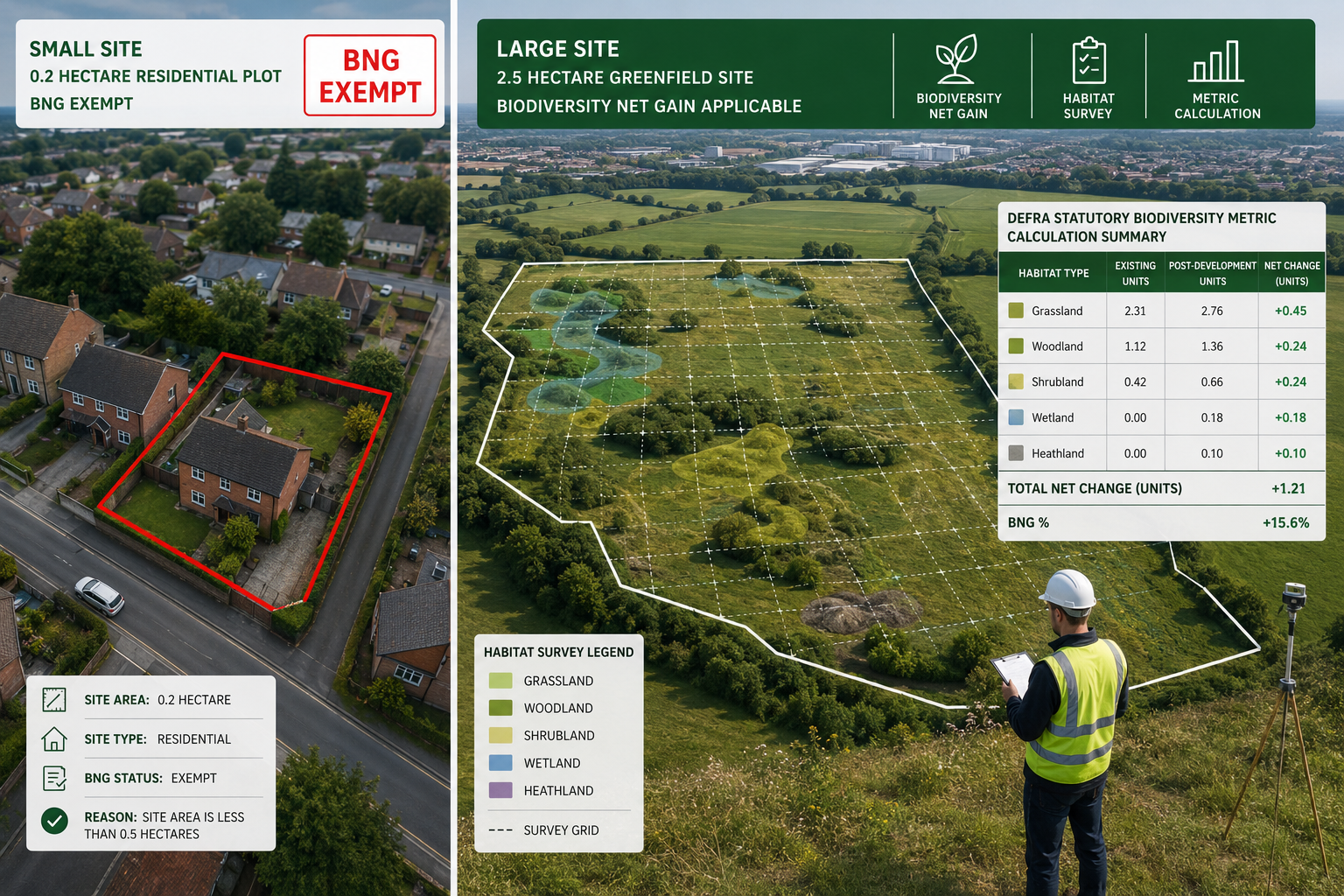
Defra launched its consultation on proposed amendments to the mandatory BNG framework earlier in 2026. The primary proposal centres on introducing an area-based exemption for small sites, replacing the current approach that uses a combination of habitat impact and planning category to determine exemption status.
Under the proposed model, any development with a footprint of 0.2 hectares or less inside the red line boundary would be automatically exempt from mandatory BNG. This is a clean, bright-line test — simpler for local planning authorities to administer and, in theory, quicker for applicants to navigate.
The consultation also tests appetite for significantly larger thresholds: 0.5 ha, 1.0 ha, 1.5 ha, 2.0 ha, and 2.5 ha. These are not the preferred option, but their inclusion signals that government is genuinely weighing the trade-off between planning simplicity and ecological ambition.
As Gowling WLG has noted in its analysis of the consultation, the area-based approach would represent a material departure from the current unit-based small site rules, which have been criticised for their complexity and inconsistent application across local planning authorities.
For a detailed breakdown of how the current exemption categories work, see the guide to exempt projects from Biodiversity Surveyors.
The 0.2 Hectare Exemption: Who Would Be Affected?
The headline statistic is striking. According to figures cited in the consultation, a 0.2 ha threshold would exempt approximately 50% of residential planning permissions currently subject to mandatory BNG. That is not a marginal adjustment — it is a structural change to the scope of the regime.
Scaling up to the larger thresholds produces even more dramatic results:
| Area Threshold | Estimated % of Residential Permissions Exempted |
|---|---|
| 0.2 ha | ~50% |
| 0.5 ha | ~55% |
| 1.0 ha | ~59% |
| 1.5 ha | ~62% |
| 2.0 ha | ~63% |
| 2.5 ha | ~64% |
The practical implication is clear: if the 0.2 ha threshold is adopted, the majority of small housebuilders, self-builders, and infill developers would no longer need to commission a biodiversity net gain assessment or submit a biodiversity gain plan with their planning application.
However, it is important to stress that the consultation has not yet closed and no decision has been made. Developers and ecologists who rely on the current framework — or who have concerns about the ecological consequences of mass exemption — have until 10 June 2026 to make their views known.
"The proposed 0.2 ha threshold is a policy choice, not an ecological one. Whether it is the right choice depends on cumulative impact data that the sector is best placed to provide."
For those working on BNG for small development projects, the outcome of this consultation will directly determine whether BNG obligations apply to the majority of their pipeline.
Implications for Biodiversity Net Gain Assessments and Baseline Surveys
For sites that remain in scope — regardless of where the final threshold lands — the process of commissioning a baseline habitat survey using the DEFRA Statutory Biodiversity Metric remains unchanged. What changes is the volume of sites requiring that survey.
If the 0.2 ha exemption is adopted, surveyors and ecologists should expect:
- Reduced demand for small site BNG assessments in the short term
- Increased complexity on larger sites, as the remaining in-scope developments will tend to be more ecologically sensitive
- Greater scrutiny on the accuracy of red line boundary measurements, since the exemption threshold will be assessed against the area inside that boundary
The Lucion Group has highlighted that accurate site measurement and boundary definition will become a critical compliance step under any area-based exemption model. A boundary drawn incorrectly could inadvertently bring a site into scope — or, conversely, allow a site to claim exemption it should not qualify for.
For sites that remain subject to mandatory BNG, understanding what you need for a biodiversity net gain report is essential before submitting a planning application.
The Biodiversity Gain Hierarchy Change: Off-site Becomes Equal for Minor Developments
A separate but related change is expected to come into force by 31 July 2026, subject to parliamentary scheduling. The biodiversity gain hierarchy — which currently prioritises on-site habitat creation, then off-site, then statutory biodiversity credits — is to be amended so that off-site provision carries equal weight to on-site for minor developments.
This is a significant practical shift. Currently, developers must demonstrate that on-site delivery is not possible or appropriate before off-site options are considered. Under the amended hierarchy, minor development applicants would be free to choose off-site delivery without needing to justify why on-site provision is unsuitable.
CMS has observed that this change is likely to stimulate demand for habitat bank units, particularly in urban and peri-urban areas where on-site BNG delivery is constrained by site size and existing land use.
For a full exploration of the strategic choice between delivery routes, see Biodiversity Net Gain: Off-site or On-site Delivery? and the detailed comparison of BNG off-site land banking vs habitat banking.
NSIPs and the 2 November 2026 Mandatory BNG Deadline

The second major milestone in the 2026 BNG calendar is the extension of mandatory requirements to English onshore Nationally Significant Infrastructure Projects, effective 2 November 2026. This was confirmed by Defra and reported by edie as part of the broader rollout of the BNG framework to infrastructure.
Key features of the NSIP BNG regime include:
- A consistent 10% net gain requirement across all NSIP categories
- No sector-specific exemptions — energy, transport, water, and waste NSIPs are all in scope
- Application through the Development Consent Order (DCO) process, with biodiversity gain plans required as part of the application
- Use of the DEFRA Statutory Biodiversity Metric for baseline and post-development calculations
The Defra Environment blog has confirmed that the NSIP regime will align with the broader mandatory BNG framework, meaning the same metric, the same hierarchy (as amended), and the same credit backstop will apply.
What NSIP Promoters Should Be Doing Now
With fewer than five months until the November deadline, NSIP promoters who have not yet begun their BNG baseline work are at risk of programme delay. The following actions are recommended:
- Commission baseline habitat surveys immediately. Surveys using the DEFRA Statutory Biodiversity Metric require appropriate seasonal conditions, and some habitat types require survey windows that cannot be replicated out of season.
- Appoint a suitably qualified ecologist with NSIP experience to lead the biodiversity gain plan.
- Engage with the DCO pre-application process to agree the scope of BNG assessment with the Planning Inspectorate early.
- Model on-site and off-site delivery scenarios using the amended hierarchy, which will be in force before the November deadline.
- Secure off-site units or statutory credits as a contingency, given the scale of habitat uplift required for large infrastructure projects.
For landowners considering whether their land could support NSIP off-site BNG delivery, the guidance for landowners provides a useful starting point.
The Role of Biodiversity Surveyors Before 10 June 2026
The consultation closing date of 10 June 2026 is not just a policy deadline — it is an opportunity for the surveying and ecology profession to shape the final framework. Biodiversity surveyors are uniquely positioned to provide evidence on:
- The ecological consequences of mass exemption at the 0.2 ha threshold
- The cumulative impact of removing 50% of residential permissions from scope
- The practical workability of area-based exemption thresholds in the field
- The adequacy of the amended biodiversity gain hierarchy for minor developments
Responses to the consultation can be submitted via the Defra consultation portal. Professional bodies including the Chartered Institute of Ecology and Environmental Management (CIEEM) are expected to submit collective responses, but individual practitioner evidence carries significant weight.
Post-Consultation Timeline
| Date | Milestone |
|---|---|
| 10 June 2026 | Defra BNG consultation closes |
| 31 July 2026 | Biodiversity gain hierarchy amendment expected in force |
| Autumn 2026 | Government response to consultation anticipated |
| 2 November 2026 | Mandatory BNG for English onshore NSIPs commences |
| 2027 (estimated) | Any legislative changes arising from consultation enacted |
Frequently Asked Questions
Q: Does the proposed 0.2 ha exemption apply to all development types?
A: The consultation focuses on residential development, but the area-based threshold may apply more broadly. The final scope will depend on government's response to consultation feedback.
Q: Will sites below 0.2 ha still need an ecological survey?
A: Exemption from mandatory BNG does not remove other ecological obligations, including protected species surveys and local planning authority requirements. A baseline survey may still be advisable.
Q: Does the NSIP BNG regime apply to offshore projects?
A: No. The 2 November 2026 mandatory requirement applies to English onshore NSIPs only. Offshore infrastructure remains outside the mandatory BNG framework at this stage.
Q: What happens if the biodiversity gain hierarchy amendment is delayed beyond 31 July 2026?
A: The amendment is subject to parliamentary scheduling. If delayed, the current hierarchy — which prioritises on-site provision — continues to apply. Developers should not assume the change is in force until confirmed.
Q: Can NSIP promoters use statutory biodiversity credits to meet the 10% requirement?
A: Yes, statutory credits remain available as a last resort under the NSIP regime, consistent with the broader BNG framework.
Q: Where can I find more detail on how the Statutory Biodiversity Metric works for baseline surveys?
A: The top 12 questions by planners about Biodiversity Net Gain covers metric methodology in accessible detail.
Conclusion
The period between now and November 2026 is the most consequential for the BNG framework since mandatory requirements were first introduced. The Biodiversity Net Gain BNG consultation closes 10 June 2026, and the proposed small site 0.2 hectare exemption alone could halve the number of residential permissions subject to mandatory obligations. The NSIPs November deadline, meanwhile, brings an entirely new category of large-scale development into scope for the first time.
Actionable next steps:
- Submit a consultation response before 10 June 2026 — individual practitioner evidence matters.
- If working on minor developments, prepare for the biodiversity gain hierarchy change expected by 31 July 2026 and review off-site delivery options proactively.
- NSIP promoters should commission baseline habitat surveys immediately and engage with the DCO pre-application process without delay.
- All practitioners should review their pipeline against the proposed thresholds and advise clients on the range of possible outcomes before the government response is published.
For comprehensive support on navigating the current and evolving BNG framework, explore the full Biodiversity Net Gain guidance from Biodiversity Surveyors.