

As global financial institutions prepare for critical UN Forum on Forests and UN Water Conference milestones in 2026, biodiversity surveyors have emerged as essential gatekeepers in the rapidly evolving nature finance landscape. With over 620 organizations now adopting Taskforce on Nature-related Financial Disclosures (TNFD) recommendations and £700 billion needed annually to protect natural systems[1], the intersection of Financial Institutions and Biodiversity Net Gain: Surveyor Playbooks for 2026 Nature Finance Compliance represents a fundamental shift in how banks assess environmental risk and regulatory adherence.
The UK's mandatory 10% Biodiversity Net Gain (BNG) requirement, now fully implemented for most developments[4], has created unprecedented demand for rigorous verification protocols that financial institutions can trust when evaluating project financing. This comprehensive guide equips biodiversity surveyors with the frameworks, methodologies, and compliance strategies needed to serve as trusted advisors to the banking sector during this transformative year.
Key Takeaways
- Financial sector engagement: Over 350 signatory banks in the Principles for Responsible Banking community are actively integrating nature-related risk assessments, requiring standardized surveyor verification protocols[1]
- Mandatory compliance framework: England's 10% BNG requirement creates 30-year habitat maintenance obligations that directly impact loan portfolios and project financing decisions[4][7]
- Strategic elevation: The UK's 2026 national security assessment explicitly addresses biodiversity loss as a security concern, transforming nature compliance from environmental to strategic priority[1]
- Verification gap: Financial institutions need reliable third-party surveyor protocols to validate BNG claims and assess nature-related financial risks in development portfolios
- Timeline urgency: Nationally significant infrastructure projects (NSIPs) face updated May 2026 BNG implementation deadlines, creating immediate compliance pressure[7]
Understanding the Financial Institutions and Biodiversity Net Gain Landscape in 2026
The Convergence of Nature Finance and Regulatory Compliance
The financial services sector has undergone a dramatic transformation in its approach to nature-related risks. More than half of global economic value generation now depends moderately or highly on natural systems, yet the annual funding gap for nature protection remains at £700 billion[1]. This economic reality has pushed biodiversity from a peripheral environmental concern to a core financial risk category.
Key regulatory drivers shaping Financial Institutions and Biodiversity Net Gain: Surveyor Playbooks for 2026 Nature Finance Compliance include:
🏦 Banking sector commitments: The Principles for Responsible Banking (PRB) Nature Community of Practice now includes over 350 signatory banks actively working to integrate nature considerations into lending decisions[1]
📊 Disclosure frameworks: TNFD recommendations provide standardized nature-related financial disclosure protocols that 620 organizations have already adopted[1]
🌍 National security framing: Biodiversity loss is now explicitly recognized in the UK's national security assessment, elevating compliance requirements beyond traditional environmental regulations[1]
💼 Practical implementation: UNEP FI's "Nature Journey" roadmap, launched in 2026, provides banks with actionable steps for integrating nature into governance, risk management, and strategic decision-making[1]
For biodiversity surveyors, this convergence creates both opportunity and responsibility. Financial institutions increasingly require independent verification of Biodiversity Net Gain assessments to ensure projects meet regulatory standards and accurately represent nature-related financial risks.
The BNG Regulatory Framework Financial Institutions Must Navigate
Understanding the mandatory Biodiversity Net Gain framework is essential for surveyors advising financial institutions. The Environment Act 2021 established clear requirements that directly impact project financing:
| BNG Requirement | Financial Implication | Surveyor Role |
|---|---|---|
| 10% minimum gain | Increases project costs 2-5% | Baseline assessment verification |
| 30-year maintenance | Creates long-term financial obligations | Habitat viability assessment |
| Gain hierarchy (on-site → off-site → credits) | Affects land valuation and project feasibility | Site capacity evaluation |
| May 2026 NSIP implementation | Impacts infrastructure financing timelines | Expedited assessment protocols |
| Local Plan variations | Creates regional compliance complexity | Multi-jurisdiction expertise |
The implementation timeline has evolved significantly, with nationally significant infrastructure projects (NSIPs) now facing May 2026 deadlines rather than the originally planned November 2025 date[7]. This compressed timeline has intensified pressure on both developers and their financial backers to secure compliant BNG assessments quickly.
Exemptions remain limited but important for financial risk assessment. Projects exempt from BNG requirements include permitted development, applications below de minimis thresholds, self-build housing, and householder applications[4]. Surveyors must help financial institutions identify which projects require full BNG compliance versus those falling under exemptions.
Surveyor Protocols for Financial Institutions and Biodiversity Net Gain Verification
Establishing Credible Baseline Assessments for Banking Clients
Financial institutions require defensible baseline data that can withstand regulatory scrutiny and inform accurate risk assessment. Surveyors serving the banking sector must adopt enhanced protocols that exceed standard development requirements.
Core baseline assessment protocols include:
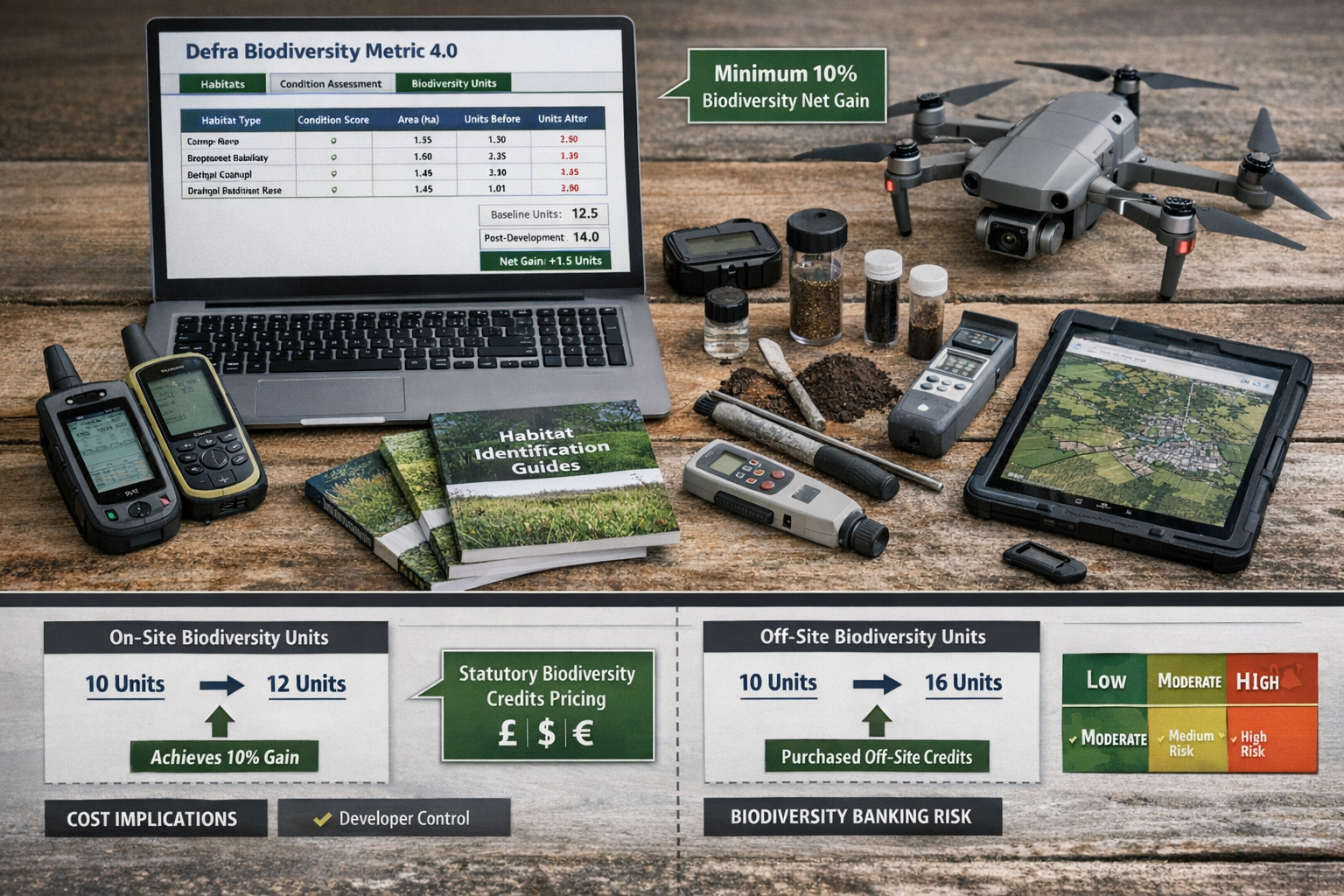
- Comprehensive habitat mapping: Document all habitat types using Defra's Biodiversity Metric 4.0 classification system, with georeferenced boundaries and photographic evidence
- Condition assessment rigor: Apply standardized condition assessment criteria with detailed justification for scoring decisions that may be reviewed by bank risk teams
- Temporal considerations: Conduct surveys during appropriate seasonal windows to capture full ecological value and avoid underestimation of baseline biodiversity
- Third-party verification: Implement peer review processes for high-value projects where financial institutions require additional assurance
- Data management standards: Maintain audit trails and documentation that meet financial sector compliance requirements, not just planning authority standards
For projects seeking financing, surveyors should prepare baseline assessments that address the specific concerns of financial risk managers. This includes clear articulation of uncertainty ranges, potential for habitat degradation during construction, and realistic timelines for achieving target conditions in enhancement areas.
The 10% Biodiversity Net Gain requirement must be demonstrated through transparent calculations that financial analysts can verify. Surveyors should provide sensitivity analyses showing how different design choices affect biodiversity unit generation and project viability.
Validating On-Site and Off-Site Delivery Mechanisms
Financial institutions financing development projects need clear guidance on the relative risks and financial implications of different BNG delivery approaches. The mandatory gain hierarchy—prioritizing on-site delivery, then off-site units, and finally statutory credits as a last resort—creates distinct risk profiles that affect loan terms and project feasibility[7].
On-site delivery verification requires surveyors to assess:
✅ Spatial feasibility: Can the development site accommodate habitat creation or enhancement that generates sufficient biodiversity units?
✅ Ecological viability: Will proposed habitats reach target condition within reasonable timeframes given site constraints?
✅ Management capacity: Does the developer have credible plans and financial resources for 30-year maintenance obligations?
✅ Planning integration: Are BNG proposals compatible with other planning requirements and development objectives?
Off-site delivery assessment introduces additional complexity that financial institutions must understand. Surveyors should evaluate off-site versus on-site delivery options by examining:
- Geographic proximity: Are off-site units located within the same local planning authority or national character area?
- Habitat matching: Do off-site habitats align with the biodiversity lost on the development site?
- Delivery certainty: What is the track record and financial stability of the off-site unit provider?
- Cost implications: How do off-site unit prices compare to on-site creation costs and statutory credit rates?
The cost of biodiversity units and statutory credits varies significantly by region and habitat type, directly affecting project financing requirements. Surveyors must provide financial institutions with realistic cost projections that account for market volatility and supply constraints.
Implementing 30-Year Monitoring and Verification Frameworks
The 30-year maintenance obligation represents one of the most significant financial commitments created by BNG legislation[7]. For financial institutions, this long-term requirement introduces novel risks that must be quantified and managed throughout the loan lifecycle.
Surveyors developing monitoring frameworks for financial institution clients should address:
Year 1-5 (Establishment phase)
- Quarterly site visits to verify habitat establishment
- Intervention protocols for failed plantings or habitat degradation
- Photographic documentation and condition scoring updates
- Financial reserve adequacy assessment
Year 6-15 (Maturation phase)
- Annual monitoring with detailed condition assessments
- Adaptive management recommendations based on habitat trajectory
- Verification that habitats are progressing toward target conditions
- Updated financial projections for remaining maintenance obligations
Year 16-30 (Maintenance phase)
- Biennial monitoring with targeted interventions
- Long-term habitat stability verification
- Succession management to maintain target habitat types
- Final condition assessment and regulatory sign-off
Financial institutions increasingly require independent verification of monitoring reports to ensure borrowers are meeting their obligations. Surveyors can provide this third-party assurance function, creating an additional service line while supporting nature finance compliance.
The challenge of securing 30-year commitments has led to innovative financial instruments including biodiversity unit banking, habitat creation funds, and conservation covenants. Surveyors must understand these mechanisms to advise financial institutions on risk mitigation strategies.
Integrating TNFD Recommendations into Surveyor Workflows
Aligning Field Assessments with Nature-Related Financial Disclosures
The Taskforce on Nature-related Financial Disclosures (TNFD) framework has rapidly achieved mainstream adoption, with 620 organizations now committed to nature-related financial disclosure[1]. This creates new expectations for how biodiversity surveyors present data and recommendations to financial institution clients.
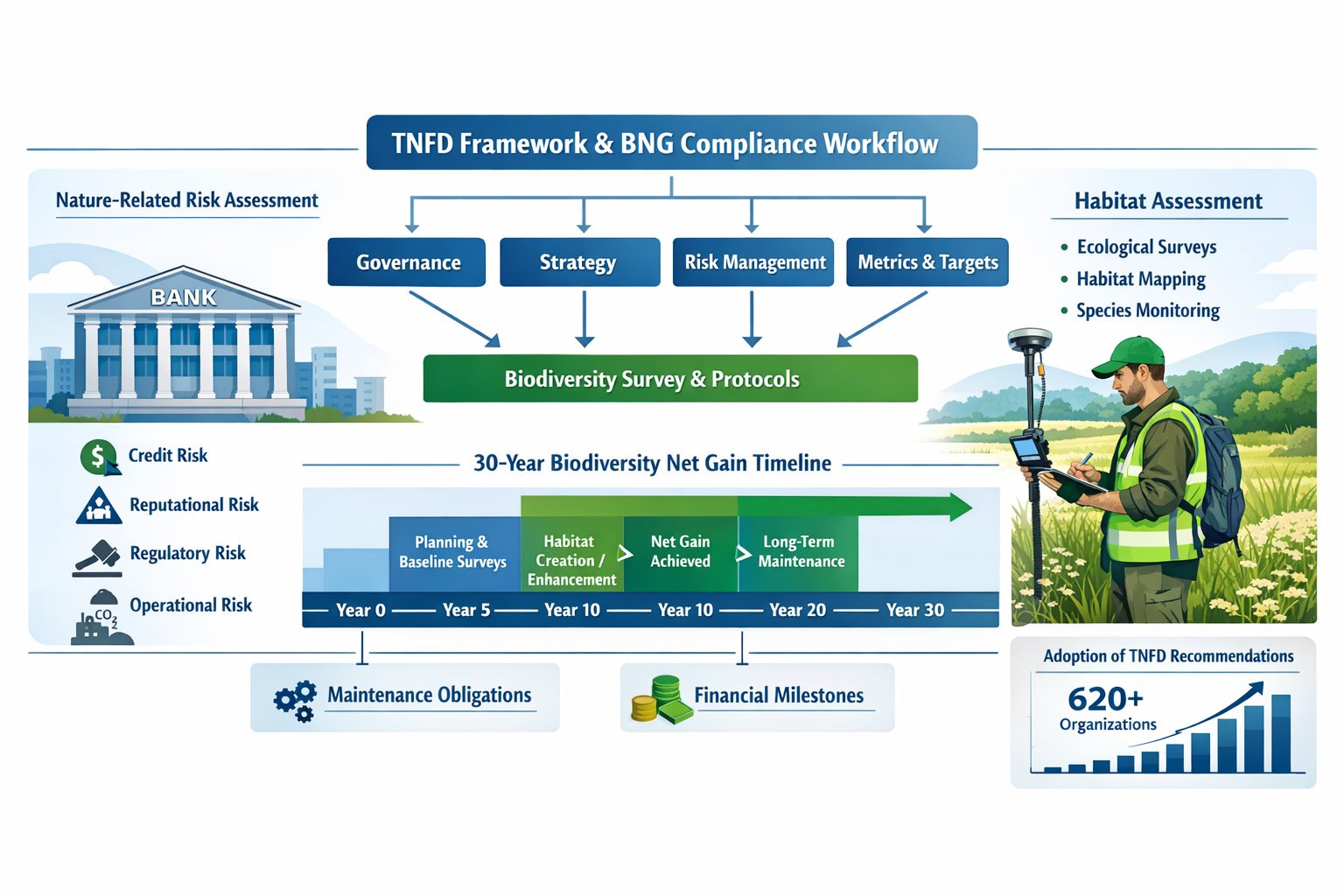
TNFD's four pillars provide a structure for integrating surveyor work into broader institutional nature strategies:
1. Governance: Surveyors should help financial institutions establish oversight mechanisms for nature-related risks in their lending portfolios, including regular reporting on BNG compliance status across financed projects.
2. Strategy: Field assessments should inform scenario analysis showing how different biodiversity outcomes affect project viability and financial returns under various regulatory and market conditions.
3. Risk Management: Surveyor protocols must identify and quantify nature-related risks including regulatory non-compliance, habitat creation failure, and long-term maintenance cost escalation.
4. Metrics & Targets: Biodiversity unit calculations and condition assessments provide quantifiable metrics that financial institutions can aggregate across portfolios and report to stakeholders.
For surveyors working with financial institutions, data standardization is critical. Adopting consistent methodologies across projects enables portfolio-level analysis that banks need for TNFD disclosure. This includes standardized habitat classification, condition scoring criteria, and biodiversity unit calculations using approved metrics.
The Nature Journey roadmap launched by UNEP FI in 2026 provides practical guidance for banks integrating nature considerations into decision-making[1]. Surveyors should familiarize themselves with this framework to position their services as essential components of institutional nature strategies.
Developing Risk Assessment Tools for Banking Sector Clients
Financial institutions require quantitative risk assessment that translates ecological uncertainty into financial terms. Surveyors can bridge this gap by developing risk scoring frameworks tailored to banking sector needs.
Proposed risk assessment matrix for BNG compliance:
| Risk Category | Low Risk | Medium Risk | High Risk |
|---|---|---|---|
| Baseline data quality | Multiple seasonal surveys, peer-reviewed | Single-season survey, standard protocols | Limited survey effort, data gaps |
| On-site delivery feasibility | >120% of required units achievable on-site | 100-120% achievable with optimization | <100% on-site, off-site units required |
| Habitat creation certainty | Low-risk habitat types (e.g., grassland) | Moderate-risk types (e.g., woodland) | High-risk types (e.g., wetland) |
| Management capacity | Established provider, proven track record | New provider, adequate resources | Unclear management arrangements |
| Financial reserves | >150% of projected 30-year costs | 100-150% of costs | <100% of costs |
| Regulatory complexity | Standard BNG, no additional constraints | Multiple designations, elevated requirements | Protected species, complex mitigation |
This risk framework enables financial institutions to differentiate loan terms based on nature-related risk profiles. Projects with low-risk BNG strategies may qualify for preferential rates, while high-risk projects require additional reserves or enhanced monitoring.
Surveyors should also help financial institutions understand temporal risk—the possibility that habitats fail to reach target conditions within expected timeframes, extending maintenance obligations and increasing costs. Providing realistic timelines with confidence intervals helps banks model cash flow requirements accurately.
Preparing for UN Forum and Water Conference Milestones
Positioning Surveyor Services for Global Nature Finance Initiatives
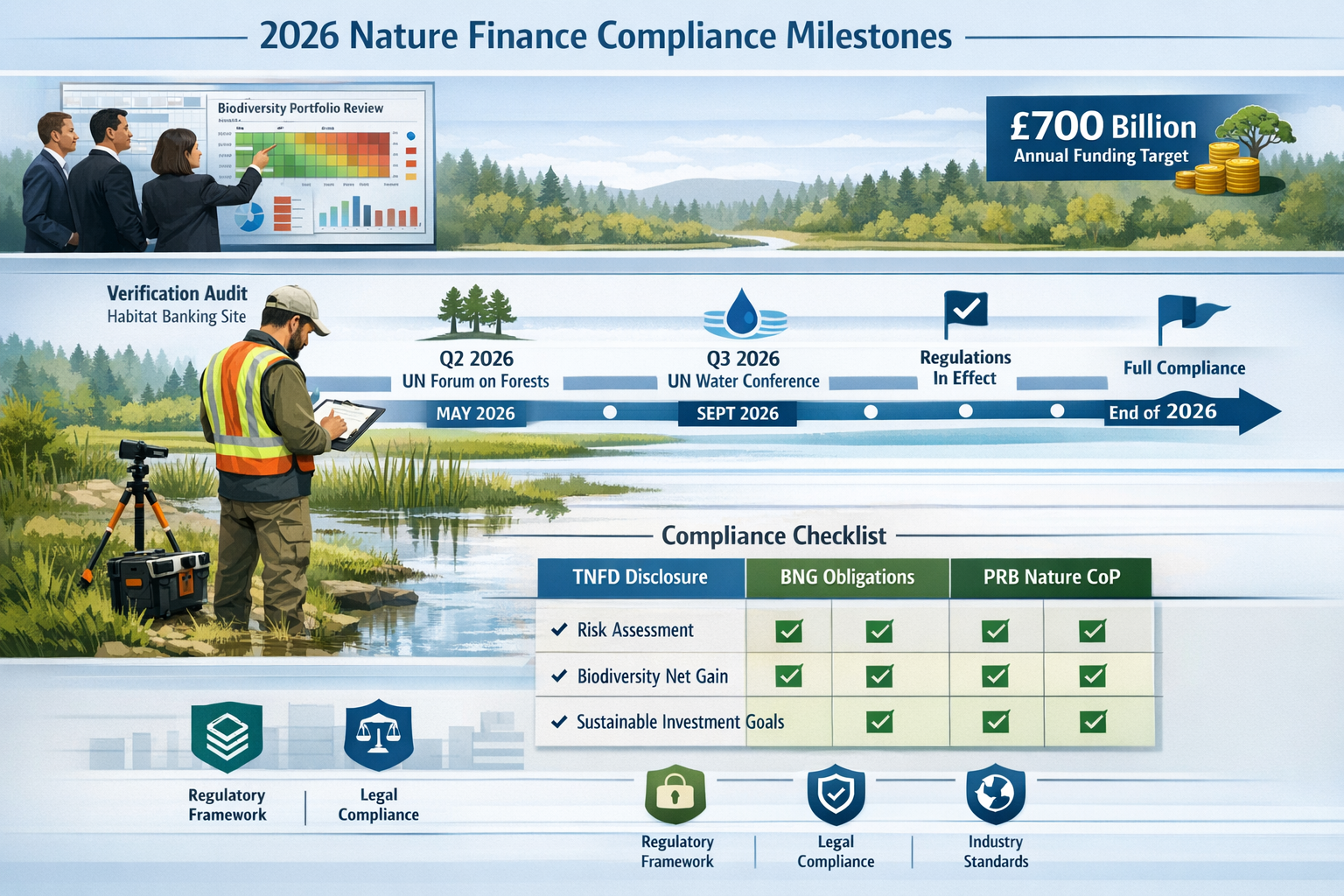
The 2026 calendar includes critical international milestones that will shape nature finance compliance requirements for years to come. The UN Forum on Forests and UN Water Conference represent opportunities for financial institutions to demonstrate leadership in nature-positive financing, creating demand for robust verification services.
Key opportunities for surveyor engagement:
🌲 Portfolio-level biodiversity assessment: Financial institutions need baseline assessments of nature-related risks across their entire lending portfolios, not just individual projects. Surveyors can develop sampling methodologies and extrapolation frameworks that provide portfolio-level insights.
💧 Water-biodiversity nexus: The UN Water Conference emphasizes connections between freshwater ecosystems and biodiversity. Surveyors with expertise in aquatic and riparian habitats can help financial institutions assess water-related nature risks.
📈 Impact measurement and reporting: Banks participating in global nature initiatives require standardized metrics for reporting biodiversity outcomes. Surveyors can provide the field data and verification that underpins credible impact reporting.
🤝 Multi-stakeholder collaboration: International forums bring together financial institutions, regulators, NGOs, and technical experts. Surveyors should engage with these networks to shape emerging standards and position themselves as trusted advisors.
The UNEP FI network of over 550 member institutions represents a substantial market for surveyor services[1]. Surveyors who understand the specific needs of this community—including TNFD alignment, PRB commitments, and nature-positive financing targets—can differentiate themselves in an increasingly competitive market.
Building Institutional Capacity for Long-Term Nature Finance Compliance
Financial Institutions and Biodiversity Net Gain: Surveyor Playbooks for 2026 Nature Finance Compliance must address not just immediate regulatory requirements but also long-term institutional capacity building. The 30-year maintenance obligations and evolving disclosure frameworks require sustained engagement between surveyors and financial institutions.
Capacity building priorities include:
Training programs: Develop educational offerings that help bank risk managers, loan officers, and portfolio managers understand BNG requirements, biodiversity metrics, and nature-related financial risks. Surveyors are ideally positioned to deliver this technical training.
Decision support tools: Create simplified assessment frameworks that enable financial institutions to conduct preliminary nature risk screening before engaging full surveyor services. This might include GIS-based tools, habitat risk matrices, and cost estimation calculators.
Standardized reporting templates: Design reporting formats that meet both planning authority requirements and financial institution needs, reducing duplication and improving efficiency.
Quality assurance protocols: Establish industry standards for surveyor qualifications, methodologies, and peer review processes that give financial institutions confidence in assessment quality.
Technology integration: Explore how remote sensing, artificial intelligence, and biodiversity monitoring technologies can enhance efficiency and reduce costs while maintaining assessment rigor.
The importance of BNG to the UK economy extends beyond environmental benefits to include financial system stability and investment certainty[5]. Surveyors who help financial institutions navigate this landscape contribute to both nature recovery and economic resilience.
Practical Implementation: Case Studies and Best Practices
Commercial Development Financing with Integrated BNG Verification
Consider a regional bank evaluating a £50 million mixed-use development requiring BNG compliance. The surveyor's role extends beyond standard habitat assessment to include:
Pre-financing assessment: Conduct preliminary BNG feasibility analysis showing the development can achieve 10% net gain through combination of on-site green infrastructure (60% of required units) and off-site woodland creation (40% of units). Provide cost estimates showing BNG adds approximately 3.2% to total project costs.
Risk quantification: Identify key risks including dependency on third-party off-site unit provider, 18-month timeline to achieve target condition for on-site grassland creation, and requirement for specialized management expertise for woodland habitat. Recommend financial reserves of 125% of projected 30-year costs.
Monitoring framework: Design phased verification protocol with quarterly inspections for first two years, annual monitoring for years 3-10, and biennial assessments thereafter. Provide bank with clear trigger points for intervention if habitats fail to progress as expected.
Portfolio integration: Structure reporting to align with bank's TNFD disclosure requirements, enabling aggregation of biodiversity metrics across multiple financed projects.
This comprehensive approach transforms the surveyor from a compliance checkbox into a strategic advisor helping the financial institution manage nature-related risks throughout the project lifecycle.
Infrastructure Project Nature Risk Assessment
For nationally significant infrastructure projects facing May 2026 BNG implementation deadlines[7], surveyors must work at unprecedented speed while maintaining rigor. A surveyor supporting a financial institution evaluating a major transportation project might:
Accelerated baseline assessment: Deploy multiple survey teams simultaneously to complete comprehensive habitat mapping within compressed timelines, using drone imagery and remote sensing to supplement field surveys.
Alternative scenario modeling: Present financial institution with multiple BNG delivery scenarios showing trade-offs between cost, risk, and timeline, enabling informed decision-making about project structure and financing terms.
Regulatory liaison: Coordinate with planning authorities and Natural England to clarify interpretation of BNG requirements for complex infrastructure, reducing uncertainty for financial institution.
Long-term stewardship planning: Help structure financial arrangements ensuring 30-year maintenance obligations are adequately funded through combination of developer reserves, endowments, and third-party management agreements.
The planning considerations for BNG become even more complex for infrastructure projects, requiring surveyors to navigate multiple jurisdictions, habitat types, and stakeholder interests while keeping financial institutions informed of risks and opportunities.
Emerging Challenges and Future Directions
Addressing Market Constraints and Capacity Gaps
The rapid implementation of BNG requirements has revealed significant capacity constraints across the biodiversity surveying sector. Financial institutions report difficulty securing timely, high-quality assessments for projects requiring financing decisions. Key challenges include:
⚠️ Surveyor availability: Demand for qualified ecologists exceeds supply, particularly during peak survey seasons, creating bottlenecks in project timelines.
⚠️ Off-site unit scarcity: Limited availability of off-site biodiversity units in some regions forces developers toward more expensive statutory credits, affecting project viability.
⚠️ Data standardization: Inconsistent methodologies across surveyors complicate portfolio-level risk assessment for financial institutions.
⚠️ Cost uncertainty: Volatile pricing for biodiversity units and management services makes financial modeling difficult.
⚠️ Technology lag: Slow adoption of remote sensing and automated monitoring technologies limits efficiency gains.
Surveyors can address these challenges by investing in staff training, adopting standardized protocols aligned with financial sector needs, and leveraging technology to increase capacity. Financial institutions, meanwhile, should engage surveyors early in project development to avoid last-minute assessment rushes.
Preparing for Regulatory Evolution Beyond 2026
The BNG framework will continue evolving as regulators, financial institutions, and practitioners gain experience with implementation. Surveyors should anticipate several likely developments:
Enhanced disclosure requirements: TNFD recommendations will likely become mandatory for large financial institutions, increasing demand for standardized biodiversity reporting.
Expanded scope: BNG principles may extend beyond development projects to include agricultural lending, forestry investments, and other sectors with significant nature impacts.
International harmonization: As more countries adopt BNG-style requirements, international standards for biodiversity assessment and verification will emerge, creating opportunities for surveyors with multi-jurisdiction expertise.
Technology integration: Artificial intelligence, satellite monitoring, and environmental DNA analysis will increasingly supplement traditional survey methods, requiring surveyors to develop new technical skills.
Market maturation: Biodiversity unit markets will become more sophisticated with standardized pricing, trading platforms, and financial instruments, requiring surveyors to understand market dynamics alongside ecological principles.
Surveyors who position themselves at the intersection of ecology, finance, and regulatory compliance will be best placed to serve financial institutions navigating this evolving landscape. The comprehensive guidance for developers applies equally to the financial institutions that fund development projects.
Conclusion
Financial Institutions and Biodiversity Net Gain: Surveyor Playbooks for 2026 Nature Finance Compliance represents a fundamental transformation in how the financial sector engages with nature-related risks and opportunities. With 620 organizations adopting TNFD recommendations, over 350 banks committed to nature action through the Principles for Responsible Banking, and £700 billion in annual funding needed for nature protection, the integration of robust biodiversity verification into financial decision-making has never been more critical[1].
Biodiversity surveyors serve as essential bridges between ecological science and financial risk management. By developing protocols that meet both regulatory requirements and banking sector needs, surveyors enable financial institutions to confidently finance development projects while managing nature-related risks and contributing to the 10% BNG mandate now in force across England[4][7].
As the UK's national security assessment explicitly recognizes biodiversity loss as a strategic concern[1], and as international milestones like the UN Forum on Forests and UN Water Conference drive global nature finance initiatives, the surveyor's role will only grow in importance. The 30-year maintenance obligations embedded in BNG legislation create long-term relationships between surveyors, developers, and financial institutions that require sustained technical excellence and strategic advisory capacity.
Actionable Next Steps
For biodiversity surveyors seeking to serve financial institution clients effectively:
- Develop TNFD literacy: Understand how your field assessments contribute to nature-related financial disclosure and position services accordingly
- Standardize methodologies: Adopt consistent protocols that enable portfolio-level analysis for banking clients
- Build risk assessment capabilities: Translate ecological uncertainty into financial risk metrics that inform lending decisions
- Establish quality assurance: Implement peer review and verification processes that give financial institutions confidence in assessment quality
- Engage with banking networks: Connect with PRB Nature Community of Practice and UNEP FI initiatives to understand institutional needs
- Invest in technology: Leverage remote sensing, monitoring technologies, and data management systems that improve efficiency and reduce costs
- Plan for long-term relationships: Recognize that 30-year maintenance obligations create sustained engagement opportunities with financial institution clients
The convergence of mandatory BNG requirements, TNFD disclosure frameworks, and growing financial sector recognition of nature-related risks creates unprecedented opportunity for biodiversity surveyors willing to expand their expertise beyond traditional ecological consulting. Those who successfully bridge the worlds of ecology and finance will play crucial roles in directing capital toward nature-positive development while ensuring regulatory compliance and financial system stability.
The playbook for 2026 nature finance compliance is still being written. Surveyors who contribute to its development—through rigorous field work, innovative verification protocols, and strategic advisory services—will help shape a financial system that recognizes nature not as an externality but as fundamental infrastructure requiring protection, enhancement, and careful stewardship.
References
[1] Action On Nature What Can Financial Institutions Expect In 2026 – https://www.unepfi.org/themes/ecosystems/action-on-nature-what-can-financial-institutions-expect-in-2026/
[2] Biodiversity Net Gain Regulations Opportunities And Challenges January 2026 – https://www.ipf.org.uk/resourceLibrary/biodiversity-net-gain-regulations—opportunities-and-challenges–january-2026-.html
[3] Biodiversity Net Gain Changes 2026 – https://devisarchitecture.com/new-build/biodiversity-net-gain-changes-2026/
[4] Biodiversity Net Gain Legislation What You Need To Know – https://www.tetratecheurope.com/news/biodiversity-net-gain-legislation-what-you-need-to-know/
[5] Biodiversity Net Gain A Roadmap For Action – https://www.greenfinanceinstitute.com/hive/insights/biodiversity-net-gain-a-roadmap-for-action/
[6] Biodiversity Net Gain Hundreds Firms Warn Proposed Rule Changes Mark Backwards Step – https://www.businessgreen.com/news/4523274/biodiversity-net-gain-hundreds-firms-warn-proposed-rule-changes-mark-backwards-step
[7] Understanding Biodiversity Net Gain – https://www.gov.uk/guidance/understanding-biodiversity-net-gain