

The ocean's soundscape tells a story that visual surveys alone cannot capture. As marine ecosystems face unprecedented pressures from climate change, shipping traffic, and coastal development, scientists are turning to passive acoustic monitoring to establish critical baseline data for marine mammal populations. The Marine Mammal Acoustic Monitoring for Baselines: 2026 Protocols from World Conference Insights represent a watershed moment in conservation science, bringing together cutting-edge technology and standardized methodologies that will shape environmental assessments for years to come.
Throughout 2026, a series of international conferences has spotlighted acoustic monitoring as an essential tool for tracking marine biodiversity. These gatherings have produced practical protocols that enable researchers, environmental consultants, and biodiversity surveyors to document shifting baselines amid contaminants and climate shifts. The insights gained provide deployment guides specifically relevant for biodiversity net gain reporting and environmental impact assessments.
Key Takeaways
- 🎯 Standardized protocols from 2026 world conferences provide consistent methodologies for establishing marine mammal acoustic baselines across different ocean regions
- 🔊 Passive acoustic monitoring captures year-round data on marine mammal presence, behavior, and population trends that visual surveys cannot detect
- 📊 Baseline establishment is critical for biodiversity net gain assessments, enabling developers and planners to measure project impacts accurately
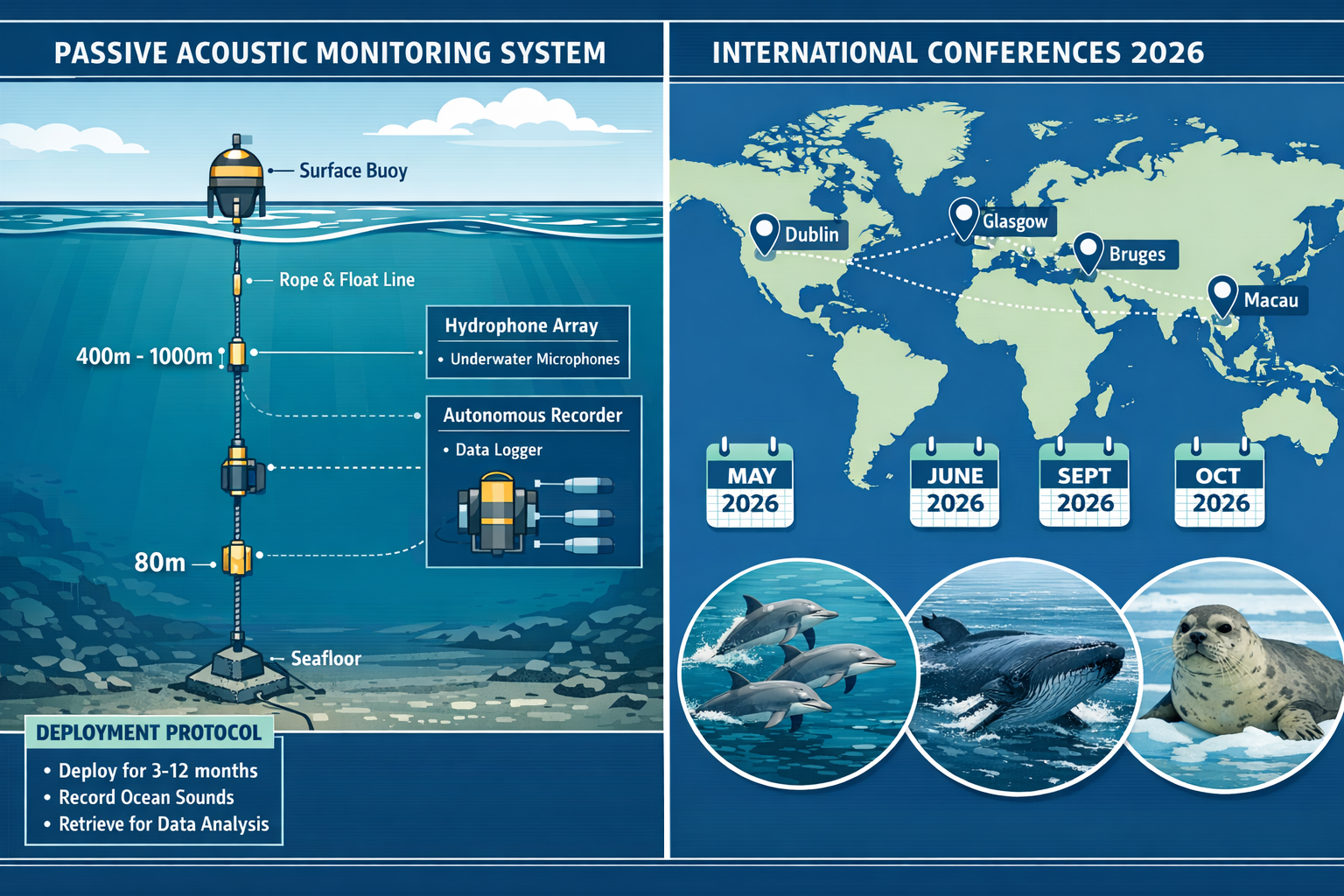
- 🌍 International collaboration through conferences in Dublin, Macau, Glasgow, and Bruges has unified global approaches to marine acoustic monitoring
- ⚙️ Deployment guidelines now include specific protocols for equipment selection, data collection, and analysis relevant to regulatory compliance
Understanding Marine Mammal Acoustic Monitoring for Baselines: 2026 Protocols from World Conference Insights
What Is Acoustic Baseline Monitoring?
Acoustic baseline monitoring involves deploying specialized underwater microphones (hydrophones) to record the sounds produced by marine mammals over extended periods. Unlike traditional visual surveys that depend on favorable weather and daylight, acoustic monitoring operates continuously—capturing vocalizations during night, storms, and throughout seasons when animals might be present but unseen.
Key components include:
- Passive acoustic recorders that capture ambient ocean sounds
- Hydrophone arrays positioned at strategic depths and locations
- Data analysis software that identifies species-specific vocalizations
- Long-term datasets establishing presence, abundance, and behavior patterns
The 2026 protocols emphasize establishing baselines before development projects begin. This approach mirrors the principles used in terrestrial biodiversity net gain assessments, where understanding existing conditions is paramount to measuring future impacts.
Why 2026 Marks a Turning Point
The year 2026 has brought together leading marine scientists, acousticians, and conservation practitioners at multiple world conferences. These events have produced consensus on monitoring standards that address previous inconsistencies in data collection and analysis methods.
The International Conference on Ocean Acoustics and Marine Mammal Research (ICOAMMR) scheduled for April 21, 2026, in Dublin, Ireland [1], and June 25, 2026, in Macau, China [2], specifically focuses on advancing acoustic monitoring techniques. Meanwhile, the International Conference on Underwater Acoustics scheduled for June 15-18, 2026, in Glasgow [3], addresses technical aspects of sound propagation and recording equipment calibration.
Perhaps most significantly, the World Conference on Marine Biodiversity scheduled for November 17-20, 2026, in Bruges, Belgium [4], includes a dedicated session on animal movement and biologging that integrates acoustic monitoring with broader biodiversity assessment frameworks.
"Acoustic monitoring provides the temporal resolution needed to understand how marine mammals use habitats throughout annual cycles—information that's essential for evidence-based conservation decisions." — Conference proceedings insight
Core Protocols from the 2026 Conference Series
Equipment Selection and Deployment Standards
The 2026 protocols establish clear guidelines for equipment selection based on target species, water depth, and monitoring objectives. These standards ensure data comparability across different projects and geographic regions.
Recommended equipment specifications:
| Equipment Type | Specifications | Application |
|---|---|---|
| Autonomous Recorders | 16-bit resolution, 48-96 kHz sampling rate | Long-term baseline studies (3-12 months) |
| Real-time Systems | Continuous transmission, solar/battery powered | Active monitoring zones, mitigation |
| Hydrophone Arrays | Multiple units, 500m-2km spacing | Population density estimates |
| Calibrated Systems | Known sensitivity, frequency response | Quantitative sound level measurements |
Deployment protocols include:
- 📍 Site selection criteria based on habitat types, known migration routes, and project impact zones
- ⚓ Mooring designs appropriate for seabed conditions and water depths
- 🔋 Power requirements calculated for desired recording schedules (continuous vs. duty-cycled)
- 🛡️ Biofouling prevention using copper guards or cleaning protocols for long deployments
These technical standards align with the systematic approach required for biodiversity impact assessments, ensuring monitoring efforts produce defensible data for regulatory review.
Data Collection Methodologies
The 2026 protocols emphasize consistency in data collection to enable meaningful comparisons across seasons, years, and geographic locations. This standardization is particularly valuable for establishing shifting baselines—the gradual changes in ecosystem conditions that occur over time.
Key methodological elements:
- Recording schedules: Minimum 10% duty cycle (recording 10 minutes per hour) for presence/absence data; continuous recording preferred for behavioral studies
- Deployment duration: Minimum 90 days per season to capture temporal variability; year-round monitoring for comprehensive baselines
- Spatial coverage: Multiple recording locations within study areas to account for animal movement and sound propagation variability
- Metadata standards: Detailed documentation of equipment settings, deployment coordinates, water depth, and environmental conditions
Quality control measures include regular equipment calibration, acoustic file integrity checks, and standardized file naming conventions that facilitate data management and long-term archiving.
Species Identification and Analysis Protocols
One of the most significant advances in the Marine Mammal Acoustic Monitoring for Baselines: 2026 Protocols from World Conference Insights is the standardization of species identification methods. Different marine mammals produce distinctive vocalizations—from the complex songs of humpback whales to the echolocation clicks of dolphins and porpoises.
Analysis workflow:
- Automated detection algorithms screen large datasets for potential marine mammal sounds
- Manual verification by trained analysts confirms species identifications
- Call classification categorizes vocalizations by type (social calls, feeding buzzes, songs)
- Temporal analysis tracks presence patterns across hours, days, and seasons
- Spatial analysis maps acoustic detections to understand habitat use
The protocols recommend using validated software tools with documented detection performance metrics. This ensures that baseline data collected by different teams can be compared reliably—a critical requirement for biodiversity net gain reporting where consistency and transparency are essential.
Integrating Acoustic Baselines into Environmental Assessments
Application to Biodiversity Net Gain Frameworks
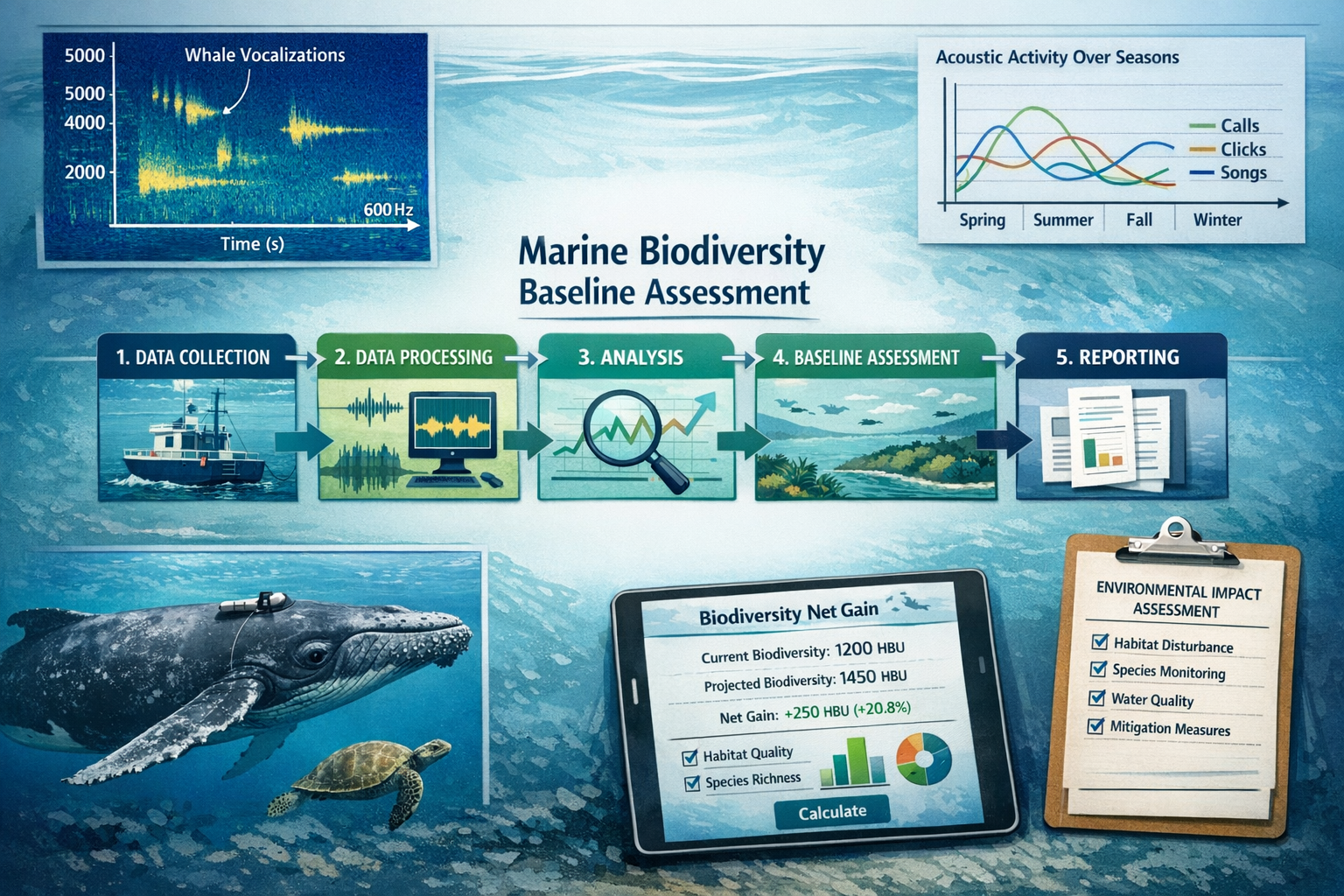
While biodiversity net gain (BNG) requirements have primarily focused on terrestrial and freshwater habitats, marine development projects increasingly require similar approaches. The Marine Mammal Acoustic Monitoring for Baselines: 2026 Protocols from World Conference Insights provide the methodological foundation for marine BNG assessments.
Integration steps include:
- Pre-development baseline establishment: Deploy acoustic monitoring equipment 12-24 months before construction to capture seasonal variations
- Impact prediction: Use baseline data to model how construction noise, vessel traffic, or habitat modification might affect marine mammal presence
- Mitigation design: Develop time-area restrictions or noise reduction measures based on critical habitat use periods identified through acoustic monitoring
- Post-construction monitoring: Continue acoustic surveys to verify impact predictions and measure recovery
This approach parallels the systematic methodology used in creating biodiversity plans for developers, adapted for the marine environment where visual surveys face significant limitations.
Addressing Shifting Baselines and Climate Change
One of the most challenging aspects of marine conservation is the "shifting baseline syndrome"—the gradual acceptance of degraded conditions as normal because each generation lacks knowledge of historical ecosystem states. Acoustic monitoring provides objective, repeatable measurements that document changes over time.
Climate-related changes detected through acoustic baselines:
- 🌡️ Range shifts: Species moving poleward as ocean temperatures warm
- 📅 Phenological changes: Altered timing of migration, breeding, and feeding behaviors
- 🔊 Behavioral modifications: Changes in vocalization patterns potentially linked to stress or habitat quality
- 📉 Population trends: Declining detection rates indicating population decreases
The 2026 protocols specifically address the need for long-term monitoring programs that extend beyond individual project timelines. By establishing standardized methods now, the scientific community creates datasets that will reveal ecosystem trends over decades—information essential for adaptive management strategies.
Contaminant and Noise Pollution Assessment
Marine mammals face threats from both chemical contaminants and acoustic pollution. The 2026 protocols recognize that baseline acoustic monitoring serves dual purposes: documenting biological presence and characterizing the ambient sound environment.
Noise baseline components:
- Anthropogenic sources: Shipping traffic, construction activities, sonar, seismic surveys
- Natural sounds: Wind, waves, precipitation, biological choruses
- Frequency analysis: Identifying sound energy in frequency bands relevant to marine mammal hearing
- Temporal patterns: Daily, seasonal, and annual variations in noise levels
Understanding the existing acoustic environment enables regulators and developers to set appropriate noise limits for construction activities. This evidence-based approach supports the principles outlined in guidance for developers working in sensitive environmental contexts.
Practical Implementation Guidelines for 2026 and Beyond
Step-by-Step Deployment Process
For environmental consultants, researchers, and biodiversity surveyors implementing the 2026 protocols, a systematic deployment process ensures data quality and regulatory compliance.
Phase 1: Planning (2-3 months before deployment)
- Define monitoring objectives and target species
- Conduct desktop review of existing marine mammal data for the region
- Select appropriate equipment based on water depth, deployment duration, and budget
- Obtain necessary permits for equipment deployment and data collection
- Develop health and safety protocols for fieldwork
Phase 2: Deployment (1-2 weeks)
- Conduct pre-deployment equipment testing and calibration
- Deploy recorders at planned locations with precise GPS coordinates
- Document deployment conditions (weather, sea state, water depth)
- Create detailed deployment logs and metadata files
- Establish retrieval schedule based on battery life and data storage capacity
Phase 3: Data Collection (3-12 months)
- For real-time systems, monitor data transmission and equipment status
- For autonomous recorders, conduct periodic servicing visits if feasible
- Maintain deployment logs documenting any equipment issues or environmental events
- Archive raw acoustic data with appropriate backup protocols
Phase 4: Analysis and Reporting (2-6 months)
- Process acoustic data using standardized detection algorithms
- Conduct manual verification of automated detections
- Generate presence/absence matrices, detection rates, and temporal patterns
- Prepare technical reports following 2026 protocol standards
- Integrate findings into environmental impact assessments or BNG reports
Cost Considerations and Resource Planning
Implementing comprehensive acoustic monitoring programs requires significant investment in equipment, personnel, and analysis time. Understanding these costs helps project planners budget appropriately.
Typical cost components:
- Equipment purchase: $5,000-$25,000 per autonomous recorder unit
- Deployment vessels: $1,000-$5,000 per day for boat charter and crew
- Data analysis: $50-$150 per hour for trained acoustic analysts
- Report preparation: $10,000-$50,000 depending on project complexity
- Long-term monitoring: Annual costs of $30,000-$100,000+ for multi-site programs
While these investments may seem substantial, they provide defensible baseline data that can prevent costly project delays or mitigation failures. The approach mirrors the value proposition of thorough biodiversity impact assessments in terrestrial contexts.
Regulatory Compliance and Reporting Standards
The Marine Mammal Acoustic Monitoring for Baselines: 2026 Protocols from World Conference Insights align with regulatory frameworks in multiple jurisdictions. Environmental agencies increasingly require acoustic monitoring for projects in marine mammal habitats.
Key regulatory applications:
- Environmental Impact Statements (EIS): Baseline data supporting impact predictions
- Marine Protected Area (MPA) management: Monitoring effectiveness of conservation measures
- Offshore energy development: Wind farms, oil and gas platforms, tidal energy
- Port and harbor expansions: Assessing impacts of dredging and construction
- Military activities: Documenting marine mammal presence before sonar exercises
Reports should include standardized sections covering methodology, detection results, seasonal patterns, species composition, and comparison to regional datasets. This structure facilitates regulatory review and ensures findings can contribute to broader scientific understanding.
Future Directions and Emerging Technologies
Advances in Automated Detection and AI
Artificial intelligence and machine learning are revolutionizing acoustic data analysis. The 2026 conference series highlighted several emerging technologies that will enhance baseline monitoring capabilities:
Technological innovations:
- 🤖 Deep learning classifiers achieving >95% accuracy for common species
- ☁️ Cloud-based analysis platforms enabling real-time processing of streaming data
- 📱 Mobile applications for field deployment documentation and quality control
- 🔗 Integrated sensor networks combining acoustic, oceanographic, and satellite data
These advances will reduce analysis costs and enable near-real-time monitoring systems that provide immediate alerts when marine mammals enter construction zones—improving both conservation outcomes and project efficiency.
Integration with Broader Biodiversity Monitoring
The principles established in the Marine Mammal Acoustic Monitoring for Baselines: 2026 Protocols from World Conference Insights extend beyond marine mammals to encompass entire ocean soundscapes. Fish, invertebrates, and even coral reefs produce sounds that acoustic monitoring can detect.
This holistic approach aligns with the comprehensive perspective required for achieving biodiversity net gain across multiple taxonomic groups. Future protocols will likely integrate acoustic monitoring with visual surveys, environmental DNA sampling, and satellite tracking to create multi-dimensional baseline assessments.
Building International Collaboration Networks
The 2026 conference series has fostered unprecedented international collaboration among researchers, regulators, and industry practitioners. This network effect amplifies the value of individual monitoring efforts by:
- Sharing reference libraries of marine mammal vocalizations
- Standardizing methods across national boundaries
- Pooling datasets to identify large-scale population trends
- Coordinating research priorities to address critical knowledge gaps
Organizations and professionals involved in biodiversity surveying can contribute to these networks by implementing standardized protocols and sharing findings through scientific publications and data repositories.
Conclusion
The Marine Mammal Acoustic Monitoring for Baselines: 2026 Protocols from World Conference Insights represent a significant advancement in marine conservation science. By establishing standardized methodologies for equipment deployment, data collection, and species identification, these protocols enable consistent baseline assessments across different projects and geographic regions.
For developers, environmental consultants, and regulatory agencies, acoustic monitoring provides objective data that supports evidence-based decision-making. The protocols address critical needs in biodiversity net gain assessments, environmental impact statements, and adaptive management programs—all while accounting for the challenges of shifting baselines amid climate change and anthropogenic pressures.
Actionable Next Steps
For project developers:
- Incorporate acoustic baseline monitoring into early project planning phases
- Budget for 12-24 months of pre-construction data collection
- Engage qualified marine acousticians with experience implementing 2026 protocols
- Consider acoustic monitoring as part of comprehensive biodiversity planning
For environmental professionals:
- Attend upcoming conferences to stay current on protocol refinements
- Invest in training for acoustic data analysis and species identification
- Develop partnerships with marine mammal specialists and acoustic equipment providers
- Integrate acoustic monitoring capabilities into service offerings
For researchers and policymakers:
- Support long-term monitoring programs that extend beyond individual project timelines
- Contribute data to international repositories and reference libraries
- Refine regulatory frameworks to incorporate acoustic baseline requirements
- Fund research addressing critical knowledge gaps in marine mammal acoustics
The ocean's soundscape provides a window into ecosystem health that visual observations alone cannot achieve. By implementing the 2026 protocols, the conservation community takes a significant step toward understanding and protecting marine biodiversity in an era of rapid environmental change. The insights gained will inform management decisions for decades to come, ensuring that development proceeds with full knowledge of its impacts on the remarkable marine mammals that share our ocean planet.
For organizations seeking expertise in biodiversity assessments and environmental monitoring, Biodiversity Surveyors offers comprehensive services that integrate cutting-edge methodologies with regulatory compliance requirements.
References
[1] Eventdetails – https://internationalconferencealerts.com/eventdetails.php?id=100211653
[2] conferencealerts.co.in – https://conferencealerts.co.in/event/100427363
[3] Meetings – https://www.iqoe.org/meetings
[4] Animal Movement Behaviour And Biologging Session World Conference Marine Biodiversity – https://wildlabs.net/event/animal-movement-behaviour-and-biologging-session-world-conference-marine-biodiversity