

{"cover":"Professional landscape format (1536×1024) hero image featuring bold text overlay 'Business Case for Biodiversity Credits: Surveyor Strategies to Quantify Economic Risks in 2026 Reporting' in extra large 70pt white sans-serif font with dark shadow and semi-transparent overlay box, positioned in upper third. Background shows aerial view of rewilded farmland with diverse habitats, surveyor with equipment in field, overlaid with transparent financial risk assessment graphs and biodiversity metric charts. Color scheme: deep forest green, white, gold accents. High contrast, professional editorial quality, magazine cover aesthetic combining nature conservation with business analytics","content":["Detailed landscape format (1536×1024) image showing professional ecologist conducting biodiversity survey in restored habitat with tablet displaying biodiversity metric calculations, split-screen composition with left side showing natural habitat assessment and right side displaying standardized credit valuation framework dashboard with 1% per hectare improvement metrics, calculator overlays, and 30-year projection timelines. Includes visual elements of habitat types, species monitoring equipment, and financial modeling charts. Color palette: natural greens, professional blues, clean white backgrounds. Editorial quality with technical precision","Wide landscape format (1536×1024) infographic-style visualization depicting economic risk quantification framework for biodiversity credits, featuring three distinct risk categories in columns: restoration cost analysis (showing £1.5 million credit value versus fifteen-times-higher actual costs), temporal investment risks (69-92% biodiversity increase projections over 30-year timeline with 5-year verification checkpoints), and market standardization challenges (80+ global brokers with varying unit definitions). Includes bar charts, timeline graphics, risk heat maps, and financial calculator elements. Professional business aesthetic with data visualization focus, deep blue and orange color scheme","Comprehensive landscape format (1536×1024) business reporting dashboard mockup showing 2026 biodiversity credit disclosure framework with multiple panels: CSRD compliance checklist, TNFD guidance integration, greenwashing safeguard protocols, and Indigenous data sovereignty requirements. Features corporate report templates, regulatory timeline graphics, stakeholder engagement flowcharts, and verification methodology frameworks. Includes visual elements of official reporting documents, quality principle badges, and marine/coastal biodiversity credit working group symbols. Clean corporate aesthetic with professional typography, navy blue, white, and green accent colors"]
The promise of voluntary biodiversity credits has captivated investors and conservationists alike, yet a groundbreaking March 2026 study from Cambridge University reveals a sobering reality: biodiversity gains worth £1.5 million in voluntary credits would be insufficient to cover restoration costs fifteen times higher. [1] This stark economic gap underscores why the Business Case for Biodiversity Credits: Surveyor Strategies to Quantify Economic Risks in 2026 Reporting has become essential for developers, landowners, and financial institutions navigating nature recovery investments. As regulatory frameworks tighten and approximately 80 brokers globally offer varying biodiversity credit definitions, [1] professional surveyors must adopt systematic approaches to prove investment value while managing unprecedented economic uncertainties.
Key Takeaways
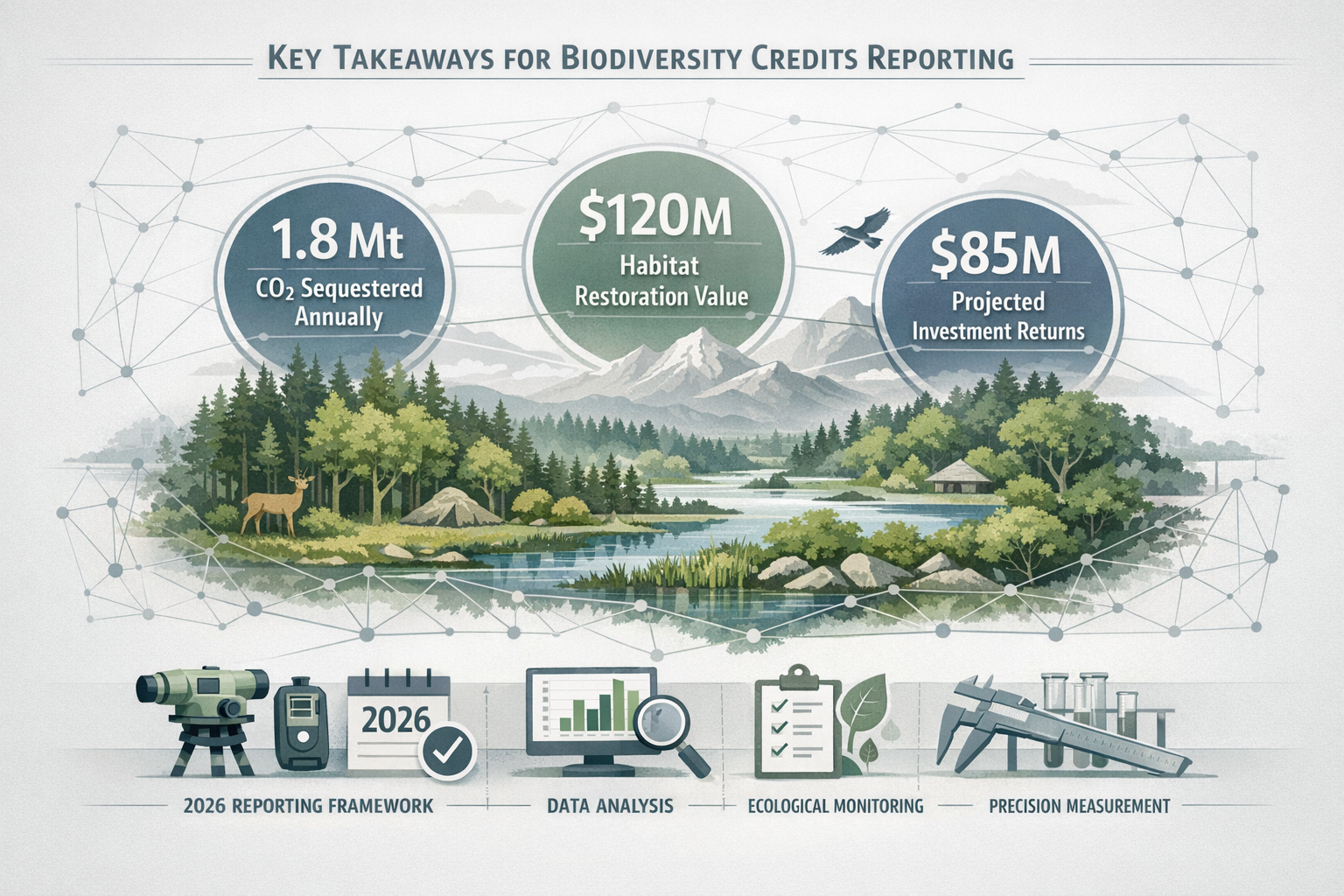
- 🔍 Voluntary biodiversity credits alone cannot fund nature recovery projects, with restoration costs reaching fifteen times the credit value at case study sites [1]
- 📊 Standardized metrics are critical: One biodiversity credit equals a 1% improvement per hectare, but 80+ global brokers use varying definitions [1]
- ⏳ Long-term forecasting is essential: Biodiversity increases of 69-92% over 30 years require reliable projection models for investor returns [2]
- 📋 2026 regulatory pressure intensifies: EU CSRD regulations and TNFD guidance drive mandatory biodiversity disclosure requirements [4]
- 🛡️ Greenwashing safeguards limit claims: Most purchasers can only claim "contributing to" biodiversity outcomes, not direct impact [6]
Understanding the Economic Reality Behind Biodiversity Credits
The Funding Gap Challenge
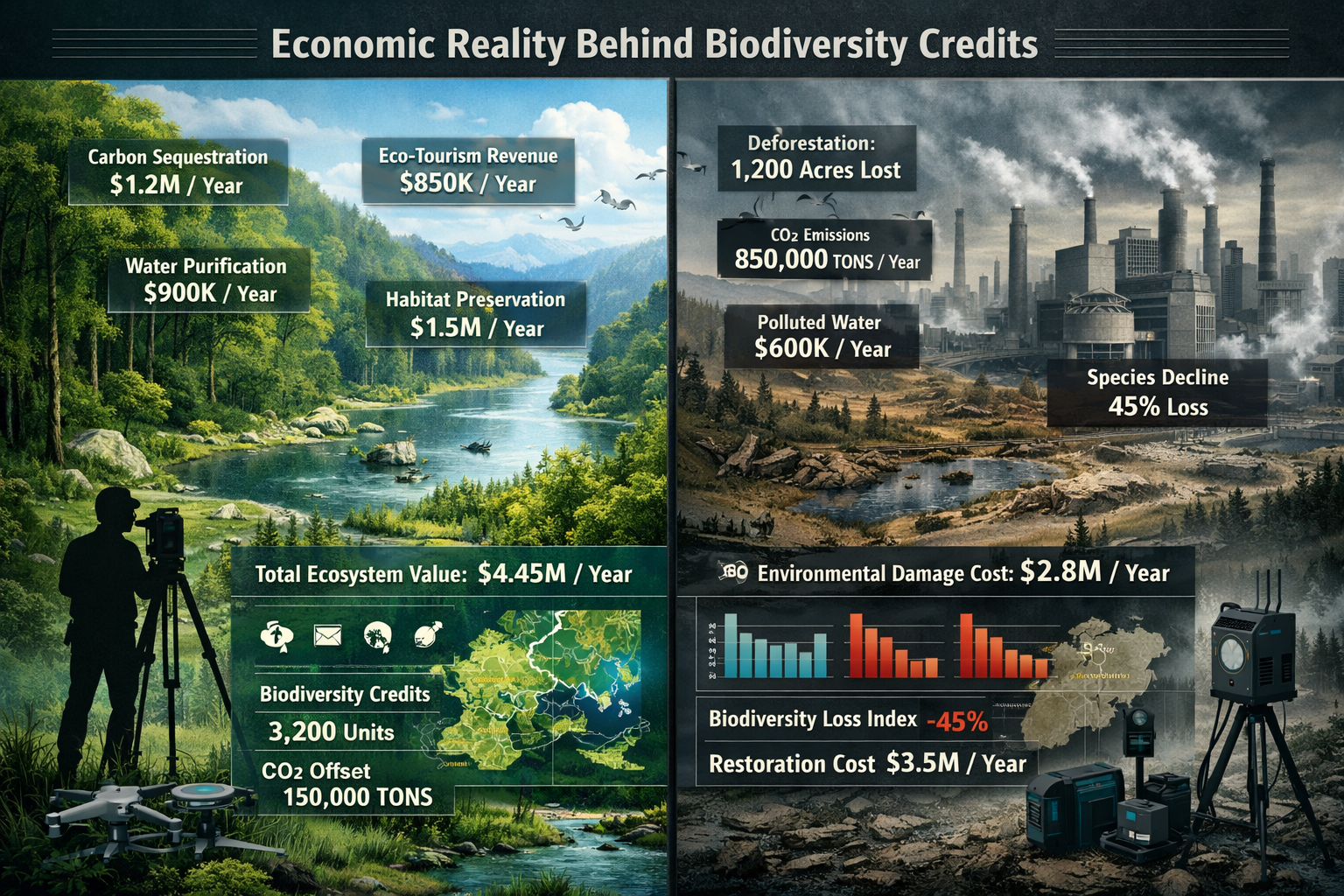
The Cambridge study analyzing Boothby farm's biodiversity credit potential revealed a fundamental economic challenge that surveyors must quantify in their assessments. While the site projected biodiversity gains worth approximately £1.5 million in voluntary credits, the actual restoration costs exceeded this amount by a factor of fifteen. [1] This disparity demonstrates that voluntary biodiversity credits cannot serve as standalone funding mechanisms for nature recovery projects.
For surveyors developing biodiversity net gain assessments, this finding necessitates transparent economic modeling that accounts for:
- Initial land acquisition costs
- Ongoing habitat management expenses
- Long-term monitoring requirements
- Verification and certification fees
- Administrative overhead
Temporal Dimensions of Credit Valuation
The same Cambridge research projects biodiversity increases of 69% to 92% over 30 years at the case study site. [2] This extended timeframe creates significant implications for investor return calculations and risk assessment. Investors can sell credits every five years if biodiversity gains are proven, [1] requiring surveyors to develop reliable forecasting methodologies that account for:
| Timeframe | Surveyor Requirements | Economic Risk Factors |
|---|---|---|
| Years 0-5 | Baseline establishment, initial habitat creation | High uncertainty, establishment failure risks |
| Years 5-10 | First verification cycle, early gains measurement | Market volatility, methodology changes |
| Years 10-20 | Mid-term habitat maturation, species colonization | Management continuity, climate impacts |
| Years 20-30 | Full ecosystem development, maximum credit generation | Long-term stewardship, policy shifts |
Understanding how to achieve 10% biodiversity net gain requires surveyors to integrate these temporal considerations into their economic risk assessments.
Business Case for Biodiversity Credits: Surveyor Strategies for Metric Standardization
The Global Standardization Challenge
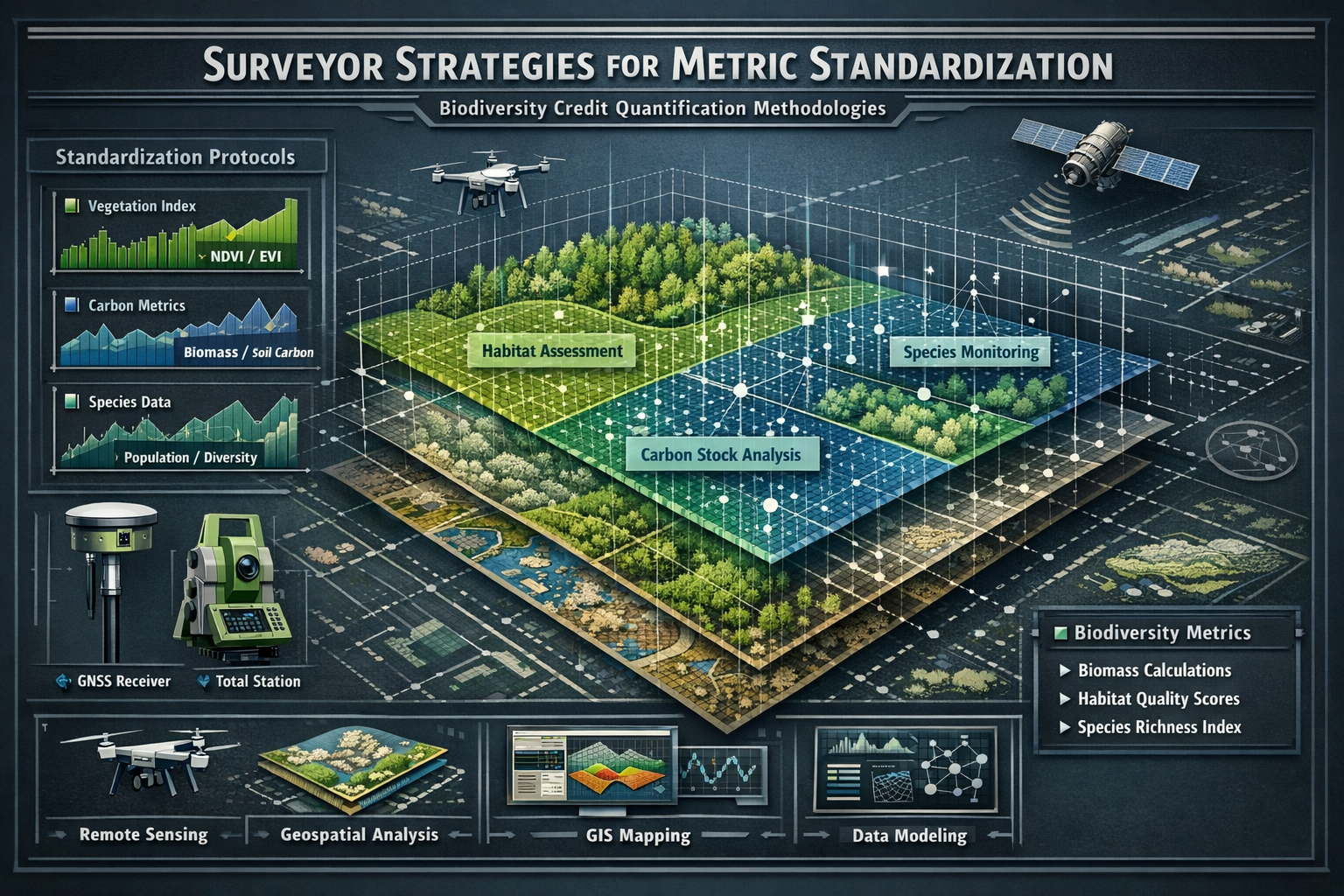
As of 2026, approximately 80 brokers offer voluntary biodiversity credits globally, yet no standard definition of a biodiversity unit exists. [1] This fragmentation creates substantial economic risks for investors and developers seeking comparable, reliable credit valuations. The Wallacea Trust framework, now globally applicable, defines one biodiversity credit as a 1% improvement in biodiversity per hectare of land. [1] However, implementation variations persist across jurisdictions and ecosystems.
Surveyors must navigate this complexity by:
- Adopting recognized frameworks like the Biodiversity Metric 4.0 in the UK context
- Documenting methodology choices transparently in all reporting
- Comparing credit calculations across multiple standardization approaches
- Quantifying uncertainty ranges in credit valuations
- Maintaining audit trails for verification purposes
Implementing Robust Assessment Frameworks
The Biodiversity Credit Alliance's 2026 strategic priorities emphasize developing credit methodologies that meet quality principles through consultative processes with scientific and technical experts. [3] Professional surveyors implementing the Business Case for Biodiversity Credits: Surveyor Strategies to Quantify Economic Risks in 2026 Reporting should incorporate:
Quality Principle Checklist:
✅ Scientific Robustness: Methodologies grounded in peer-reviewed ecological research
✅ Market Relevance: Metrics aligned with investor decision-making needs
✅ Verification Capability: Measurable indicators suitable for third-party auditing
✅ Temporal Appropriateness: Accounting for ecosystem development timelines
✅ Geographic Specificity: Adapted to local habitat types and species assemblages
For developers seeking guidance, understanding the cost of biodiversity units and statutory credits provides essential context for economic planning.
Marine and Coastal Biodiversity Credits
The BCA's dedicated working group on marine and coastal biodiversity credits [3] highlights emerging opportunities and challenges in aquatic ecosystems. Surveyors expanding into these domains face additional complexity:
- Three-dimensional habitat structures (water column, benthic zones)
- Dynamic environmental conditions (tidal influences, currents)
- Mobile species populations with variable residency patterns
- Limited baseline data compared to terrestrial systems
- Higher monitoring costs requiring specialized equipment
Quantifying Economic Risks in 2026 Reporting Frameworks
Regulatory Pressure and Compliance Requirements
Companies face increasing regulatory pressure in 2026 through the EU's Corporate Sustainability Reporting Directive (CSRD) and the Taskforce on Nature-Related Financial Disclosure (TNFD) guidance. [4] This regulatory environment drives demand for biodiversity credit purchases as organizations anticipate mandatory requirements.
"Carbon and biodiversity credits remain viewed primarily as a potential upside rather than core drivers of investment decisions as of early 2026." [5]
This perspective creates a critical tension that surveyors must address in their economic risk assessments. While regulatory frameworks push toward mandatory disclosure, market participants have not yet fully integrated biodiversity considerations into core financial planning. Surveyors developing the Business Case for Biodiversity Credits: Surveyor Strategies to Quantify Economic Risks in 2026 Reporting must therefore quantify:
Regulatory Risk Categories:
- Compliance Timing Risks: Uncertainty about implementation schedules and phase-in requirements
- Methodology Alignment Risks: Potential mismatches between survey approaches and emerging regulatory standards
- Disclosure Liability Risks: Legal exposure from inaccurate or incomplete biodiversity reporting
- Market Transition Risks: Valuation volatility as mandatory requirements reshape credit markets
Greenwashing Safeguards and Claims Limitations
Significant safeguards are required to prevent greenwashing, with guidance limiting most purchasers to claims of "contributing to" or "supporting" biodiversity outcomes rather than claiming direct impact. [6] This restriction applies except in regulated compensatory mitigation programs, creating a two-tier system that surveyors must navigate carefully.
Permissible Claims Framework:
| Program Type | Allowable Claims | Surveyor Documentation Requirements |
|---|---|---|
| Voluntary Markets | "Contributing to biodiversity conservation" | Detailed methodology, third-party verification, uncertainty quantification |
| Regulated Compensatory Mitigation | "Achieving biodiversity net gain" | Statutory compliance evidence, approved metric calculations, legal agreements |
| Corporate Sustainability Reporting | "Supporting nature recovery efforts" | TNFD-aligned disclosures, materiality assessments, stakeholder engagement records |
Understanding these distinctions is crucial when achieving biodiversity net gain without the risk of overstated environmental claims.
Indigenous Data Sovereignty and Community Engagement
The BCA strategic priorities include ensuring Indigenous data sovereignty and supporting effective engagement of Indigenous Peoples and local communities in biodiversity credit methodology development and monitoring. [3] This emerging governance requirement introduces additional economic considerations:
- Consultation costs for meaningful community engagement
- Benefit-sharing arrangements that affect net credit revenues
- Traditional knowledge integration requiring specialized expertise
- Cultural site protections that may limit certain restoration activities
- Long-term stewardship agreements with community stakeholders
Surveyors must incorporate these factors into economic models, recognizing that projects with strong community partnerships often demonstrate greater long-term resilience despite higher upfront costs.
Advanced Surveyor Strategies for Investment Value Demonstration
Multi-Metric Assessment Approaches
Unlike carbon markets, biodiversity lacks a single metric to capture its full range of characteristics, making globally standardized monitoring essential but difficult. [6] This complexity creates ongoing concerns about reliability and effectiveness that surveyors must address through comprehensive assessment strategies.
Recommended Multi-Metric Framework:
🌿 Habitat Diversity Metrics: Area, condition, and connectivity of distinct habitat types
🦋 Species Richness Indicators: Taxonomic diversity across multiple groups (plants, invertebrates, birds, mammals)
🔄 Ecosystem Function Measures: Nutrient cycling, pollination services, carbon sequestration
🎯 Conservation Priority Alignment: Presence of threatened species, habitat rareness, landscape significance
📈 Temporal Trajectory Analysis: Rate of improvement, resilience indicators, succession stage
This approach aligns with guidance for developers on how to conduct a biodiversity impact assessment while providing the comprehensive data investors need for risk evaluation.
Scenario Modeling for Uncertainty Quantification
Given the 30-year timeframes and multiple risk factors involved in biodiversity credit generation, surveyors should employ scenario modeling to quantify economic uncertainties:
Best-Case Scenario:
- Optimal weather conditions supporting rapid habitat establishment
- Successful species colonization exceeding projections
- Stable regulatory framework with increasing credit values
- Strong market demand maintaining premium prices
- Projected ROI: 8-12% annually over 30 years
Base-Case Scenario:
- Typical establishment challenges with moderate delays
- Biodiversity improvements within projected 69-92% range [2]
- Evolving regulations requiring methodology adjustments
- Moderate market growth with periodic volatility
- Projected ROI: 4-6% annually over 30 years
Worst-Case Scenario:
- Climate impacts causing establishment failures requiring replanting
- Biodiversity gains at lower end of projections
- Major regulatory changes requiring costly re-verification
- Market oversupply depressing credit values
- Projected ROI: 0-2% annually or negative returns
This scenario framework enables investors to understand the full risk spectrum while allowing surveyors to demonstrate professional risk assessment capabilities essential to the Business Case for Biodiversity Credits: Surveyor Strategies to Quantify Economic Risks in 2026 Reporting.
Technology Integration for Cost-Effective Monitoring
Advanced monitoring technologies can reduce long-term costs while improving data quality:
- Remote Sensing: Satellite and drone imagery for habitat condition tracking
- Acoustic Monitoring: Automated species detection reducing field survey costs
- eDNA Sampling: Efficient biodiversity assessment through environmental DNA
- AI-Powered Analysis: Machine learning for pattern recognition in monitoring data
- Blockchain Verification: Transparent, tamper-proof credit transaction records
Landowners exploring opportunities to sell biodiversity units should consider these technological investments as mechanisms to reduce monitoring costs and enhance credit credibility.
Strategic Implementation for Different Stakeholder Groups
For Developers and Project Sponsors
Developers must integrate biodiversity credit economics into project feasibility analysis from the earliest planning stages. The guide to biodiversity credits for developers provides foundational guidance, but 2026 reporting requirements demand more sophisticated approaches:
Developer Action Plan:
- Pre-Acquisition Phase: Commission preliminary biodiversity assessments to identify credit generation potential or obligation requirements
- Design Integration: Incorporate on-site or off-site delivery strategies based on economic optimization
- Financial Modeling: Include biodiversity credit costs/revenues in pro forma analysis with sensitivity testing
- Risk Allocation: Structure contracts with clear responsibility for credit delivery and verification
- Reporting Preparation: Establish data collection systems aligned with TNFD and CSRD requirements
For Landowners and Credit Generators
Landowners considering biodiversity credit generation face different economic considerations. While the Cambridge study demonstrates that voluntary credits alone cannot fund restoration, [1] they can provide supplementary revenue streams when combined with other funding sources.
Landowner Economic Optimization:
- Stacked Revenue Streams: Combine biodiversity credits with carbon credits, sustainable farming incentives, and eco-tourism
- Phased Implementation: Start with lower-cost interventions generating early credits to fund more intensive restoration
- Partnership Structures: Collaborate with conservation organizations providing technical expertise and funding
- Long-Term Agreements: Secure premium pricing through extended commitment periods
- Diversification: Generate credits across multiple habitat types to hedge against market variations
Understanding what sustainable farming incentive programs offer helps landowners identify complementary funding opportunities.
For Financial Institutions and Investors
Investment institutions require standardized risk assessment frameworks to evaluate biodiversity credit opportunities. Surveyors serving this stakeholder group should provide:
Investor-Grade Reporting Elements:
📊 Quantified Risk Metrics: Probability-weighted return scenarios with clear assumptions
📋 Comparable Benchmarks: Performance relative to similar projects and market indices
🔍 Due Diligence Documentation: Complete methodology transparency and third-party verification
⚖️ Legal Structure Clarity: Ownership rights, transfer mechanisms, and liability allocation
📈 Exit Strategy Options: Secondary market liquidity, early termination provisions, credit banking
Emerging Trends Shaping 2026 and Beyond
Market Maturation and Consolidation
The current landscape of 80+ brokers with varying standards [1] will likely consolidate as regulatory requirements and investor demands favor standardized, high-quality credits. Surveyors should anticipate:
- Platform Consolidation: Fewer, larger marketplaces with enhanced verification standards
- Premium Pricing: Higher-quality credits with robust monitoring commanding significant premiums
- Increased Transparency: Public registries and transaction databases improving market efficiency
- Professional Certification: Specialized credentials for biodiversity credit assessors
Integration with Nature-Based Solutions
Biodiversity credits increasingly integrate with broader nature-based solution strategies addressing climate, water, and community objectives simultaneously. This convergence creates opportunities for:
- Multi-Benefit Valuation: Credits reflecting combined biodiversity, carbon, and water benefits
- Landscape-Scale Planning: Regional approaches optimizing multiple ecosystem services
- Public-Private Partnerships: Blended finance structures combining credit revenues with public funding
- Community Co-Benefits: Employment, recreation, and cultural values enhancing project viability
Technological Advancement in Verification
Verification costs represent a significant economic burden in biodiversity credit systems. Technological advances in 2026 and beyond will likely reduce these costs through:
- Standardized Monitoring Protocols: Automated data collection reducing field survey requirements
- AI-Powered Verification: Machine learning algorithms detecting biodiversity changes from remote sensing
- Distributed Ledger Technology: Blockchain-based credit registries ensuring transaction integrity
- Citizen Science Integration: Community monitoring programs providing cost-effective supplementary data
Conclusion
The Business Case for Biodiversity Credits: Surveyor Strategies to Quantify Economic Risks in 2026 Reporting requires professional surveyors to navigate complex economic realities that extend far beyond traditional ecological assessment. The Cambridge study's revelation that voluntary credit values fall fifteen times short of restoration costs [1] underscores the critical need for transparent, comprehensive economic modeling that accounts for multiple funding sources, extended timeframes, and substantial uncertainties.
As regulatory frameworks tighten through CSRD and TNFD requirements [4] and approximately 80 global brokers compete with varying standards, [1] surveyors must adopt systematic approaches to metric standardization, risk quantification, and stakeholder communication. The temporal dimension—with biodiversity increases of 69-92% projected over 30 years [2] and credit sales possible every five years [1]—demands sophisticated forecasting capabilities that integrate ecological knowledge with financial modeling expertise.
Actionable Next Steps
For Surveyors:
- Develop standardized economic risk assessment templates aligned with emerging regulatory frameworks
- Invest in training on TNFD guidance and CSRD requirements
- Establish partnerships with financial analysts to enhance economic modeling capabilities
- Implement technology solutions for cost-effective long-term monitoring
For Developers:
- Commission comprehensive biodiversity net gain assessments early in project planning
- Integrate biodiversity credit economics into financial feasibility analysis with scenario testing
- Establish relationships with verified credit providers and brokers
- Prepare data collection systems for mandatory 2026 reporting requirements
For Landowners:
- Explore opportunities to buy or sell biodiversity units as part of diversified land management strategies
- Investigate stacked revenue opportunities combining biodiversity credits with other incentive programs
- Engage with conservation organizations offering partnership and funding support
- Consider long-term stewardship agreements that may command premium credit pricing
For Investors:
- Demand standardized risk reporting from biodiversity credit projects using multi-scenario analysis
- Prioritize investments with robust third-party verification and transparent methodologies
- Evaluate portfolio diversification across habitat types, geographies, and timeframes
- Monitor regulatory developments that may create mandatory demand for biodiversity credits
The biodiversity credit market in 2026 stands at a critical juncture where professional surveyor expertise in quantifying economic risks will determine which projects attract investment, which methodologies gain regulatory acceptance, and ultimately, which nature recovery efforts receive adequate funding. By adopting systematic approaches to risk assessment, embracing metric standardization, and providing transparent economic analysis, surveyors can bridge the gap between ecological potential and investment reality—transforming biodiversity credits from speculative instruments into credible components of nature finance strategies.
References
[1] 2026 03 Biodiversity Credits Boost Rewilding Fall – https://phys.org/news/2026-03-biodiversity-credits-boost-rewilding-fall.html
[2] Voluntary Biodiversity Credits Could Help Fund Global Nature Recovery Alongside Other Approaches – https://www.cam.ac.uk/research/news/voluntary-biodiversity-credits-could-help-fund-global-nature-recovery-alongside-other-approaches
[3] Bca Strategic Plan 25 26 V3 – https://www.biodiversitycreditalliance.org/wp-content/uploads/2025/09/BCA_Strategic_Plan_25-26-v3.pdf
[4] Biodiversity Credits Gaining Acceptance Guide For 2025 – https://trellis.net/article/biodiversity-credits-gaining-acceptance-guide-for-2025/
[5] Energy Nature And Net Zero Update March 2026 – https://rural.struttandparker.com/article/energy-nature-and-net-zero-update-march-2026/
[6] Biodiversity Credits – https://www.nature.org/en-us/what-we-do/our-insights/biodiversity/biodiversity-credits/