

The biodiversity crisis has moved from environmental concern to boardroom priority. As corporations worldwide pledge to protect nature, a critical question emerges: how can businesses accurately measure their dependence on ecosystems? In 2026, the gap between corporate biodiversity commitments and measurable action is narrowing, thanks to innovative surveyor tools designed specifically for nature dependence assessments. These instruments are transforming how ecologists support companies in understanding their environmental footprint while meeting rising investor demands for transparency.
The convergence of regulatory requirements, voluntary disclosure frameworks, and stakeholder pressure has created unprecedented demand for robust biodiversity data. Financial institutions and corporations now require standardized, science-based approaches to assess their nature-related risks and dependencies. This shift presents both opportunity and responsibility for ecological professionals equipped with the right assessment protocols.
Key Takeaways
- 🌍 Over 70 specialized tools now exist to help businesses assess nature dependencies, impacts, risks, and opportunities through frameworks like TNFD's LEAP approach
- 📊 No single assessment tool suffices—financial institutions and corporations need integrated approaches combining footprinting models, ecosystem services valuation, and biodiversity metrics
- 🔬 Advanced monitoring technologies including eDNA surveys and remote sensing provide scalable solutions for baseline assessments and ongoing impact disclosure
- 📈 Analytics capacity has become the limiting factor, requiring investment in institutional capabilities, standards, and governance rather than further technology development
- 🎯 Alignment with multiple frameworks (TNFD, CSRD, ISSB, GRI, SBTN) enables surveyors to deliver assessments that meet diverse regulatory and voluntary reporting requirements
Understanding Corporate Biodiversity Commitments: Surveyor Tools for 2026 Nature Dependence Assessments
The landscape of corporate environmental responsibility has fundamentally shifted. Where companies once focused primarily on carbon emissions, biodiversity and nature dependence have emerged as equally critical concerns. This transformation reflects growing scientific consensus that ecosystem collapse poses systemic risks to global economic stability.
The Rise of Nature-Related Financial Disclosure
The Taskforce for Nature-related Financial Disclosures (TNFD) has established a comprehensive framework that mirrors the successful Task Force on Climate-related Financial Disclosures (TCFD). At its core lies the LEAP approach—a structured methodology guiding organizations through four stages:
- Locate interface points between business operations and nature
- Evaluate dependencies and impacts on ecosystems
- Assess material risks and opportunities
- Prepare responses and disclosure strategies
This framework provides the foundation for Corporate Biodiversity Commitments: Surveyor Tools for 2026 Nature Dependence Assessments, creating a common language between ecological professionals and corporate decision-makers.
Regulatory Drivers Shaping Assessment Needs
Multiple regulatory frameworks are converging to mandate biodiversity reporting:
- Corporate Sustainability Reporting Directive (CSRD) in the European Union requires detailed environmental disclosures
- International Sustainability Standards Board (ISSB) establishes global baseline sustainability disclosure standards
- European Sustainability Reporting Standards (ESRS) provide specific technical requirements for EU companies
- Science Based Targets Network (SBTN) offers voluntary but rigorous target-setting guidance
For surveyors, these frameworks create standardized reporting requirements that translate ecological data into business-relevant metrics. Understanding how biodiversity impact assessments align with these disclosure standards has become essential professional knowledge.
Navigating the Nature Tools Compass: Essential Assessment Instruments
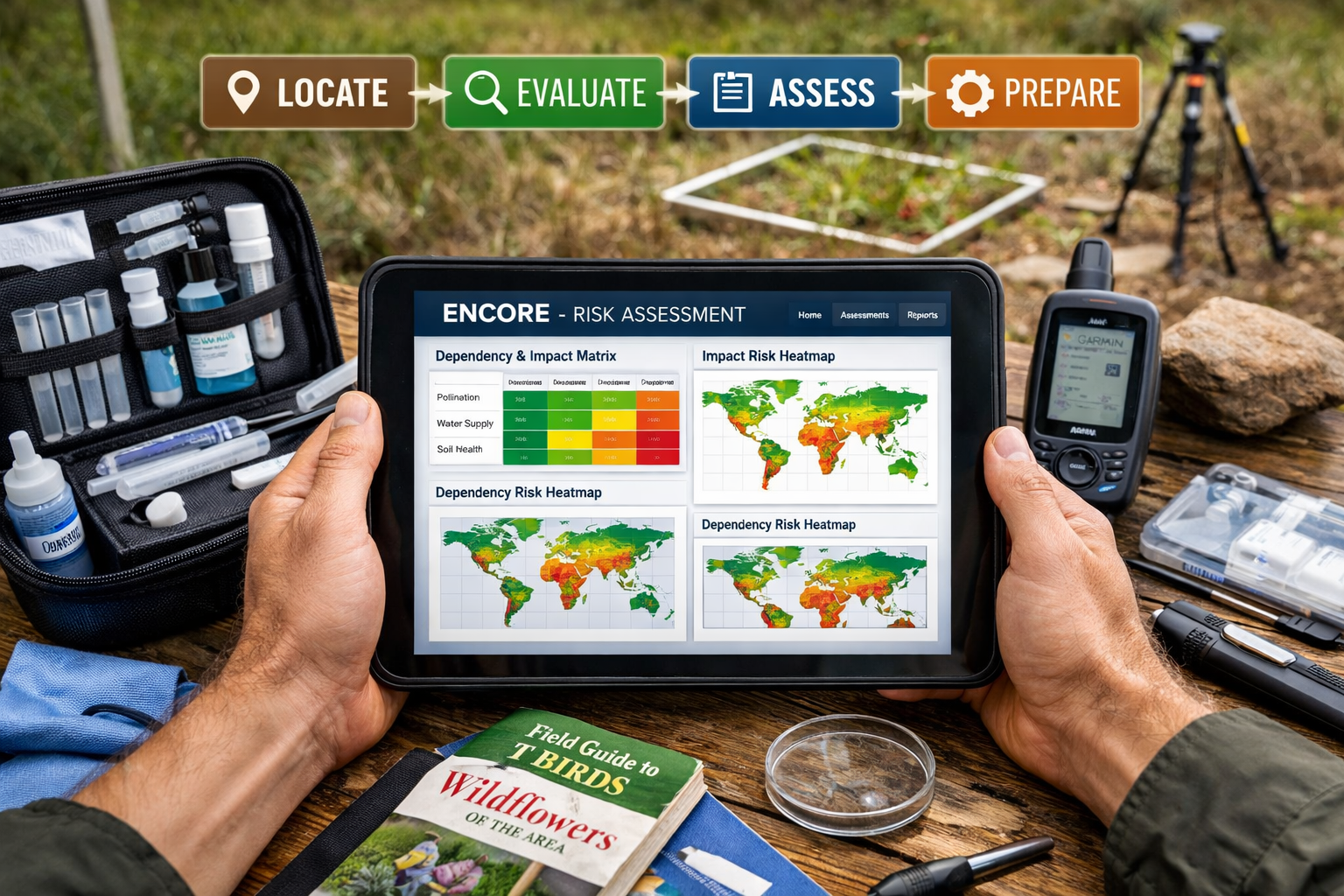
The proliferation of biodiversity assessment tools has created both opportunity and confusion. To address this challenge, the Nature Tools Compass was launched to help businesses and financial institutions navigate over 70 available instruments [1]. This platform categorizes tools according to the LEAP approach, enabling users to select appropriate assessments for each stage of their nature-related due diligence.
Core Assessment Categories
Corporate Biodiversity Commitments: Surveyor Tools for 2026 Nature Dependence Assessments fall into several functional categories:
Dependency Mapping Tools
These instruments identify how business operations rely on ecosystem services:
- ENCORE (Exploring Natural Capital Opportunities, Risks and Exposure) maps production processes to their ecosystem service dependencies across 167 economic sectors
- Natural Capital Protocol provides a standardized framework for identifying, measuring, and valuing natural capital impacts and dependencies
- Ecosystem Services Valuation Database (ESVD) offers monetary values for ecosystem services to support economic analysis
Impact Assessment Frameworks
These tools measure how corporate activities affect biodiversity:
- Biodiversity Footprint for Financial Institutions (BFFI) quantifies biodiversity impacts throughout investment and lending portfolios
- Life Cycle Assessment (LCA) frameworks with biodiversity modules track impacts across product life cycles
- Biodiversity Intactness Index (BII) measures ecosystem integrity changes resulting from human activities [3]
Risk Screening Instruments
These platforms identify biodiversity-related business risks:
- Integrated Biodiversity Assessment Tool (IBAT) overlays business locations with protected areas and key biodiversity areas
- WWF Biodiversity Risk Filter assesses operational risks based on geographic exposure to biodiversity threats
- Country Biodiversity Risk Index (CBRI) combines 43 indicators across four dimensions to assess national-level biodiversity risks [2]
The CBRI Innovation: Four-Pillar Risk Assessment
The Country Biodiversity Risk Index represents a significant advancement in Corporate Biodiversity Commitments: Surveyor Tools for 2026 Nature Dependence Assessments. Developed by Crédit Agricole CIB, this tool addresses critical gaps in existing frameworks by providing both static assessment (current biodiversity status) and forward-looking perspective (future trajectory) [2].
The four integrated dimensions include:
| Dimension | Key Indicators | Assessment Focus |
|---|---|---|
| Ecosystem Health | Habitat extent, forest cover, wetland condition | Current state of natural systems |
| Species Conservation Status | Threatened species populations, extinction risk | Biological diversity integrity |
| Anthropogenic Pressures | Land use change, pollution, resource extraction | Human impact intensity |
| Protection Measures | Protected area coverage, conservation investment | Mitigation and response capacity |
This multi-dimensional approach enables financial institutions to identify biodiversity exposure concentrations throughout their lending and investment portfolios, supporting more informed capital allocation decisions.
Implementing Surveyor Protocols for Supply Chain Impact Assessments

Supply chains represent the primary channel through which most corporations impact biodiversity. For companies without direct land management operations, upstream dependencies on natural resources and ecosystem services create hidden nature-related risks. Surveyor protocols for supply chain assessments must therefore address complexity, geographic dispersion, and data limitations.
The SBTN High-Impact Commodity Approach
The Science Based Targets Network has developed a Materiality Screening Tool and High-Impact Commodity List that helps companies identify which economic activities most significantly impact biodiversity [6]. This holistic starting point enables surveyors to prioritize assessment efforts where they matter most.
High-impact commodities typically include:
- 🌾 Agricultural products: Palm oil, soy, beef, cocoa, coffee
- 🌲 Forest products: Timber, pulp, paper
- 🐟 Aquatic resources: Wild-caught fish, farmed seafood
- ⛏️ Extracted materials: Minerals, aggregates, fossil fuels
For each commodity, surveyor protocols must assess:
- Geographic sourcing locations and their biodiversity sensitivity
- Production methods and their ecosystem impacts
- Certification status and credibility of sustainability claims
- Traceability systems enabling verification of origin
- Alternative sourcing options with lower biodiversity footprints
Integrated Assessment Methodology
Recent workshops with financial institutions revealed a critical insight: no single biodiversity assessment tool is sufficient on its own [3]. Effective Corporate Biodiversity Commitments: Surveyor Tools for 2026 Nature Dependence Assessments require integrated approaches combining multiple complementary methods.
A comprehensive supply chain protocol might integrate:
Primary Data Collection
- Site-specific habitat surveys at key sourcing locations
- Species inventories using standardized sampling protocols
- Ecosystem condition assessments using ecological indicators
- Stakeholder consultations with local communities and conservation organizations
Secondary Data Analysis
- Spatial analysis overlaying sourcing locations with biodiversity databases
- Life cycle assessment using industry-specific impact factors
- Ecosystem services modeling to quantify dependencies
- Risk screening using tools like IBAT and Biodiversity Risk Filter
Quantitative Modeling
- Biodiversity footprint calculation using BFFI or similar frameworks
- Natural capital valuation applying ESVD or Natural Capital Protocol
- Scenario analysis modeling future biodiversity trajectories under different management approaches
This integrated methodology aligns with biodiversity net gain assessment principles while extending beyond site-specific development projects to encompass global supply networks.
Scalable Monitoring Technologies
Traditional field surveys face significant scalability challenges when assessing dispersed supply chains. Advanced monitoring technologies offer solutions that balance rigor with practicality [5]:
Environmental DNA (eDNA) Surveys
- Water or soil samples analyzed for genetic material
- Species detection without direct observation
- Particularly effective for aquatic ecosystems and elusive species
- Enables standardized protocols across diverse geographies
Remote Sensing Applications
- Satellite imagery tracking land use change and habitat loss
- Vegetation indices monitoring ecosystem health
- Machine learning algorithms detecting deforestation and degradation
- Temporal analysis revealing biodiversity trends
Acoustic Monitoring
- Automated recording devices capturing soundscapes
- Bioacoustic analysis identifying species presence
- Long-term deployment enabling seasonal pattern detection
- Cost-effective compared to traditional observer-based surveys
These technologies support baseline assessments for restoration projects, enable repeated monitoring for impact disclosure, and reduce uncertainty in biodiversity additionality claims [5]. When integrated with traditional survey methods, they create robust evidence bases for corporate reporting.
BNG-Aligned Reporting for Investor Transparency
The Biodiversity Net Gain (BNG) framework, while initially developed for development planning contexts, provides valuable principles for corporate biodiversity reporting. Investor transparency increasingly demands quantitative metrics demonstrating that corporate activities deliver measurable positive outcomes for nature.
Translating BNG Principles to Corporate Context
Core BNG concepts translate effectively to broader corporate biodiversity commitments:
The Mitigation Hierarchy
- Avoid biodiversity impacts through alternative approaches
- Minimize unavoidable impacts through best practices
- Restore degraded ecosystems affected by operations
- Offset residual impacts through conservation investments
This hierarchy provides a structured decision framework that resonates with both ecological professionals and corporate sustainability teams. Understanding how to achieve biodiversity net gain in development contexts provides transferable skills for corporate assessment work.
Quantitative Biodiversity Units
The BNG metric system—calculating biodiversity units based on habitat distinctiveness, condition, and extent—offers a model for corporate impact quantification. While supply chain assessments may require adapted metrics, the fundamental approach of translating ecological condition into standardized units enables:
- Aggregation of impacts across diverse operations
- Comparison of biodiversity performance over time
- Benchmarking against sector peers
- Verification of improvement claims
Surveyors familiar with biodiversity credits and units possess relevant expertise for developing corporate biodiversity accounting systems.
Additionality and Permanence
Investor scrutiny focuses intensely on whether corporate biodiversity investments deliver genuine additional benefits beyond business-as-usual scenarios. Surveyor protocols must therefore incorporate:
- Baseline condition assessments establishing counterfactual scenarios
- Additionality testing demonstrating incremental conservation outcomes
- Permanence mechanisms ensuring long-term biodiversity maintenance
- Monitoring protocols tracking outcomes against commitments
These requirements align closely with principles governing biodiversity net gain delivery, whether on-site or through offset mechanisms.
Alignment with Multiple Disclosure Frameworks
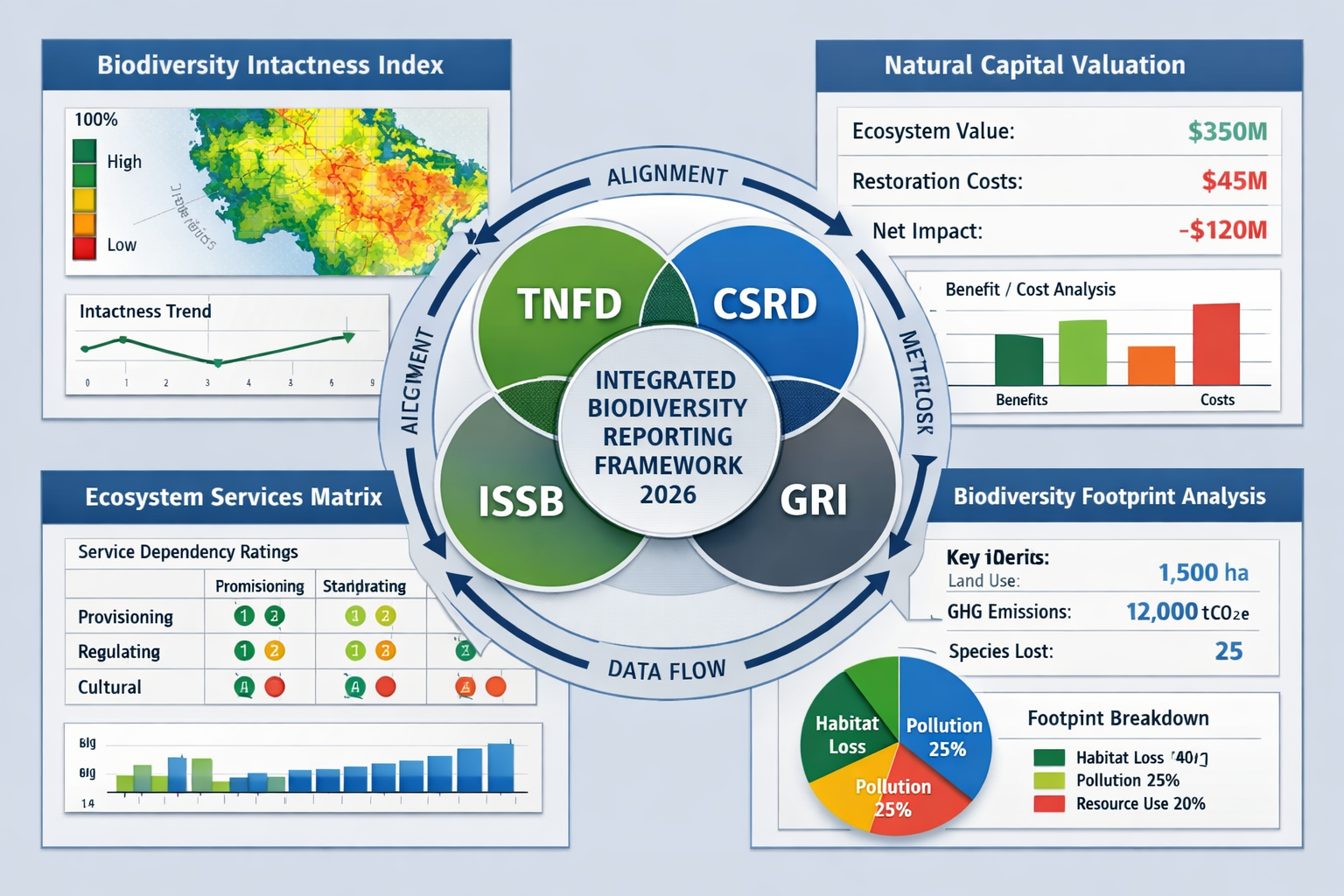
Corporate Biodiversity Commitments: Surveyor Tools for 2026 Nature Dependence Assessments must generate data compatible with multiple reporting standards simultaneously. The Nature Tools Compass and various assessment instruments are being aligned with [1]:
TNFD Recommendations
- Disclosure of nature-related dependencies, impacts, risks, and opportunities
- LEAP-aligned assessment processes
- Location-specific biodiversity information
- Scenario analysis of nature-related risks
CSRD/ESRS Requirements
- Double materiality assessment covering impact and financial materiality
- Quantitative and qualitative biodiversity indicators
- Value chain impact disclosure
- Time-bound biodiversity targets and performance tracking
ISSB Standards
- Nature-related risks with potential financial implications
- Governance, strategy, risk management, and metrics disclosure
- Integration with climate-related disclosures
- Cross-industry comparability
GRI Standards
- Biodiversity impact management approaches
- Protected area interactions
- Threatened species affected by operations
- Habitat restoration and conservation measures
SBTN Targets
- Science-based biodiversity targets aligned with global goals
- Sector-specific action pathways
- Measurement protocols for target tracking
- Interim milestone reporting
Surveyors who understand how these frameworks interrelate can design single assessment processes that generate data meeting multiple disclosure requirements simultaneously, reducing corporate reporting burden while maintaining rigor.
Addressing the Analytics Capacity Challenge
A critical insight from recent biodiversity data research identifies analytics capacity as the primary limiting factor rather than technology availability [5]. The convergence of new biodiversity data streams (eDNA, remote sensing, citizen science) with modern statistical methods creates technological opportunity for real-time decision-making. However, institutional capacity—analytics expertise, data governance, and quality standards—lags behind.
For surveyor professionals, this presents both challenge and opportunity:
Skill Development Priorities
- Statistical analysis and data science capabilities
- Geographic Information Systems (GIS) proficiency
- Database management and data quality assurance
- Visualization and communication of complex ecological data
Institutional Investments
- Standardized data collection protocols ensuring comparability
- Quality assurance frameworks for biodiversity data
- Interoperable data systems enabling integration across sources
- Governance structures defining data ownership and access
Organizations that invest in these analytics capabilities position themselves to deliver Corporate Biodiversity Commitments: Surveyor Tools for 2026 Nature Dependence Assessments that transform raw ecological data into actionable business intelligence.
Practical Implementation: From Commitment to Action
The Biodiversa+ reports released in January 2026 highlight persistent implementation barriers between corporate biodiversity commitments and measurable action [4]. These reports complement the forthcoming IPBES Business and Biodiversity Assessment by focusing on how biodiversity data are actually used by companies, rather than merely collected.
Overcoming Common Implementation Barriers
Data Availability and Quality
Many corporations struggle to obtain biodiversity data for dispersed operations and supply chains. Surveyor solutions include:
- Developing proxy indicators when direct measurement is impractical
- Creating risk-based assessment tiers focusing detailed surveys on high-impact locations
- Leveraging global biodiversity databases (GBIF, IUCN Red List, protected area databases) for preliminary screening
- Establishing collaborative monitoring programs with suppliers, NGOs, and research institutions
Technical Expertise Gaps
Corporate sustainability teams often lack ecological expertise to interpret biodiversity data. Surveyors can bridge this gap through:
- Decision-support tools translating ecological metrics into business-relevant indicators
- Training programs building internal corporate capacity
- Ongoing advisory services supporting interpretation and application
- Standardized reporting templates simplifying disclosure preparation
Cost and Resource Constraints
Comprehensive biodiversity assessments require significant investment. Cost-effective approaches include:
- Phased implementation starting with materiality screening and progressively deepening assessment
- Technology adoption using remote sensing and eDNA to reduce field survey costs
- Collaborative initiatives sharing assessment costs across industry sectors
- Integration with existing processes embedding biodiversity assessment into environmental management systems
Building Effective Surveyor-Corporate Partnerships
Successful implementation of Corporate Biodiversity Commitments: Surveyor Tools for 2026 Nature Dependence Assessments requires effective collaboration between ecological professionals and corporate teams. Key success factors include:
Shared Language and Objectives
- Translating ecological concepts into business terminology
- Aligning assessment scope with corporate materiality
- Focusing on decision-relevant metrics rather than comprehensive inventories
- Connecting biodiversity outcomes to financial performance
Integrated Planning
- Involving surveyors early in strategy development
- Coordinating biodiversity assessment with biodiversity planning processes
- Aligning assessment timing with corporate reporting cycles
- Building flexibility for adaptive management as understanding evolves
Transparency and Verification
- Establishing clear methodological documentation
- Enabling third-party verification of assessment claims
- Disclosing limitations and uncertainties
- Committing to continuous improvement as tools and standards evolve
Future Directions: Evolving Tools and Standards
The field of Corporate Biodiversity Commitments: Surveyor Tools for 2026 Nature Dependence Assessments continues rapid evolution. Several emerging trends will shape future practice:
Standardization and Interoperability
Current tool proliferation creates challenges for comparability and aggregation. Ongoing standardization efforts focus on:
- Common biodiversity metrics enabling cross-sector comparison
- Interoperable data formats facilitating integration across tools
- Harmonized methodologies reducing assessment burden
- Quality assurance frameworks ensuring data credibility
Integration with Climate Action
Nature and climate are deeply interconnected, yet corporate reporting often treats them separately. Future assessment approaches will increasingly:
- Quantify nature-climate synergies in nature-based solutions
- Assess biodiversity co-benefits of climate mitigation actions
- Evaluate climate-biodiversity trade-offs in renewable energy deployment
- Integrate nature and climate targets in science-based frameworks
Artificial Intelligence and Automation
Machine learning and AI applications are transforming biodiversity monitoring:
- Automated species identification from images and acoustic recordings
- Predictive modeling of biodiversity responses to management interventions
- Pattern recognition detecting ecosystem changes in satellite imagery
- Natural language processing extracting biodiversity information from unstructured data
Real-Time Monitoring and Adaptive Management
Static assessments are giving way to continuous monitoring enabling adaptive responses:
- Sensor networks providing real-time ecosystem condition data
- Dynamic risk assessment updating as conditions change
- Automated alerts triggering management responses to threshold breaches
- Performance dashboards tracking progress against biodiversity targets
These technological advances will enhance the effectiveness of Corporate Biodiversity Commitments: Surveyor Tools for 2026 Nature Dependence Assessments while requiring ongoing professional development to maintain expertise.
Conclusion
Corporate biodiversity commitments have reached a critical juncture in 2026. The gap between ambitious nature pledges and measurable action is narrowing, driven by regulatory requirements, investor pressure, and the emergence of sophisticated assessment tools. For ecological professionals, this transformation creates unprecedented opportunity to support corporate sustainability while advancing conservation outcomes.
The key to success lies in integration—combining multiple assessment tools, aligning with diverse disclosure frameworks, and bridging ecological science with business decision-making. No single instrument suffices; effective nature dependence assessments require complementary approaches spanning dependency mapping, impact quantification, risk screening, and opportunity identification.
Surveyors equipped with Corporate Biodiversity Commitments: Surveyor Tools for 2026 Nature Dependence Assessments possess critical capabilities for this moment. By mastering frameworks like TNFD's LEAP approach, leveraging technologies from eDNA to remote sensing, and translating ecological data into business-relevant metrics, professionals can deliver assessments that genuinely inform corporate strategy while maintaining scientific rigor.
The limiting factor is no longer technology availability but analytics capacity and institutional capability. Organizations that invest in data science skills, quality assurance frameworks, and collaborative partnerships will lead the next phase of corporate biodiversity action.
Actionable Next Steps
For surveyors seeking to engage with corporate biodiversity assessment:
- Build framework literacy across TNFD, CSRD, ISSB, and SBTN standards to understand corporate reporting requirements
- Develop integrated assessment protocols combining multiple tools rather than relying on single instruments
- Invest in technology skills including GIS, remote sensing interpretation, and statistical analysis
- Establish corporate partnerships focusing on high-impact sectors and commodities
- Engage with standards development to ensure surveyor perspectives inform evolving frameworks
- Pursue continuous learning as tools, technologies, and requirements rapidly evolve
The convergence of corporate commitment and assessment capability creates genuine potential for transformative biodiversity outcomes. By equipping themselves with appropriate tools and protocols, ecological professionals can ensure that 2026 marks not just another year of pledges, but measurable progress toward nature-positive business practices.
For those ready to contribute expertise to corporate biodiversity goals, exploring how biodiversity surveyors benefit both nature and developers provides valuable context for this expanding professional opportunity.
References
[1] New Nature Tools Compass To Support Businesses And Financial Institutions – https://www.unep-wcmc.org/en/news/new-nature-tools-compass-to-support-businesses-and-financial-institutions
[2] New Tool Understanding Biodiversity Risks – https://www.ca-cib.com/en/news/new-tool-understanding-biodiversity-risks
[3] Financial Institutions Explore Approaches And Tools Assess Positive Biodiversity Impact 2026 02 18 En – https://green-forum.ec.europa.eu/news/financial-institutions-explore-approaches-and-tools-assess-positive-biodiversity-impact-2026-02-18_en
[4] New Reports Show How Biodiversity Data Can Move Business From Commitment To Action – https://www.biodiversa.eu/2026/01/22/new-reports-show-how-biodiversity-data-can-move-business-from-commitment-to-action/
[5] Closing Gap Between Biodiversity Commitments And Measuring Nature – https://sps.columbia.edu/news/closing-gap-between-biodiversity-commitments-and-measuring-nature
[6] Business Action For Biodiversity Via Science Based Targets For Nature – https://sciencebasedtargetsnetwork.org/wp-content/uploads/2026/01/Business-action-for-biodiversity-via-science-based-targets-for-nature.pdf