

As biodiversity loss increasingly threatens financial stability, the relationship between ecological survey work and investment decision-making has fundamentally transformed. Financial Institutions and Biodiversity Surveys: 2026 Protocols for Ecologists Supporting Nature-Related Disclosures represents a critical evolution in how surveyors deliver investor-grade data that enables nature-related financial disclosures and supports biodiversity-compliant lending decisions.
The landscape shifted dramatically in February 2026 when the Intergovernmental Science-Policy Platform on Biodiversity and Ecosystem Services (IPBES) concluded its landmark Business and Biodiversity Assessment, providing authoritative evidence on how businesses and financial institutions depend upon and impact nature.[1] This watershed moment established clear expectations: ecological surveyors must now deliver data that meets the rigorous standards required for Taskforce on Nature-related Financial Disclosures (TNFD) reporting and Biodiversity Net Gain (BNG) compliance in lending portfolios.
For ecologists working with development projects, this means survey protocols must evolve beyond traditional conservation assessments to produce standardized, financially relevant biodiversity metrics that investment managers can integrate into risk models and disclosure frameworks.
Key Takeaways
- 🏦 50% of banking institutions have completed biodiversity impact screening as of 2026, with the remaining 50% actively implementing screening programs[2]
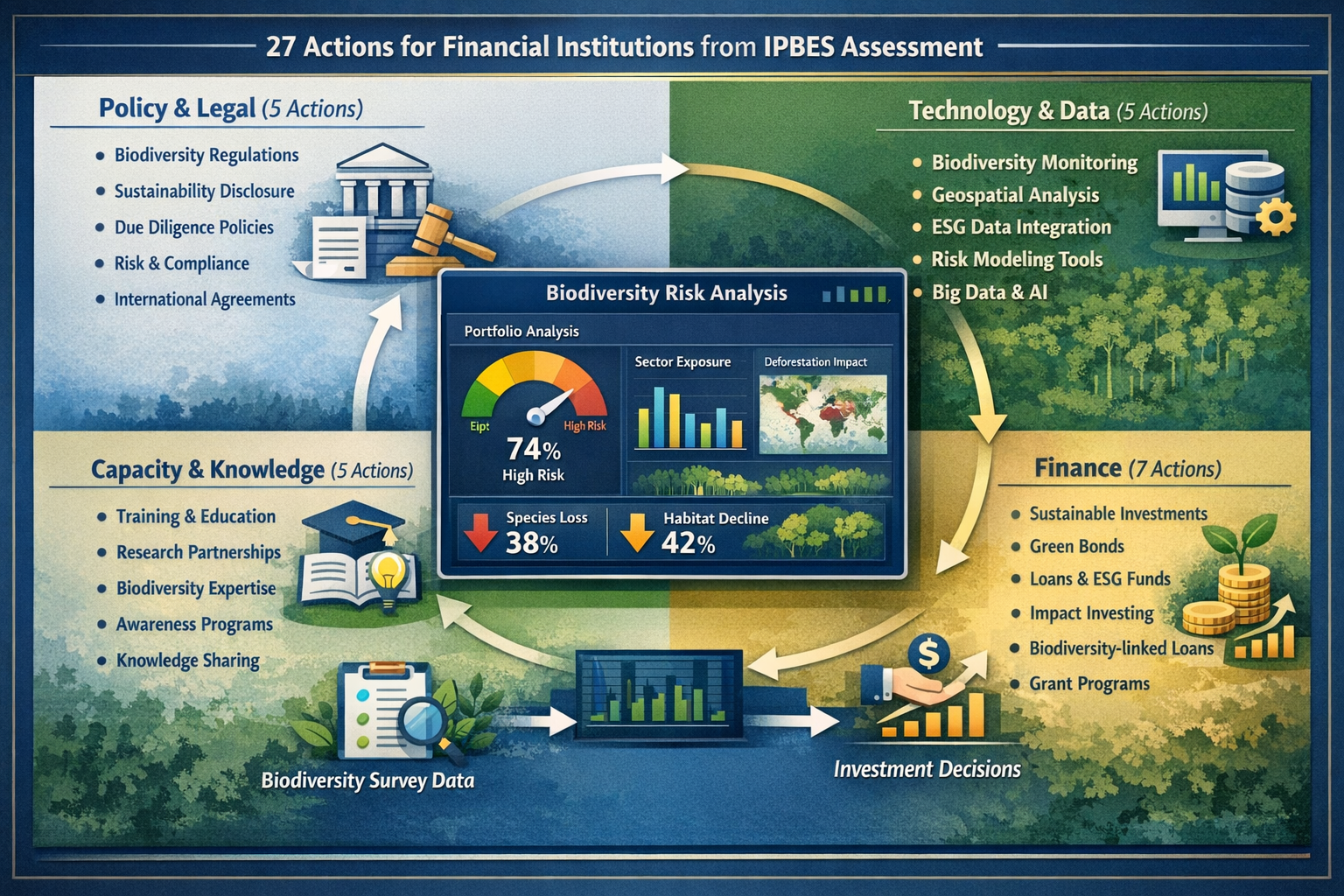
- 📊 27 specific actions for financial institutions have been identified across Policy & Legal, Technology & Data, Capacity & Knowledge, and Finance categories[1]
- 🔍 ENCORE adoption is universal among surveyed financial institutions, establishing a baseline screening tool that ecologists must understand[2]
- 📉 Dependency screening significantly lags behind impact screening, creating urgent demand for surveyors who can assess ecosystem service dependencies[2]
- 📈 88% of Finance for Biodiversity Community members conduct impact assessments, yet only 1% of public companies report biodiversity impacts, revealing a massive disclosure gap[1]
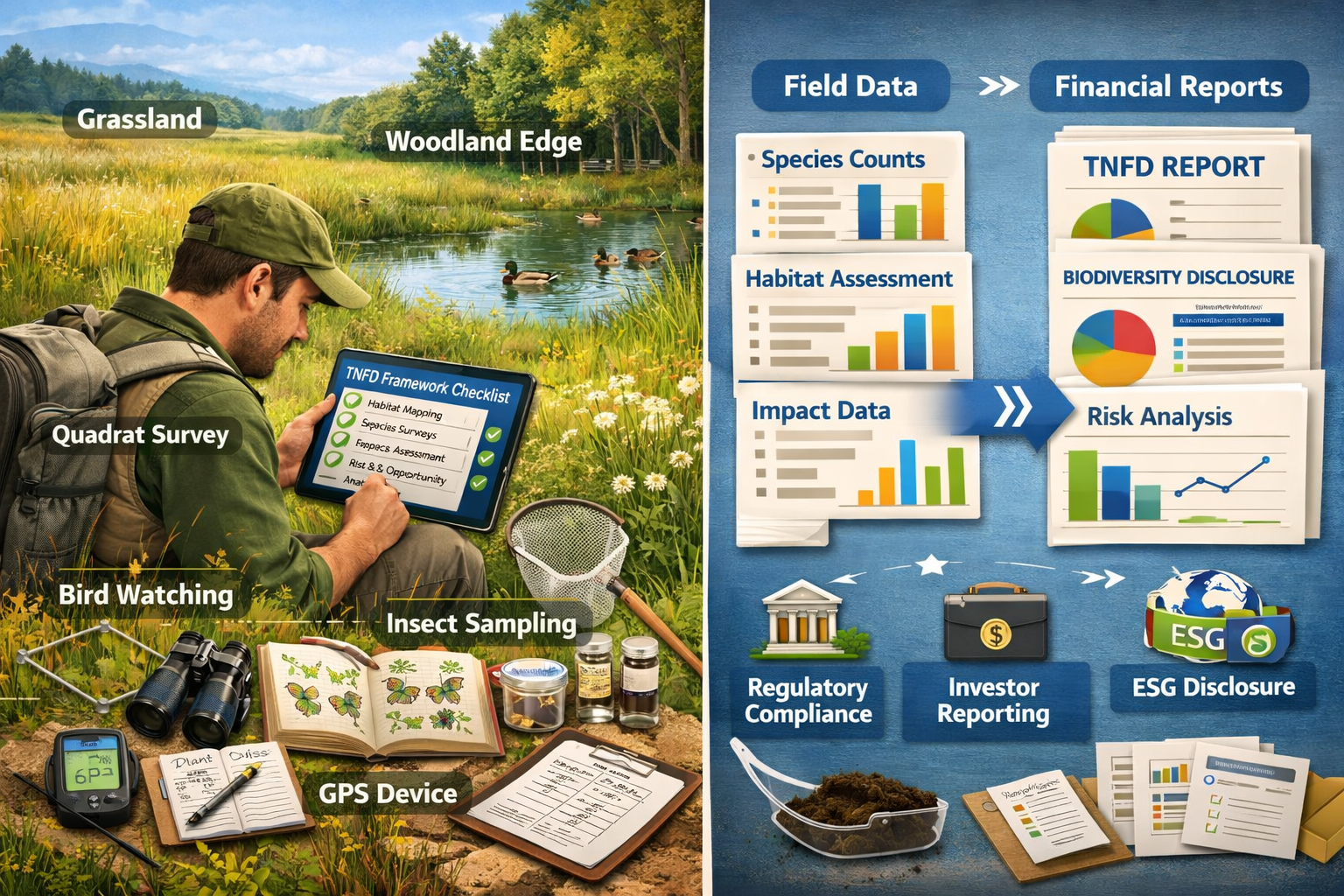
Understanding the 2026 Biodiversity Disclosure Landscape for Financial Institutions
The IPBES Assessment: A Game-Changer for Survey Requirements
The IPBES-12 Business and Biodiversity Assessment synthesized authoritative evidence that fundamentally reshaped expectations for biodiversity data in financial contexts.[1] This comprehensive assessment identified 100 next-step actions across stakeholder groups, with 27 actions specifically targeting businesses and financial institutions.
For ecological surveyors, the most significant insight from the Assessment is clear: lack of guidance and decision-meaningful tools—not data availability—represents the primary barrier to effective biodiversity integration in financial decision-making.[1] This finding transforms the surveyor's role from pure data collection to delivering structured, decision-ready information that financial analysts can immediately apply.
The Four Categories of Financial Institution Actions
The IPBES Assessment organizes the 27 actions for financial institutions into four strategic categories:[1]
| Category | Number of Actions | Relevance to Surveyors |
|---|---|---|
| Policy & Legal | 5 actions | Understanding mandatory disclosure requirements that drive survey specifications |
| Technology & Data | 5 actions | Delivering data in formats compatible with screening tools like ENCORE |
| Capacity & Knowledge | 5 actions | Building expertise in translating ecological data to financial metrics |
| Finance | 7 actions | Supporting portfolio decision criteria, blended finance, and impact investing instruments |
Ecologists must particularly focus on the Technology & Data and Capacity & Knowledge categories, where survey protocols directly enable financial institution compliance.
Current State of Biodiversity Assessment in Banking
Recent research reveals the operational reality facing financial institutions in 2026:[2]
- 50% completed biodiversity impact screening
- 50% started or planning impact screening
- Dependency screening significantly underdeveloped compared to impact screening
- Systematic assessment remains the least developed operational area
This creates immediate opportunities for surveyors who can deliver dependency assessment data—evaluating how development projects and investment portfolios rely on ecosystem services like pollination, water regulation, and soil formation. Understanding how biodiversity assessments benefit both nature and developers provides essential context for this work.
Financial Institutions and Biodiversity Surveys: Core Protocol Requirements for 2026
TNFD-Aligned Survey Templates for High-Risk Sites
The Taskforce on Nature-related Financial Disclosures (TNFD) framework requires location-specific biodiversity data for high-risk assets in lending portfolios. Ecologists supporting these disclosures must structure surveys around four core TNFD pillars:
1. Governance Data Requirements
Surveys must document:
- Existing biodiversity management policies at project sites
- Stakeholder engagement processes with local communities
- Indigenous land rights and traditional ecological knowledge
- Oversight mechanisms for biodiversity commitments
2. Strategy Assessment Components
Field surveys should identify:
- Dependencies: Ecosystem services the project relies upon (water purification, pollination, climate regulation)
- Impacts: Direct and indirect effects on habitats and species
- Risks: Physical risks from ecosystem degradation, transition risks from policy changes
- Opportunities: Nature-based solutions and biodiversity enhancement potential
3. Risk Management Protocols
Survey data must enable:
- Identification of material biodiversity risks
- Assessment of risk mitigation hierarchy application
- Evaluation of residual risk after mitigation measures
- Quantification of potential financial exposure
4. Metrics and Targets Documentation
Standardized measurements including:
- Baseline biodiversity condition using recognized metrics (Biodiversity Intactness Index, habitat hectares)
- Predicted impact quantification
- BNG calculations showing net change
- Monitoring protocols for ongoing assessment
For developers navigating these requirements, understanding what's included in a Biodiversity Net Gain assessment provides essential foundation.
Standardized Measurement Tools Financial Institutions Use
All surveyed financial institutions in 2026 employ ENCORE (Exploring Natural Capital Opportunities, Risks and Exposure) as their primary screening tool, with 50% also using the WWF Biodiversity Risk Filter.[2] Ecologists must understand how to translate field data into formats these tools require.
ENCORE Integration Requirements:
- Sector classification of development projects (using standardized economic activity codes)
- Identification of material ecosystem service dependencies
- Assessment of 21 ecosystem services across six categories
- Spatial data on ecosystem condition and integrity
Available Portfolio Measurement Approaches:
The IPBES Assessment identifies only two methodologies currently ready for portfolio-level biodiversity measurement:[1]
- Life Cycle Approaches – for screening priorities
- Macro-scale environmental economic models – for screening priorities
Critically, location-based analysis tools require rapid methodological development,[1] creating urgent demand for surveyors who can pioneer standardized location-specific protocols.
The Five Assessment Tools Workshop Series Insights
Between April and June 2025, a comprehensive workshop series evaluated five biodiversity assessment approaches for financial institutions:[3]
- Biodiversity Intactness Index (BII) – Measures ecosystem integrity relative to pristine conditions
- Ecosystem Services Valuation Database (ESVD) – Quantifies economic value of ecosystem services
- Life Cycle Assessment (LCA) frameworks – Evaluates biodiversity impacts across product/service lifecycles
- Biodiversity Footprint for Financial Institutions (BFFI) – Calculates portfolio-level biodiversity impacts
- Natural Capital Valuation (NCV) models – Assigns monetary values to natural assets
Each tool presents specific strengths and limitations. The forthcoming 5th edition of the Biodiversity Measurement Approaches Guide will incorporate these workshop insights,[3] providing critical guidance for surveyors designing field protocols.
For projects requiring Biodiversity Net Gain compliance, understanding how survey data feeds these measurement tools is essential.
Implementing BNG-Compliant Survey Protocols for Lending Portfolios
The Impact vs. Dependency Screening Gap
Current data reveals a critical imbalance in financial institution biodiversity assessment:[2]
Impact Screening: 50% complete, 50% in progress or planned
Dependency Screening: Significantly underdeveloped
This gap creates immediate demand for surveyors who can assess ecosystem service dependencies. Unlike traditional impact assessments that measure how projects affect nature, dependency screening evaluates how projects rely upon nature for operational continuity.
Key Dependency Assessment Components:
🌊 Water-Related Dependencies
- Surface water availability and quality
- Groundwater recharge rates
- Flood regulation services
- Water purification capacity
🌱 Soil and Vegetation Dependencies
- Soil formation and fertility maintenance
- Erosion control and mass stabilization
- Pollination services for agriculture/landscaping
- Climate regulation through carbon sequestration
🦋 Biodiversity-Mediated Dependencies
- Pest and disease control
- Genetic resources and seed dispersal
- Nursery habitat provision
- Buffering and attenuation of environmental extremes
Developers seeking to achieve 10% Biodiversity Net Gain must address both impact and dependency dimensions.
Structuring Survey Data for Portfolio Decision Criteria
Financial institutions increasingly adopt portfolio-level biodiversity decision criteria as recommended in the IPBES Assessment's Finance category actions.[1] Surveyors must deliver data that aggregates effectively across multiple projects.
Essential Data Standardization Requirements:
✅ Consistent Habitat Classification
- Use standardized habitat typologies (UK Habitat Classification or equivalent)
- Apply consistent condition assessment criteria
- Document spatial extent with GIS-compatible formats
- Enable aggregation across geographic regions
✅ Comparable Impact Metrics
- Calculate biodiversity units using recognized methodologies
- Express impacts in common units (hectares, biodiversity units, MSA.km²)
- Separate temporary vs. permanent impacts
- Quantify uncertainty ranges
✅ Temporal Alignment
- Establish baseline conditions at consistent timepoints
- Project impact trajectories over standardized periods (typically 30 years for BNG)
- Account for time-to-target for habitat creation/enhancement
- Document monitoring frequency and duration
✅ Risk Categorization
- Classify sites by biodiversity sensitivity (low/medium/high risk)
- Identify proximity to protected areas and priority habitats
- Flag presence of protected species
- Assess regulatory compliance status
For planners working with multiple projects, reviewing top questions about Biodiversity Net Gain helps understand portfolio-level considerations.
Supporting Blended Finance and Impact Investing Instruments
The IPBES Assessment identifies deploying blended finance and impact investing instruments as a key financial action.[1] Biodiversity surveys supporting these mechanisms require additional data layers:
Additionality Demonstration:
- Document baseline conditions without intervention
- Project business-as-usual scenarios
- Quantify incremental biodiversity benefits from investment
- Establish causality between finance and outcomes
Verification and Monitoring Frameworks:
- Design protocols for third-party verification
- Establish measurable milestones and indicators
- Create monitoring schedules aligned with investment reporting cycles
- Develop adaptive management triggers
Co-Benefits Quantification:
- Assess carbon sequestration alongside biodiversity
- Evaluate water quality improvements
- Quantify social benefits (recreation, wellbeing, employment)
- Document alignment with Sustainable Development Goals
Bridging the Disclosure Gap: From Assessment to Public Reporting
The 88% vs. 1% Paradox
Perhaps the most striking finding from the IPBES Assessment reveals a massive disclosure gap:[1]
- 88% of Finance for Biodiversity Community respondents conducted biodiversity impact assessments in 2025
- Only 1% of publicly reporting companies disclosed biodiversity impacts
This paradox indicates that while financial institutions are actively assessing biodiversity, public disclosure remains severely underdeveloped. For ecologists, this means survey data must not only support internal risk assessment but also enable external reporting that meets emerging regulatory requirements.
Mandatory Disclosure Requirements Driving Survey Specifications
The IPBES Assessment's Policy & Legal actions emphasize supporting mandatory disclosure rules.[1] Across jurisdictions, regulatory frameworks increasingly require biodiversity reporting:
European Union:
- Corporate Sustainability Reporting Directive (CSRD) with biodiversity-specific disclosure requirements
- EU Taxonomy alignment requiring biodiversity impact assessments
- Sustainable Finance Disclosure Regulation (SFDR) principal adverse impact indicators
United Kingdom:
- Mandatory Biodiversity Net Gain for planning applications
- Taskforce on Climate-related Financial Disclosures (TCFD) expanding to nature
- Financial Conduct Authority sustainability disclosure requirements
International:
- TNFD framework adoption across major financial institutions
- Science-Based Targets for Nature (SBTN) emerging standards
- Global Biodiversity Framework monitoring requirements
Surveyors must design protocols that generate data meeting these diverse but converging regulatory standards. Understanding how to conduct biodiversity impact assessments provides essential methodology.
Creating Decision-Meaningful Tools from Survey Data
The IPBES Assessment emphasizes that lack of decision-meaningful tools—not data availability—constrains biodiversity integration.[1] Ecologists must transform raw survey data into actionable intelligence for financial decision-makers.
Key Translation Requirements:
📊 Financial Materiality Assessment
- Link biodiversity impacts to financial risks (operational, reputational, regulatory)
- Quantify potential cost implications of biodiversity loss
- Assess probability and magnitude of nature-related financial impacts
- Express findings in business-relevant terms (ROI, NPV, risk-adjusted returns)
📈 Scenario Analysis Support
- Provide data for nature-related scenario modeling
- Enable assessment of policy change impacts (e.g., strengthened BNG requirements)
- Support physical risk scenarios (ecosystem service disruption)
- Facilitate transition risk evaluation (market shifts toward nature-positive investments)
🎯 Target-Setting Enablement
- Deliver baseline data for science-based target establishment
- Quantify improvement trajectories needed for target achievement
- Enable progress tracking against commitments
- Support verification of target attainment
For developers creating comprehensive approaches, exploring how to create a biodiversity plan demonstrates practical application.
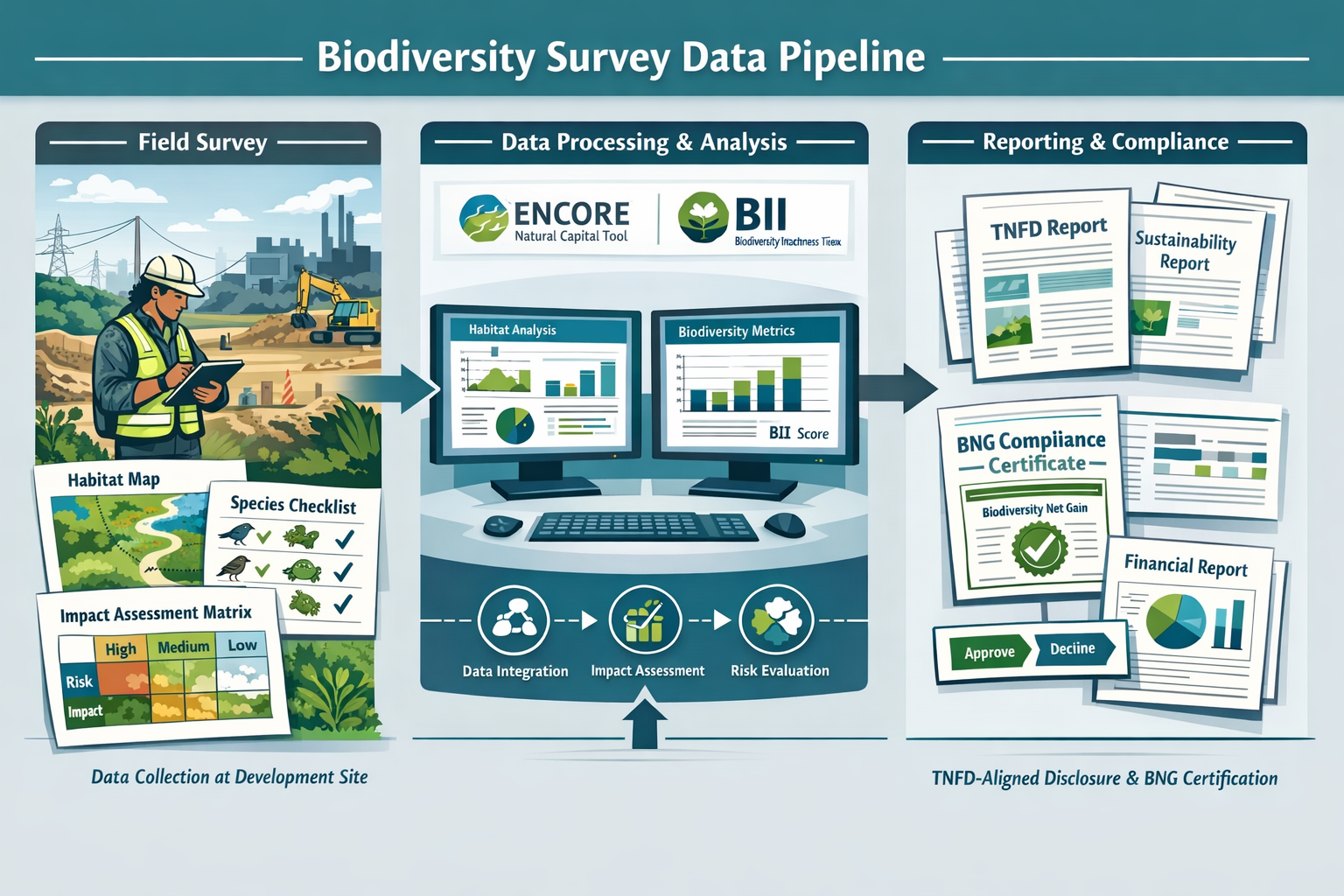
Practical Implementation: Survey Protocols for High-Risk Lending Sites
Site Prioritization Using Financial Institution Screening Results
Financial institutions use screening tools to identify high-risk assets requiring detailed biodiversity assessment. Ecologists should align survey prioritization with these institutional approaches:
High-Priority Sites for Detailed Surveys:
- Projects in biodiversity hotspots or Key Biodiversity Areas
- Developments near protected areas (within 1-5km depending on sensitivity)
- Sites with confirmed or likely protected species presence
- Projects in sectors with high biodiversity dependencies (agriculture, forestry, water utilities)
- Locations in regions with high ecosystem service value
- Areas with Indigenous Peoples' territories or community-managed lands
Risk-Based Survey Intensity:
- Low Risk: Desktop assessment with remote sensing validation
- Medium Risk: Phase 1 habitat survey with targeted species surveys
- High Risk: Comprehensive multi-season surveys with specialist assessments
Understanding guidance for developers helps align survey scope with project risk profiles.
Standardized Field Data Collection Templates
To enable portfolio aggregation and disclosure reporting, surveyors should adopt standardized field templates incorporating:
Habitat Assessment Module:
- UK Habitat Classification (or local equivalent) to Level 4
- Condition assessment using standardized criteria
- Spatial extent measurement (GIS-recorded polygons)
- Photographic documentation with georeferencing
- Connectivity assessment to adjacent habitats
Species Records Module:
- Taxonomic identification to species level where possible
- Abundance/density estimates using consistent methods
- Protected species presence/absence with legal status
- Invasive species documentation
- Evidence type (direct observation, field signs, remote detection)
Ecosystem Services Module:
- Regulating services assessment (water, climate, erosion control)
- Provisioning services documentation (food, materials, water)
- Cultural services evaluation (recreation, aesthetic, spiritual)
- Supporting services baseline (soil formation, nutrient cycling)
- Dependency risk scoring for project operations
Impact Quantification Module:
- Pre-development biodiversity unit calculation
- Post-development biodiversity unit projection
- Net change quantification
- Temporal impact assessment (construction vs. operational phases)
- Cumulative impact consideration with nearby projects
For small-scale projects, reviewing BNG for small development projects provides proportionate approaches.
Quality Assurance for Investor-Grade Data
Financial institutions require investor-grade data with documented quality assurance. Surveyors must implement:
Competency Standards:
- Appropriately qualified ecologists (CIEEM membership or equivalent)
- Species-specific expertise for protected species surveys
- Demonstrated experience with biodiversity metric calculations
- Understanding of financial disclosure frameworks
Methodological Rigor:
- Survey timing aligned with species activity periods
- Sufficient survey effort meeting best practice guidelines
- Appropriate weather conditions for valid surveys
- Equipment calibration and maintenance records
Data Verification:
- Independent peer review of survey reports
- Third-party validation of biodiversity metric calculations
- Quality control checks on species identifications
- Spatial data accuracy verification
Documentation Standards:
- Transparent methodology descriptions
- Limitations and assumptions clearly stated
- Uncertainty quantification and confidence levels
- Audit trail for all data transformations
Understanding what you need for a Biodiversity Net Gain report establishes baseline quality expectations.
Future Developments: The 5th Edition Measurement Guide and Beyond
The forthcoming 5th edition of the Biodiversity Measurement Approaches Guide will incorporate insights from the 2025 workshop series,[3] providing updated guidance for financial institutions and their ecological consultants. Surveyors should anticipate:
Enhanced Location-Based Methodologies:
The IPBES Assessment identifies location-based analysis as requiring rapid development.[1] Expect new protocols for:
- Site-specific biodiversity footprinting
- Spatial risk mapping at asset level
- Localized ecosystem service valuation
- Fine-scale impact attribution
Improved Dependency Assessment Tools:
Given the current lag in dependency screening,[2] new frameworks will likely address:
- Standardized ecosystem service dependency matrices by sector
- Quantitative dependency risk scoring
- Supply chain dependency mapping
- Operational resilience assessment linked to ecosystem health
Integration Across Assessment Approaches:
Rather than selecting single tools, future protocols may combine:
- BII for ecosystem integrity baseline
- LCA frameworks for product/service lifecycle impacts
- BFFI for portfolio aggregation
- NCV for financial materiality assessment
- ESVD for ecosystem service valuation
Ecologists should position themselves to adopt these emerging methodologies as they become standardized.
Conclusion: Positioning Ecological Expertise for the Nature-Finance Interface
Financial Institutions and Biodiversity Surveys: 2026 Protocols for Ecologists Supporting Nature-Related Disclosures represents far more than technical methodology—it embodies a fundamental shift in how ecological expertise supports economic decision-making. As biodiversity loss increasingly threatens financial stability, the surveyor's role has evolved from conservation assessment to delivering investor-grade data that enables nature-related disclosures and biodiversity-compliant lending.
The evidence is compelling: with 50% of banking institutions having completed biodiversity impact screening and the remainder actively implementing programs,[2] demand for standardized, financially relevant biodiversity data will only intensify. The IPBES Assessment's identification of 27 specific actions for financial institutions[1] provides a clear roadmap for how ecological surveys must evolve to meet these needs.
Actionable Next Steps for Ecologists
🔍 Immediate Actions:
- Familiarize yourself with ENCORE and understand how it screens biodiversity risks by sector
- Review TNFD framework requirements to understand disclosure data needs
- Audit existing survey templates to identify gaps in financial disclosure support
- Develop dependency assessment capabilities to address the current screening gap
- Establish quality assurance protocols meeting investor-grade data standards
📚 Capacity Building:
- Study the IPBES Business and Biodiversity Assessment to understand institutional drivers
- Monitor the forthcoming 5th edition Measurement Guide for updated methodologies
- Engage with Finance for Biodiversity Community resources and guidance
- Build competency in biodiversity metrics beyond traditional ecological assessment
- Develop financial literacy to translate ecological data into business-relevant insights
🤝 Collaboration Opportunities:
- Partner with financial institutions to understand their specific data needs
- Engage with developers implementing BNG-compliant approaches
- Contribute to methodology development for location-based assessment tools
- Share best practices within professional ecological networks
- Support landowners exploring biodiversity unit sales for habitat banking
The convergence of biodiversity conservation and financial stability creates unprecedented opportunities for ecologists who can bridge these domains. By adopting TNFD-aligned survey protocols, delivering decision-meaningful data, and supporting both impact and dependency screening, surveyors position themselves as essential partners in the transition toward nature-positive finance.
The question is no longer whether financial institutions will integrate biodiversity into decision-making—the IPBES Assessment and current screening adoption rates confirm this trajectory. The question is whether ecological surveyors will lead this integration by delivering the investor-grade data that makes nature-related disclosures possible.
For organizations ready to implement these protocols, professional biodiversity surveying services provide the expertise, standardization, and quality assurance that financial institutions require. The nature-finance interface demands nothing less than excellence in ecological assessment—and 2026 protocols provide the roadmap for achieving it.
References
[1] IPBES Business Biodiversity Assessment Key Insights For Financial Institutions – https://www.financeforbiodiversity.org/wp-content/uploads/2026/02/IPBES-Business-Biodiversity-Assessment-Key-insights-for-financial-institutions.pdf
[2] SFC Biodiversity Sep2025 – https://sustainablefinancecluster.com/wp-content/uploads/2025/08/SFC_Biodiversity_Sep2025.pdf
[3] Financial Institutions Explore Approaches And Tools Assess Positive Biodiversity Impact 2026 02 18 En – https://green-forum.ec.europa.eu/news/financial-institutions-explore-approaches-and-tools-assess-positive-biodiversity-impact-2026-02-18_en