

The race to protect Earth's biodiversity has reached a critical juncture in 2026. As nations worldwide grapple with implementing Biodiversity Net Gain (BNG) requirements, a fundamental challenge emerges: how can surveyors and developers measure biodiversity consistently across borders? Without standardized indicators, comparing biodiversity outcomes between a development project in Manchester and one in Munich becomes nearly impossible—undermining global conservation commitments and creating compliance nightmares for international developers.
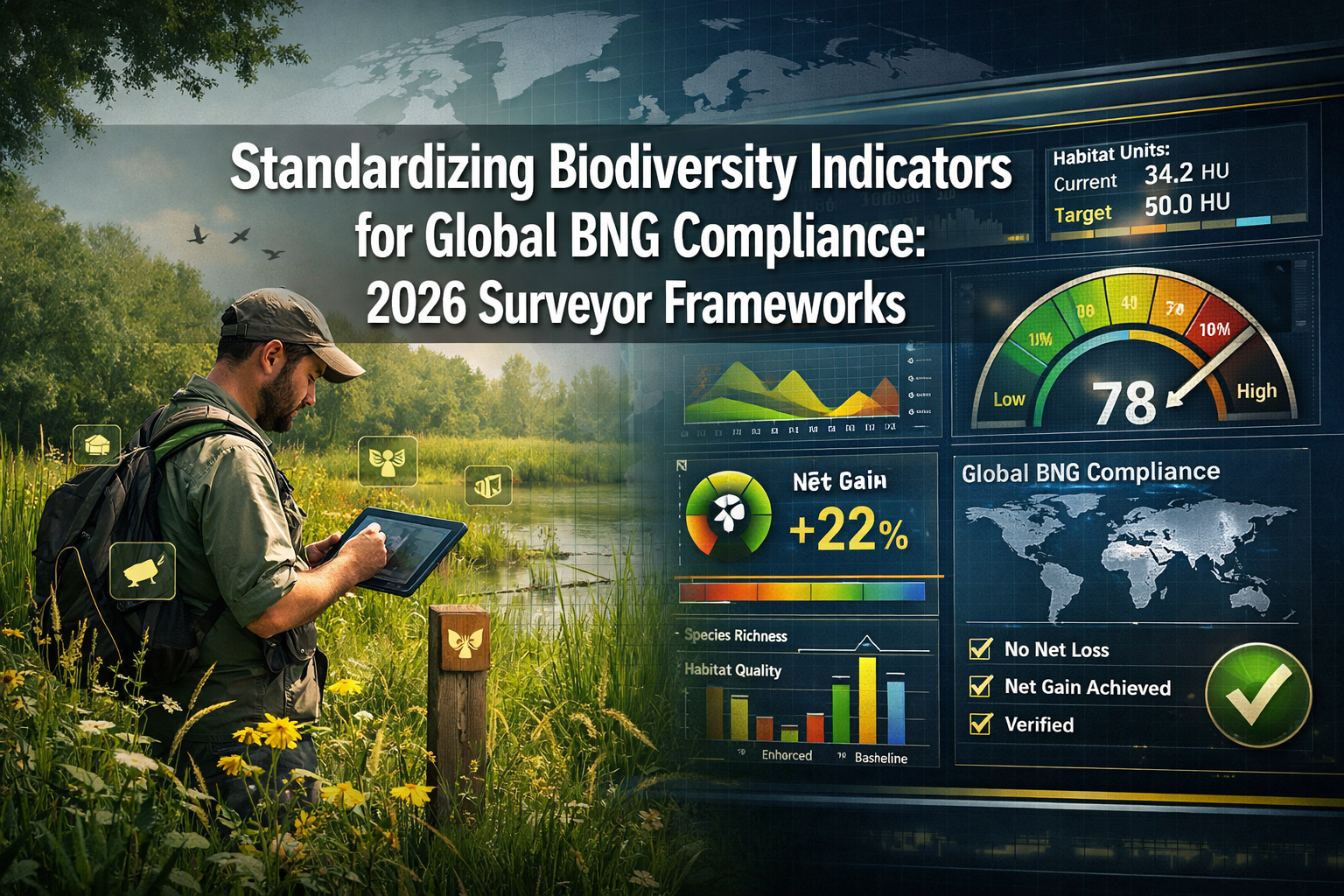
Standardizing Biodiversity Indicators for Global BNG Compliance: 2026 Surveyor Frameworks represents the urgent solution to this fragmentation. Recent global scenario analyses have exposed significant gaps in comparable BNG reporting, prompting the development of harmonized frameworks that enable surveyors to measure, monitor, and verify biodiversity outcomes using consistent methodologies. This standardization isn't merely administrative—it's essential for meeting international commitments under the Kunming-Montreal Global Biodiversity Framework while providing developers with clear, actionable compliance pathways.
Key Takeaways
- 🌍 Global harmonization is advancing through the European Biodiversity Metric (EBM), which provides standardized calculations across 38 countries, enabling consistent BNG compliance reporting
- 📊 Three core measurement units—area habitat units, hedgerow units, and watercourse units—form the foundation of standardized biodiversity indicators across major frameworks
- ⏰ 2026 marks critical deadlines including UN progress reports from all member states and the CBD COP17 global review in October, requiring comparable biodiversity data
- ✅ 10% minimum uplift and 30-year sustainability requirements are becoming international standards, creating consistent benchmarks for surveyor assessments
- 🔧 Data gaps and methodological inconsistencies remain the primary barriers to full standardization, requiring integrated Earth Observation data and improved ecosystem condition metrics
Understanding the Global BNG Compliance Landscape in 2026
The biodiversity compliance landscape has transformed dramatically over the past two years. What began as pioneering UK legislation has evolved into a global movement toward mandatory Biodiversity Net Gain requirements. Understanding this landscape is essential for surveyors developing frameworks that meet both local regulations and international commitments.
The Evolution of BNG Requirements
Biodiversity Net Gain became mandatory for major developments in England on February 12, 2024, extended to small sites on April 2, 2024, and is set to apply to Nationally Significant Infrastructure Projects (NSIPs) from November 2025 [3]. This phased implementation established the UK as a testing ground for BNG compliance frameworks that other nations now study and adapt.
The 10% biodiversity uplift standard has emerged as the international benchmark [4]. This mandatory minimum requires developments to deliver a measurable 10% increase in biodiversity value compared to pre-development conditions. Local planning authorities can impose higher targets, but 10% represents the baseline for understanding what constitutes adequate biodiversity net gain.
Critically, these gains must be sustained for a minimum of 30 years through comprehensive management and monitoring plans secured by legal agreements [3]. This long-term commitment fundamentally changes how surveyors approach biodiversity assessments—moving from snapshot evaluations to sustained monitoring frameworks.
International Frameworks Shaping Surveyor Standards
The Kunming-Montreal Global Biodiversity Framework (KMGBF) has become the cornerstone of international biodiversity commitments. In February 2026, all EU Member States submitted progress reports to the UN Convention on Biological Diversity, with the European Commission reporting the EU is on track to achieve 16 out of 45 biodiversity targets [2].
These submissions reveal both progress and challenges. While certain targets show strong advancement, significant gaps remain in:
- Ecosystem condition data across different biomes
- Functional biodiversity metrics that capture ecosystem services
- Consistent methodologies for measuring biodiversity change
- Alignment between scientific indicators and policy reporting requirements [5]
The upcoming UN Biodiversity Conference (CBD COP17) scheduled for October 2026 will conduct a global review of implementation based on these submitted progress reports [2]. This review creates unprecedented pressure for standardized, comparable biodiversity indicators that enable meaningful cross-border assessments.
The Compliance Consequences
Failure to comply with mandatory BNG requirements in England results in denial of planning permission, making BNG integration essential from project inception [3]. This enforcement mechanism has profound implications for developers and surveyors alike.
For international developers working across multiple jurisdictions, inconsistent standards create compliance complexity and financial risk. A development approach that satisfies requirements in one country may fall short in another, necessitating duplicative assessments and potentially incompatible mitigation strategies.
This fragmentation has catalyzed demand for standardized biodiversity impact assessment methodologies that can adapt to local regulatory contexts while maintaining consistent core principles.
Standardizing Biodiversity Indicators for Global BNG Compliance: Core Measurement Frameworks
The foundation of effective BNG compliance lies in standardized measurement frameworks that enable consistent, comparable biodiversity assessments. In 2026, several key frameworks have emerged as industry standards, each addressing specific aspects of the standardization challenge.
The Statutory Biodiversity Metric: UK's Foundation
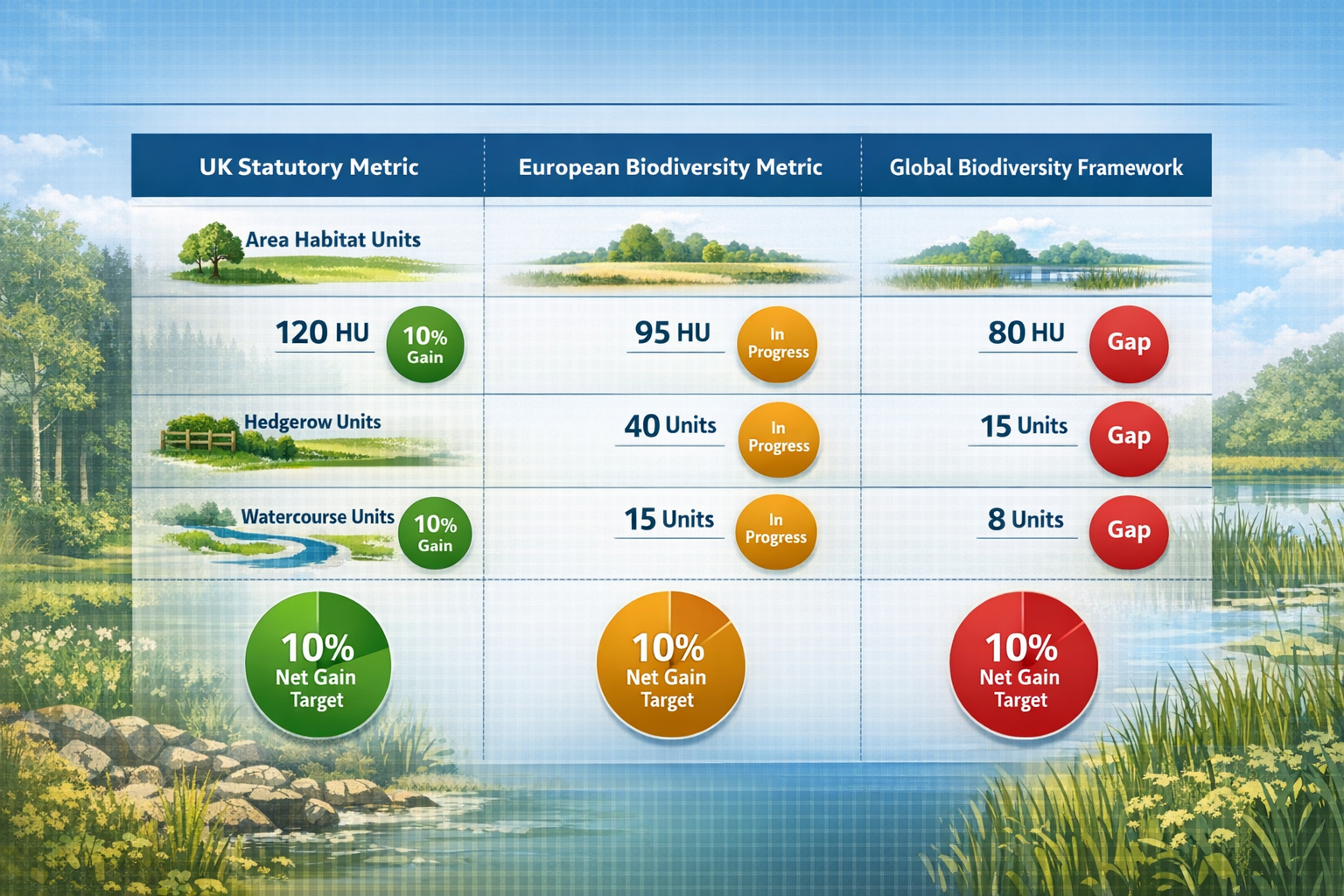
The Statutory Biodiversity Metric serves as the primary standardized tool for calculating biodiversity net gain in the UK. This framework measures habitats through three distinct unit types [3]:
| Unit Type | What It Measures | Application |
|---|---|---|
| Area Habitat Units | Biodiversity value of land parcels based on habitat type, distinctiveness, condition, and strategic significance | Grasslands, woodlands, scrubland, and other area-based habitats |
| Hedgerow Units | Linear habitat features including species composition, condition, and connectivity | Hedgerows, tree lines, and similar linear features |
| Watercourse Units | Aquatic and riparian habitats considering water quality, flow, and bank condition | Rivers, streams, ditches, and water features |
Each unit calculation incorporates habitat distinctiveness (how rare or valuable the habitat type is), habitat condition (current ecological quality), and strategic significance (location within priority habitat networks). This multi-factor approach prevents simplistic "like-for-like" replacements that ignore ecological quality.
For developers, understanding these measurement frameworks is critical for achieving the mandatory 10% biodiversity net gain without costly redesigns or project delays.
The European Biodiversity Metric: Continental Harmonization
In a groundbreaking development, Ramboll launched the first standardized European Biodiversity Metric (EBM) designed to provide a harmonized approach across 38 member and cooperating countries in the European Environment Information and Observation Network (Eionet) [1].
The EBM represents a significant advancement in Standardizing Biodiversity Indicators for Global BNG Compliance: 2026 Surveyor Frameworks by:
- Using the same core calculations as the Australian Biodiversity Metric (ABM) and Global Biodiversity Metric (GBM)
- Enabling organizations to switch between metrics across different geographies without recalculating baseline data
- Aligning directly with EU policy frameworks including the EU Nature Restoration Regulation and EU Biodiversity Strategy for 2030
- Supporting compliance with multiple regulatory requirements through a single assessment framework [1]
This interoperability is transformative for multinational developers. A single biodiversity assessment conducted using the EBM can inform compliance strategies across multiple European jurisdictions, dramatically reducing assessment costs and timeline complexity.
Addressing Methodological Gaps Through 2026 Frameworks
Despite these advances, significant data and methodological gaps persist. A March 2025 Biodiversa+ workshop identified critical challenges that 2026 surveyor frameworks must address [5]:
Data Availability Gaps:
- Insufficient baseline data on ecosystem condition in many regions
- Limited functional biodiversity data (pollinators, soil organisms, ecosystem engineers)
- Inconsistent temporal data preventing accurate trend analysis
- Sparse data coverage in marine and freshwater ecosystems
Methodological Inconsistencies:
- Varying definitions of "habitat condition" across frameworks
- Different approaches to calculating strategic significance
- Inconsistent treatment of temporal biodiversity changes
- Divergent methods for incorporating climate resilience factors
Policy-Science Alignment:
- Mismatch between scientific indicators and policy reporting requirements
- Difficulty translating complex ecological data into actionable compliance metrics
- Insufficient guidance on acceptable evidence standards
- Unclear protocols for handling uncertainty in biodiversity projections
The 2026 surveyor frameworks must bridge these gaps through standardized templates that harmonize indicators across surveys while maintaining scientific rigor and regulatory acceptance.
Standardizing Biodiversity Indicators for Global BNG Compliance: 2026 Surveyor Implementation Templates
Translating standardized frameworks into practical surveyor workflows requires concrete implementation templates. These templates provide the operational bridge between theoretical frameworks and field-ready assessment protocols that deliver compliant, comparable biodiversity data.
Template 1: Baseline Biodiversity Assessment Protocol
A standardized baseline assessment forms the foundation of all BNG compliance. The 2026 template incorporates:
Phase 1: Desk Study and Data Gathering
- Review existing ecological records from national databases
- Analyze historical land use patterns and habitat change
- Identify statutory and non-statutory designated sites within impact zones
- Compile climate and soil data relevant to habitat condition
- Document strategic significance within local biodiversity action plans
Phase 2: Field Survey Execution
- Conduct habitat surveys using standardized classification systems (UK Habitat Classification, EUNIS for European projects)
- Assess habitat condition using consistent condition assessment criteria
- Map habitat boundaries with GPS precision (±5m accuracy minimum)
- Document species assemblages using standardized recording protocols
- Photograph representative areas with geotagged imagery
Phase 3: Metric Calculation
- Input data into appropriate biodiversity metric tool (Statutory Metric, EBM, etc.)
- Calculate baseline area habitat units, hedgerow units, and watercourse units
- Document assumptions and data quality limitations
- Generate baseline biodiversity unit totals with uncertainty ranges
This standardized approach ensures comprehensive biodiversity net gain assessments that regulatory authorities can confidently review and approve.
Template 2: Post-Development Monitoring Framework
The 30-year sustainability requirement necessitates robust monitoring frameworks. The 2026 template establishes:
Monitoring Frequency:
- Years 1-5: Annual monitoring to verify establishment success
- Years 6-15: Biennial monitoring to track habitat maturation
- Years 16-30: Five-year monitoring to confirm long-term sustainability
Standardized Monitoring Indicators:
- Habitat extent (area measurements compared to baseline)
- Habitat condition scores using identical criteria as baseline assessment
- Target species presence/absence and population trends
- Invasive species presence and management effectiveness
- Structural diversity metrics (vegetation layers, age structure)
Reporting Requirements:
- Standardized monitoring report template with mandatory data fields
- Photographic evidence from fixed monitoring points
- Biodiversity unit recalculation demonstrating maintained or improved gains
- Adaptive management recommendations when targets underperform
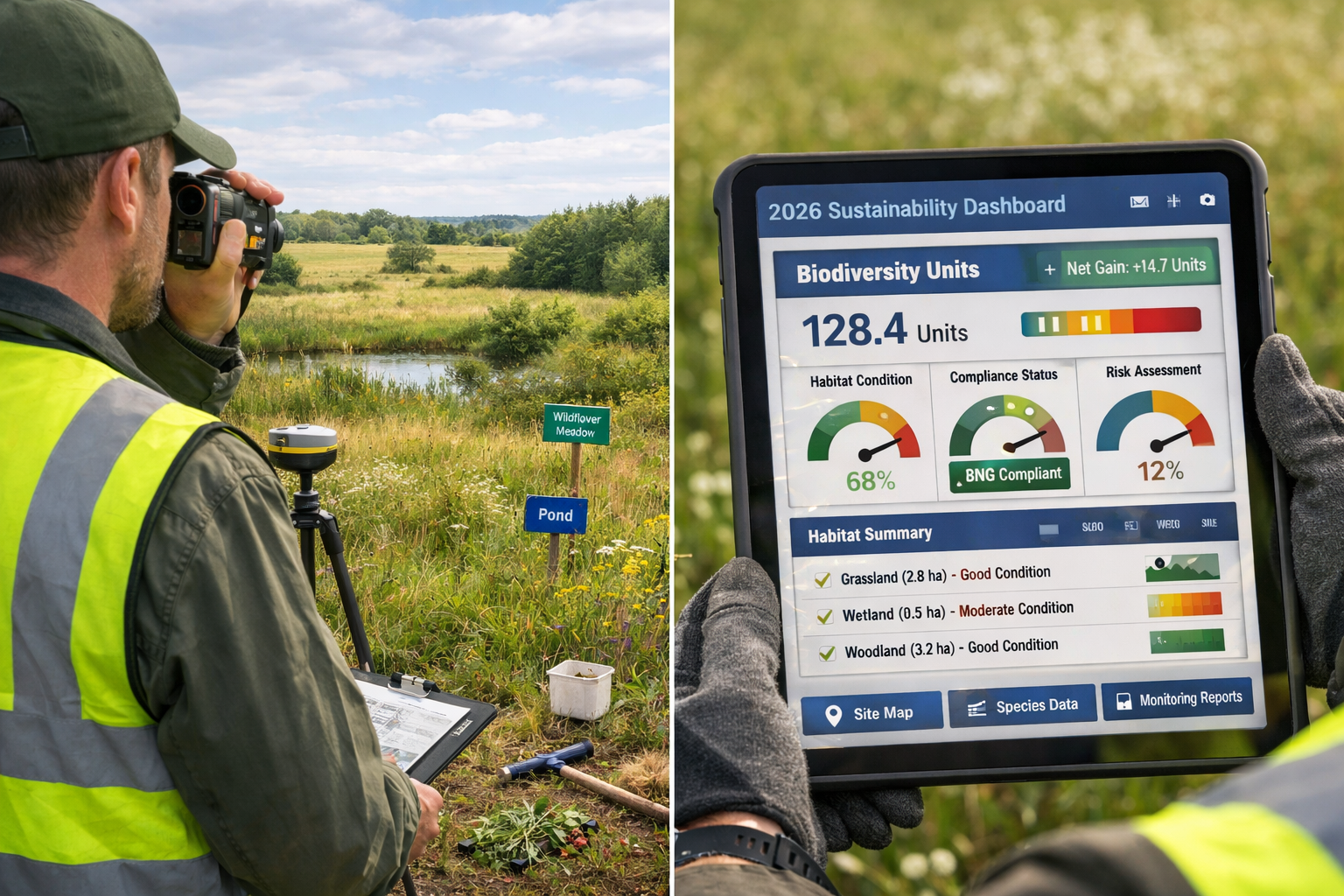
The new 2026 Sustainability Dashboard for BNG monitoring provides live feedback on biodiversity net gain compliance as designs evolve, streamlining monitoring and regulatory compliance [7]. This technological integration represents a significant advancement in making long-term monitoring both practical and cost-effective.
Template 3: Earth Observation Data Integration
The World Biodiversity Forum 2026 is addressing the integration of Earth Observation (EO) data for biodiversity monitoring across different biomes, with emphasis on calibrating EO data with in-site data and supporting national reporting for the Kunming-Montreal Global Biodiversity Framework [6].
The 2026 EO integration template includes:
Satellite Data Sources:
- Sentinel-2 multispectral imagery for habitat extent and condition
- LiDAR data for vegetation structure and three-dimensional habitat complexity
- SAR (Synthetic Aperture Radar) for wetland and water body monitoring
- High-resolution commercial imagery for detailed habitat mapping
Calibration Protocols:
- Ground-truthing requirements linking field surveys to EO signatures
- Validation sample sizes ensuring statistical confidence (minimum 30 sample points per habitat type)
- Temporal alignment between field surveys and satellite image acquisition
- Quality assurance procedures for cloud cover, seasonal variation, and atmospheric correction
Compliance Applications:
- Automated change detection identifying habitat losses or gains
- Large-scale habitat condition assessment supplementing field surveys
- Cost-effective monitoring for extensive or inaccessible sites
- Verification of developer-reported biodiversity outcomes
This integration of remote sensing technology with traditional field surveys creates a scalable, verifiable approach to biodiversity monitoring that can support both project-level compliance and national-level reporting to international frameworks.
Harmonizing Indicators Across International Commitments
The true test of Standardizing Biodiversity Indicators for Global BNG Compliance: 2026 Surveyor Frameworks lies in their ability to serve multiple regulatory masters simultaneously. Developers and surveyors need frameworks that satisfy local planning requirements, national biodiversity strategies, and international commitments without requiring redundant assessments.
Multi-Level Compliance Architecture
Effective harmonization requires understanding the hierarchical relationship between compliance levels:
Project Level (Local Planning Authority)
- Demonstrates minimum 10% biodiversity net gain
- Satisfies local habitat priorities and strategic significance criteria
- Provides 30-year management and monitoring commitments
- Secures legal agreements protecting biodiversity outcomes
National Level (Biodiversity Strategies)
- Contributes to national biodiversity targets and habitat restoration goals
- Aligns with national habitat network connectivity objectives
- Supports species recovery programs for priority taxa
- Provides data for national biodiversity monitoring programs
International Level (KMGBF and UN CBD)
- Contributes measurable progress toward KMGBF targets
- Provides standardized data compatible with international reporting formats
- Demonstrates ecosystem restoration consistent with global commitments
- Supports transparent, verifiable biodiversity accounting
The 2026 surveyor frameworks achieve this multi-level compliance through nested indicator sets—core indicators that satisfy all levels, supplemented by jurisdiction-specific indicators addressing local priorities.
Case Study: Cross-Border Development Projects
Consider a hypothetical renewable energy project spanning UK and European territories. Using standardized 2026 frameworks:
UK Component:
- Baseline assessment using Statutory Biodiversity Metric
- Calculation of area habitat units, hedgerow units, watercourse units
- Demonstration of 10% net gain per UK requirements
- 30-year monitoring plan secured through Section 106 agreement
European Component:
- Baseline assessment using European Biodiversity Metric
- Same core habitat data collected using compatible classification
- Calculation using EBM tool demonstrating compliance with EU Nature Restoration Regulation
- Integration with national biodiversity strategies of affected member states
International Reporting:
- Aggregated biodiversity outcomes reported using KMGBF-compatible indicators
- Contribution to national progress reports for CBD COP17 review
- Transparent disclosure of methodologies enabling third-party verification
This harmonized approach demonstrates how developers can benefit from standardized biodiversity frameworks that reduce assessment burden while improving compliance confidence.
Addressing Remaining Standardization Challenges
Despite significant progress, several challenges require ongoing attention:
Challenge 1: Temporal Standardization
Different frameworks use different temporal baselines (pre-development, historical reference conditions, current degraded state). The 2026 frameworks are converging on pre-development baseline as the standard reference point, but historical degradation accounting remains inconsistent.
Challenge 2: Offsite Equivalency
When choosing between on-site and off-site biodiversity net gain delivery, equivalency calculations vary significantly. Standardizing spatial discounting factors (adjustments for distance between impact and compensation sites) and temporal discounting (adjustments for time lags in habitat establishment) remains a priority.
Challenge 3: Biodiversity Credit Markets
The emerging market for biodiversity credits and units requires standardized verification protocols. Current frameworks lack consistent approaches to:
- Third-party verification standards
- Additionality requirements (ensuring credits represent genuine gains)
- Permanence guarantees beyond 30-year minimum
- Double-counting prevention across multiple compliance frameworks
Challenge 4: Marine and Freshwater Ecosystems
Terrestrial habitat frameworks are most advanced, but marine and freshwater ecosystems require specialized indicators. The 2026 frameworks are expanding watercourse units to address riverine ecosystems, but coastal, estuarine, and marine habitats need further development.

Practical Implementation: From Framework to Field
Understanding standardized frameworks is only valuable if surveyors can implement them effectively in real-world projects. This section provides actionable guidance for transitioning from theoretical frameworks to field-ready assessment protocols.
Selecting the Appropriate Framework
For UK Projects:
Use the Statutory Biodiversity Metric as the primary framework. This ensures compliance with mandatory BNG requirements and aligns with local planning authority expectations. Understanding the complete requirements helps avoid costly assessment gaps.
For European Projects:
The European Biodiversity Metric (EBM) provides the most comprehensive standardization across Eionet countries [1]. Its compatibility with national frameworks in 38 countries makes it the preferred choice for projects spanning multiple jurisdictions.
For Global Projects:
Projects with international financing or sustainability reporting requirements should consider the Global Biodiversity Metric (GBM), which shares calculation methodologies with both EBM and ABM, enabling consistent reporting across continents [1].
Building Surveyor Competency
Effective implementation requires surveyors with specific competencies:
Technical Skills:
- Habitat classification using standardized systems (UK Habitat Classification, EUNIS)
- Condition assessment using consistent criteria
- Biodiversity metric tool operation and data input
- GIS mapping and spatial analysis
- Statistical analysis for monitoring data interpretation
Regulatory Knowledge:
- Understanding local, national, and international biodiversity requirements
- Familiarity with planning policy and legal agreement structures
- Knowledge of acceptable evidence standards and documentation requirements
- Awareness of emerging regulatory changes and framework updates
Ecological Expertise:
- Species identification across relevant taxonomic groups
- Understanding of habitat succession and ecological processes
- Knowledge of appropriate management interventions for different habitat types
- Ability to design ecologically sound compensation and enhancement strategies
Organizations should invest in training programs that build these competencies systematically, ensuring surveyor teams can deliver compliant assessments consistently.
Technology Integration for Standardization
Modern technology platforms support standardization through:
Mobile Data Collection:
- Field apps with standardized data entry forms preventing inconsistent recording
- Automated GPS tagging ensuring accurate spatial data
- Photo documentation with metadata capture
- Offline functionality for remote site work
Cloud-Based Calculation Tools:
- Centralized biodiversity metric calculators ensuring version control
- Automated quality checks identifying data entry errors
- Scenario modeling supporting design optimization
- Integration with monitoring dashboards for long-term tracking [7]
Data Management Systems:
- Centralized repositories for baseline and monitoring data
- Standardized reporting templates auto-populating from field data
- Version control and audit trails for regulatory transparency
- Integration with national biodiversity data centers
These technological solutions reduce human error, improve data quality, and streamline the path from field survey to compliance documentation.
Stakeholder Communication and Transparency
Standardized frameworks enhance communication with key stakeholders:
For Developers:
Clear, consistent metrics enable architects and planners to integrate BNG requirements from project inception, avoiding late-stage design changes and cost overruns.
For Planning Authorities:
Standardized assessments using recognized frameworks reduce review time and increase confidence in approval decisions. Common questions from planners can be addressed more efficiently with consistent methodologies.
For Local Communities:
Transparent, standardized reporting helps communities understand biodiversity impacts and benefits, building social license for development projects.
For Investors and Lenders:
Financial institutions increasingly require biodiversity risk assessments. Standardized frameworks provide the consistency and comparability necessary for integrating biodiversity into financial decision-making.
Future Directions: Evolution of Standardization Beyond 2026
The journey toward fully standardized biodiversity indicators continues beyond 2026. Several emerging trends will shape the next generation of surveyor frameworks:
Artificial Intelligence and Automated Assessment
Machine learning algorithms are increasingly capable of:
- Automated habitat classification from satellite and drone imagery
- Species identification from acoustic monitoring and camera trap data
- Predictive modeling of habitat condition trajectories
- Anomaly detection in monitoring data identifying ecological concerns
These AI applications will enhance standardization by reducing subjective interpretation while maintaining ecological validity.
Real-Time Biodiversity Monitoring
Internet of Things (IoT) sensors and continuous monitoring technologies enable:
- Permanent monitoring stations tracking ecosystem parameters
- Automated alerts when biodiversity metrics fall below thresholds
- Continuous verification of developer commitments
- Dynamic adaptive management responding to real-time ecological changes
This shift from periodic surveys to continuous monitoring will fundamentally change how 30-year sustainability commitments are verified and enforced.
Blockchain for Biodiversity Credit Verification
Distributed ledger technology offers solutions for:
- Transparent, immutable recording of biodiversity credit creation and trading
- Prevention of double-counting across multiple compliance frameworks
- Automated verification of management action completion
- Permanent record of land use commitments supporting 30-year requirements
These technologies will mature the biodiversity credit market, making buying and selling biodiversity units more transparent and reliable.
Integration with Climate and Social Frameworks
Future standardization will increasingly integrate biodiversity with:
- Climate metrics: Carbon sequestration, climate resilience, adaptation value
- Social metrics: Community benefits, access to nature, environmental justice
- Economic metrics: Ecosystem service valuation, natural capital accounting
This integration recognizes that biodiversity doesn't exist in isolation but forms part of interconnected environmental, social, and governance (ESG) frameworks.
Conclusion
Standardizing Biodiversity Indicators for Global BNG Compliance: 2026 Surveyor Frameworks represents a critical evolution in how humanity measures, manages, and protects biodiversity in the face of unprecedented development pressure. The frameworks emerging in 2026—led by the European Biodiversity Metric's harmonization across 38 countries, the UK's mature Statutory Biodiversity Metric, and the integration of Earth Observation technologies—provide surveyors with practical tools to deliver consistent, comparable biodiversity assessments that satisfy local regulations while contributing to international commitments under the Kunming-Montreal Global Biodiversity Framework.
The standardization journey has achieved significant milestones: three core measurement units (area habitat, hedgerow, and watercourse), 10% minimum uplift standards, 30-year sustainability requirements, and interoperable calculation methodologies that enable cross-border consistency. Yet challenges remain, particularly in addressing data gaps, methodological inconsistencies, and the integration of marine and freshwater ecosystems into comprehensive frameworks.
For surveyors, developers, planners, and policymakers, the path forward is clear:
Actionable Next Steps
For Surveyors:
- Invest in training on standardized frameworks (Statutory Metric, EBM, GBM)
- Adopt technology platforms supporting consistent data collection and calculation
- Build competency in Earth Observation data integration
- Participate in professional development programs addressing 2026 framework updates
For Developers:
- Integrate standardized biodiversity assessments from project conception
- Engage qualified surveyors familiar with applicable frameworks early in planning
- Consider comprehensive biodiversity net gain strategies that leverage standardized approaches
- Plan for 30-year monitoring commitments in project financing and management structures
For Planning Authorities:
- Adopt standardized frameworks in local planning policy
- Provide clear guidance on acceptable evidence and assessment methodologies
- Build internal capacity to review standardized biodiversity assessments efficiently
- Contribute local data to national and international biodiversity monitoring programs
For Policymakers:
- Continue harmonization efforts across jurisdictions to reduce compliance complexity
- Address remaining gaps in marine, freshwater, and functional biodiversity indicators
- Support development of verification standards for biodiversity credit markets
- Ensure adequate funding for long-term monitoring and enforcement
The October 2026 CBD COP17 global review will provide the first comprehensive assessment of progress toward the Kunming-Montreal Global Biodiversity Framework targets. The standardized surveyor frameworks developed in 2026 will determine whether nations can demonstrate credible, comparable progress—or whether fragmented, incomparable data undermines global biodiversity commitments.
The stakes could not be higher. Biodiversity loss continues at alarming rates, with ecosystems worldwide facing unprecedented pressure from development, climate change, and resource extraction. Standardized indicators don't solve these challenges alone, but they provide the measurement foundation necessary for accountability, transparency, and ultimately, effective conservation action.
By embracing Standardizing Biodiversity Indicators for Global BNG Compliance: 2026 Surveyor Frameworks, the global community takes a crucial step toward making biodiversity net gain not just a regulatory requirement, but a measurable, verifiable contribution to planetary health that future generations will inherit.
References
[1] Ramboll Launches First Of Its Kind European Biodiversity Metric – https://www.ramboll.com/news/ramboll-launches-first-of-its-kind-european-biodiversity-metric
[2] Progress Made Biodiversity Swifter Action Needed 2026 02 12 En – https://environment.ec.europa.eu/news/progress-made-biodiversity-swifter-action-needed-2026-02-12_en
[3] Biodiversity Net Gain – https://www.thomsonec.com/news/biodiversity-net-gain/
[4] A Shift In Sustainable Development Understanding Biodiversity Net Gain Hydrology Ecology And – https://www.slrconsulting.com/us/insights/a-shift-in-sustainable-development-understanding-biodiversity-net-gain-hydrology-ecology-and/
[5] Workshop Report Advancing Biodiversity Indicators For Monitoring And Policy – https://www.biodiversa.eu/2026/03/02/workshop-report-advancing-biodiversity-indicators-for-monitoring-and-policy/
[6] Oral And Poster Sessions Wbf2026 – https://worldbiodiversityforum.org/oral-and-poster-sessions-wbf2026/
[7] Watch – https://www.youtube.com/watch?v=lucVHr-5MBE