

{"cover":"Professional landscape format (1536×1024) hero image with bold text overlay 'Tipping Points in Ecosystem Surveys: Early Warning Protocols for Biodiversity Surveyors Post-2026' in extra large 72pt white sans-serif font with dark gradient shadow, positioned center-upper third. Background shows split composition: left side displays field surveyor using tablet near wetland with monitoring equipment and data overlays, right side shows abstract visualization of ecosystem decline graphs with red warning indicators and biodiversity metrics. Color palette: deep forest green, urgent orange-red, white, charcoal. High contrast editorial quality with scientific precision aesthetic, magazine cover style, professional conservation focus","content":["Detailed landscape format (1536×1024) image showing close-up of biodiversity surveyor's hands holding tablet displaying multi-metric dashboard with real-time ecosystem health indicators including species abundance graphs trending downward, soil quality measurements, water chemistry readings, and red threshold warning alerts. Background shows blurred wetland habitat with monitoring stations visible. Overlay text '5 Critical Baseline Metrics' in bold sans-serif. Color scheme: scientific blue, warning amber, white data points. Infographic style with clean data visualization, professional field research aesthetic, technical precision focus","Landscape format (1536×1024) conceptual illustration showing three-stage ecosystem transformation sequence from healthy to tipping point to collapsed state. Left panel: vibrant green forest canopy with diverse wildlife silhouettes and upward trending biodiversity indicators. Center panel: stressed ecosystem with yellowing vegetation, fewer species, declining trend arrows, and prominent orange warning symbols. Right panel: degraded landscape with sparse vegetation, red critical alerts, cascading failure icons. Clean infographic design with clear progression arrows, professional conservation science aesthetic, educational diagram style","Wide landscape format (1536×1024) image of modern field surveyor team implementing early warning protocols in diverse habitat setting. Foreground shows surveyor using advanced monitoring equipment with AR overlay displaying real-time tipping point indicators and intervention recommendations. Middle ground features habitat restoration work in progress with marked monitoring zones. Background shows healthy ecosystem with biodiversity recovery metrics displayed as holographic data points. Color palette: professional green, technology blue, optimistic white. Action-oriented composition, future-forward conservation technology aesthetic, practical implementation focus"]

Up to eight critical ecosystem tipping points could be reached below 2°C of warming—a sobering revelation published in February 2026 that fundamentally changes how biodiversity surveyors must approach fieldwork.[6] The era of reactive ecological assessment has ended. As warm-water coral reefs already cross thermal tipping points at 1.4°C warming, surveyors face an urgent mandate: detect the warning signs before ecosystems collapse.[2]
Tipping Points in Ecosystem Surveys: Early Warning Protocols for Biodiversity Surveyors Post-2026 represents a paradigm shift from traditional snapshot assessments to dynamic, multi-metric monitoring systems. This comprehensive framework equips field professionals with the tools to identify critical thresholds before irreversible ecological transitions occur—a capability essential for proactive Biodiversity Net Gain (BNG) interventions.
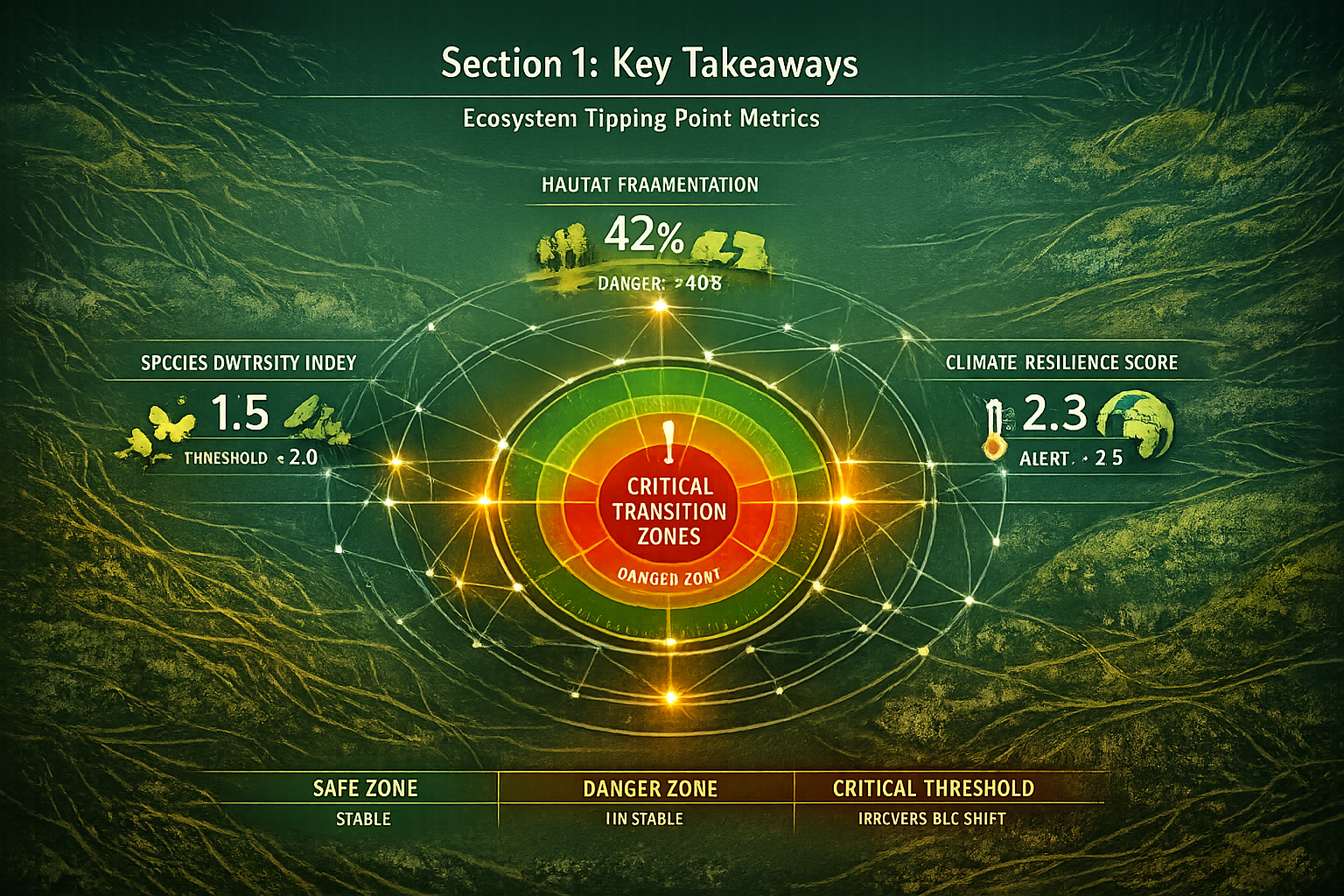
Key Takeaways
- Multi-metric baselines combining quantitative models, satellite data, and field observations provide the foundation for detecting ecosystem tipping points before collapse occurs
- Five critical indicators—species abundance trends, functional diversity loss, soil degradation, hydrological shifts, and vegetation stress—serve as early warning signals requiring immediate surveyor attention
- Regional Tipping Element Monitoring and Response Facilities (TEMRFs) offer coordinated infrastructure for aggregating monitoring data and translating scientific findings into actionable protocols[1]
- Local intervention protocols targeting non-climate stressors (overfishing, nutrient loading, deforestation) can increase ecosystem resilience even as global temperatures rise[2]
- Real-time data systems deployed in 2026 enable continuous compliance monitoring and rapid response to threshold breaches, transforming surveyor workflows from periodic to persistent observation[3]
Understanding Ecosystem Tipping Points: The Science Behind Critical Thresholds
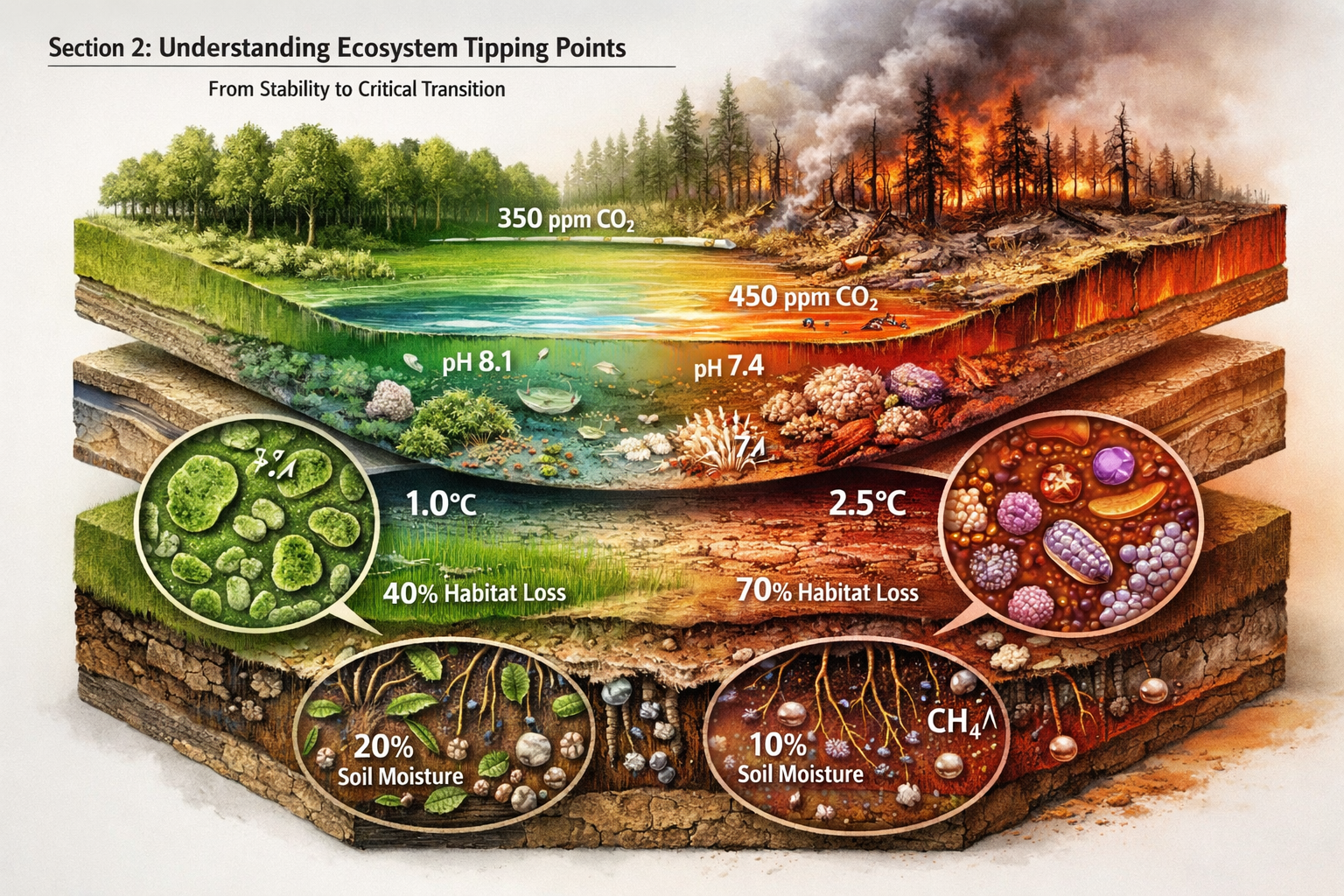
Ecosystem tipping points represent critical thresholds where small environmental changes trigger disproportionate, often irreversible ecological transitions. Unlike gradual degradation, tipping point dynamics involve rapid state shifts—a coral reef transforming from vibrant ecosystem to algae-dominated rubble, or a rainforest flipping to savanna within decades.
The Global Tipping Points Report 2025, synthesized by 160 authors from 87 institutions, provides the authoritative framework for understanding these thresholds.[2] This comprehensive analysis identifies multiple Earth system tipping elements currently at risk, with direct implications for field surveyors conducting biodiversity impact assessments.
The Mechanics of Ecological Collapse 🔄
Tipping points operate through positive feedback loops that accelerate degradation once thresholds are breached:
- Amazon Rainforest: Reduced rainfall from deforestation decreases moisture recycling, causing further tree mortality and additional rainfall decline—a self-reinforcing cycle
- Coral Reefs: Thermal stress triggers bleaching, reducing reef structural complexity, which increases vulnerability to wave damage and inhibits coral recruitment
- Wetland Systems: Hydrological changes alter vegetation composition, reducing water retention capacity and accelerating drainage—perpetuating drier conditions
UK government security assessments from January 2026 document how ecosystem collapse triggers cascading failures across multiple services: water regulation, soil fertility, pollination, disease control, and carbon storage.[4] These interconnected failures create compound risks that surveyors must anticipate when establishing monitoring protocols.
Current Tipping Point Status: 2026 Assessment
Research published February 2026 by teams from the Potsdam Institute for Climate Impact Research, University of Exeter, and CICERO establishes that global warming must peak below 2°C then return under 1.5°C to limit tipping point risks.[6] This narrow window demands immediate action from biodiversity professionals.
| Ecosystem Type | Current Risk Level | Temperature Threshold | Surveyor Priority |
|---|---|---|---|
| Warm-water coral reefs | Critical (already tipping) | 1.4°C | Immediate monitoring |
| Amazon rainforest | High | 1.5-2°C | Enhanced protocols |
| Boreal forests | Moderate-High | 1.5-2.5°C | Baseline establishment |
| Wetland systems | Variable | Site-specific | Local assessment |
| Grassland ecosystems | Moderate | 2-3°C | Preventive monitoring |
For surveyors working on BNG projects, understanding these thresholds is essential for designing resilient habitat creation schemes that account for future climate trajectories.
Tipping Points in Ecosystem Surveys: Establishing Multi-Metric Baseline Protocols
The foundation of effective early warning systems lies in comprehensive baseline establishment that captures ecosystem complexity across multiple dimensions. Single-metric approaches—monitoring species counts alone, for example—miss critical warning signals that emerge in functional relationships, soil chemistry, or hydrological patterns.
Five Critical Baseline Metrics for Tipping Point Detection
1. Species Abundance and Composition Trends 📊
Track not just presence/absence but population trajectories over time. Declining abundance of keystone species or rapid compositional shifts signal approaching thresholds. Establish quarterly monitoring for indicator species sensitive to environmental change.
2. Functional Diversity Indices
Measure the range of ecological roles (pollinators, decomposers, predators) within the system. Functional diversity loss often precedes species richness decline, providing earlier warning signals. Calculate functional dispersion and redundancy metrics during each survey cycle.
3. Soil Health Indicators
Monitor organic matter content, microbial biomass, nutrient cycling rates, and structural stability. Soil degradation cascades through ecosystems, affecting vegetation health and water regulation. Implement standardized soil sampling protocols at fixed monitoring points.
4. Hydrological Pattern Documentation
Record water table levels, surface water extent, flow patterns, and seasonal variation. Hydrological shifts frequently trigger tipping points in wetlands, riparian zones, and floodplain ecosystems. Deploy automated water level loggers for continuous data collection.
5. Vegetation Stress Indicators
Utilize remote sensing indices (NDVI, EVI) combined with ground-truthing to detect early stress signals. Changes in leaf area, flowering phenology, or seedling recruitment rates indicate declining ecosystem resilience before visible degradation occurs.
Implementing the TEMRF Framework for Regional Coordination
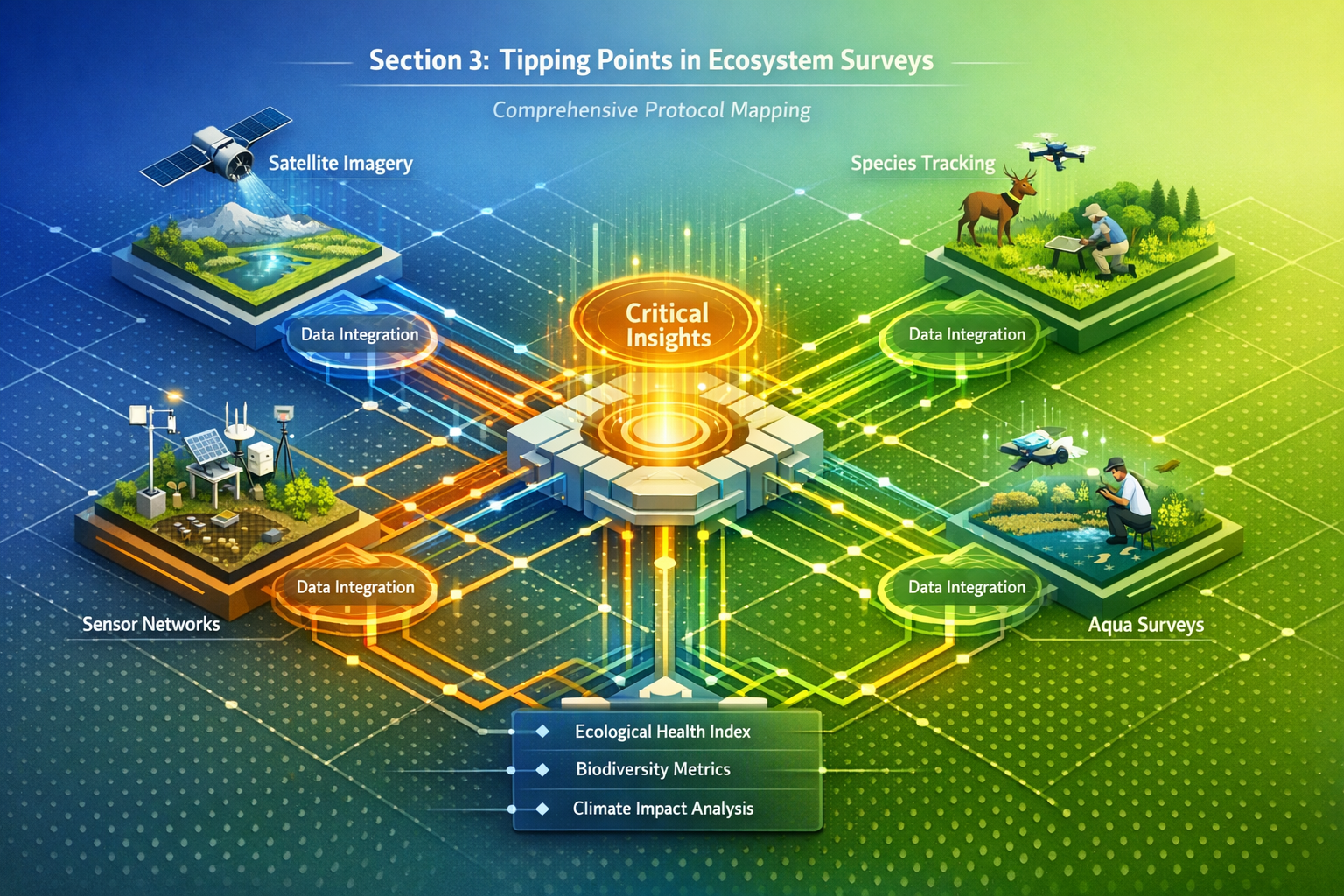
The proposed Tipping Element Monitoring and Response Facilities (TEMRFs) provide coordinated infrastructure for aggregating monitoring data from multiple sources.[1] These regional facilities combine:
- Quantitative ecological models predicting threshold behavior
- Satellite remote sensing data for landscape-scale pattern detection
- Indigenous and local knowledge capturing long-term environmental changes
- Field survey data from biodiversity professionals
For surveyors, TEMRFs offer access to contextualized data that places site-specific observations within broader regional trends. When conducting biodiversity net gain assessments, connecting to TEMRF networks enables comparison against regional baseline conditions and identification of ecosystems approaching critical thresholds.
Practical Baseline Protocol Implementation
Step 1: Site Characterization and Risk Assessment
Evaluate site vulnerability based on ecosystem type, climate exposure, existing stressors, and connectivity to source populations. High-risk sites require more intensive monitoring frequencies.
Step 2: Establish Fixed Monitoring Points
Create permanent sampling locations for repeated measurements. GPS-marked points enable precise temporal comparisons and detection of directional trends versus random variation.
Step 3: Deploy Multi-Sensor Arrays
Combine manual field surveys with automated data collection (weather stations, soil moisture probes, acoustic recorders, camera traps). Continuous data streams capture threshold-crossing events that periodic surveys might miss.
Step 4: Integrate Remote Sensing Analysis
Incorporate satellite imagery analysis for vegetation indices, land cover change detection, and thermal stress monitoring. Free platforms like Google Earth Engine provide accessible tools for time-series analysis.
Step 5: Document Local Stressor Conditions
Record non-climate pressures (pollution, invasive species, human disturbance, fragmentation) that interact with climate change to accelerate tipping point approach. These factors often provide the most actionable intervention targets.
When planning BNG projects, this multi-metric baseline approach enables adaptive management strategies that respond to early warning signals before costly restoration failures occur.
Early Warning Indicators: Detecting Critical Transitions Before Collapse
Beyond baseline establishment, surveyors must recognize specific warning signals that indicate ecosystems approaching tipping points. These indicators emerge from complex systems theory and have been validated across multiple ecosystem types.
Statistical Early Warning Signals 📈
Critical Slowing Down
As systems approach tipping points, they recover more slowly from disturbances—a phenomenon called critical slowing down. Surveyors can detect this through:
- Increased temporal autocorrelation in monitoring data (current conditions more similar to recent past)
- Rising variance in measured parameters (greater fluctuations between sampling periods)
- Longer recovery times following disturbance events (storms, droughts, fires)
Flickering Between States
Systems near tipping points may alternate rapidly between alternative states before settling into a new stable configuration. Watch for:
- Abrupt short-term shifts in species dominance
- Rapid vegetation changes that partially reverse
- Oscillating water quality parameters
Spatial Pattern Changes
Approaching tipping points often manifest in spatial organization:
- Increased spatial autocorrelation (patches becoming more uniform)
- Formation of distinct vegetation gaps or bare patches
- Changes in patch size distribution (more very large or very small patches)
Biological Warning Indicators
Keystone Species Decline 🦋
Monitor populations of species with disproportionate ecosystem influence. Pollinators, top predators, ecosystem engineers (beavers, woodpeckers), and foundation species (dominant trees, reef-building corals) provide early signals. A 30% decline in keystone species abundance warrants immediate intervention assessment.
Functional Group Collapse
Track representation across functional groups (nitrogen fixers, decomposers, seed dispersers). Loss of entire functional groups indicates approaching thresholds, even if overall species richness remains stable. This metric proves particularly valuable for achieving biodiversity net gain targets that emphasize functional ecosystem integrity.
Recruitment Failure
Absence of juvenile age classes signals reproduction breakdown—a leading indicator of population collapse. Survey for seedlings, saplings, and juvenile animals. Recruitment failure often precedes adult population decline by years, providing intervention opportunities.
Invasive Species Proliferation
Rapid invasive species expansion indicates declining native ecosystem resilience. Stressed systems lose competitive resistance, allowing invasives to establish. Track invasive cover percentage and spread rates as resilience proxies.
Environmental Threshold Indicators
Soil Carbon Loss
Declining soil organic carbon indicates degradation of the ecosystem foundation. Losses exceeding 0.5% annually signal serious degradation trajectories. Implement annual soil carbon monitoring at fixed points.
Water Quality Deterioration
Monitor nutrient levels (nitrogen, phosphorus), dissolved oxygen, pH, and turbidity. Eutrophication tipping points occur when nutrient loading exceeds assimilation capacity, triggering algal blooms and oxygen depletion cascades.
Microclimate Shifts
Document temperature and humidity changes within the ecosystem. Forest understory warming or wetland drying indicates structural degradation affecting habitat suitability for specialist species.
Implementing Real-Time Data Systems for Continuous Monitoring
The ABALOBI MONITOR platform demonstrates the potential of community-owned data systems for real-time ecological monitoring.[3] Deployed across fisheries management in 2026, this approach enables:
- Immediate data collection and transmission from field sites
- Automated threshold breach alerts
- Compliance verification and adaptive management triggers
- Multi-stakeholder data access and transparency
For biodiversity surveyors, adopting similar real-time data architectures transforms workflows from periodic snapshot assessments to continuous ecosystem health monitoring. This shift proves essential for detecting rapid tipping point transitions that occur between traditional survey intervals.
When conducting biodiversity net gain assessments for developers, real-time monitoring systems provide defensible evidence of habitat creation success and early warning of intervention needs—reducing project risk and ensuring regulatory compliance.
Intervention Protocols: Responding to Early Warning Signals
Detecting approaching tipping points holds value only when coupled with rapid, effective intervention protocols. The Global Tipping Points Report 2025 emphasizes that local actions targeting non-climate stressors can significantly increase ecosystem resilience, even as global temperatures continue rising.[2]
Priority Intervention Hierarchy
Immediate Actions (Within 1 Week of Warning Signal Detection)
- Notify stakeholders: Alert project managers, landowners, regulatory authorities, and ecological consultants
- Implement emergency protections: Establish temporary access restrictions, halt potentially damaging activities
- Deploy enhanced monitoring: Increase survey frequency, add supplementary metrics, expand spatial coverage
- Document conditions: Comprehensive photographic records, detailed species inventories, environmental measurements
Short-Term Responses (1-4 Weeks)
- Conduct rapid assessment: Engage specialist ecologists for targeted investigation of warning signals
- Identify stressor sources: Determine whether threats are climate-driven, anthropogenic, or combined
- Develop intervention plan: Design specific actions addressing identified stressors
- Secure resources: Allocate budget, personnel, and equipment for intervention implementation
Medium-Term Interventions (1-6 Months)
- Implement stressor reduction: Remove or mitigate identified threats (reduce pollution, control invasives, restore hydrology)
- Enhance connectivity: Create or improve corridors enabling species movement and genetic exchange
- Supplement populations: Consider assisted colonization or translocation for critically depleted species
- Restore structural complexity: Add habitat features (deadwood, water bodies, vegetation layers)
Ecosystem-Specific Intervention Strategies
For Wetland Systems Approaching Hydrological Tipping Points:
- Restore natural water flow patterns through ditch blocking or weir installation
- Remove drainage infrastructure accelerating water loss
- Establish buffer zones reducing nutrient and sediment inputs
- Plant water-retaining vegetation species (Sphagnum mosses, sedges)
For Woodland Systems Showing Degradation Signals:
- Implement deer management reducing browsing pressure on regeneration
- Control invasive species (rhododendron, laurel) competing with native vegetation
- Create canopy gaps promoting structural diversity and regeneration
- Enhance deadwood habitat for saproxylic species
For Grassland Systems Exhibiting Functional Decline:
- Adjust grazing regimes to appropriate intensity and timing
- Control scrub encroachment maintaining open conditions
- Reduce fertilizer application preventing nutrient enrichment
- Introduce seed mixes restoring functional plant diversity
For Aquatic Systems Approaching Eutrophication Thresholds:
- Reduce upstream nutrient sources (agricultural runoff, sewage inputs)
- Remove accumulated sediment and organic matter
- Introduce or enhance riparian buffer strips
- Restore natural flow variability and connectivity
Adaptive Management Frameworks
Intervention effectiveness requires continuous feedback loops between monitoring and management actions. Implement structured adaptive management:
- Define measurable objectives: Specific, quantifiable targets for intervention success
- Monitor intervention outcomes: Track response metrics at appropriate temporal scales
- Evaluate effectiveness: Compare outcomes against objectives and baseline trajectories
- Adjust strategies: Modify interventions based on monitoring evidence
- Document lessons learned: Create institutional knowledge for future applications
This adaptive approach aligns with achieving biodiversity net gain without risk by ensuring interventions deliver intended outcomes and enabling course corrections when initial strategies prove insufficient.
Leveraging Positive Tipping Points
Not all tipping points involve ecosystem collapse. The Earthshot Prize community identifies positive tipping points—thresholds where small interventions trigger self-reinforcing beneficial changes.[3] Examples include:
- Pollinator habitat networks: Once connectivity exceeds critical thresholds, pollinator populations expand rapidly, enhancing ecosystem services across landscapes
- Rewilding cascades: Reintroduction of keystone species (beavers, apex predators) triggers ecosystem restructuring with cascading benefits
- Community conservation momentum: Successful local projects inspire neighboring communities, creating regional conservation movements
Surveyors should identify opportunities to catalyze positive tipping points through strategic interventions that leverage ecosystem self-organization and social dynamics.
Integrating Tipping Point Protocols into BNG Frameworks
The UK's mandatory Biodiversity Net Gain requirements create both challenges and opportunities for implementing tipping point early warning systems. BNG projects require 30-year habitat management plans—timescales over which multiple tipping points may be approached or crossed.[5]
BNG Metric Limitations and Tipping Point Considerations
The statutory BNG metric calculates biodiversity units based on habitat type, condition, and strategic significance. However, this snapshot approach does not capture tipping point dynamics or trajectory-dependent ecosystem states. Two sites with identical current BNG scores may have vastly different resilience to future environmental change.
Surveyors conducting biodiversity net gain reports should supplement standard assessments with:
- Trajectory analysis: Are baseline conditions improving, stable, or declining?
- Resilience indicators: What is the ecosystem's capacity to absorb future disturbances?
- Threshold proximity: How close is the system to critical tipping points?
- Intervention requirements: What management intensity will maintain or enhance condition?
Designing Tipping Point-Resilient Habitat Creation
When planning on-site or off-site BNG delivery, incorporate tipping point considerations:
Site Selection Criteria:
- Prioritize locations with high climate resilience (topographic diversity, water availability, connectivity)
- Avoid areas approaching known tipping points (coastal erosion zones, drought-prone regions)
- Select sites enabling adaptive management (accessible, secure tenure, stakeholder support)
Habitat Design Principles:
- Create heterogeneous landscapes with multiple habitat types and successional stages
- Maximize structural complexity providing microclimate refugia
- Ensure hydrological resilience through natural water retention features
- Establish connectivity enabling species range shifts
Management Plan Requirements:
- Include monitoring protocols for early warning indicators
- Define intervention triggers and response procedures
- Allocate adaptive management budgets for unforeseen interventions
- Establish review cycles updating management based on monitoring evidence
Cost Implications and Biodiversity Unit Markets
Enhanced monitoring and adaptive management increase biodiversity unit costs. However, these investments reduce long-term project failure risks and potential regulatory penalties. For landowners considering selling biodiversity units, demonstrating robust tipping point monitoring protocols may command premium pricing due to reduced risk profiles.
Similarly, developers buying biodiversity units should evaluate whether providers implement early warning systems, as this directly affects the probability of achieving 30-year habitat outcomes and avoiding additional compliance costs.
Professional Development and Capacity Building for Surveyors
Implementing Tipping Points in Ecosystem Surveys: Early Warning Protocols for Biodiversity Surveyors Post-2026 requires new competencies beyond traditional survey skills. Professional development priorities include:
Technical Skills Enhancement 🎓
- Statistical analysis: Time-series analysis, autocorrelation detection, variance trend identification
- Remote sensing: Satellite imagery interpretation, vegetation index calculation, change detection
- Data management: Database design, automated data collection systems, real-time monitoring platforms
- Modeling fundamentals: Understanding ecological models predicting tipping point behavior
Interdisciplinary Collaboration
Tipping point detection requires integration across disciplines:
- Climate scientists: Interpreting regional climate projections and exposure scenarios
- Hydrologists: Understanding water system dynamics and threshold behaviors
- Soil scientists: Assessing soil degradation trajectories and intervention options
- Social scientists: Engaging communities and understanding human dimensions of ecosystem change
Knowledge Exchange Networks
Participate in emerging knowledge-sharing platforms:
- TEMRF regional facilities: Access aggregated monitoring data and expert interpretation[1]
- Professional societies: Ecological Society, Chartered Institute of Ecology and Environmental Management
- Online communities: Share field observations, intervention outcomes, and methodological innovations
Continuous Learning Commitments
The science of tipping points evolves rapidly. Surveyors must commit to:
- Regular review of emerging research (quarterly literature scans)
- Attendance at specialized training workshops and conferences
- Pilot testing of new monitoring technologies and analytical approaches
- Documentation and publication of field experiences
Conclusion: From Reactive Assessment to Proactive Stewardship
The science is unequivocal: multiple ecosystem tipping points loom within current warming trajectories, with some already being crossed.[2][6] The traditional surveyor role—documenting ecosystem state at discrete moments—proves inadequate for this new reality. Tipping Points in Ecosystem Surveys: Early Warning Protocols for Biodiversity Surveyors Post-2026 demands transformation from reactive assessment to proactive stewardship.
This shift requires biodiversity professionals to embrace multi-metric baseline establishment, continuous monitoring systems, statistical early warning signal detection, and rapid intervention protocols. The integration of these approaches with Biodiversity Net Gain frameworks creates opportunities to design resilient habitat creation schemes that account for future environmental change while meeting regulatory requirements.
Actionable Next Steps for Surveyors
- Audit current monitoring protocols: Identify gaps in baseline metrics, temporal coverage, and early warning indicators
- Pilot multi-metric approaches: Select representative sites for enhanced monitoring protocol testing
- Establish TEMRF connections: Connect with regional monitoring facilities and data-sharing networks
- Develop intervention playbooks: Create ecosystem-specific response protocols for common warning signals
- Integrate with BNG workflows: Incorporate tipping point considerations into standard assessment and reporting procedures
- Invest in professional development: Acquire statistical, remote sensing, and data management competencies
- Engage stakeholders: Educate clients, regulators, and landowners about tipping point risks and monitoring value
The window for preventing catastrophic ecosystem collapses narrows with each passing season. Biodiversity surveyors occupy the critical frontline position—the professionals most capable of detecting approaching thresholds and catalyzing timely interventions. By implementing comprehensive early warning protocols, the surveying community can shift from documenting decline to enabling resilience, from recording collapse to preventing it.
The ecosystems we monitor today depend on the protocols we implement tomorrow. The time for transformation is now.
References
[1] Action Needed To Counter Climate Tipping Points – https://sa.theasset.com/article-esg/55383/action-needed-to-counter-climate-tipping-points
[2] global-tipping-points – https://global-tipping-points.org
[3] Positive Tipping Points For 2026 From The Earthshot Prize Community – https://earthshotprize.org/news/positive-tipping-points-for-2026-from-the-earthshot-prize-community/
[4] Tipping Points And Ecosystem Collapse Are The Real Geopolitical Risk Commentary – https://news.mongabay.com/2026/02/tipping-points-and-ecosystem-collapse-are-the-real-geopolitical-risk-commentary/
[5] 1.5 Degrees Tipping Points – https://e360.yale.edu/features/1.5-degrees-tipping-points
[6] Global Warming Must Peak Below 2degc To Limit Tipping Point Risks – https://www.pik-potsdam.de/en/news/latest-news/global-warming-must-peak-below-2degc-to-limit-tipping-point-risks