

Deep in the Malaysian rainforest, a device no larger than a matchbox listens silently to the canopy above. When a hornbill's distinctive call echoes through the trees, the tiny sensor springs to life—not by sending data to distant servers, but by processing the sound right there on the branch. Within seconds, it identifies the species, logs the detection, and returns to its patient vigil. This is TinyML in action: artificial intelligence so compact and efficient that it can run for months on a single battery, transforming how biodiversity surveyors gather evidence in the world's most remote ecosystems.
As we navigate 2026, TinyML and AI Tools Revolutionizing Biodiversity Surveys in 2026: A Practical Guide for Surveyors has become essential reading for ecology professionals facing unprecedented pressure to deliver accurate, real-time biodiversity data. Traditional survey methods—while valuable—often struggle with the scale, speed, and accessibility demanded by modern conservation challenges. Enter TinyML: machine learning models compressed to run on microcontrollers, enabling real-time species detection without internet connectivity, cloud infrastructure, or constant power supplies.[1][2]
The 2026 Global Horizon Scan, published in Trends in Ecology & Evolution, identified TinyML and optical AI chips among 15 critical issues shaping conservation in the decade ahead.[1] These technologies aren't just incremental improvements—they represent a fundamental shift in how surveyors can monitor biodiversity, particularly in landscapes where traditional methods fall short.
Key Takeaways
- 🌳 TinyML devices operate autonomously in remote locations without internet or electrical infrastructure, running on batteries or solar power for extended periods
- 🦜 Real-time species identification happens on-device, eliminating cloud dependency and enabling faster conservation decisions in critical habitats
- ⚡ Energy efficiency dramatically reduces operational costs, with TinyML consuming minimal power compared to traditional networked monitoring systems
- 🎯 Multi-functional monitoring capabilities allow single devices to detect animal sounds, illegal activity, environmental threats, and ecosystem health indicators
- 📊 Implementation requires careful planning around data storage limitations, model complexity constraints, and equity considerations for diverse user communities
Understanding TinyML and Optical AI Technologies for Biodiversity Work
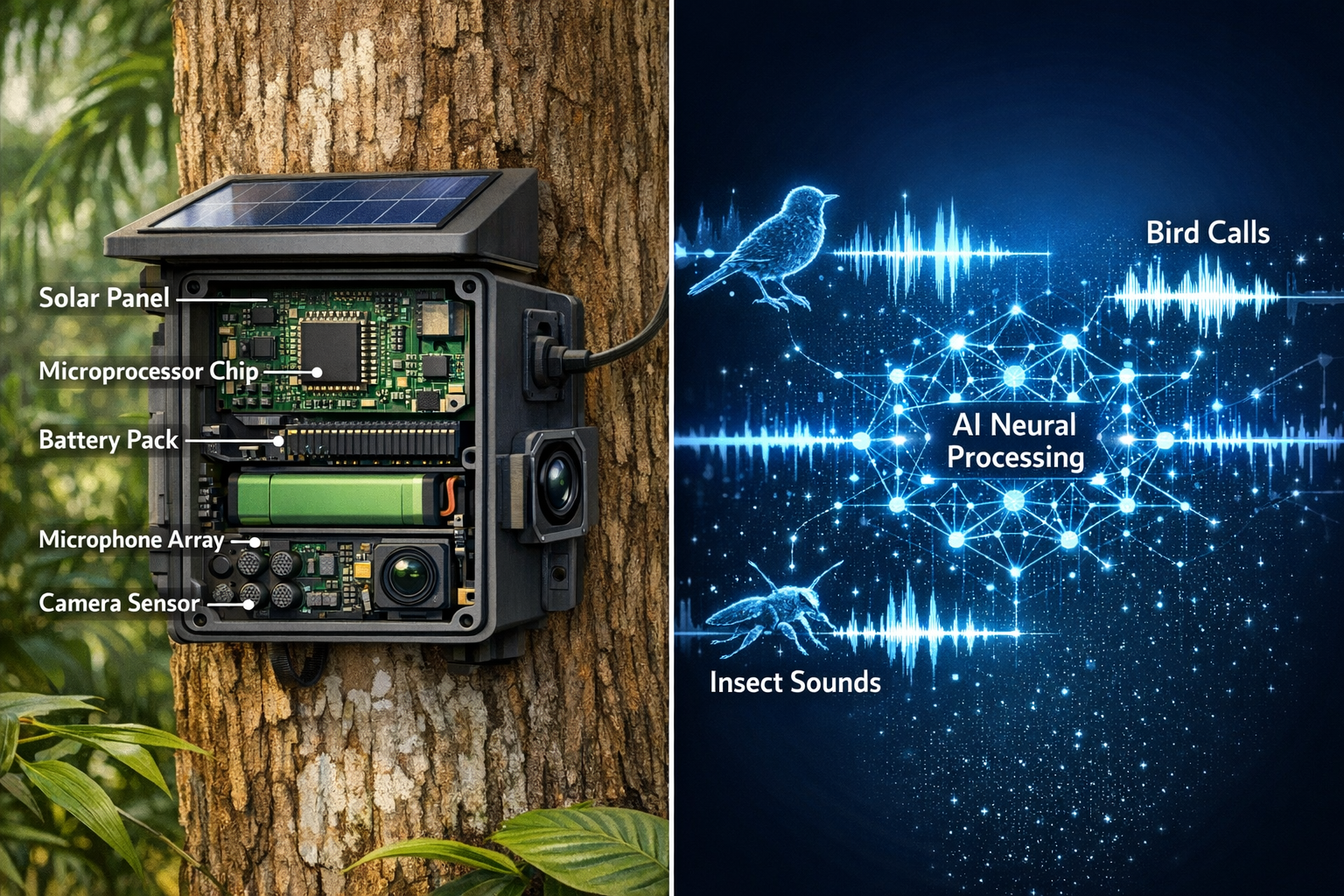
What Makes TinyML Different from Traditional AI?
TinyML (Tiny Machine Learning) represents a breakthrough in artificial intelligence deployment. Unlike conventional AI systems that rely on powerful servers and constant internet connectivity, TinyML compresses machine learning models to run on microcontrollers with severely limited memory and processing power. These devices typically operate on milliwatts of energy—roughly equivalent to a hearing aid battery.[2]
For biodiversity surveyors, this distinction matters enormously. Traditional camera traps and acoustic recorders capture vast amounts of data that must be retrieved manually or transmitted to cloud servers for analysis. TinyML devices, by contrast, analyze data on-site and store only relevant detections, reducing both data volume and energy consumption by orders of magnitude.[2]
Optical AI chips complement TinyML by processing visual information with minimal energy requirements. These specialized processors can identify species from images or video without the computational overhead of traditional computer vision systems.[1][4]
Core Capabilities Relevant to Field Surveyors
TinyML systems deployed for biodiversity monitoring can perform several critical functions:
- Bioacoustic species identification: Recognizing bird calls, bat echolocation, frog choruses, and mammal vocalizations
- Visual species detection: Identifying animals captured by camera sensors using optical AI
- Threat detection: Recognizing chainsaw noise, vehicle sounds, or gunshots that indicate poaching or illegal logging[2]
- Environmental monitoring: Tracking temperature, humidity, soil conditions, and water quality
- Disease surveillance: Detecting disease-transmitting organisms or monitoring crop health[3][4]
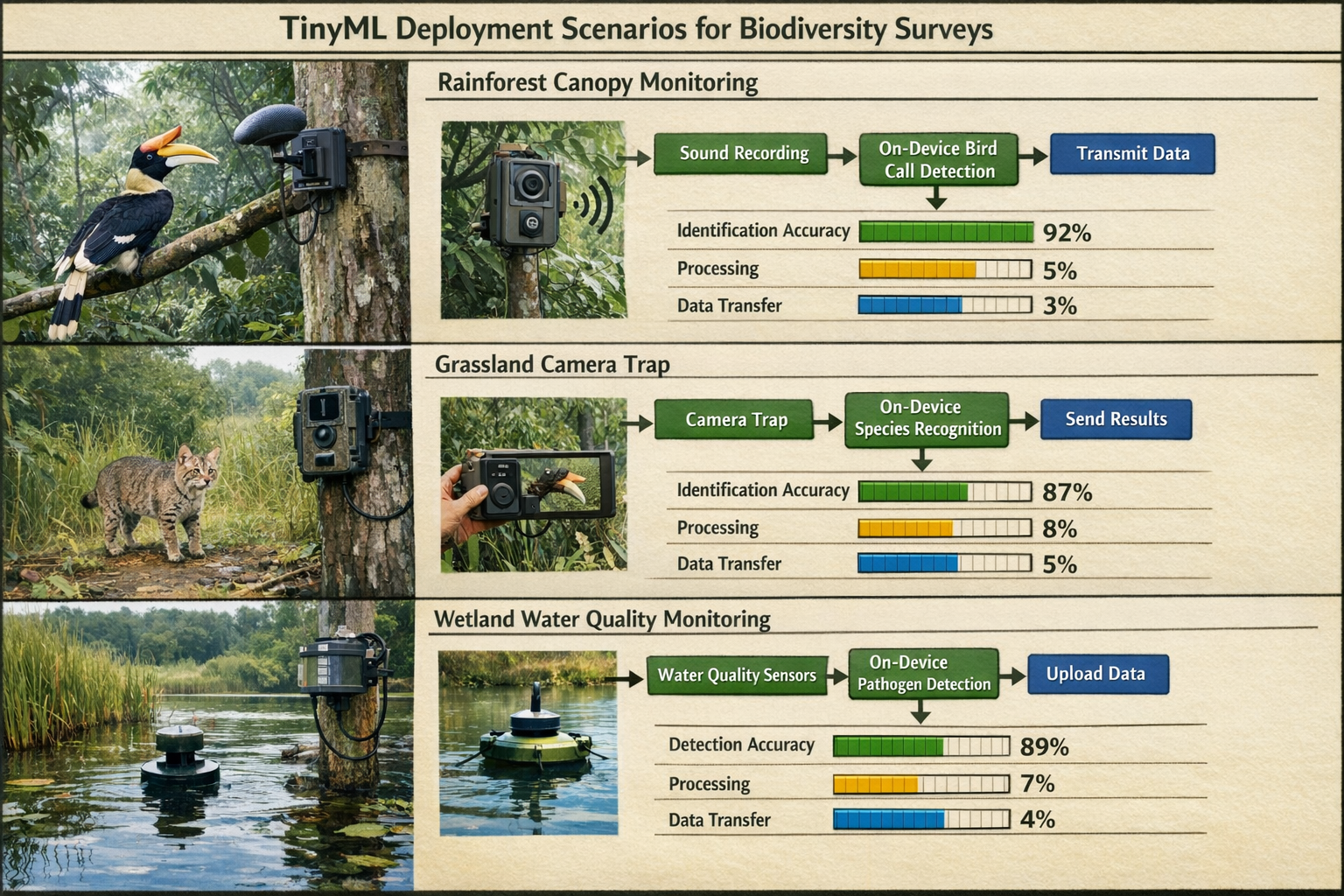
The technology has already demonstrated impressive results. In Malaysian forests, TinyML models successfully identified hornbill calls with high accuracy on edge devices, providing crucial data for conservation of these threatened species facing habitat loss and poaching pressure.[2]
Technical Specifications Surveyors Should Know
Understanding the technical parameters helps surveyors make informed deployment decisions:
| Specification | TinyML Devices | Traditional Systems |
|---|---|---|
| Power consumption | 1-100 milliwatts | 1-10 watts |
| Battery life | Months to years | Days to weeks |
| Internet required | No | Usually yes |
| Data storage | Limited (kilobytes to megabytes) | Extensive (gigabytes to terabytes) |
| Processing location | On-device (edge) | Cloud servers |
| Response time | Real-time (milliseconds) | Delayed (minutes to hours) |
| Deployment complexity | Low | Moderate to high |
These specifications translate directly to practical advantages when conducting biodiversity impact assessments in challenging environments.
How TinyML and AI Tools Are Revolutionizing Biodiversity Surveys in 2026
Real-Time Detection in Remote Landscapes
The most transformative aspect of TinyML and AI Tools Revolutionizing Biodiversity Surveys in 2026: A Practical Guide for Surveyors lies in their ability to deliver immediate results without infrastructure dependencies. Traditional biodiversity surveys often involve deploying recording equipment, waiting weeks or months, retrieving devices, and spending additional weeks analyzing data. By the time results arrive, ecological conditions may have changed significantly.
TinyML eliminates this delay. When a device detects a target species or environmental event, it can:
- Log the detection instantly with timestamp and confidence score
- Trigger alerts (if equipped with low-power communication modules)
- Activate additional sensors for detailed recording only when needed
- Adjust monitoring parameters based on detection patterns
This real-time capability improves the evidence base for conservation decisions while reducing reliance on continuous data transmission.[1] For surveyors working on time-sensitive projects—such as those requiring biodiversity net gain assessments—this acceleration can be project-defining.
Autonomous Operation in Harsh Conditions
Biodiversity hotspots rarely coincide with areas of reliable infrastructure. Tropical rainforests, remote wetlands, mountain ecosystems, and oceanic environments present severe challenges for traditional monitoring equipment. TinyML devices work independently without stable internet or electrical infrastructure, operating on batteries or solar power for extended periods.[2][3]
Consider these deployment scenarios:
🌊 Marine environments: Waterproof TinyML sensors monitor coral reef sounds, detecting fish populations and ecosystem health without underwater cables or frequent retrieval
🏔️ Mountain ecosystems: Solar-powered devices track alpine species across elevation gradients where grid power is nonexistent
🌴 Tropical forests: Canopy-mounted sensors identify endangered species calls while withstanding extreme humidity and temperature fluctuations
🏜️ Arid landscapes: Low-power devices monitor desert biodiversity during rare rainfall events, capturing ephemeral ecological phenomena
This autonomy enables surveyors to establish monitoring networks at scales previously impractical, covering entire landscapes rather than isolated sample points.
Energy and Cost Efficiency
The financial implications of TinyML deployment deserve careful consideration. While initial device costs may seem comparable to traditional equipment, the operational cost advantages become substantial over time:
Energy savings: TinyML devices consume 100-1000 times less power than traditional systems, dramatically reducing battery replacement frequency and solar panel size requirements.[2]
Data transmission costs: By processing data locally and transmitting only detections rather than raw recordings, TinyML systems can reduce data costs by 90% or more.
Labor efficiency: Reduced need for manual data retrieval and processing frees surveyor time for analysis and strategic planning.
Scalability: Lower per-device operational costs enable larger monitoring networks within fixed budgets.
For organizations managing biodiversity credits or implementing 10% biodiversity net gain requirements, these cost efficiencies can significantly improve project economics.
Multi-Functional Monitoring Capabilities
Modern TinyML devices transcend single-purpose monitoring. A well-designed deployment can simultaneously:
- Track target species through acoustic or visual identification
- Detect illegal activities by recognizing chainsaw sounds or unauthorized vehicles[2]
- Monitor environmental conditions affecting habitat quality
- Assess ecosystem health through biodiversity indices calculated on-device
- Identify emerging threats such as invasive species or disease vectors[3][4]
This multi-functionality transforms TinyML nodes from simple sensors into comprehensive biodiversity intelligence platforms, providing surveyors with holistic ecosystem insights rather than isolated data points.
Practical Implementation Guide for Biodiversity Surveyors
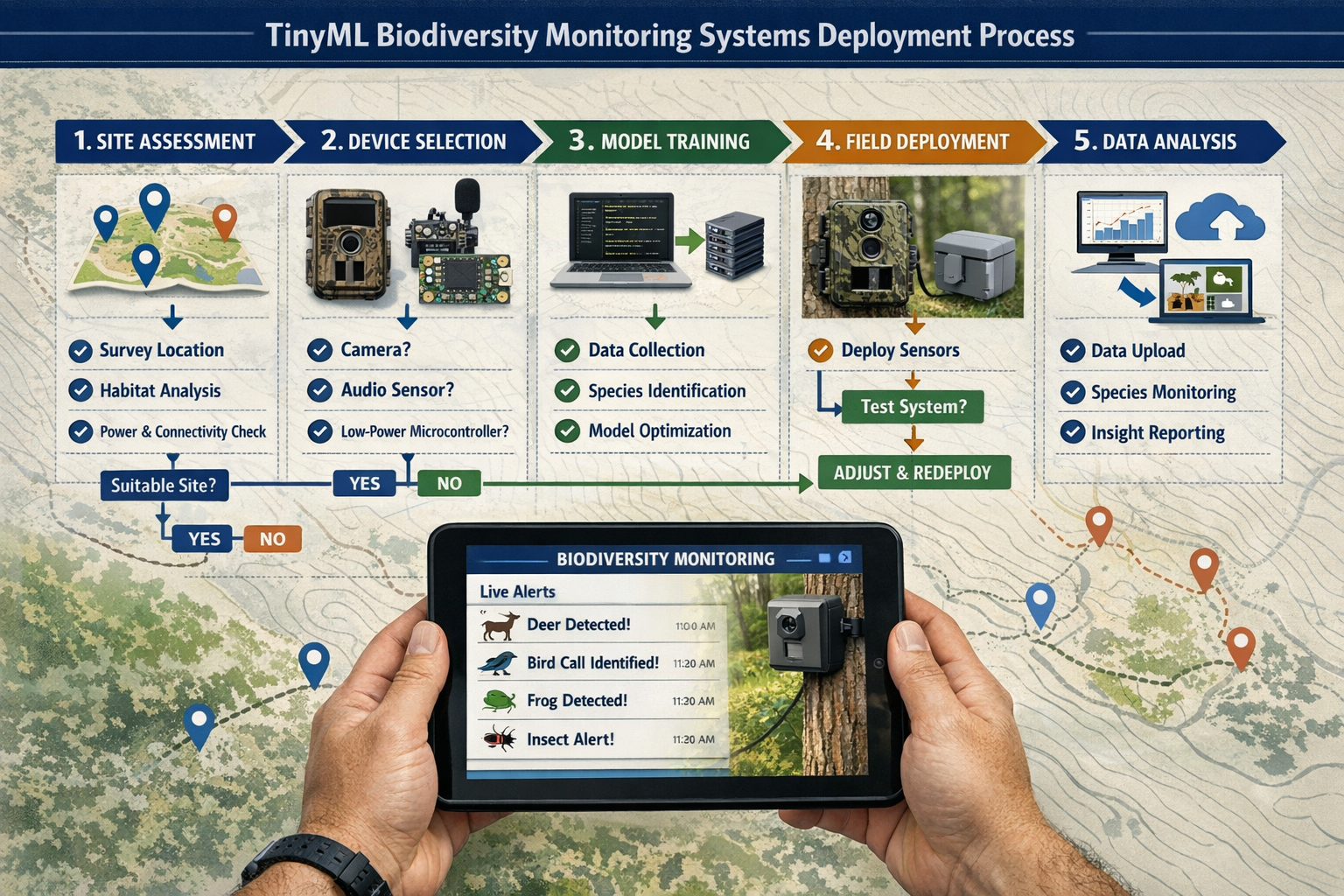
Step 1: Define Monitoring Objectives and Target Species
Successful TinyML deployment begins with clear objectives. Unlike traditional surveys that capture everything and sort later, TinyML systems require upfront specification of target species, behaviors, or environmental conditions.
Key questions to address:
- Which species or species groups require monitoring?
- What detection accuracy is acceptable for project goals?
- How frequently should detections occur to meet statistical requirements?
- What temporal patterns matter (daily, seasonal, annual)?
- Are there specific threats or illegal activities to monitor?
For projects involving biodiversity impact assessments, align TinyML objectives with regulatory requirements and baseline data needs.
Step 2: Select Appropriate Hardware and Sensors
TinyML hardware selection depends on monitoring objectives, environmental conditions, and budget constraints.
Primary sensor types:
🎤 Acoustic sensors: Ideal for birds, bats, amphibians, insects, and illegal activity detection. Consider microphone frequency response, weatherproofing, and directional vs. omnidirectional patterns.
📷 Camera sensors: Essential for visual species identification, behavioral observation, and activity pattern analysis. Evaluate resolution, infrared capability, trigger mechanisms, and power consumption.
🌡️ Environmental sensors: Temperature, humidity, soil moisture, water quality, and air quality sensors provide context for biological observations.
Processing platforms:
Common TinyML platforms include Arduino-based systems, Raspberry Pi Pico, ESP32 microcontrollers, and specialized biodiversity monitoring devices. Each offers different balances of processing power, energy efficiency, and ease of programming.
Step 3: Develop or Acquire AI Models
TinyML requires trained machine learning models optimized for microcontroller deployment. Surveyors have several options:
Option A: Use pre-trained models
Many conservation organizations and research institutions now share TinyML models for common species. The hornbill detection models deployed in Malaysia demonstrate this approach's viability.[2]
Option B: Train custom models
For unique species or specific detection requirements, custom model training may be necessary. This requires:
- Collecting representative audio or image samples
- Labeling data accurately
- Training models using TinyML frameworks (TensorFlow Lite, Edge Impulse)
- Optimizing models for microcontroller constraints
- Validating accuracy in field conditions
Option C: Hybrid approach
Start with pre-trained models and fine-tune them with local data for improved accuracy in specific habitats.
Step 4: Plan Deployment Strategy
Strategic device placement maximizes detection probability while minimizing deployment costs.
Spatial considerations:
- Habitat representation: Ensure devices cover key habitat types and gradients
- Species behavior: Position sensors where target species are most active
- Accessibility: Balance remote placement with maintenance requirements
- Environmental exposure: Protect devices from extreme weather while maintaining sensor effectiveness
Temporal considerations:
- Survey duration: Determine minimum monitoring period for statistical validity
- Seasonal coverage: Plan deployments to capture seasonal variations in species activity
- Battery life: Calculate power budgets and schedule maintenance intervals
Network design:
- Standalone nodes: Independent devices storing data locally
- Mesh networks: Devices sharing data through low-power communication
- Gateway systems: TinyML nodes feeding data to central collection points
For developers working on biodiversity plans, coordinate TinyML deployment with construction timelines and regulatory milestones.
Step 5: Deploy and Configure Devices
Field deployment requires careful attention to technical details and environmental factors.
Installation best practices:
- Weatherproofing: Use appropriate enclosures rated for expected conditions
- Mounting stability: Ensure devices remain secure through storms and animal interactions
- Sensor orientation: Position microphones and cameras for optimal detection
- Power systems: Install solar panels at appropriate angles; use battery types suited to temperature ranges
- Configuration verification: Test detection functionality before leaving sites
Documentation requirements:
- GPS coordinates with precision appropriate to project needs
- Habitat descriptions and photographs
- Device serial numbers and configuration parameters
- Installation dates and surveyor identities
- Any observed species or environmental conditions during installation
Step 6: Data Collection and Quality Control
TinyML systems require different data management approaches than traditional surveys.
On-device data management:
- Storage capacity monitoring: Track available memory and plan retrieval schedules
- Data formats: Understand how devices store detections (timestamps, confidence scores, metadata)
- Backup systems: Implement redundancy for critical monitoring locations
Quality assurance protocols:
- False positive assessment: Regularly validate detection accuracy against manual review
- Detection probability: Calculate and report detection rates for target species
- System health monitoring: Track battery levels, sensor functionality, and environmental conditions
- Calibration verification: Ensure sensors maintain accuracy over deployment periods
Data retrieval options:
- Manual collection: Physical device retrieval for data download
- Remote transmission: Low-power wireless protocols (LoRaWAN, cellular) for periodic uploads
- Hybrid approaches: TinyML processing with selective transmission of high-priority detections
Step 7: Analysis and Reporting
TinyML data requires specialized analysis approaches that account for both technological capabilities and limitations.
Analytical considerations:
📊 Detection histories: Compile species presence/absence and activity patterns over time
📈 Occupancy modeling: Use detection/non-detection data to estimate site occupancy while accounting for imperfect detection
🗺️ Spatial analysis: Map species distributions and identify habitat associations
⏰ Temporal patterns: Analyze daily, seasonal, and annual activity rhythms
⚠️ Threat assessment: Quantify illegal activity patterns and conservation risks
Reporting frameworks:
Align TinyML results with established biodiversity reporting standards. For UK projects, ensure compatibility with biodiversity net gain requirements and statutory reporting obligations.
Challenges and Limitations Surveyors Must Address
Data Storage and Retrospective Analysis Constraints
One significant drawback of TinyML systems is that data produced may not be usable in retrospective analyses.[3] Traditional recording systems capture complete audio or video that can be reanalyzed as new questions emerge or identification techniques improve. TinyML devices, by contrast, typically store only detection events—not raw data.
Mitigation strategies:
- Hybrid recording: Configure devices to save short audio/video clips around detections
- Selective archiving: Trigger full recording for rare species or unusual events
- Complementary surveys: Combine TinyML monitoring with periodic traditional surveys
- Clear documentation: Record model versions and parameters to enable future interpretation
Model Complexity and Accuracy Limitations
TinyML faces restrictions in model complexity, data storage, and system sustainability.[2] The same constraints that enable low-power operation also limit the sophistication of AI models that can run on microcontrollers.
Practical implications:
- Species discrimination: Distinguishing closely-related species may require more complex models than TinyML can support
- Environmental variability: Models trained in one habitat may perform poorly in different conditions
- Rare species detection: Limited training data for endangered species can reduce accuracy
- Novel situations: TinyML models may struggle with scenarios not represented in training data
Addressing limitations:
- Set realistic accuracy expectations based on model testing
- Implement confidence thresholds to balance false positives and false negatives
- Use ensemble approaches combining multiple models
- Conduct regular validation against expert identification
Equity and Accessibility Considerations
Ensuring TinyML technologies work for a wide range of users—including communities with limited digital infrastructure—remains central to equitable benefit sharing.[1] Questions around transparency, data access, and energy demand require thoughtful consideration.
Equity challenges:
- Technical expertise requirements: Model training and device programming may exclude some users
- Cost barriers: Initial investment in hardware and training
- Data ownership: Clarifying rights to data collected on community lands
- Benefit sharing: Ensuring local communities gain from biodiversity monitoring on their territories
Promoting accessibility:
- Develop user-friendly interfaces requiring minimal technical knowledge
- Create open-source models and tools reducing cost barriers
- Establish clear data governance frameworks respecting community rights
- Provide training and capacity building for diverse user groups
- Design culturally appropriate deployment approaches
Real-World Applications and Case Studies
Hornbill Conservation in Malaysian Forests
The successful deployment of TinyML for hornbill call identification in Malaysia demonstrates the technology's conservation potential.[2] Hornbills face severe threats from habitat loss and poaching, making accurate population monitoring essential for conservation planning.
TinyML acoustic sensors deployed in forest canopies identified hornbill calls with high accuracy while operating for months on solar power. The system provided conservationists with real-time alerts about hornbill presence, enabling rapid response to poaching threats and detailed mapping of habitat use patterns.
Key success factors:
- Species-specific model training using local hornbill vocalizations
- Strategic sensor placement in known hornbill territories
- Integration with anti-poaching patrol routes
- Community engagement in device monitoring and maintenance
Anti-Poaching and Illegal Logging Detection
Conservation teams worldwide now embed TinyML models into sound- and image-sensing nodes to recognize chainsaw noise or detect unauthorized vehicle movement.[2] Unlike continuous recording systems that generate massive data volumes requiring manual review, TinyML devices trigger alerts only when specific patterns occur.
This approach dramatically reduces false positives and battery drain while enabling faster response to illegal activities. In several protected areas, TinyML-based threat detection has reduced response times from days to hours, significantly improving enforcement effectiveness.
Multi-Threat Monitoring in Agricultural Landscapes
TinyML devices deployed in agricultural settings demonstrate the technology's versatility by simultaneously monitoring:
- Pollinator activity: Identifying bee and butterfly species supporting crop production
- Pest detection: Recognizing insect sounds or visual signatures indicating pest outbreaks
- Disease surveillance: Detecting disease-transmitting organisms[3][4]
- Crop health: Monitoring plant stress through multispectral imaging
- Wildlife conflicts: Identifying large mammals approaching crops
This multi-functional approach provides farmers and conservationists with comprehensive ecosystem intelligence supporting both agricultural productivity and biodiversity conservation.
Future Developments and Emerging Opportunities
Integration with Biodiversity Net Gain Frameworks
As biodiversity net gain requirements expand across jurisdictions, TinyML offers powerful tools for long-term monitoring and verification. Developers implementing on-site or off-site biodiversity net gain can use TinyML networks to:
- Document baseline biodiversity before development
- Monitor species responses to habitat creation or enhancement
- Verify achievement of biodiversity targets over time
- Provide transparent evidence for regulatory compliance
The real-time monitoring capability addresses a critical gap in current net gain frameworks, which often rely on infrequent manual surveys that may miss important ecological dynamics.
Advances in Model Efficiency and Capability
Ongoing research continues to push the boundaries of what TinyML can achieve. Emerging developments include:
- Improved compression techniques: Enabling more sophisticated models on existing hardware
- Multi-modal sensing: Combining acoustic, visual, and environmental data for enhanced accuracy
- Federated learning: Allowing devices to improve models through shared learning without transmitting raw data
- Energy harvesting innovations: Extending deployment durations through improved solar panels and kinetic energy capture
Expansion to Marine and Freshwater Ecosystems
While early TinyML biodiversity applications focused on terrestrial environments, marine and freshwater deployments represent significant growth opportunities. Underwater acoustic monitoring, reef health assessment, and freshwater species detection all benefit from TinyML's low-power, autonomous operation.
Integration with Citizen Science and Community Monitoring
TinyML's accessibility enables broader participation in biodiversity monitoring. Communities can deploy and maintain sensor networks, contributing to conservation while building local environmental awareness. This democratization of monitoring technology aligns with growing recognition of community-based conservation's importance.
Conclusion: Practical Next Steps for Surveyors
TinyML and AI Tools Revolutionizing Biodiversity Surveys in 2026: A Practical Guide for Surveyors represents more than technological innovation—it signals a fundamental shift in how ecology professionals can gather, analyze, and act on biodiversity data. The ability to deploy autonomous, real-time monitoring networks in remote landscapes without infrastructure dependencies opens possibilities that seemed impractical just years ago.
For surveyors ready to integrate TinyML into their practice, the path forward involves:
Immediate Actions
✅ Assess current projects for TinyML suitability—identify surveys where real-time detection, remote operation, or cost efficiency would provide significant advantages
✅ Explore existing models for target species in your region—leverage open-source resources before investing in custom model development
✅ Start small with pilot deployments—test TinyML capabilities on limited scales before committing to large networks
✅ Build technical capacity through training courses, online resources, and collaboration with experienced practitioners
✅ Engage stakeholders early—discuss TinyML capabilities and limitations with clients, regulators, and communities
Medium-Term Development
📚 Develop organizational expertise in model training, device configuration, and data analysis specific to TinyML systems
🤝 Establish partnerships with technology providers, research institutions, and conservation organizations advancing TinyML applications
📊 Create standardized protocols for TinyML deployment, data collection, and quality assurance aligned with professional standards
💰 Evaluate cost-benefit across project portfolios—identify where TinyML offers greatest return on investment
🌍 Contribute to knowledge sharing—document successes, failures, and lessons learned to advance the field
Long-Term Strategic Integration
The surveyors who thrive in coming years will be those who thoughtfully integrate TinyML capabilities while maintaining the ecological expertise and field skills that remain irreplaceable. TinyML doesn't eliminate the need for professional judgment—it amplifies surveyors' capacity to gather evidence, detect patterns, and inform conservation decisions.
As biodiversity faces unprecedented pressures from climate change, habitat loss, and human activity, the tools we use to understand and protect it must evolve. TinyML and optical AI represent that evolution—not as replacements for traditional methods, but as powerful complements that extend our reach, accelerate our insights, and ultimately strengthen our ability to conserve the natural world.
For those conducting biodiversity impact assessments or supporting developers in achieving biodiversity net gain, TinyML offers evidence-gathering capabilities that can transform project outcomes. The technology is ready. The question now is: are you prepared to deploy it?
References
[1] Whats Next For Biodiversity Conservation Insights From The 2026 Horizon Scan – https://www.unep-wcmc.org/en/news/whats-next-for-biodiversity-conservation-insights-from-the-2026-horizon-scan
[2] Tiny Machine Learning Tinyml In The Wild Offline Environmental Ai – https://www.ignitec.com/insights/tiny-machine-learning-tinyml-in-the-wild-offline-environmental-ai/
[3] New Conservation Opportunities And Obstacles In A New Year – https://www.pew.org/en/research-and-analysis/articles/2026/01/16/new-conservation-opportunities-and-obstacles-in-a-new-year
[4] Conservation Horizon Scan Ai Drought Climate Change Tropical Forests Seaweed Southern Ocean – https://www.theinvadingsea.com/2026/01/02/conservation-horizon-scan-ai-drought-climate-change-tropical-forests-seaweed-southern-ocean/