

A single bat species can emit over 200 echolocation calls per minute while hunting—yet traditional visual surveys miss 90% of nocturnal wildlife activity. This gap between what exists in nature and what surveyors document has driven the rapid adoption of Soundscape Ecology for Acoustic Biodiversity Monitoring: Tools and Protocols for 2026 Surveyors as an essential complement to conventional ecological assessment methods.
Passive acoustic monitoring (PAM) enables continuous, large-scale biodiversity monitoring across terrestrial, freshwater, and marine environments without disturbing natural systems[1]. For ecology professionals working in 2026, acoustic methods provide standardized observations in remote or inaccessible regions while capturing species that remain invisible to traditional survey techniques. This comprehensive guide explores the tools, protocols, and best practices that define modern acoustic biodiversity monitoring.
Key Takeaways
- Autonomous Recording Units (ARUs) now range from affordable DIY options to professional-grade systems, making acoustic monitoring accessible for projects of all scales
- Ecoacoustic indices provide rapid biodiversity assessment metrics, though they work best when combined with species-specific identification methods
- Machine learning and AI have transformed acoustic data analysis, enabling automatic species identification and large-scale pattern detection
- Standardized protocols for deployment, data management, and analysis are critical for producing reliable, comparable biodiversity data
- Integration with visual surveys creates comprehensive baseline assessments that support biodiversity net gain planning and conservation decision-making
Understanding Soundscape Ecology for Acoustic Biodiversity Monitoring
What Makes Acoustic Monitoring Essential?
Traditional ecological surveys rely heavily on visual observation during daylight hours. This approach systematically underrepresents:
🦇 Nocturnal species – Bats, owls, nightjars, and nocturnal mammals
🐸 Cryptic species – Small, camouflaged, or shy animals that avoid human presence
🦗 Invertebrates – Crickets, grasshoppers, and other sound-producing insects
🐦 Migratory birds – Species passing through during non-survey periods
Remote acoustic sensors enable non-invasive monitoring of species distribution, behavior, and population dynamics while also detecting illegal activities such as gunshots and chainsaw noise in conservation areas[4]. This capability makes acoustic monitoring particularly valuable for biodiversity impact assessments where comprehensive baseline data determines mitigation requirements.
The Acoustic Habitat Hypothesis
Sound environments influence habitat selection for species that depend on acoustic communication. The acoustic habitat hypothesis suggests that animals choose locations based partly on the acoustic properties of the environment[2]. For surveyors, this means:
- Background noise levels affect species presence and abundance
- Anthropogenic sound can mask important biological signals
- Acoustic niche partitioning reveals community structure
- Temporal patterns indicate habitat quality and disturbance levels
Understanding these relationships helps ecology professionals assess not just which species are present, but whether habitats support viable populations over time.
Essential Tools for Acoustic Biodiversity Monitoring in 2026
Autonomous Recording Units (ARUs)
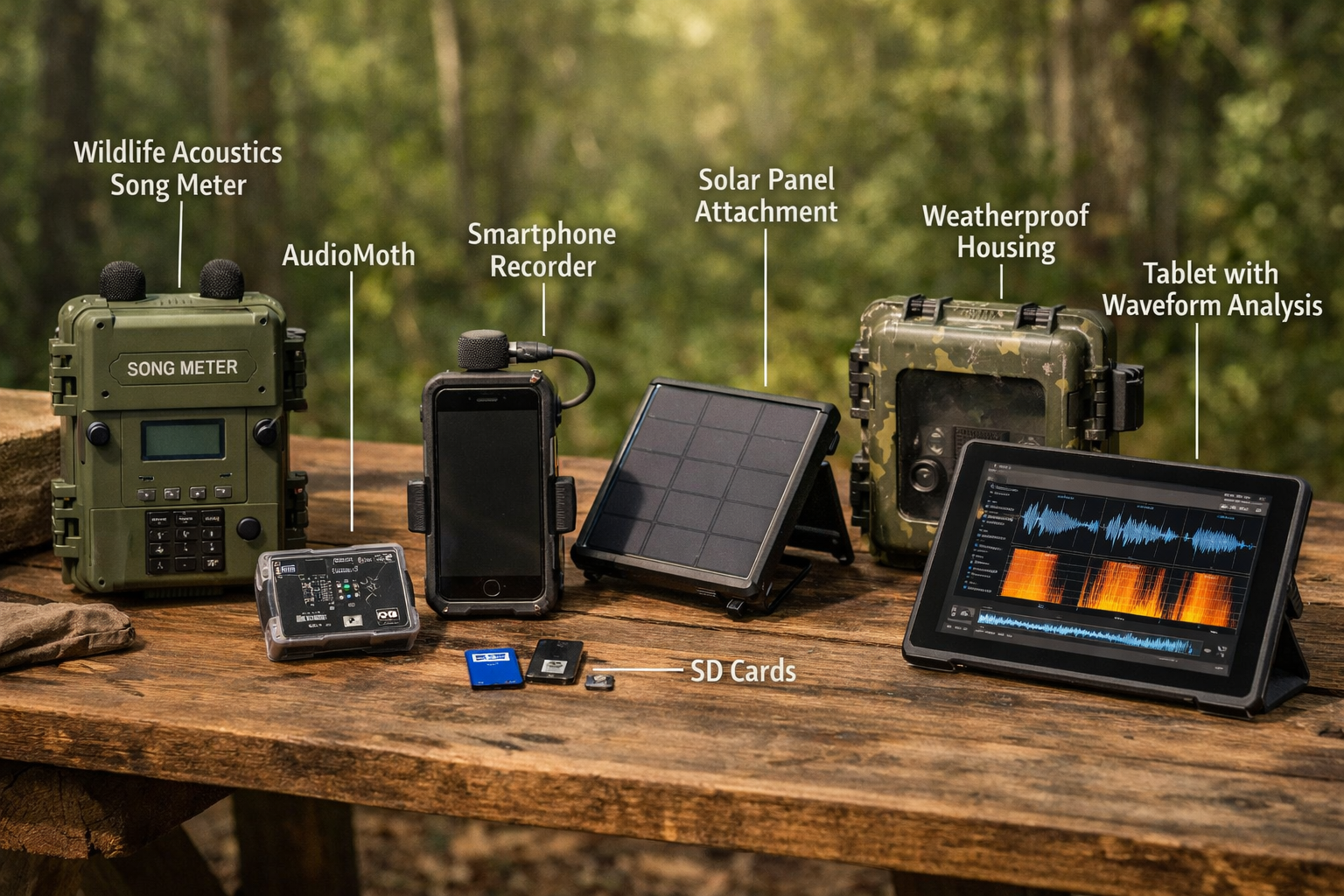
Autonomous Recording Units have become more affordable and accessible, with devices available from major manufacturers including Wildlife Acoustics, Frontier Labs, and Open Acoustic Devices, plus do-it-yourself and low-cost options expanding researcher access[2].
Professional-Grade Systems
Wildlife Acoustics Song Meter Series
- Full-spectrum recording (0-192 kHz)
- Extended battery life (weeks to months)
- Weatherproof housing for all conditions
- GPS timestamping and metadata
- Cost: £800-£2,500 per unit
Frontier Labs BAR Series
- Scheduled recording programs
- Ultra-low power consumption
- Remote configuration capability
- Integrated data management
- Cost: £600-£1,800 per unit
Budget-Friendly Options
AudioMoth (Open Acoustic Devices)
- Open-source design
- Simple configuration via smartphone
- Excellent cost-to-performance ratio
- Growing community support
- Cost: £50-£100 per unit
DIY Raspberry Pi Systems
- Customizable recording parameters
- Integration with other sensors
- Learning curve required
- Variable reliability
- Cost: £80-£200 per unit
Key Selection Criteria
When choosing equipment for Soundscape Ecology for Acoustic Biodiversity Monitoring: Tools and Protocols for 2026 Surveyors, consider:
| Factor | Considerations |
|---|---|
| Frequency Range | Birds: 1-12 kHz; Bats: 20-120 kHz; Full spectrum: 0-192 kHz |
| Recording Schedule | Continuous vs. triggered vs. scheduled sampling |
| Storage Capacity | 32-512 GB depending on recording duration and quality |
| Power Requirements | Battery life vs. solar options vs. mains power |
| Environmental Protection | IP rating, temperature range, moisture resistance |
| Data Retrieval | Manual collection vs. remote download capability |
Software Tools for Analysis
A growing but fragmented software tool landscape exists for PAM workflows, covering data management, signal pre-processing, visualization/navigation, and acoustic analysis[1].
Essential Software Categories:
📊 Data Management
- Kaleidoscope Pro (Wildlife Acoustics)
- Raven Pro (Cornell Lab of Ornithology)
- PAMGuard (open-source)
🔍 Species Identification
- BirdNET (automated bird identification)
- Bat Classify (machine learning for bat calls)
- Timelapse (image and audio annotation)
📈 Acoustic Analysis
- soundecology (R package for indices)
- seewave (R package for signal analysis)
- Arbimon (cloud-based platform)
Machine learning and AI technologies are advancing species identification and source separation, enabling automatic screening of recordings for specific species and extraction of meaningful acoustic habitat information[2].
Protocols for Effective Acoustic Biodiversity Surveys
Survey Design Principles
Spatial Coverage
Effective acoustic monitoring requires strategic placement that balances coverage with practical constraints:
- Minimum density: 1 recorder per 5-10 hectares for detailed assessment
- Habitat representation: Units in each distinct habitat type
- Edge effects: Recorders at habitat boundaries capture transition zones
- Access considerations: Balance optimal placement with retrieval logistics
Temporal Coverage
Different species are active at different times, requiring thoughtful scheduling:
🌅 Dawn chorus (30 minutes before sunrise to 2 hours after)
- Peak bird vocalization period
- High species detection rates
- Critical for breeding season surveys
🌙 Nocturnal periods (sunset to sunrise)
- Bat activity peaks 1-3 hours after sunset
- Owl and nightjar surveys
- Mammal vocalizations
🌳 24-hour sampling (continuous or scheduled)
- Captures full community composition
- Reveals temporal niche partitioning
- Generates large datasets requiring efficient analysis
Deployment Best Practices
Equipment Setup
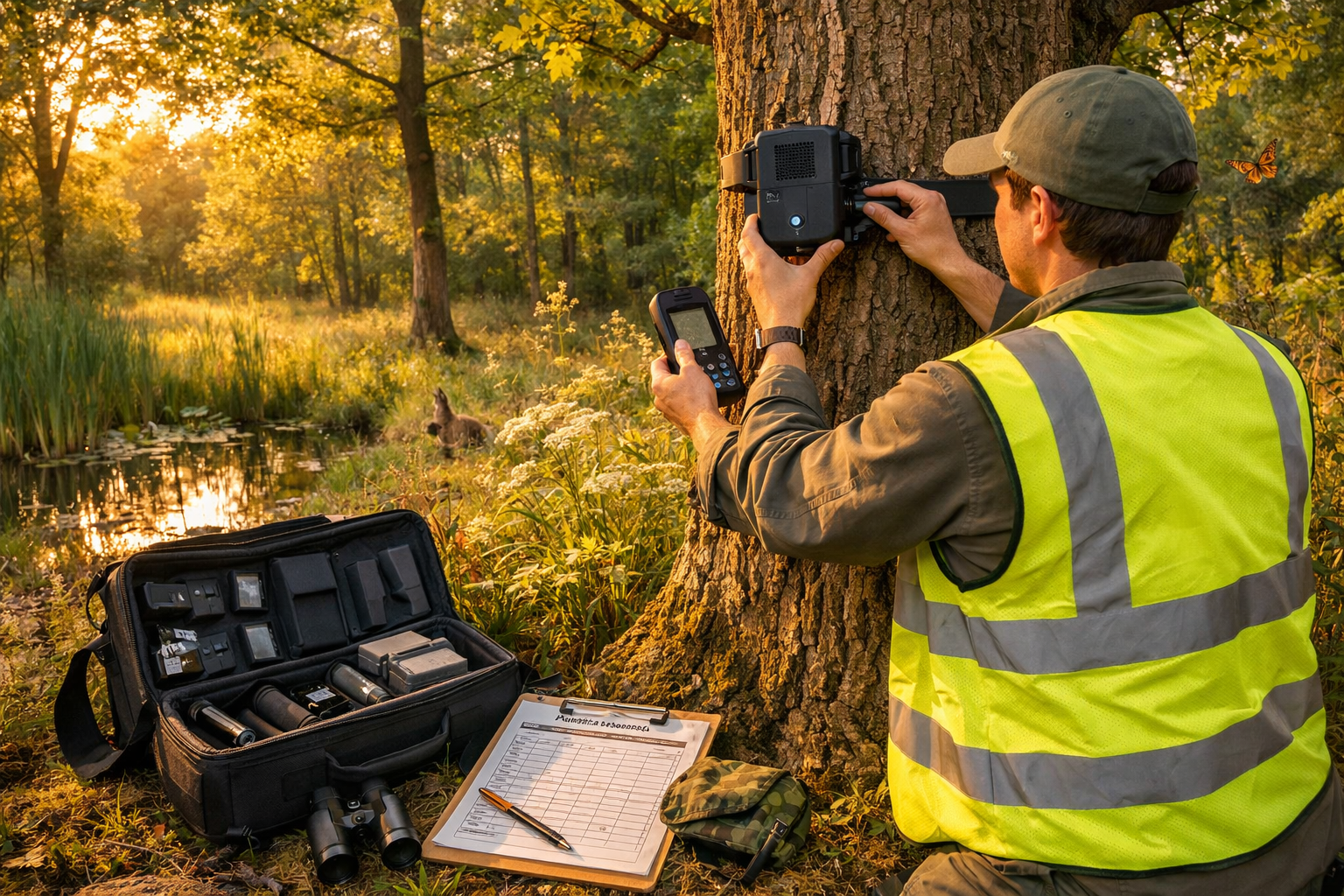
- Height placement: 1.5-2 meters for terrestrial species; higher for canopy species
- Microphone orientation: Away from prevailing winds; toward target habitats
- Obstruction clearance: Minimum 3 meters from dense vegetation
- Weather protection: Ensure seals are intact; check desiccant packets
- Security measures: Camouflage housing; use security cables in public areas
Metadata Recording
Document these critical details at each deployment:
- GPS coordinates (±5 meter accuracy)
- Habitat description and photos
- Microphone height and orientation
- Date, time, and surveyor name
- Weather conditions
- Nearby noise sources
- Equipment settings and serial numbers
This information proves essential when interpreting results and supports biodiversity net gain assessments that require detailed baseline documentation.
Data Collection Standards
Recording Parameters
| Parameter | Recommended Setting | Rationale |
|---|---|---|
| Sample Rate | 48 kHz (birds); 256 kHz (bats) | Captures target frequency ranges |
| Bit Depth | 16-bit minimum | Balances quality with file size |
| File Format | WAV (uncompressed) | Preserves full acoustic information |
| File Duration | 1-5 minute segments | Manageable file sizes for analysis |
| Duty Cycle | 10 min/hour or continuous | Depends on survey objectives |
Quality Control Checks
Before leaving the deployment site:
✅ Record test file and verify playback
✅ Check battery voltage levels
✅ Confirm GPS signal acquisition
✅ Verify clock synchronization
✅ Test weatherproofing seals
✅ Document deployment in field notes
Ecoacoustic Indices for Rapid Assessment
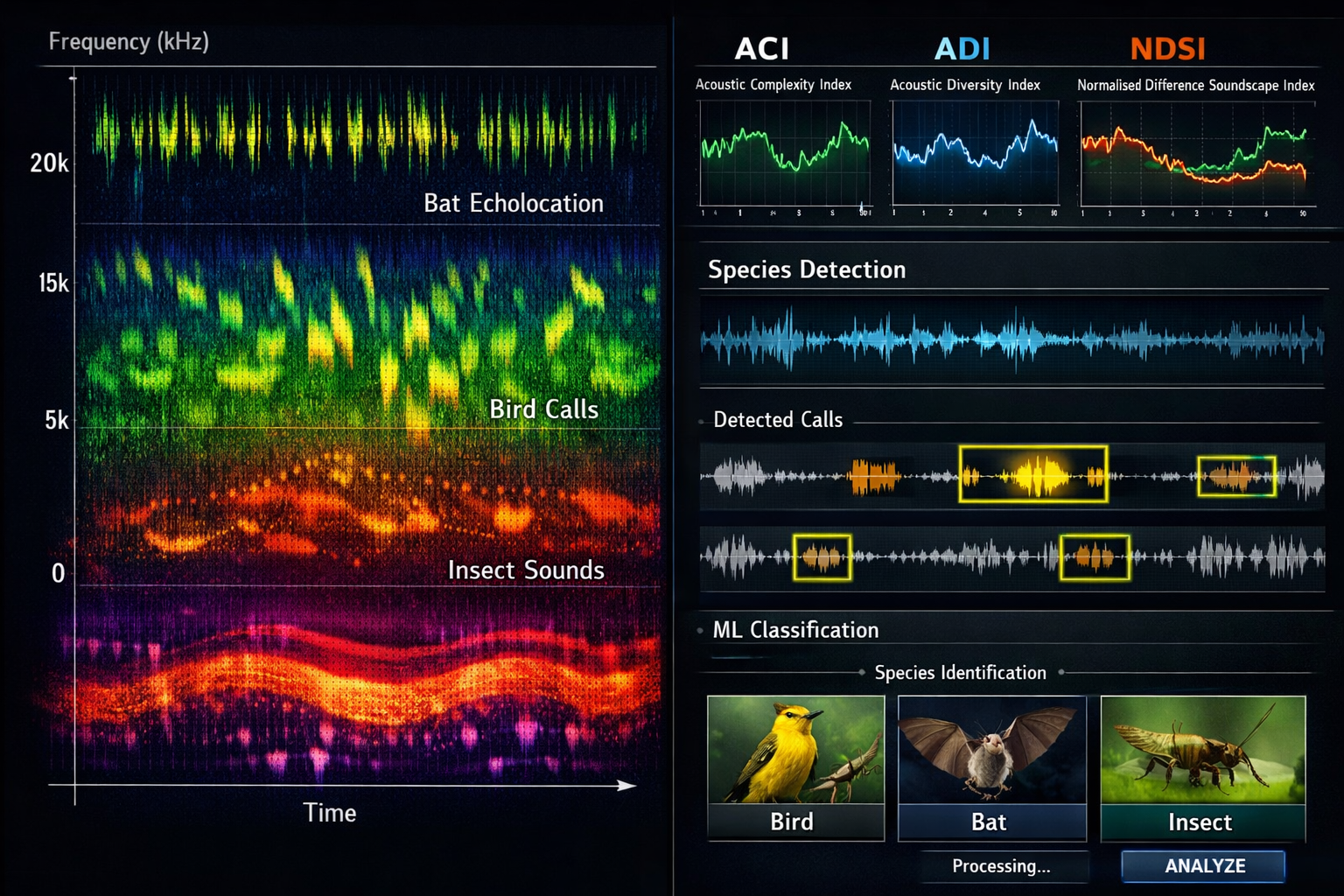
Ecoacoustic indices including Acoustic Complexity Index (ACI), Acoustic Diversity Index (ADI), Acoustic Evenness Index (AEI), Bioacoustic Index (BI), and Normalized Difference Soundscape Index (NSDI) are used to assess biodiversity and anthropogenic disturbances, though their reliability remains debated[2].
Common Indices Explained:
🔊 Acoustic Complexity Index (ACI)
- Measures temporal variability in recordings
- Higher values suggest more complex soundscapes
- Sensitive to biophony (biological sounds)
🎵 Acoustic Diversity Index (ADI)
- Calculates diversity across frequency bands
- Based on Shannon diversity formula
- Indicates acoustic niche utilization
⚖️ Acoustic Evenness Index (AEI)
- Measures evenness of sound distribution
- Low values indicate dominance by single sources
- Complements ADI for community assessment
🌿 Normalized Difference Soundscape Index (NDSI)
- Ratio of biophony to anthrophony
- Ranges from -1 (all human noise) to +1 (all biological)
- Useful for disturbance assessment
Critical Limitations:
While indices provide rapid assessment capabilities, they should not replace species-specific identification. Environmental noise, weather conditions, and recording equipment differences all affect index values. Use indices as screening tools, then conduct detailed analysis on recordings of interest.
Data Analysis and Species Identification
Processing Workflows
Step 1: Data Organization
- Create standardized folder structures (site/date/time)
- Rename files with consistent conventions
- Back up raw data before processing
- Generate metadata spreadsheets
Step 2: Quality Filtering
- Remove recordings with equipment malfunction
- Flag files with excessive wind or rain noise
- Identify periods of human disturbance
- Document quality issues for reporting
Step 3: Initial Screening
Use automated tools to identify recordings containing target species or high biodiversity indicators. This reduces manual review time by 70-90%.
Step 4: Manual Verification
Expert review remains essential for:
- Confirming automated identifications
- Identifying rare or unusual species
- Distinguishing similar calls
- Assessing behavior (breeding, foraging, alarm)
Machine Learning Applications
Machine learning and AI technologies have revolutionized acoustic monitoring by enabling automatic screening of recordings for specific species[2]. In 2026, surveyors can access:
Pre-trained Models
- BirdNET: 6,000+ bird species globally
- Bat Detect: European and North American bats
- Frog ID: Regional amphibian call libraries
Custom Model Development
- Training datasets from local recordings
- Transfer learning from existing models
- Species-specific classifiers for rare taxa
- Continuous improvement as data accumulates
Performance Expectations
Current AI systems achieve:
- 85-95% accuracy for common species with clear calls
- 60-80% accuracy for cryptic or similar species
- 40-70% accuracy in noisy environments
- Continuous improvement through active learning
Always validate AI results with expert review, especially for rare species or critical conservation decisions.
Integration with Traditional Survey Methods
Complementary Approaches
Soundscape Ecology for Acoustic Biodiversity Monitoring: Tools and Protocols for 2026 Surveyors works best when integrated with visual surveys, camera traps, and habitat assessments. This multi-method approach:
- Validates acoustic detections through visual confirmation
- Captures non-vocal species missed by acoustic methods
- Documents habitat condition affecting species presence
- Provides comprehensive baseline data for biodiversity net gain requirements
Supporting Development Projects
For developers navigating biodiversity net gain obligations, acoustic monitoring offers:
Pre-development Benefits:
- Year-round species inventory
- Detection of protected species
- Baseline acoustic environment documentation
- Evidence for planning applications
Post-development Applications:
- Monitoring mitigation effectiveness
- Tracking habitat recovery
- Demonstrating compliance
- Adaptive management feedback
Projects requiring biodiversity credits benefit from acoustic data demonstrating habitat quality improvements over time.
Addressing Current Challenges
Standardization Needs
Critical challenges persist in soundscape monitoring: standardized data collection methods remain absent, data processing and security issues are unresolved, and equipment costs continue to limit widespread adoption[2].
Priority Standardization Areas:
- Recording protocols – Consistent parameters across projects
- Metadata standards – Interoperable data formats
- Quality assurance – Validation procedures and benchmarks
- Data sharing – Repositories and access protocols
- Reporting formats – Consistent presentation of results
Data Management Solutions
Large acoustic datasets (often terabytes per project) require robust management:
Storage Strategy:
- Local backup on external drives
- Cloud storage for processed data
- Archive systems for long-term retention
- Documented file organization
Security Considerations:
- Encrypted storage for sensitive locations
- Access controls for proprietary data
- Compliance with data protection regulations
- Clear data sharing agreements
Cost-Benefit Optimization
While equipment costs have decreased, comprehensive acoustic monitoring still requires investment. Optimize budgets by:
💰 Starting small – Pilot projects with 3-5 units
💰 Mixing equipment tiers – Professional units at key sites; budget units for spatial coverage
💰 Leveraging open-source tools – Free software for analysis
💰 Collaborative approaches – Shared equipment pools among consultancies
💰 Phased deployment – Expand monitoring as budgets allow
Future Directions for 2026 and Beyond
Emerging Technologies
Real-time Monitoring
- Cellular-enabled ARUs transmit data continuously
- Immediate alerts for protected species detection
- Live dashboards for project stakeholders
- Adaptive survey adjustments based on results
Sensor Integration
- Combined acoustic-visual systems
- Environmental sensors (temperature, humidity)
- Weather stations for context
- Multi-modal AI analysis
Edge Computing
- On-device species identification
- Reduced data transmission requirements
- Faster results delivery
- Privacy-preserving processing
Regulatory Developments
As acoustic monitoring becomes mainstream, expect:
- Inclusion in standard ecological survey guidelines
- Specific requirements for protected species assessments
- Integration with biodiversity net gain frameworks
- Quality standards for acoustic consultancy services
Conclusion
Soundscape Ecology for Acoustic Biodiversity Monitoring: Tools and Protocols for 2026 Surveyors represents a fundamental expansion of ecological assessment capabilities. By capturing nocturnal, cryptic, and elusive species that traditional methods miss, acoustic monitoring provides the comprehensive biodiversity data essential for conservation planning, development projects, and regulatory compliance.
The technology has matured significantly, with accessible equipment options, powerful analysis software, and proven protocols now available to ecology professionals. While challenges around standardization and data management persist, the benefits of continuous, non-invasive monitoring far outweigh the implementation hurdles.
Actionable Next Steps
For Ecology Consultancies:
- Invest in pilot equipment – Start with 3-5 ARUs matched to typical project needs
- Develop internal protocols – Standardize deployment, retrieval, and analysis procedures
- Train staff – Build acoustic identification skills and software proficiency
- Integrate with existing services – Combine acoustic and visual survey offerings
- Communicate value to clients – Demonstrate how acoustic data strengthens biodiversity assessments
For Individual Surveyors:
- Build identification skills – Practice with online call libraries and training courses[5]
- Gain software proficiency – Learn key analysis platforms (Raven, Kaleidoscope, R packages)
- Understand limitations – Know when acoustic methods complement vs. replace traditional surveys
- Stay current – Follow developments in AI identification and ecoacoustic research[6]
- Network with specialists – Join acoustic monitoring communities and working groups
The acoustic revolution in biodiversity monitoring is here. Surveyors who embrace these tools and protocols position themselves at the forefront of ecological assessment, delivering more comprehensive, reliable, and valuable data to support conservation and sustainable development in 2026 and beyond.
References
[1] 15 48 – https://f1000research.com/articles/15-48
[2] academic.oup – https://academic.oup.com/jue/article/11/1/juaf002/8088407
[3] Ecosystem Biodiversity Or Soundscape Monitoring – https://www.wildlifeacoustics.com/solutions/ecosystem-biodiversity-or-soundscape-monitoring
[4] Acoustic Monitoring – https://www.wwf.org.uk/project/conservationtechnology/acoustic-monitoring
[5] Introduction Acoustic Monitoring – https://wildlabs.net/courses/introduction-acoustic-monitoring
[6] 2041 210x – https://besjournals.onlinelibrary.wiley.com/doi/full/10.1111/2041-210x.70285