

Spring 2026 presents a critical window for organizations seeking to understand the true ecological value of their land holdings. As biodiversity regulations tighten and stakeholder expectations grow, the question isn't whether to conduct baseline surveys—it's when and how to capture data that truly reflects ecosystem health. Establishing Robust Biodiversity Baselines in Early 2026: Why Spring Surveys Capture Full Seasonal Dynamics has become essential knowledge for developers, landowners, and conservation practitioners who need defensible data for compliance, planning, and impact assessment.
Starting biodiversity monitoring in early spring allows capture of complete biological activity arcs that single-season surveys inevitably miss. When surveys begin in March or April, ecologists can document the full progression of breeding birds, emerging amphibians, flowering plants, and invertebrate emergence—species groups that remain hidden or dormant during other seasons. This comprehensive approach transforms baseline data from a regulatory checkbox into a strategic asset for biodiversity net gain planning and long-term land management.
Key Takeaways
- 🌱 Spring surveys capture peak biological activity across multiple taxonomic groups simultaneously, providing richer baseline data than single-season assessments
- 📊 Multi-season monitoring starting in spring enables detection of 40-60% more species than summer-only surveys, particularly for breeding birds and amphibians
- ⏰ Early 2026 survey initiation allows completion of full annual cycles before planning deadlines, avoiding costly project delays
- 🎯 Robust baselines established through spring-initiated protocols provide defensible data for biodiversity impact assessments and regulatory compliance
- 💡 Seasonal dynamics documentation reveals ecosystem functionality that static snapshots cannot capture, supporting better conservation outcomes
Understanding Biodiversity Baselines and Their Critical Role in 2026
A biodiversity baseline represents the starting point—a comprehensive snapshot of species, habitats, and ecological processes present at a site before any intervention occurs. These baselines serve as the reference against which all future changes are measured, making their accuracy and completeness fundamental to conservation success[1].
In 2026, biodiversity baselines have evolved from simple species lists to sophisticated assessments incorporating habitat condition, ecosystem functionality, and temporal dynamics. Regulatory frameworks now demand this depth, particularly for developments requiring biodiversity net gain assessments under UK legislation and similar international standards.
Why Baseline Quality Matters More Than Ever
The quality of baseline data directly determines the credibility of impact predictions and the effectiveness of mitigation strategies. Poor baselines lead to:
- Underestimation of ecological value resulting in inadequate compensation requirements
- Missed protected species triggering project delays and legal challenges
- Inaccurate habitat classifications affecting biodiversity metric calculations
- Weak monitoring frameworks that cannot detect genuine ecological change
Recent guidance from the Science-Based Targets Network emphasizes that companies must establish quantitative biodiversity targets supported by robust monitoring frameworks[6]. Without comprehensive baselines, tracking progress toward these targets becomes impossible.
The Data Crisis Facing Biodiversity Assessment
Despite growing recognition of biodiversity's importance, a persistent data crisis undermines conservation efforts globally. Comprehensive baseline data remains foundational for conservation, yet gaps persist in standardized protocols across regions and temporal scales[4]. This challenge affects both terrestrial and marine ecosystems, where understanding baselines and trends represents the cornerstone of effective biodiversity management.
The IPBES Business and Biodiversity Assessment released in February 2026 highlighted that assessment methods vary significantly in their suitability for business applications, with differences in coverage, accuracy, and responsiveness[7]. Organizations establishing baselines must navigate these methodological variations while ensuring their data meets both scientific standards and regulatory requirements.
Establishing Robust Biodiversity Baselines in Early 2026: The Spring Survey Advantage
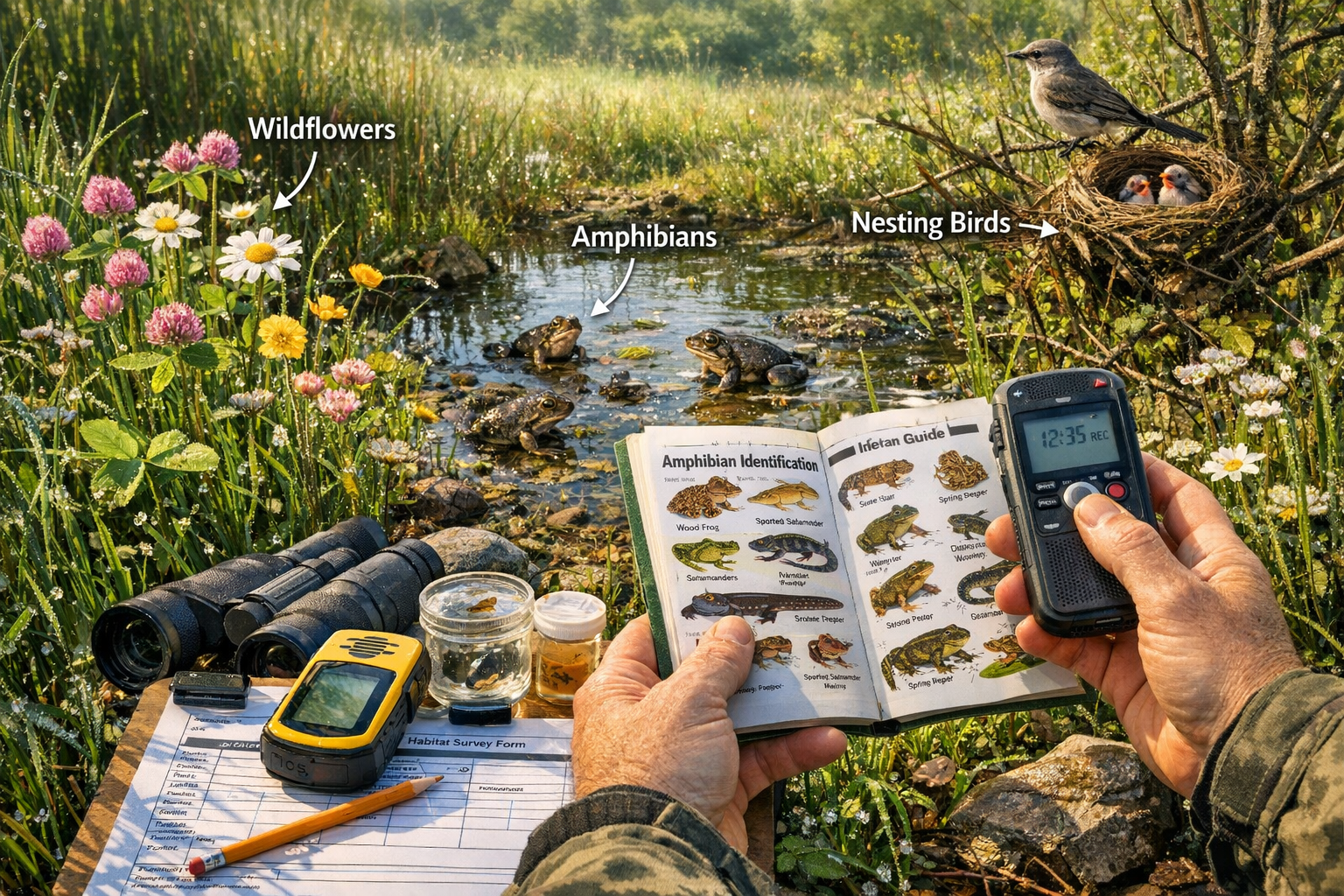
Spring represents the biological "new year" when ecosystems transition from dormancy to peak activity. Establishing Robust Biodiversity Baselines in Early 2026: Why Spring Surveys Capture Full Seasonal Dynamics centers on this fundamental ecological principle—that spring surveys provide access to species and ecological processes unavailable during other seasons.
Peak Activity Across Multiple Taxonomic Groups
Spring surveys capture simultaneous activity peaks across diverse species groups:
| Species Group | Spring Activity | Detection Advantage |
|---|---|---|
| 🐦 Breeding Birds | Territory establishment, song activity | 85-95% detection rates vs 40-60% in summer |
| 🐸 Amphibians | Migration to breeding ponds, calling | Only reliably detected March-May |
| 🌸 Flowering Plants | Early bloomers, spring ephemerals | Many species complete lifecycle before summer |
| 🦋 Invertebrates | Emergence, early broods | Spring specialists missed in later surveys |
| 🦇 Bats | Return from hibernation, roost selection | Behavioral patterns differ from summer activity |
This temporal concentration of biological activity means that spring-initiated surveys achieve higher species detection rates with fewer survey visits compared to protocols starting later in the year[3].
Critical Windows for Protected Species
Many legally protected species can only be reliably detected during narrow spring windows. Great crested newts, for example, are most detectable during their breeding season from mid-March through May. Surveys conducted outside this period require additional visits and specialized techniques, increasing costs and reducing data quality.
Similarly, breeding bird surveys must begin in early spring to capture territory establishment behaviors. The British Trust for Ornithology recommends survey visits between April and June, with early visits providing the most complete data as territorial behaviors peak before nesting begins.
Spring Ephemerals and Seasonal Specialists
Certain plant communities contain spring ephemeral species that complete their entire above-ground lifecycle before the tree canopy closes. These species—including wood anemone, bluebell, and early dog violet—represent important indicators of ancient woodland and high-quality habitats. Surveys beginning in summer completely miss these species, resulting in significant undervaluation of habitat quality in biodiversity net gain calculations.
Establishing the Foundation for Multi-Season Monitoring
When baseline assessments begin in spring, they establish the framework for comprehensive multi-season monitoring. Early initiation allows:
- Complete annual cycle coverage within a single calendar year
- Adaptive survey planning based on spring findings
- Resource optimization through strategic scheduling
- Regulatory compliance meeting survey season requirements
- Stakeholder confidence through demonstrated thoroughness
Organizations that delay baseline surveys until summer or autumn often discover they cannot complete required survey seasons before planning deadlines, forcing expensive delays or acceptance of incomplete data[1].
Why Spring Surveys Capture Full Seasonal Dynamics: The Science of Temporal Completeness
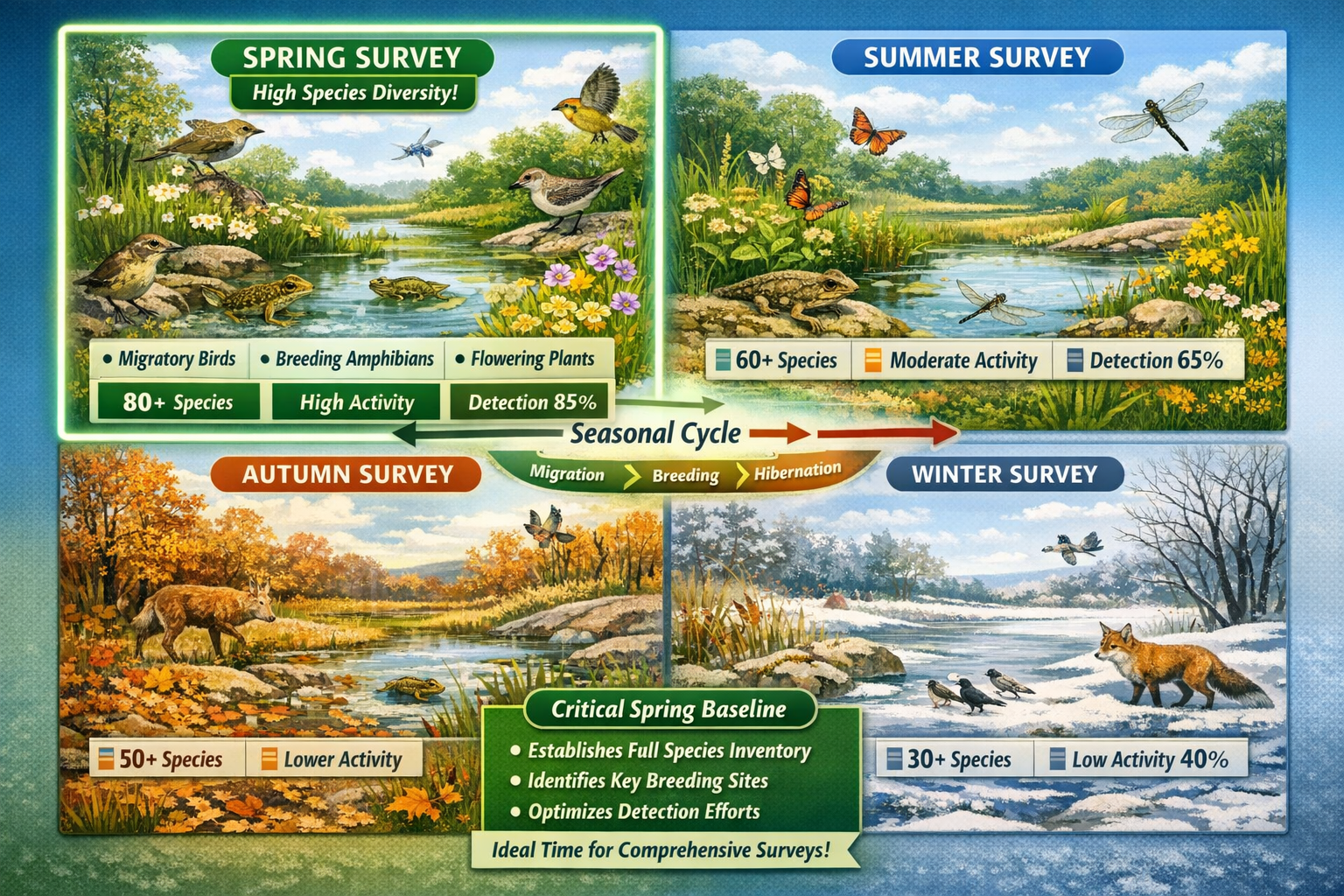
Establishing Robust Biodiversity Baselines in Early 2026: Why Spring Surveys Capture Full Seasonal Dynamics reflects a fundamental ecological principle: biodiversity is not static but varies systematically across temporal scales. Understanding these dynamics requires strategic survey timing that captures the full range of seasonal variation.
Phenological Patterns and Survey Design
Phenology—the timing of biological events—drives seasonal dynamics in ecosystems. Different species groups exhibit distinct phenological patterns:
- Early spring specialists (March-April): Amphibians, early flowering plants, overwintering birds
- Late spring peaks (May-June): Breeding birds, spring invertebrates, woodland flora
- Summer activity (July-August): Peak invertebrate diversity, plant flowering completion
- Autumn transitions (September-October): Migration, fruiting, hibernation preparation
Surveys initiated in spring can systematically sample across these phenological periods, building a complete picture of community composition and ecosystem function. Later survey starts inevitably miss early phenological windows, creating systematic bias toward late-season species[8].
Species Accumulation and Survey Effort
Research demonstrates that species accumulation curves—graphs showing how species counts increase with survey effort—differ dramatically based on survey start timing. Spring-initiated surveys typically reach asymptotic species counts (the point where additional surveys add few new species) more efficiently than those starting later.
This efficiency translates to better data quality per unit survey effort, a critical consideration for organizations balancing ecological rigor with project budgets. Good practice guidance emphasizes that biodiversity baseline data collection should be proportionate to project scale while maintaining scientific defensibility[2].
Capturing Ecosystem Functionality
Beyond species lists, robust baselines document ecosystem functionality—the ecological processes that sustain biodiversity and provide ecosystem services. Spring surveys capture critical functional indicators:
- Breeding success indicating habitat quality for reproduction
- Migration patterns revealing landscape connectivity
- Pollinator activity during peak flowering periods
- Trophic interactions between predators and prey
- Habitat condition during the growing season onset
These functional indicators provide context that static species inventories cannot, supporting more sophisticated impact predictions and mitigation design.
Addressing Seasonal Detectability Variation
Different survey methods exhibit varying effectiveness across seasons. For example:
- Bird point counts are most effective during dawn chorus in spring
- Bat acoustic surveys capture different species assemblages in spring vs summer
- Invertebrate sweep netting yields different taxa depending on vegetation structure
- Aquatic surveys access different microhabitats as water levels change
Spring survey initiation allows ecologists to optimize methodology for each taxonomic group based on seasonal detectability patterns, maximizing data quality across the full survey program[3].
Practical Implementation: Designing Spring-Initiated Baseline Surveys for 2026
Translating the theoretical advantages of spring surveys into practical survey programs requires careful planning and execution. Organizations seeking to establish robust baselines in 2026 should follow structured approaches that balance comprehensiveness with feasibility.
Survey Planning Timeline for 2026
For surveys beginning in early 2026, the ideal planning timeline includes:
January-February 2026:
- Desk study completion (habitat mapping, historical records review)
- Survey methodology design based on site characteristics
- Surveyor procurement and scheduling
- Landowner permissions and access arrangements
March-May 2026:
- Phase 1: Spring breeding bird surveys (minimum 2-3 visits)
- Amphibian surveys (4-6 visits during breeding season)
- Spring botanical surveys capturing early flowering species
- Initial bat roost assessments
June-August 2026:
- Phase 2: Summer bird surveys (breeding confirmation)
- Peak invertebrate surveys (multiple taxonomic groups)
- Full botanical surveys including late-flowering species
- Bat activity surveys (emergence and foraging)
September-October 2026:
- Phase 3: Autumn surveys (migration, fruiting)
- Habitat condition assessments
- Data synthesis and baseline report preparation
This timeline ensures capture of all critical survey seasons within a single calendar year, supporting planning applications in late 2026 or early 2027. Organizations can explore detailed guidance on planning biodiversity net gain projects to integrate survey timing with development schedules.
Taxonomic Scope and Survey Methods
Comprehensive baselines typically include multiple taxonomic groups, each requiring specialized methods:
Core Survey Components:
- Habitats: Phase 1 habitat survey, condition assessment, botanical quadrats
- Birds: Territory mapping, point counts, breeding evidence
- Mammals: Signs and field evidence, camera trapping, bat surveys
- Amphibians and Reptiles: Presence/absence, population estimates
- Invertebrates: Targeted surveys for key indicator groups
Extended Scope (site-dependent):
- Freshwater invertebrates and fish
- Fungi and lichens
- Soil biota
- Acoustic monitoring for bats and birds
Survey scope should be proportionate to site characteristics, project scale, and regulatory requirements. The Better Buildings Partnership guidance recommends risk-based approaches that focus effort on likely significant impacts[1].
Data Quality and Standardization
Robust baselines require consistent data collection following established protocols. Key quality assurance measures include:
✅ Qualified surveyors with appropriate species licenses and experience
✅ Standardized methods following national guidance (e.g., UK Habitat Classification)
✅ Appropriate survey effort meeting minimum visit requirements
✅ Weather-appropriate timing avoiding surveys during unsuitable conditions
✅ Comprehensive documentation including negative results and survey limitations
✅ Independent review by senior ecologists before finalization
Organizations developing baseline surveys should reference industry good practices for biodiversity baseline data collection, which emphasize the importance of standardized approaches and quality control[2][3].
Integration with Biodiversity Metric Calculations
In jurisdictions requiring biodiversity net gain, baseline surveys must generate data compatible with statutory biodiversity metrics. For UK projects, this means:
- Habitat mapping aligned with UK Habitat Classification system
- Condition assessments using Defra metric condition criteria
- Spatial data in appropriate formats for metric calculators
- Documentation supporting habitat distinctiveness and condition scores
Early coordination between field surveyors and metric specialists ensures baseline data directly supports achieving 10% biodiversity net gain requirements without requiring supplementary surveys.
Adaptive Management and Unexpected Findings
Spring surveys occasionally reveal unexpected protected species or habitat features requiring modified survey approaches. Robust survey programs build in flexibility to address:
- Protected species discoveries triggering additional specialized surveys
- Habitat complexity requiring refined mapping or extended survey areas
- Access constraints necessitating alternative survey methods
- Weather delays affecting survey timing and seasonal windows
Organizations should budget contingency time and resources for adaptive responses while maintaining overall survey program integrity.
Overcoming Common Challenges in Spring Baseline Establishment
Despite clear advantages, spring-initiated baseline surveys face practical challenges that organizations must anticipate and address.
Weather Variability and Survey Delays
Spring weather in temperate regions can be highly variable, with late frosts, heavy rainfall, and cold periods affecting both species activity and survey feasibility. Mitigation strategies include:
- Flexible scheduling with backup survey dates
- Weather monitoring to optimize survey timing
- Extended survey windows allowing rescheduling within appropriate periods
- Contingency budgets for additional visits if conditions prevent surveys
Resource Availability and Surveyor Capacity
Demand for ecological surveyors peaks in spring as multiple projects compete for limited specialist capacity. Organizations planning 2026 baselines should:
- Book surveyors early (ideally by January for March starts)
- Consider multi-year programs for large sites requiring extensive effort
- Build relationships with reliable survey providers
- Plan realistically based on surveyor availability rather than ideal timelines
Engaging with experienced biodiversity surveyors early in the planning process helps secure necessary capacity and expertise.
Balancing Comprehensiveness with Budget Constraints
Comprehensive multi-season surveys require significant investment. Organizations can optimize value through:
- Phased approaches prioritizing highest-risk areas or habitats
- Targeted surveys focusing on likely significant species groups
- Desk study rigor to inform field effort allocation
- Technology integration using remote sensing and acoustic monitoring to supplement field surveys
The key is ensuring baseline quality remains sufficient for regulatory acceptance and impact assessment validity, even if some taxonomic groups receive less intensive coverage.
Stakeholder Expectations and Communication
Developers, landowners, and planning authorities may not fully understand why spring survey initiation matters or why multi-season programs require extended timelines. Effective communication should:
- Explain regulatory requirements clearly and early
- Demonstrate value of comprehensive baselines for risk management
- Provide timeline certainty with realistic survey program schedules
- Show cost-benefit of avoiding incomplete baselines and subsequent delays
Educational resources like understanding biodiversity net gain reports help stakeholders appreciate baseline survey importance.
The Strategic Value of Robust Baselines Beyond Compliance
While regulatory compliance drives much baseline survey activity, comprehensive spring-initiated baselines deliver strategic benefits extending well beyond meeting statutory requirements.
Risk Management and Project Planning
Robust baselines identify ecological constraints early in project development, allowing:
- Site layout optimization avoiding high-value habitats
- Mitigation strategy development before designs are fixed
- Protected species licensing planning with adequate lead time
- Stakeholder engagement supported by credible ecological data
Early identification of constraints prevents costly redesigns and planning delays, making comprehensive baselines a valuable project risk management tool.
Biodiversity Credit Opportunities
For landowners considering selling biodiversity units, robust baselines are essential for demonstrating habitat creation or enhancement gains. Spring-initiated surveys provide:
- Accurate baseline habitat assessments for metric calculations
- Species data supporting habitat distinctiveness determinations
- Temporal datasets demonstrating habitat improvement trajectories
- Credible documentation for biodiversity credit verification
The emerging biodiversity credit market rewards high-quality baseline data with greater credit values and faster verification.
Corporate Sustainability Reporting
Organizations with biodiversity commitments under frameworks like the Science-Based Targets Network require robust monitoring data to track progress[6]. Spring-initiated baselines establish:
- Quantitative biodiversity metrics aligned with corporate targets
- Repeatable monitoring protocols for trend detection
- Credible reporting data for sustainability disclosures
- Stakeholder confidence in corporate biodiversity commitments
Long-term Land Management
Beyond immediate project needs, comprehensive baselines inform adaptive land management by:
- Identifying management priorities based on ecological value
- Establishing monitoring frameworks for ongoing stewardship
- Supporting conservation planning at landscape scales
- Documenting ecological change over multi-year periods
Organizations viewing land holdings as long-term assets benefit from baseline investments that support decades of informed management decisions.
Emerging Technologies and Future Directions in Baseline Assessment
As 2026 progresses, technological innovations are transforming how organizations establish and maintain biodiversity baselines, though traditional field surveys remain irreplaceable for comprehensive assessment.
Remote Sensing and Habitat Mapping
Satellite imagery, drone surveys, and LiDAR increasingly supplement field-based habitat mapping, offering:
- Large-area coverage at lower cost per hectare
- Temporal datasets showing habitat change over time
- Structural data including vegetation height and canopy complexity
- Baseline context for targeting field survey effort
However, remote sensing cannot replace ground-truthing and species-level surveys, making it complementary rather than alternative to spring field programs.
Acoustic and Camera Monitoring
Automated recording technologies extend survey coverage beyond human observer limitations:
- Bat acoustic detectors recording continuously across nights
- Bird song recorders capturing dawn chorus data
- Camera traps documenting mammal activity patterns
- Aquatic sensors monitoring water quality and fish presence
These technologies excel at capturing temporal dynamics and rare events but require expert interpretation and validation through traditional surveys.
Environmental DNA (eDNA)
eDNA techniques detect species from genetic material in water or soil samples, offering:
- Non-invasive detection of aquatic and terrestrial species
- High sensitivity for rare or cryptic species
- Reduced field effort for some taxonomic groups
- Expanding applications as reference databases grow
While promising, eDNA currently supplements rather than replaces traditional surveys, particularly for species abundance estimation and habitat assessment.
Data Integration and Analysis Platforms
Digital platforms increasingly integrate diverse baseline data sources, supporting:
- Centralized data management across multiple survey seasons
- Automated metric calculations for biodiversity net gain
- Spatial analysis of habitat connectivity and landscape context
- Trend detection through time-series analysis
Organizations establishing 2026 baselines should consider data management infrastructure that supports both immediate needs and long-term monitoring requirements.
Conclusion: Taking Action on Spring 2026 Baseline Surveys
Establishing Robust Biodiversity Baselines in Early 2026: Why Spring Surveys Capture Full Seasonal Dynamics represents more than ecological best practice—it's a strategic imperative for organizations navigating increasingly complex biodiversity regulations and stakeholder expectations. The evidence is clear: spring-initiated surveys capture biological diversity and ecosystem functionality that single-season or later-starting programs inevitably miss.
As spring 2026 approaches, organizations with development projects, land management responsibilities, or biodiversity commitments should prioritize baseline establishment now. The benefits—comprehensive species data, regulatory compliance, risk management, and strategic flexibility—far outweigh the costs of delayed or incomplete assessments.
Actionable Next Steps
For Developers and Project Managers:
- Review project timelines to identify baseline survey requirements and planning deadlines
- Engage ecological consultants by January 2026 to secure spring survey capacity
- Integrate baseline findings into early design development for constraint-responsive layouts
- Plan for multi-season programs recognizing that comprehensive baselines require 6-9 months
- Explore biodiversity net gain strategies early in project development
For Landowners:
- Commission baseline surveys if considering biodiversity credit generation or habitat banking
- Document existing ecological value through spring-initiated comprehensive assessments
- Establish monitoring frameworks supporting long-term land stewardship
- Investigate biodiversity unit opportunities based on baseline findings
For Sustainability Professionals:
- Align baseline protocols with corporate biodiversity target frameworks
- Establish repeatable monitoring for credible sustainability reporting
- Integrate baseline data into enterprise risk management systems
- Engage stakeholders with science-based biodiversity commitments
For All Organizations:
- Act now to secure spring 2026 survey slots before surveyor capacity fills
- Invest in quality recognizing that baseline data serves multiple purposes over years
- Plan comprehensively addressing all relevant taxonomic groups and habitats
- Document thoroughly ensuring baseline data meets both current and future requirements
The window for spring 2026 baseline initiation is brief. Organizations that act decisively now will establish the robust ecological foundations supporting informed decision-making, regulatory compliance, and genuine conservation outcomes for years to come. Those who delay risk incomplete data, project delays, and missed opportunities to demonstrate environmental leadership in an era when biodiversity has never mattered more.
Spring 2026 represents not just another survey season, but a critical opportunity to establish the biodiversity baselines that will shape land use decisions and conservation outcomes throughout the decade. The question is no longer whether to conduct comprehensive baselines, but whether your organization will be among those who recognized the strategic imperative and acted while the spring window remained open.
References
[1] Gn 121 Establish Biodiversity Baseline – https://www.betterbuildingspartnership.co.uk/responsible-property-management-toolkit/biodiversity/gn-121-establish-biodiversity-baseline
[2] Good Practices Collection Biodiversity Baseline Data – https://idbinvest.org/en/publications/good-practices-collection-biodiversity-baseline-data
[3] Good Practices For The Collection Of Biodiversity Baseline Data – https://www.ipieca.org/resources/good-practices-for-the-collection-of-biodiversity-baseline-data
[4] 2 Marine Biodiversity Its All About Baselines And Trends – https://www.wcmb2026.org/2-marine-biodiversity-its-all-about-baselines-and-trends
[5] Verra Launches Nature Framework – https://verra.org/verra-launches-nature-framework/
[6] Business Action For Biodiversity Via Science Based Targets For Nature – https://sciencebasedtargetsnetwork.org/wp-content/uploads/2026/01/Business-action-for-biodiversity-via-science-based-targets-for-nature.pdf
[7] Ipbes Publishes Its Business And Biodiversity Assessment – https://www.biodiversa.eu/2026/02/10/ipbes-publishes-its-business-and-biodiversity-assessment/
[8] nsojournals.onlinelibrary.wiley – https://nsojournals.onlinelibrary.wiley.com/doi/10.1002/oik.11943