

The clock is ticking for ecology surveyors across the UK and Europe. As regulatory frameworks tighten and reporting deadlines loom, the decisions made in 2026 about biodiversity monitoring will determine the quality of environmental data for decades to come. Establishing biodiversity baselines in 2026: why ecology surveyors should start full-season monitoring now is not just a matter of regulatory compliance—it's about creating robust, defensible datasets that can truly measure ecological change and conservation success.
With Europe's comprehensive roadmap identifying 84 Essential Biodiversity Variables (EBVs) and the UK's Biodiversity Duty reporting deadline already passed in January 2026, the urgency for proactive monitoring has never been greater. Yet many organizations still rely on single-season snapshots that capture only a fraction of ecological reality. These weak baselines, skewed by seasonal variation and existing environmental pressures, will undermine every future comparison and assessment.

Key Takeaways
- 🌱 Baseline quality determines future validity: Every future biodiversity assessment depends on the starting point—weak baselines established during degraded conditions or limited seasons create permanent blind spots in trend detection
- 📊 Full-season protocols capture true variation: Multi-season monitoring distinguishes weather-driven fluctuations from genuine population declines and reveals intervention effectiveness that single surveys miss
- 🤖 Integrated technology enhances coverage: Combining automated sensors, eDNA, satellite data, and AI with human expertise creates scalable, cost-effective monitoring systems aligned with Europe's 84 Essential Biodiversity Variables
- ⏰ 2026 is the critical window: With UK reporting cycles established and European frameworks launching, starting comprehensive monitoring now avoids retrospective data gaps and ensures compliance with emerging requirements
- 📈 Robust baselines enable demonstrable net gain: Full-season baseline data provides the evidence needed for achieving Biodiversity Net Gain and validates conservation interventions in future monitoring cycles
Understanding Biodiversity Baselines and Why They Matter in 2026
A biodiversity baseline represents the ecological starting point—a comprehensive snapshot of species composition, abundance, habitat condition, and ecosystem function before development or intervention occurs. This baseline becomes the reference against which all future changes are measured, making its accuracy and completeness absolutely critical.
In 2026, the importance of robust baselines has intensified dramatically. The European Parliament has approved a preparatory action for the European Biodiversity Observation Coordination Center (EBOCC) to implement a continent-wide monitoring system based on 84 Essential Biodiversity Variables.[1] These standardized metrics—ranging from species abundance and genetic diversity to ecosystem structure and function—require consistent, comparable data collection across seasons and years.
The Problem with Single-Season Snapshots
Many ecology surveyors still conduct baseline assessments during a single optimal season, typically late spring or summer when species detectability peaks. While this approach reduces immediate costs, it creates several critical problems:
- Seasonal bias: Migratory species, overwintering populations, and early/late breeding species remain undetected
- Weather sensitivity: A particularly wet or dry season can dramatically skew abundance estimates
- Phenological gaps: Critical life stages, breeding behaviors, and resource dependencies go unrecorded
- Incomplete habitat assessment: Seasonal variation in vegetation structure, water availability, and resource provision remains hidden
As research emphasizes, baselines established only when reporting requirements appear will already be weakened by existing degradation or imbalance.[3] Every month of delay means environmental pressures—from climate change to habitat fragmentation—continue altering ecosystems before monitoring begins.
The UK Biodiversity Duty Context
The UK Biodiversity Duty reporting deadline in January 2026 required Local Planning Authorities to submit comprehensive reports documenting past biodiversity actions and future five-year plans.[6] This mandatory reporting cycle establishes clear expectations for ongoing monitoring and creates accountability for measurable ecological outcomes.
For developers and landowners, this regulatory landscape makes Biodiversity Net Gain not just a planning requirement but an ongoing obligation. Weak baselines established in 2026 will compromise the ability to demonstrate net gain achievement in subsequent monitoring cycles, potentially triggering compliance issues and financial penalties.
Establishing Biodiversity Baselines in 2026: The Full-Season Monitoring Advantage
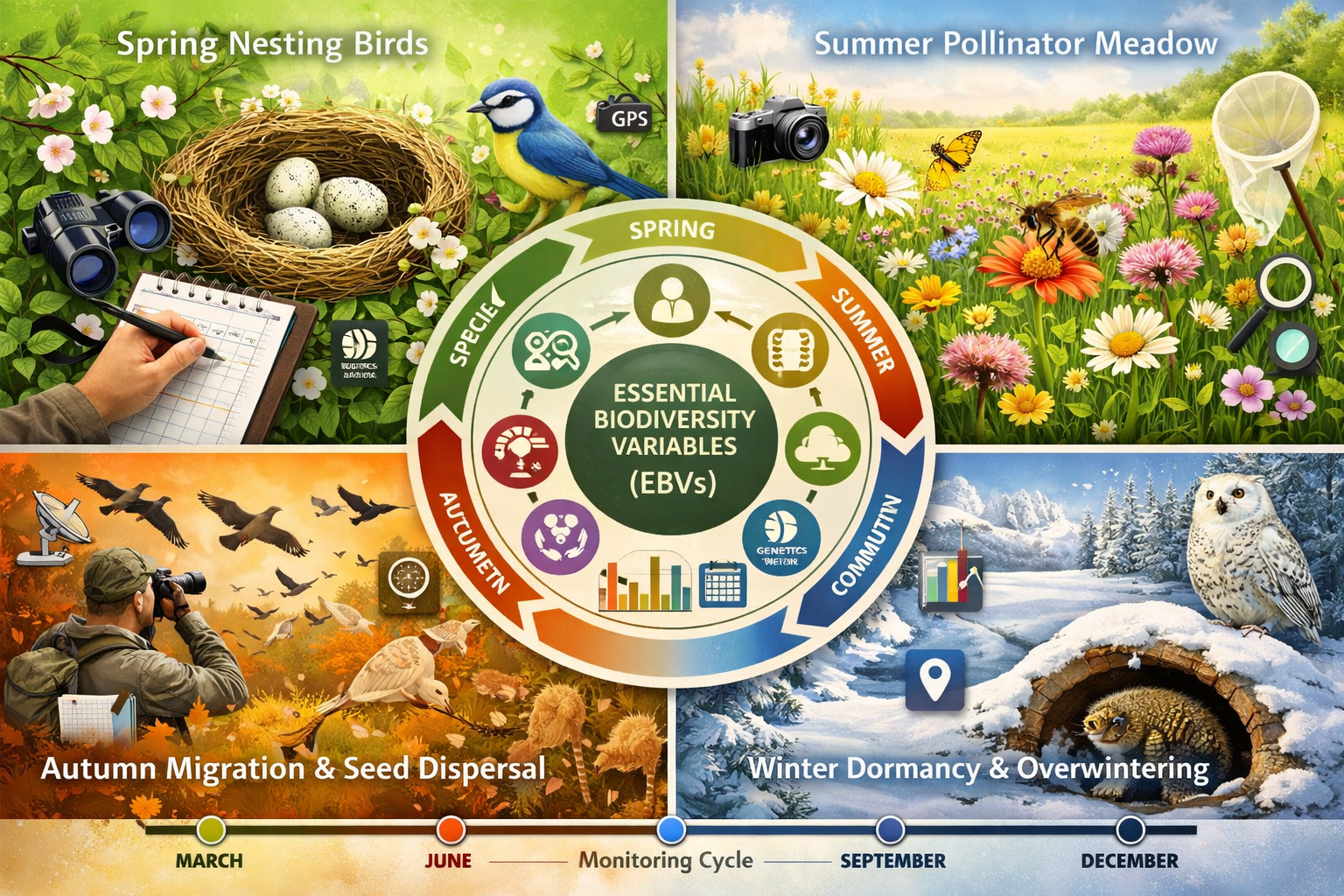
Full-season monitoring transforms baseline quality by capturing the complete annual cycle of ecological processes, species movements, and habitat dynamics. This comprehensive approach reveals patterns and relationships that single surveys cannot detect, creating datasets robust enough to support long-term trend analysis and adaptive management.
Capturing Seasonal Dynamics and Species Turnover
Different species groups exhibit peak activity during specific seasons, making year-round monitoring essential for complete species inventories:
| Season | Key Species Groups | Critical Monitoring Activities |
|---|---|---|
| Spring | Breeding birds, emerging amphibians, early pollinators | Nest surveys, dawn chorus counts, pond surveys, flowering plant surveys |
| Summer | Peak invertebrate diversity, breeding mammals, botanical diversity | Pollinator transects, bat activity surveys, full botanical surveys, reptile surveys |
| Autumn | Migration, seed dispersal, pre-hibernation activity | Passage bird surveys, fruit/seed production assessment, hibernation site identification |
| Winter | Overwintering birds, dormant habitat structure, winter specialists | Wintering waterfowl counts, tree/shrub structure mapping, winter bat roost surveys |
This seasonal coverage ensures that migratory species, short-lived invertebrates, and phenologically distinct populations all contribute to the baseline dataset. For woodland habitats, trials through 2025-2026 have established core indicators including plant abundance, bird abundance and biodiversity, insect abundance and biodiversity, and lichen/moss abundance for temperate rainforests.[2]
Distinguishing Natural Variation from Genuine Trends
One of the most valuable aspects of full-season monitoring is its ability to separate environmental noise from real ecological signals. A single-year population decline might reflect:
- Temporary weather impacts (drought, flooding, late frost)
- Short-term disturbance (construction noise, temporary habitat alteration)
- Natural population cycles (predator-prey dynamics, mast years)
- Genuine long-term decline requiring intervention
Only continuous, multi-season data collection can distinguish these scenarios. As monitoring guidance emphasizes, full-season protocols reveal intervention effectiveness by providing the temporal resolution needed to detect recovery trajectories and assess whether conservation actions produce measurable benefits.[3]
Validating Habitat Condition Across Phenological Stages
Habitat quality varies dramatically across seasons, affecting species use and ecological function. Full-season assessment captures:
- Spring: Breeding habitat suitability, nesting substrate availability, early nectar sources
- Summer: Peak resource provision, thermal refuge quality, water availability during stress periods
- Autumn: Seed/fruit production for overwintering species, migration stopover quality
- Winter: Shelter provision, food resource persistence, frost/flood resilience
This temporal perspective is essential for conducting biodiversity impact assessments that accurately predict development effects and design effective mitigation measures.
Establishing Biodiversity Baselines in 2026: Technology and Methodology Integration

The 2026 monitoring landscape demands a multi-technology approach that combines automated sensors, artificial intelligence, environmental DNA (eDNA), and satellite remote sensing with traditional human expertise.[1] This integration creates scalable, efficient monitoring systems capable of delivering the data quality and coverage required by modern biodiversity frameworks.
Essential Biodiversity Variables (EBVs) as the Framework
Europe's 84 Essential Biodiversity Variables provide a standardized framework for organizing monitoring efforts across six major classes:
- Genetic composition: Population genetic diversity, inbreeding, effective population size
- Species populations: Abundance, distribution, demographic structure
- Species traits: Morphology, physiology, phenology, movement
- Community composition: Taxonomic diversity, species interactions, functional diversity
- Ecosystem structure: Habitat extent, fragmentation, physical structure
- Ecosystem function: Productivity, nutrient cycling, disturbance regimes
This framework ensures that monitoring efforts capture multiple dimensions of biodiversity, from genes to ecosystems, creating comprehensive baselines that support diverse reporting requirements and research questions.
Technology Integration for Scalable Monitoring
Modern biodiversity monitoring leverages multiple complementary technologies:
Automated Acoustic Sensors 🎤
- Continuous recording of bird calls, bat echolocation, amphibian choruses
- AI-powered species identification and abundance estimation
- Captures nocturnal and crepuscular species missed by human surveys
- Provides permanent audio archives for validation and reanalysis
Environmental DNA (eDNA) 🧬
- Water, soil, or air samples analyzed for species genetic material
- Detects rare, cryptic, and aquatic species with minimal disturbance
- Enables comprehensive species inventories with reduced field effort
- Particularly valuable for monitoring aquatic ecosystems and elusive mammals
Satellite Remote Sensing 🛰️
- Copernicus data provides free, high-resolution habitat mapping
- Multispectral imagery tracks vegetation health, phenology, and structure
- Detects habitat loss, fragmentation, and restoration progress
- Enables landscape-scale monitoring beyond individual site boundaries
Camera Traps and Motion Sensors 📷
- 24/7 monitoring of mammal activity, behavior, and population dynamics
- Non-invasive detection of shy or nocturnal species
- Provides behavioral data and habitat use patterns
- Creates visual evidence for validation and public engagement
The Irreplaceable Role of Human Expertise
Despite technological advances, human expertise remains central to effective biodiversity monitoring.[1] Citizen scientists, taxonomic specialists, and professional ecologists provide:
- Taxonomic precision: Expert identification of difficult species groups
- Contextual interpretation: Understanding unusual observations and ecological relationships
- Quality assurance: Validating automated identifications and flagging data anomalies
- Adaptive protocols: Adjusting methods based on site-specific conditions and emerging issues
- Community engagement: Building public support and understanding for conservation
The most effective monitoring systems combine technological efficiency with human judgment, using automation to expand coverage while reserving expert attention for complex identifications and strategic decisions.
Data Harmonization and Integration Challenges
Europe's hundreds of existing monitoring programs produce siloed, incompatible, or incomplete datasets.[1] The EBOCC will establish unified data pipelines integrating:
- Professional field survey data
- Citizen science observations
- Automated sensor recordings
- eDNA analysis results
- Satellite imagery products
This harmonization requires standardized protocols, quality control procedures, and data management systems that ensure comparability across sites, seasons, and years. For organizations establishing baselines in 2026, adopting these emerging standards from the outset avoids costly retrofitting and ensures future data compatibility.
Establishing Biodiversity Baselines in 2026: Practical Implementation for Ecology Surveyors
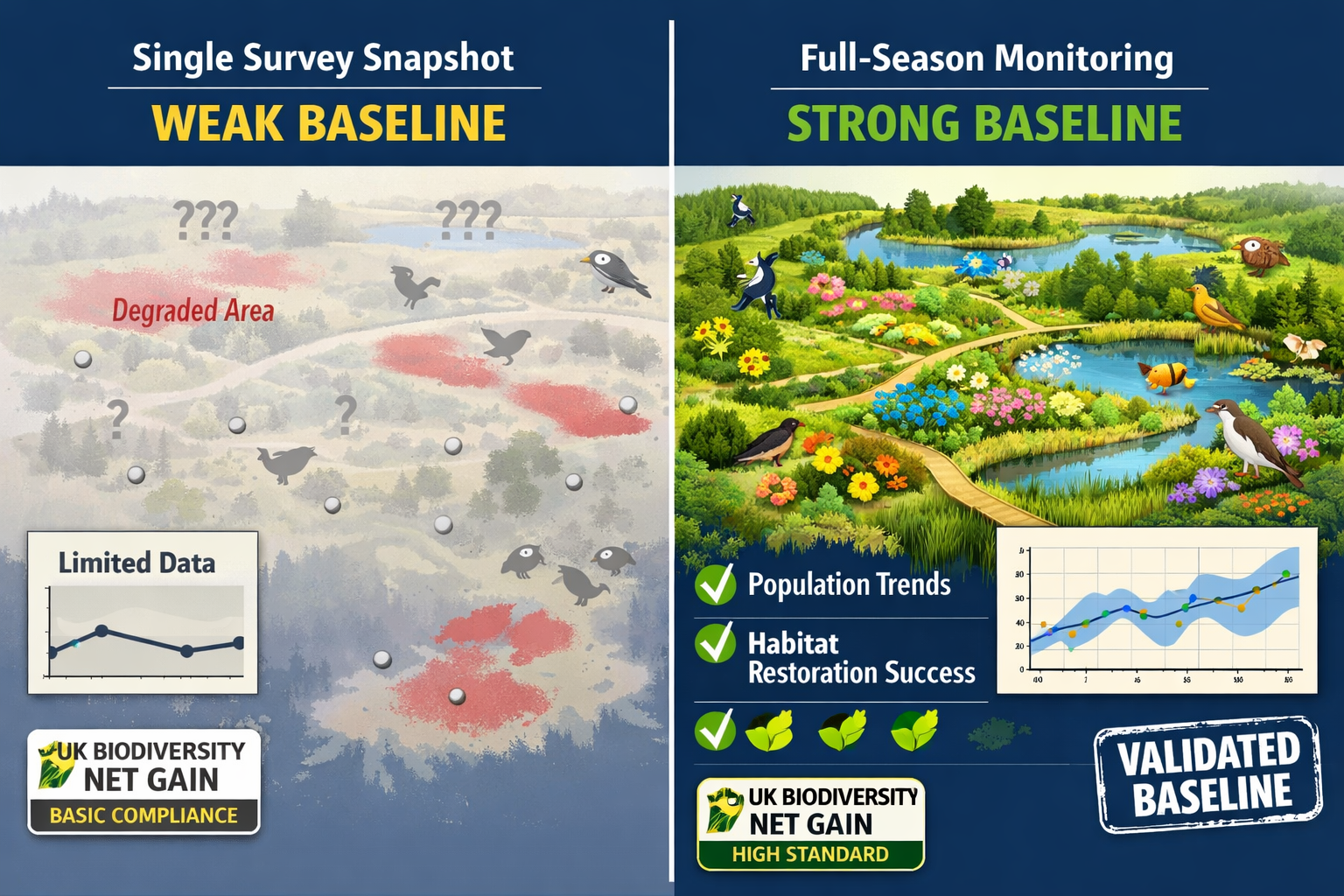
Implementing full-season monitoring requires strategic planning, appropriate resource allocation, and clear protocols. For ecology surveyors working in 2026, several practical considerations determine baseline quality and long-term utility.
Designing a Robust Baseline Monitoring Plan
A comprehensive baseline monitoring plan should include:
1. Clear Objectives and Scope
- Define specific biodiversity components to monitor (species groups, habitats, EBVs)
- Establish spatial boundaries and sampling intensity
- Identify regulatory requirements and reporting obligations
- Determine temporal scope (minimum one full year, ideally two for inter-annual comparison)
2. Seasonal Survey Schedule
- Map species-specific survey windows to ensure optimal detectability
- Schedule habitat condition assessments across phenological stages
- Plan technology deployment for continuous automated monitoring
- Build flexibility for weather-related delays and repeat visits
3. Methodology Selection and Standardization
- Choose survey methods appropriate for target species and habitats
- Adopt standardized protocols compatible with national/European frameworks
- Integrate multiple survey techniques for comprehensive coverage
- Document all methodological decisions for future consistency
4. Quality Assurance Procedures
- Establish identification verification protocols
- Implement data validation checks and error correction procedures
- Plan for expert review of unusual or significant records
- Create audit trails for data provenance and reliability assessment
Resource Allocation and Cost Management
Full-season monitoring requires greater upfront investment than single surveys, but delivers substantial long-term value:
Cost-Benefit Considerations:
- Reduced future uncertainty: Robust baselines minimize risk of compliance failures and costly remediation
- Defensible data: Comprehensive datasets withstand regulatory scrutiny and planning challenges
- Adaptive management: Seasonal data enables responsive conservation interventions
- Multiple reporting uses: Single dataset serves Biodiversity Net Gain, Environmental Impact Assessment, and ongoing compliance needs
For developers, understanding the cost of biodiversity units and statutory credits helps contextualize baseline monitoring investment against potential offsetting expenses.
Aligning with Biodiversity Net Gain Requirements
For UK development projects, baseline monitoring directly supports Biodiversity Net Gain requirements:
Baseline Data Requirements:
- Habitat condition assessments using Defra Metric methodology
- Species surveys documenting protected and notable species
- Habitat connectivity and functionality evaluation
- Temporal variation in habitat quality and species use
Validation and Registration:
- Approved monitoring plans required before baseline data can be registered
- Validated baseline assessments must meet quality standards
- Data must be submitted to national carbon registries and biodiversity registers[2]
- Future monitoring cycles must use consistent methodology for comparability
Organizations establishing baselines in 2026 should ensure protocols align with both current Biodiversity Net Gain requirements and emerging European EBV standards, maximizing data utility across multiple frameworks.
Leveraging Citizen Science and Community Engagement
Citizen science networks provide cost-effective monitoring expansion while building public support for conservation:
- Structured recording schemes: Coordinate with national recording schemes (BTO, Butterfly Conservation, etc.)
- Community bioblitzes: Engage local residents in intensive survey events
- Educational partnerships: Collaborate with schools and universities for ongoing monitoring
- Digital platforms: Use apps like iNaturalist, eBird, and iRecord for standardized data collection
Human engagement remains essential for long-term monitoring success, creating stakeholder investment in ecological outcomes and generating social license for conservation interventions.[1]
Avoiding the Baseline Trap: Why Starting Now Prevents Future Problems
The most critical insight for ecology surveyors in 2026 is that baseline quality determines all future assessments. Every comparison, trend analysis, and impact evaluation depends on the reference point established now. Weak baselines create permanent limitations that cannot be corrected retrospectively.
The Degradation Baseline Problem
Establishing baselines only when regulatory requirements appear means capturing ecosystems already affected by:
- Climate change impacts: Shifted species ranges, altered phenology, changed community composition
- Cumulative development pressure: Habitat fragmentation, edge effects, pollution
- Invasive species establishment: Novel competitive dynamics and ecosystem alterations
- Historical land use legacy: Depleted soil quality, simplified structure, reduced connectivity
These existing pressures become invisible in future assessments, making it impossible to detect further decline until thresholds are crossed. As research warns, this creates blind spots where significant biodiversity loss goes unrecognized because the baseline already reflected degraded conditions.[3]
The Single-Season Snapshot Problem
Baselines established during a single season suffer from:
- Incomplete species inventories: Missing seasonal specialists and migrants
- Weather-driven bias: Unusual conditions skewing abundance estimates
- Unrepresentative habitat conditions: Failing to capture seasonal variation in quality
- Limited intervention evaluation: Lacking temporal context for assessing management effects
When future monitoring reveals apparent population declines, single-season baselines cannot distinguish genuine trends from normal seasonal variation, undermining confidence in ecological assessments and conservation recommendations.
The Compliance and Liability Dimension
For developers and landowners, weak baselines create significant compliance risks:
Regulatory Challenges:
- Inability to demonstrate Biodiversity Net Gain achievement
- Contested Environmental Impact Assessments due to inadequate baseline data
- Planning delays and conditions requiring additional surveys
- Potential enforcement action for failing to meet conservation obligations
Financial Implications:
- Unexpected costs for buying biodiversity units when on-site net gain cannot be demonstrated
- Delayed project timelines affecting financing and returns
- Remediation costs for undetected impacts on protected species
- Reduced land value if biodiversity obligations cannot be discharged
Investing in robust full-season baselines in 2026 mitigates these risks, creating defensible datasets that support confident decision-making and regulatory compliance.
Future-Proofing Biodiversity Monitoring: Alignment with Global Frameworks
Europe's monitoring roadmap directly supports multiple international frameworks, ensuring that baselines established in 2026 remain relevant and valuable as global biodiversity governance evolves.[1]
Key Framework Alignments
Kunming-Montreal Global Biodiversity Framework (GBF):
- Target 3: 30% protected areas by 2030
- Target 7: Reduce pollution impacts
- Target 8: Minimize climate change impacts
- Target 10: Sustainable agriculture, aquaculture, fisheries, and forestry
- Target 14: Integrate biodiversity values into policies and regulations
Group on Earth Observations Biodiversity Observation Network (GEO BON):
- Essential Biodiversity Variables framework
- Global coordination of monitoring systems
- Data sharing and harmonization protocols
EU Legislative Framework:
- Birds Directive and Habitats Directive reporting
- Water Framework Directive ecological status assessments
- Marine Strategy Framework Directive
- Nature Restoration Law (emerging)
Organizations establishing baselines aligned with these frameworks ensure data compatibility with future reporting requirements, maximizing return on monitoring investment.
National Monitoring System Integration
Countries are developing national biodiversity monitoring systems using headline indicators supplemented by component and complementary indicators aligned with national circumstances.[4] Ecology surveyors should:
- Adopt national indicator species: Focus monitoring on species identified in national strategies
- Use standardized methodologies: Follow national protocol guidance for comparability
- Contribute to national databases: Submit records to centralized biodiversity information systems
- Align reporting cycles: Synchronize monitoring with national reporting deadlines
This integration ensures local monitoring efforts contribute to national and international biodiversity assessments while meeting site-specific management needs.
Conclusion: The 2026 Imperative for Full-Season Biodiversity Baselines
Establishing biodiversity baselines in 2026: why ecology surveyors should start full-season monitoring now represents one of the most consequential decisions for ecological data quality in the coming decades. The convergence of European monitoring frameworks, UK regulatory requirements, and global biodiversity commitments creates both unprecedented opportunity and significant risk.
The opportunity lies in establishing robust, comprehensive baselines that capture complete ecological reality across seasons, species groups, and habitat conditions. These high-quality datasets will support confident trend detection, effective conservation interventions, and defensible regulatory compliance for years to come.
The risk emerges from delayed action and inadequate monitoring scope. Single-season snapshots and reactive baseline assessments create permanent blind spots that undermine every future comparison and assessment. As environmental pressures intensify, weak baselines established in degraded conditions make it impossible to detect further decline until critical thresholds are crossed.
Actionable Next Steps for Ecology Surveyors
For professionals working in 2026, the path forward requires immediate action:
- Initiate full-season monitoring immediately: Don't wait for specific project triggers—begin establishing comprehensive baselines now to capture complete annual cycles
- Adopt multi-technology approaches: Integrate automated sensors, eDNA, and satellite data with traditional survey methods for scalable, efficient monitoring
- Align with emerging standards: Design protocols compatible with Europe's 84 Essential Biodiversity Variables and UK Biodiversity Net Gain requirements
- Invest in data management infrastructure: Establish systems for harmonizing diverse data streams and ensuring long-term data accessibility
- Engage stakeholders and communities: Build support networks through citizen science and educational partnerships that enhance monitoring coverage and social license
For developers and landowners, partnering with experienced biodiversity surveyors who understand full-season monitoring requirements ensures baseline quality that supports both regulatory compliance and genuine conservation outcomes. The investment made in 2026 will determine ecological data quality for decades, making this the critical year for establishing monitoring foundations that truly serve biodiversity conservation and sustainable development.
The message is clear: proactive, comprehensive baseline monitoring in 2026 is not optional—it's essential. Every month of delay weakens the reference point against which all future ecological change will be measured. Start full-season monitoring now to create the robust baselines that effective conservation and credible compliance demand.
References
[1] 2026 02 Roadmap Outlines Biodiversity Variables Europe – https://phys.org/news/2026-02-roadmap-outlines-biodiversity-variables-europe.html
[2] Trialling Measurement Biodiversity Baseline – https://www.woodlandcarboncode.org.uk/trialling-measurement-biodiversity-baseline
[3] Why Monitor Biodiversity In 2026 – https://evolito.earth/stories/why-monitor-biodiversity-in-2026
[4] Guidance For Plans For National Monitoring Systems Final Sept24 English – https://www.learningfornature.org/wp-content/uploads/2024/10/Guidance-for-plans-for-national-monitoring-systems-Final-Sept24-ENGLISH.pdf
[6] Biodiversity Duty Reporting Due January 2026 – https://www.landuse.co.uk/thoughts/biodiversity-duty-reporting-due-january-2026/